Mark 1:40
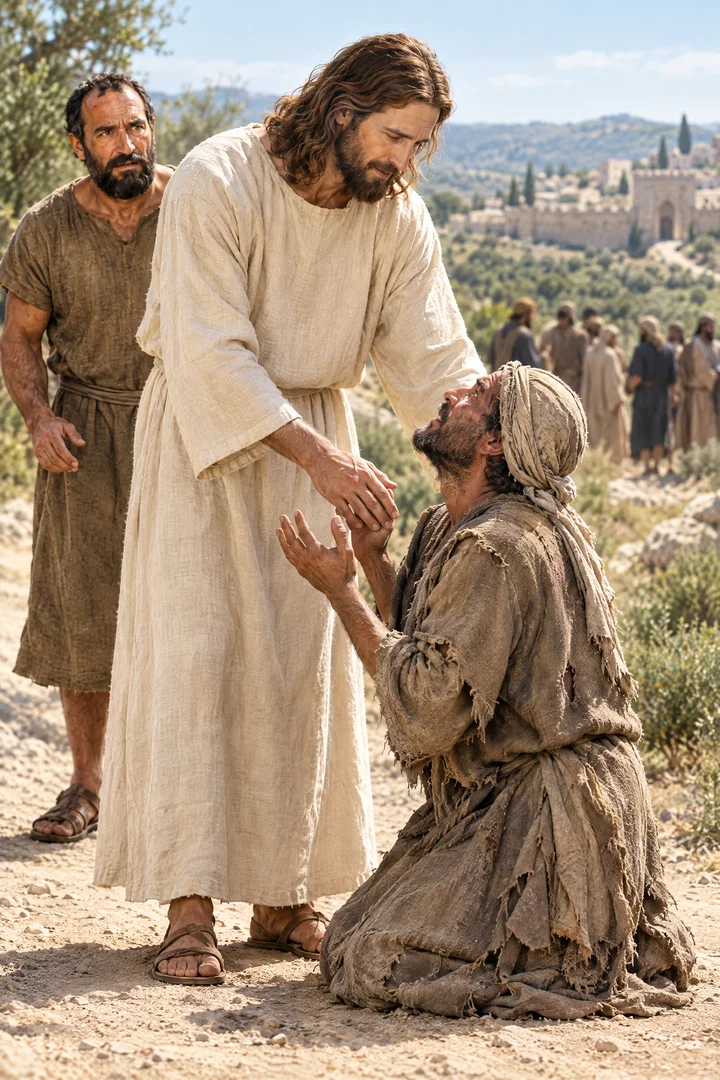
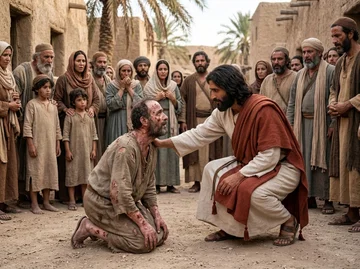
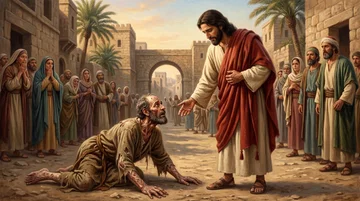
And there came a leper to him, beseeching him, and kneeling down to him, and saying unto him, If thou wilt, thou canst make me clean.
Translations
And there came a leper to him, beseeching him, and kneeling down to him, and saying to him, If you will, you can make me clean.
King James Version, KJV Cambridge Paragraph Bible
And there came a leper to him, beseeching him, and kneeling down to him, and saying unto him, If thou wilt, thou canst make me clean.
And there came a leper to him, beseeching him, and kneeling down to him, and saying to him, If thou wilt, thou canst make me clean.
Revised Version, American Standard Version
And there cometh to him a leper, beseeching him, and kneeling down to him, and saying unto him, If thou wilt, thou canst make me clean.
and there doth come to him a leper, calling on him, and kneeling to him, and saying to him — 'If thou mayest will, thou art able to cleanse me.'
And there comes to him a leper, beseeching him, and falling on his knees to him, and saying to him, If thou wilt thou canst cleanse me.
And there cometh unto him, a leper, beseeching him and [kneeling],—saying unto him—If thou be willing, thou canst cleanse me;
Then a leper came to Jesus, begging on his knees: “ If You are willing, You can make me clean.”
Then a leper came to Jesus, begging and kneeling before Him and saying to Him: “ If You are willing, You can make me clean.”
A leper came to him, begging him, kneeling down to him, and saying to him, “ If you want to, you can make me clean.”
And a leper came to him and, going down on his knees before him, made a request, saying, If it is your pleasure, you have the power to make me clean.
And there came a leper to him, beseeching him, and kneeled downe vnto him, and said to him, If thou wilt, thou canst make me cleane.
Douay-Rheims (Challoner revision)
And there came a leper to him, beseeching him, and kneeling down said to him: If thou wilt, thou canst make me clean.
Pictures
Cross-references
- Luke 5:12-13
And it came to pass, when he was in a certain city, behold a man full of leprosy: who seeing Jesus fell on his face, and besought him, saying, Lord, if thou wilt, thou canst make me clean.
Jesus heals a leper who appeals to him for cleansing.
- Matthew 8:2-3
And, behold, there came a leper and worshipped him, saying, Lord, if thou wilt, thou canst make me clean.
The leper asks Jesus to cleanse him, and Jesus heals him.
- Leviticus 13:45-46
And the leper in whom the plague is, his clothes shall be rent, and his head bare, and he shall put a covering upon his upper lip, and shall cry, Unclean, unclean.
Sets out the leper’s required warning and separation.
- Leviticus 14:2-32
This shall be the law of the leper in the day of his cleansing: He shall be brought unto the priest:
Prescribes the priestly examination and offerings for a cleansed leper.
- Mark 1:44
And saith unto him, See thou say nothing to any man: but go thy way, shew thyself to the priest, and offer for thy cleansing those things which Moses commanded, for a testimony unto them.
Jesus directs the healed man to make the required offering.
- Leviticus 13:2-3
When a man shall have in the skin of his flesh a rising, a scab, or bright spot, and it be in the skin of his flesh like the plague of leprosy; then he shall be brought unto Aaron the priest, or unto one of his sons the priests:
The priest examines the skin disease and pronounces the man unclean.
- 2 Kings 5:10-14
And Elisha sent a messenger unto him, saying, Go and wash in Jordan seven times, and thy flesh shall come again to thee, and thou shalt be clean.
Naaman’s cleansing is an earlier known case of healing leprosy.
- Leviticus 5:3
Or if he touch the uncleanness of man, whatsoever uncleanness it be that a man shall be defiled withal, and it be hid from him; when he knoweth of it, then he shall be guilty.
Contact with an unclean person made one ceremonially unclean.
- Matthew 8:17
That it might be fulfilled which was spoken by Esaias the prophet, saying, Himself took our infirmities, and bare our sicknesses.
Jesus’ healing is linked to bearing human sickness.
Commentary
Each commentary is drawn from primary sources: the writings of Ellen G. White and Adventist pioneers and periodicals. Each commentary is separate. Its own words are not a quotation; follow the references to read the source passages.
Ellen G. White
31 sources
A loathsome outcast cut off as unclean and doomed to exile pressed through the fearful crowd and knelt before Jesus in humble, urgent entreaty.DA 262.1–3DA 262.4–264.2LC1 71.23RED 49.1–23RED 47.2 His plea confessed both utter need and confident faith that Jesus had power to give health and make him clean, while leaving the act to His mercy without presuming He would be willing.DA 262.1–3DA 262.4–264.21RED 71.2–73.2 Jesus did not shrink from him but drew near and touched him, and by life-giving command changed his decaying body to healthy flesh.DA 262.4–264.2ST Jan 14, 18892SP 229.1–2 The cleansing of the leper shows Christ's power and willingness to cleanse any humble, believing soul from the deep-rooted, deadly leprosy of sin, which no human power can remove.HMW 28.4ST Oct 25, 1905ST Jul 28, 1914MH 106.2–3
The Leper's Plea to Jesus
The plea belongs to the healing that took place while Jesus was teaching by the lake outside the city limits with many gathered to hear Him.ST Mar 11, 1913ST Apr 26, 1883 The crowd had come to listen and to be healed, for He was restoring the lame, the blind, the paralytic and those dying of various maladies by word and touch.ST Mar 11, 1913ST Apr 26, 1883
Leprosy was incurable, contagious, fearful and loathsome in its effect, the most dreaded disease of the East.DA 262.1–3ST Apr 26, 1883 Among the Hebrews it was regarded as a judgment from God for sin and as a symbol of sin.DA 262.1–3DA 262.4–264.2
The leper was pronounced unclean, barred from entering towns and villages, isolated from family, friends and society, cut off from the congregation of Israel, and doomed to associate only with those similarly afflicted.3RED 47.23RED 47.1ST Apr 26, 1883 He was forced away from home and kindred to publish his own calamity by rending his garment and warning all to flee with the mournful cry of uncleanness.ST Apr 26, 1883 Because Christ's chief work lay among the populace, reaching Him where He worked therefore seemed impossible.3RED 47.1ST Apr 26, 1883 His disease had left him shunned and considered incurable, with Jesus as his only hope.LC1 71.2
This man had once held a high position of distinction.3RED 47.2ST Apr 26, 1883 He had been examined by noted physicians who found his disease incurable, and then by the priest who pronounced it the worst form of leprosy.ST Apr 26, 1883 That sentence condemned him to a living death in exile from home, family, friends, community and society.3RED 47.2ST Apr 26, 1883
In his isolation he heard of the mighty works of healing.ST Mar 11, 1913ST Apr 26, 1883MH 68.3–69.1 He drew as near as he dared, standing afar off to hear Christ's words and watch Him lay hands on the sick.ST Mar 11, 1913ST Apr 26, 1883 The more he heard and saw, the more he became convinced that Jesus was the promised Saviour of the world to whom all things were possible and who was authorized of God.ST Mar 11, 1913ST Apr 26, 18833RED 47.3 He longed to come into His presence to be healed, and hope strengthened his faith until Jesus became his only hope.ST Mar 11, 1913ST Apr 26, 1883MH 68.3–69.13RED 47.3
His faith laid hold of the Saviour, and though he had not meant to endanger the people, he forgot the restrictions placed on lepers, the safety of the people and the horror with which they regarded him, thinking only of the blessed hope of freedom from infirmity.ST Mar 11, 1913ST Apr 26, 1883 He pressed forward heedless of the frightened multitude that fell back to avoid him and tried to prevent him from coming near.ST Jul 28, 1914ST Mar 11, 1913ST Apr 26, 1883 Even the disciples were filled with terror and wanted to keep their Master from being touched.3RED 49.1–2 Seeing only the Son of God and hearing only the voice giving health and happiness to the suffering, he came before Him and prostrated his foul, decaying body in humble, urgent, kneeling entreaty.DA 262.1–3DA 262.4–264.2ST Mar 11, 1913ST Apr 26, 1883
His few words comprehended his great need and expressed confident faith that Christ had power to give him life and health and make him clean.1RED 71.2–73.2ST Jan 14, 1889ST Mar 11, 1913ST Apr 26, 1883 He left the decision to Jesus' willingness, hoping for mercy without presuming that Jesus would act.DA 262.1–3DA 262.4–264.21RED 71.2–73.22SP 229.3–230.1 Because leprosy was regarded as divine judgment, he feared rejection as from others, yet the healings he had heard about gave him hope.DA 262.4–264.2
Jesus did not shrink or recoil from his approach but drew near him with calm fearlessness.2SP 229.1–23RED 49.1–2 Though by the law of Moses he who touched a leper was himself unclean, He laid His hand upon the supplicant.2SP 229.1–23RED 49.1–2 He answered the petition with the life-giving command to be clean, and no sooner were the words spoken than the dying body of corruption was changed to healthy flesh with sensitive nerves and firm muscle.ST Jan 14, 18892SP 229.1–23RED 49.1–2 The rough scaly surface peculiar to leprosy was gone and a soft glow like that upon the skin of a healthy child appeared in its place.3RED 49.1–2 The eager multitude lost their terror and crowded around to behold this new manifestation of divine power.DA 262.4–264.23RED 49.1–2
The healing was not meant for display, so Jesus told the cleansed man not to tell what had been done.Ms 189, 1905, par. 1–63RED 51.1–2 He directed him instead to show himself to the priest and make the offering Moses commanded.2SP 229.3–230.13RED 51.1–2 This instruction showed He was not opposed to the law of Moses.2SP 229.3–230.13RED 51.1–2 The priestly examination, certification and offering became public testimony to the cure and to His divine power and respect for the law.2SP 229.3–230.1DA 264.3–265.4
The command for silence was to keep the priests and rulers from coming right after Him to hedge up His way in every possible way, and they did try to hinder Him.Ms 189, 1905, par. 1–6 The man's public report of his cure brought crowds that hindered Jesus' work.DA 264.3–265.4 It forced Him to withdraw beyond the city and made His enemies more determined to oppose Him.DA 264.3–265.43RED 51.1–2 He knew that others would seek the same cure, that people would fear contamination, and that His enemies could use the case against Him.3RED 51.1–2
Cleansing Body and Soul
The plea itself gives the sick words to pray, casting the helpless soul upon the Mighty Healer and placing the hand in His hand by faith to ask to be made whole, with the added cry to take away unbelief.Lt 168, 1902, par. 7–8 The sufferer can take the Lord at His word and need not lie helpless but may in faith rise and walk, because the One who is present is able to save to the uttermost all who come to Him and to make every whit whole and free from disease.Lt 168, 1902, par. 7–8 That cleansing of the leper illustrates Christ's power to cleanse the soul from the leprosy of sin, which is deep-rooted, deadly, and beyond human ability to remove.ST Oct 25, 1905ST Jul 28, 1914MH 106.2–3 As with leprosy, cleansing from sin cannot be accomplished by human power.ST Oct 25, 1905ST Jul 28, 1914
Applied to heart and mind, the plea teaches that anyone who comes to Jesus in humble, believing dependence for cleansing may receive it, for Jesus is willing to reach out and make the person clean.HMW 28.4ST Oct 25, 1905ST Jul 28, 1914 His touch does not defile Him but His presence brings healing.ST Oct 25, 1905ST Jul 28, 1914 It is God's will to deliver people from sin, make them His children, and enable them to live holy lives.ST Jul 28, 1914 Bodily healing like the leper's opens the way to reach the mind with light and truth.ST Apr 26, 1883 Christ's servants can lead sinners to Him as the great Physician.MH 106.2–3
The leper stands as one who had lost all hope of recovery, like the paralytic at Capernaum, and belongs with the sinful and helpless who can be encouraged to seek healing.ST Jun 30, 1914MH 73.2–3 Even loathsome lepers found access to His presence and were healed, proving He turns no one away but is willing to receive the suffering and outcast.ST Mar 24, 1881ST Oct 16, 18792SP 292.1 Their healing showed His willingness to receive such cases.ST Mar 24, 1881 That lepers could come to Jesus, find access to Him, and be healed gave the paralytic's friends hope that the helpless paralytic might also be relieved if brought under His notice.3RED 67.2–68.1ST Mar 24, 1881ST Apr 5, 18772SP 292.1
Sources
Pioneers and periodicals
44 sources
A loathsome outcast cut off from home and society by incurable, defiling leprosy breaks through custom and crowd to kneel before Jesus in earnest supplication.ST Mar 11, 1913ST Apr 5, 1899ST Jan 14, 1913ST Apr 5, 1899 His few words leave the choice to Jesus while declaring sure confidence that He has power to make him clean if He is willing.ST Jan 24, 1911ST Apr 5, 1899ST Jul 21, 1914ST Jan 1, 1894 Jesus does not turn him away but in compassion shows He is willing, and by touch and word of creative power heals him at once without being defiled Himself.ST Jan 24, 1911ST Jan 14, 1913ST Jan 24, 1911 That cleansing pictures the pardon of sin, a deep-rooted corruption no human power can remove but which Christ can cleanse without stain because He hates sin yet loves the sinner.ST Oct 25, 1905RH Mar 20, 1900ST Jan 24, 1911ST Jan 1, 1894 His willingness to cleanse from sin is fully assured, so the guilty need not hesitate but may come as they are in humble faith, willing to surrender, trusting He both can and will make them clean.ST Oct 25, 1905ST Jan 24, 1911ST Jul 21, 1914ST Oct 31, 1911
Historical Setting and Background
Mark was not written by an apostle but by John Mark from facts learned from Peter by inspiration of the Holy Spirit, giving the events of Christ's life directly and in chronological order with repeated immediacy.ST Sep 23, 1913 The verse belongs to the swift account of the ministry in Galilee that moves from John the Baptist's preaching, Jesus' baptism and temptation, and His preaching into a series of miracles, in which divine power and living energy stand out.ST Jul 22, 1908 The opening records Jesus baptized by John in Jordan and going forth preaching that the time is fulfilled in the autumn of A.D. 27, the close of the sixty-nine weeks or 483 years from the decree of B.C. 457 to Messiah the Prince.ST May 6, 1880
The leper comes while Jesus is on His preaching tour through the towns of Galilee after healing the multitude at Peter's house in Capernaum and withdrawing to pray.ST Apr 5, 1899 The encounter happens while Jesus is teaching by the lake outside the city limits with many gathered to hear, where the leper draws as near as he dares, stands afar off to hear His words and watch Him restore the lame, the blind, the paralytic, and those dying of various maladies by word and touch.ST Mar 11, 1913ST Apr 26, 1883 It is also placed as Jesus comes from the mountain after teaching the Sermon on the Mount, with a crowd around Him.ST
Leprosy was a dreadful, loathsome, gradually consuming disease, incurable by human skill in its worst forms, the most fearful disease of the East for its contagious character and horrible effect, leaving the sufferer with lost hope of recovery.ST Apr 26, 1883ST Jun 30, 1914ST Jan 14, 1913ST Apr 5, 1899 Luke's parallel describes this man as full of leprosy, falling on his face before Jesus and calling Him Lord when making this plea.ST Apr 5, 1899 Among the Hebrews two kinds mentioned in Scripture made a person unclean; a priest's examination could declare him unclean, sentence him to living death exiled from home, family, society, and the congregation of Israel to associate only with the similarly afflicted, rending his garment and warning all to flee with the cry of uncleanness, living apart, barred from the community and debarred from entering any city or village.ST Apr 26, 1883ST Apr 5, 1899ST Jan 14, 1913ST Apr 5, 1899
This leper had been a man of high distinction, examined by noted physicians who found the disease incurable and then by the priest who pronounced it the worst form of leprosy.ST Apr 26, 1883 Many such sufferers were in the region of Christ's ministry, and news of the great Healer reached even them in isolation and sprang up hope that coming into His presence might bring relief, yet reaching Him seemed impossible because His chief work lay among the populace.ST Apr 26, 1883 The cleansing is a real historical miracle, part of healing the sick, cleansing the lepers, casting out demons, and raising the dead recorded by Matthew, Mark, Luke, and John.RH Jun 5, 1866 It states fact, not speculation, of a kind eyewitnesses could not mistake, leaving no middle ground that either Jesus truly did these things or the writers are impudent lying knaves.RH Jun 5, 1866
Leper's Plea and Faith
In his seclusion the leper had heard of Jesus' mighty works and had perhaps seen them from a distance, and the more he heard and saw the more he was convinced that Jesus was the promised Saviour of the world to whom all things were possible and who was authorized of God.ST Mar 11, 1913ST Apr 26, 1883ST Apr 5, 1899 Watching other sufferers healed strengthened his faith, and he longed to come into His presence to be healed.ST Mar 11, 1913ST Apr 26, 1883 His coming boldly despite the warning customarily required of lepers was made possible by faith in Christ's saving power.ST Apr 5, 1899ST Apr 5, 1899 Faith laid hold of the Saviour, and longing for freedom from infirmity made him forget the restrictions placed on lepers, the safety of the people, and the horror with which they regarded him.ST Mar 11, 1913ST Apr 26, 1883
Though isolated and feared by others and though he had not meant to endanger the people, he presses through the crowd because he sees Jesus as his only hope.ST Mar 11, 1913ST Apr 26, 1883 Heedless of the frightened multitude that falls back to avoid him and tries to prevent him, he sees only the Son of God and hears only the voice giving health and happiness to the suffering.ST Jul 28, 1914ST Mar 11, 1913ST Apr 26, 1883 He comes beseeching and pleading, in humble, earnest, urgent supplication, kneeling down before Jesus.ST Jan 14, 1889ST Apr 5, 1899RH Dec 21, 1905ST Jan 16, 1896 Falling on his face, he prostrates his foul, decaying body before Him and calls Him Lord.ST Mar 11, 1913ST Apr 26, 1883ST Apr 5, 1899
His few words declare belief rather than directly asking to be cleansed.ST Jan 24, 1911 They express confidence that Jesus has power to give him life, health, and cleansing if He chooses, while leaving the choice to Jesus' will and asking whether He is willing.ST Jan 24, 1911ST Apr 5, 1899ST Apr 5, 1899 His words express simple, childlike faith, unlike the afflicted father's doubt about whether Christ could heal.ST Jul 21, 1914 His faith lays hold of Jesus, and his appeal expresses new hope after years of exclusion and despair.ST Jul 21, 1914STST Jan 1, 1894 His appeal also expresses faith in Christ's willingness as well as His ability to save.ST Feb 15, 1883
Christ's Character and Power
Jesus is the glorious King and the one perfect hero, combining power with love, benevolence with justice, empire with humility, and respect for the rights of the least equally with the greatest.RH Oct 30, 1860 In healing the diseased He shows sympathy with the suffering, always relieving the burdened while bearing the heaviest burdens Himself, without ambition to exalt Himself, without selfish design, with purest disinterested benevolence in every act and no stain upon His spotless character.RH Oct 30, 1860 He stands as the model of perfection, altogether lovely, a tower of defense, Deliverer, King, Conqueror, brave and true, of noble birth and ancient family and of highest boundless empire.RH Oct 30, 1860 He did not work this miracle by exercising a particular kind or degree of faith, but wrought this and all His miracles by power He had already received from His Father.RH May 24, 1870RH Apr 17, 1855 As the One by whom the world was made He had ample power in Himself to perform every miracle.RH May 24, 1870RH Apr 17, 1855
Jesus answers the leper's doubt about His willingness with compassion, does not reject him, and shows He was willing to cleanse him.ST Jan 24, 1911ST Jan 14, 1913ST Jan 24, 1911ST His response shows both willingness and compassion, and His touch conveys healing and sympathy and shows that God does not forget people in need.ST Jan 14, 1913ST He touches him although a word alone could heal, and by compassionate touch and spoken word of creative power immediately restores him completely.ST Jan 14, 1913 His divine power overcomes leprosy and its danger of contamination, His touch does not defile Him but His presence brings healing, and the healing shows the power of His word to produce an immediate result.ST Oct 25, 1905
No disease was incurable for Him, for the leprosy vanishes at once.RH Feb 8, 1915 His healing was not limited by whether an illness was functional or organic, contagious or infectious, and He heals by the creative power of His word or touch.ST He turns no one away, so that even loathsome lepers find access to His presence and are healed, proving His willingness to receive the suffering and outcast.ST Mar 24, 1881ST Apr 5, 1877ST Oct 16, 1879 This healing is regarded as one of the most beautiful of His earthly life.ST The bodily healing opens the way to reach the mind with light and truth, and gives friends of the incurable hope that the helpless might also be relieved if brought under His notice.ST Apr 26, 1883ST Mar 24, 1881
Cleansing as Picture of Salvation
The kneeling plea for cleansing pictures the sinner asking Christ to remove the stain of sin, and the cleansing that follows illustrates pardon from sin.RH Mar 20, 1900RH Mar 20, 1900 Jesus' mercy can remove sin and bring pardon and new life, cleansing people from the guilt that makes them spiritually unclean, freeing them from its corruption, cleansing the soul, giving new life and making the sinner whole.RH Mar 20, 1900ST Jan 24, 1911ST Feb 15, 1883RH Mar 20, 1900 His healing mercy restores the afflicted person who lets Him reach him in humble, pleading faith.ST Feb 15, 1883RH Mar 20, 1900
Cleansing from sin, like cleansing from leprosy, cannot be accomplished by human power, for sin is deep-rooted, deadly, and beyond human ability to remove.ST Oct 25, 1905ST Jul 28, 1914 As He cleansed the leper by a word, Jesus can cleanse people from sin, and He can cleanse the sinner without being defiled, for His touch does not defile Him but His presence brings healing.ST Oct 25, 1905ST Jul 28, 1914ST Jan 1, 1894 Through Christ's sacrifice and persistent faith the sinner is reconciled to God, for Christ's healing touch removes the distance between the holy Lawgiver and the sin-stained offender. Jesus hates sin but loves the sinner, and when sinners renounce sin and trust Christ His word cleanses them and saves them.ST Jan 1, 1894
No sin is too defiling for the sympathetic Saviour to cleanse, and Christ does not turn away even the most dreadful case. He is both able and willing to save and cleanse even the lowest sinner, and everyone who calls to Him in simple faith can be reached and healed.ST Feb 3, 1898 The person must be willing to give up sin and surrender to God, for unwillingness to surrender stands between the soul and salvation.ST Oct 31, 1911
Believers need not hesitate as the leper did about Christ's willingness, because His power is certain and His willingness to cleanse from sin has been amply assured.ST Oct 25, 1905 It is God's will to deliver from sin, to sanctify, to make them His children, and to enable them to live holy lives, so whoever comes to Him in faith for cleansing receives His willing answer, help, and cleansing, confident that He can and will forgive and make clean.ST Oct 25, 1905ST Jul 28, 1914ST Jan 24, 1911 Sinners may come to Him as they are in humble contrition and faith without first trying to make themselves better, trusting His life as the pledge of His love.ST Jan 24, 1911ST Jul 21, 1914ST Feb 3, 1898 The leper's childlike faith illustrates trusting Christ for cleansing from the leprosy of sin and, in some cases, healing from physical illness.ST Jul 21, 1914ST Jul 21, 1914 A person held captive by a destructive habit such as enslavement to alcohol may likewise come in faith trusting Christ's power to make him clean and free, and through faith in Jesus and His death the bondage can be broken and Christ can preserve him in freedom.ST Those who turn from sin now will welcome Christ at His second coming, while those who remain identified with sin will share its destruction.ST Jan 1, 1894
Access Healing and Application
The needy soul may come to Christ personally and directly, without first passing through disciples who claim the right to guard access to Him, as the leper's approach shows.ST Apr 16, 1896 The cleansing of the leper is God's direct method of dealing with the sick and suffering, where healing is wrought by divine power alone without the employment of natural agencies or means.ST Mar 31, 1898 This stands in contrast to the indirect method, where healing is accomplished through means.ST Mar 31, 1898
Jesus can cleanse a person immediately, as He cleansed the physical leper.ST Oct 31, 1911 The leper came in humility with confidence in His power while leaving the choice to His will, and that same appeal when made by a sick woman was followed by immediate healing as a clear miracle.ST May 6, 1875 News that Jesus had cleansed a leper with a word reached others and helped that suffering woman believe that He could heal her.RH Jun 17, 1915
Sources