Leviticus 13:2
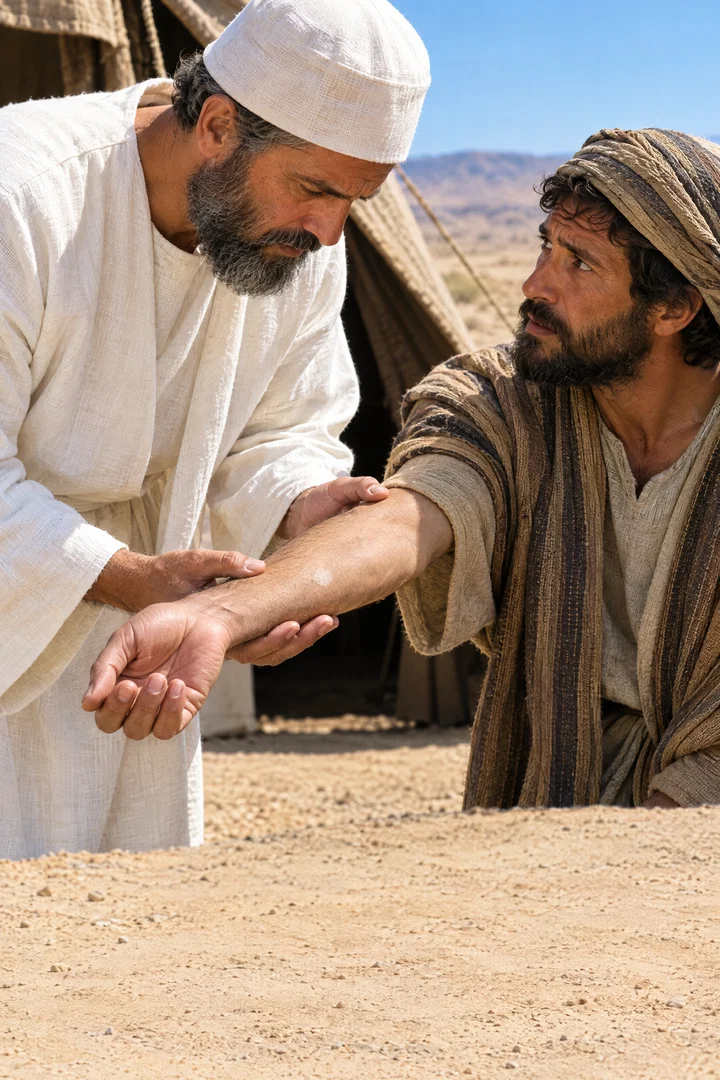
When a man shall have in the skin of his flesh a rising, a scab, or bright spot, and it be in the skin of his flesh like the plague of leprosy; then he shall be brought unto Aaron the priest, or unto one of his sons the priests:
Translations
American King James Version, Webster Bible
When a man shall have in the skin of his flesh a rising, a scab, or bright spot, and it be in the skin of his flesh like the plague of leprosy; then he shall be brought to Aaron the priest, or to one of his sons the priests:
King James Version, KJV Cambridge Paragraph Bible
When a man shall have in the skin of his flesh a rising, a scab, or bright spot, and it be in the skin of his flesh like the plague of leprosy; then he shall be brought unto Aaron the priest, or unto one of his sons the priests:
Revised Version, American Standard Version
When a man shall have in the skin of his flesh a rising, or a scab, or a bright spot, and it become in the skin of his flesh the plague of leprosy, then he shall be brought unto Aaron the priest, or unto one of his sons the priests:
'When a man hath in the skin of his flesh a rising, or scab, or bright spot, and it hath become in the skin of his flesh a leprous plague, then he hath been brought in unto Aaron the priest, or unto one of his sons the priests;
When a man shall have in the skin of his flesh a rising or a scab, or bright spot, and it become in the skin of his flesh a sore [ as] of leprosy, then he shall be brought unto Aaron the priest, or unto one of his sons the priests.
When, any man, shall have—in the skin of his flesh—a rising, or a scab, or a bright spot, and it shall become in the skin of his flesh the plague-spot of leprosy, then shall he be brought in unto Aaron the priest, or unto one of his sons the priests;
“ When someone has a swelling or rash or bright spot on his skin that could become an infectious skin disease, he must be brought to Aaron the priest or to one of his sons who is a priest.
“ When someone has a swelling or rash or bright spot on his skin that may be an infectious skin disease, he must be brought to Aaron the priest or to one of his sons who is a priest.
“ When a man shall have a swelling in his body’s skin, or a scab, or a bright spot, and it becomes in the skin of his body the plague of leprosy, then he shall be brought to Aaron the priest or to one of his sons, the priests.
If a man has on his skin a growth or a mark or a white place, and it becomes the disease of a leper, let him be taken to Aaron the priest, or to one of the priests, his sons;
The man that shall haue in the skin of his flesh a swelling or a skab, or a white spot, so that in the skinne of his flesh it be like the plague of leprosie, then he shalbe brought vnto Aaron the Priest, or vnto one of his sonnes the Priestes,
Douay-Rheims (Challoner revision)
The man in whose skin or flesh shalt arise a different colour or a blister, or as it were something shining, that is, the stroke of the leprosy, shall be brought to Aaron the priest, or any one of his sons.
Pictures
Cross-references
- Leviticus 14:2
This shall be the law of the leper in the day of his cleansing: He shall be brought unto the priest:
The priest examines the leper and begins the prescribed cleansing rites.
- Matthew 8:2-4
And, behold, there came a leper and worshipped him, saying, Lord, if thou wilt, thou canst make me clean.
Jesus heals a leper and directs him to show himself to the priest.
- Leviticus 13:45-46
And the leper in whom the plague is, his clothes shall be rent, and his head bare, and he shall put a covering upon his upper lip, and shall cry, Unclean, unclean.
The leper’s unclean verdict requires separation from the community.
- Luke 5:12-14
And it came to pass, when he was in a certain city, behold a man full of leprosy: who seeing Jesus fell on his face, and besought him, saying, Lord, if thou wilt, thou canst make me clean.
Jesus cleanses a leper and sends him to fulfill the priestly requirement.
- Mark 1:40-44
And there came a leper to him, beseeching him, and kneeling down to him, and saying unto him, If thou wilt, thou canst make me clean.
A leper is cleansed and sent to the priest as the law requires.
- Luke 17:12-14
And as he entered into a certain village, there met him ten men that were lepers, which stood afar off:
Ten lepers keep their distance and are cleansed as they go to the priests.
Commentary
Each commentary is drawn from primary sources: the writings of Ellen G. White and Adventist pioneers and periodicals. Each commentary is separate. Its own words are not a quotation; follow the references to read the source passages.
Ellen G. White
4 sources
Anyone in whose skin appeared a rising, a scab, or a bright spot that looked like the plague of leprosy was to be brought to Aaron the priest or to one of his sons for examination, and the priest examined him and decided whether the disease was present.MH 67.1–23RED 47.22SP 227.2DA 262.1–3 That priestly examination decided the case with decisive authority, even where noted physicians had already examined the case thoroughly and confessed that their skill was baffled and the disease was incurable.3RED 47.22SP 227.2 No rank exempted a man from this requirement, for it bound even a man of high distinction whose case physicians of note had examined thoroughly and searched their books for further knowledge before reluctantly acknowledging that their skill was baffled.3RED 47.2
One pronounced unclean was isolated and cut off, separated from family and home, from friends, from the congregation and community, and from the society in which he had lived.MH 67.1–23RED 47.22SP 227.2DA 262.1–3 Those declared lepers were required to live apart together with others afflicted with the disease.MH 67.1–2 A priestly verdict that the case was the worst form of leprosy sentenced the person to a living death as an exile from home.3RED 47.22SP 227.2 That sentence fell even on one who had held a lofty position in society, whose former admirers and those who had courted his favor fled from his presence with horror.3RED 47.2
Leprosy was dreaded as contagious and incurable.MH 67.1–2 Among the Jews it was regarded as a judgment for sin and as a symbol of sin.MH 67.1–2DA 262.1–3
Sources
Pioneers and periodicals
17 sources
When a rising, a scab, or a bright spot appears in the skin resembling the plague of leprosy, the person must be brought to Aaron the priest or to one of his sons the priests for examination.RH Feb 3, 1916ST Feb 7, 1911ST Apr 16, 1896 The priest examines the case and pronounces the decision, and the one declared a leper is pronounced unclean and shut out as in a living death from home, family, society, and the congregation to dwell apart with fellow lepers.ST Jul 28, 1914ST Apr 16, 1896 Leprosy is a horrible, dreaded disease and a fitting type and symbol of sin, even mortal sin.ST Jul 28, 1914 Like leprosy, sin is deep-rooted, ineradicable, and deadly, never getting well of itself and incurable by human means, eating away its victim while polluting the inner source of life.ST Jul 28, 1914RH Feb 23, 1869RH Oct 19, 1869 Like leprosy, sin is infectious and contagious, for as the leper defiles what he touches and pollutes the air by his breath, so the sinner contaminates the very atmosphere and by his society leads others to sin.ST Jul 28, 1914RH Feb 23, 1869RH Oct 19, 1869 Only the great Physician can cleanse this plague, for Christ's blood cleanses from sin and his healing of lepers showed his power to heal, while these instructions also belong to sanitary guidance whose observance preserves health and still stands at the head of sanitary law.RH Feb 23, 1869ST Feb 7, 1911ST Feb 3, 1909ST Apr 20, 1904RH Aug 29, 1871
Signs and Priestly Examination
The verse names a rising, a scab, or a bright spot in the skin of the flesh resembling the plague of leprosy as signs that require the person to be brought to Aaron the priest or to one of his sons the priests for examination.RH Feb 3, 1916ST Feb 7, 1911ST Apr 16, 1896ST Jan 14, 1913 These are initial signs that may indicate leprosy, introducing laws for examining skin conditions that might be leprosy.RH Feb 3, 1916ST Feb 7, 1911 The law also required lepers to keep their distance from others, and the ten lepers followed the law as they went to the priests and were cleansed on the way.ST Apr 16, 1896 The passage calls for further study of biblical information about lepers and leprosy, and these laws also reflect the need for proper precautions against unsanitary conditions.RH Feb 3, 1916ST Feb 7, 1911
The priest must examine the suspected case and decide it, pronouncing the person unclean and shutting him out if he is a leper.ST Jul 28, 1914ST Mar 11, 1913 That decision could declare the disease to be leprosy in its worst form.ST Jan 14, 1889ST Mar 11, 1913 Even a man of high distinction already examined thoroughly by noted physicians and found incurable must still submit to the priest's examination and decision.ST Mar 11, 1913 That verdict meant exile from home, friends, and society, a life of separation described as a living death.ST Jan 14, 1889ST Mar 11, 1913
If pronounced a leper the person is declared unclean and shut out as in a living death, separated from home, family, friends, society, and the congregation of Israel to associate only with fellow lepers.ST Jul 28, 1914ST Jan 14, 1889 Even kings and rulers are not exempt from this shutting out from the habitations of men like one already dead.ST Jul 28, 1914 The separated leper goes with loose hair and covered upper lip, crying Unclean, Unclean when people approach, and is immediately separated from the cities and people if on examination the priest finds the smiting.ST Jan 14, 1913
The Hebrew word for the plague means a smiting, pointing more to its fearful and hopeless result than to its beginning.ST Jan 14, 1913 It begins slowly and insidiously with no effect on general health at first except slight itching when the skin is heated.ST Jan 14, 1913 Of three kinds mentioned in the Scriptures the first did not render one unclean but the other two did.ST Jan 14, 1913 The disease in its worst forms is incurable by human skill or power, and it is common to both sexes and to all ages and all ranks of society.ST Jan 14, 1913
A small growing white swelling or scaly eruption illustrates the suspicious mark, treated as a possible warning sign of the disease. The sufferer fears the diagnosis and tries to dismiss it as a harmless blotch or scab. He believes the mark means leprosy and that it is punishment for his sins. Simon of Bethany was examined under this law and declared unclean, and after healing he returned to the priest to be examined for cleansing.ST Nov 1, 1910
Leprosy as Type of Sin
Leviticus 13:2 introduces the laws regulating uncleanness in the case of leprosy, a horrible, dreaded disease that serves as a fitting type and symbol of sin, including mortal sin.ST Jul 28, 1914RH Aug 29, 1871 In the East it was the most dreaded disease because it was incurable and contagious and horrible in its effect upon its victims.ST Jul 28, 1914 Among the Jews it was regarded as a judgment on account of sin, called the stroke and the finger of God.ST Jul 28, 1914
Like leprosy, sin is deep-rooted, ineradicable, and deadly, never getting well of itself and incurable by human means.ST Jul 28, 1914RH Feb 23, 1869RH Oct 19, 1869 It is universal among Adam's descendants, residing not only in visible acts of wrongdoing but in the heart's motives, purposes, and desires.RH Feb 23, 1869 It eats away its victim and pollutes the inner source of life while making the outer person shameful.RH Feb 23, 1869 Like leprosy, sin is infectious and contagious: the leper defiles whatever he touches and pollutes the air by his breath, and the sinner contaminates the very atmosphere, introduces pollution where all before was comparative purity, and by his society leads others to sin, so that such influence is more to be feared than the infection of the leper.ST Jul 28, 1914RH Feb 23, 1869RH Oct 19, 1869
Sin is a worse disease than physical leprosy, and healing from it requires pride and self to die rather than seeking some grand act that avoids humility.RH Jun 27, 1871 Only the great Physician can cleanse this plague: Christ's blood cleanses from sin, and he helps those who repent sincerely and believe in him.RH Feb 23, 1869 Christ's healing of lepers showed his power to heal.RH Aug 29, 1871 The complete cleansing of the acknowledged incurable leper described there was no less a miracle than raising the dead, being a matter of faith in the cleansing power of the Author of the ceremonies and thus showing faith in Christ in the rites of the Levitical law.ST Apr 20, 1904
Health, Cleansing, and Healing
The opening direction to bring a suspicious skin mark to the priest belongs to sanitary guidance concerning contagious diseases.ST Feb 7, 1911ST Feb 3, 1909 The same instructions reflect the need for proper precautions against unsanitary conditions, including infections that can remain in buildings.ST Feb 7, 1911ST Feb 3, 1909 These Mosaic laws of sanitation still stand at the head of sanitary law, above the sanitary laws understood and enforced by modern physicians.ST Jan 20, 1914 Observing this sanitary law has real value for preserving health and preventing disease and death.ST Jan 20, 1914 Its enduring superiority proves divine guidance and inspiration.ST Jan 20, 1914
The verse stands within the law of cleansing in Leviticus 12-15, where a man with a rising, scab, or bright spot like leprosy must be brought to the priest.RH Oct 14, 1852 There physical uncleanness had to be removed first, with the object made visibly clean so that it would be called clean.RH Oct 14, 1852 That preparatory making clean prepared it for its real cleansing with blood by atonement.RH Oct 14, 1852 This preparatory cleansing is distinct from the moral uncleanness of idolatry and transgression that defiled the sanctuary in the sight of the Lord.RH Oct 14, 1852 It is likewise distinct from the cleansing the heavenly sanctuary was to undergo at the end of the 2300 days.RH Oct 14, 1852
Israel’s cleansing laws connect with health reform and obedience to God’s laws of health.RH Nov 3, 1868 They illustrate the need to become clean vessels fit for God’s Spirit to dwell in.RH Nov 3, 1868 That cleansing work applies to the remnant’s preparation to receive the latter rain.RH Nov 3, 1868
Sources