Mark 13:15
And let him that is on the housetop not go down into the house, neither enter therein, to take any thing out of his house:
Translations
American King James Version, King James Version
And let him that is on the housetop not go down into the house, neither enter therein, to take any thing out of his house:
and let him that is on the housetop not go down into the house, neither enter therein, to take any thing out of his house:
And let him that is on the house-top not go down into the house, neither enter it, to take any thing out of his house:
Revised Version, American Standard Version
and let him that is on the housetop not go down, nor enter in, to take anything out of his house:
and he upon the house-top, let him not come down to the house, nor come in to take anything out of his house;
and him that is upon the housetop not come down into the house, nor enter [ into it] to take away anything out of his house;
He that is on the house-top, let him not come down, neither let him enter, to take away anything out of his louse;
Let no one on the housetop go back inside to retrieve anything from his house.
Let no one on the housetop go back inside the house to retrieve anything from his house.
and let him who is on the housetop not go down, nor enter in, to take anything out of his house.
And let him who is on the house-top not go down, or go in, to take anything out of his house:
And let him that is vpon the house, not come downe into the house, neither enter therein, to fetch any thing out of his house.
Douay-Rheims (Challoner revision)
And let him that is on the housetop, not go down into the house, nor enter therein to take any thing out of the house:
Pictures
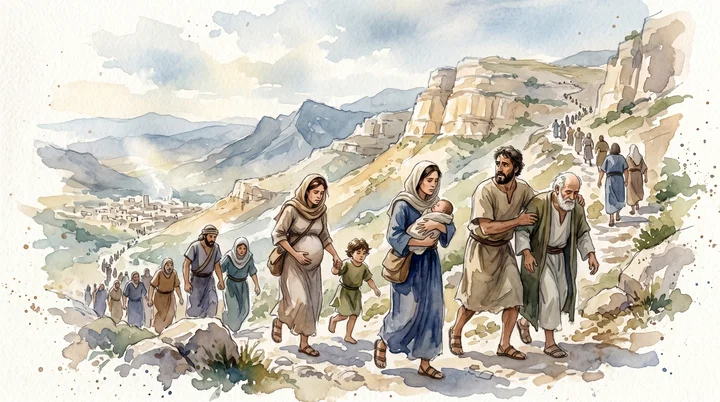
Cross-references
- Matthew 24:17
Let him which is on the housetop not come down to take any thing out of his house:
Gives the parallel warning not to return for possessions.
- Luke 21:20-21
And when ye shall see Jerusalem compassed with armies, then know that the desolation thereof is nigh.
Jerusalem’s encirclement signals immediate flight from the city.
- Daniel 9:27
And he shall confirm the covenant with many for one week: and in the midst of the week he shall cause the sacrifice and the oblation to cease, and for the overspreading of abominations he shall make it desolate, even until the consummation, and that determined shall be poured upon the desolate.
Prophesies the abomination of desolation Jesus cites.
- Luke 21:20
And when ye shall see Jerusalem compassed with armies, then know that the desolation thereof is nigh.
Gives the sign of Jerusalem’s encirclement before its destruction.
- Luke 17:22-37
And he said unto the disciples, The days will come, when ye shall desire to see one of the days of the Son of man, and ye shall not see it.
Uses similar language about fleeing in connection with Christ’s coming.
- Matthew 24:3
And as he sat upon the mount of Olives, the disciples came unto him privately, saying, Tell us, when shall these things be? and what shall be the sign of thy coming, and of the end of the world?
The disciples’ question opens the parallel prophecy.
Commentary
Each commentary is drawn from primary sources: the writings of Ellen G. White and Adventist pioneers and periodicals. Each commentary is separate. Its own words are not a quotation; follow the references to read the source passages.
Ellen G. White
6 sources
Jesus spoke these words on the Mount of Olives to Peter and James and John and Andrew, who came to Him alone after He had left the temple.Ms 35, 1906, par. 15–23DA 627.1–3 They came after the disciples had pointed to the temple's strength and beauty and He had foretold that its buildings would be thrown down with not one stone left upon another.Ms 35, 1906, par. 15–23DA 627.1–3 They asked when these things would happen and what would be the sign when all would be fulfilled, of His coming and of the end of the world.Ms 35, 1906, par. 15–23DA 627.1–3
In its immediate setting the command belongs to the moment when the abomination of desolation spoken of by Daniel is seen standing where it ought not, and those in Judea must flee to the mountains.Ms 35, 1906, par. 15–23 With it stand woe to those with child and nursing in those days and prayer that flight be not in winter, because then comes affliction unequaled since creation.Ms 35, 1906, par. 15–23 That affliction is followed by false Christs, darkened sun and moon and falling stars, the coming of the Son of man to gather the elect, the lesson of the fig tree, and the command to watch.Ms 35, 1906, par. 15–23
The saying mingles the destruction of Jerusalem with the great day of His coming, blending the description of the two great crises in mercy because the disciples could not have endured the future events as He beheld them, leaving them to study out the meaning for themselves.DA 627.1–3 What is said of Jerusalem reaches beyond that event to the final conflagration when the Lord rises to punish the world for iniquity.DA 627.1–3 The discourse was given not for the disciples only but for those who live in the last scenes of this earth's history.DA 627.1–3
The verse commands utter immediacy of escape: when the warning sign appears and the time to flee comes, the one on the housetop must flee at once toward the mountains without going back down into the house or entering to take anything out.Ms 35, 1906, par. 15–23GC88 26.1Ms 189, 1907, par. 14Ms 119, 1909, par. 20–22 He must not delay even for valuable possessions or belongings, just as the man in the field must not turn back to take his garment, lest he be caught in the destruction.Ms 35, 1906, par. 15–23GC88 26.1 When the sign comes there must be no delay to gather belongings, because people will be driven at once into the mountains.Ms 189, 1907, par. 14Ms 119, 1909, par. 20–22
As part of this discourse it stands as a warning relevant to the destruction of cities full of sin, which may come through earthquakes, fire, or flood, when human possessions and carefully protected buildings cannot withstand God's authority.21MR 66.7–67.1 It warns of a coming crisis requiring immediate escape, so parents in the large cities should get out now to places with room where children can move about and have land to cultivate.Ms 189, 1907, par. 14 There they should educate them in cultivation, teach them to keep the Sabbath, never leave the house without committing the family to God, and set Christ before them as the Saviour who gave His life for the life of the world.Ms 189, 1907, par. 14 The warning shows that sudden events of unknown timing and nature will require readiness and immediate action, so people must prepare day by day.Ms 119, 1909, par. 20–22
Sources
Pioneers and periodicals
53 sources
Him that is on the housetop must not go down into the house nor enter to take anything out, but flee at once without delay, because in the crisis there is no time to spare.ST Nov 15, 1899ST Jan 24, 1906ST Jul 8, 1897 The warning concerned Jerusalem's imminent desolation, when the surrounding of the city by Roman armies was the sign that the time to escape to the mountains had come.ST Jan 24, 1906RH Dec 3, 1867ST May 14, 1902 God opened a plain way for escape by causing Cestius Gallus suddenly to raise the siege and retreat, so the disciples who trusted the warning fled to the mountains before Titus returned, and none was in the city when it was overthrown and the Temple destroyed in A.D. 70.RH Dec 3, 1867ST May 14, 1902RH Feb 17, 1916RH Dec 15, 1904 The fall of Jerusalem had only a partial fulfillment, furnishing the colors and imagery for distant future events, for the discourse was not all fulfilled when Rome destroyed Jerusalem since the second coming, the deliverance of God's people, and the appearance of the Son of man in heaven had not yet occurred.RH Feb 17, 1916RH Apr 12, 1915ST Aug 21, 1893ST Sep 16, 1889 The same urgency points to the last-day tribulation, when the final decree threatens the lives of those who refuse to worship the beast or its image, and the one on the housetop must again flee without returning for possessions, for attachment to earthly property could cause hesitation and destruction.ST Mar 5, 1896ST Oct 8, 1894
Immediate Command to Flee
When the sign of desolation appears, the one on the housetop is not to go down into the house nor enter to take anything out of it, but is to flee at once without delay.ST Nov 15, 1899ST Jan 24, 1906ST Jul 8, 1897 The warning was given for the moment when the Roman army surrounded Jerusalem as the signal that its destruction was imminent, opening an opportunity for escape that had to be seized immediately.ST Jan 24, 1906ST Jul 8, 1897 In that crisis there is no time to spare, so flight takes priority over every earthly belonging.ST Jan 24, 1906ST Jul 8, 1897
The instruction shows the urgency of escape by forbidding loss of time in going back indoors or entering the home to collect possessions.ST Jan 24, 1906RH Dec 3, 1867ST Mar 5, 1896 Like Lot's family at Sodom, those fleeing were not to turn back or linger for possessions, but to leave all behind and escape without delay.ST Mar 5, 1896 This waymark marked the setting of Jerusalem surrounded by armies, when duty required immediate flight rather than care for property.ST Jan 24, 1906RH Dec 3, 1867
In that setting the people were to flee to the mountains, acting at once when the opportunity opened.RH Dec 3, 1867 The signal brought a change in duties and trials, and those who heeded the warning acted in harmony with the word.RH Dec 3, 1867
Destruction of Jerusalem Fulfilled
The warning was given for Jerusalem's imminent destruction, with the gathering of the Roman armies around the holy city as the sign that desolation was near and the time to escape had come.ST Jan 24, 1906RH Dec 3, 1867ST May 14, 1902 When that sign appeared, the one on the housetop was not to go down into the house nor enter to take anything out, but to flee without delay, putting flight above earthly belongings and losing no time over possessions.ST Jan 24, 1906RH Dec 3, 1867ST May 14, 1902 Fulfillment came when God caused Cestius Gallus suddenly to raise the siege and retreat, opening a plain way of escape even though the disciples had been surrounded.RH Dec 3, 1867ST May 14, 1902 Those who trusted the warning used that opening when it came to flee quickly to the mountains, before Titus returned to lay the city to the ground.RH Dec 3, 1867ST May 14, 1902
The disciples heeded the warning and escaped to the mountains, so that no disciple was in the city during its destruction. What followed was the siege and overthrow of Jerusalem and the destruction of the Temple, illustrated as fulfilled history in the overthrow of Jerusalem in A.D. 70.RH Dec 15, 1904ST Aug 25, 1887 The predictions concerning Jerusalem were really fulfilled in the capture of the city by Titus.RH Feb 17, 1916
Dual Scope and Future Coming
The verse belongs to the prophecy given on the Mount of Olives after Jesus left the temple, answering the disciples' questions about the destruction of the temple, the sign of His coming, and the end of the world.ST Jan 17, 1906ST May 14, 1896 There He spoke of Jerusalem's destruction, the persecution of His followers, signs of the end, and His second coming.ST Jan 17, 1906RH Aug 20, 1901 Mark's account presents part of the instruction found also in Matthew 24 and Luke 21, and the three accounts together provide its fuller meaning.ST Jan 17, 1906ST May 14, 1896 The chapter gives striking teaching about the destruction of Jerusalem and the end of the world, with its signs applying both to Jerusalem's fall and to the end.ST Mar 3, 1909ST May 14, 1896
The discourse does not apply entirely to the destruction of Jerusalem and does not refer only to the time between the prediction and the destruction of Jerusalem in A.D. 70.ST Aug 21, 1893 It was not all fulfilled when the Romans destroyed Jerusalem, for the second coming did not occur then and had not yet occurred.ST Sep 16, 1889ST Nov 27, 1879 The description of Christ's coming and the gathering of His people forbids that limit, wars of nation against nation and kingdom against kingdom were impossible before Jerusalem was destroyed because Rome ruled the world, and John wrote Revelation more than twenty years after A.D. 70 yet gives the same signs as omens of the coming of the great day of God.ST Aug 21, 1893ST Sep 16, 1889 Their correct application must be learned by comparing Scripture with Scripture, since the statements do not all occur in the order given or refer to the same time.ST Sep 16, 1889ST Nov 27, 1879
Its predictions about the destruction of Jerusalem were really fulfilled in the capture of the city by Titus, but that event was only a partial fulfillment.RH Feb 17, 1916RH Apr 12, 1915 The nearer fall of Jerusalem furnished the colors and imagery for depicting distant future events belonging to the end of the age.RH Feb 17, 1916RH Apr 12, 1915 In this way Jerusalem's destruction serves as a type of the second coming.RH Feb 17, 1916ST Oct 20, 1909 Full fulfillment requires the deliverance of God's people, the punishment of God's enemies, and the appearance of the sign of the Son of man in heaven, none of which happened when Jerusalem fell, so the destruction of Jerusalem does not itself fulfill the promise of Christ's return.RH Feb 17, 1916RH Apr 12, 1915
The discourse places His second coming after a sequence of events rather than immediately in the disciples' time, saying that many notable events, including Jerusalem's destruction and the great tribulation, would occur before the end.ST Jul 30, 1902 His coming was not in their day and was not due in the apostles' own day.ST Feb 14, 1906ST Jul 30, 1902 Its definite time was not to be known, and the declarations that the time is not known stand as a forcible objection against setting a definite time for the second advent.ST Feb 14, 1906RH Jan 21, 1873 It was spoken to His disciples to show how Jerusalem should be destroyed, to prepare them for coming disappointment, and to show the future triumph of the Son of God.ST Feb 14, 1906ST Mar 3, 1909 It gives a prophetic sketch of the leading events from the first advent down to the second, so its expressions about definite time apply to the last generation.ST Feb 14, 1906RH Jan 21, 1873
The prophecy sets forth what should come to pass from the destruction of Jerusalem to the second advent, whose final act is still future.RH Jan 7, 1904ST Jan 9, 1893 Its fulfillment is traced through consecutive disturbances down to the writer's day, while only the prophecies directly connected with the Lord's coming remain future.RH Jan 7, 1904ST Jan 6, 1887 The literal, visible, bodily return of Christ to which it points is still future.RH Apr 12, 1915ST Jan 9, 1893 It was not fulfilled by Pentecost, by the indwelling of the Spirit, or by providence in history.RH Apr 12, 1915
Signs of Near Return
Mark 13 answers the disciples' questions about the signs of Christ's coming and the end of the world, giving literal signs by which it is possible to know when His coming is near. Those signs call people to recognize that Christ is near, and their appearance, whether fulfilled or still being fulfilled, shows that the Son of man is near, even at the doors.GSAM 67.2–68.1ST Jul 21, 1898 They include events and signs occurring through the church's great tribulation that show His coming was near.GSAM 67.2–68.1
The signs in the sun, moon, and stars were to appear immediately after the tribulation of the long centuries of papal persecution, the 1,260 years of papal supremacy dated 538 to 1798.ST Apr 24, 1879ST Apr 15, 1903ST Nov 28, 1895 Although that period had not yet ended, persecution had already been restrained by the Reformation, and the fulfillment of the predicted signs began in that period.ST Apr 24, 1879ST Apr 15, 1903 The darkening of the sun and the moon withholding light was fulfilled May 19, 1780, when the sun became black as sackcloth of hair at midday and the full moon the following night gave no light and appeared as blood whenever it appeared through the darkness.ST Apr 24, 1879ST Apr 15, 1903ST Dec 30, 1903 The falling of the stars was fulfilled November 13, 1833, also cited as November 30, 1833, in an unparalleled shower of meteors with no scientific explanation, occurring within the time of the end this side of 1798 and within the present living generation as heralds of His coming.ST Apr 15, 1903ST Nov 28, 1895
These fulfilled signs prove He is near, even at the door, as surely as budding trees prove summer is near.ST Feb 7, 1906ST Apr 15, 1903 With all but one of the heavenly signs already in the past and conditions now everywhere manifest, the coming of the Lord in glory is near.ST Feb 7, 1906ST Apr 15, 1903 The generation that sees all these signs and bears the last message of mercy proclaimed in fullness from 1844 will witness His coming and shall not pass till all things including Christ's coming are fulfilled, so the final events, culminating in the everlasting gospel given to the world and the second coming of the Lord, may occur at almost any time.ST Dec 24, 1912ST Apr 15, 1903
Mark 13 is one of the great lines of symbolic and literal prophecy about the end of the age and Christ's coming.ST Nov 28, 1900ST Nov 8, 1905ST Dec 14, 1904 Together with the other converging lines of prophecy it brings the time almost to the focal center, proving that the end of earthly rule is nearly over and that Christ's coming is near.ST Nov 28, 1900ST Dec 14, 1904 It presents Jesus' literal prophecy of His return, foretelling signs that will occur before it and marking the last days of earth's sorrow and travail with particular distinctness.ST Dec 24, 1912ST Nov 8, 1905
The lesson was spoken to the disciples but written for the present generation, the people acting now who see all these things.ST Feb 14, 1906 It was spoken to show that Jerusalem should be destroyed and how, that His coming was not in their day, and that its definite time was not to be known, so the instruction could be used for those coming afterward.ST Feb 14, 1906 The greater part of that instruction, the definite signs, fearful dangers, deceptions, admonitions, warnings, and assurances, is for the people who see these signs in the light of God's Word, some of whom shall not die till Christ comes again.ST Feb 14, 1906 Its word stands sure though heaven and earth pass away, and it bids the faithful pilgrim be of good courage and endure unto the end against weariness of waiting, sleep, the peace-and-safety cry, deceptions, and the force of a great numerical rich popular church and of higher criticism and a converted world.ST Feb 14, 1906
The exhortations to watch were given in connection with the signs of the second advent and apply to a certain period just prior to that event, the waiting, watching time since the disappointment in the autumn of 1844 when believers wait for the coming of the Lord and in an especial sense watch and pray without definite time.RH Oct 15, 1872RH Jan 21, 1873 Its expressions about definite time apply to the last generation, giving a prophetic sketch of the leading events from the first advent down to the second.RH Jan 21, 1873 The declarations in the discourse that the time is not known stand as a forcible objection against setting a definite time for the second advent.RH Oct 15, 1872RH Jan 21, 1873
Harmony With Other Prophecies
The same instruction is recorded in Matthew and Luke, for Mark's account presents part of the teaching found also in Matthew 24 and Luke 21, and the three accounts together provide its fuller meaning.ST Jan 17, 1906 They stand as three versions of the same teaching about the destruction of Jerusalem and the second coming, each supplementing the others without contradiction, with Matthew 24 the most complete.ST Aug 14, 1893 Together they give plain proof that Christ's coming is near, so that the simple and unlearned can understand the warning and heed its admonitions without the knowledge of history needed for long symbolic prophecies.ST Aug 14, 1893
Mark 13 is Christ's great discourse on the Mount of Olives, parallel to Matthew 24 and Luke 21.RH Feb 17, 1916RH Apr 12, 1915 It belongs with Matthew 24 and 25 and Luke 17 and 21 as part of the great prophecy revealing the future course of nations, churches, and individuals in this dispensation and specially marking the condition of things in the last days.ST Oct 16, 1893 It is an example of literal prophecy whose predictions are stated in plain language rather than in symbols and figures.ST Apr 9, 1896 It throws great light on the pathway of God's people until the dawn of eternal day, so that the day of the Lord will not come upon them as a thief, and neglecting or disregarding it proves ruinous.ST Oct 16, 1893
Its signs were given, in connection with the unsealed prophecies of Daniel and John, so His people might know His coming is nigh even at the doors.RH Dec 9, 1851 Only the generation able to know this from the signs and prophecies could give the judgment-hour message.RH Dec 9, 1851
Their correct application must be learned by comparing Scripture with Scripture, since prophecy is not always given in the order in which it is fulfilled.ST Sep 16, 1889 Its statements do not all occur in the order given or refer to the same time, and some require comparison with other Scriptures to determine their application, for it was not all fulfilled when the Romans destroyed Jerusalem.ST Nov 27, 1879 The description of Christ's coming and the gathering of His people forbids limiting Mark 13 only to the time between the prediction and the destruction of Jerusalem in A.D. 70.ST Aug 21, 1893 Wars of nation against nation and kingdom against kingdom were impossible before Jerusalem was destroyed because Rome ruled the world, and John wrote the Revelation more than twenty years after A.D. 70 yet gives the same signs as omens of the coming of the great day of God.ST Aug 21, 1893
The great prophecy given while viewing Jerusalem from the Mount of Olives outlines the history of the Christian dispensation and era, the gospel age, and the whole dispensation through the end of the great controversy to the consummation of Christ's kingdom.RH Feb 6, 1855ST Aug 5, 1913 It is a prophetic timetable marking progress through the Christian era toward the second coming, telling the story of His second coming and proclaiming Him as the coming King of kings.RH Nov 5, 1903ST Oct 20, 1909 Every prophecy is shown fulfilled in consecutive order, with fulfillment traced through the disturbances of the writer's day, including the generation addressed by the worldwide warning of coming judgment.RH Jan 7, 1904RH Nov 5, 1903RH Feb 6, 1855 Like the other prophetic lines it begins at a different point in world history and carries the reader forward toward the glorious completion of Christ's kingdom, whose final act is still future.RH Jan 7, 1904ST Aug 5, 1913
Doctrine and Faithful Readiness
The verse stands within teaching about the manner of Christ's coming in clouds with great power and glory, not in weakness as at the manger in Bethlehem, no more to suffer shame at the hands of men, in the day of His triumph and recognition as the coming King of kings.ST Sep 14, 1882RH Nov 5, 1903 He will descend to earth with the heavenly hosts and gather His people to Himself, and that gathering of the elect is the time when the sleeping saints are taken home to the heavenly mansions.RH Nov 1, 1870 It belongs to His outline history of the world telling the story of His second coming, with every prophecy shown fulfilled in consecutive order.RH Nov 5, 1903
The discourse describes the last days as evil and shows they will bring persecution of those who do God's will.ST Dec 26, 1892ST Jul 1, 1908 That persecution follows the church's backsliding and union with the world, and is linked to the outcome of the Sunday-sabbath movement.ST Dec 26, 1892 For this reason the world will not be converted before the end.ST Jul 1, 1908
The warning calls for watchfulness and prior preparation and readiness when the signs show His coming is near.RH Sep 7, 1916ST Oct 26, 1904 The coming described is identified with Christ leaving the heavenly sanctuary to receive His kingdom before His later personal return to earth, so that those unprepared for that event will also be unprepared for His return.RH Sep 7, 1916 The prophecy reveals the future by describing events to take place and the course that nations, churches, and individuals will pursue in this dispensation, and it specially marks the condition of things in the last days.ST Oct 16, 1893 It throws great light on the pathway of God's people until the dawn of eternal day, so that the day of the Lord will not come upon them as a thief, while neglecting or disregarding it proves ruinous.ST Oct 16, 1893
The literal instruction for the disciples to flee Jerusalem when destruction approached, not to go inside to collect belongings but to escape without delay like Lot's family at Sodom who were not to turn back or linger for possessions, also points to a similar need to flee during the last-day tribulation.ST Mar 5, 1896ST Oct 8, 1894 When the final decree threatens the lives of those who refuse to worship the beast or its image, the person on the housetop must flee without returning to the house for possessions, recalling the flight from Jerusalem when it was surrounded by armies.ST Mar 5, 1896ST Oct 8, 1894 This urgency means God's people will already have given up everything, for attachment to earthly property could make a person hesitate and be destroyed.ST Oct 8, 1894
The fulfillment of these prophecies given by Christ furnishes evidence of the divine stamp upon the Scripture canon.ST Sep 26, 1895 Their words have been illustrated as fulfilled in historical events, including the overthrow of Jerusalem in A.D. 70.RH Dec 15, 1904 The signs of that day bring fear and distress to His enemies but are encouraging announcements to His servants because their redemption draws nigh.ST Sep 14, 1882 They were spoken to the disciples to show that Jerusalem should be destroyed and how, that His coming was not in their day, and that its definite time was not to be known, yet written for the present generation who see all these things.ST Feb 14, 1906 The greater part of that instruction, the definite signs, fearful dangers, deceptions, admonitions, warnings, and assurances, is for those who see the signs in the light of God's Word, some of whom shall not die till Christ comes again, and its word stands sure though heaven and earth pass away, bidding the faithful pilgrim be of good courage and endure unto the end against weariness of waiting, sleep, the peace-and-safety cry, deceptions, and the force of a great numerical rich popular church and of higher criticism and a converted world.ST Sep 14, 1882ST Feb 14, 1906
Sources