Mark 5:39
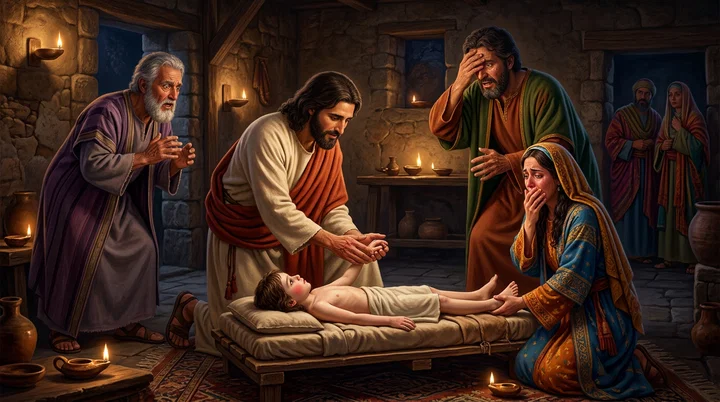
And when he was come in, he saith unto them, Why make ye this ado, and weep? the damsel is not dead, but sleepeth.
Translations
And when he was come in, he says to them, Why make you this ado, and weep? the damsel is not dead, but sleeps.
King James Version, KJV Cambridge Paragraph Bible
And when he was come in, he saith unto them, Why make ye this ado, and weep? the damsel is not dead, but sleepeth.
And when he had come in, he saith to them, Why make ye this tumult, and weep? the damsel is not dead, but sleepeth.
Revised Version, American Standard Version
And when he was entered in, he saith unto them, Why make ye a tumult, and weep? the child is not dead, but sleepeth.
and having gone in he saith to them, 'Why do ye make a tumult, and weep? the child did not die, but doth sleep;
And entering in he says to them, Why do ye make a tumult and weep? the child has not died, but sleeps.
and, entering, he saith unto them—Why are ye making a tumult, and weeping? The child, is, not dead, but, is sleeping;
Berean Standard Bible, Majority Standard Bible
He went inside and asked, “ Why all this commotion and weeping? The child is not dead, but asleep.”
When he had entered in, he said to them, “ Why do you make an uproar and weep? The child is not dead, but is asleep.”
And when he had gone in, he said to them, Why are you making such a noise and weeping? The child is not dead, but sleeping.
And he went in, and said vnto them, Why make ye this trouble, and weepe? the childe is not dead, but sleepeth.
Douay-Rheims (Challoner revision)
And going in, he saith to them: Why make you this ado, and weep? the damsel is not dead, but sleepeth.
Pictures
Cross-references 20 of 28
- John 11:11-14
These things said he: and after that he saith unto them, Our friend Lazarus sleepeth; but I go, that I may awake him out of sleep.
Jesus describes Lazarus’s death as sleep, then plainly says he is dead.
- Luke 8:52-55
And all wept, and bewailed her: but he said, Weep not; she is not dead, but sleepeth.
Jesus calls the girl asleep and restores her to life.
- Matthew 9:24
He said unto them, Give place: for the maid is not dead, but sleepeth. And they laughed him to scorn.
Jesus likewise says the girl is asleep before raising her.
- Luke 7:14-15
And he came and touched the bier: and they that bare him stood still. And he said, Young man, I say unto thee, Arise.
Jesus raises the widow’s son to life, as he raises Jairus’s daughter.
- 1 Thessalonians 4:13-16
But I would not have you to be ignorant, brethren, concerning them which are asleep, that ye sorrow not, even as others which have no hope.
The dead in Christ sleep and rise when the Lord calls.
- 1 Corinthians 15:20
But now is Christ risen from the dead, and become the firstfruits of them that slept.
Both describe the dead as asleep, awaiting resurrection.
- John 11:43-44
And when he thus had spoken, he cried with a loud voice, Lazarus, come forth.
Both describe Jesus raising someone from the dead to mortal life.
- 1 Corinthians 15:51
Behold, I shew you a mystery; We shall not all sleep, but we shall all be changed,
The dead are described as asleep until resurrection and change.
- 2 Kings 4:18-37
And when the child was grown, it fell on a day, that he went out to his father to the reapers.
Elisha raised the Shunammite’s son.
- Job 14:12
So man lieth down, and riseth not: till the heavens be no more, they shall not awake, nor be raised out of their sleep.
Both describe the dead as sleeping until they awake.
- Acts 9:36-42
Now there was at Joppa a certain disciple named Tabitha, which by interpretation is called Dorcas: this woman was full of good works and almsdeeds which she did.
Tabitha’s raising is compared with Jairus’s daughter.
- John 5:25
Verily, verily, I say unto you, The hour is coming, and now is, when the dead shall hear the voice of the Son of God: and they that hear shall live.
Christ’s voice raises the dead to life.
- Daniel 12:2
And many of them that sleep in the dust of the earth shall awake, some to everlasting life, and some to shame and everlasting contempt.
Those sleeping in the dust awake to different destinies.
- Matthew 27:52-53
And the graves were opened; and many bodies of the saints which slept arose,
Saints who had slept arose from the dead after Christ’s resurrection.
- 1 Corinthians 15:6
After that, he was seen of above five hundred brethren at once; of whom the greater part remain unto this present, but some are fallen asleep.
Both describe the dead as asleep, awaiting resurrection.
- 1 Corinthians 15:18
Then they also which are fallen asleep in Christ are perished.
The dead are described as asleep while awaiting resurrection.
- 1 Kings 17:22
And the LORD heard the voice of Elijah; and the soul of the child came into him again, and he revived.
listed as another pre-Christ revival
- John 11:25
Jesus said unto her, I am the resurrection, and the life: he that believeth in me, though he were dead, yet shall he live:
Christ gives life to those who appear dead.
- Hebrews 2:14
Forasmuch then as the children are partakers of flesh and blood, he also himself likewise took part of the same; that through death he might destroy him that had the power of death, that is, the devil;
Christ’s victory over death breaks the devil’s power.
- Luke 8:55
And her spirit came again, and she arose straightway: and he commanded to give her meat.
Jesus directs that the girl be given food after she rises.
Commentary
Each commentary is drawn from primary sources: the writings of Ellen G. White and Adventist pioneers and periodicals. Each commentary is separate. Its own words are not a quotation; follow the references to read the source passages.
Ellen G. White
11 sources
Coming in to the house, He asked why there was this commotion and weeping, and declared that the damsel was not dead but sleeping.DA 342.1–343.2 Those present knew she had died, for they had seen her lifeless, pulseless and unconscious, and they laughed at, mocked and scorned His words because they believed she was dead.DA 342.1–343.2ST Jul 28, 18812SP 323.1–324.13RED 97.3–99.1ST Oct 6, 1887 He called her death sleep because He was about to restore her to life, and His statement announced the raising that would immediately follow.DA 342.1–343.2ST Jul 28, 18812SP 323.1–324.1ST May 31, 18773RED 97.3–99.1
He rebuked the mourners' public display of grief, whose commotion did not change His authority over death.ST May 31, 1877ST Oct 6, 1887 She had been sick only a short time and was raised soon, immediately after death, at His command.DA 342.1–343.2DA 534.3–535.42SP 323.1–324.1 This showed that death was not beyond His power and that in this instance it was like sleep from which she could be awakened.ST Jul 28, 18812SP 323.1–324.13RED 97.3–99.1
His word asleep was later used to claim she had merely slept and had not really died, making the miracle seem deceptive.DA 534.3–535.4DA 533.1–534.2 But she had been dead and He raised her to life.DA 534.3–535.4DA 533.1–534.2 Her return to life was a temporary restoration to mortal life, not a clothing with immortality.ST Feb 3, 1914Ms 115, 1897, par. 17–20
Like the son of the widow of Nain and Lazarus, she remained subject to death and decay.ST Feb 3, 1914Ms 115, 1897, par. 17–20 This stands in contrast to those who came forth at Christ's resurrection, who were raised to everlasting life to be with Him where He is, nevermore to see death or experience sorrow.ST Feb 3, 1914 In the same account, after restoring her to life He directed her parents to give her something to eat.15MR 41.2–3 This shows that even while the great work of redemption weighed on Him and teaching and healing taxed all the energies of body and soul to the utmost, He noticed the simplest things in human life and did not overlook the needs of the humblest.15MR 41.2–3
Sources
Pioneers and periodicals
50 sources
Jesus entered the ruler's house after the twelve-year-old daughter had died amid loud wailing and commotion, questioned and rebuked the uproar, put the throng out, took her by the hand and restored her to life.ST May 31, 1899RH Dec 15, 1859ST Nov 22, 1910ST Mar 27, 1907 She was truly dead in the ordinary sense, pulseless, unconscious and lifeless, yet he called her death sleep because in his purpose it would last only a short time before he awakened her.ST Jul 28, 1881ST Mar 20, 1879ST Feb 20, 1879ST Dec 3, 1874ST Apr 4, 1900 Those who held otherwise taught she was not dead but in a trance and that he restored her by natural recovery rather than miraculous resurrection.RH Feb 24, 1859RH Sep 8, 1853ST Nov 29, 1910 His word shows death is a quiet, unconscious rest without thought or trouble, not conscious life elsewhere, and because it is temporary it is called sleep until the dead are awakened to live again.ST Mar 20, 1879ST Feb 20, 1879ST May 2, 1878ST Dec 3, 1874ST May 31, 1877 As the compassionate Life-giver and Conqueror of death his voice awakened her, calling Jairus to believe rather than fear, and her hearing his voice and living confirms he can raise the dead at the last day.RH Oct 30, 1860ST Nov 8, 1899STRH Oct 19, 1869ST Jan 26, 1915
Story Setting and Details
The verse belongs to the account of Jairus's little daughter, who lay prostrated by fever and dying.ST Nov 8, 1899ST Apr 20, 1904RH Aug 29, 1871 In humility and faith Jairus pleaded with Jesus to heal her and give her life, trusting in his power, and Jesus went with him in response to the plea.ST Nov 8, 1899ST Apr 20, 1904 His urgent, specific request for his dying daughter exemplifies direct prayer for a clearly felt need.RH Oct 23, 1860 She died while Jesus was on the way to heal her.ST Feb 6, 1896ST Apr 20, 1904 This took place in Capernaum immediately after he healed the woman who touched his garment, and before he gave the twelve power and sent them out.ST Jun 7, 1899
She was twelve years old and was reported dead while mourners were wailing at the house.ST Nov 22, 1910 Afterward she was seen alive in her father's garden, and her raising is like the raising of the dead man of Nain.ST Nov 22, 1910 The room where she lay was a place of loud, public mourning with clanging discordant music and wailing mourning women.ST Mar 27, 1907 The family sat in open exhibition of grief in sackcloth garments with coarse cloth tied around the head, unwashed and uncombed, eating with the fingers, if at all, food supplied by friends.ST Mar 27, 1907
Jesus entered the ruler's house after her death and challenged the noisy commotion.ST May 31, 1899RH Dec 15, 1859 He put the noisy throng out before raising her.ST May 31, 1899 When he took her hand, life returned and she looked at him and smiled, restored to life.RH Dec 15, 1859
Words About Death and Sleep
With compassion and assurance he confronts the commotion and weeping over the dead child, asking why the ado is made and why they weep, and bidding them not to make an uproar.ST Oct 6, 1887RH Oct 30, 1860ST May 31, 1899RH Aug 12, 1902 His question meets the ruler's grief with assurance that she is sleeping, even after the report that she had died, and it introduces his putting the noisy throng out before he restores her.ST Oct 6, 1887RH Oct 30, 1860ST May 31, 1899RH Aug 12, 1902 He rebukes the public display of grief, and the mourners scorn his words because they believe she is dead.ST Oct 6, 1887RH Aug 12, 1902
He calls the damsel not dead but sleeping because in his purpose her death would last only a short time before he awakened and restored her to life.ST Jul 28, 1881ST Dec 3, 1874ST Apr 4, 1900ST Apr 4, 1900ST Apr 20, 1904 Her sleep is a figure for death in view of resurrection, not a claim that she lives on conscious elsewhere, and it declares his present authority and power as Conqueror of death to restore life.ST May 31, 1877ST Dec 3, 1874ST Apr 4, 1900ST Apr 4, 1900ST Apr 20, 1904 At his command and when he takes her hand and tells her to arise, the pulseless, unconscious body rises, showing his power to raise the dead.ST Jul 28, 1881ST May 31, 1877ST Apr 20, 1904 The mourners' display does not change that authority over death.ST May 31, 1877
Her death is real in the ordinary sense, with the body lying dead with no signs of life, pulseless, unconscious and lifeless, with life and animation suspended, as the mourners had seen her lifeless.ST Jul 28, 1881ST Oct 6, 1887ST Mar 20, 1879ST Feb 20, 1879 She is called asleep because she would remain so until awakened, and without his act she would have slept until the final resurrection.ST Mar 20, 1879ST Feb 20, 1879 He speaks, and she awakes, showing death is not the end of existence and the dead will awaken, while remaining unconscious until resurrection.ST Mar 20, 1879ST Feb 20, 1879
According to those who held the trance teaching, she was not dead but in a trance with her spirit not entirely left the body.RH Feb 24, 1859RH Sep 8, 1853 In that teaching, Christ in his superior condition saw this and by his magnetic power restored the action of her system, so the restoration was a natural recovery from trance rather than a miraculous resurrection.RH Feb 24, 1859RH Sep 8, 1853 The same is claimed in that teaching for Lazarus.RH Feb 24, 1859RH Sep 8, 1853
According to those who held the related teaching, his saying she was not dead but sleeping means she was only asleep and therefore was not raised from death.ST Nov 29, 1910 In that teaching her case is grouped with the cleansing of Simon the leper, the restoration of the young man of Nain, and Lazarus as instances of healing and restoring.ST Nov 29, 1910
Christ's Power and Faith
Jesus meets death with compassion and calm assurance, questioning the commotion and declaring the girl asleep because he is about to awaken her.ST Jul 28, 1881RH Oct 30, 1860ST Apr 20, 1904 He is the source of life and the Conqueror of death, present to restore life, and at his command and touch she rises again.ST Jul 28, 1881ST Nov 8, 1899ST Apr 20, 1904 Jairus came to him in humility and faith, believing he could heal his dying daughter and give her life, and Jesus went with him in answer to that plea.ST Nov 8, 1899 Her body lay pulseless, unconscious and without signs of life, yet when he took her hand and told her to arise she lived again, showing his power to raise the dead and giving reason to trust him against the grave.ST Jul 28, 1881ST Apr 20, 1904ST
His words meet grief with assurance, telling the mourners not to make an uproar or weep because she is not beyond his power to restore.ST Feb 6, 1896ST Nov 8, 1899 Their noisy display of grief does not alter his authority over death, and their scorn reveals unbelief because they believed she was truly dead and lifeless as they had seen her.ST May 31, 1877ST Oct 6, 1887ST Nov 8, 1899 He rebuked their public display even as he prepared to awaken her, and his declaration that her death was temporary pointed to his purpose to raise her and return her to her parents.ST Oct 6, 1887ST Nov 8, 1899 In that setting, with the report that she had died while he was on the way to heal her, his words encourage Jairus to trust his restoring power, a power that heals soul as well as body, even those dead in sin.ST Feb 6, 1896
Jesus tells the ruler not to fear but to believe, and the ruler believes.RH Apr 8, 1873RH Aug 12, 1902 Jairus's faith that Christ could restore his daughter was not disappointed, for Jesus' word brought her back to life and showed him to be the Life-giver.RH Apr 8, 1873ST Apr 20, 1904 That fellowship of faith brings people into contact with Christ's life-giving power that conquers death.RH Aug 12, 1902 Her return to life itself made that power known even without words.ST Apr 20, 1904
The raising shows his care for a humble, personal need in a heartbroken ruler's child.RH Apr 2, 1861 It is an example of God healing and restoring life by direct action rather than through natural agencies.ST Mar 31, 1898 The miracle was worked through Jesus by the Spirit of God, whose power brings the dead to life with new life and vitality, the same Spirit who afterward worked through Peter in raising Tabitha.ST Feb 21, 1906
It was one of three occasions on which Jesus raised the dead, done openly before many onlookers and witnesses.ST Oct 7, 1913ST May 8, 1907 Together with healings of every kind of disease, teaching heard by great multitudes including rulers, tax collectors and centurions, and his public trial and crucifixion, it shows his work was widely known and not done in secret or in a corner.ST May 8, 1907
Death as Unconscious Sleep
The damsel's body lay dead with no signs of life, with life and animation suspended, yet she is called asleep to show that death is not the end of existence.ST Mar 20, 1879ST Feb 20, 1879 Death is a peaceful and quiet rest without thought, awareness, sorrow or trouble until awakening comes.ST May 2, 1878 The dead are not gone forever but remain in that unconscious state rather than living on in conscious thought or experience elsewhere.ST Feb 20, 1879ST Christ described one who had truly died in ordinary terms as sleeping because the dead await being raised, and at his word she awoke.ST Mar 20, 1879ST Mar 20, 1879
His words do not mean she was alive and conscious elsewhere while her body lay dead.ST Mar 20, 1879 They do not demonstrate that the soul is inherently immortal, for he called her death a sleep because in his purpose and plan it would last only a short time before he awakened and restored her.ST Apr 4, 1900ST Apr 4, 1900 Nor do they teach that her soul remained alive apart from her body, since he spoke as one having power to restore life.ST Apr 4, 1900ST Apr 4, 1900 When brought back she made no report of experiences in an afterlife, and her silence supports that the dead know nothing and remain unconscious until resurrection.ST Mar 20, 1879ST Nov 4, 1880
Death is called sleep because it is temporary, a figure for death and not a claim that the person is alive elsewhere.ST Dec 3, 1874ST Mar 20, 1879 Without his act she would have slept until the final resurrection, but the dead are called not dead in view of the resurrection, for they will be awakened and live again.ST Feb 20, 1879ST Dec 3, 1874 Death is therefore described as sleep and not as being lost beyond hope.ST May 31, 1877
The same image applies to Christians who have died, who wait for Christ's voice to call them up from the dead.ST May 31, 1877 The sleep of death expresses the hope of being raised with the just.ST Mar 15, 1877 It is a temporary rest from which Jesus will awaken the dead, offering comfort in the hope that he will soon come.RH Oct 30, 1900
Her raising to life in the presence of many onlookers, alongside other resuscitations, stands as evidence for understanding the human condition after death.ST Oct 7, 1913
Resurrection Hope and Application
The raising is a literal instance of the dead hearing the voice of Christ and living, demonstrating his power over death and confirming that he is able to raise the dead at the last day.RH Oct 19, 1869ST Jan 26, 1915 Her return was only a temporary restoration to mortal earthly life, not a clothing with immortality and not the true resurrection.ST Feb 3, 1914RH Feb 25, 1873 After she was raised she was still subject to death, like the son of the widow of Nain and Lazarus.ST Feb 3, 1914 This stands in contrast to those who came forth at Christ's resurrection, who were raised to everlasting life to be with him where he is, nevermore to see death or experience sorrow.ST Feb 3, 1914
Her raising before his own resurrection was an exception to the general rule that the dead live again through a future resurrection.ST Dec 21, 1882ST Jan 28, 1889 Yet it did not contradict his being first, for he is chief and first begotten and firstfruits of them that slept, and his resurrection brought light and immortality and pledged future life to believers.ST Dec 21, 1882RH Feb 25, 1873 The true resurrection is ascension out from among the dead in the spirit world, where the good come forth to the resurrection of life and the evil to the resurrection of condemnation.RH Feb 25, 1873
Her being raised is grouped as resurrection from the dead with the raising of Lazarus, the widow of Nain's son, the widow's son, and the Shunammite woman's son, all revived from natural death before Christ died.ST Dec 30, 1903RH Feb 25, 1873 Christ's coming never means death but life, for he went to the house of Jairus to give life to the little daughter, just as he entered Nain to give life to the widow's son and came to Bethany to give life to Lazarus.ST May 10, 1910 His coming was life to Lazarus, but death to Lazarus was not his coming, so death is not the second coming of Christ.ST May 10, 1910
The same power that heals the body heals the soul, including those dead in sin, for the girl was not beyond his power to restore when he described her death as sleep before raising her to life.ST Feb 6, 1896 The girl was beyond human help, yet his words and touch show that he can awaken her.ST Jan 19, 1915 As he awakened the girl, he can awaken a person long indifferent and spiritually unresponsive in answer to persistent prayer, so those praying should not fear but believe.ST Jan 19, 1915ST Jan 19, 1915 Her apparent death was not beyond his power to overcome, and this gives parents reason not to fear but to believe that God can awaken one who is spiritually unresponsive.ST Jan 19, 1915
Sources