Mark 5:40
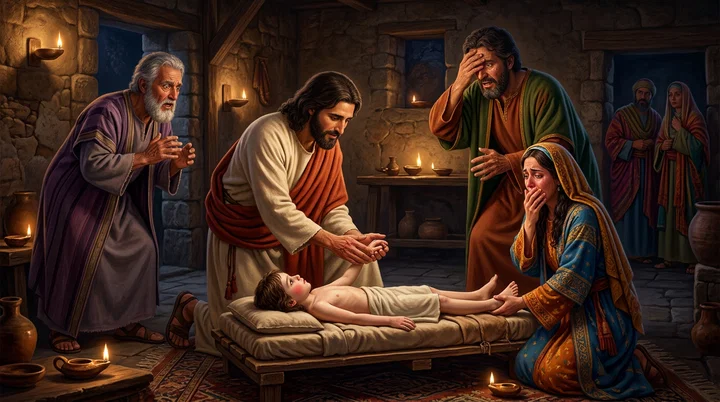
And they laughed him to scorn. But when he had put them all out, he taketh the father and the mother of the damsel, and them that were with him, and entereth in where the damsel was lying.
Translations
And they laughed him to scorn. But when he had put them all out, he takes the father and the mother of the damsel, and them that were with him, and enters in where the damsel was lying.
King James Version, KJV Cambridge Paragraph Bible
And they laughed him to scorn. But when he had put them all out, he taketh the father and the mother of the damsel, and them that were with him, and entereth in where the damsel was lying.
And they derided him: but when he had put them all out, he taketh the father and the mother of the damsel, and them that were with him, and entereth in where the damsel was lying.
Revised Version, American Standard Version
And they laughed him to scorn. But he, having put them all forth, taketh the father of the child and her mother and them that were with him, and goeth in where the child was.
and they were laughing at him. And he, having put all forth, doth take the father of the child, and the mother, and those with him, and goeth in where the child is lying,
And they derided him. But he, having put [ them] all out, takes with [ him] the father of the child, and the mother, and those that were with him, and enters in where the child was lying.
and they were deriding him. But, he, thrusting all forth, taketh with him the father of the child, and the mother, and them who were with him,—and entereth where the child was;
And they laughed at Him.After He had put them all outside, He took the child’s father and mother and His own companions, and went in to see the child.
And they laughed at Him. After He had put them all outside, He took the child’s father and mother and His own companions, and went in where the child was lying.
They ridiculed him. But he, having put them all out, took the father of the child, her mother, and those who were with him, and went in where the child was lying.
And they were laughing at him. But he, having sent them all out, took the father of the child and her mother and those who were with him, and went in where the child was.
And they laught him to scorne: but hee put them all out, and tooke the father, and the mother of the childe, and them that were with him, and entred in where the childe lay,
Douay-Rheims (Challoner revision)
And they laughed him to scorn. But he having put them all out, taketh the father and the mother of the damsel, and them that were with him, and entereth in where the damsel was lying.
Pictures
Cross-references
- Matthew 9:23-25
And when Jesus came into the ruler’s house, and saw the minstrels and the people making a noise,
Jesus puts the crowd outside and raises the ruler’s daughter.
- Luke 8:51-56
And when he came into the house, he suffered no man to go in, save Peter, and James, and John, and the father and the mother of the maiden.
Jesus enters with the girl’s parents and chosen disciples before raising her.
- Luke 7:14-15
And he came and touched the bier: and they that bare him stood still. And he said, Young man, I say unto thee, Arise.
Jesus raises the widow’s son, another example of his power over death.
- John 11:43-44
And when he thus had spoken, he cried with a loud voice, Lazarus, come forth.
Jesus raises Lazarus from the dead, another person he restored to life.
- Luke 8:49-50
While he yet spake, there cometh one from the ruler of the synagogue’s house, saying to him, Thy daughter is dead; trouble not the Master.
Jesus hears the girl is dead and tells Jairus to believe.
- Acts 9:40
But Peter put them all forth, and kneeled down, and prayed; and turning him to the body said, Tabitha, arise. And she opened her eyes: and when she saw Peter, she sat up.
Peter followed Jesus' example in putting all out
- Mark 5:36
As soon as Jesus heard the word that was spoken, he saith unto the ruler of the synagogue, Be not afraid, only believe.
Jesus tells the girl’s father not to fear but to believe.
- John 5:25
Verily, verily, I say unto you, The hour is coming, and now is, when the dead shall hear the voice of the Son of God: and they that hear shall live.
The daughter’s raising illustrates the Son giving life to the dead.
- Luke 8:52-55
And all wept, and bewailed her: but he said, Weep not; she is not dead, but sleepeth.
Parallel account of the mourners and the girl’s return to life.
- Mark 5:22-24
And, behold, there cometh one of the rulers of the synagogue, Jairus by name; and when he saw him, he fell at his feet,
Jairus pleads with Jesus to save his daughter.
- Mark 5:35
While he yet spake, there came from the ruler of the synagogue’s house certain which said, Thy daughter is dead: why troublest thou the Master any further?
The report of the girl’s death made further appeal seem useless.
- 2 Kings 4:32-35
And when Elisha was come into the house, behold, the child was dead, and laid upon his bed.
The Shunammite woman’s son is cited as another person raised from the dead.
- Mark 5:25-34
And a certain woman, which had an issue of blood twelve years,
The woman is healed while Jesus is on the way to Jairus’s daughter.
- 1 Kings 17:22
And the LORD heard the voice of Elijah; and the soul of the child came into him again, and he revived.
another raising before Christ like Jairus daughter
- Mark 5:1-20
And they came over unto the other side of the sea, into the country of the Gadarenes.
Mark’s account of the healing at Gadara mentions one demoniac.
- John 11:25
Jesus said unto her, I am the resurrection, and the life: he that believeth in me, though he were dead, yet shall he live:
Both show Christ’s life-giving power over death.
- John 11:14
Then said Jesus unto them plainly, Lazarus is dead.
Jesus plainly says Lazarus is dead after speaking of sleep.
Commentary
Each commentary is drawn from primary sources: the writings of Ellen G. White and Adventist pioneers and periodicals. Each commentary is separate. Its own words are not a quotation; follow the references to read the source passages.
Ellen G. White
14 sources
Jesus went to the home of Jairus, a ruler of the synagogue whose little daughter lay dying after physicians had given her up, slowing His steps through the pressing crowd to minister on the way while the anxious father feared delay.ST Jul 28, 18813SP 226.1–2
When He said she was sleeping and not dead, the mourners who had seen her die laughed Him to scorn in indignation, so He put the grieving unbelievers out and entered where she lay with only her father and mother and Peter, James, and John.DA 341DA 342.1–343.2ST Jul 28, 1881
There He restored her to life at her bedside, yet to mortal life still subject to death and decay like the son of the widow of Nain and Lazarus.DA 342.1–343.2ST Jul 28, 1881ST May 31, 1877ST Feb 3, 1914Ms 115, 1897, par. 17–20
This stands apart from those raised at His own resurrection to everlasting life to ascend with Him as trophies of victory over death, nevermore to see death or sorrow.ST Feb 3, 1914
His clearing of the room teaches that prayer for the sick should be apart from unbelievers in a private place, and His care for her need for food afterward shows thoughtful attention to even the smallest bodily necessities.COL 357.2–358.1Ms 14, 1850, par. 4–615MR 41.2–3
Setting and Miracle Action
This moment belongs to the healing of Jairus' daughter after the return from healing the demoniacs at Gadara.ST Jul 28, 1881 Jairus, a ruler of the synagogue, fell at Jesus' feet and begged Him to come and lay hands on his little daughter who lay at the point of death after the most learned physicians had given her up to die.ST Jul 28, 1881 Jesus went with him toward his home, His progress slowed by the pressing crowd while He stopped to minister to their spiritual darkness and physical maladies as the anxious father feared being too late.ST Jul 28, 1881 It belongs to the account of raising the dead at Capernaum, one of His remarkable works that the disciples remembered when they returned to Galilee.3SP 226.1–2
The mourners in the house laughed Him to scorn when He said the girl was sleeping and not dead.DA 341DA 342.1–343.2ST Jul 28, 1881ST May 31, 18772SP 323.1–324.1 They did so because they had seen her die.2SP 323.1–324.1 They were indignant when He told them to stop lamenting.2SP 323.1–324.1
Jesus cleared the house by putting them all out, ordering the grieving, laughing, unbelieving mourners to leave.DA 341DA 342.1–343.2ST Jul 28, 1881ST May 31, 18772SP 323.1–324.1 He then entered in where the damsel was lying with only her father and mother and them that were with Him.DA 341DA 342.1–343.2ST Jul 28, 1881ST May 31, 18772SP 323.1–324.1 That small company was her parents and a few faithful disciples, specifically Peter, James, and John.DA 342.1–343.2ST May 31, 18772SP 323.1–324.13RED 97.3–99.1 By thus limiting who witnessed the event to that small group, He approached her bedside and restored her to life, setting the scene for raising Jairus' daughter from the dead.DA 342.1–343.2ST Jul 28, 1881ST May 31, 18773RED 97.3–99.1ST Oct 6, 1887
Mortal Return Not Immortality
The raising in this verse belongs to the ministry work of raising the ruler's daughter, Jairus' daughter, back to life.ST Feb 3, 1914Ms 115, 1897, par. 17–20 Her return was a return to mortal life, not a clothing with immortality.ST Feb 3, 1914Ms 115, 1897, par. 17–20 After being raised she was still subject to death and decay, like the son of the widow of Nain and Lazarus.ST Feb 3, 1914Ms 115, 1897, par. 17–20 This stands in contrast to those who came forth from the grave at Christ's own resurrection, who were raised to everlasting life to ascend with Him as trophies of His victory over death, redeemed from Satan's captivity to be where He is, nevermore to see death or experience sorrow.ST Feb 3, 1914
Lessons for Prayer and Care
Jesus putting the unbelieving crowd out before entering the room where the girl lay, with her parents and those accompanying Him, is the pattern for prayer for the sick, that the elders should pray apart from unbelievers, in a private room.Ms 14, 1850, par. 4–6 Even while the great work of redemption weighed constantly on His soul and taxed body and soul to the utmost in teaching and healing, He noticed the most simple things in human life, heard every needy cry, and did not overlook the needs of the humblest.15MR 41.2–3 His divine nature combined with the human was so finely wrought that the least touch of faith brought a response, and this teaches order and economy and attention to little things for nurses and physicians to follow.15MR 41.2–3 After putting the laughing mourners out and entering the room with Jairus and the girl's mother and the disciples who were with Him, His attention to the girl's ordinary need for food after raising her from the dead, reminding her parents she must have something to eat, shows careful, thoughtful concern for bodily life and even small, practical necessities.COL 357.2–358.115MR 41.2–3
Sources
Pioneers and periodicals
42 sources
When Jesus said the girl was sleeping the mourners laughed Him to scorn for unbelief, and He put them all out and went in where she lay with her father and mother and Peter, James and John, and took her by the hand and restored her to life by His word.ST Jul 28, 1881ST Feb 6, 1896ST May 31, 1899ST Apr 4, 1900ST He stands there as the Conqueror of death, showing calm authority and compassion and proving that death is under His command and waits only for His call.RH Oct 30, 1860ST May 31, 1877ST Apr 20, 1904ST Jan 26, 1915RH Apr 2, 1861 Her death was but a brief sleep, with no conscious experience to report, and her return was to mortal earthly life still subject to death, not to immortality.ST Feb 3, 1914ST Apr 4, 1900STST Nov 4, 1880RH Feb 25, 1873 She had been raised before His own resurrection on the strength of His promised death and rising, which does not set aside His pre-eminence as the firstborn and firstfruits from the dead through whom all are raised.ST Dec 21, 1882ST Dec 30, 1903RH Feb 25, 1873 Though she was beyond all human help, Jairus received her back by believing Christ's word not to fear but to believe, showing that no soul seemingly beyond reach is beyond God to awaken.RH Apr 8, 1873ST Apr 20, 1904RH Aug 12, 1902ST Jan 19, 1915ST Jan 19, 1915
Setting and Background
The scene belongs to the healing of Jairus' daughter after the return from across the sea where the demoniacs at Gadara had been healed.ST Jul 28, 1881 Jairus, a ruler of the synagogue, fell at Jesus' feet and begged Him to come and lay His hands on his little daughter, who lay at the point of death after the most learned physicians had given her up to die.ST Jul 28, 1881 Jesus went with him toward his home, His progress slowed by the pressing crowd while He stopped to minister to their spiritual darkness and physical maladies, as the anxious father feared being too late.ST Jul 28, 1881 The account took place at Capernaum, probably near the close of the second year of ministry.ST Feb 6, 1896
Jesus went with Jairus to restore his dying daughter, and on the way a woman reached out and touched His garment in faith.ST Apr 20, 1904 The giving of life to the daughter in Capernaum came immediately after the healing of that woman.ST Apr 20, 1904 Around the house was loud mourning and wailing, reflecting Jewish funeral custom in which professional mourners joined the grief of the family and early burial was usual.ST Apr 4, 1900ST Mar 27, 1907 The wailing of the mourners and the sorrow of the household formed the background from which the crowd was sent out before entering the room.ST Apr 4, 1900ST Mar 27, 1907
The raising of Jairus' daughter comes before Jesus gives power to the twelve disciples and sends them out.ST Jun 7, 1899
Clearing the Room
When He said the child was not dead but sleeping, the mourners laughed Him to scorn, and He at once put them all out.ST Jul 28, 1881ST Oct 6, 1887ST May 31, 1899ST Apr 4, 1900 He ordered the grieving, noisy crowd outside and allowed only a small group to remain with Him before He approached her bedside to restore her to life.ST Jul 28, 1881ST Oct 6, 1887ST May 31, 1899 Their scorn was unbelief, a rejection of His words because they did not perceive His divine power.ST May 31, 1877ST Nov 8, 1899
They laughed because they believed the girl was beyond help.ST Jan 19, 1915 Their scorn did not change His response, for He kindly told her parents not to fear but to believe and said that she was sleeping.ST Jan 19, 1915
After removing the noisy, scornful crowd, He entered in where the damsel was lying with the father and the mother of the child and the disciples and companions who were with Him.ST Oct 6, 1887ST Apr 4, 1900ST May 31, 1877ST Apr 4, 1900ST Nov 8, 1899 He sent the others out and went in with her parents and the disciples He had chosen.ST Apr 4, 1900ST May 31, 1877ST Those He took in were Jairus, the child's mother, and His three disciples Peter, James, and John.ST May 31, 1877ST Feb 6, 1896STST Apr 20, 1904ST Apr 20, 1904 By doing so He limited who witnessed the raising.ST May 31, 1877
There He took the girl by the hand and raised her to life.ST May 31, 1899ST Apr 20, 1904ST Nov 8, 1899 After she had died He touched her hand and life returned, she looked at Christ and smiled, and her father blessed the Saviour who restored his child.RH Dec 15, 1859 He restored the girl to life by His word.RH Apr 8, 1873
Christ's Character and Power
Jesus acts with calm authority and care, putting out those who laugh at him and entering with the child's parents and his own companions, joining power with compassion and respect for the family.RH Oct 30, 1860 That restoring of the heartbroken ruler's child shows patient care for people in humble, particular circumstances.RH Apr 2, 1861
Though the girl is dead, he is present as the Conqueror of death, sending the crowd away and entering the room with her parents and Peter, James, and John to take her hand and bid her arise.ST Apr 20, 1904 The scorn came because his divine power was not perceived, yet death is under his command and those who die await his call to rise.ST May 31, 1877 The raising of the little maid, with the scornful onlookers put out, shows his power over death.ST Jan 26, 1915
The raising is a direct manifestation of divine power, unlike healing accomplished through natural means.ST Mar 31, 1898 The restoration comes through God's presence and the operation of the Spirit, the life-giving power that brings new life. It is a miracle wrought by the Spirit of God through Jesus of Nazareth, the same Spirit that wrought through his apostles and chosen servants, so it is not to be set above or apart from the raising of Tabitha.ST Feb 21, 1906 It is one of three instances in which he raised the dead, belonging openly to his ministry and not to a secret movement.ST May 8, 1907
After the message that she had died he urges the ruler not to fear but to believe, and her restoration shows that faith brings a person into fellowship with the power of endless life, which conquers death.RH Aug 12, 1902 His coming to the house to enter where the little daughter lay and give her life proves that his coming never means death but life, so death is not his coming and is not the second coming.ST May 10, 1910 The daughter of Jairus, whom he raised from the dead, is among the women on whom the Lord bestowed special favor.
Death as Sleep
Her death was only a brief sleep in God's purpose, because Jesus was about to restore her life.ST Apr 4, 1900 Her condition is described as sleep, with no account of thoughts or experiences during death, showing that the dead are unconscious until raised.ST If the dead went consciously to Paradise she would have returned with knowledge of what she experienced there, yet she made no revelation of it, supporting that the dead know nothing.ST Nov 4, 1880
The event is counted among resuscitations witnessed by many people and is relevant to understanding the condition of people after death.ST Oct 7, 1913 It is a literal raising in which the dead hear the Son of God's voice and live.ST Oct 7, 1913RH Oct 19, 1869 That raising was a return to mortal, natural earthly life before Christ's own death and rising, not a clothing with immortality.ST Feb 3, 1914RH Feb 25, 1873 After being raised she was still subject to death, like the widow's son by the prophet, the son of the widow of Nain, and Lazarus.ST Feb 3, 1914RH Feb 25, 1873
It stands in contrast to those who came forth from the grave at Christ's own resurrection, who were raised to everlasting life to ascend with Him as trophies of His victory over death.ST Feb 3, 1914 They were redeemed from Satan's captivity to be where He is, nevermore to see death or experience sorrow.ST Feb 3, 1914 The raising was an exception to the general rule that the dead rise through Christ's power at the resurrection.ST Jan 28, 1889
Resurrection and Firstfruits
The raising of the ruler's daughter took place before Jesus' own resurrection, and it stands as one of several earlier resurrections showing that His being first to rise does not mean no one had been raised before Him.ST Dec 21, 1882 Those earlier raisings rested on the promise that Christ would die and rise.ST Dec 21, 1882 His resurrection was the pledge of future life for believers.ST Dec 21, 1882
Her being called back to life does not contradict Christ being the firstborn or firstfruits from the dead.ST Dec 30, 1903 Those terms can denote pre-eminence rather than priority in time.ST Dec 30, 1903 Christ is the one through whom the dead are raised.ST Dec 30, 1903
Christ was not the first to rise if resurrection means return to this present life, since this girl, the widow's son restored by the prophet, the widow of Nain's son, Lazarus and others were all restored before Him.RH Feb 25, 1873 His being the first begotten of the dead, the firstfruits of them that slept, and the first that should rise means His arising out from among the dead ones already in the spirit world.RH Feb 25, 1873
Those who denied the miraculous held that the maid was not truly dead but in a trance with her spirit not entirely out of her body.RH Sep 8, 1853RH Feb 24, 1859 They held that Jesus in His superior condition saw this and restored the action of her system by His magnetic power, the same as with Lazarus.RH Sep 8, 1853RH Feb 24, 1859 That use of the account is a denial of the miraculous nature of the event.RH Sep 8, 1853
His declaration that the maid was sleeping rather than dead has been seized upon to deny that she had died and to deny that any resurrection took place.ST Nov 29, 1910 The raising belongs among His works of power alongside the healing of Martha's sister, the cleansing of Simon the leper at Bethany so that his flesh became like a child's, and the raising of the youth at Nain.ST Nov 29, 1910 It is set against the death of Lazarus to call for faith that whatever Jesus asks of God will still be given.ST Nov 29, 1910
Faith Prayer and Application
After the message came that the ruler's daughter had died, Jesus urged him not to fear but only to believe, and her restoration to life showed that faith brings fellowship with the power of endless life which conquers death.RH Aug 12, 1902 The mourners laughed because they believed the girl was beyond help, but their scorn did not change His response, for He kindly told her parents not to fear but to believe and said that she was sleeping.ST Jan 19, 1915 He put out the people who scorned Him and entered where she lay with Jairus and the child's mother and His own companions, and then restored her to life by His word.RH Apr 8, 1873ST Apr 20, 1904 Jairus received his daughter back by believing that assurance not to fear but to believe, and his faith that Jesus could restore his dead daughter was not disappointed.RH Apr 8, 1873ST Apr 20, 1904 Her return to life became a quiet but powerful testimony to His work.ST Apr 20, 1904
She was beyond human help, yet Jesus could awaken her.ST Jan 19, 1915 This shows that a person who is spiritually indifferent or seemingly beyond help can still be reached by God, so those praying for such a one should not fear but believe.ST Jan 19, 1915 Jairus urgently seeking Christ's intervention for his dying daughter is an example of prayer with a definite, deeply felt request.RH Oct 23, 1860
Jesus putting everyone out before raising her set the example Peter followed when raising Dorcas.ST Mar 18, 1897 Putting them out means seeking an uninterrupted season of prayer to concentrate the mind upon the will of the Lord.ST Mar 18, 1897 Being alone with the dead is fitting for the solemnity of the occasion.ST Mar 18, 1897
Sources