Mark 5:38
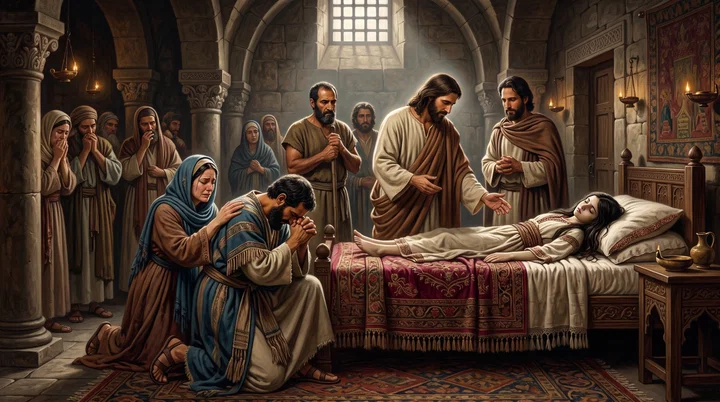
And he cometh to the house of the ruler of the synagogue, and seeth the tumult, and them that wept and wailed greatly.
Translations
And he comes to the house of the ruler of the synagogue, and sees the tumult, and them that wept and wailed greatly.
King James Version, KJV Cambridge Paragraph Bible, Webster Bible
And he cometh to the house of the ruler of the synagogue, and seeth the tumult, and them that wept and wailed greatly.
Revised Version, American Standard Version
And they come to the house of the ruler of the synagogue; and he beholdeth a tumult, and many weeping and wailing greatly.
and he cometh to the house of the chief of the synagogue, and seeth a tumult, much weeping and wailing;
And he comes to the house of the ruler of the synagogue, and sees the tumult, and people weeping and wailing greatly.
And they come into the house of the synagogue-ruler, and he observeth a tumult, and persons weeping and wailing greatly;
When they arrived at the house of the synagogue leader, Jesus saw the commotion and the people weeping and wailing loudly.
When He arrived at the house of the synagogue leader, Jesus saw the commotion and the people weeping and wailing loudly.
He came to the synagogue ruler’s house, and he saw an uproar, weeping, and great wailing.
And they came to the house of the ruler of the Synagogue; and he saw people running this way and that, and weeping and crying loudly.
So hee came vnto the house of the ruler of the Synagogue, and sawe the tumult, and them that wept and wailed greatly.
Douay-Rheims (Challoner revision)
And they come to the house of the ruler of the synagogue; and he seeth a tumult, and people weeping and wailing much.
Pictures
Cross-references
- Matthew 9:23-25
And when Jesus came into the ruler’s house, and saw the minstrels and the people making a noise,
Jesus encounters mourners at the ruler’s house and raises his daughter.
- Luke 8:52-55
And all wept, and bewailed her: but he said, Weep not; she is not dead, but sleepeth.
Both accounts describe the mourners and Jesus restoring Jairus’s daughter to life.
- Luke 8:40-50
And it came to pass, that, when Jesus was returned, the people gladly received him: for they were all waiting for him.
Jairus pleads for his dying daughter; Jesus encourages him after news of her death.
- Mark 5:25-34
And a certain woman, which had an issue of blood twelve years,
The woman’s healing immediately precedes Jesus’s visit to Jairus’s house.
- Acts 9:39
Then Peter arose and went with them. When he was come, they brought him into the upper chamber: and all the widows stood by him weeping, and shewing the coats and garments which Dorcas made, while she was with them.
The widows’ weeping recalls the mourning at Jairus’s daughter’s house.
- Luke 7:14-15
And he came and touched the bier: and they that bare him stood still. And he said, Young man, I say unto thee, Arise.
Christ raises the widow’s son, another literal instance of his raising the dead.
- Mark 5:22-23
And, behold, there cometh one of the rulers of the synagogue, Jairus by name; and when he saw him, he fell at his feet,
Jairus urgently asks Christ to help his dying daughter.
- John 11:1-44
Now a certain man was sick, named Lazarus, of Bethany, the town of Mary and her sister Martha.
Both recount Jesus raising a person from the dead.
- 1 Kings 17:17-24
And it came to pass after these things, that the son of the woman, the mistress of the house, fell sick; and his sickness was so sore, that there was no breath left in him.
Elijah raises the widow’s son, foreshadowing Christ’s raising of the ruler’s daughter.
- 2 Kings 4:18-37
And when the child was grown, it fell on a day, that he went out to his father to the reapers.
The Shunammite woman’s son is named as another person raised from the dead.
Commentary
Each commentary is drawn from primary sources: the writings of Ellen G. White and Adventist pioneers and periodicals. Each commentary is separate. Its own words are not a quotation; follow the references to read the source passages.
Ellen G. White
12 sources
This verse belongs to the account of Jesus going with Jairus to heal his dying daughter.ST Jul 28, 1881 He responded at once to the distressed father, though the crowd slowed the journey as He stopped to help people along the way.ST Jul 28, 1881 He then hurried with Jairus to the house after the messenger reported the daughter dead.ST May 31, 1877
The house was in Capernaum, one of the places where He performed remarkable works.6RED 64.2 The raising of the dead there was one of His most wonderful manifestations of power.3SP 226.1–2
The tumult on arrival was a loud, customary outward display of grief over the girl's death by hired mourners.ST May 31, 18772SP 323.1–324.13RED 97.3–99.1 It included flute-players and women employed according to local custom to weep and wail.DA 342.1–343.2ST May 31, 18772SP 323.1–324.13RED 97.3–99.1ST Oct 6, 1887 The house was filled with commotion and people weeping and wailing over the daughter, making a great show of external sorrow.ST Jul 28, 1881ST May 31, 18772SP 323.1–324.1
Jesus rebuked the mourners and commanded them to weep not and stop lamenting, because she was not dead but sleeping.ST Jul 28, 1881ST May 31, 18772SP 323.1–324.13RED 97.3–99.1ST Oct 6, 1887 They were indignant and laughed His words to scorn because they had seen that she was lifeless and dead.ST Jul 28, 1881ST May 31, 18772SP 323.1–324.13RED 97.3–99.1ST Oct 6, 1887 They had seen death change the living child to a pulseless and unconscious form.ST May 31, 1877 They questioned by what authority a humble stranger ordered them to stop lamenting and asserted she still lived.ST May 31, 1877 At His command they left the room, so that only the father and mother with Peter, James and John remained with Jesus where the child lay dead, and He sent them out before restoring her to life.ST May 31, 18772SP 323.1–324.1
In raising her He attended not only to her restoration to life but also to her ordinary need for food, making careful attention to small needs an example of faithful service.COL 357.2–358.1 Her raising restored mortal life only and was temporary.ST Feb 3, 1914Ms 115, 1897, par. 17–20 She was not clothed with immortality but remained subject to death and decay, just like the widow of Nain's son and Lazarus.ST Feb 3, 1914Ms 115, 1897, par. 17–20 This is different from those who came forth at Christ's own resurrection, who were raised to everlasting life to be with Him where He is, nevermore to see death or experience sorrow.ST Feb 3, 1914
Sources
Pioneers and periodicals
38 sources
He comes to the house of Jairus, the ruler of the synagogue at Capernaum, whose only daughter lies dead after he pleaded for Jesus to come and heal her, and he finds mourning already begun with funeral preparations underway.ST Jul 28, 1881ST May 31, 1877ST Nov 8, 1899ST Apr 20, 1904ST Apr 4, 1900 The tumult is the noisy commotion of an Eastern funeral, with hired professional mourners weeping and wailing greatly to make an outward display of sorrow, accompanied by flutes, wild lamentation, beating of the breast and rending of garments.ST May 31, 1899ST Apr 4, 1900STST Jan 19, 1915ST Mar 27, 1907 Jesus rebukes them and bids them weep not, declaring the girl sleeps and not dead, but they laugh him to scorn because they have seen her lifeless form, and at his command they leave while only her parents with Peter, James and John remain.ST Jul 28, 1881ST May 31, 1877ST Oct 6, 1887 He takes her by the hand and restores her to mortal life by his word, which comforts the bereaved father, rewards his believing appeal, and shows Christ's public power over death before many witnesses.RH Dec 15, 1859ST Apr 20, 1904RH Apr 8, 1873ST Apr 20, 1904ST May 8, 1907 That raising was to natural life only and not to immortality, an exception in which the dead heard his voice and lived without reporting any conscious intermediate state, pledging that he who is the first-fruits will raise believers to everlasting life.ST Feb 3, 1914RH Oct 19, 1869ST Nov 4, 1880ST Dec 21, 1882ST Jan 26, 1915
Narrative Setting and Context
The scene belongs to the account of Jairus, the ruler of the synagogue at Capernaum, whose only daughter lay near death.ST Nov 8, 1899ST Apr 20, 1904 He humbled himself and pleaded with Jesus to come, believing she could be healed and live.ST Nov 8, 1899 Jesus had just returned from Gadara to the western shore of Galilee when the request was made, and He went with Jairus at once to restore her.ST Jul 28, 1881ST Nov 8, 1899ST Apr 20, 1904
The way was slowed by the crowding multitude as Jesus stopped to help people along the journey.ST Jul 28, 1881 That delay included the healing of the woman who touched His garment, which took place immediately before the visit to the house. The house itself was in Capernaum, probably near the close of the second year of ministry.ST Feb 6, 1896
After the messenger reported the daughter dead, Jesus hurried with Jairus and His disciples to the house.ST May 31, 1877ST Apr 4, 1900 On arrival mourning was already taking place there.ST Apr 4, 1900 Funeral preparations had already begun, because early burial was usual among the Jews.ST Apr 4, 1900
The verse is part of Mark's graphic account of Jesus raising Jairus's daughter from the dead. It gives the scene before He restored her, as He came to the house and saw the mourners weeping and wailing over the girl.ST Feb 6, 1896ST Jun 7, 1899 It is mentioned as the event that precedes Jesus giving the twelve power and sending them out.ST Jun 7, 1899
Tumult and Mourning Customs
When he comes to the house he finds a noisy crowd in great commotion, the terrible clamor always present at Eastern funerals.ST May 31, 1899ST Apr 4, 1900ST Jan 19, 1915 Funeral preparations have already begun, for early burial is usual.ST Apr 4, 1900 Those weeping and wailing greatly are hired professional mourners customarily in attendance at funerals.ST May 31, 1899ST Apr 4, 1900ST Nov 22, 1910 They are women employed according to the custom of the country to make an outward display of sorrow.ST Jul 28, 1881ST May 31, 1877ST Oct 6, 1887 They are called minstrels, and their number is in proportion to the wealth of the afflicted family.ST May 31, 1899
Their lamentation is accompanied by wind instruments and solemn flute music.ST May 31, 1899ST They keep up continual discord on the instruments with wild howls of lamentation.ST May 31, 1899 They vie with each other in mournful, dolorous ejaculations.ST Apr 4, 1900 The display includes wailing, beating the breast, rending the outer garments, and tearing out the hair.ST Apr 4, 1900 The broader mourning customs recalled by the scene include discordant music, women's wailing, sackcloth clothing and head coverings, neglect of washing and grooming, and food for the bereaved supplied by friends.ST Mar 27, 1907
Rebuke and Raising to Life
On entering the house Jesus rebuked the mourners and commanded them to weep no more, declaring that the girl was not dead but sleeping.ST Jul 28, 1881ST May 31, 1877ST Oct 6, 1887 The tumult he confronted was a customary outward display of grief made by women employed for the purpose, weeping and wailing greatly around the dead child.ST Jul 28, 1881ST May 31, 1877ST Oct 6, 1887
They scorned his words because they had seen that she was lifeless.ST Jul 28, 1881ST May 31, 1877ST Oct 6, 1887 They were indignant because they had watched death change the living child into a pulseless and unconscious form, and they questioned by what authority a humble stranger ordered them to stop lamenting and asserted that she still lived, laughing his words to scorn.ST Jul 28, 1881ST May 31, 1877 At his command they left the room, while only the father and mother with Peter, James and John remained with Jesus where the child lay dead.ST May 31, 1877
The grief and apparent finality surrounding the scene established the setting for the miracle, with cries and solemn flute music marking the sorrow over a death believed certain.ST Apr 20, 1904STST Nov 22, 1910 Jesus then proceeded to the bedside, took the girl by the hand, and restored her to life by his word.RH Dec 15, 1859STRH Apr 8, 1873 That restoration comforted the bereaved father and showed Christ's power over death in the presence of many onlookers.RH Dec 15, 1859ST Nov 22, 1910ST Oct 7, 1913
That raising restored mortal life only, for the ruler's daughter was not clothed with immortality and remained subject to death, just like the widow of Nain's son and Lazarus.ST Feb 3, 1914 This is different from those who came forth from the grave at Christ's own resurrection, who were raised to everlasting life to be with him where he is, nevermore to see death or experience sorrow.ST Feb 3, 1914
Death and Resurrection Doctrine
The ruler's daughter belongs among those restored to natural life before Christ's own resurrection, while Christ remains chief and first-fruits, whose resurrection brings light and immortality and pledges future life to believers.ST Dec 21, 1882 Her raising shows that Christ was not the first person brought back to natural life, a restoration to this life that is distinct from being first to rise out from among the dead in the spirit world.ST Dec 21, 1882RH Feb 25, 1873
Her resurrection is an instance of the dead hearing Christ's voice and living.RH Oct 19, 1869 It is an exception to the general rule that the dead await the resurrection, because Jesus raised her before the general resurrection.ST Jan 28, 1889 The act demonstrates that Jesus has power over death and supports the promise that He will raise the dead to everlasting life.ST Jan 26, 1915
Those Jesus raised, including the ruler's daughter, came back from death without reporting experiences in an intermediate spirit realm, consistent with the dead knowing nothing until life is restored.ST Nov 4, 1880
Her restoration to life is an example of God's Spirit giving life to the dead. It is a miracle worked by the Spirit of God through Jesus.ST Feb 21, 1906 It is an example of God healing and restoring life directly by divine power.ST Feb 21, 1906ST Mar 31, 1898
The scene at the house amid loud mourning is one of the three instances in which Jesus raised the dead, showing that His work was public and not secret.ST May 8, 1907 Its witnesses could have been questioned to establish what happened.ST May 8, 1907ST Jan 19, 1882
His coming to the house amid tumult and great weeping and wailing meant life and not death, for He came to give life to the little daughter.ST May 10, 1910 This proves that the coming of Jesus never means death but life, and that death is not His coming and not the second coming.ST May 10, 1910
Faith, Witness, and Application
In this setting the command to the ruler is not to fear but to believe only, and Jairus receives his daughter restored to life by the word of Jesus.RH Apr 8, 1873RH Aug 12, 1902 His faith in Christ's power is not disappointed when the girl is brought back to life amid the grief of the household.ST Apr 20, 1904 The scene shows faith bringing a person into fellowship with Christ's power over death.RH Aug 12, 1902
Her return to life becomes a public witness to Jesus, even though the family is told not to report it.ST Apr 20, 1904 Jairus's appeal is an example of a clearly defined, deeply felt request brought to Christ in prayer.RH Oct 23, 1860 Jesus restoring the heart-broken ruler's child shows Christ's care for an ordinary family in its grief as part of his faithful attention to humble, particular needs.RH Apr 2, 1861
Though the girl appeared beyond human help, Jesus awakened her when the situation seemed hopeless, and his words calling for trust meet that hopelessness.ST Jan 19, 1915 This shows that even a person who seems spiritually indifferent or unreachable can be awakened by God.ST Jan 19, 1915 She is counted as one raised from the dead alongside Lazarus, the widow of Nain's son, and the Shunammite woman's son.ST Dec 30, 1903 She is held up alongside Simon the leper and the youth of Nain as proof of Christ's healing power, of whom he said the maid is not dead but sleeps, and she is identified as one of the unnamed women on whom Jesus bestowed a signal favor.ST Nov 29, 1910
Sources