Mark 7:24
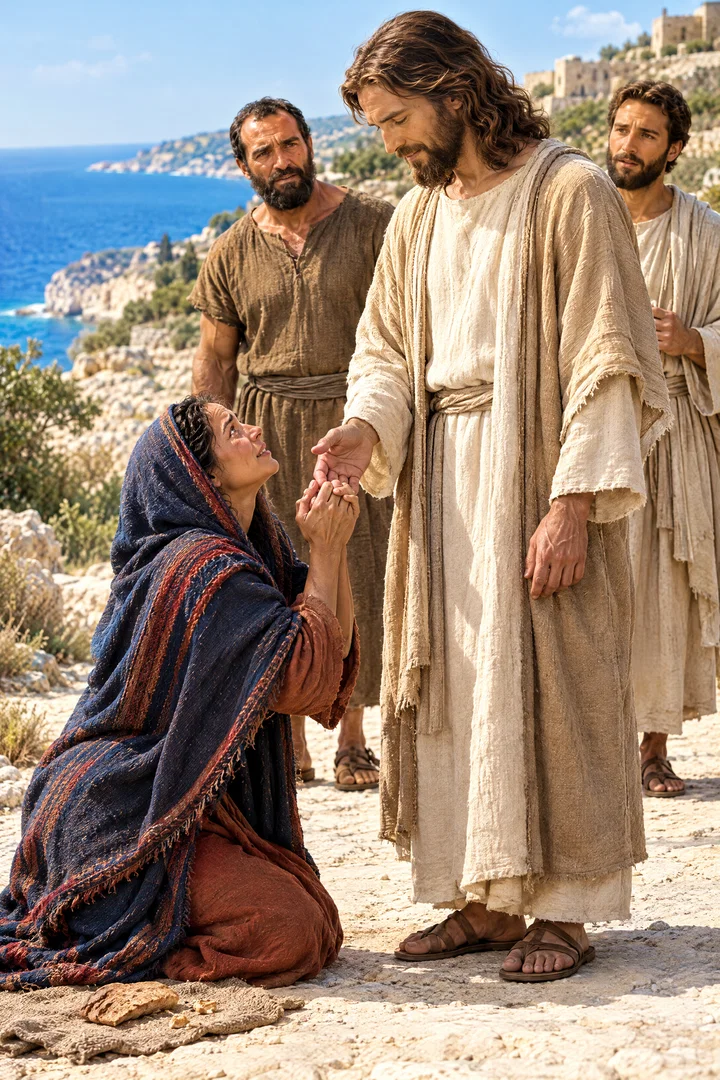
And from thence he arose, and went into the borders of Tyre and Sidon, and entered into an house, and would have no man know it: but he could not be hid.
Translations
And from there he arose, and went into the borders of Tyre and Sidon, and entered into an house, and would have no man know it: but he could not be hid.
And from thence he arose, and went into the borders of Tyre and Sidon, and entered into an house, and would have no man know it: but he could not be hid.
KJV Cambridge Paragraph Bible, Webster Bible
And from thence he arose, and went into the borders of Tyre and Sidon, and entered into a house, and would have no man know it: but he could not be hid.
And from thence he arose, and went away into the borders of Tyre and Sidon. And he entered into a house, and would have no man know it: and he could not be hid.
And from thence he arose, and went away into the borders of Tyre and Sidon. And he entered into a house, and would have no man know it; and he could not be hid.
And from thence having risen, he went away to the borders of Tyre and Sidon, and having entered into the house, he wished none to know, and he was not able to be hid,
And he rose up and went away thence into the borders of Tyre and Sidon; and having entered into a house he would not have any one know [ it], and he could not be hid.
And, from thence arising, he departed into the bounds of Tyre [and Zidon]. And, entering into a house, he was wishing, no one, to know it, and yet could not escape notice,—
Jesus left that place and went to the region of Tyre. Not wanting anyone to know He was there, He entered a house, but was unable to escape their notice.
Jesus left that place and went to the region of Tyre and Sidon. Not wanting anyone to know He was there, He entered a house, but was unable to escape their notice.
From there he arose and went away into the borders of Tyre and Sidon. He entered into a house and didn’ t want anyone to know it, but he couldn’ t escape notice.
And he went away from there to the country of Tyre and Sidon. And he went into a house, desiring that no man might have knowledge of it: and he was not able to keep it secret.
And from thence he rose, and went into the borders of Tyrus and Sidon, and entred into an house, and woulde that no man should haue knowen: but he could not be hid.
Douay-Rheims (Challoner revision)
And rising from thence he went into the coasts of Tyre and Sidon: and entering into a house, he would that no man should know it, and he could not be hid.
Pictures

Cross-references
- Matthew 15:21-28
Then Jesus went thence, and departed into the coasts of Tyre and Sidon.
Matthew gives the parallel account of Jesus’ journey and the woman’s appeal and her daughter’s healing.
- Mark 7:31-35
And again, departing from the coasts of Tyre and Sidon, he came unto the sea of Galilee, through the midst of the coasts of Decapolis.
The next healing occurs on the same journey after Jesus leaves Tyre.
- Mark 7:28-30
And she answered and said unto him, Yes, Lord: yet the dogs under the table eat of the children’s crumbs.
The Greek woman’s faith leads to her daughter’s healing.
- Matthew 15:28
Then Jesus answered and said unto her, O woman, great is thy faith: be it unto thee even as thou wilt. And her daughter was made whole from that very hour.
Jesus grants the healing after the journey to Tyre and Sidon.
- 1 Kings 17:8-16
And the word of the LORD came unto him, saying,
Elijah is sent to a widow in the region of Sidon during famine.
- Matthew 15:22
And, behold, a woman of Canaan came out of the same coasts, and cried unto him, saying, Have mercy on me, O Lord, thou Son of David; my daughter is grievously vexed with a devil.
A Canaanite woman cries to Jesus for mercy for her demon-possessed daughter.
- Acts 21:3-6
Now when we had discovered Cyprus, we left it on the left hand, and sailed into Syria, and landed at Tyre: for there the ship was to unlade her burden.
Records Paul’s visit to Tyre, where disciples lived.
- Isaiah 23:18
And her merchandise and her hire shall be holiness to the LORD: it shall not be treasured nor laid up; for her merchandise shall be for them that dwell before the LORD, to eat sufficiently, and for durable clothing.
The prophecy about Tyre connects with Jesus’ visit there.
- Matthew 5:14
Ye are the light of the world. A city that is set on an hill cannot be hid.
explains why He could not be hid
- Matthew 15:24
But he answered and said, I am not sent but unto the lost sheep of the house of Israel.
Jesus describes his mission as sent to Israel’s lost sheep.
Commentary
Each commentary is drawn from primary sources: the writings of Ellen G. White and Adventist pioneers and periodicals. Each commentary is separate. Its own words are not a quotation; follow the references to read the source passages.
Ellen G. White
25 sources
After conflict with the Pharisees, Jesus withdrew from Capernaum across Galilee to the hill country on the borders of Tyre and Sidon, entering a house seeking retirement and to be unknown.DA 399.12SP 304.13RED 79.2Lt 227, 1905, par. 9–10ST Jun 12, 1879 He left His field of labor because the scribes and Pharisees refused the salvation offered them, murmured in unbelief and bitterness, and sought His life.2SP 304.13RED 79.2DA 401.1 He could not be hid, for reports of His healing mercy had gone before Him and drew attention to Him.DA 399.2Lt 227, 1905, par. 9–101MR 305.1 The only miracle of that journey was the healing of the Gentile Syrophoenician woman's demon-afflicted daughter, who came and fell at His feet crying for help.DA 399Ms 36, 1898, par. 21–23DA 399.2 The journey was made both to relieve her and to leave His disciples an example of mercy toward a despised people, leading them from Jewish exclusiveness to a gospel work unrestricted by custom or nationality.Ms 36, 1898, par. 21–232SP 304.23RED 80.1ST Jan 6, 1888
Journey to Gentile Borders
After His encounter with the Pharisees He withdrew from Capernaum across Galilee to the hill country on the borders of Phenicia, Tyre and Sidon.DA 399.1 He hoped there to find the retirement He had failed to secure at Bethsaida and to prepare His disciples for their mission.DA 399.1 From those hills He could look down upon the ancient cities of Tyre and Sidon with their heathen temples, magnificent palaces and marts of trade, and harbors filled with shipping, and beyond them the broad Mediterranean over which messengers of the gospel would later bear its glad tidings to the centers of the world's great empire, but the time for that work was not yet.DA 399.1
He departed from His field of labor at Jerusalem and Capernaum because the scribes and Pharisees murmured and complained, manifested unbelief and bitterness, refused the salvation so freely offered them, and sought to take His life.2SP 304.13RED 79.2DA 401.1 He entered into a house and would have no man know it, seeking privacy and retirement and withdrawing to avoid notice.Lt 227, 1905, par. 9–10ST Jun 12, 1879 It was His manner sometimes to leave places where interest in His work was greatest and go privately to more obscure regions after giving instruction and warning, to prevent a dangerous outbreak among enemies and friends and thus preserve His work until the appointed time for it to end.Lt 191, 1900, par. 9
But He could not be hid, for reports of His healing work had reached that region.DA 399.2 His character, words, deeds of mercy, and power drew attention even where He sought seclusion.Lt 227, 1905, par. 9–10 As His presence then could not remain hidden, so His presence in medical missionary work likewise cannot be concealed.1MR 305.1
The healing of the afflicted woman's daughter was the only miracle He wrought on that journey, done for the purpose of relieving her.3RED 80.1DA 402.1 A Greek, Syrophoenician, Canaanitish, foreign Phoenician woman, whose daughter had an unclean spirit and was grievously afflicted by a demon, heard of Him and came and fell at His feet, crying for help and beseeching Him to cast the devil out of her daughter.DA 399Ms 36, 1898, par. 21–23DA 399.22SP 301.1
Mercy Beyond Israel
The journey into the borders of Tyre and Sidon was made to relieve the afflicted Gentile woman and at the same time to leave the disciples an example of the work they should do, an example of mercy toward one of a despised people for their benefit when He should no longer be with them.Ms 36, 1898, par. 21–232SP 304.23RED 80.1DA 402.1ST Jan 6, 1888 It was meant to lead them away from Jewish exclusiveness to be interested in working for others besides their own people and to open their minds more fully to the labor before them among the Gentiles.2SP 304.23RED 80.1DA 402.1ST Jan 6, 1888 The event prepared them to work beyond their own nation without limits imposed by custom or nationality.2SP 304.23RED 80.1ST Jan 6, 1888 When the Jews turned still more persistently from the disciples because they declared Jesus to be the Saviour of the world, and the partition wall between Jew and Gentile was broken down by the death of Christ, this lesson pointing to a gospel work unrestricted by custom or nationality brought a powerful influence to bear in directing their labors.2SP 304.23RED 80.1ST Jan 6, 1888
His entering Gentile territory outside the acknowledged people of Israel and working directly among Gentiles, as in the Syrophoenician woman's conversion, was an effort to lead beyond exclusiveness and a sign of the wider, continuing mission to them.3SP 356.2–3ST Apr 23, 1885ST Jun 12, 1879 This visit showed that Gentiles as well as Jews could receive salvation, and that people regarded as unworthy of salvation could hunger for the light of truth.3SP 356.2–3AA 19.2–20.1ST Apr 23, 1885 He had come into this region so His disciples could see the spiritual ignorance and unmet needs of people living near Judea. The encounter there gave opportunity to teach them that those blessed with knowledge of God should serve others, including people from other nations.
The woman belonged to an unfortunate and despised race not favored with the light of God's word, yet she had no national or religious pride, prejudice, or pretense to influence her.2SP 304.13RED 79.2 She yielded at once to divine influence, trusted completely that Jesus was the Redeemer with power to grant her request, and unconditionally acknowledged Him.2SP 304.13RED 79.2 Though His heart was moved by her grief and He was a pitying Saviour who knew her heart, He seemed for a time to disregard her plea and received it in a way that reflected the cold treatment Jews would have given someone of her race.2SP 302.1COL 175.2–3ST May 28, 18963RED 78.1 His apparent indifference and brief seeming rejection tested her faith, sincerity, and confidence and was meant to teach His disciples how they should respond to people in distress.2SP 302.1COL 175.2–3ST May 28, 18963RED 78.12SP 302.2
The disciples, seeing His indifference, supposed Jewish prejudice against Canaanites pleased Him, so their sympathies were not aroused and they asked Him to send her away.3RED 78.12SP 302.2 His answer that He was sent only to the lost sheep of the house of Israel sounded like Jewish prejudice but was an implied rebuke to them.3RED 78.12SP 302.2 It reminded them that He came to the world to save all who would accept Him and that all who seek Him ready to believe are the lost sheep He came to gather into His fold.3RED 78.12SP 302.2 When her persevering faith was shown, He turned to her with pity and love, commended her great faith, and granted what she asked, declaring it be unto her as she willed, and from that hour her daughter became whole and the demon troubled her no more.3RED 79.2COL 175.2–3 Christ Himself had inspired her persistence and did not fail to honor the confidence He had given her.COL 175.2–3
Her story teaches that persevering prayer is rewarded, that those who ask Christ in faith are not left to perish, and that even the weakest and most struggling soul may find hope and sufficiency in God.COL 175.2–3ST May 28, 1896 The account reveals Christ's great love for suffering humanity in answering earnest, humble supplication.Ms 7, 1873, par. 9 It rebukes selfishness and neglect of the unfortunate, the blind, the lame and afflicted, the widow and the fatherless.Ms 7, 1873, par. 9 It calls for greater missionary effort right at home in families and neighborhoods in caring for the afflicted, the suffering, and the discouraged.Ms 7, 1873, par. 9
Sources
Pioneers and periodicals
40 sources
Jesus left Galilee for a deliberate journey into the Gentile borders of Tyre and Sidon, where He entered a house wishing to remain unknown, but He could not be hid because news of His works drew seekers to Him.ST Jun 7, 1905ST Jun 28, 1899ST Jun 21, 1899ST Jun 7, 1905 He had come there expressly to meet one poor Syrophoenician Greek woman outside Israel, to relieve her anxious heart and heal her demon-possessed daughter.RH Nov 28, 1912ST Jun 7, 1905ST Nov 21, 1911 His seeming silence and rebuffs were purposeful testing to develop her humble, persevering faith and to teach His disciples mercy beyond Jewish exclusiveness.ST May 28, 1896ST Jul 4, 1900ST Jan 6, 1888ST Jun 7, 1905ST Nov 21, 1911 The visit shows salvation is not limited by national or social lines but is open to whosoever will come, with Gentiles as well as Jews valued equally and human need put above tradition and prejudice.ST Jun 15, 1904ST Jul 29, 1908ST Jul 4, 1900RH May 21, 1857ST Apr 13, 1904 As His life could not be concealed, so His presence in a person cannot be hidden but shines out, calling for real faith that persists through delay and apparent indifference until it receives the help asked for.ST May 28, 1896ST Jun 15, 1904ST Jan 16, 1893RH Dec 3, 1867
Setting and Background
Jesus left Galilee after nights and days crowded with praying, teaching, healing and many mighty works, calling his disciples to go with him on a deliberate journey of forty to sixty miles toward the old cities of Tyre and Sidon with a definite object in mind, a long withdrawal into hiding that perplexed them and left them wondering why he had come.ST Jun 7, 1905 The withdrawal belongs to Phenicia around A.D. 30.ST Jun 28, 1899 It was a northward and westward journey toward the seacoast into the borders of Tyre and Sidon, a Gentile region densely settled with Jews drawn there by commerce and long half heathen and half Jewish.ST Jul 4, 1900ST Jun 21, 1899 Faith there could cross the barrier between Jews and Gentiles, for God rejects caste and values all people equally, offering salvation to everyone without distinction of age, rank, nationality or religious privilege.ST Jul 4, 1900
There he entered a house and wished to remain unknown and to have no man know it, seeking privacy and intending to stay hidden for an unknown time.ST Jun 21, 1899ST Jul 29, 1908RH Aug 28, 1860ST Jun 7, 1905 He had come expressly to meet the Syrophoenician woman yet purposely kept himself hidden from her at first.ST Nov 21, 1911 But he could not be hid.ST Jun 21, 1899ST Jul 29, 1908RH Aug 28, 1860ST Jun 7, 1905 News of him and his works drew people to seek him, and the fullness of God's love in him reached a grieving mother who sought help for her afflicted daughter.ST Jun 21, 1899ST Jun 7, 1905ST Jun 28, 1899 His character and influence for good could not be concealed even in a remote place, but exerted a powerful influence, while the excitement surrounding him increased his enemies' hatred and the people received spiritual teaching and healing as a foretaste of God's restored kingdom.ST Jun 28, 1899ST Jan 16, 1893
The miracle that made him known forced him to leave sooner than he had purposed.ST Sep 22, 1881 Instead of returning at once to Capernaum he set out northeastward through Sidonian territory toward the country east of Jordan, making a wide circuit without passing through Galilee to reach his old haunts, which brought him to the territory of Decapolis.ST Sep 22, 1881 The verse stands after Jesus rebuked the Pharisees for hypocrisy, when deputies from Jerusalem came directly to him after reports that the people were ready to accept him as king and that he resolutely refused a political movement, with rumors of his independence as a religious reformer.ST Sep 8, 1881 They complained that his disciples had plucked and rubbed ears of barley on the Sabbath, counted as reaping and threshing, and had eaten without ceremonially washing hands, dishes, couches and tables, a strict rabbinical law built on perverting the Mosaic purifications of Leviticus on the ground that any possible impurity could pass from person or vessel to food and through food to body and soul.ST Sep 8, 1881
The verse belongs to teaching against making ceremonial rules about washing and food the basis of righteousness: the heart must be right before God, and when the heart is right conduct follows rightly.ST Aug 13, 1912 It is part of the portrayal of Jesus as a perfect King, combining power with love and humility and showing benevolence without selfish ambition.RH Oct 30, 1860 His ability to converse with the Syro-Phoenician woman in the region of Tyre and Sidon shows he could communicate beyond the Aramaic he commonly spoke, but does not establish that he spoke Phoenician.ST Mar 10, 1881
Purpose in Withdrawing
He came into Gentile territory outside Israel expressly to meet one poor Syrophoenician woman, a Greek woman not of His faith, leaving the crowds of Judea and Galilee to bring her the gospel, relieve her anxious heart, heal her demon-possessed daughter, and bring comfort and salvation to the mother.RH Nov 28, 1912ST Jun 7, 1905ST Nov 21, 1911ST Sep 9, 1886ST May 12, 1914 He journeyed the weary miles to the borders of Tyre and Sidon on purpose for this work, moved by a love greater than mother-love, hearing her plea, sympathizing with her distress, and blessing her child.ST Jun 7, 1905ST Sep 9, 1886ST Oct 1, 1896 He had come there expressly for her, yet purposely kept Himself hidden from her at first after entering the house and trying to remain unknown.ST Nov 21, 1911 His willingness to travel a long distance, even up to Sidon and the coasts of Canaan, for one suffering soul shows the eternal worth of each individual in God's sight and the value of individual care and personal contact with a single soul rather than only preaching to crowds.ST May 12, 1914ST Oct 1, 1896ST Apr 13, 1904ST Jun 8, 1904 He utterly disregarded Jewish corporate tradition and national prejudice that counted the Gentile nations as accursed, counting one poor suffering soul of more worth than those traditions, which proves He ever exalts the man above the thing, however holy the thing or how holily it is regarded.ST Apr 13, 1904 His cordial welcome to everyone who came for light or healing shows that in dealing with awakened souls nothing can take the place of personal contact.ST Jun 8, 1904
He went there not only to avoid opposition or to heal the woman's daughter, but also to show that faith can cross the barriers between Jews and Gentiles, for God rejects caste and values all people equally and salvation is offered to everyone without distinction of age, rank, nationality, or religious privilege.ST Jul 4, 1900 He came into this region so His disciples could see the spiritual ignorance and unmet needs of people living near Judea, giving Him opportunity to teach them mercy and that those blessed with knowledge of God should serve others, including people from other nations.ST Jan 6, 1888 His response to her urgent pleas tested her faith and sincerity and taught His disciples to show mercy to people in distress from a despised people.ST Jan 6, 1888 He went there to heal the afflicted Gentile woman, and the act also taught His disciples to leave Jewish exclusiveness, custom and nationality and to serve people beyond their own nation, preparing them for gospel work among the Gentiles unrestricted by custom or nationality, whose barrier Christ's death later broke down.ST Jan 6, 1888 Her conversion was an instance of His direct work among Gentiles outside Israel and a sign of the wider continuing mission to them, leading the Jews beyond their exclusiveness.ST Apr 23, 1885 His later healing of her daughter showed the compassion with which they should treat such distressed cases, unlike the cold response they could expect from the Jews.ST Jan 6, 1888
His apparent concealment, silence, and keeping Himself hidden from the woman at first was purposeful, to lead her to seek Him more earnestly and persistently.ST Nov 21, 1911ST Nov 21, 1911ST Nov 21, 1911 His withdrawing to the region of Tyre and Sidon and seeking privacy, yet being found by a mother in need, with seeming rebuffs tested a faith He knew would endure without complaint.ST Nov 21, 1911 His apparent hiding served to draw her to seek Him more persistently, and her persistent faith was richly rewarded.ST Nov 21, 1911ST Nov 21, 1911
Encounter with Woman
Mark 7:24 opens the account of a Gentile woman of the coast, a Greek, Syrophoenician, Canaanite woman from a despised people, who came crying after Jesus for mercy because her daughter was grievously vexed and possessed by a devil, hailing him as Lord and Son of David.RH Aug 28, 1860ST Jan 6, 1888RH May 21, 1857ST Nov 29, 1883ST Sep 9, 1886 He had traveled through the coasts of Tyre and Sidon on his mission to save the lost and rescue man from the ruin of the fall, eagerly watching for every opportunity to turn the sinner's mind toward heaven and ready to relieve whenever a poor afflicted mortal reached to touch him or cried after him for help.ST Nov 29, 1883 His journey to Tyre and Sidon was to relieve the anxious heart of this mother whose daughter was possessed by an evil spirit, showing his compassion for a mother in distress.ST Sep 9, 1886
Moved by a love greater than mother-love, Jesus journeyed the weary miles to the borders of Tyre and Sidon on purpose to deliver the child.ST Jun 7, 1905 He heard and sympathized and was ready to deliver even in apparent indifference, for he knew the woman's heart and his compassion remained.ST May 28, 1896ST Jun 7, 1905 After testing briefly he healed the daughter's body, snatched the child from the demon, blessed the child and comforted the mother's heart, then returned to Galilee.ST Jun 7, 1905ST Sep 9, 1886 He hears the plea of such a mother and blesses her child.ST Sep 9, 1886
His seeming indifference, silence and rebuffs tested her humble, persevering faith and sincerity.ST Jan 6, 1888ST Jun 7, 1905 He knew her faith would endure without complaint, and his apparent concealment and silence led her to seek him more earnestly, so that her persistent faith was richly rewarded.ST Nov 21, 1911 At first he answered her nothing, and his silence served to develop perseverance and earnestness in her.ST Nov 29, 1883 Though he seemed to reject her, he knew her heart and acted this way briefly to teach his disciples, for the delay was testing, not rejection.ST May 28, 1896RH Feb 26, 1861 He delayed responding in order to test her faith, and her earnest persistence prevailed.RH Dec 3, 1867
His silence also exposed the hearts of his disciples, who did not have his deep love for the suffering, grew weary of her pitiful tones and asked him to send her away.ST Nov 29, 1883 His later healing of her daughter showed the compassion with which they should treat such distressed cases.ST Jan 6, 1888
She answered his comparison about children's food and dogs with humility, ready wit and self-abasement, did not take offense, and received healing for her daughter.RH Aug 28, 1860 She humbly accepted the low position assigned to her and persisted in seeking his help.ST Jun 15, 1904 Her self-abasement shows humility that recognizes human corruption while still honoring the human worth of being made for immortality, kneeling in the dust yet looking toward heaven.RH Feb 18, 1858
Her faith and prayer, from one with few opportunities to learn about Jesus, recognized his goodness and power.RH May 21, 1857 Her belief contrasts with the Jews who rejected him.RH May 21, 1857 With her great faith she received healing for her daughter, and her humility and faith were preserved as a lasting example.RH Aug 28, 1860 The miracles support his Messiahship and the truth of his religion.RH May 21, 1857
Her conversion was an instance of his direct work among Gentiles outside Israel and a sign of the wider continuing mission to them.ST Apr 23, 1885ST Jun 12, 1879 His dealing with her taught that the ministry of God's blessings reaches outside the chosen people to all of every class and that such faith is not the heritage of Jews alone, for this Gentile mother was also one of the lost sheep pleading for the Shepherd.ST Jun 7, 1905
Salvation for All Nations
The journey to the borders of Tyre and Sidon shows that salvation is not bounded by any national or social line but stands open to whosoever will come and receive eternal life.ST Jun 15, 1904ST Jul 29, 1908 That same visit brings comfort to people of every class and nation, since Christ's work and miracles there belong to all.ST Jun 15, 1904ST Jul 29, 1908 It calls for real faith in Christ that is not turned aside by apparent indifference nor even by humiliating comparison, with the true child of God accepting in unworthiness whatever place the Master assigns.ST Jun 15, 1904
God rejects caste and values all people equally, offering salvation to everyone without distinction of age, rank, nationality, or religious privilege.ST Jul 4, 1900 His mercy is intended for Gentiles as well as Jews, and faith is able to cross the barrier between them.ST Jul 4, 1900RH May 21, 1857 Even one with few opportunities to learn of Jesus can recognize His goodness and power, and such persevering prayer encourages all to pray and hope in God's mercy, in contrast with those who having great privilege reject Him.RH May 21, 1857
People of every nationality may be counted among true Israel, for such humble, persistent faith is not the heritage of Jews alone.ST Jun 15, 1904ST Jun 7, 1905 The Greek woman humbly accepted the low position assigned to her and persisted in seeking help, and this Gentile mother proved to be also one of the lost sheep pleading for the Shepherd.ST Jun 15, 1904ST Jun 7, 1905 The dealing with her taught that the ministry of God's blessings reaches outside the chosen people to all of every class.ST Jun 7, 1905 In going up to Sidon to heal the suffering child of a poor Syrophoenician woman, Jesus utterly disregarded Jewish corporate tradition and national prejudice and custom that counted the Gentile nations as accursed.ST Apr 13, 1904ST Oct 29, 1896 He put her human need above those traditions and prejudices, counting one poor suffering soul of more worth than them, and the act proves the eternal worth of each individual in God's sight and that He ever exalts the man above the thing, however holy the thing or how holily it is regarded.ST Apr 13, 1904ST Oct 29, 1896
The act showed His tender care for those regarded as outsiders and outcasts.ST Jan 6, 1888RH Mar 24, 1910 It also taught His followers to leave Jewish exclusiveness and serve people beyond their own nation, preparing them for gospel work among the Gentiles unrestricted by custom or nationality.ST Jan 6, 1888 That barrier between Jews and Gentiles His death later broke down.ST Jan 6, 1888 At Tyre He met a woman of great faith, and He could not remain hidden because news of Him and His works drew people to seek Him.ST Jun 28, 1899 The excitement surrounding Him increased His enemies' hatred, while the people received spiritual teaching and healing as a foretaste of God's restored kingdom.ST Jun 28, 1899
Faith Tested and Applied
When he entered a house in the region of Tyre and Sidon and wished to remain unnoticed, he could not be hidden but became known and people came to find him.ST Jan 16, 1893 His character and influence for good could not be concealed even in a remote place where he sought privacy.ST Jan 16, 1893 His presence in a person changes the life so that it shines through the face and actions and may draw others to seek him. Her humility and faith in the encounter that follows were preserved as a lasting example.RH Aug 28, 1860 She answered the comparison about children's food and dogs with humility and ready wit, did not take offense, humbly accepted the low position assigned to her, and received healing for her daughter.RH Aug 28, 1860 Her self-abasement shows humility that recognizes human corruption while still honoring the human worth of being made for immortality, kneeling in the dust yet looking toward heaven.RH Feb 18, 1858
The visit calls for real faith in him that is not turned away by apparent indifference nor even by humiliating comparisons, with the true child of God accepting in unworthiness any position assigned by the Master.ST Jun 15, 1904 Salvation is not limited by any national or social lines but is open to whosoever will come and receive eternal life.ST Jun 15, 1904 Those who ask him in faith are not left to perish, and even the weakest and most struggling soul may find hope and sufficiency in God.ST May 28, 1896 Though he seemed to reject the Syro-Phoenician woman who persistently asked him to heal her daughter, he knew her heart and acted that way briefly to teach his disciples, his compassion remained, and her persevering faith received the help she asked for.ST May 28, 1896 He delayed responding to her in order to test her faith, and her earnest persistence prevailed, teaching that faith may be tried through delay before prayer is answered.RH Dec 3, 1867
The delay in parrying her entreaties was testing of sincerity, not rejection, for a happy hope gained too easily would be valued too lightly.RH Feb 26, 1861 Those searching after the Saviour must not be discouraged if they do not receive immediate assurance of pardon and peace, but must keep seeking, come with boldness to ask for what they want and all they want, refuse despair and retreat, press on, and take the last decisive step of surrendering the whole soul to Christ that unlocks the eternal glories of the heavenly inheritance.RH Feb 26, 1861 He hears, loves, sympathizes and is ready to deliver demon-afflicted children even in his apparent indifference.ST Jun 7, 1905 Sons and daughters today are still demon-possessed in mind and body by unrestrained pleasure, unreasoning temper, blind passion, ambition, intemperance, profanity, obscenity and vice, and anxious mothers should pray humbly, earnestly and persistently for them, ignoring the obstacles Satan puts between them and Christ, because he will deliver.ST Jun 7, 1905 He took a long journey to the coasts of Canaan to bring relief to one poor woman, showing his cordial welcome to everyone who came to him for light or for healing by meeting a single soul with personal contact rather than only preaching to a crowd, proving that in dealing with awakened souls nothing can take the place of personal contact.ST Jun 8, 1904
Sources