Matthew 15:26
But he answered and said, It is not meet to take the children’s bread, and to cast it to dogs.
Translations
American King James Version, King James Version, KJV Cambridge Paragraph Bible
But he answered and said, It is not meet to take the children’s bread, and to cast it to dogs.
But he answered and said, It is not meet to take the children's bread, and to cast it to dogs.
Revised Version, American Standard Version
And he answered and said, It is not meet to take the children’s bread and cast it to the dogs.
and he answering said, 'It is not good to take the children's bread, and to cast to the little dogs.'
But he answering said, It is not well to take the bread of the children and cast it to the dogs.
But, he, answering, said, It is, not seemly, to take the loaf of, the children, and cast, to the little dogs.
Berean Standard Bible, Majority Standard Bible
But Jesus replied, “ It is not right to take the children’s bread and toss it to the dogs.”
But he answered, “ It is not appropriate to take the children’s bread and throw it to the dogs.”
And he made answer and said, It is not right to take the children's bread and give it to the dogs.
And he answered, and said, It is not good to take the childrens bread, and to cast it to whelps.
Douay-Rheims (Challoner revision)
Who answering, said: It is not good to take the bread of the children, and to cast it to the dogs.
Pictures
Cross-references
- Mark 7:27-29
But Jesus said unto her, Let the children first be filled: for it is not meet to take the children’s bread, and to cast it unto the dogs.
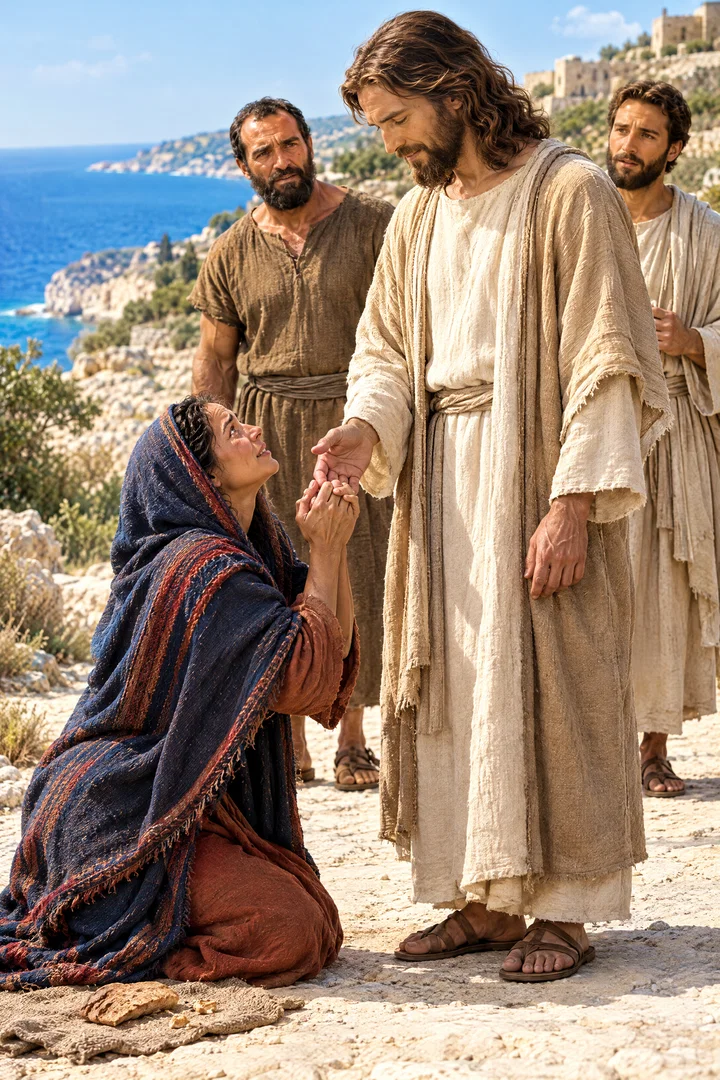
Jesus gives the bread-and-dogs saying, and the woman answers with faith.
- Matthew 10:5-6
These twelve Jesus sent forth, and commanded them, saying, Go not into the way of the Gentiles, and into any city of the Samaritans enter ye not:
Jesus’ earthly mission is directed first to Israel, not Gentiles.
- Matthew 15:22
And, behold, a woman of Canaan came out of the same coasts, and cried unto him, saying, Have mercy on me, O Lord, thou Son of David; my daughter is grievously vexed with a devil.
The woman pleads for mercy for her demon-possessed daughter.
- Philippians 3:2
Beware of dogs, beware of evil workers, beware of the concision.
Both texts use the image of dogs to distinguish outsiders from God’s people.
- Mark 7:1-23
Then came together unto him the Pharisees, and certain of the scribes, which came from Jerusalem.
Paired with Matthew 15 as opposing ceremonialism.
- Acts 10:9-16
On the morrow, as they went on their journey, and drew nigh unto the city, Peter went up upon the housetop to pray about the sixth hour:
Peter’s vision of the sheet overturns his former distinction.
- Acts 10:44-48
While Peter yet spake these words, the Holy Ghost fell on all them which heard the word.
The Holy Spirit is given to Gentile believers.
- Acts 10:34-35
Then Peter opened his mouth, and said, Of a truth I perceive that God is no respecter of persons:
God accepts those who fear him and do what is right in every nation.
- Romans 15:8-9
Now I say that Jesus Christ was a minister of the circumcision for the truth of God, to confirm the promises made unto the fathers:
Jesus’ mission to Israel also brings God’s mercy and blessing to the Gentiles.
- Mark 7:31-37
And again, departing from the coasts of Tyre and Sidon, he came unto the sea of Galilee, through the midst of the coasts of Decapolis.
In Decapolis, Gentiles glorify Israel’s God after Jesus heals the deaf man.
- Mark 7:24
And from thence he arose, and went into the borders of Tyre and Sidon, and entered into an house, and would have no man know it: but he could not be hid.
same seeking of privacy that failed
Commentary
Each commentary is drawn from primary sources: the writings of Ellen G. White and Adventist pioneers and periodicals. Each commentary is separate. Its own words are not a quotation; follow the references to read the source passages.
Ellen G. White
37 sources
It is not right to take what belongs to favored children at a well-supplied table and throw it to outsiders, with the bread picturing the blessings and truth given to Israel and the dogs picturing Gentile strangers regarded as having no share in them.DA 399.23RED 78.2DA 400.42SP 304.1 Jesus spoke in the language of that common Jewish prejudice and for a time acted out its cold exclusiveness in order to expose it and rebuke it by contrast.Lt 28, 1909, par. 13–153RED 78.2DA 400.4ST May 28, 1896 Beneath the apparent refusal was pitying compassion, for He delayed only to test and manifest her confidence and persistence and did not mean a final rejection of a suffering suppliant.DA 400.43RED 79.22SP 304.1ST May 28, 1896 She admitted she had no claim yet trusted His power, willing to receive even a crumb, and her great faith endured the test and obtained the healing of her demon-afflicted daughter.3RED 79.2ST May 28, 18962SP 303.1–2DA 401.1COL 175.2–3 By this mercy to one of a despised people He taught His disciples to turn from exclusiveness and showed that His mercy and the gospel were not bounded by nationality but were already reaching beyond Israel to the nations.2SP 304.23RED 80.1ST Jan 6, 1888SLP 51.1ST Apr 23, 1885
Historical Setting and Encounter
After conflict with the Pharisees over the hollowness of their piety and the unscripturalness of their teachings, Jesus withdrew from Capernaum and from the vicinity of Jerusalem across Galilee to the hill country on the borders of Phenicia overlooking Tyre and Sidon and the Mediterranean.DA 399.1Lt 227, 1905, par. 9–10 He hoped there to find the retirement He had failed to secure at Bethsaida, and in keeping with His character not to strive nor cry nor cause His voice to be heard in the streets, not to proclaim His own merits or enter into controversy or strife, He entered into a house and would have no man know it.DA 399.1Lt 227, 1905, par. 9–10 His work at that time was to prepare His disciples for their mission, because the time had not yet come to bear the glad tidings of the gospel across the sea to the centers of the world's great empire.DA 399.1 Yet His wise gracious words and deeds of mercy revealed a power far above the power of priests and rulers, and His Godlike character made Him the observed of all observers, so that He could not be hid.Lt 227, 1905, par. 9–10
The saying about children's bread belongs to His encounter there with a foreign woman of the old Canaanite people of Phenicia, a Syrophoenician of a despised heathen idolatrous race unfavored with the light of God's word, who came as a mother pleading for her daughter grievously vexed with a devil and afflicted by a demon.DA 399DA 399.22SP 301.13RED 77.1DA 404.1–405.2 She knew the Jews had no dealings with Canaanites and refused even to speak to them.DA 399.22SP 301.13RED 77.1 Having sought help from heathen gods without relief and having heard of the prophet who healed all manner of diseases and performed miracles of mercy whether those who came were rich or poor, hope sprang up in her heart.DA 399.23RED 77.1 With resolute purpose not to lose her only hope and with perfect faith in His power to do what she asked, she determined to bring her affliction to Jesus until He must heal her child.DA 399.22SP 301.13RED 77.1
Jesus went to the borders of Tyre and Sidon and to the coasts of Tyre and Sidon after leaving the vicinity of Jerusalem for the purpose of meeting this afflicted woman.3RED 77.1DA 402.1 Healing her daughter was the only miracle He performed on that journey.DA 402.1 It was an intentional act of mercy toward one of a despised people, breaking down barriers and left as an example for the disciples to follow after He would no longer be with them.DA 399DA 402.1 There He heeded the mother's urgent appeal for aid and healed her daughter, showing Himself as the great Medical Missionary whose whole life was a representation of God.Lt 227, 1905, par. 9–10
Meaning of Bread and Dogs
The children's bread is the blessings, truth, and gospel brought to God's favored people Israel, the children who daily enjoyed special advantages and promises as at a father's abundantly supplied table.3RED 78.2DA 400.42SP 304.12SP 303.1–23RED 78.1 It marks the distinction then made between the Jews, who had received the gospel, and others outside that favor.DA 400.42SP 304.1 The dogs are strangers and aliens from Israel, the Canaanite and Gentile outsiders regarded as heathen idolaters, despised and hated by the Jews, excluded from those advantages and treated as having no claim or share in them.DA 399.23RED 78.2DA 400.4DA 404.1–405.2 The old Canaanite people of Phenicia belonged to that despised heathen class, and the Syrophoenician woman belonged to it.DA 399.2DA 400.4DA 404.1–405.2 The saying that it is not right to take the children's bread and cast it to dogs voices the unfeeling prejudice commonly held by Jews that the blessings given to God's favored people should not be lavished on outsiders.3RED 78.2DA 400.43RED 78.1 It expresses the Jewish view that they as God's children were entitled to His promises and love while other peoples were outsiders with no share in them.3RED 78.1
Christ spoke in apparent agreement with that exclusive sentiment and for a time acted out the feelings that controlled many following Him and the cold way the Pharisees taught people to act toward heathen.Lt 28, 1909, par. 13–15DA 400.4ST May 28, 18962SP 302.1 He treated her request as Jews would have treated a member of a despised race, and seemed to act toward her as the Pharisees taught the people to act toward heathen.Lt 28, 1909, par. 13–15ST May 28, 18962SP 302.1 He did this in order to show the disciples that cold and heartless treatment and to teach them a needed lesson, rebuking that prejudice by contrast with the compassionate way He would have them act rather than imitate Jewish prejudice.Lt 28, 1909, par. 13–15DA 400.4ST May 28, 18962SP 302.1 Beneath the apparent refusal lay a divine compassion and pitying tenderness He could not hide, with His heart touched by her woe and grief.DA 400.4ST May 28, 1896 That compassion could be seen and seized by earnest faith, even while He delayed and seemed to neglect her plea.DA 400.4ST May 28, 1896
Testing Faith Not Rejection
The hard saying was a test of the woman's confidence, faith, sincerity, and persistence, to see whether she would yield at once to divine influence with implicit trust in His power to grant what she asked.3RED 79.22SP 304.12SP 302.12SP 303.1–23RED 77.2 It probed whether that trust could stand apart from national and religious prejudice and pride, as one from an unfortunate and despised race unfavored with the light of God's word unconditionally acknowledged Him as Redeemer able to do all she asked.3RED 79.22SP 304.1 By treating her for a time as Jews treated members of a despised race, the cold reception examined her humility and endurance rather than leaving her discouraged by apparent rejection.2SP 302.12SP 303.1–2 She continued to ask for mercy, trusting His benevolence and power even with no claim to His favor.2SP 304.12SP 303.1–2
His heart was touched with divine compassion and pitying tenderness at her woe and grief over her suffering child, and He longed to give immediate assurance that her prayer was heard.ST May 28, 1896 He knew her heart, the sorrow pressing her soul, and her persistent determination not to be driven away until her request was granted.ST May 28, 1896 Yet He delayed, and for a short time seemed to neglect her plea and to act toward her as the Pharisees taught the people to act toward the heathen.ST May 28, 1896COL 175.2–3 That delay allowed her faith and persistence to become manifest, so that her ready answer could be commended and the precious boon granted.ST May 28, 1896COL 175.2–3
His purpose through the whole encounter remained to meet her need and relieve her suffering, and the words were part of an act of mercy and not a final rejection.Lt 31, 1898, par. 5–8ST Aug 25, 1898 Humble, suffering suppliants are dealt with tenderly and compassionately, and no frown sends them away.ST Aug 25, 1898 The mother was not finally driven off but was attended to, and the child was healed, showing compassion to both mother and child.Lt 31, 1898, par. 5–8ST Aug 25, 1898
Lesson for Disciples and Nations
By mercy to a woman of a despised people, the encounter turned the disciples away from Jewish exclusiveness and self-sufficiency that kept them from helping those in spiritual darkness, teaching them not to imitate Jewish prejudice but to answer distress with compassion.3RED 80.1ST Jan 6, 18882SP 302.1 The cold reception first shown to her exposed that heartless treatment, and the healing that relieved her suffering became the example they were to follow.2SP 302.1 The pride that regarded Israel as children entitled to promises and love, and other peoples as outsiders with no share in them, was wrong.
That mercy showed that Christ's compassion and the gospel are not restricted by Jewish custom or nationality.2SP 304.23RED 80.1ST Jan 6, 1888 The disciples were thereby prepared for work beyond their own nation, for an unrestricted mission to the Gentiles.2SP 304.23RED 80.1ST Jan 6, 1888 The distinction between Jews who had received the gospel and Gentiles treated as outsiders must not limit ministry, for people of every nation who long for help and truth are to receive it.
Her conversion was direct work outside acknowledged Israel, already reaching beyond Israel to the Gentiles.SLP 51.1ST Apr 23, 18858RED 14.1–2 It helped lead the Jews out of exclusiveness and prepared the way for sustained preaching among Gentile communities and their reception into God's church.ST Apr 23, 18858RED 14.1–2ST Jun 12, 1879 The lesson gained still greater force when Christ's death broke down the barrier between Jews and Gentiles.2SP 304.2ST Jan 6, 1888 The healing taught that those regarded as unworthy of salvation could hunger for truth, and that salvation is for all mankind.AA 19.2–20.1
Israel had been blessed in order to bless other nations, so religious privilege is a duty to serve others rather than ground for pride. The woman's confiding trust, free from national and religious prejudice and pride, refreshed Christ and yielded at once to divine influence with implicit faith in His ability to grant favor.DA 401.1DA 404.1–405.2 That faith, and the glad reception by heathen people, stands against the contemptuous unbelief, murmuring, complaining and bitterness that met Him in Galilee where most of His works had been done, even while the distinction between children and outsiders remained strong in the disciples.DA 401.1DA 404.1–405.2
Woman's Faith and Healing
She admitted she had no claim on favor, yet she trusted His benevolence and power to help her suffering child.ST May 28, 18962SP 303.1–2DA 401.1 When told it was not right to take the children's bread and cast it to dogs, she was willing to be regarded as a dog if she might have a dog's privilege.ST May 28, 1896DA 401.1 She begged only for the crumbs that fall from the Master's table, believing that even a crumb from His bounty could help her.ST May 28, 18962SP 303.1–2DA 401.1
She yielded at once to divine influence with implicit trust in His ability to grant her favor.3RED 79.2DA 401.1 No national or religious prejudice or pride shaped her course.3RED 79.2DA 401.1 Unconditionally and immediately she acknowledged Him as Redeemer, able to do all that she asked of Him.3RED 79.2DA 401.1
Her ready answer and endurance under the test satisfied Jesus and refreshed Him.3RED 79.2DA 404.1–405.2 He commended her great faith, holding it up against the lack of such faith in Israel.ST May 28, 1896DA 404.1–405.2 He then granted the precious boon she asked and healed her demon-afflicted daughter, and so finished His lesson to the disciples.3RED 79.2ST May 28, 1896COL 175.2–3 Her faith and persistence, allowed for a time to become manifest under apparent neglect, were thus answered in full.ST May 28, 1896COL 175.2–3DA 404.1–405.2
The encounter shows His sympathy for a mother's distress and His purpose to relieve an anxious heart.DA 512.2Lt 31, 1898, par. 5–8 It reveals His love for suffering people in answering an earnest, humble plea.DA 512.2Ms 7, 1873, par. 9 He did not finally drive the humble, persevering mother away with a frown, but attended to her need and gave comfort and help in grief and need to both mother and child.DA 512.2Lt 31, 1898, par. 5–8
Practical Applications for Believers
The encounter is kept on record to teach what happens when need is pressed upon the Hearer of prayer with persevering faith.ST May 28, 1896COL 175.2–3 Though the plea for a suffering child seemed for a time to be neglected and the answer delayed, the delay allowed faith and persistence to become manifest, and then the request was commended and granted.ST May 28, 1896COL 175.2–3 No soul who asks Christ for help in faith will be left to perish, but even the weakest and most struggling soul may live and find in God hope and sufficiency.ST May 28, 1896COL 175.2–3 The same account shows that Jesus went to relieve an anxious mother's heart, that He sympathizes with mothers in their troubles and distress, and that He hears their earnest prayers for their children.ST Mar 23, 1882ST Aug 20, 1902
Those who came from other nations to be healed or to plead for relatives and friends represented the great human family who did not know God or the truth yet felt a soul-longing for something they did not have.Ms 50, 1897, par. 2 All who came listened to instruction, and as they heard the word of truth they were deeply impressed.Ms 50, 1897, par. 2 By speaking words of hope to those weary, unsatisfied souls and by healing the infirmities of those who came, Christ set an example of speaking and acting for humanity at large to be practiced from one end of the world to another.Lt 227, 1905, par. 9–10Ms 50, 1897, par. 2 In this He is revealed as the great Medical Missionary whose whole life represented God.Lt 227, 1905, par. 9–10
The truth belonging to God's children is their bread, and it must not be taken and given to dogs.3MR 401.2–402.2Lt 8, 1851, par. 14–18 To go into the churches to proclaim the third angel's message is wrong when entrance can be gained only by taming that message down, for such watered-down proclaiming takes the children's bread and gives it to dogs.3MR 401.2–402.2 So one who weakens the third angel's message to gain entry into the churches, as Brother Baker did, takes the spiritual bread meant for God's people, for His starving sheep, and gives what belongs to them to those likened to dogs.Lt 8, 1851, par. 14–18
Sources
Pioneers and periodicals
73 sources
The saying was spoken to a Gentile mother pleading for her demon-possessed daughter, declaring that the blessings of his ministry belonged first to Israel as God's children and not yet to outsiders regarded as dogs.ST Jan 6, 1888ST Jun 21, 1899RH May 21, 1857ST Jan 6, 1888 It states a divine order of priority rather than a final refusal, for the children must first be filled yet compassion is not withheld from those outside.ST Jul 4, 1900ST Jun 21, 1899RH May 21, 1857ST Jul 4, 1900RH Jun 16, 1868 The hard form of the answer tested and drew out her faith while exposing Jewish exclusiveness, though his heart remained full of pity and purpose to help.RH Feb 25, 1873ST Nov 21, 1911ST Nov 21, 1911ST Jan 6, 1888 She humbly accepted the low place, trusted that even a crumb of his abundance was enough, and persevered until her great faith was commended and her daughter healed from that hour.RH Dec 6, 1906ST Nov 29, 1883RH Apr 10, 1866ST Jan 6, 1888ST Jan 6, 1888 Her prevailing prayer stands as the pattern for all seekers, teaching that no soul who asks in humble, persistent faith will be sent away empty, and that privilege given to Israel was meant to bless every nation.ST May 28, 1896ST Sep 2, 1875RH Aug 26, 1875
Setting of the Encounter
The saying belongs to Jesus meeting a Canaanite, Syrophoenician Gentile woman near Tyre and Sidon when she appealed for her daughter, grievously vexed and demon-possessed, to be healed.ST Jan 6, 1888 The encounter crossed the divide in which Jews and Canaanites had no dealings with one another, and in which Jews regarded Gentiles as strangers and as dogs.ST Jan 6, 1888ST Aug 29, 1911 Even so she trusted Jesus as her only hope and believed he could help her daughter.ST Jan 6, 1888
He had made a long journey of forty to sixty miles from the vicinity of Galilee, where he had been praying, teaching and healing night and day, to the region of Tyre and Sidon.ST Jun 7, 1905 There he entered into a house and would have no man know it, undertaking the journey to reach one soul.ST Jun 7, 1905RH Feb 26, 1914 It was the same Jesus who is coming again who made that long weary journey to Sidon to heal a stranger mother's demon-possessed child.ST Apr 15, 1897
It was spoken in the parts of Tyre and Sidon during his continued work in Galilee about two months after the death of John the Baptist, while opposition to his work continued to increase until its culmination at the cross.ST Mar 17, 1898 The place is the same region where Elijah performed the work recorded in 1 Kings 17:8-24, and the miracle connected with the saying illustrates the object and mission of miracles.ST Mar 17, 1898 The conversation in the coasts of Tyre and Sidon shows he was able to hold conversation there, for the tongue in which he thought and commonly spoke and taught was Syriac or west-Aramaic.ST Mar 10, 1881 At the same time he had acquaintance with Latin as the language of official life, with Greek as the medium of polite intercourse spoken in nearby Caesarea and Tiberias and used in the Septuagint he quoted, and with Hebrew of the Scriptures, sufficient to speak with Pilate, to be at home in Tiberias, and to have a delicate sense of the precise force of terms in the Hebrew Scriptures.ST Mar 10, 1881
The sequence is that having first answered her not a word and declared he was not sent but unto the lost sheep of the house of Israel, he answered her worship and plea, Lord, help me, with this apparently indifferent reply about taking the children's bread and casting it to dogs.ST Jun 21, 1899ST Mar 17, 1898ST Mar 17, 1898 In that reply Israel is compared to children whose bread should be given to them first, and the Gentile woman to a dog asking for that bread, with the parallel account adding that the children must first be filled.ST Jul 4, 1900 Her humble answer that even the dogs eat of the crumbs which fall from their masters' table then drew his declaration, O woman, great is thy faith, with the promise be it done unto thee even as thou wilt.ST Mar 17, 1898ST Mar 17, 1898 Her daughter was healed from that hour, so that when sent home she found her freed from the evil spirit.ST Mar 17, 1898ST Jul 4, 1900
Meaning of Bread and Dogs
The children's bread is the blessings of Jesus' ministry, nourishment and mercy given first to Israel as God's children, the chosen and favored people, while the dogs are the Gentiles regarded as outsiders, outcasts and sinners outside the household that receives the bread.ST Jun 21, 1899RH May 21, 1857ST Jan 6, 1888ST Jun 21, 1899 Dogs was a contemptuous Jewish term for uncircumcised people and Gentiles, reflecting Eastern hostility to dogs, and Gentile dog was a common reproach among Jews in general.ST Jun 21, 1899ST Mar 17, 1898 The name was given a claimed basis that the heathen peoples in the mass were exceedingly unclean and ferocious and barked incessantly against the true God and godliness.ST Mar 17, 1898
It is not meet or right to take the children's bread and give it to the dogs, and the parallel account adds that the children must first be filled, so the saying expresses priority and not final exclusion.ST Jul 4, 1900ST Jul 4, 1900 Here the term is not meant as an insult but tests faith, and her faith shows she is in fact one of the children, proving the image does not exclude Gentiles from Christ's compassion.RH May 21, 1857ST Jul 4, 1900 The children are Israel and the dogs are Gentiles not yet admitted to the covenant mission, reflecting the period when the gospel was preached to the Jews while the covenant was being confirmed.RH May 6, 1862RH Mar 1851 After that period the gospel went to the Gentiles, who on being grafted into Abraham's family become Israel and share in the covenants then in force as fellow citizens in God's household, a truth later shown when the vision of unclean animals overturned Peter's belief that Gentiles must first become Jews to be saved and marked them to share in the gospel's blessings.RH May 6, 1862RH Mar 1851ST Oct 30, 1879
Those who held a different application taught that giving the children's bread to dogs fittingly pictures assigning God's promises to those who are not rightful heirs, since the promises belong to Abraham's children by faith and not merely to natural descendants, so to apply them to carnal Jews rather than the faithful is taking the children's bread and casting it to dogs.RH Mar 3, 1853 Beyond its history the children's bread pictures the nourishment belonging to God's children by which a famished soul is fed by God's love and a wanderer coming to God is welcomed by grace into the children's place.ST Sep 9, 1875 Misapplied, it warns that the bread meant for a preacher's children should not be spent on lazy people, lest misusing entrusted support damage his influence and dry up his support. The crumb cast to famished dogs was also used ironically of Jews as outsiders getting only a small share of religious instruction from a church that claimed to offer spiritual nourishment while forcing attendance at sermons through abuse.ST Jul 29, 1908
Why the Hard Answer
His silence, seeming indifference and apparent refusal tested the mother's faith and sincerity and drew her to seek him more earnestly.ST Jan 6, 1888ST Nov 21, 1911ST Nov 21, 1911 The delay in granting her request was not denial, and the hard answer did not mean heaven had failed to notice her, nor that he failed to hear, love, sympathize or would deliver.RH Feb 25, 1873RH May 21, 1857ST Jun 7, 1905 He knew what she could bear and the strength of her faith, knew she would endure the trial without complaint, and allowed her faith to be drawn out so that she would value the blessing more deeply.ST Nov 21, 1911RH May 21, 1857
For a short time he seemed to act out the feelings that prompted the disciples and to answer as Jews and Pharisees taught the people to act toward heathen of a despised race.ST May 28, 1896ST Jan 6, 1888ST Jun 7, 1905 He spoke as a Jew with seeming indifference, as if the blessings of God belonged first to Israel as children while Gentiles stood outside as dogs.ST Jan 6, 1888ST Jun 7, 1905 This course delayed immediate assurance in order to teach the disciples a lesson, that they should not respond coldly to such distress but show compassion as he did in granting her request and healing her daughter.ST May 28, 1896ST Jan 6, 1888 The trial that drew out her persistent faith was thus for their instruction as well.ST Jan 6, 1888RH May 21, 1857
The reply voices the Jewish prejudice and exclusiveness that the blessings brought to Israel as God's favored people should not be lavished on strangers, aliens and outsiders.ST Jan 6, 1888 Beneath the apparent refusal, however, his heart was touched with divine compassion and pitying tenderness at her woe and grief, and he longed to give immediate assurance that her prayer was heard.ST May 28, 1896 His purpose remained to meet her need, for his dealings with humble, suffering suppliants are tender and compassionate and no frown sends them away.ST May 28, 1896ST Aug 25, 1898
The words about children's bread and dogs showed the woman her humble condition and lowly place as one outside the household receiving the bread, revealing to her that unworthiness.ST Nov 29, 1883ST Nov 29, 1883RH Feb 18, 1858 Christ put her in a low place, and her acceptance of it without offense or despair was utter self-abasement and perfect humility.ST Nov 29, 1883ST Nov 29, 1883RH Feb 18, 1858 From that depth of having nothing she sees the whole blessed mystery of heaven and possesses all things, hating self as corrupt yet respecting self as made to be immortal, kneeling in the dust while gazing on the skies.RH Feb 18, 1858
Woman's Faith and Humility
She was a pious Gentile from a despised people who had not received the light of God's word, yet she trusted Jesus as Redeemer and her only hope and believed he could help her daughter.ST Jan 6, 1888ST Jun 21, 1883ST Jan 6, 1888 Her faith was not hindered by national or religious prejudice, pride, racial pride, or false pride, for her whole soul went out for her daughter's salvation.ST Jan 6, 1888ST May 23, 1911ST Mar 17, 1898 Like others who sought God and came to pray before him, her coming illustrates that people from many nations would seek the Lord.ST Jun 21, 1883
She was not offended by the comparison of children's bread and dogs, and she did not despair or fall but accepted humbly her lowly place as a heathen outsider outside the household with no claim or merit.ST Nov 29, 1883RH Apr 10, 1866ST Nov 29, 1883ST Nov 21, 1911 She was willing to be counted among the dogs, and her humility and ready wit answered fittingly, so that her response was remembered as an example of humility and faith connected with her daughter's healing.RH Aug 28, 1860ST May 23, 1911ST Mar 17, 1898 Her acceptance of the low place where she was put is utter self-abasement and perfect humility, hating self as corrupt yet respecting self as made to be immortal, kneeling in the dust while gazing on the skies.RH Feb 18, 1858 From that depth she sees the whole blessed mystery of heaven, so that by having nothing she possesses all things.RH Feb 18, 1858
She trusted his abundant goodness, benevolence, and power that even a small share, even crumbs from the table, are enough.RH Apr 10, 1866ST Jan 6, 1888ST Jan 6, 1888 She asked only for the crumbs that fall from the master's table and belong beneath it, accepting that the children's portion should not be taken from them.ST Nov 21, 1911RH May 21, 1857 She thus turned the apparent refusal into an appeal for mercy, and her humble, fervent, persevering faith received help from the treasury of divine benevolence.RH May 21, 1857
Her persistent, loving prayer was not hindered, did not give up, and would not be turned aside, but endured every apparent obstacle until it was praised.ST Jan 6, 1888ST Jun 7, 1905ST Jan 21, 1913 Jesus commended her great faith, granted the precious boon she sought, and her daughter was healed that hour.RH Dec 6, 1906ST Jan 6, 1888ST Jan 21, 1913 Her humble persevering faith proved that faith was not the heritage of Jews alone and that God's blessings reach outside the chosen people to all of every class, showing she too was among the lost sheep sought out.ST Jun 7, 1905
Her example teaches one seeking deliverance from sin to come humbly to Christ, to persevere despite seeming denial, and to wait for his time and measure of grace.RH Jun 7, 1864 Grace gives strength to overcome the present temptation and assurance of further help when needed, though deliverance is not necessarily sudden or permanent.RH Jun 7, 1864 Faith can thus turn obstacles and what seemed rebuff and denial into stepping-stones that bring a person nearer to Christ.RH Jun 7, 1864ST Mar 23, 1888
Israel First Then Gentiles
The saying about children's bread and dogs expresses that his mission was first directed to Israel as the lost sheep of God's people, so it was not fitting to take their privilege and give it to those outside.ST Jun 21, 1899ST May 1, 1907 Although he began his work among Israel, he did not send the Canaanite woman away empty.RH Jun 16, 1868 Her encounter and the healing of her daughter show the gospel being brought to a non-Jew.ST May 1, 1907
The healing was an act of mercy that relieved suffering and also an example meant to turn the disciples from Jewish exclusiveness and prepare them to work for people beyond their own nation.ST Jan 6, 1888 It shows him working beyond acknowledged Israel and helping lead the Jews out of exclusiveness.ST Apr 23, 1885 The journey beyond the land of the Jews to meet a Canaanite woman whose daughter needed physical and spiritual help shows that the gospel call was not limited to the Jews, for God knows every heart and the good news will reach even one in a remote place who will accept salvation.ST Jun 9, 1898 Gentiles outside Judea also longed for the Healer's help and for the truth given abundantly to the Jews. That lesson pointed to a gospel mission unrestricted by custom or nationality, which became especially vital when his death broke down the barrier between Jews and Gentiles.ST Jan 6, 1888
The distinction the Jews made was that they as God's children were entitled to his promises and love while other peoples as outsiders had no share in them, but that view was wrong. Israel had been blessed so that it could bless other nations. The scene exposes the pride and self-sufficiency that kept the Jews from helping people in spiritual darkness, and teaches that religious privilege brings a duty to serve others. The distinction between Jews who had received the gospel and Gentiles treated as outsiders must not restrict the gospel, for people of every nation who long for help and truth are to receive his ministry.
Her conversion is an instance of direct work among people outside Israel, anticipating the later sustained preaching of the gospel among Gentiles and their reception into God's church.ST Apr 23, 1885ST Jun 12, 1879 Although Jews regarded Gentiles as accursed, he went to Sidon to help a poor Syrophoenician woman's child, showing that national prejudice and tradition did not outweigh the need of a suffering person.ST Oct 29, 1896 He loved the outcast Canaanite woman, seeing and valuing what was good in her despite her being an outsider.RH Jun 2, 1904 He treated her with loving, generous compassion beyond the prejudices and animosities around him.RH Mar 24, 1910
Call to Persevering Prayer
The Canaanite mother's encounter stands as instruction and encouragement in persevering, prevailing faith.ST Sep 2, 1875RH Aug 26, 1875 Prayer is answered on the condition of faith, so faith is essential to receiving what is asked.RH Jul 1, 1902 Jesus for a time seemed to refuse the poor woman's request, yet she persevered and gained her suit. Persistent prayer in this way prevails and is answered even after apparent refusal.
Effectual prayer expresses sincere, supreme and intense desire for what is asked.RH Jul 28, 1863 Weak desire for spiritual blessings shows that they are not rightly valued.RH Jul 28, 1863 Her urgent pleading argued for blessing even in the face of a discouraging answer, following Christ into the house and pressing her plea more earnestly despite the wish to send her away and his silence.RH Jul 10, 1860RH Jul 10, 1860 That earnest, humble pleading is the model of earnestness and effort, of urgent persevering prayer and of secret prayer successfully managed.RH Jul 10, 1860RH Jul 10, 1860RH Jul 21, 1863
The case is placed on record to show the result of persevering in presenting needs to the Hearer of prayer.ST May 28, 1896 No soul who asks Christ for help in faith will be left to perish.ST May 28, 1896 Even the weakest, most struggling soul may live and find hope and sufficiency in God.ST May 28, 1896 His seeming indifference does not mean he fails to hear, love, sympathize or will not deliver, but calls for humble, earnest, persistent prayer that does not stop for obstacles, and mothers today with sons and daughters bound in mind and body by demons of unrestrained pleasure, unreasoning temper and blind passion, ambition, intemperance, profanity, obscenity and vice should keep praying humbly, earnestly and persistently for their deliverance.ST Jun 7, 1905
Compassionate Personal Ministry
The saying belongs to a long journey undertaken to relieve the anxious heart of a mother distressed because her daughter was possessed by an evil spirit and grievously vexed by a demon.ST Mar 23, 1882ST Jun 23, 1914ST Dec 18, 1907ST Aug 20, 1902ST Sep 9, 1886 That coming to a Canaanite woman reveals compassion for mothers and willingness to comfort and help them in their grief and need.ST Mar 23, 1882ST Jun 23, 1914ST Dec 18, 1907ST Aug 20, 1902ST Sep 9, 1886 He sympathizes with mothers in their troubles and in distress, and the account supports assurance that he hears mothers’ earnest prayers and will bless their children.ST Mar 23, 1882ST Jun 23, 1914ST Dec 18, 1907ST Aug 20, 1902ST Sep 9, 1886
The journey to answer the soul yearnings of a Syrophoenician woman outside his faith shows personal attention to one suffering person even after leaving the crowds.ST May 12, 1914ST Oct 1, 1896RH Feb 26, 1914 He valued ministering to one soul as worthwhile, undertaking the trip to the region and coasts of Tyre and Sidon to reach that one soul with personal, persistent ministry beyond preaching to large audiences.ST May 12, 1914ST Oct 1, 1896RH Feb 26, 1914 Relieving the Canaanite woman and restoring her child stands alongside more dramatic works as faithful attention to humble, everyday acts of service, showing that no compassionate duty is too small to receive attention.ST Oct 1, 1896RH Feb 26, 1914RH Apr 2, 1861
Going to the borders of Tyre and Sidon to help one in need is an example of showing gracious favor to the poor and needy.ST Aug 5, 1886 He ministered freely, unselfishly, and without withholding good from the needy, hastening on from healing the sick in one place to meet need in another.ST Aug 5, 1886 Even a mother watching many miles distant over the hills by the bedside of her dying child belonged in that field of labor, to comfort her heart by healing the sick one. His time was occupied in doing good, toiling foot-sore and weary without seeking pleasure and ease or stopping for praise, giving freely what had been received.ST Aug 5, 1886
Sources