Translations
American King James Version, King James Version, KJV Cambridge Paragraph Bible, Webster Bible, Revised Version, American Standard Version
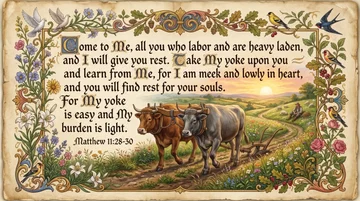
For my yoke is easy, and my burden is light.
for my yoke [is] easy, and my burden is light.'
for my yoke is easy, and my burden is light.
For, my yoke, is easy, and, my burden, light.
Berean Standard Bible, Majority Standard Bible
For My yoke is easy and My burden is light.”
For my yoke is easy, and my burden is light.”
For my yoke is good, and the weight I take up is not hard.
For my yoke is easie, and my burden light.
Douay-Rheims (Challoner revision)
For my yoke is sweet and my burden light.
Pictures
Cross-references 20 of 27
- 1 John 5:3
For this is the love of God, that we keep his commandments: and his commandments are not grievous.
God’s commandments are not burdensome, like Christ’s easy yoke.
- Psalms 55:22
Cast thy burden upon the LORD, and he shall sustain thee: he shall never suffer the righteous to be moved.
Casting burdens on the Lord brings his sustaining care.
- Matthew 16:24
Then said Jesus unto his disciples, If any man will come after me, let him deny himself, and take up his cross, and follow me.
Taking Christ’s yoke involves denying oneself, bearing the cross, and following Him.
- Isaiah 58:6
Is not this the fast that I have chosen? to loose the bands of wickedness, to undo the heavy burdens, and to let the oppressed go free, and that ye break every yoke?
Breaking oppressive yokes echoes Christ’s easy yoke of service.
- Acts 15:10
Now therefore why tempt ye God, to put a yoke upon the neck of the disciples, which neither our fathers nor we were able to bear?
The unbearable yoke placed on disciples contrasts with Christ’s easy yoke.
- 1 Peter 5:7
Casting all your care upon him; for he careth for you.
Both call for giving burdens to God and relying on his care.
- Matthew 23:4
For they bind heavy burdens and grievous to be borne, and lay them on men’s shoulders; but they themselves will not move them with one of their fingers.
Religious leaders impose heavy burdens, in contrast with Christ’s easy yoke.
- Galatians 6:2
Bear ye one another’s burdens, and so fulfil the law of Christ.
Both describe Christ’s way as bearing burdens and helping lighten them.
- Galatians 5:1
Stand fast therefore in the liberty wherewith Christ hath made us free, and be not entangled again with the yoke of bondage.
Christ’s liberty contrasts with the yoke of bondage.
- Exodus 33:14
And he said, My presence shall go with thee, and I will give thee rest.
God promises His presence and rest.
- Luke 9:23
And he said to them all, If any man will come after me, let him deny himself, and take up his cross daily, and follow me.
Christ’s light yoke is linked with denying self, bearing the cross, and following him.
- Mark 8:34
And when he had called the people unto him with his disciples also, he said unto them, Whosoever will come after me, let him deny himself, and take up his cross, and follow me.
Both describe the path of following Christ.
- Hosea 11:4
I drew them with cords of a man, with bands of love: and I was to them as they that take off the yoke on their jaws, and I laid meat unto them.
God draws people with loving bonds, not cruel bondage.
- 2 Corinthians 4:17
For our light affliction, which is but for a moment, worketh for us a far more exceeding and eternal weight of glory;
Christ’s yoke makes afflictions light in view of eternal glory.
- Isaiah 10:27
And it shall come to pass in that day, that his burden shall be taken away from off thy shoulder, and his yoke from off thy neck, and the yoke shall be destroyed because of the anointing.
The destroyed yoke is linked with release from the enemy’s burden.
- Lamentations 3:27
It is good for a man that he bear the yoke in his youth.
Both teach that bearing the yoke in youth is good.
- Amos 3:3
Can two walk together, except they be agreed?
explains yoke as walking in agreement
- John 15:10
If ye keep my commandments, ye shall abide in my love; even as I have kept my Father’s commandments, and abide in his love.
Christ’s obedience exemplifies the easy yoke of those who follow him.
- Hebrews 4:9-11
There remaineth therefore a rest to the people of God.
The passage connects Christ’s invitation with finding rest through trust.
- Romans 8:4
That the righteousness of the law might be fulfilled in us, who walk not after the flesh, but after the Spirit.
Christ enables the law’s righteousness to be fulfilled in those who walk by the Spirit.
Commentary part 1 of 6
Each commentary is drawn from primary sources: the writings of Ellen G. White and Adventist pioneers and periodicals. Each commentary is separate. Its own words are not a quotation; follow the references to read the source passages.
Ellen G. White
1,324 sources
Jesus invites all who labor under sin and sorrow to come to him, take his yoke of obedience and learn his meekness, and in doing so find rest for the soul.ST Jul 8, 18896T 318.28MR 260.5Ms 20, 1897, par. 1–2Lt 8a, 1879, par. 2 His yoke is submission to God's commandments and law of love in lifelong service, and his burden is the work of discipleship in carrying that yoke.Ms 147, 1899, par. 1–38MR 12.2Lt 81, 1900, par. 2Lt 44, 1899, par. 3–4DA 329.2–3 It is easy and light not because it removes duty, self-denial and the cross, but because he bore its weight on Calvary and now bears the heaviest part alongside those yoked with him.6T 247.2ST Jun 29, 1904Lt 58, 1902, par. 1212MR 232.3–4ST Jul 22, 1897 In contrast to galling yokes of sin, worldly care, man-made ritual, Satan's bondage and self-imposed worry and control, his yoke brings freedom, delight and transforming grace to the submissive heart.ST Jun 12, 1907DA 328.1–2Lt 106a, 1896, par. 36ST Apr 15, 1913Ms 11, 1906, par. 3–4 Rest comes only on condition of coming just as they are, yielding the will wholly to him and learning daily in his school, and those who do find peace, strength for toil and power to overcome.12MR 232.3–4ST Jul 22, 1897Ms 13, 1888, par. 68–71Ms 45, 1902, par. 16–18Lt 44, 1903, par. 2–10
Words and Immediate Setting
The invitation is open to everyone who labors and feels heavily burdened, calling them to come, take the yoke, learn from one who is meek and lowly in heart, and so receive rest for the soul, because the yoke is easy and the burden is light.ST Jul 8, 18896T 318.2Ms 20, 1897, par. 1–2Ms 196, 1899, par. 2Lt 299, 1905, par. 2–3 No one is excluded from the offer, which presents him as the source of strength, help, comfort and hope for all in trouble.ST Jul 8, 1889Lt 299, 1905, par. 2–3 Accepting the invitation and learning in his school is what equips a person to lead others to him.6T 318.2 Those who accept it experience its truth, and all are to seek this promised rest and show the world that wearing his yoke brings genuine happiness.Lt 299, 1905, par. 2–3Ms 76, 1904, par. 1
The promise closes his rebuke of Chorazin, Bethsaida and Capernaum for failing to repent, and his thanks to the Father for hiding truth from the wise and revealing it to babes, ending with rest for the soul through taking his yoke and learning his meekness and lowliness because his rule is gentle and his load is not heavy.9T 265.1–4 It is part of the gospel sounding down through the ages to the present, still ringing above world confusion and trouble, where taking his easy yoke means doing God's commandments as the only hope of rescue.Lt 78, 1900, par. 8 The same rest is offered throughout the history of the church as the peace and assurance belonging to righteousness.Ms 34, 1900, par. 49 As the greatest Teacher he speaks to laboring, heavy-laden students, knocking at the door of the heart with angels present when the Spirit moves, so that hearing his voice brings pardon, true joy and clearer views of him as Sin-bearer, and setting studies aside to seek him is no loss.Ms 73, 1896, par. 2 Giving thanks for the security of the covenant of redemption, he then opens his heart of love to offer salvation beyond priests and Pharisees to all people, rich and poor, high and low, learned and unlearned, presenting eternal life, inviting all into the covenant of grace as balm for sorrow over sin and disquiet of thought.Ms 106, 1902, par. 34
It was spoken from yearning to make souls happy, in successful work with the common people who heard gladly, and belonging to him and learning his meekness and lowliness gives rest to laboring, heavy-laden souls because his way is gentle and not crushing.Lt 153a, 1897, par. 25ST Mar 10, 1898 He gave the invitation while walking among people uplifting the weak, the halting and the suffering and gladdening the hearts of the desponding and discouraged.Ms 63, 1898, par. 23 It closes his far-reaching invitation of kindness to weary, oppressed souls, showing tender pitying love that rebukes selfishness and heartlessness, patience that never wearies and love never repressed.Lt 104, 1910, par. 11–12 Spoken wherever he went, in temple, streets, field and wayside, as he scattered blessings, preached the gospel, healed the sick and let gospel light shine, it belongs to his example of constant progress in unselfish service and going about doing good for followers to copy.Lt 104, 1910, par. 11–12STB 438.2–439.1 He bore this yoke himself in ceaseless toil teaching in the temple, healing the sick, explaining Scripture in streets and byways, comforting mourners, bringing hope to the hopeless and healing scars made by sin, until exhausted human nature cried for rest and sleep in a fisherman's boat, rebuking those who do nothing to bless others.ST Mar 10, 1898 The same care appears in sympathy for the weary from heavy burdens, sharing their burdens and teaching God's love, kindness and goodness.COS 42.1–43.2
He spoke with positive authority, not guesswork, in perfect harmony of voice and subject, and his invitations of mercy and goodness cut away doubt whether the Lord will hear prayer, have mercy and give favor, so that mercy, grace and salvation in God can be found with certainty without remaining in ignorance and questioning.Ms 173, 1897, par. 20–21 His I will makes the invitation certain, not dependent on changing feelings, and accepting his yoke and learning from his meek and lowly heart brings rest to the soul.Lt 35, 1894, par. 4–5 The promise is to be grasped by faith and held fast even in difficulty.Lt 35, 1893, par. 1 It is to be claimed by asking and believing in order to receive salvation of the soul.Ms 103, 1902, par. 9 It must be personally accepted in entire faith as a word from his lips, held in humility and earnest prayer, asking and seeking with confidence that the Father will verify his word and make claimants rich in grace, because faithful is he that promised.Lt 293, 1905, par. 19–25 He means exactly what he says and is to be taken at his word, so the helpless soul hangs upon him and trusts the promise, finding the hand nailed to the cross stretched out to save, hear confession, receive requests, forgive sins and make the sinner a member of the royal family, giving hope to cheer under every circumstance and grace to bear all temptations.Lt 97, 1895, par. 62–63
Rest comes by simply looking in faith to Jesus lifted on the cross for everlasting life, exactly as bidden, just as bitten Israelites were commanded to look to the bronze serpent lifted on the pole and whoever looked was immediately healed.Lt 97, 1895, par. 20–21ST Jul 23, 1896 The call goes to sinful, erring, weak, unworthy souls, to weary, homesick, sin-sick souls, to those longing to understand the Lord and his ways, and to the disappointed and perplexed, to come, accept his guidance and learn from his meek and lowly heart.ST Jul 23, 1896 It means obedient looking without reasoning how it is possible or questioning where the power to make whole lies, for those who stopped to reason died.Lt 97, 1895, par. 20–21ST Jul 23, 1896
The promise is full and complete, and even the frailest who implicitly obeys his word will find rest by wearing his yoke and learning from him rather than learning from those with no living connection with God.Lt 93, 1899, par. 7–10 With the authority of true goodness and greatness it speaks to the wealthy, to people in business and high trust, to educated and gifted leaders, and to all in high social position who trust riches and feel not their danger, meeting those heart-sore and sick of vanity who long for peace they do not have and hunger and thirst for salvation and enduring value.COL 229.4–231.1Lt 79, 1900, par. 14–16 It is to be brought home to them by personal labor with tender affection, brotherly regard and kind manner made tender by love.COL 229.4–231.1 Coming brings a person onto holy ground into the presence of superior goodness immeasurably beyond anything earth affords and close to the living fountain of mercy and love, where the life of the only begotten Son offered up and assurance of pardon for the guilty race are impressed on heart and mind by the Spirit.Lt 79, 1900, par. 14–16 It also offers relief to those burdened by sin and responsibility, to sin-weary souls coming in faith, to the woe-stricken inhabitants of earth entreated by the loving Saviour, giving assurance of peace and pardon to the guilty through one meek and lowly in heart with power to secure salvation.ST Oct 10, 1900Lt 115, 1905, par. 9–12 Finding this rest means coming to the fountain of living water to drink and gaining the most vital thing, the knowledge of God and of Jesus Christ whom he sent, proved by revealing God in life and character and making him known to others, a light, joy and peace found nowhere else.
For Edson the invitation to those who labor and feel heavily burdened to come, take the yoke, learn from the meek and humble character and receive rest means rest and peace come only through full surrender, while struggling to maintain his own way leaves him without rest or peace.Lt 36, 1892, par. 13 The yoke is easy and the burden light in contrast to heavy burdens a person gathers to himself that leave the mind in constant perplexity and trial, a self-imposed yoke God did not place on the neck.Lt 323, 1905, par. 8–9 For him this means laying down the heavy burdens he placed on himself and taking Christ's yoke in ministering in word and doctrine with active mind and clear understanding of Scripture to write books of special interest.Lt 323, 1905, par. 8–9
It is an invitation to Hattie Belden and her daughter to come to Jesus, learn from his meek and lowly heart and find rest for their souls, since serving under him is not an oppressive burden.Lt 194, 1907, par. 3 When Mary submits her will to God and follows him she knows his yoke is easy and burden light, because surrendering the unsubdued will is the way out of its bondage, not a hardship that makes salvation hard.21MR 253.5–254.2Lt 1, 1858, par. 9–11
Not wearing his yoke left John Kellogg and Willie Kellogg in darkness, while he calls them to take it, unite with brethren who all need to wear it, and learn his meekness and lowliness of heart which gives rest to the soul.Lt 165, 1904, par. 9–13 Wearing it and keeping hold of his strength makes them children of light, all light in the Lord, revealing his meekness and lowliness.Lt 165, 1904, par. 9–13 Wearing it means taking fewer burdens than in the past, walking unitedly and circumspectly with him as helper and sufficiency, having no fellowship with unfruitful works of darkness but reproving them.Lt 165, 1904, par. 9–13
The invitation completes his gracious call to all laboring under heavy loads to come for rest of soul by taking his yoke and learning his meekness and lowliness, where his rule brings ease and relief.Lt 223, 1904, par. 7–8 It was extended to save leading men in the medical work at Berrien Springs from carrying out cherished personal plans and treating the effort to save them as victory over brethren, calling them to accept the outstretched helping hand.Lt 223, 1904, par. 7–8 Their refusal leaves his appeal asking why they will not come and find rest and why they refuse his help.Lt 223, 1904, par. 7–8 The weary invalid too is invited to find rest in him by taking up assigned work rather than remaining inactive, feeling responsibility, living as a family by themselves, doing useful household labor within strength while shunning wearing labor, letting the mind receive healthy tone by dwelling on heavenly things, and earnestly training children in nurture and admonition, which also relieves others of constant care and sympathy.1T 557.2–558.1
Learning to follow means wearing his yoke and carrying his burdens, which the young women were not doing while giving Edith their deepest affection and letting admiration for her draw them from devotion to God.Lt 37, 1885, par. 4–6 His yoke of following and learning is easy and his burden light, giving rest to comers and enabling development of Christlike character even in a corrupt age, as Enoch did.Ms 13, 1899, par. 15–18
The invitation calls laboring, heavy-laden people today to gain a fitted experience under the divine Teacher who stays with them to help and instruct, as Moses was kept with God through forty years of shepherd work until fitted to lead his people out of bondage.Lt 133, 1897, par. 23–25 This learning goes on even in aggressive warfare amid hindrances and contention, ignorance and cheap earthly conceptions, duplicity and pride of opinion, perils by land and sea, false brethren, privations, trials, discord and strife, because submission to his training brings relief rather than oppression.Lt 133, 1897, par. 23–25 Taking his yoke means learning his humility and meekness, as Moses learned to lay aside pride and self-sufficiency and become patient, reverent, humble and very meek.Ms 11, 1903, par. 9–11 It means walking humbly before God, putting away self-sufficiency, and helping imperiled souls with gentle words and acts as God's little children rather than driving them farther away by harshness.Ms 11, 1903, par. 9–11
The call comes from the divine Christ who took human nature without ceasing to be divine, whose meek and lowly character gives the pattern for learning from him, offering the weary rest through a yoke and burden easy and light.6MR 112.3 It reveals him as greater than Abraham and Paul in genuine courtesy, his whole life a striking illustration of courtesy with countless instances of kindness, tender sympathy and love, and marvelous condescension shedding softness and beauty over his entire life.19MR 12.2–13.2 He has a kind look and encouraging word for all wearied and worn with labor, ready to help the most helpless.19MR 12.2–13.2
Meaning of Yoke and Burden
The yoke is restraint and submission and obedience, requiring full and complete obedience to all of God's commandments because human beings belong to him by creation and by redemption, and the burden is the work and duty of carrying that yoke in service and discipleship, including self-denial, lifting the cross and following in his footprints, with responsibility in his work.Ms 147, 1899, par. 1–38MR 12.2Ms 27, 1902, par. 12 Taking it means accepting submission, restraint and obedience with meekness and humility, receiving the truth and practicing it, coming into harmony with him and learning meekness and lowliness of heart, and those so yoked find rest and peace and are enabled to keep God's law.8MR 12.2Lt 81, 1900, par. 2Lt 145, 1900, par. 3–4 Wearing that yoke means following the obedience he himself exemplified, forming a character God can approve rather than living to please natural inclinations.Ms 27, 1902, par. 12Ms 68, 1897, par. 33 Unlike a self-made yoke which is galling, his yoke of restraint and obedience is easy and his burden light.Lt 81, 1900, par. 2Lt 145, 1900, par. 3–4
The yoke that binds to service is the law of God, the great law of love revealed in Eden, proclaimed upon Sinai, and in the new covenant written in the heart, which binds the worker to the will of God.DA 329.2–3ST Jun 29, 1904 As cattle are yoked for effectual labor, so people are called to service as long as life lasts as co-laborers with him, joined to God's will which is high and noble and elevating for lifelong service as co-workers.DA 329.2–3ST Jun 29, 1904 God so confines people to his will that they do not follow their own inclinations into Satan's snare and become possessors of his attributes, but patiently and wisely take up the duties of service.ST Jun 29, 1904 Yokes men frame for themselves that seem light prove heavy and galling and intolerably heavy, while submitting to his yoke and giving up the unprofitable struggle teaches needed lessons and gives rest, and yoking with him as co-worker brings perfect rest and freedom whereas self-rule does not bring true liberty.ST Jun 29, 1904Ms 68, 1897, par. 30 His yoke prepared by God is easy and light because it is in conformity with his requirements and his ten holy precepts, and wearing it in obedience is duty, while Satan's yokes are heavy because they are not in conformity and bind to the world against the commandments.ST Apr 28, 1898Ms 68, 1897, par. 303MR 70.4
The easy yoke and light burden mean the work God lays out in Isaiah 58:6-11 for fellowmen and for him, and that work should be tried.12MR 237.3–238.1 They do not give a life of ease and freedom and selfish indulgence, for his life was self-denial and self-sacrifice at every step and his true follower follows in his footsteps with consistent Christlike tenderness and love, becoming inspired with his spirit and life.12MR 237.3–238.1 The yoke is also the yoke of obedience meaning surrender of will and way and purpose to God, love for God and faith shown by obedience, receiving him as Saviour and taking a decided stand to be on the Lord's side, specifically by keeping the seventh day as the Sabbath after six days of labor, which gives rest to the soul, so that delay in surrender is loss every hour.Lt 44, 1899, par. 3–4
His yoke is a life of restraint and obedience learned by sharing his humility, and his meekness and lowliness lead followers toward peace and contentment and joy and an immortal inheritance.Lt 150, 1899, par. 8 It means giving up the will to God, the same thing as taking up the cross, cutting selfishness from the soul and ending following one's own way and doing one's own pleasure, denying inclinations and wishes when they do not accord with divine requirements even to a complete change of plans and purposes, and it cannot be separated from following him.ST Jun 29, 1904 Like the yoke on oxen that aids in drawing the load, his yoke lightens life's load when the will is swallowed up in the will of God and his gifts are used to bless others, and walking in his commandments means walking with him whose love brings rest to the heart.ST Jun 29, 1904ST May 13, 1908 The bearer looks to the Master to direct the course in difficulty and presses more closely to his side as circumstances grow more trying, and finds the heaviest labor can be performed and the heaviest burdens borne because the Lord gives strength and gladness in doing the work.ST Jun 29, 1904 Accepting his yoke gladly displaces haughty self-sufficiency and makes room for his meekness and lowliness in daily life, so that when self is given to God he controls every part of the being.21MR 151.1
His yoke is not galling to the true Christian, for serving him is the truest freedom and obedience to God's law is a delight, and the Christian strives to live up to the law's perfection rather than lowering its commands to match shortcomings.AAP 4.1 It becomes easy and light when the heart is changed to see the beauty of holiness and to love God and his law, so that obedience springs from a heart aligned with God.MYP 102.1–2 Those who learn from him and take his yoke find rest because he walks with them and bears the heaviest weight, accepting obedience and even suffering for his sake without complaint, trusting his presence and following his example of keeping the Father's commandments.ST Jan 6, 1888 The ease and lightness do not mean obedience is unnecessary, for living in harmony with his holy and just and good law is the path of life and in the believer's highest interest.ST Jan 6, 1888 His yoke is the willing service of one whose will is being freed from sin and brought into harmony with him, and as people consent to serve him he shapes their thoughts and aims to conform to his will, so that doing his service expresses their own refined and sanctified impulses and becomes their highest delight.ST Nov 19, 1896FE 461.2–462.1 What Satan presents as galling, claiming it means giving up everything pleasant and yielding to arbitrary laws, really means loving God with all heart and soul and spirit in return for what he has done and living out the principles of the Word including in the family, opposed because it fits people to be children of God and partakers of blessing.3MR 71.1
The yoke of restraint and obedience is easy and the burden light when his truth is in the heart and his life gives strength, and wearing it keeps followers safe on the Lord's side and enables them to resist temptation and remain steadfast, whereas without his strength they cannot stand firm.Ms 59, 1902, par. 73–74 Rest comes when truth moves beyond mere conviction of conscience into the heart, placed there by the Spirit to captivate the soul and renew the spirit of the mind and show transforming power in character, for truth held by conscience alone while the heart resists only agitates the mind and leaves restlessness, but received in the heart makes following gentle and freeing.Ms 130, 1897, par. 6–7 It is borne through meek humble submission to his rule and obedience to God's law, yielding the whole being to his control where his transforming grace makes sinners complete, and this submission brings peace and is the condition of salvation.ST Jul 22, 1897 Worn by pressing close to his side with his truth in the heart and his life as vitalizing power within, learned by sitting at his feet to be meek and lowly, those who wear it are strong in the Lord to resist temptations from within and without and to stand firm instead of bending like a willow at criticism or failing through dependence on man.Ms 59, 1902, par. 73–74 God shapes the character of those who accept it, makes them partakers of the divine nature and gives power to overcome the world's corruption, so that hearers who obey form righteous characters while those who disregard form characters shaped by indulged desires.Lt 44, 1903, par. 27
Taking his yoke is taking up in covenant the yoke of restraint and obedience to follow him and learn of him as a student in his school.Lt 66, 1899, par. 3–4 Putting the name on the church books declares that covenant to wear his yoke, to serve him voluntarily and to be his follower, and complying with his invitation means yoking up with him from the heart by daily genuine conversion and linking up with him every day by earnest prayer.Lt 66, 1899, par. 3–4 Formal union with the church without heart-union with him is worthless, and failing to lift the cross and yoke up with him loses much in this life and everything in the future life.Lt 66, 1899, par. 3–4 The yoke is taken in the covenant of membership to walk in his footsteps in harmony and love and unity in meekness and lowliness of mind, drawing together in sympathy and forbearance, cultivating courtesy and respect, strengthening the weak and inexperienced, so that what is lacking in one is supplied by another and all talents work together under the Spirit as he worked.Lt 26, 1900, par. 19–22 Wearing it is the only way for the church to have most perfect unity, with rest found in learning his meekness and lowliness, and wearing it means accepting the conditions of service through which by his grace human beings are united with the divine and joined in heart and mind.Ms 165, 1907, par. 4–68MR 440.1–3ST Apr 22, 1903
The yoke is worn through humble dependence on God and faith that trusts him at all times and in every circumstance.Ms 62, 1896, par. 41–44 Wearing it means bringing every passion under God's control and bringing thoughts into captivity to him, and this leads to healthy growth in beauty and grace of character.Ms 62, 1896, par. 41–44Lt 71, 1893, par. 9 It is the restraint of the Spirit, so that those yoked with him resist heated passion and refrain from speaking angry fiery words, as he teaches meekness and lowliness and gives rest to the soul.Ms 73, 1897, par. 20–21 Even when the natural tendency is to seek amusement and avoid responsibility, submitting to his discipline is not crushing, for thoughts are brought into captivity and the way of obedience is easy and light.Lt 71, 1893, par. 9 His yoke is made up of patience and gentleness and longsuffering, and he humbled himself and took human nature to teach fallen people how to share in the divine nature, so that learning his meekness teaches them to love one another and refuse to criticize and condemn, borne by learning from him and placing self in his hands.Ms 118, 1904, par. 15–16 This lived obedience brings rest and includes practicing Christian politeness and treating others as one wishes to be treated, and those who take it work with God and carry his burdens so that when they meet temptation they can endure without being overcome or dishonoring their Redeemer.Ms 239, 1902, par. 2Ms 174, 1897, par. 29–31
Why His Yoke Is Easy
His yoke of doing the work God gives is easy and its burden light because he bore its weight on the cross at Calvary.6T 247.2Lt 206, 1899, par. 139MR 82.5 Of himself man can accomplish nothing in that great work set forth by God, and he came to show men how to do it, so those who come, take his yoke, learn his meekness and lowliness of heart find rest of soul in that service, the yoke manageable and the load not heavy.Lt 206, 1899, par. 13Ms 169, 1899, par. 16 His call is to all who labor and carry heavy loads to take up his way of working and receive rest, and the cross he requires to be borne creates more strength than it uses up, though taking his burden still means meeting conflicts and trials in doing duty.Ms 169, 1899, par. 16Lt 7, 1877, par. 6 The hindrances to perfecting Christian character are in ourselves which he can remove, and every self-denial and sacrifice in following him is a step of the lost sheep returning toward the open doors of the heavenly Canaan entered through the door and not by climbing up some other way, the life he prepared through his own suffering and death never having cost pain or grief if it had never been left.Lt 7, 1877, par. 6
The yoke is easy and light because he carries the weight for those yoked with him, stays near and bears the heaviest part, so yoked to the car of duty the burdens of life are carried lightly while without him the load is heavy.Lt 58, 1902, par. 1212MR 232.3–4ST Jul 22, 1897Lt 134, 1901, par. 2–4Lt 144, 1901, par. 1–3 Rest and peace come only on condition of yoking up with him, and learning from him and wearing his yoke makes learners meek and lowly in heart who through experience find rest in serving him and bear joyful witness to its lightness.Lt 58, 1902, par. 1212MR 232.3–4 His yoke helps bear every burden that needs to be carried, and willing obedience to God's requirements brings peace of mind, clear judgment and steadfastness of character to redeem through faith, with meekness and humility marking all obedient to God's law.12MR 232.3–4ST Jul 22, 1897 Serving him is not an unbearable burden, for when people take his yoke and learn from him he carries the load with them and they receive promised help, finding rest in trying to please the Lord as students of his meek and lowly lessons.Lt 134, 1901, par. 2–4Ms 8, 1886, par. 15Lt 144, 1901, par. 1–3
He makes work lighter because he bears the yoke with his people as laborers together with God able to sow the world with seed bearing fruit for him.Ms 68, 1895, par. 5–6 His promise of a light burden rests on his own experience, for he bore human nature and was tempted as people are, feeling affliction even more keenly because his nature was higher and nobler, and he is fully able to help because through strength received from God he overcame Satan and fallen angels.Ms 68, 1895, par. 5–6Lt 324, 1907, par. 12–13 His human nature, not his divine nature, endured the wilderness temptations and the contradiction of sinners, living a perfect human life tempted in all points like others and suffering physical weariness, weakness, hunger, thirst, sadness and sorrow over hard hearts, spending whole nights in prayer for those who would not come for life, so those for whom he suffered should not choose own will and selfish gratification since without him nothing can be done.14MR 334.1–2 His yoke of submission is easy and his burden light because he bore the difficulties and trials human beings face, and those who take it and learn his meekness find rest with a way of escape provided though the enemy brings strong temptations, his sympathetic heart identifying with suffering people while God's mind, peace and grace guide the worker serving as instrument in God's hands.ST Jun 10, 1908Lt 86a, 1893, par. 49–51
The easiness rests on his humiliation and atoning sacrifice which unlocked the gates of prayer, set ajar the gates of hope and opened the heaven he desires people to reach, while his patience, forbearance and grace keep it open, giving reason now to believe, hold fast to the arm of God's power and trust without worrying.Lt 123, 1904, par. 8–9 His humility is shown in veiling his divine nature in humanity and humbling himself as a man, no humility surpassing that of the Lamb of God who takes away the sin of the world, and looking to him subdues self-seeking so the spiritual eye beholds the glory of his character.Ms 64, 1895, par. 9–10 He took human nature and lived it out to show how flawed humanity with objectionable features, infirmities, tendencies and prejudices can link up in harmony of opinion and sentiment, which means learning from him who is meek and lowly, looking to him for how to act, seeking wisdom from God, committing mind and soul to his leading and not cultivating natural and hereditary tendencies to wrong.Ms 60, 1898, par. 9–13 The invitation comes from One who was Prince of heaven and made infinite sacrifice to come to a world marred by the curse and lay hold of fallen humanity, carrying terms that must be accepted by taking his yoke, learning his meekness and rendering cheerful obedience to become an example, with every advantage to accepters who find the rest they crave.Lt 309, 1905, par. 9 Taking the easy yoke means denying self, taking up the cross and following him in consecration, self-denial and self-sacrifice as he lived when he left heaven, lived the law and gave himself for souls, for only in that self-denying discipleship is rest found fitting believers for prepared mansions, exemplified in laying aside royal robe and crown to come as a babe living lowliness, poverty, privation and self-sacrifice to establish correct methods of medical missionary work in simplicity and economy without display or demanding stipulated sums.Lt 84, 1900, par. 5–7Lt 145, 1904, par. 14–17
Spoken to every human being whether they know it or not because all are weary and heavy laden with burdens only he can remove, the easy yoke and light burden mean release from the heaviest burden of sin that would crush sinners if left to bear it, because the Sinless One took their place and bore guilt to give rest.ST Jun 29, 1904DA 328.5 It also means he bears the burden of care and sorrow, inviting all to cast care upon him because he carries them on his heart and understands every circumstance of life.ST Jun 29, 1904IRCUP 17.1–3 No human or angelic being is a sin-bearer and no one can save self by good works or blot out one sin, so the weary, despairing, weak and troubled must look away from self, lay sins of omission and commission upon him who bore the sins of the whole world, and believe his words that he pardons and accepts the erring just as they are to become children of God through his blood, for he loves to have the weak come, bears long with erring children and ministers by angels to every believing soul.Lt 36, 1900, par. 1–3Lt 72, 1903, par. 18 His followers can bring every trouble to him and leave it with him trusting he will carry it, for he is the sin-bearer who takes away the world's sin.Lt 72, 1903, par. 18
His yoke is easy and his burden light because believers are privileged to draw from his inexhaustible supply of grace and light and love, and the more they impart to meet the necessities of others the more they receive, with their own souls refreshed and satisfied by his love.Ms 63, 1898, par. 23 Accepting his invitation by linking life with him and submitting the whole self to God brings rest of soul, and those who take up this yoke of discipleship and service are sustained by that inexhaustible supply.Ms 63, 1898, par. 23Ms 183, 1901, par. 7–8Lt 164, 1900, par. 8–9 His service is not an oppressive burden, for his abundant fullness supplies every qualification needed by those who serve sincerely, and those who accept and learn his meekness and lowliness find rest sustained by grace.Ms 140, 1903, par. 55–56ST May 8, 1901
The yoke becomes easy and the burden light as human character is transformed, for through faith anyone may become one with him in obedience and service sharing his life and the inner strength of piety that animated him.21MR 370.2Lt 153a, 1897, par. 13–15 Wearing his yoke and lifting his burdens means putting him on in words, spirit and actions with him living within, a life of obedience to all God's commandments from love and disinterested, true-hearted, honorable labor taking up responsibility toward fellow men as the law defines and loving neighbor as self, so all service merges into his life, not feebleness and inactivity or self-love and self-pleasing but noble obedience revealing itself as part of his life and making its possessor a partaker of the divine nature.ST Mar 10, 1898Lt 153a, 1897, par. 13–15 John learned to wear his yoke and bear his burden as he opened his heart to his influence, hid self in him and followed his lessons, yielding as he watched his tenderness and forbearance and learned humility and patience until a violent, proud, ambitious spirit gave way to a life shaped by him.DA 295.5–296.2ST Mar 8, 1905
The yoke of following him is easy and his burden light when a person's will is aligned with God's and they walk beside him, carrying their part while he carries the heavier part and growing one step at a time, so taking up the cross, denying self, overcoming the world and following in his path do not make the burden gall the neck but give rest and strength for the way.Ms 13, 1888, par. 68–71 Taking his yoke means restraining human will, appetite and inclination, and yielding to him brings rest bearing witness that his yoke is easy, found easy when a person gives up own will to be led and taught, choosing his disposition and doing his will so even heaviest spiritual labor can be borne because the Lord gives strength, power and gladness.Lt 44, 1903, par. 2–10RH Dec 6, 1906 His yoke is easy when life is in harmony with him and learns from him, but galls when out of harmony, and coming to him with burdens brings rest for he knows sorrows and stands ready to help, with wearing his yoke involving obedience and sanctification through truth, growing in divine life, understanding duty and confessing him.Ms 40, 1886, par. 103MR 73.1 Taking them means fully surrendering to God, submitting to the yoke and bearing its burdens rather than making a half-hearted commitment.Ms 7, 1890, par. 12
The yoke is easy to a submissive person and his burden light, for learning from him who is meek and lowly brings rest to the soul.Ms 239, 1902, par. 5 It proves easy and light only to those who submit and learn his meekness and lowliness, which means self-sacrifice and entire consecration of body, soul and spirit, and all who would work for the Master must enter that submission while those who have not are not to be exalted to high positions, yet as workers learn they find service restful and do not grow weary.Ms 57, 1903, par. 3Lt 200, 1902, par. 17 It is easy and light for one who submits entirely and accepts the whole truth with all its consequences, only appearing galling and the cross only looking fearful, inconvenient and too heavy because Satan makes it appear so, for he loves the sinner, accepts full consecration and becomes Burden-bearer and never-failing Friend so none need try hard to save self or do some great thing to commend self to God but cast away fear, leave consequences with the Lord and resolutely and cheerfully lay hold, when taken up thus the burden not grievous but a support lifting the bearer.Lt 20, 1867, par. 6–7 His yoke is lighter than the burden of sin and the pain of a violated conscience, belonging to his invitation to the weary to come and find rest from One who understands weakness and temptation and gives help rather than demanding they carry burdens alone, and it is easy when the heart is fully surrendered so love springs up, the will is yielded and what was a cross becomes a pleasure, whereas reliance on own efforts brings no rest but rest comes through faith in his acceptance of repentance.RH Apr 19, 1870GW92 439.2–440.2
Heavy Yokes in Contrast
His yoke is a yoke of love and tenderness, unlike the galling burden of worldly cares, customs and fashions that weary people and mar character, and even the weakest can grow strong through grace while wearing it in harmony with God, with fullness of joy and praise, humility, active communion, tenderness, mutual respect and kindness among laborers instead of tearing down another's work or needing outside amusements.ST Jun 12, 1907ST Jun 12, 1907Ms 73, 1906, par. 11 His service is not a crushing ritual burden like man-made ceremonies and priestly restrictions that left continual unrest and inability to meet requirements, obscured the commandments and turned the Sabbath into a burden hiding its true meaning, nor minute rabbinical requirements that could not be kept and left no rest from troubled conscience and discouraged service, nor a different yoke formed by ministers teaching fables and foolish human imaginings that galls souls with disquietude and discouragement, for God's law itself is holy, just and good and becomes grievous only when human requirements are added and presented as God's, and no one keeps it without His righteousness but through His strength can obey fully and reflect His character.DA 328.1–2ST Apr 28, 1898ST Apr 28, 1898DA 29.3–414MR 63.2 His yoke is easy and light in contrast to Satan's yoke, and by taking it and learning from Him a person finds rest, recovers from sin and is freed from captivity, while refusing it leaves one yoked with Satan and his confederacy in deceiving destroying power and held captive unless surrender is without reserve.Lt 106a, 1896, par. 36ST Sep 25, 1893Lt 83, 1886, par. 3 Refusing means putting a heavy galling yoke on one's own neck by sinful indulgence, such as appetites with no foundation in nature like drinking wine or beer, using tobacco, and cardplaying and gambling that fill the mind with vain hopes, degrading God-given powers with irritating galling consequences difficult to break once taken.Lt 8, 1893, par. 5
The heavy galling yoke in contrast is self-made and self-imposed, cumbrous, consisting of worldly anxiety and care, guilt, self-righteousness, and following own ways, wills and plans, leaving darkness, discouragement, tumult and bondage, while His prepared yoke brings rest, peace and wisdom unto salvation, knowledge to the ignorant and hope to the despairing.ST Apr 15, 1913Ms 11, 1906, par. 3–413MR 239.3–240.2Ms 1, 1891, par. 24–26 Surrender must put off that self-made yoke and take His instead, yielding whole mind, soul and body, resting in the compassionate Saviour, receiving Christ through the Holy Spirit as ever-abiding power and sufficiency, laying burdens at His feet rather than rushing to human agencies, becoming meek and lowly with self hid, ceasing complaint and judging, beholding His spotless purity until self dies, the new birth quenches unholy ambition that keeps guilt upon the soul, and daily beholding and practicing His virtues keeps perception clear and the yoke easy.ST Apr 15, 1913Ms 11, 1906, par. 3–4Ms 102, 1902, par. 9 Only humble, contrite, diligent students who cherish meekness find abiding peace, saving knowledge of Scripture, rich experience in trusting and obeying, strength in the Redeemer despite feebleness, and quietness amid tumult by believing without feeling and working from principle in unwavering trust, laboring as He labored with self-sacrifice to strengthen weak hands, confirm feeble knees, remove stumbling blocks and bring sinners to conversion, laying aside the yoke of bondage made by serving the world and worrying over its cares to make His service the chief aim.ST Apr 15, 1913Ms 1, 1891, par. 24–26MH 480.3–481.2
Unlike painful burdens people make for themselves by dwelling on trials, condemning themselves, doubting God, worrying, planning and trying to manage everything alone with perplexity, care and worry, taking His yoke means coming, learning His meekness and lowliness, trusting His promise to bear griefs and burdens, and finding rest.Ms 80, 1893, par. 87–90Ms 88, 1893, par. 9–1321MR 228.5 The responsibilities the Lord gives are not to overtax so as to leave weariness, irritability and loss of self-control, and duties God did not design to be performed, excessive or unsuitable demands He never made duty, are not to be groaned under, but are to be borne with trust, pure, sweet, sympathetic heart.MYP 135.2RH Oct 31, 19076MR 185.3–186.1 Christ lays no galling yoke, so no yoke made by any human being should be taken up for self or for God's people, for cooperating with Him keeps His yoke easy and communion with Him lightens daily burdens, following the plain course of duty without letting earthly ties however dear obstruct it and without letting human agents frame duties or bind and hamper movement now or in the future, allowing truth to shape character and standing free.12MR 38.4Lt 24, 1895, par. 19Ms 175, 1899, par. 5Ms 28, 1902, par. 4 Taking His yoke means struggling not against natural claims but against sin to be met and repulsed at every step in the plainly marked way of denying self and taking up the cross daily.14MR 62.1–2Lt 207, 1899, par. 19–20
His yoke is not oppressive like yokes devised to control others, contrasting human control, dictation over those laboring in partnership with God, kingly authority, human-imposed restraints on service, and extra tests and crosses invented for others, and followers are not to submit to them or be ruled by human will but to be guided by God's word, learning from Him in meekness, humility and lowliness in daily obedience, with requirements presented in mercy and invitation rather than hardness, and with humble prayer and reliance receiving strength and committing the case to truthful righteous judgment, since the Father understands weakness, needs and capacities.STMW9 3.2Lt 344, 1907, par. 218MR 98.1–99.1ST Sep 4, 1901Lt 191, 1902, par. 1–3 This presents a choice between His yoke and man's yoke of human control and influence, which must be broken and taken away before physicians and workers for God can do their God-given part in proclaiming truth, requiring refusal to remain noncommittal or neutral in the conflict between the Prince of life and the prince of darkness, freed from deceptive sentiments that spoil faith and lead downward to denying Him who bought them.Lt 255, 1904, par. 15–20STB 77.2Ms 76, 1904, par. 2 Those appointed to His work wear His yoke only when they refuse to bind themselves to human-devised restrictions, such as conditions on handling God's goods like the sale of health foods, for coming exactly to men's terms is not wearing His yoke but a yoke framed by human devising that proves a snare, and God will give counterorders to restrictions that bind His servants, leaving them free under God alone as owner and manager to act as circumstances demand.Lt 51, 1900, par. 30–32
Wearing His yoke means refusing to make leaders burden-bearers by pouring all difficulties and perplexities into them and wearing them out, refusing to take on the crushing burden of acting as conscience for others, and refusing to carry others' sins by dwelling on, watching, accusing and talking of faults and errors, since Jesus alone as Redeemer bore human sin in His own body and alone knows the worth of souls He purchased, and no human can be a sin-bearer even for his own guilt, so to take that work crushes the life out and bows one down while bringing distress rather than rest.21MR 270.4–6Lt 19, 1901, par. 9–12Lt 23a, 1893, par. 50–56Ms 89, 1907, par. 8–912MR 8.1 Instead burdens, need for wisdom, and others' mistakes are to be brought straight to God who gives liberally, turning attention to Him who heals, comforts, gives hope, peace and rest, with each individually accountable to God and acting as God moves rather than being moved by another mind, impressed and directed by the Spirit with freedom of action and choice instead of human restraint, founded on Christ and His righteousness.Lt 23a, 1893, par. 50–56Ms 89, 1907, par. 8–9Lt 26, 1897, par. 5 In contrast to oppressive self-placed demands such as fashion that sacrifices health and life's best interests and enslaves, His way brings freedom from that self-imposed slavery, and obedience to God's and nature's laws brings contentment, peace and happiness, meaning contentment with plain, convenient, healthful clothing and living usefully by His meekness and simplicity rather than a burden heavier than He requires.Ms 109, 1909, par. 53–54CTBH 92.1 The mother fails to hear His invitation to rest because fashion's clamorous demands drown out His voice, its very galling yoke overtaxing mind and body with early and late work to remodel garments and keep pace with display, leaving her too tired and heartless to read the Bible, pray or train children, and bringing perplexity and distress.RH Jan 24, 1907
Sources