Mark 4:35
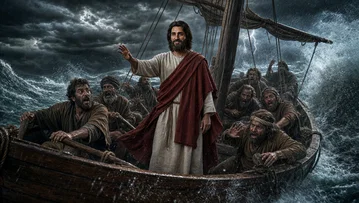
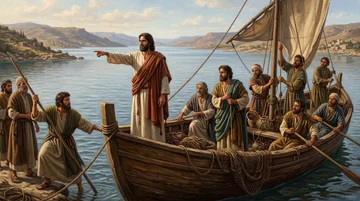
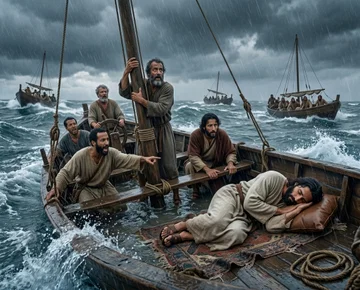
And the same day, when the even was come, he saith unto them, Let us pass over unto the other side.
Translations
And the same day, when the even was come, he says to them, Let us pass over to the other side.
King James Version, KJV Cambridge Paragraph Bible
And the same day, when the even was come, he saith unto them, Let us pass over unto the other side.
And the same day, when the evening was come, he saith to them, Let us pass over to the other side.
Revised Version, American Standard Version
And on that day, when even was come, he saith unto them, Let us go over unto the other side.
And he saith to them on that day, evening having come, 'We may pass over to the other side;'
And on that day, when evening was come, he says to them, Let us go over to the other side:
And he saith unto them, on that day, when evening came, Let us cross over unto the other side;
Berean Standard Bible, Majority Standard Bible
When that evening came, He said to His disciples, “ Let us cross to the other side.”
On that day, when evening had come, he said to them, “ Let’s go over to the other side.”
And on that day, when the evening had come, he said to them, Let us go over to the other side.
Nowe the same day when euen was come, he saide vnto them, Let vs passe ouer vnto the other side.
Douay-Rheims (Challoner revision)
And he saith to them that day, when evening was come: Let us pass over to the other side.
Pictures
Cross-references
- Matthew 8:23-27
And when he was entered into a ship, his disciples followed him.
Jesus calms the storm and challenges the disciples’ fear.
- Luke 8:22-25
Now it came to pass on a certain day, that he went into a ship with his disciples: and he said unto them, Let us go over unto the other side of the lake. And they launched forth.
Jesus and his disciples cross the lake; he calms the storm and calls them to faith.
- Mark 4:39
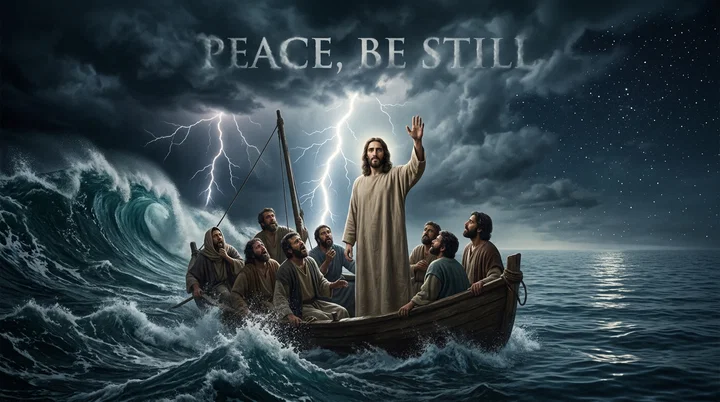
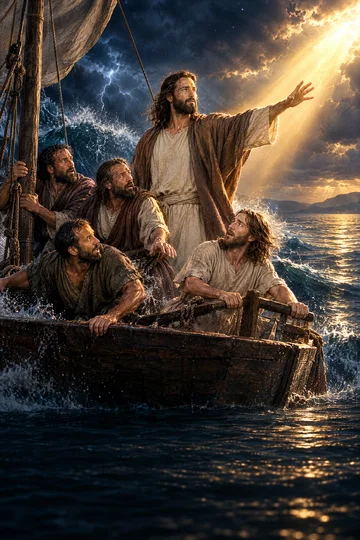
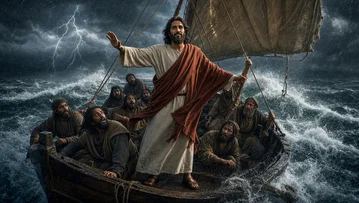
And he arose, and rebuked the wind, and said unto the sea, Peace, be still. And the wind ceased, and there was a great calm.
Jesus stills the storm during the crossing begun in Mark 4:35.
- Psalms 107:29
He maketh the storm a calm, so that the waves thereof are still.
God stills the storm and its waves.
- Matthew 14:25-32
And in the fourth watch of the night Jesus went unto them, walking on the sea.
Jesus walks on the sea and rescues the disciples from danger.
- Matthew 8:18
Now when Jesus saw great multitudes about him, he gave commandment to depart unto the other side.
Records Jesus’ command to depart to the other side.
- Mark 5:1-2
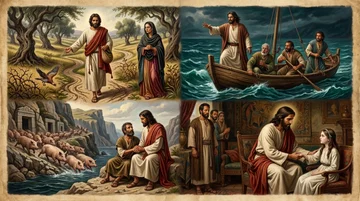
And they came over unto the other side of the sea, into the country of the Gadarenes.
After crossing the sea, Jesus meets a demon-possessed man on shore.
- Mark 6:45-52
And straightway he constrained his disciples to get into the ship, and to go to the other side before unto Bethsaida, while he sent away the people.
Jesus comes to the disciples on the water and calms the storm.
- John 6:16-21
And when even was now come, his disciples went down unto the sea,
Both recount Jesus and his disciples crossing the sea by boat.
- Mark 4:40
And he said unto them, Why are ye so fearful? how is it that ye have no faith?
Jesus rebukes fear and unbelief after commanding them to cross.
- Luke 8:26-39
And they arrived at the country of the Gadarenes, which is over against Galilee.
Parallel account of the crossing and its events.
- Matthew 8:28-34
And when he was come to the other side into the country of the Gergesenes, there met him two possessed with devils, coming out of the tombs, exceeding fierce, so that no man might pass by that way.
Parallel account of Jesus healing the demon-possessed men.
- Matthew 14:30
But when he saw the wind boisterous, he was afraid; and beginning to sink, he cried, saying, Lord, save me.
Peter cries to the Lord for rescue as he begins to sink.
- Mark 5:11-13
Now there was there nigh unto the mountains a great herd of swine feeding.
swine destroyed after crossing
Commentary
Each commentary is drawn from primary sources: the writings of Ellen G. White and Adventist pioneers and periodicals. Each commentary is separate. Its own words are not a quotation; follow the references to read the source passages.
Ellen G. White
25 sources
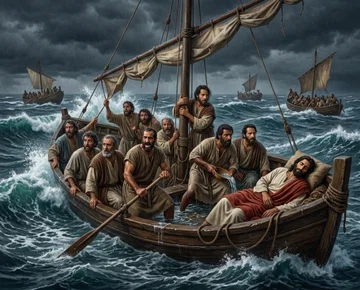
On the evening of the same exhausting day of teaching, healing and ministering to pressing crowds, Jesus dismissed the people and ordered the disciples to cross to the solitary eastern shore to find retirement and rest, showing there is a limit to human endurance that must be renewed for future work.ST Jul 14, 1881DA 333.3–334.1Ms 130, 1903, par. 3–5 They took Him into the boat and set out in calm and pleasant weather with other boats following to learn more, on a night voyage across the Sea of Galilee that ran into darkness and violent storm before landing early in the morning on the beach of the Gadarenes.ST Jul 14, 1881DA 333.3–334.1ST Jan 18, 1877 Because the command to cross came from Jesus Himself, the later peril did not mean He had abandoned them, and their only hope was in Him who was aboard.ST Jul 14, 18812SP 307.1–308.13RED 83.1–2 When the furious storm threatened to sink them they forgot He was on board and struggled in self-reliance and despair until their skill failed, when they should have remembered Him and called at once, for those who trust Him need have no fear.ST Jul 14, 18813RED 85.1ST Jan 18, 18773RED 85.3 When they finally cried out He heard their humble plea and by His commanding voice stilled the tempest and delivered the two demon-possessed men they met on landing, revealing His power over nature and over Satan as the Son of God.3RED 85.22SP 310.12SP 316.23RED 91.1–2EW 139.3
Evening Crossing Ordered
The command to pass over to the other side was given in the evening of that same day, after a day and even days of teaching and healing and ministering to pressing crowds.DA 333.3–334.1Ms 130, 1903, par. 3–5DA 333.1–22SP 307.1–308.13RED 82.2 Jesus was exhausted and weary and hungry, heavily taxed in strength and about to faint, worn by long and arduous labor with scarcely any rest and by incessant work made more severe and harassing by the constant malicious criticism and misrepresentations of the Pharisees.DA 333.3–334.1Ms 130, 1903, par. 3–5DA 334.2–5 Having dismissed the multitude that still remained on the shore, whom He regarded with deepest compassion, He told the disciples to go with Him to the other side, the eastern shore.ST Jul 14, 1881DA 333.3–334.1ST Jan 18, 18772SP 307.1–308.13RED 82.1 He sought retirement and rest from fatigue in a solitary, comparatively deserted place away from dwellings, a sparsely settled region with little contact with Galilee and a more heathen population.ST Jul 14, 1881DA 333.3–334.1DA 333.1–2ST Jan 18, 18773RED 82.1 His leaving the people then shows there is a limit to human endurance, and He must have rest in order to be prepared for future work.Ms 130, 1903, par. 3–5
They took Him into a boat and set out from calm and pleasant weather into night on a night voyage across the Sea of Galilee that began in calm before darkness and a violent storm came, and ended with a landing early in the morning on the beach of the Gadarenes.ST Jul 14, 1881DA 333.3–334.13RED 82.2DA 334.2–5 A number of other boats loaded with people wanting to learn more and eager to hear more of His teaching followed them across.ST Jul 14, 1881DA 333.3–334.1ST Jan 18, 18773RED 82.1 The order to cross came from Jesus Himself.ST Jul 14, 18812SP 307.1–308.13RED 82.23RED 83.1–2 Their later peril in the furious storm therefore did not mean He had abandoned them, and their only hope was in Jesus who was aboard.ST Jul 14, 18812SP 307.1–308.13RED 83.1–2
Faith Tested By Storm
When the furious storm threatened to sink the leaking ship, the disciples forgot that Jesus was on board with them and gave way to despair.ST Jul 14, 18813RED 85.1ST Jan 18, 1877 They feared they would perish, as if He had abandoned them or could not help them in their helplessness.ST Jul 14, 1881DA 334.2–5 Their fear showed unbelief and self-reliance, for they tried to save themselves by their own strength and skill instead of calling on Him.3RED 85.1ST Jan 18, 1877 They remembered only when their skill could not save them that they had set out at His own command to cross, and that their only hope was in Him who was aboard.3RED 83.1–2DA 334.2–5 They should have remembered Him and called on Him as soon as danger appeared rather than struggling alone, and He would have relieved their anxiety.3RED 85.1ST Jan 18, 1877 Those who trust Him need have no fear for themselves, for He is concerned only that they distrust Him.ST Jan 18, 18773RED 85.3
Even after they had wearied themselves in efforts to save themselves, when they finally cried out He heard their humble plea and saved them.3RED 85.1ST Jan 18, 18773RED 85.3 By His voice He commanded the storm to cease, the elements obeyed, and His followers were saved.3RED 85.22SP 310.1 Though He reproved their unbelief for not seeking Him at the very beginning of the trial, He accepted them and gave the help He knew was best.3RED 85.1ST Jan 18, 18773RED 85.3 He does not forsake those in danger who cry to Him, but hears and delivers them.3RED 85.22SP 310.1ST Jan 18, 1877
The passage to the other side was wrought for present believers as well as for the disciples then in the boat.Ms 130, 1903, par. 19 It pictures tempests of temptation, with flashing lightning and waves sweeping over, when believers battle the storm alone, forget there is One who can help, and trust in their own strength until hope is lost and they are ready to perish.Ms 130, 1903, par. 19 The pitching and tossing of the boat while the Master remains on board illustrates how circumstances test faith in crisis.Lt 20, 1896, par. 5–7 Remembering Jesus and calling upon Him to save is never in vain, whether on land or on sea, sleeping or waking, for the call of faith will always meet with response.Ms 130, 1903, par. 193RED 85.3 Living faith in the Redeemer smooths the sea of life and delivers from danger in the way He knows to be best, though He sorrowfully reproves unbelief and self-confidence.Ms 130, 1903, par. 193RED 85.3 The lesson is to keep faith through crises, tell Him the difficulties, and move forward with hope and courage.Ms 130, 1903, par. 19Lt 20, 1896, par. 5–7
The little boat tossed up and down on high running waves with spray dashing over reveals the majesty of God and His works.7MR 280.4–281.2 He holds the winds in His hand and controls the waters, and at one glance beholds the highest heavens and the midst of the sea.7MR 280.4–281.2 In His sight finite beings on the broad deep waters are mere specks, yet angels are sent from His excellent glory to guard the wave-buffeted boat.7MR 280.4–281.2
Power and Mission Shown
By His voice and commanding power Jesus stilled the tempest that threatened His followers on the crossing, speaking peace to the troubled sea so that the elements obeyed and they were saved.3RED 85.22SP 310.16RED 64.23RED 91.1–23SP 28.1–30.1 He trod the foaming, white-capped billows, showing His power to rescue those with Him and to command the forces of nature and control the elements.2SP 316.26RED 64.23RED 91.1–2EW 139.3Lt 1, 1880, par. 5–6 This mighty work over nature revealed Him as the Son of God.3RED 91.1–2EW 139.3 It was evidence of His Messiahship.3RED 91.1–23SP 28.1–30.1
The crossing brought Him across the sea to two demon-possessed men, whom He delivered after the tempestuous night when they landed in the morning.2SP 316.22SP 311.1–312.2 In stilling the tempest on the way He showed that He had power over Satan as well as the storm.2SP 316.22SP 311.1–312.2 The people on the far shore heard from the travelers about the danger of the previous night and His power over the elements, yet they sent Him away because they feared further loss of property.2SP 316.23RED 91.1–2
The disciples themselves witnessed the calming of wind and sea along with His healing the sick, opening blind eyes, unstopping deaf ears, rebuking and casting out devils, and raising the dead to life.EW 139.3 Together with the voice heard and the glory seen at the mount of transfiguration, these works strengthened their faith that He was the Son of God.EW 139.3 When they watched His trial they called this to mind and could not believe He would die, but expected Him to manifest His divine power to deliver Himself from His enemies, punish their cruelty, disperse the bloodthirsty multitude with His commanding voice as He had driven the merchants from the temple, and convince all that He was the King of Israel.EW 139.3 That work on the Sea of Galilee was part of fulfilling His mission as the Pattern Man, just as certainly His mission as toiling as a carpenter at Nazareth hiding His divine mission, as raising the dead to life, and as dying as man's sacrifice on the cross to lift the whole race to a new and perfect life.Lt 1, 1880, par. 5–6
Sources
Pioneers and periodicals
52 sources
On the evening of the same day after long teaching of the great multitude by the sea in parables, Jesus himself commanded his disciples to cross with him to the eastern side at Gadara.ST Feb 4, 1889ST Nov 15, 1910ST Jul 19, 1905ST Jan 23, 1893 That command began the night voyage in a small boat with other boats accompanying, on which a furious storm arose while he slept in the stern and which he then stilled into a great calm.ST Jul 19, 1905ST May 17, 1899ST May 17, 1899ST Jul 24, 1907 The stilling shows his divine power over nature and danger, for sea and wind obey his sovereign word and he remains master of the storm even while sleeping without fear.ST Jan 23, 1893ST Jul 24, 1907RH Feb 16, 1860ST Jan 18, 1877RH Nov 28, 1865 Because the order came from him, the disciples should have trusted his presence in the ship instead of panicking as if forsaken, and he rebuked their fear and shaken faith as unbelief.ST Jul 14, 1881ST Jan 18, 1877RH Feb 16, 1860RH Jan 1, 1861RH Jul 2, 1901 The same power that calmed the waves brings peace to the troubled soul and guilty heart that humbly turns to him in danger, temptation and sin.ST Mar 16, 1904ST Feb 6, 1896ST Jul 24, 1907RH Jul 1, 1862ST Jun 26, 1879
Evening Time and Place
The command was given in the evening of the same day after long hours of arduous labor teaching a great multitude by the sea in parables, including the parables recorded in Matthew 13.ST Nov 15, 1910ST Jul 19, 1905 It had been a busy day of teaching the crowds in parables and familiar illustrations. The crowd had grown so great and pressed so hard that he stepped into a boat pushed out a little from shore and sat there teaching the multitude many things.
The same day, when the even was come refers to the earlier Jewish evening beginning as the sun declined, around the ninth hour, not the sunset beginning a new day, so it is consistent with the day still continuing.RH Mar 19, 1861 The Jews reckoned two evenings within a day, an earlier evening and the actual evening beginning at sunset, and the expression belongs to the earlier one.RH Mar 19, 1861
After dismissing the multitude he sought rest and retirement from fatigue on a desert shore away from dwellings, for the far shore was sparsely settled.ST Jul 14, 1881ST Jan 18, 1877ST Nov 15, 1910 A number of boats loaded with people wanting to learn more followed as they set out.ST Jul 14, 1881ST Jan 18, 1877 He had spent the day teaching the crowd and healing the sick, told the disciples to prepare the boat and cross to the other side, and though exhausted went with them after sending the crowd away.ST Nov 22, 1910 He was weary enough from his work to sleep in the stern during the crossing.ST Nov 15, 1910ST Jul 19, 1905
They set out from calm and pleasant weather into night, hoping the crossing would bring rest from their labor.ST Jul 14, 1881ST Jan 18, 1877 The setting was the Sea of Galilee near Capernaum.ST Nov 26, 1894ST Jul 7, 1898 That sea is also called the sea of Tiberias and Gennesareth and in the Old Testament the sea of Chinnereth, and the crossing was one of his many crossings in his labors of love.RH May 27, 1858 He often crossed the lake there.ST Jul 7, 1898
The destination was the other, eastern side at Gadara, the country of the Gadarenes.ST Feb 4, 1889ST Jan 23, 1893 They crossed toward the opposite shore and, after a tempestuous night at sea, reached it early in the morning.ST Feb 4, 1889 The eastern shore looks near because of its height and the clearness of the air but requires two hours to row across when there is no wind.RH May 14, 1872 It is reached by boat with less risk and touched at points along the shore, with landing by being carried a few yards through the water, and a little rising wind roughens the waves and makes passengers ill.RH May 14, 1872
Crossing to Other Side
It was Jesus himself who spoke the command to cross, both ordering and inviting his disciples to go with him to the other, eastern side at Gadara after the multitude had been dismissed.ST Jul 14, 1881ST Jan 18, 1877ST Jan 23, 1893ST Nov 22, 1910 He sent the crowd away and had the boat prepared because he sought rest from fatigue after long and arduous labor spent through the day teaching the crowd and healing the sick, hoping to reach a desert, sparsely settled shore away from dwellings.ST Jul 14, 1881ST Jan 18, 1877ST Nov 22, 1910 They put out from calm and pleasant weather into night, though a number of other boats loaded with people who wanted to learn more went with them.ST Jul 14, 1881ST Jan 18, 1877 At his request they set out at eventide in a frail boat and bark onto the heaving water, with those accompanying boats around them, while wind and wave would lash and toss them on a foamy path.ST Jul 14, 1881ST Jul 19, 1905ST Apr 1, 1897RH Jul 22, 1873 While the winds rose in wild commotion and dashed against the vessel's side, he slept calmly on a pillow, heeding not the raging billow.ST Apr 1, 1897RH Jul 22, 1873
The saying marks the beginning of the boat journey and night voyage on which he calmed the storm, opening the account of the stilling of the tempest after he had taught the people by the sea and dismissed the audience that had finished hearing him.ST May 17, 1899ST May 17, 1899ST Feb 6, 1896 It begins the crossing in which they set out by boat and the scene that leads to his sleeping through the storm and then calming wind and waves, the fearful storm in which human skill cannot keep the boat safe until, awakened and given command, he brings peace over the sea and those with him.ST Mar 20, 1907 Mark's telling of that stilling is more complete than those in Matthew and Luke, and it stands parallel to the account in Luke 8.STST Feb 6, 1896 It belongs to a biblical account of a miracle presented as what actually happened, not an imaginative or merely poetic story.RH May 10, 1906
That crossing was one of his many crossings of the Sea of Galilee in his labors of love, the sea also called the sea of Tiberias and Gennesareth and in the Old Testament the sea of Chinnereth.RH May 27, 1858 The voyage it began is distinct from the other calming when he comes to them walking on the sea, for here he wakes from quiet sleep in the hinder part of the boat to still the waves.RH May 27, 1858 The evening proposal to cross came after long hours of teaching that included the parables in Matthew 13, and weary from his work he fell asleep in the stern.ST Jul 19, 1905 Worn from the day's work and soothed to rest by the billow, he slept in the stern on a rough pillow in a fisherman's boat while the boat was battered by a furious, violent storm with raging billows and the disciples feared they would perish.ST Jul 24, 1907RH Jul 1, 1862STRH Feb 16, 1860ST Jun 26, 1879
Christ's Power and Care
The stilling of the waves that follows the evening command shows him powerful yet benevolent, a defender and deliverer whose rule is marked by selfless care rather than ambition.RH Oct 30, 1860 The sea was his creature, and by his word and sovereign will governing sea and land he commanded wind and waves to be still into a wondrous calm and great peace.ST Jan 23, 1893ST Jul 24, 1907RH Feb 16, 1860ST Jun 26, 1879ST Jan 18, 1877 The evening crossing led into a furious storm while he slept as the boat was battered, and when awakened he rebuked doubt and spoke, and the tempest became calm for fearful people who thought they would perish.ST Jul 24, 1907RH Jul 1, 1862ST Jun 26, 1879 The scene is his divine power over nature, shown when he stills wind and waves by speaking and then rebukes fear and lack of faith.RH Feb 16, 1860ST Jan 18, 1877
That same power rules over danger and preserves those who trust him, guiding and sustaining the believer through trial so that a believing passenger will not be cast overboard when human help offers little hope.RH Feb 16, 1860ST Jan 18, 1877RH Nov 28, 1865 His power over the waves foreshadowed his authority over the demons encountered on shore, for after spending the tempestuous night at sea they landed in the morning where he delivered two men from demons.ST Feb 4, 1889 He was not himself in danger and had no fear for himself, but slept calmly heeding not the raging billow while winds rose in wild commotion against the vessel.ST Jan 18, 1877ST Jan 23, 1893RH Jul 22, 1873 He remains master of the storm, near to guide and comfort those in distress, concerned that his own distrust him and try to save themselves without calling on him.ST Jan 18, 1877ST Apr 3, 1928
He cares for fearful people, knows their distress, remains their care, and listens to prayer.RH Jul 1, 1862RH Jul 22, 1873 Now he reigns in glory where he never sleeps, hears silent breathing bowed before his throne, and still says to the soul covered by dark billows breaking over it, Peace, be still.RH Jul 22, 1873 His calming of stormy seas is a physical miracle contrasted with the greater miracle of transforming the human heart through grace.RH Aug 7, 1913 The story belongs to the same Jesus who lived, died, rose, ascended, and is expected to appear again, whom those who have known and loved him will recognize without fear.RH Mar 21, 1912
Faith Tested and Rebuked
The evening crossing became a test of faith, for the command to pass over led directly into a violent, storm-tossed passage that tried the disciples' trust.RH Jan 1, 1861ST Jan 17, 1911 The lesson of that night is that faith should endure in danger as well as in calm, and that tempests do not last forever but give way to safe guidance home under a near, protecting hand that works for good.RH Jan 1, 1861ST Jan 17, 1911 Because the order to cross came from Jesus himself, the disciples should have trusted him when the furious storm threatened to sink the leaking ship.ST Jul 14, 1881 Instead they forgot he was on board, gave way to despair, panicked, and feared they would perish.ST Jul 14, 1881RH Jan 1, 1861
When awakened in dire alarm amid the wind and waves, he rebuked their doubts, fear, lack of trust, and shaken faith.RH Feb 16, 1860ST Jan 18, 1877ST Apr 1, 1897RH Jan 1, 1861 That rebuke shows that fear which treats danger as proof of being forsaken is unbelief, and that divine power over nature exposes such fear rather than excusing it.ST Jan 18, 1877RH Feb 16, 1860ST Jan 18, 1877 He was concerned that they distrusted him and tried to save themselves by their own strength and skill without calling on him.ST Jan 18, 1877 Human skill cannot keep the boat safe, but when he is given command he brings peace over the sea and over those with him.ST Jan 18, 1877ST Mar 20, 1907
People in danger should turn to him at the first sign of trouble rather than rely on themselves.ST Jan 18, 1877 Yet even when they call only after struggling alone, he accepts their humble plea and gives the help he knows is best.ST Jan 18, 1877 Those who trust him need not fear because he does not forsake them.ST Jan 18, 1877 His presence in the ship, even while sleeping, means the vessel need not be feared as lost, and the storm does not mean the Lord is absent.RH Jul 2, 1901ST Jan 29, 1880
No power can harm one in whose heart Christ dwells by faith, for the sea was his creature and yielded to the word of God.ST Jan 23, 1893 No storm can overwhelm where he is present, so safety rests only on having him present.ST Aug 7, 1901 He is therefore a refuge in life's storms, calling for continual trust in him.ST Aug 7, 1901ST Jul 28, 1898 His own faith in his power to still the tempest is an example of the kind of faith his followers will have.ST May 5, 1914
Peace for Troubled Hearts
The same power that stilled the raging waves on the sea brings peaceful calm to the troubled soul when the enemy tries to convince a person that he is without hope, through faith that believes all things and hopes all things as a sure and steadfast anchor of the soul.ST Mar 16, 1904 The evening crossing that opens the stilling of the storm belongs to the encouragement of faith and teaches a powerful lesson of faith to troubled souls.ST Feb 6, 1896ST Jul 24, 1907 He who was with the disciples in the boat though he slept while the waves raged, and who calmed the tempest with a word by his authority over sea and storm, can bring peace amid fear and danger and comfort in life's troubles, for he knows distress, remains the care of fearful people, and his power over the storm brings comfort to a troubled soul.ST Jul 24, 1907RH Jul 1, 1862ST Dec 8, 1881
When temptation and sin seem overwhelming, people cannot save themselves by their own strength, but Christ is near and can bring peace when they humbly turn to him.ST Jun 26, 1879 Worn from the day's work he slept while wind and wave frightened the disciples on a foamy path in a frail boat, and when awakened in dire alarm he rebuked doubts and lack of faith and fear, then commanded wind and sea into wondrous calm by his power and sovereign will governing sea and land, so that even wind and sea obeyed his voice.ST Jun 26, 1879ST Apr 1, 1897 That same Jesus who stilled the tempest pictures travelers over the stormy sea of human life whose shores are strewn with wrecks, hopeless of aid and ready in dark despair to give up the struggle, yet gives peace to every guilty soul that seeks glad release from a sense of sin and fear, requiring only faith.ST Apr 1, 1897
He bids the endangered soul come to him onto the heaving water to pass to the other side, speaks a cheering word, extends his powerful arm to shield from harm, regards the cry and keeps the soul, saves from perishing, and reconciles the erring child to God through himself when humbly meeting his will.RH Jun 3, 1873 While winds rose in wild commotion and dashed against the vessel, he slept calmly on a pillow heeding not the raging billow, yet his presence and sovereign power to calm the tempest with a word and to listen to prayer still meets the trembling soul in fear and sorrow on life's dark and troubled ocean.RH Jul 22, 1873 Now reigning in glory where he never sleeps, he hears silent breathing bowed before his throne and still says to the soul covered by dark billows breaking over it, Peace, be still.RH Jul 22, 1873 Raging winds and stormy sea are ever subject to his will, he makes the waves peaceful with his word, he answers the cry of those becalmed and unable to move forward, and he calls the stormy human heart to obey him as wind and wave obey.ST Apr 17, 1901
He gives rest on himself, blessed presence, unmolested peace, soothed fear, and a balm for every ill, so the waves can be breasted by those who rest on his breast, safe and secure and blessed in storm or calm.ST Apr 17, 1901RH Jun 3, 1873 As the waters tossed the boat he slept in peace, then calmed the storm and brought peace to his frightened disciples, showing that Christ's peace can remain amid the world's troubles and can quiet a troubled human heart.ST Feb 22, 1905 His peace was undisturbed by threatening circumstances while the disciples were frightened, and Christians may have peace amid trouble and through him bring peace to frightened hearts, for God's peace belongs to a heart submitted to his will.ST Dec 4, 1901
Life's troubles can stir the depths where true peace dwells and from which pure joy rises, for he can calm a distressed soul as he calmed the storm-tossed sea.ST Jun 26, 1893 Amid danger and despair his voice in the storm brings peace to hearts on the journey that led into the storm at sea.RH Dec 10, 1901 The crossing of the sea by boat where he stills the storm portrays Christ calming a troubled soul.ST Feb 10, 1887
Guidance Through Life's Storms
The evening crossing pictures life's dark and troubled ocean, and travelers over the stormy sea of human life whose shores are strewn with wrecks, hopeless of aid in supreme need and ready in dark despair to give up the struggle.ST Apr 1, 1897RH Jul 22, 1873 The trembling soul in fear and sorrow is still met there by the Lord's presence and sovereign power to calm the tempest with a word.RH Jul 22, 1873 The crossing to the other side becomes a passing over the tumults of passion in the soul, with Christ speaking peace to the turbulent forces and guiding and keeping all the being's resources within His control, so that measure and mission are perfected and home is reached at eventime.ST May 18, 1904
Jesus calls His followers to go with Him to the other side even through storm, and they can follow His direction through calm or storm, trusting His love knows the way and His power can keep a sinking boat.ST Apr 17, 1901ST Jan 9, 1912 His call is a call to heed Him and be saved.ST Jan 9, 1912 He answers the cry of those becalmed and unable to move forward, and He calls the stormy human heart to obey Him as wind and wave obey.ST Apr 17, 1901
The storm-tossed ship pictures a believer's trial in which human help offers little hope, yet faith can rest on His power and wait for Him.RH Nov 28, 1865 He guides and sustains the believer through the storm, so a believing passenger will not be cast overboard.RH Nov 28, 1865 God works for the good of all His creatures, and the Savior's protecting hand stays near to guide through hardship.ST Jan 17, 1911 Tempests do not last forever, and after they cease He guides the battered traveler safely home.ST Jan 17, 1911
The old ship Zion is safe even when outwardly in peril while Jesus appears asleep.ST Aug 7, 1901 Earnest crying in faith brings the Master to rebuke the wind, and no water can swallow the ship where the Master of ocean and earth and skies lies, because all obey His will into peace.ST Aug 7, 1901 Because He could protect His disciples in a storm, a child has reason to trust He can care for her during a thunderstorm too.ST Jun 3, 1880 The lake is remembered as the place where the Lord's voice quieted the tempest, and the calm sea recalls His command that stilled the storm.ST Jul 7, 1898ST Jul 14, 1898
Sources