Translations
Who has ears to hear, let him hear.
King James Version, KJV Cambridge Paragraph Bible, Webster Bible
Who hath ears to hear, let him hear.
Revised Version, American Standard Version, Rotherham's Emphasised Bible
He that hath ears, let him hear.
He who is having ears to hear — let him hear.'
He that has ears, let him hear.
He who has ears, let him hear.”
Majority Standard Bible, World English Bible
He who has ears to hear, let him hear.”
He who has ears, let him give ear.
He that hath eares to heare, let him heare.
Douay-Rheims (Challoner revision)
He that hath ears to hear, let him hear.
Pictures

Cross-references 20 of 24
- Matthew 13:18-23
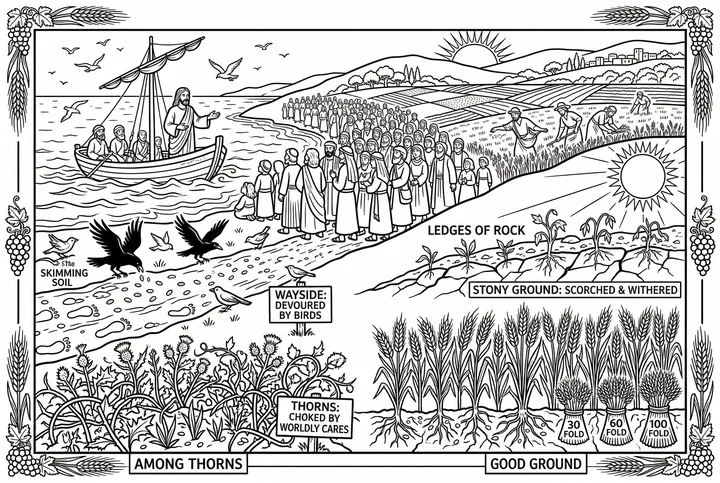
Hear ye therefore the parable of the sower.
Christ explains the different responses to the seed and how hearing the word bears fruit.
- Luke 8:8
And other fell on good ground, and sprang up, and bare fruit an hundredfold. And when he had said these things, he cried, He that hath ears to hear, let him hear.
Luke’s parallel account gives the same admonition after the parable.
- Mark 4:9
And he said unto them, He that hath ears to hear, let him hear.
The parallel account ends with the same call to hear.
- Matthew 13:13-16
Therefore speak I to them in parables: because they seeing see not; and hearing they hear not, neither do they understand.
Contrasts closed ears that fail to understand with blessed hearers who see and hear.
- Isaiah 6:9-10
And he said, Go, and tell this people, Hear ye indeed, but understand not; and see ye indeed, but perceive not.
Both describe hearers who have ears but fail to hear and understand.
- 2 Timothy 4:3-4
For the time will come when they will not endure sound doctrine; but after their own lusts shall they heap to themselves teachers, having itching ears;
People turn their ears from the truth and toward fables.
- Luke 8:18
Take heed therefore how ye hear: for whosoever hath, to him shall be given; and whosoever hath not, from him shall be taken even that which he seemeth to have.
Jesus warns listeners to take heed how they hear.
- Luke 8:15
But that on the good ground are they, which in an honest and good heart, having heard the word, keep it, and bring forth fruit with patience.
Good-ground hearers keep the word and bear fruit with patience.
- Hebrews 4:2
For unto us was the gospel preached, as well as unto them: but the word preached did not profit them, not being mixed with faith in them that heard it.
The preached word benefits hearers only when joined with faith.
- Matthew 13:43
Then shall the righteous shine forth as the sun in the kingdom of their Father. Who hath ears to hear, let him hear.
The righteous shine in the kingdom after the wicked are removed at the harvest.
- Matthew 13:24-30
Another parable put he forth unto them, saying, The kingdom of heaven is likened unto a man which sowed good seed in his field:
The wheat and tares grow together until the harvest.
- Mark 4:11-13
And he said unto them, Unto you it is given to know the mystery of the kingdom of God: but unto them that are without, all these things are done in parables:
Parables invite hearers to seek understanding.
- Acts 28:26-28
Saying, Go unto this people, and say, Hearing ye shall hear, and shall not understand; and seeing ye shall see, and not perceive:
Paul applies the same prophecy to people who resist hearing.
- Mark 4:24
And he said unto them, Take heed what ye hear: with what measure ye mete, it shall be measured to you: and unto you that hear shall more be given.
Jesus warns listeners to take care what they hear.
- Matthew 13:16
But blessed are your eyes, for they see: and your ears, for they hear.
Blesses those who hear and see what earlier prophets longed to witness.
- Mark 4:3-8
Hearken; Behold, there went out a sower to sow:
The sower’s seed bears fruit according to the soil that receives it.
- Isaiah 55:3
Incline your ear, and come unto me: hear, and your soul shall live; and I will make an everlasting covenant with you, even the sure mercies of David.
Hearing God brings life to the soul.
- Psalms 40:6
Sacrifice and offering thou didst not desire; mine ears hast thou opened: burnt offering and sin offering hast thou not required.
Both speak of ears opened to hear.
- Matthew 13:19
When any one heareth the word of the kingdom, and understandeth it not, then cometh the wicked one, and catcheth away that which was sown in his heart. This is he which received seed by the way side.
The wayside seed represents a hearer who does not understand the word.
- Romans 2:13
( For not the hearers of the law are just before God, but the doers of the law shall be justified.
Hearing must lead to doing.
Commentary part 1 of 2
Each commentary is drawn from primary sources: the writings of Ellen G. White and Adventist pioneers and periodicals. Each commentary is separate. Its own words are not a quotation; follow the references to read the source passages.
Ellen G. White
138 sources
The call is to listen with close attention and take the teaching into mind and heart to keep it and act on it.Ms 116, 1909, par. 1Lt 317a, 1905, par. 6–8RH Jul 2, 1908ST Dec 11, 1893Lt 20, 1894, par. 4 It means more than merely hearing sound, requiring a willing, believing mind that receives by faith and obeys, since without faith and obedience the message does not profit.Lt 317, 1905, par. 7–92SP 236.3–237.2ST Sep 13, 1899Lt 126, 1893, par. 2 The same seed brings different results because the soil is the hearer's heart, and hardness, shallowness, or worldly cares choke it while only a prepared, receptive heart bears fruit.TCBMP 140.1–142.13T 111.1COL 56.1–23T 114.1ST Feb 2, 1915 The seed is the word of God and the principles of truth for eternal life, living seed that the great Sower scatters to bring people back to loyalty to God.COL 33.1Ms 34, 1898, par. 5–7Ms 45, 1898, par. 9Ms 24, 1898, par. 9Ms 22b, 1895 [Copy 2], par. 24–27 It closes the parable of the sower, spoken to the gathered crowd to show the nature of God's kingdom and why many were free to accept or reject it with limited immediate response.ST Jun 30, 18812SP 241.1–2COL 30.14RED 86.2–34RED 78.1–2
Parable Setting and Purpose
The closing call to hear ends the parable of the sower, spoken to the gathered crowd by the Sea of Galilee in the open air.ST Jun 30, 1881COL 30.1 Jesus used the visible sowers, fields, birds, rocks, ground and lake around Him to make the lesson memorable, so that seeing those things later would remind hearers of what they heard.ST Jun 30, 18814RED 78.1–2 The sower's work represents Jesus' own work, and the parable explains the nature of God's kingdom and how it would be established.DA 333.1–2
He taught sublime, immortal truth through familiar images from nature and daily life, including seed sown and growing, to make divine truth plain, clear, memorable and meaningful.3MR 333.2–31MR 21.4–22.2ST May 1, 1901 Those illustrations were given to reach people of every class and from different walks of life, reaching many minds and applying to all.2SP 253.2–3ST Dec 1, 1887ST May 1, 1901 They engage mind and heart and awaken thought and sympathy, helping hearers remember the lessons whenever they encounter such images in daily life.DA 253.6–254.13MR 333.2–313MR 242.1–243.1 In this way the unseen is made meaningful and the deep meaning carried by familiar things such as seed is kept before those with receptive hearts.DA 253.6–254.13MR 333.2–3
Truth was spoken in parables as the only way to rebuke sin without causing personal offense, while angels in the form of men mingled with hearers to suggest, criticize, misapply and misinterpret His words.Lt 140, 1903, par. 11–13RH Aug 11, 1903 The same work goes on now, when evil angels in the form of men talk with those who know the truth to misinterpret and misconstrue the statements of God's messengers.Lt 140, 1903, par. 11–13RH Aug 11, 1903 Satan is linked with the religionists of today, so though good seed is sown the soil is unprepared and does not spring up to bear fruit, because the enemy's suggestions and insinuations cause the words of life to lose their force.Lt 140, 1903, par. 11–13RH Aug 11, 1903 Many hear the message but refuse to heed, yet the warning must still be given to all in clear plain tones, not only in public assemblies but by house-to-house work in the Lord's name, with heavenly angels as companions to resist the enemy's attacks on those cooperating with God.RH Aug 11, 1903
His illustrations were meant to awaken thought and sympathy, and those who wanted fuller understanding could ask Him and receive it.4RED 80.213MR 242.1–243.1
The parable illustrates the kingdom of heaven and Christ's work sowing the world with the seed of truth, using natural sowing to explain gospel sowing.COL 33.1Ms 34, 1898, par. 5–7 That sowing brings people back to loyalty to God, with the gospel as the instrument of redemption to reveal God.COL 33.1Ms 34, 1898, par. 5–7Ms 45, 1898, par. 9 It contains the greatest yet most simple lessons, teaching the things of the kingdom by natural things, with human life in all its bearings similar to nature.Ms 45, 1898, par. 9 The seed has life in it but must receive sunshine and living water from the Source of truth to become fruitful.Ms 24, 1898, par. 9 The seed hidden in the earth contains the substance of the precious golden harvest, so truth stays hidden like hidden treasure from those who do not take pains to seek and dig for it, while every branch of knowledge is found by searching the Scriptures and human reasoning can never find out the science of education and deserves little confidence.Ms 45, 1898, par. 9
The parable sets out the different tendencies of the human heart and the kinds of people Christ taught, showing how different kinds of hearts receive His teaching.2SP 241.1–24RED 86.2–3 It explains why His ministry had limited immediate results: people were free to accept or reject Him and were not compelled to believe or obey, and Christ does not force belief or obedience.2SP 241.1–24RED 86.2–3
Christ uses earthly things to represent spiritual truths, and material and spiritual seed-sowing follow a common law, so the natural picture teaches spiritual truth and makes the lesson clear to the mind.Ms 45, 1898, par. 15Ms 28, 1898, par. 12 The things God created repeat His lessons, speaking to the senses so people may take heed to God's voice, and Christ gives the light that reveals the lesson so the resulting glory belongs to Him, not to human teachers.Ms 45, 1898, par. 15Ms 28, 1898, par. 12 All nature is a lesson book and teacher to everyone willing to learn, bringing hearers into contact with nature so with tender hearts and receptive minds they hear the voice speaking in all created things and interpret the spiritual teaching in the scenes they see.Lt 223, 1905, par. 8–10 Its purpose is to brighten the daily task from mere toil with constant reminders of the spiritual and unseen and to open the true philosophy of nature's great lesson book, teaching simplicity and trust in God and how to distinguish the genuine from the artificial, drawing from facts of life and experience familiar to hearers to interest every mind and appeal to every heart.Lt 223, 1905, par. 8–10
Meaning of Hearing Call
The call is to receive the teaching attentively as heavenly seed scattered for minds and hearts that desire light and knowledge, to gather it as precious treasure from heaven.RH Jul 2, 1908ST Dec 11, 1893 As truth is presented the Spirit works on the heart, and when fully accepted it removes selfish purposes and makes the heart ready for continued growth and a harvest for God.Lt 20, 1894, par. 4Lt 12, 1912, par. 1 The seed image carries the hope that truth sown will spring up, take root, and bear fruit to the glory of God.Lt 74, 1899, par. 6–7Ms 81, 1906, par. 22–25 Those who are attentive and receptive in this way are as good ground.RH Jul 2, 1908Lt 20, 1894, par. 4
The words were given because the hearers greatly needed them, and the same words are greatly needed now, so hearing means being placed where the precious words can be understood and can bring forth fruit.Ms 116, 1909, par. 1 The instruction is a warning to be taken seriously, to be read as for life, and to be heeded with watchfulness over oneself.Lt 317a, 1905, par. 6–8Lt 317, 1905, par. 7–9 Hearing therefore demands urgent personal attention that allows no one to blind the mind by human sophistries or by mocking burlesque of sacred things, for such mocking is blasphemy.Lt 317, 1905, par. 7–9
Hearing is more than physical listening; it is attending with desire to benefit, perceiving life-giving power, receiving by faith, and practicing what is heard.ST Sep 13, 1899Lt 126, 1893, par. 2 Without faith and willing obedience even the divine message does not profit, and rejection brings guilt, as seen in Israel's failure to heed and in the refusal of Noah's warning.ST Sep 13, 1899 A preoccupied heart crowded with competing concerns leaves no room for the seed to take root and grow.Lt 126, 1893, par. 2 It requires a receptive believing mind rather than one closed by unbelief, pride, or love of worldly things.2SP 236.3–237.2 Those who refuse truth and neglect opportunity remain unable to understand, while those who follow Christ as the source of light and truth, ready to learn, gain practical understanding of the kingdom of God, and the call also reproves disciples slow to grasp the parable.2SP 236.3–237.2
Those who hear the living oracles every day must hear with purpose to give entrance to the Word and not remain surface-ground or stony-ground hearers.Ms 177, 1897, par. 2–4 Such shallow hearers gather chaff and pass precious treasures as of no consequence, love excited talk and perverse things, emulate the tattling wicked tongue, and sow evil seed broadcast that roots in minds to the injury of souls and bears its harvest.Ms 177, 1897, par. 2–4 True hearing promotes the honor and glory of God by sound speech seasoned with grace and by doing the action God requires in each opportunity of life, while neglect brings guilt, for God lives and reigns.Ms 177, 1897, par. 2–4 It refuses to be content with a thimbleful of truth but taxes the mind in Bible study, because meaning often lies beneath the surface and precious gems are passed by when their value is not discerned, and knowledge so gained becomes like heavenly seeds planted by the divine Sower.Ms 107, 1897, par. 3
The call turns minds from earthly things to heavenly plain truths essential for salvation and unites hearers with Christ in sowing the world with seeds of truth by which knowledge of Him restores the moral image of God in the soul.CT 438.3–4 Refusing to hear is turning from the fountain of true knowledge into studying Scripture only to sustain traditions and enforce man-made observances, making it express sentiments never given, obscuring by mystical construction what was made plain, and disputing technicalities while practically denying the most essential truths, so the Word is robbed of power and evil spirits work their will.CT 438.3–4 The truths to be cherished are the grand, elevating, uplifting, ennobling truths of Scripture sown by a sower from a higher world, whose simplicity graced in a way no human mind could originate proves their divine origin.Ms 76, 1897, par. 12–13 This sowing is the higher phase of education that alone prepares students for the higher school where Christ and God teach and learning to magnify God's name continues through eternity, where even without Greek and Latin earnest zeal to prepare for eternal life carries forward, advancement there matching striving here for knowledge of God and the Redeemer, and reward in immortal life matching advancement in seeking God and His righteousness.Ms 76, 1897, par. 12–13
Having ears means awaking to the spiritual character of the work and arising to its responsibilities and privileges in entire consecration, with the gospel calling for consecration and the sower going forth to sow.Lt 32, 1908, par. 12 Sluggish senses that do not discern, with strong unbelief, fretting, and contentions, disqualify for labor.Lt 32, 1908, par. 12 True hearing spends less on self-indulgence and needless adorning, uses the Lord's money for His sacred cause, and educates children to missionary work and offerings to God.Lt 32, 1908, par. 12 It means being transformed by grace, meditating and studying the glorious truths of the life of the Great Teacher, feeding on the Word, following Christ to the very letter, and holding up the elevated standard of virtue and holiness to prepare students for the higher grade.Lt 60, 1896, par. 6–7 Teachers therefore sow precious seeds in students' minds after the order of Jesus as standard Teacher, refusing to bring in with pen or voice their own ideas, plans, imaginings, schemes, ambitions, likes and dislikes to mold students, and refusing to exalt as all-essential anything Christ did not teach.Lt 60, 1896, par. 6–7
Hearing means Jesus' clear pointed words cut the heart, with seed sown in the mind even when effect is not seen at once, later springing up to God's glory for the saving of souls, revived after the crucifixion and resurrection and repeated for future generations to the close of time.ST May 2, 1878 It means the student keeps searching and never thinks he knows all worth knowing, for there is beautiful harmony beyond ordinary searching, and digging with all capabilities for truth as for hidden treasure brings wonderful development.Ms 34, 1898, par. 14–15 The gospel is the key unlocking mysteries and opening the Jewish economy as compact prophecy of Christ, with parables drawn from nature teaching through the natural world the principles of the spiritual kingdom, so study of God's work in nature gives most precious lessons, and clear spiritual eyesight is needed to discern and gather the doctrines of grace sown like precious jewels.Ms 34, 1898, par. 14–15 Many may hear in one day, results are revealed at the final reckoning, and the seed heard should spring up and bear fruit to God's glory.Lt 10a, 1877, par. 11
Little children have ears when Bible subjects are taught simply and practically, as by molding figures of clay, and truth so heard is seed sown in earliest years remembered wherever their lot is cast to a precious harvest.7MR 12.3–5 The living seed is to be sown deeply in children's hearts, with parents laboring for them while they remain outside Christ.Ms 9, 1868, par. 8 Bible lessons planted in them and repeated at home reach both children and parents as sowing for a future harvest revealed at God's judgment.Lt 2, 1899, par. 51 The closing appeal warns to truly heed the Word rather than ignore counsel and let worldly pleasure shape life, since a young person's influence can lead others away, so hearing requires responding to truth and guiding others toward Christ.1MR 379.1–380.1 The call to all who can hear to listen and heed is reflected in appeals to respond to neglected light of truth, people in Washington and Takoma Park are described as having ears among the highway hearers, and its setting is Christ teaching His disciples in sowing truth to lead people to Him.HMW 14.4RH Sep 28, 1905Ms 116, 1909, par. 7
Different Hearts Receiving Truth
The same seed and the same sower produce different results because of the condition of the soil, which is the hearer's heart and the way the word is received.COL 56.1–2ST Feb 2, 1915 No hearer needs to remain unreceptive or to let worldly things choke the word, for by resisting the Spirit people become inattentive to God's word and are themselves responsible for the hardness and unchecked growth that hinder it.COL 56.1–2ST Feb 2, 1915 The Spirit seeks to awaken hearers, and their own choices decide whether the word takes root and bears fruit.ST Feb 2, 1915 Yet the heart can still be prepared through repentance and diligent effort, with God's help, so that the word can take root and bear fruit.COL 56.1–2
People respond differently to the same truth: some let it go unheeded because their hearts have been hardened by neglected moral duty and corrupt influences, some receive it eagerly but abandon it when trials expose shallow character, and some accept it yet allow love of wealth, worldly cares, pleasures and honors to choke it.TCBMP 140.1–142.13T 114.1 Some do not retain it, some fail under trial, and some let other things choke it, while only a few are nourished and established in the truth.3T 114.1 Merely hearing truth or being stirred and affected by it is not enough; it must be received deeply, lived out, and allowed to transform the heart.TCBMP 140.1–142.13T 111.1
Wayside hearers have hardened hearts, fail to recognize the sacred character of the truth, remain among corrupting influences and temptations, and at last lose their regard for the truth they first received.3T 111.1 A hardened, unresponsive heart is like stony ground that does not truly receive the word, so the word cannot take root or bear fruit; a heart softened by God's grace is needed to receive the word and enter the kingdom.Lt 13, 1898, par. 9–10 Others let the spirit of the world choke the seed sown in the heart so that it fails to spring up and bear fruit.Lt 21, 1868, par. 6–7 The seed is truth of heavenly origin opposed to the heart's natural disposition, and when it falls on poor soil it will not grow successfully without careful culture and earnest, diligent toil to bring all powers into subjection to Christ and to keep the body under, lest one who has preached to others becomes a castaway.Lt 53, 1876, par. 22–25
The Pharisees show hearts that are barren, hopeless, profitless soil where the seeds of heavenly truth cannot take root.ST Dec 3, 1912ST Dec 17, 1894 Their self-deluding feeling of superiority and exalted self, claiming all faith, honor and love for themselves, keeps the word from growing.ST Dec 17, 1894 That same hard soil supposes others are at fault, speaks strong hard words of reproof and condemnation that crush hope and courage, lets bitterness take root at the goodness of heart seen in true Christians whereby many are defiled, and in fullness of evil thoughts suspects even the purest and makes a man an offender for a word.ST Dec 17, 1894
Many who are stirred by the teaching soon lose its impression and return to indifference when worldly cares and temptations return, while others carry the teaching into daily life and begin a holier life by living out its principles.4RED 79.2–80.12SP 234.1–2 The visible scene of the different kinds of ground and the sowing helps fix the teaching in the hearers' minds.4RED 79.2–80.1 Some eagerly catch the words while only dimly understanding them, yet even so the words can take root in their hearts and later bear good fruit.2SP 295.1 So the gospel seed took root in some who witnessed Jesus before the judges and later grew into faith in Him as the world's Redeemer.3SP 121.2
Nicodemus shows this seed-and-soil working, for Jesus sowed truth in him but for three years it produced little apparent fruit.4RED 18.1 During that time he watched Jesus, pondered His teaching, and weighed the evidence carefully, until the raising of Lazarus gave him decisive evidence of Jesus' Messiahship.4RED 18.1 A heart may be a hard path that resists the message, but Christlike personal ministry can soften even a hard heart so that the seed of truth takes root.COL 57.1–2GW 185.1 Removing prejudice and making a favorable impression prepares people to receive it, and the seed of truth is gladly received by hearts God has prepared even where prejudice and false zeal are also met.HRP 10.1CH 34.3 Believers should therefore be taught the foundations of Christian life: to make Christ's life and character their own, bear burdens, deny natural inclinations, serve and endure hardship, trust Christ, and care for the lost, for such service turns attention from self and helps the truth remove worldly distractions and uproot evil tendencies.COL 57.1–2
Seed Growth and Preparation
The seed is the Word of God, the principles of truth concerning eternal interests sown in the heart.Lt 29, 1890, par. 10–12Ms 22b, 1895 [Copy 2], par. 24–27 It is living seed with life in it, but it must receive sunshine and living water from the Source of truth to become fruitful.Ms 24, 1898, par. 9 When shared in ways that awaken inquiry and allow it to take root, that seed under the Holy Spirit's influence bears fruit unto salvation.Ms 22b, 1895 [Copy 2], par. 24–27
The heart is a garden and field where good seed, the seed of truth, and bad seed can be sown.STE 74.2–75.1ED 111.1–2 As a garden must be prepared for natural seed, so the heart must be prepared for the seed of truth, and no raw unprepared heart can be expected at once to yield a harvest.STE 74.2–75.1ED 111.1–2Ms 28, 1895, par. 6 The soil must be broken up by repentance, and the evil growths that choke the good grain must be uprooted.ED 111.1–2 Hardened hearts need much labor of plowing and harrowing and breaking up and subduing to bring them into fit condition for planting, and this requires skill, discernment, painstaking thoroughness, and intelligent harmonious cooperation of the divine and the human by those appointed to watch for souls.11MR 37.1–3Ms 182, 1897, par. 3–4 Surface work and haphazard half-effort show in a poor harvest, while faithful labor to prepare the soil is rewarded with a harvest to be garnered for food for the necessities of man.11MR 37.1–3Ms 182, 1897, par. 3–4 The Spirit of God must refine and discipline the heart so it can produce fruit to God's glory.Ms 28, 1895, par. 6 Tilling the literal soil teaches this work continually, by weeding out wrongs and stirring up the fallow ground of the heart, so education joining book knowledge with agricultural lines trains hearers to prepare the heart to receive truth.Ms 139, 1906, par. 51 This lesson is made practical by having children prepare soil and sow seed while being taught the correspondence between natural and spiritual sowing at each step as the plant grows.STE 74.2–75.1ED 111.1–2 Little children may be Christians with an experience in accordance with their years, which is all that is required of them, and they need every advantage from parents to form characters after a lovely similitude.STE 74.2–75.1
The human mind is the field and soil where heavenly thoughts are to be impressed, with the Word giving themes for thought and meditation upon eternal realities.Ms 67, 1890, par. 6 Between an uncultivated field and an untrained mind there is a striking similarity.CT 136.4 When thoughts are captivated and directed in a wrong channel by fictitious reading and storybooks, the field is preoccupied and the channel obstructed, leaving the mind unprepared for the impressions to be made upon it.Ms 67, 1890, par. 6 The more powerful the capabilities of the mind, the greater the evil if thus perverted.Ms 67, 1890, par. 6 In the minds of children and youth the enemy sows tares that will spring up to bear evil fruit unless parents keep watchful guard with unceasing care.CT 136.4 Cultivating the soil of the mind means teaching children to reject trashy, exciting tales and to turn to sensible reading that leads to interest in Bible story, history, and argument, reading that throws light upon the Sacred Volume and quickens desire to study it.CT 136.4
Spiritual sowing requires diligent, persevering labor in preparation of the soil, sowing of the seed, and culture of the crop.ED 111.1–2 Truth must be impressed point by point in plain teaching and Bible readings, with questions asked and answered in the plainest manner so points and texts are fastened in the mind until the seed springs up and bears fruit.Lt 29, 1890, par. 10–12 Long sermons fail this pattern because hearers retain only a few points that lose force, while other things come in to choke the seed of truth.Lt 29, 1890, par. 10–12 The sowing must be done from the very first in a dignified, godlike manner that gives character to the heavenly truth, with great care in presentation, carrying minds along guardedly.Lt 14, 1887, par. 19 Practical godliness must be woven into doctrinal discourses, and the teachings and love of Christ used to soften and subdue the soil for the seed.Lt 14, 1887, par. 19 Confidence is gained by working to know people, the elevated character of the work is kept up, and publications, papers, and pamphlets prepare the minds of the reading class for preaching, so that wise beginning and wise prosecution bring success while the sower stays humble and teachable to lead others in truth and righteousness.Lt 14, 1887, par. 19
The word may remain hidden in a cold, worldly, selfish heart before the Spirit brings it to life and it bears fruit.GW92 402.3 Even when teaching seems to have little effect, if the work has been wrought in God some lessons of divine truth will linger in the memory of the most careless, and the Holy Spirit will water the seed sown so that often after many days it will spring up and bear fruit to the glory of God.STSE 97.2 Those who sow cannot know which work will prosper; they are to do their work and leave results with God.GW92 402.3 After hearers have received the truth sown in their hearts, the Spirit's power enables further workers to bring the work to maturity and gather the harvest, ripening it through His power.Lt 37, 1897, par. 10–1112MR 347.4–348.1 Christ today sows good seed in human hearts, and the tender plant needs sunshine and shower, summer and winter, dew, frost, and wind to develop and bear fruit.Ms 138, 1899, par. 43 All who receive the word into good and honest hearts will reap if they do not faint, with Christian character formed by grace.Ms 138, 1899, par. 43 Seed sown in a meeting produces fruit with effects extending into eternity.Lt 43, 1894, par. 5
The great Sower scatters the seeds of truth in the soil of the heart, and parents are given the work of preparing their children's hearts for that sowing.CTBH 67.3ST Jan 23, 1901RH Feb 28, 1907 They do this by educating them in nurture and admonition, making the Word of God the standard against worldly fashions, keeping them close in early years in simple habits, and teaching cheerful and willing obedience and submission for usefulness.ST Jan 23, 1901RH Feb 28, 1907 So truth sown in early years grows into Christian manhood and womanhood and secures future happiness.ST Jan 23, 1901RH Feb 28, 1907 The mind is especially impressionable in early life, and when good seed is sown in good soil it bears fruit unto eternal life.4T 499.2 Early instruction helps the seed bear lasting fruit, for teaching is as seed growing to harvest.9MR 44.1–45.1
The parable, studied through daily sowing and harvest, shows God working in nature and making the things of the kingdom plain.6T 185.1–2 Working the soil teaches precious lessons for the soul: as grounds are cultivated, the garden of the soul must be cultivated with the same care for life and character to produce precious fruit for the benefit of others and for the Master.Ms 56, 1896, par. 1–10 Seed must be sown in faith and hope with expectation of results, sowing seed to reap a harvest of its kind and planting trees to yield rich fruit.Ms 56, 1896, par. 1–10 That which is sown will also be reaped again, and work done on missionary ground in simplicity, faith, and hope brings fellowship and sheaves, for one soul is worth more than land.Ms 56, 1896, par. 1–10 Even the most unpromising fields and seeming mistakes become the Lord's work to give light and convert souls who desire truth.Ms 56, 1896, par. 1–10
Truth is received in hearts prepared to hear, and patient, non-controversial religious meetings can help prepare hearts for the seed.3T 166.3–167.2 Hearing alone is not enough: preaching sows the seed, and personal care helps cultivate the heart so the seed can take root.6T 68.1 As land is prepared for seed and harvest, souls need spiritual cultivation and discipline.Ms 168, 1897, par. 5
The Word can be understood by those who diligently search it, and those who receive its truth are responsible for sharing it with others, sowing the good seed in their minds and preparing them for the Spirit's work.Ms 71, 1898, par. 6 True grace must be received before it can be shared, for grace is active, penetrative, and aggressive.Lt 117, 1896, par. 5–7 By hearing the Word new ideas flash into the receptive heart and mind, and unless the heart is barricaded against light, that living seed cast into living soil regenerates the heart and produces fruit increasing more and more.Lt 117, 1896, par. 5–7 The mind must be kept free from every species of selfishness and covetousness, which is idolatry, that grace may rule in the soul temple.Lt 117, 1896, par. 5–7 Then souls are captivated with contemplating God, accept the providences and blessings within reach, obtain all possible knowledge of truth and grace in order to diffuse it to those they meet, and work the works of God.Lt 117, 1896, par. 5–7
Sowing Truth in Mission
Poor soil never excuses the sower from sowing, for truth is to be proclaimed everywhere even when hearers respond differently and no immediate visible result appears.7T 35.3Lt 184, 1908, par. 6–9Ms 25, 1908, par. 6–7 The seed falls on different kinds of ground, yet diligent sowing brings some to good ground where it springs up and bears abundant fruit in varying measure, as every laborer will find.Ms 1b, 1874, par. 2–45MR 300.4–301.1Ms 25, 1908, par. 6–7 The message is to be given widely, including among seekers of more light, and hearers must receive and believe it or face condemnation for rejecting it.Ms 1b, 1874, par. 2–4Lt 184, 1908, par. 6–9 Cities especially are to be sown and persisted with until thoroughly warned.Ms 25, 1908, par. 1
The divine Teacher sowed with care, anxiety, self-denial and continued sacrifice for others, and that example calls for self-denying, earnest, persevering labor that trusts God to quicken the seed to life.TBC1872 111.1 The precious seed may lie dormant until grace convicts the heart, then awaken, spring up and bear fruit to God's glory, so workers labor unselfishly as co-workers with Christ and heavenly angels without growing weary in well-doing.TBC1872 111.1 Followers are therefore to sow wherever they go, visiting people in homes and sharing the gospel, earnestly sowing the world and sharing the bread of life with perishing souls.6T 323.2–324.1MC 29.2–30.1Ms 127, 1903, par. 3 As He sowed wherever He went, workers carry truth to homes and new districts and plant it in willing listeners who hear and heed.Ms 127, 1903, par. 321MR 353.6–354.2STB 725.3–726.1
Sowing is not to be left for ministers to do the greatest part, but men not called to ministry are to labor according to ability.Lt 86, 1907, par. 17Lt 330, 1906, par. 3–51MR 79.1–2 As a worker gives himself unreservedly he gains experience for ever more successful work, and the influence that drew him to Christ helps him draw others, so that even without public speaking he is a minister born of God.Lt 86, 1907, par. 17 Those who receive truth go forth after conversion and transformation of character and daily habits to hold neighbor meetings and awaken interest in others.Lt 82, 1898, par. 5 More self-denying workers are needed to share the work in this way.Lt 330, 1906, par. 3–51MR 79.1–2
Gospel truth as seed is sown widely through books containing present light, placed in all homes with everything possible done to leave them with as many as possible, without holding back even from businessmen.Ms 157, 1902, par. 11 The books carry light to seekers and the sown seed springs to fruit, doing good wherever taken hold of in earnest and richly repaying workers with highest-value lessons learned.JIOKP 44.1–3Ms 157, 1902, par. 11Lt 294, 1907, par. 8–10 This includes the campaign to circulate books for schools and sanitariums, where the light and knowledge in the books is sown as workmen circulate them to those unacquainted with truth, and lively interest in the work brings abundant blessing.Lt 74, 1908, par. 2 At large gatherings workers must give thorough instruction in best methods of presenting Christ's Object Lessons and Ministry of Healing and periodicals such as Signs of the Times, since failure to appoint presenters loses great blessings for the people and means for institutions.JIOKP 44.1–3Lt 294, 1907, par. 8–10
The simple truths of the parables are as needed today as when Christ was present in person.Lt 29, 1905, par. 18 Well-trained nurses going among families to awaken households, with evangelists and Bible workers laboring in cities, find many opportunities to sow, with work for every energetic, thorough, earnest worker.Lt 29, 1905, par. 18 The Christian physician or nurse gently plants truth in the suffering heart open to divine influence, and physicians draw hope and consolation from Scripture to sow in ready patients.CH 372.3–373.1Lt 20, 1902, par. 26–28 Teaching and singing that leave a good impression are also a sowing of spiritual seed in hope it will bear fruit.Lt 190, 1900, par. 6
The gospel ministry as sowing teaches how the work is to be done, with house-to-house labor after public meetings especially essential.Ms 7, 1900, par. 16–19 Places never worked, like Newcastle and Maitland and towns toward Queensland near Cooranbong, are ready fields where the message must go by Bible readings, preaching and camp meetings.Lt 111, 1898, par. 7 The seed is not to be crowded in one place but cast wherever possible, reaching towns and cities with little warning.Lt 182, 1909, par. 2 The call to hear belongs with carrying the word to people and places not yet reached, even where prospects seem unpromising.Lt 318, 1908, par. 12–13Lt 182, 1909, par. 2
The seed is to be spread openly and clearly through speech so people can receive it.Ms 1, 1874, par. 4MC 21.4 Presenting Christ as Saviour and proclaiming redeeming love wins hearers to take root and bear fruit.GW 158.1 Practical generosity such as providing a meal for visitors sows truth in inquiring hearts, an act by which the giver loses nothing.Lt 176, 1907, par. 9Lt 220, 1907, par. 13
Gathering a large company daily and feeding many is no true evidence of success or advancement, for true success is souls saved through well-defined methods and spiritual help given to helpers and those served.Lt 182, 1902, par. 16–20 Hearing means helpers and patrons take interest in present truth and are fortified against temptation, so helpers do not grow indifferent and the business does not oppose truth.Lt 182, 1902, par. 16–20
Teachers and strong young men rooted in faith and closely connected with God as channels of light are to drop truth into other minds.Lt 44, 1887, par. 12 Entering higher schools to learn the theology taught there in order to meet prevailing errors, they sow truth while there, making impressions and giving tendencies that endure to eternity.Lt 44, 1887, par. 12 Sowing religious teaching in this way may bring fruit in some who hear.Lt 190, 1900, par. 7–8
Truth is to be sown wherever opportunity offers.CH 304.2–3 Christ spoke plainly so none would misunderstand, scattering heavenly doctrine concerning this life and the life to come, which is planted in minds and must be patiently cultivated.Ms 178, 1899, par. 19–20 Apostles and followers keep sowing to an abundant harvest unto eternal life.Ms 178, 1899, par. 19–20 The work is urgent, with God's Spirit upon hearts as it is proclaimed, and gospel seeds through instruction and meetings are to be heard by those reached.Ms 4, 1913, par. 4Ms 178, 1899, par. 19–20
Sources