Translations
And he said to them, He that has ears to hear, let him hear.
King James Version, KJV Cambridge Paragraph Bible
And he said unto them, He that hath ears to hear, let him hear.
And he said to them, He that hath ears to hear, let him hear.
Revised Version, American Standard Version
And he said, Who hath ears to hear, let him hear.
And he said to them, 'He who is having ears to hear — let him hear.'
And he said, He that has ears to hear, let him hear.
And he was saying—He that hath ears to hear, let him hear!
Berean Standard Bible, Majority Standard Bible
Then Jesus said, “ He who has ears to hear, let him hear.”
He said, “ Whoever has ears to hear, let him hear.”
And he said to them, Whoever has ears, let him give ear.
Then he said vnto them, He that hath eares to heare, let him heare.
Douay-Rheims (Challoner revision)
And he said: He that hath ears to hear, let him hear.
Pictures

Cross-references
- Luke 8:4-15
And when much people were gathered together, and were come to him out of every city, he spake by a parable:
The same parable describes the different outcomes of hearing the word.
- Matthew 13:9
Who hath ears to hear, let him hear.
Both give Jesus’ call to hear the parable.
- Mark 4:14-20
The sower soweth the word.
The parable explains how hearers receive the word and whether it bears fruit.
- Isaiah 6:9-10
And he said, Go, and tell this people, Hear ye indeed, but understand not; and see ye indeed, but perceive not.
Both describe hearing without understanding.
- Matthew 13:16
But blessed are your eyes, for they see: and your ears, for they hear.
Blesses those who hear Jesus’ teaching with believing understanding.
- Matthew 11:15
He that hath ears to hear, let him hear.
Both call hearers to listen and heed the word.
- Luke 14:35
It is neither fit for the land, nor yet for the dunghill; but men cast it out. He that hath ears to hear, let him hear.
Both call hearers to heed the teaching.
- Mark 4:23
If any man have ears to hear, let him hear.
Both call those with ears to hear to listen attentively.
- Hebrews 3:7-8
Wherefore ( as the Holy Ghost saith, To day if ye will hear his voice,
Hearing God’s voice today requires not hardening the heart.
- Revelation 3:22
He that hath an ear, let him hear what the Spirit saith unto the churches.
Both call those with ears to hear to heed Christ’s message.
- Matthew 13:18-23
Hear ye therefore the parable of the sower.
A parallel account of the parable.
- Hebrews 4:2
For unto us was the gospel preached, as well as unto them: but the word preached did not profit them, not being mixed with faith in them that heard it.
The preached word profits hearers only when received with faith.
- Mark 4:13
And he said unto them, Know ye not this parable? and how then will ye know all parables?
Christ identifies the sower parable as key to understanding the others.
- Mark 4:1
And he began again to teach by the sea side: and there was gathered unto him a great multitude, so that he entered into a ship, and sat in the sea; and the whole multitude was by the sea on the land.
boat pulpit before the crowd
- Luke 8:11
Now the parable is this: The seed is the word of God.
Defines the seed in the parable as the word of God.
Commentary
Each commentary is drawn from primary sources: the writings of Ellen G. White and Adventist pioneers and periodicals. Each commentary is separate. Its own words are not a quotation; follow the references to read the source passages.
Ellen G. White
43 sources
Spoken at the close of the parable of the sower, it is a call to listen carefully and take its teaching to heart rather than merely hear its words.2SP 232.1–233.34RED 79.2–80.14RED 78.1–2 To have ears to hear is to be willing to receive and understand with a good and honest heart, receiving the word with faith and acting upon it.4RED 78.3–79.1Lt 106, 1898, par. 3–74RED 82.1–2 The seed sown is the word of God and is the same, while the result depends on the condition of the soil, which is the heart.COL 33.1COL 30.1COL 56.1–2 Some resist it, some receive it briefly then fall away under trial, and others let cares, riches and pleasures choke it, while those who truly hear receive it deeply, live by it and bring forth fruit thirty, sixty and a hundredfold.TCBMP 140.1–142.1Ms 1, 1874, par. 5TBC1872 111.1 Hearers remain free to accept or reject, and those who welcome the light given receive more until their light grows, while those who refuse remain in darkness by their own choice yet need not remain unreceptive.2SP 241.1–24RED 86.2–3COL 56.1–24RED 82.1–2ST May 10, 1877
Parable Setting and Wording
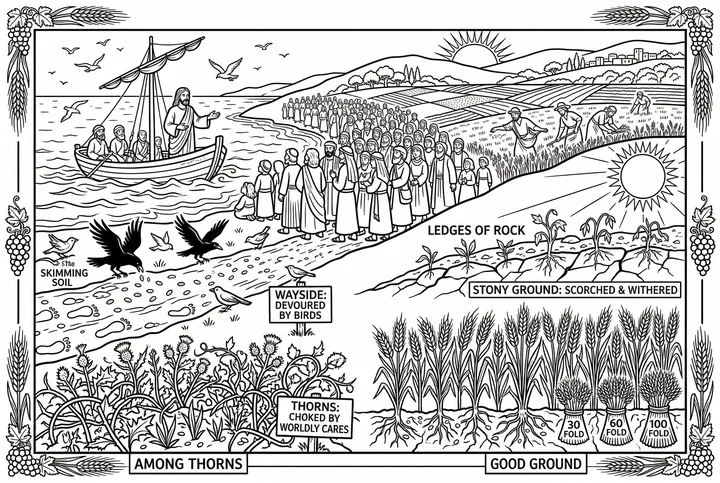
The saying belongs to the parable of the sower, taught to a crowd from a boat by the Sea of Galilee where the seed sown is the word of God.COL 33.2–34.1COL 30.1Lt 15, 1876, par. 7 It was spoken early in the morning after a night spent in prayer, seated in a fisherman's boat pulled out a little from shore to teach without interruption a pressing multitude on the beach, patient toward those under temptation and tender toward the sorrowing and disheartened.2SP 232.1–233.3 Lake, mountains, spreading fields, sunlight, sowers and reapers side by side, fruitful valleys, barren rocks, and birds were in plain sight around the hearers.2SP 232.1–233.3 It stands as the closing appeal of the parable, calling hearers to listen carefully and take its teaching to heart.2SP 232.1–233.34RED 79.2–80.14RED 78.1–2
The call urges attentive hearing that receives the meaning of the parable and not merely its words, heeding what is taught through the truths of God's kingdom and grace sown like seed to bring people back to loyalty to God.4RED 78.3–79.1ST Jun 30, 1881COL 33.1Ms 91, 1901, par. 41–43 It was given when people were rejecting Jesus as Redeemer because He did not fulfill their hopes for a Messiah who would establish a temporal kingdom and exalt their nation.4RED 80.2 The parable was designed to awaken thought, prompt inquiry, and lead to clearer understanding, with fuller explanation available to those who asked as the disciples did.ST May 3, 18772SP 235.1–2ST May 3, 1877
Many who heard received and cherished the teaching, while the Pharisees willfully closed their ears and eyes by refusing to understand so that their hearts remained unreachable.ST May 3, 1877ST May 3, 1877 Earthly things are thus made a lesson book for spiritual truths, with the scenery and familiar things of nature employed to illustrate deliverance and salvation.2SP 232.1–233.3Ms 28, 1898, par. 12Ms 25, 1890, par. 11 Seeing those objects afterward would recall the lessons as daily reminders, the natural sights helping impress the truth on minds and the created world repeating the lessons and speaking eternal truths.2SP 232.1–233.34RED 78.1–2Ms 28, 1898, par. 12 In unadorned simplicity the parable remains pure and beautiful.2SP 232.1–233.3
What True Hearing Means
To hear is more than to listen with the physical ear; it is to receive the word with consecrated ears and a good and honest heart, to understand it, to receive it with faith, and to act upon it, for the word does not profit those who hear without faith and practice.Lt 106, 1898, par. 3–74RED 82.1–2 It reproves slowness to grasp Christ's teaching and urges hearers to open their minds and believe.4RED 82.1–2 No one is forced into belief or obedience, but all remain free to accept or reject Christ; those who follow Him and accept instruction gain practical knowledge of the kingdom of God, while those who neglect opportunity or refuse the truth remain in darkness by their own choice.2SP 241.1–24RED 86.2–34RED 82.1–2 Having ears is not enough, for a person must be willing to listen and no one can compel him, so the first essential work is to gain the attention of the people that they may consider the cross and redemption.Lt 59, 1895, par. 9–1019MR 269.3–270.1
Having ears to hear means having a heart to feel and respond to the messages God sends both to believers and to unbelievers.18MR 378.4–379.1 Such ears are found even among unbelievers who have not had great light and have not rejected light and truth, evidenced by shed tears and responding hearts, while those who profess the truth can lack them, being hardened in unbelief and not knowing the time of their visitation.18MR 378.4–379.1 Hearers are responsible when they resist the Spirit and allow hardness of heart or worldly growths to hinder the word, yet they need not remain unreceptive.COL 56.1–2 The response depends on the condition of the heart, and hearers can cooperate in preparing their hearts so that truth can take root and grow.COL 57.1–2COL 56.1–2 As soil is broken up and weeds are removed for a crop to grow, so repentance prepares the heart, and evil tendencies must be uprooted through choice and earnest effort in the strength of Jesus.COL 56.1–2ED 111.1–2
Those who welcome the light given receive more knowledge and privilege until their light grows, and their response can bring salvation to themselves and benefit to others; those who reject it remain in darkness, yield to temptation, and lose even the knowledge they had.4RED 82.1–2ST May 10, 1877 Christ taught men to join their own efforts with divine power to overcome sin.4RED 86.2–3 The truth is made plain through simple illustrations, and those who truly hear retain its lessons: God's commandments require human kindness, compassion, and love, and Christ's righteousness stands against false interpretations and traditions.Ms 66, 1890, par. 6
Hearts Soils and Harvest
The closing call to hear bids listeners to attend to the parable and take its meaning to heart, for the parable sets forth the different kinds of human hearts that were taught and explains why so much teaching produced so little immediate result.2SP 241.1–24RED 86.2–3 People were left free to accept or reject, never forced into belief or obedience, and receiving depended on the heart.2SP 241.1–24RED 86.2–3 They were taught to join their own effort with divine power in order to overcome sin.4RED 86.2–3
In the parable the seed and the sower remain the same while the differing results turn entirely on the soil, and the seed sown is the word of God through which the truths of the kingdom and grace are sown to bring people back to loyalty.COL 33.1COL 30.1COL 56.1–2 Hearing the truth does not itself secure keeping it, for some resist it, some receive it briefly and then fall away under trial, and others allow worldly cares, riches, and pleasures to choke it.TCBMP 140.1–142.1 Genuine hearing receives the truth deeply enough to live by it and bear fruit.TCBMP 140.1–142.1
The teaching stirred its hearers, making the gospel attractive and understandable so that a new and holier life seemed desirable.ST May 3, 18774RED 79.2–80.12SP 234.1–2 Yet for some the impression soon faded amid worldly cares, temptations, and unfavorable surroundings when they returned to daily life.ST May 3, 18774RED 79.2–80.12SP 234.1–2 Others kept the lesson in mind, carried its principles into daily life, and entered upon a holier life.ST May 3, 18774RED 79.2–80.12SP 234.1–2
Those who hear and receive the truth may bear fruit afterward, help save others, and hand the instruction on to future generations.ST May 2, 1878 Seed on good ground brings forth fruit, some thirty, some sixty, and some a hundredfold, while seed on poor soil yields no fruit unto eternal life.Ms 1, 1874, par. 5 The seed may lie dormant for a time, yet God can awaken it to life and make it fruitful, so that truth heard only once may still take root and later bear fruit in conversion, which is why sowing should continue while people are coming to hear.Ms 1, 1874, par. 5TBC1872 111.1Lt 202, 1897, par. 6
Hearts can be as hard as the beaten path, but love shown through personal ministry can soften them so the seed of truth takes root.GW 185.1 The seed is truth sown in the mind, and because the mind is especially receptive in early life, good seed planted in good soil can bear fruit unto eternal life.4T 499.2
Sowing Work and Application
The call to hear pictures Christ's own work and that of His servants in sowing the gospel seed upon all kinds of soil, where seed on good ground brings forth fruit, some thirty, some sixty, and some a hundredfold, while that falling on poor soil yields no fruit unto eternal life.Ms 1, 1874, par. 5 The sower does not cease his work because some yields nothing, for the message is worldwide and is not to be localized but is to be given to all cities and all villages and proclaimed in the highways and the byways.Ms 1, 1874, par. 5 The seeds of truth are to be sown in every place, and wherever access can be gained the Word is to be held forth, sowing beside all waters, with no discouragement though the result of labor may not be seen at once, by speaking Christ's words, working in His lines, and following His example of going forth everywhere.Ms 1, 1874, par. 5
Preaching the theory of the truth with its evidences sows seed in souls who listen, and the seed springs up and bears fruit to the glory of God when Christ as the Saviour of the world and the cross of Christ and His redeeming love are exalted in connection with the theory and a practical application is made to the heart.4T 393.3 Discourses that are wholly argumentative and do not present the cross leave souls unbalanced, and when some are listening to the last sermon they will ever hear or will never again have the chain of truth brought before them, that golden opportunity lost is lost forever.4T 393.3 Sowing truth wherever one goes calls people to listen attentively and heed the truth and requires careful, prayerful study of the Bible.4T 285.1 Because seed of truth heard only once may yet take root in a heart and later bear fruit in conversion, when people are coming to hear, meetings should continue so the seed can be sown.Lt 202, 1897, par. 6
The heart is soil that must be carefully prepared for the Sower to scatter the good seed, and parents must prepare the soil of their young children's hearts by keeping the moulding of the infant mind in their own hands till eight or ten years of age.CTBH 67.3 They are to make the open air amid flowers and birds the schoolroom and the treasures of nature the textbook, opening God's great book of nature before them as fast as their minds can comprehend it so the lessons will not soon be forgotten, and using time and labor to cultivate their minds and form correct habits instead of following the fashions of the world.CTBH 67.3 In teaching children, truth is sown like seed through plain lessons using objects and nature, and the good these lessons accomplish will be revealed at the great day of God.6T 205.1 Teaching is seed sown in the heart that grows and bears fruit unto a harvest, so books of science and philosophy where skepticism is concealed, vague fanciful fairy stories, and works on Scripture subjects that weave in fanciful human interpretations plant a harvest of infidelity that is reaped in the depravity of the human family.CT 186.3–187.2 Cultivation of the soil and work in garden and field brings children and youth into direct contact with nature and nature's God, and education with flower gardens and lands for cultivation is in accordance with God's directions for the instruction of youth, giving health and happiness and impressions that do not fade because they are associated with objects continually before the eyes.CT 186.3–187.2
The first essential work is to get the ears of the people, but having ears is not enough since people must be willing to listen and no one can compel them to hear.Lt 59, 1895, par. 9–1019MR 269.3–270.1 In Tasmania this meant people more loyal to their ministers than to God refused to come and listen because their ministers warned them against hearing, so only a few heard the sown seed.Lt 59, 1895, par. 9–10 Refusing to hear is refusing to contemplate the cross of Calvary and the great plan of redemption, while being willing to see wondrous things out of the law of God gains the soul.Lt 59, 1895, par. 9–10 Gaining their attention so they can consider the cross and redemption opens the way for the few who hear and accept the truth to teach others until an army is raised up to rally round the standard, for the Lord has a work for each and all to do and not one is excused.Lt 59, 1895, par. 9–1019MR 269.3–270.1 It is an appeal to those who are able to hear to listen and heed by reading the Bible and taking seriously its warnings about Satan's deceptions, including false teachings that distort the sanctuary and Christ's ministry of salvation, undermine the atonement, and weaken confidence in Scripture and the doctrines associated with the third angel's message.MWISDAP 17.2–4
Sources
Pioneers and periodicals
57 sources
Christ's call to hear is an urgent appeal for everyone able to hear to listen attentively, take in its meaning, understand it and obey it, not merely hear its sound.ST Jun 30, 1881ST May 3, 1877ST Nov 26, 1894 It was spoken in the parable of the sower, where visible sowing was used to make the gospel attractive and understandable, awaken thought and lead inquiring minds to clearer understanding.ST Jan 28, 1889ST May 3, 1877ST Jan 28, 1889 In that parable the seed is the word of God sown by preaching, and the human mind and heart are the soil in which it is received.RH Dec 21, 1905RH Jul 10, 1856ST Oct 19, 1882 Hearing that saves means receiving the word with a prepared, receptive and honest heart by faith, keeping it and laboring patiently until it takes root, governs heart and life, and bears abundant fruit.RH May 11, 1869RH Jul 10, 1856ST Jun 16, 1887RH Oct 22, 1914RH Jul 7, 1874 The same truth produces different results according to the heart, for it may be taken away before it is understood, abandoned under trouble and persecution, or choked by worldly cares, riches and pleasures, while those who welcome the light receive more and those who refuse it remain in darkness and lose even what they had.ST May 10, 1877RH Aug 6, 1861RH Jul 10, 1860
Call to Attentive Hearing
He that hath ears to hear is Christ's urgent appeal to all who can hear to listen attentively, to receive the meaning, to understand it and to heed it, and not merely to hear its words.ST Jun 30, 1881ST May 3, 1877ST Jan 28, 1889ST May 3, 1877ST Nov 26, 1894 It calls hearers to attend to the teaching just given, to take its lesson to heart and to take it in, prompting inquiry that leads to clearer understanding of truth.ST May 3, 1877ST Jan 28, 1889ST May 3, 1877ST Jan 28, 1889RH May 11, 1869 Hearing in this sense must lead to fruitful action, for the good-ground hearers are wise and diligent, understand what they hear, keep it and labor patiently so that the seed bears fruit, while the other hearers fail to produce a lasting harvest.ST May 3, 1877RH May 11, 1869 The teaching stirred its listeners and made the gospel attractive and understandable, but some soon let its impression fade amid worldly cares and temptations, while others carried its principles into a holier life and many received and cherished what they heard.ST May 3, 1877ST May 3, 1877
The saying stands in the parable of the sower in Mark 4:3-20, where Jesus used the visible work of sowing to teach lessons meant to reach the minds and hearts of his hearers.ST Jan 28, 1889ST May 3, 1877RH May 14, 1872RH Sep 17, 1857ST Jun 27, 1911 His illustrations were meant to awaken thought, to make the gospel attractive and understandable, to prompt inquiry and to lead to clearer understanding and to a serious taking of its meaning.ST May 3, 1877ST May 3, 1877ST Jan 28, 1889 There the Word is presented as seed whose reception depends on the hearer, with the hope that those who receive its message deeply will bear fruit.RH Sep 17, 1857ST Jun 27, 1911 The same sowing had application in every age since it was spoken but is most applicable at the present time, fulfilled every time the seeds of present truth are sown in new fields, with the sower applying more particularly to the minister but more generally to all who hold the truth, and the sower putting seed into the ground and afterwards reaping of the same impresses the certainty that men will receive hereafter according to the deeds of this life.RH May 14, 1872RH Sep 17, 1857
Those who wanted fuller understanding could ask him and receive an explanation, as the disciples did, while those who willfully refused to understand closed their ears and eyes so that their hearts remained unreachable.ST May 3, 1877ST May 3, 1877ST Jan 28, 1889 The parable encourages faith by showing the possibilities attending the seed that fell on good ground, and carefully studied it yields rare treasure in encouragement of faith.ST Feb 6, 1896 It also serves as a key to understanding Christ's other parables.RH Oct 6, 1904
Heart as Soil
In the parable the seed is the word of God, the truth taught from the Bible, words of truth and spiritual power, and sowing it is preaching it, while the human mind and heart and human lives are the soil in which it is received.RH Dec 21, 1905RH Jul 10, 1856ST Oct 19, 1882ST Apr 11, 1900ST Aug 5, 1913 The seed of truth can revive people, and the desired fruit is obedience to the truth.RH Dec 21, 1905 Though small and insignificant, people are valuable because they can receive that seed, and what they have, however little, is asked to be given and can be made much from.ST Aug 5, 1913 The gospel is the good seed, and when sown in young minds as in good ground it can produce an abundant harvest, so children should be encouraged to attend worship and hear the sermon since impressions made on them may last and lead to salvation.ST Mar 18, 1889
Hearing requires a prepared, receptive heart, with faith supplying the conditions for the words to grow and act with power.RH Jul 10, 1856RH Oct 22, 1914ST Apr 11, 1900RH May 11, 1869 Merely receiving them as words does not make them grow, and the fault is not in the seed.ST Apr 11, 1900 People must be receptive to divine influences, or those influences may be scattered over them in vain.RH Oct 22, 1914 The word bears fruit when received by a heart prepared to hear it, and responsibility for fruitlessness rests on those who hear.RH May 11, 1869
As the husbandman watches his land, so the heart must be searched and examined to cast out ill weeds that naturally take possession of it and in which every ill weed will take root and spread itself.RH Jul 10, 1856 The thorns are worldly care and the thistles are worldly vanity, along with unprofitable weeds and roots of bitterness, and worldly cares, desires and rival priorities.RH Jul 10, 1856RH Aug 6, 1861 When this work is rightly performed, the soil is ready for the good seed to spring up and prosper under divine grace, as corn grows by rain and sunshine from above.RH Jul 10, 1856 Truth takes root and endures only when it becomes the heart's ruling principle and is given room to govern heart and life, for shallow or divided commitment fails under persecution and trial.RH Aug 6, 1861 The heart's soil can be made fit to bear fruit by doing in faith what is commanded and need not remain unfruitful.ST Jun 9, 1898
Teaching should prepare the hearer to receive the truth without obscuring it.ST Oct 19, 1882RH Oct 7, 1915 Good truth can be smothered by excessive scolding, needless repetition, or explanations that bury it.ST Oct 19, 1882 Bible teaching therefore calls for prayerful care that its message falls on good ground, takes root, and bears fruit in due time.ST Oct 19, 1882RH Oct 7, 1915 The ground is prepared by plowing, presented as historical upheavals preparing for the Word that is sown and to be listened to.ST Sep 19, 1911 Hard and unresponsive hearts can be softened by the story of Jesus and his love so that the seed takes root and leads to everlasting life.RH Oct 23, 1913
Fruit and Different Responses
Hearing means receiving the truth so that it can take root and bear fruit leading to salvation, and the call to hear is a call to attend to the parable and its lesson until it issues in fruitful action.RH May 11, 1869ST Jun 16, 1887RH Jul 7, 1874 The good-ground hearers are wise and diligent, understand what they hear, keep the Word with an honest and good heart, labor patiently, and bear abundant fruit, and responsibility for fruitlessness rests on those who hear rather than on the seed.RH May 11, 1869RH May 11, 1869 Even those described as slow to understand can comprehend the plan of salvation and be saved through the merits of Christ when the message of salvation is heard and received.RH Dec 24, 1908 Preaching should therefore bring the word home to the guilty person and their sin so that it takes root in the conscience, since the enemy may take it away and leave it unfruitful.ST Jun 16, 1887
The same truth produces different results according to the condition of the heart, and truth takes root and endures only when it is given room to govern heart and life as its ruling principle rather than being crowded out by worldly cares, desires, riches, pleasures and rival priorities.RH Aug 6, 1861RH Jul 10, 1860 The Word may be taken away by the enemy before it is understood, abandoned when trouble, persecution, temptation or trial comes, choked by life's cares and pleasures, or remain without effect, while others receive it and bear abundant fruit.RH Jul 10, 1860RH Jan 9, 1913 Shallow or divided commitment fails under persecution and trial, and some who respond and give themselves to Christ may afterward fall away.RH Aug 6, 1861RH Jan 9, 1913
The teaching stirred its listeners and made the gospel attractive and understandable, but some soon let its impression fade amid worldly cares and temptations, while others carried its principles into a holier life.ST May 3, 1877 Those who hear and receive the truth may later bear fruit, help save others, and pass the instruction on to future generations.ST May 2, 1878 Seed once heard can be cherished for a long time, even eleven years, and when clear light comes it grows until the hearer and his wife take their stand for the truth.ST May 5, 1881
Though small and insignificant, people are valuable to God because they can receive that seed, and God asks them to give what they have, however little, and can make much from it.ST Aug 5, 1913 Receptive soil brings forth a lasting harvest, producing neighboring churches that become the backbone of the believers in a district, as shown by the German Russian wheat-growing colonies in the province of Entre Rios receiving the seed and yielding several churches.ST The sower putting seed into the ground and afterwards reaping of the same impresses the certainty that men will receive hereafter according to the deeds of this life, so that no man can reap differently from what he has sown and every ground of complaint about final destiny is closed against the sinner.RH Sep 17, 1857 If he sows tares he will reap only tares, if he will not sow wheat he cannot expect wheat, and if he will not sow at all he cannot expect a harvest, for the present lifetime is the world's sowing time in which all mankind are putting in seed and preparing for a future harvest either good or bad.RH Sep 17, 1857
Responsibility Light and Warning
The call to hear places the blame for unfruitfulness on the hearer rather than on the seed, for the word bears fruit only when it is received by a heart prepared to hear it.RH Oct 22, 1914RH May 11, 1869 Attentive hearing is required, and people must stay receptive to divine influences or those influences may be scattered over them in vain.RH Oct 22, 1914RH May 11, 1869
Those who welcome the light they are given are granted more knowledge and privilege, their light grows, and their response can bring salvation to themselves and benefit to others.ST May 10, 1877 Those who reject the light remain in darkness, yield to temptation, and lose even the knowledge they once had.ST May 10, 1877 So the Pharisees, by willfully refusing to understand, closed their own ears and eyes until their hearts remained unreachable.ST May 3, 1877
Hearers are divided into those who have ears to hear and those who do not.RH Sep 25, 1856 Those who have ears are people still willing to listen to truth and must be given extended opportunity to hear it preached, while those without ears heard truth before, refused it, lost interest, fell into spiritual slumber, and will remain asleep until it is forever too late.RH Sep 25, 1856 Having ears to hear means being willing to listen to the truth when prejudice is laid aside, and people who would not hear at one time can gain ears to hear later as outside prejudice gives way.RH Apr 9, 1872 Publicly presented truth triumphs in the minds of honest people and does them good.RH Apr 9, 1872RH Jul 31, 1856
Repeated warnings to hear show the danger of dulling spiritual hearing by neglecting what God says or letting worldly noise crowd it out, so believers must train themselves to listen for God's quiet guidance. The verse calls all to hear Christ's voice saying I AM today without hardening the heart as the twelve did, lest they lose the infinite comfort and strength in the assurance that He is.ST Jun 12, 1901 Hearing means fixing the mind upon the fact that He is when in deep trouble or temptation, listening to His voice and letting the soul be swallowed up in contemplating it until lost to everything else.ST Jun 12, 1901 For one who so hears, knowing not only that Christ is near but that His presence creates, upholds and saves, trouble becomes light as air, temptation loses its power, the tempter flees, and anything can be endured.ST Jun 12, 1901 Letting Him be the I AM gives everything that is in Him, for with Christ God freely gives all things, and such confidence leads to seeing Him as He is.ST Jun 12, 1901
Sowing Truth in Mission
The parable of the sower illustrates the work of the people of God in the last days, to whom are committed the great truths of the last message for a perishing world.RH May 14, 1872 It had application in every age since it was spoken, but it is most applicable at the present time, and it is fulfilled every time the seeds of present truth are sown in new fields.RH May 14, 1872 The sower applies more particularly to the minister, but more generally to all who hold the truth.RH May 14, 1872 Hearing means that churches take hold of all the truth, live it out, and send those who are able to carry the last message to perishing people, and the spread of that truth depends on the response of the churches, for when they act God can work through them with great power.RH Feb 5, 1867
The message must be heard and shared, and the gospel seed is to be sown to every kind of person whether or not they heed it.RH May 18, 1916 Gospel preaching and the circulation of publications is sowing seed that calls for hearing and receiving, requiring perseverance in sowing whenever there is opportunity while praying for God's blessing, with hope that despite opposition and slow results some seed will grow in hearers and produce an abundant harvest of converts.ST Aug 12, 1880 The seed to be heard is truth, and sowing it is the quiet work of isolated believers who tell others they keep the right day, who approach tradespeople and acquaintances with missionary literature and ask help for missions, and who by their daily lives prepare the way for definite efforts by ministers to follow.RH Nov 11, 1909
Gospel truth preached in meetings is seed sown in the hearts of hearers, including outsiders, and that seed will in time spring up and bear fruit unto eternal life, bringing new spiritual life and fresh impetus for work.RH Feb 10, 1910 Seed that has taken root in some hearts is to be prayed for to grow and spread to others.RH Apr 2, 1867 The Word takes root in a hearer after he receives a tract and hears the Bible explained.
Congregations described as having an ear to hear are receptive to the message and their interest increases.RH Aug 2, 1870 The verse applies to people attending meetings who are willing to hear and desire to understand the message.RH Jan 9, 1855 Meetings are open not only to church members but also to anyone willing to hear.RH Nov 27, 1866 Presenting the truth to all such willing listeners is a proper purpose of a general meeting to advance present truth, and the meeting seeks people ready to hear and heed what is taught for plain preaching.RH Jun 22, 1869RH Oct 2, 1856RH Jun 8, 1869
Applying Word at Home
He that hath ears to hear is called to attentive hearing, and the seed of the lesson is blessed teaching that should take root in the hearts of children, though distraction can divert it before it settles and bears fruit.ST Jun 18, 1885 The gospel is the good seed, and when sown in young minds as in good ground it can produce an abundant harvest.ST Mar 18, 1889 Children should therefore be encouraged to attend worship and hear the sermon, since impressions made upon them may last and lead to their salvation.ST Mar 18, 1889
The sermon is like seed sown in soil, and it calls for listening attentively to the word.ST Mar 11, 1886 Criticism at home can act like a wind that carries that seed away before it takes root in a receptive heart.ST Mar 11, 1886ST Dec 2, 1897 Such criticism distracts the listener and spoils the good soil in which the message might have taken root.ST Dec 2, 1897
The call to hear urges taking seriously the counsel that follows it: warn the unruly, comfort the fainthearted, support the weak, be patient toward all, and pursue what is good among believers and toward everyone.RH Feb 17, 1852 Truth once taught remains, and the truth taught to Tom remained in him.RH Dec 10, 1867 Seeing faith expressed in compassionate action helps it take root and bear fruit, for faith joined with works helps teaching that has been heard take root and ripen.RH Dec 10, 1867ST Feb 11, 1875
The word must be attended to and received so that it takes root in the conscience and bears fruit leading to salvation.ST Jun 16, 1887 The enemy may take it away and leave it unfruitful.ST Jun 16, 1887 Preaching should therefore bring the word home to the guilty person and to his sin.ST Jun 16, 1887
Sources