Matthew 14:29
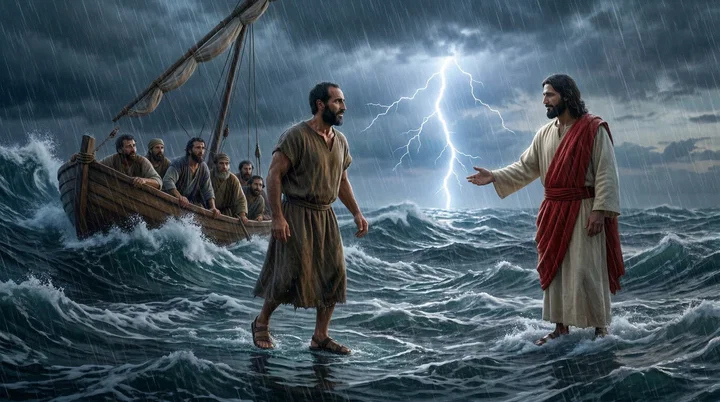
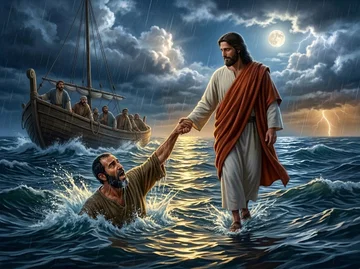
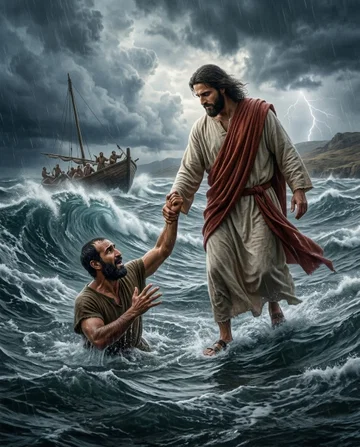
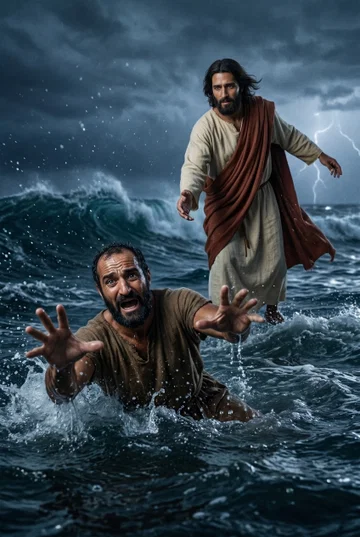
And he said, Come. And when Peter was come down out of the ship, he walked on the water, to go to Jesus.
Translations
American King James Version, King James Version, KJV Cambridge Paragraph Bible
And he said, Come. And when Peter was come down out of the ship, he walked on the water, to go to Jesus.
And he said, Come. And when Peter had come down out of the boat, he walked on the water, to go to Jesus.
And he said, Come. And Peter went down from the boat, and walked upon the waters, to come to Jesus.
And he said, Come. And Peter went down from the boat, and walked upon the waters to come to Jesus.
and he said, 'Come;' and having gone down from the boat, Peter walked upon the waters to come unto Jesus,
And he said, Come. And Peter, having descended from the ship, walked upon the waters to go to Jesus.
And, he, said—Come! And, descending from the boat, Peter walked upon the waters, and came unto Jesus.
“ Come,” said Jesus.Then Peter got down out of the boat, walked on the water, and came toward Jesus.
“ Come,” said Jesus. Then Peter got down out of the boat and walked on the water to go toward Jesus.
He said, “ Come!”Peter stepped down from the boat and walked on the waters to come to Jesus.
And he said, Come. And Peter got out of the boat, and walking on the water, went to Jesus.
And he saide, Come. And when Peter was come downe out of the shippe, he walked on the water, to goe to Iesus.
Douay-Rheims (Challoner revision)
And he said: Come. And Peter going down out of the boat, walked upon the water to come to Jesus.
Pictures
Cross-references
- John 6:19-21
So when they had rowed about five and twenty or thirty furlongs, they see Jesus walking on the sea, and drawing nigh unto the ship: and they were afraid.
Jesus walks across the water to the disciples’ boat.
- Mark 6:48-51
And he saw them toiling in rowing; for the wind was contrary unto them: and about the fourth watch of the night he cometh unto them, walking upon the sea, and would have passed by them.
Jesus walks across the stormy sea to the disciples and calms their fear.
- Matthew 14:33
Then they that were in the ship came and worshipped him, saying, Of a truth thou art the Son of God.
The disciples worship Jesus and confess him as the Son of God.
- Matthew 26:69-75
Now Peter sat without in the palace: and a damsel came unto him, saying, Thou also wast with Jesus of Galilee.
Peter’s denial exposes how little he could endure for Christ.
- Isaiah 43:2
When thou passest through the waters, I will be with thee; and through the rivers, they shall not overflow thee: when thou walkest through the fire, thou shalt not be burned; neither shall the flame kindle upon thee.
God promises to be with his people amid dangerous waters.
- Matthew 8:24
And, behold, there arose a great tempest in the sea, insomuch that the ship was covered with the waves: but he was asleep.
Both texts describe the disciples facing a storm at sea with Jesus present.
- Matthew 14:25
And in the fourth watch of the night Jesus went unto them, walking on the sea.
Jesus comes to the disciples walking on the sea amid the storm.
- Hebrews 11:6
But without faith it is impossible to please him: for he that cometh to God must believe that he is, and that he is a rewarder of them that diligently seek him.
The passage says faith is necessary to please God and explains Peter’s walking as dependent on looking to Christ.
- Luke 22:32
But I have prayed for thee, that thy faith fail not: and when thou art converted, strengthen thy brethren.
Jesus prays that Peter’s faith will not fail under testing.
- John 13:37
Peter said unto him, Lord, why cannot I follow thee now? I will lay down my life for thy sake.
Peter declares his readiness to follow Jesus and lay down his life for him.
- Acts 2:14-41
But Peter, standing up with the eleven, lifted up his voice, and said unto them, Ye men of Judæa, and all ye that dwell at Jerusalem, be this known unto you, and hearken to my words:
Peter later boldly preaches and brings many to faith.
- Hebrews 12:2
Looking unto Jesus the author and finisher of our faith; who for the joy that was set before him endured the cross, despising the shame, and is set down at the right hand of the throne of God.
Looking unto Jesus is the safety that let Peter walk.
Commentary
Each commentary is drawn from primary sources: the writings of Ellen G. White and Adventist pioneers and periodicals. Each commentary is separate. Its own words are not a quotation; follow the references to read the source passages.
Ellen G. White
39 sources
At His word Come Peter left the boat and walked on the water toward Jesus, upheld by Jesus' power as an act of trust in His call.COS 86.12SP 267.2–268.1ST Dec 29, 1887 While his eye of faith was fixed steadily upon Jesus he walked securely and safely, for the change afterward was in Peter and not in Jesus or the water.Ms 10, 1891, par. 7–10COS 86.12SP 267.2–268.1 When he turned his eyes from Jesus to the wind and waves and danger he became afraid, his faith gave way and he began to sink, which revealed his weakness where he thought himself strong.Ms 10, 1891, par. 7–10COS 86.1ST Dec 29, 1887 When he recognized his danger and cried for help, Jesus immediately reached out and grasped and saved him, and such an appeal in sore need is never in vain.COS 86.1RH Feb 6, 1913DA 382.1 In the same way a sinner can be saved only by beholding Jesus and trusting His atoning merits, and the Christian treads the stormy billows of the world safely only while keeping faith fixed on Christ rather than on self or on threatening appearances around.Ms 10, 1891, par. 7–103RED 62.2–63.12SP 269.1–2DA 382.1SPBC 151.4–152.1
Setting After Feeding Multitude
The night of this walking on the water followed the feeding of the vast multitude seated on the grassy plain in the twilight of the spring evening, when all shared food created by divine power from five barley loaves and two small fishes, showing Jesus to be the prophet foretold by Moses.DA 377.1 After that miracle the people's hopes rose that Jesus was the long-awaited Deliverer who would bring Israel earthly prosperity, defeat its enemies and restore its dominion.DA 377.2 When He refused to be made King of Israel the disciples left Him with dissatisfied hearts and unholy ambition.3RED 60.1–62.1
In obedience to His command to go to the farther side, the disciples spent many hours, all night, rowing fruitlessly against a furious storm, adverse winds and white-capped billows in a crowded boat.DA 3763RED 60.1–62.1ST Jul 18, 1878DA 383.2–384.1 Driven from their course, their vessels would not obey their will, and they were driven hither and thither.3RED 60.1–62.1ST Jul 18, 1878 Despite their strength and skill their strength was exhausted at the oars until they laid down their oars in despair.3RED 60.1–62.1ST Jul 18, 1878 They expected to perish and be engulfed.3RED 60.1–62.1ST Jul 18, 1878
Jesus Comes On Stormy Sea
From the distant shore His eye pierced the darkness, saw the disciples' danger and read their thoughts, never losing sight of them through the fearful storm and never forgetting them.3RED 60.1–62.1DA 381.1Lt 5, 1876, par. 9–15 His watchful eye of tender sympathy and pitying love, tender as a mother watching a suffering child, rested upon them, while angels guarded the small boat.Lt 5, 1876, par. 9–157MR 280.4–281.2 He holds the winds in His hands and controls the waters, and the grandeur of the sea points to God's majesty, and a trial of their faith was necessary until their ambition was quelled and they humbly prayed for help.3RED 60.1–62.1DA 381.1Lt 5, 1876, par. 9–157MR 280.4–281.2
In the fourth watch of the night, when they had given up all for lost and despair was taking the place of hope and they believed themselves lost, while tempest and billows talked with death, Christ whom they had left on the other side appeared walking firmly and calmly upon the white-capped billows toward them to help them and would not suffer one of them to perish.3RED 60.1–62.1ST Dec 29, 1887ST Jul 18, 1878Lt 5, 1876, par. 9–15Ms 138, 1897, par. 1–4 A flash of lightning revealed a man stepping upon the water, exercising power over the elements.3RED 60.1–62.1Ms 138, 1897, par. 1–4 Bewildered by the uselessness of their efforts, they were seized with unspeakable terror, thought it was a spirit omening their destruction and a sure precursor of immediate death, and cried out in great fear.3RED 60.1–62.1ST Jul 18, 1878
They then recognized His form and voice as He advanced, His voice heard above the roar of the elements saying It is I; be not afraid.DA 3763RED 60.1–62.1ST Jul 18, 1878 Instead of heralding death He came as the messenger of life, they cried out supplicating His help, received His reassurance and hailed Him with joy as their Deliverer.3RED 60.1–62.1ST Jul 18, 1878 The scene quickly changed from the horror of despair to the joy of faith and hope in the presence of the beloved Master, so that His presence turns sorrow into joy and despair into faith and hope, restores confidence that it is Jesus the Master, and removes anxiety and dread and fear of death.4T 288.1–2ST Jul 18, 1878Lt 5, 1876, par. 9–15 The tempest was suddenly stilled and the boat reached land.4RED 87.2DA 383.2–384.1
The adventure of Peter and its result, with the sudden stilling of the tempest and landing of the boat, was afterward faithfully recounted by the disciples to the wondering crowd that had come from Bethsaida and found Jesus in the synagogue.4RED 87.22SP 307.1–308.1DA 383.2–384.1 That earlier deliverance by walking on the water remained in their minds as their hope in danger during a later storm when they were afraid and could no longer save themselves.3RED 83.1–2
Peter Walks Toward Jesus
At the single word Come — command and invitation and bidding in one — Peter came down out of the ship, left the boat and stepped onto the stormy water, and walked on the water to go to Jesus toward Him.2SP 267.2–268.1ST Dec 29, 18873RED 62.2–63.1DA 381.4–62SP 269.1–2 At Jesus' command he was able to walk, for Jesus' power made it possible and upheld him, and his stepping out was an act of trust in response to Jesus' call.COS 86.12SP 267.2–268.1ST Dec 29, 18873RED 62.2–63.1DA 381.4–6
Peter's first step came from love for Jesus and desire to be near Him, to meet Him and worship Him, and Jesus granted his request.2SP 267.2–268.1ST Dec 29, 18872SP 269.1–2 The incident lays bare his earnest, impulsive character and his mingled faith and unbelief after Jesus had assured the disciples of His presence.2SP 267.2–268.12SP 269.1–2RH Feb 6, 1913
Soon, however, in self-satisfaction and pride Peter glanced back toward his companions in the boat to see whether they admired him, turning his eyes from Jesus to seek their admiration.ST Dec 29, 18873RED 62.2–63.1DA 381.4–62SP 269.1–2 That pride and unbelief brought doubt and fear.ST Dec 29, 18873RED 62.2–63.1DA 381.4–6
Faith Fails Then Rescues
While his eye of faith was fixed steadily upon Jesus and he looked unto Him, Peter walked securely and safely on the water, upheld by Christ's power, and apart from that power he would have perished.Ms 10, 1891, par. 7–102SP 267.2–268.1DA 381.4–6Lt 3b, 1881, par. 3–5 The change when he began to sink was in Peter himself, not in Jesus or in the water, for the same power that enabled him to walk continued unchanged.COS 86.1 At Jesus' command he had been made able to walk toward Him, and his continuing to walk depended on keeping his eyes upon Jesus.Ms 10, 1891, par. 7–10COS 86.12SP 267.2–268.1
When the boisterous wind and high waves came between him and Jesus, he took his eyes from Jesus and looked at the waves, the troubled billows and the danger, attending to the threatening waves and focusing on the danger.Ms 10, 1891, par. 7–10ST Dec 29, 18873RED 62.2–63.1DA 381.4–6Lt 3b, 1881, par. 3–5 Then he was afraid and fear overwhelmed him, his faith failed and gave way and his footing was lost and he began to sink.Ms 10, 1891, par. 7–10COS 86.1DA 381.4–6RH Feb 6, 1913 Through unbelief and self-exaltation he very nearly lost his life, leaving him subdued and silent with no reason to boast over others, which revealed his weakness and that the point where he thought himself strong was where he was weak.3RED 62.2–63.1DA 381.4–6DA 382.2
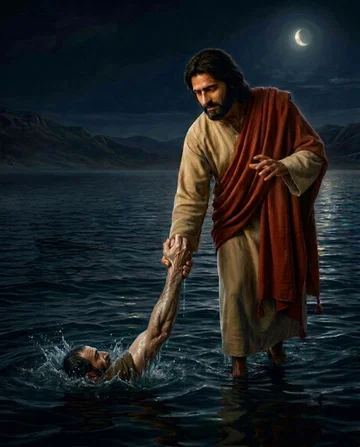
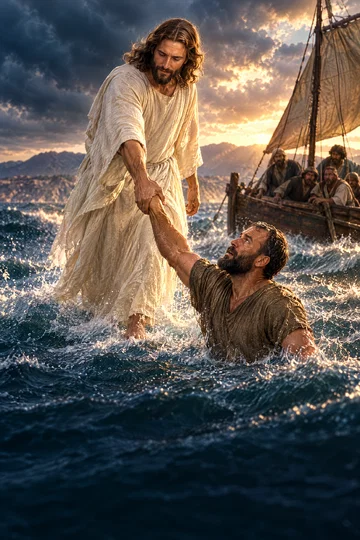
When he recognized his danger he cried to Jesus for help and lifted his hand to Christ, and such an appeal in sore need is never in vain.COS 86.1RH Feb 6, 191321MR 116.5–117.1Lt 38, 1885, par. 2–7 Jesus immediately reached out, grasped, lifted and saved him with prompt and all-powerful aid.COS 86.1RH Feb 6, 191321MR 116.5–117.1Lt 38, 1885, par. 2–7 He holds firmly the soul He died to save even when its own hold feels feeble, showing Him as the one who lifts and saves the sinking disciple, so that it is safe to let go of earthly support and trust Christ, who does not forsake those who follow at His call to come.DA 382.14T 557.4–558.1Lt 38, 1885, par. 2–7
The experience was meant to teach Peter to distrust his own strength and depend continually on divine power so he could walk safely amid temptation.DA 382.2 That lesson, learned fully, would have helped him stand firm in the later great test.DA 382.2 When Jesus warned that he would deny Him he could have asked for the same help that grasped him in the storm, for Christ could save him from his own weakness and help him remain loyal under trial.ST May 12, 1898
Salvation And Daily Trust
Peter could walk on the water toward Jesus only while he kept his eyes fixed steadily upon Him, and in that same way a sinner can be saved only by beholding Jesus.SPBC 151.4–152.1Lt 57, 1895, par. 45–4614MR 130.1 It must be made the life business to behold the uplifted Saviour and by faith to accept the merits of His atoning sacrifice, which it is the privilege to claim.Lt 57, 1895, par. 45–4614MR 130.1 Without that steady look of faith to Jesus the sinner can no more be saved than Peter could walk upon the water without it.SPBC 151.4–152.1Lt 57, 1895, par. 45–46
Faith must stay directed to Jesus and not be turned to self, to unworthiness, or to the turmoil, confusion, perplexity and threatening appearances around.DA 382.1Lt 3b, 1881, par. 3–52T 273.1–3 To lose sight of Him and fix upon the danger brings fear and makes the footing fail, and the soul sinks into depression, unbelief, weakness and despondency.DA 382.1Lt 3b, 1881, par. 3–5Lt 41, 1874, par. 10–1119MR 368.2Lt 35, 1874, par. 15 Faith can hold to God's promises without being ruled by threatening appearances, looking to Jesus with confidence and hope rather than fixing on the danger.2T 273.1–3Lt 41, 1874, par. 10–1119MR 368.2 It trusts God for sustaining help rather than letting danger and difficulty cause fear or perplexity.Lt 41, 1874, par. 10–1119MR 368.2Lt 35, 1874, par. 15 Strength and hope come by ceasing to talk and ponder upon self and by meditating on the mercy, goodness and excellency of the character of Jesus as Surety and Substitute, the righteous spotless Lamb of God, and by hanging the helpless care-troubled soul upon Him as the helpful Burden-bearer, trusting Him fully and entirely.Lt 3b, 1881, par. 3–5
Keeping one's attention fixed on the Saviour enables a Christian to tread the stormy billows of the world and to walk safely through danger.Ms 10, 1891, par. 7–103RED 62.2–63.12SP 269.1–2 The call to come does not mean He will forsake those who follow at His call, for He calls people to come to Him and is near to help those who rely on Him through weakness and trial.Ms 10, 1891, par. 7–10DA 382.121MR 116.5–117.1 The need is to keep trusting Christ and to rely on Him rather than on self.Ms 10, 1891, par. 7–103RED 62.2–63.121MR 116.5–117.1
Jesus calling Peter across the troubled water and then stretching out His hand to save sinking Peter proves that the compassionate Saviour watches His afflicted servant.Lt 10, 1865, par. 5–8Lt 38, 1885, par. 2–710MR 28.1–2 He is touched with the feelings of his infirmities, loves him and pities him beyond human pity, and is present with him strengthening and supporting him by His all-powerful arm.Lt 10, 1865, par. 5–8 His watchful eye of tender sympathy and pitying love, tender as a mother watching a suffering child, watches through the fearful storm and does not forget, for He holds the winds in His hands and controls the waters.Lt 5, 1876, par. 9–15 Such an appeal in sore need is never in vain, for Jesus responds to every appeal and helps the helpless, holding firmly with prompt and all-powerful aid the soul He died to save even when its own hold feels feeble.Lt 38, 1885, par. 2–7 He is the powerful, gracious, compassionate Redeemer able with infinite power to calm all tempests and revive all hearts, to be trusted in the storm as well as the sunshine, whose coming turns sorrow into joy and restores confidence that it is Jesus the Master.Lt 5, 1876, par. 9–15 As He saved Peter He will save His servant who has labored for souls, bringing him out of affliction to health and making him to triumph in His name, so the afflicted should be of good courage and wait patiently a little longer to see the salvation of God.Lt 10, 1865, par. 5–810MR 28.1–2
Sources
Pioneers and periodicals
90 sources
On the stormy Sea of Galilee at night after the feeding of the five thousand, Jesus came to his distressed disciples walking on the water, and at his bidding Peter got down out of the boat and walked on the water to go to Jesus until he saw the wind, sank, cried for rescue, and was immediately grasped and brought to worship him as the Son of God.ST Aug 2, 1905ST Feb 1, 1899ST Sep 21, 1904ST May 20, 1886 The word Come was at once command, invitation and promise, carrying in itself the divine power that made the sea solid under Peter's tread and enabled him to do what was naturally impossible.ST Jun 14, 1899ST Sep 15, 1898ST Jan 23, 1893RH Jan 29, 1861 While Peter kept his eyes fixed on Jesus in trust he walked safely as on solid ground, but when he turned to the wind and waves and forgot Jesus fear overtook him, faith failed, and he began to sink.ST Jun 20, 1900ST Aug 2, 1905ST Apr 14, 1914ST Jun 20, 1900RH Nov 30, 1916 Faith is trust expressed by acting on his word and keeping attention on Jesus, and obeying Christ supplies power for the hour to do what God requires.ST Jun 23, 1898ST Jun 23, 1898ST Jun 23, 1898 When he began to sink he remembered Jesus and cried out, and a sincere believing cry brings immediate rescue by Christ's outstretched hand, which does not delay salvation.RH Feb 6, 1913ST Feb 17, 1888ST Jul 22, 1913RH Jun 25, 1901RH Sep 30, 1915
Historical Setting and Sequence
The setting is the Sea of Galilee at night after the feeding of the five thousand, when the disciples had been sent across to the farther side and were left alone in the boat in the midst of the sea.ST Jul 18, 1878ST Jul 7, 1898ST May 20, 1886 They were distressed by contrary wind and waves in darkness and storm, driven hither and thither until their vessels would not obey their will, and they laid down their oars in despair and expected to perish.ST Jul 18, 1878ST Sep 21, 1904ST May 20, 1886 They toiled in rowing until about the fourth watch after a hard day's work, while Christ whom they had left on the other side had spent time in prayer.ST Feb 1, 1899ST May 20, 1886 Peter went out from the boat at Jesus' call to meet Him on the water and walked toward Jesus while the storm and darkness surrounded them.ST Sep 21, 1904ST Jul 7, 1898ST May 20, 1886
Jesus came to the distressed disciples by walking calmly upon the boisterous, white-capped waves, and they feared He was an apparition and a sure precursor of immediate death and cried out in great fear.ST Jul 18, 1878ST May 20, 1886 Instead of heralding death He came as the messenger of life, His voice heard above the roar of the elements telling them to be of good cheer and not to fear, which changed horror of despair to joy of faith and hope.ST Jul 18, 1878ST May 20, 1886 Peter answered by asking to be bidden to come, and at the word he got down out of the boat and walked on the water to go to Jesus, but only until he saw the wind and became afraid and began to sink and cried for rescue.ST May 20, 1886 Jesus immediately stretched out His hand and took hold of him and pointed to his little faith and doubt, and when they came up into the boat the wind ceased and those in the boat worshiped Him as truly the Son of God and the boat was straightway at the land.ST May 20, 1886ST Sep 17, 1896 The sudden stilling of the tempest and the landing of the boat were afterward faithfully recounted by the disciples to the wondering crowd gathered around Jesus in the synagogue and across the sea amid amazement and questioning.ST Sep 17, 1896
The account of Jesus overtaking the disciples on the sea by walking on the water is to be told together, especially Matthew 14:26-33 and Mark 6:51-52.ST Jun 14, 1899 The walking on the water is a plain, genuine, witnessed fact that could not be mistaken, seen by others who were present in the boat.ST Jan 24, 1911RH Dec 11, 1860 This stands in contrast to a false claim to walk on water that was exposed as a trick using submerged planks.ST Jul 30, 1894
The miracles in this account reveal God's wisdom, power, and love, and show Jesus as master of the deep and of the storm and able to save those in danger.ST Aug 2, 1905ST Oct 12, 1904 Under His tread the rolling waves become firm ground, displaying divine power over the waves so that waves cannot hinder Him.ST Oct 28, 1897ST Mar 4, 1913 That walking on the waves is a sign of His power over nature which supports the question of whether He also has authority over death, demonstrated by raising the dead.ST May 24, 1905 Some hold only that Jesus walked toward the disciples across the stormy water to help them and would not let them perish, without further detail about Peter's step onto the water.ST Dec 29, 1887ST Aug 2, 1905ST Oct 28, 1897
Toiling and rowing without Jesus makes little progress, only five and twenty or thirty furlongs by the fourth watch after many hours of fruitless rowing against adverse winds and the fury of the storm, while receiving Jesus brings immediate arrival at the destination.ST Sep 17, 1896
Power of Christ's Invitation
The single word spoken to Peter was at once command, invitation, and promise, and it carried within itself the power and divine support to enable obedience.ST Jun 14, 1899ST Jun 23, 1898 Trusting that word, he stepped out of the boat and walked on the water toward Jesus, doing what was naturally impossible and beyond all human ability.ST Jun 14, 1899ST Sep 15, 1898ST Jun 23, 1898 That word made the sea solid beneath his tread and bore him up as he left the boat, and the same living word that upholds the earth could act through all who trusted him.ST Jan 23, 1893RH Jan 29, 1861RH Jul 11, 1907ST Sep 26, 1895 As long as he did not doubt, he was sustained; his step depended wholly on the word of Christ.ST Jan 23, 1893RH Jul 11, 1907ST Sep 26, 1895
Faith is trust in God's power expressed by acting on His word and sustained by keeping attention on Jesus and its source.ST Jun 23, 1898ST Jun 23, 1898ST Mar 25, 1889 Obeying Christ supplies the power to do what He commands and brings a reward that meets the need of the hour, and implicit obedience is the first step into the Lord's confidence and the law of friendship with Him.ST Jun 23, 1898ST Jun 23, 1898 When the word faded from the mind, that power no longer sustained, for faith depends on God's power and not on what a person can do by himself.ST Jun 23, 1898ST Mar 25, 1889 The act itself is not presented as an example to be imitated; the lesson is to believe and live by God's word.ST Jun 23, 1898ST Jun 23, 1898 That same power remains available through God's promises across the centuries, calling believers to take action and enabling people to do what God requires and what seems impossible by human experience.ST Jun 23, 1898ST Jun 23, 1898RH May 7, 1914
Peter's dependence on Jesus while walking on the water was no greater than when walking on land, for all people depend on God for existence and its continuance even when that dependence is less apparent.ST Aug 26, 1897 The verse illustrates the venture of entrusting oneself to Christ, daring to leave the vessel with eyes fixed on Him and not sinking though stepping onto the deep water.ST Jan 2, 1893 Jesus' invitation enabled what human strength could not, teaching that God's people can carry out an impossible task when they obey His call and rely on His power rather than looking at obstacles or other people. God uses people who are weak in themselves but strong in faith to do His miraculous work when they trust and obey His commands.RH May 7, 1914
Looking to Jesus in Faith
As long as Peter kept his eyes fixed on Jesus and trusted him, the water bore him up and he walked safely toward him as on solid ground, and he could walk as Jesus did only while looking to him in reliance on his word.ST Jun 20, 1900ST Aug 2, 1905ST Apr 14, 1914ST Mar 25, 1889 When he turned his attention to the wind and waves and forgot Jesus, fear overtook him, faith failed, and he began to sink.ST Jun 20, 1900ST Aug 2, 1905ST Jun 27, 1900RH Jul 28, 1903ST Mar 15, 1905 Obedience when Christ calls is therefore to be rendered even when it involves real sacrifice, trusting him for support without fear or doubt and keeping the eyes fixed on him.ST Jun 27, 1900 Keeping attention on Jesus in this way gives strength to endure trouble and overcome difficulties, and it enables one to help others who are sinking by sympathy, encouragement, and practical help, whereas turning attention to surrounding dangers brings sinking into trouble.RH Jul 28, 1903ST Mar 15, 1905
The change was in Peter, not in Jesus or the water, for his ability came not from himself but from Christ's power and divine power upholding him, and apart from that power he would have perished.ST Jun 20, 1900RH Nov 30, 1916ST Mar 25, 1889 Safety comes from keeping the eyes fixed on Jesus, since faith must keep looking to the Lord rather than to surrounding dangers or to human strength and ability.ST Jun 20, 1900RH Nov 30, 1916 Faith in this walking depends on God's power, not on what a person can do by himself.ST Mar 25, 1889
Peter's first step expressed eager love, trust, and desire to be near Jesus, but he lost focus when pride led him to think of himself and to look toward his companions to see whether they admired him.ST Dec 29, 1887ST Aug 25, 1881ST Jun 20, 1900 When he took his eyes from Jesus and attended to the threatening waves, and when he turned to look toward the others in the boat, fear overwhelmed him and he began to sink.ST Dec 29, 1887ST Aug 25, 1881 Keeping attention fixed on Jesus enables a person to withstand the storms of life, while pride and divided attention give way to doubt and fear, and Jesus immediately reached out and caught the sinking disciple.ST Aug 25, 1881
Fear is the natural result of looking away from Christ and losing confidence in him, becoming frightened at wind and waves, and doubting with little faith brings failure and sinking.ST Feb 17, 1888ST Jun 12, 1901 Doubt kills and is faithfully rebuked as little faith, yet a sincere, humble, contrite, believing cry brings immediate rescue by his outstretched hand, for he does not delay salvation but answers the prayer of faith as soon as uttered, while still requiring full and complete faith.ST Feb 17, 1888ST Jun 12, 1901 Trembling at threatening circumstances shows unbelief, and moral courage depends on strong, steady faith in God, so that when faith failed Peter later denied his Lord.ST Oct 11, 1877RH Feb 26, 1861 Fear and uncertainty about whether the work is nearly finished and probation about to close belong to unbelief, while faith presses forward despite dark appearances and does not lose faith when circumstances look threatening.RH Feb 26, 1861
Faith proper is blind to all that would divert the eye from the immutable promises as they are, but when reason subverted his faith Peter turned philosopher and began to sink.RH Jul 1, 1862 Too many follow his bad example when they let reason, philosophy, preconceived opinions, and theology turn them from reading and understanding the word as it is and from looking according to God's promise for just what he has promised.RH Jul 1, 1862 Safety requires keeping the look always above with fixed confidence and never looking beneath, because looking down at the whirling, roaring torrent at the feet plunges into instant destruction.RH Oct 9, 1866 The Christian when tempted and dismayed is like an inexperienced swimmer in danger, whose danger is greatly increased if he desponds and drops his head, but by courageously looking upward to Jesus he mounts the waves with buoyancy and delight.
Jesus draws near on the waves at night to save a trembling life tossed on a stormy sea in a frail, shivering boat, knowing his peril though his lips are dumb, and bidding him come to him across the watery waste. Coming means clinging to no frail floating supports, quickly leaving the sinking boat, and standing upright on the slippery, treacherous water, strong in his strength and brave in his courage. Walking on the waters to him requires not thinking how high the angry waters rise, not thinking of men gazing with wondering eyes, and not thinking that one's own exalted power upholds one's feet, but fixing the eyes on his divine face, taking the kind hand he stretches out, and not letting clear faith waver or grow dim.
Peter's Character and Motives
Peter stepping out of the boat and walking on the water toward Jesus shows an earnest, impulsive character of mingled faith and unbelief.RH Feb 6, 1913RH Nov 25, 1873 His first step expressed eager love and trust and a strongest desire to be near and with Jesus.ST Aug 25, 1881RH Nov 25, 1873 When he noticed the wind and the angry, tempestuous waves threatening to engulf him, he forgot his Lord's power, his mind was caught away from Jesus, fear overtook him, and he began to sink.RH Feb 6, 1913RH Nov 25, 1873 His turning aside came through pride and divided attention, for he looked toward his companions in the boat to see whether they admired him, and looking to them brought fear and sinking.ST Aug 25, 1881 His cry for help was then met immediately, as Jesus grasped and lifted him.RH Feb 6, 1913
The asking and the bidding formed a mutual test, with Peter testing Christ by asking to come and Christ testing Peter by bidding him come.ST Feb 17, 1888 The test exposed ambition and vainglory, impulsiveness and readiness to run risks, and spiritual vanity in wanting to outdo the other disciples and to do what Jesus does.ST Feb 17, 1888 Ambition to display supernatural power is not faith.ST Feb 17, 1888ST Oct 1, 1896 Walking was borne up by divine miraculous power only while looking straight to Christ with lively, unfaltering faith and continued help from a higher power, and when attention turned to the roaring wind and tumultuous waves, trust was forfeited, faith failed, and sinking began.ST Feb 17, 1888 Christ allowed the sinking in part to show weakness, need, and the folly of the undertaking.ST Feb 17, 1888
Peter wanted to do a miraculous great work because common everyday duties seemed too little for him.RH Jul 15, 1862 That desire for an extraordinary deed belongs with his boast that he was ready to go with Jesus to prison and to death, and with his volunteering for martyrdom.RH Jul 15, 1862 Christ's later commands to feed lambs and sheep rebuked that ambitious pride by calling him to the lowly place of a shepherd watching and feeding the flock, after his denial proved how little he could brave and suffer for Christ's sake.RH Jul 15, 1862RH Jun 10, 1875
Peter wanted not only to be saved himself but also to share in Jesus' power so that he could help save others.RH Jul 28, 1903 Keeping the eyes fixed on Jesus gives power to endure trouble and overcome difficulties and enables a person to help others who are sinking by sympathy, encouragement, and practical help.RH Jul 28, 1903 His struggle on the waves illustrates how he could fail despite willingness to follow Jesus.RH Mar 18, 1915 His later return to faithful service shows that those who have failed can turn back, yield their lives to God, and serve with love and loyalty.RH Mar 18, 1915 When his faith failed on the water he began to sink, and the same failure of steady faith later led him to deny his Lord, showing that moral courage depends on strong, steady faith.ST Oct 11, 1877 He could have asked for the same grasping, saving help when warned that he would deny Jesus, for Christ could have saved him from his own weakness and kept him loyal under trial.ST May 12, 1898
The account of Peter walking on the sea in Matthew 14:28-31 was used by Innocent III as an argument that Christ had granted Peter authority over the world and that Peter's successors were therefore entitled to rule the nations.RH Nov 28, 1907 Peter was immersed enough when he walked on the sea, yet being covered or sprinkled by the sea was not baptism in the religious sense.ST Jan 13, 1881 Baptism requires obedience to religious discipline, so the walking distinguishes accidental encounter with water from baptism.ST Jan 13, 1881
Rescue, Salvation and Doctrine
When Peter began to sink he remembered Jesus and cried out, and that sincere, humble, contrite, believing cry brought immediate rescue by Christ's outstretched hand.RH Feb 6, 1913ST Feb 17, 1888ST Jul 22, 1913ST Jun 12, 1901ST Feb 17, 1909 Christ does not delay salvation but answers the prayer of faith as soon as uttered, grasping and lifting the sinking one, and the hand that saved Peter remains powerful to help all who cry out in need.RH Feb 6, 1913ST Feb 17, 1888ST Jul 22, 1913ST Jun 12, 1901ST Feb 17, 1909 Yet full and complete faith is required, for doubt kills and is rebuked as little faith.ST Feb 17, 1888ST Jun 12, 1901 While keeping confidence in Christ Peter was able to walk, but losing confidence and looking away toward the wind and waves and toward the others in the boat he became frightened and began to sink.RH Feb 6, 1913ST Jun 12, 1901
Sinking times are praying times, proving that human weakness is reinforced by laying hold on infinite strength.RH Jun 25, 1901 Peter's appeal as the waves threatened to overwhelm him expressed his need, and such a prayer is heard and answered.RH Sep 30, 1915RH Oct 10, 1907 One in urgent danger should pray at once without waiting for a specially prepared form, and a needy soul may call without eloquent words in fervent, humble appeal seeking Christ's hand.RH Sep 30, 1915RH Oct 10, 1907ST Apr 10, 1893 Christ supports those who call on him, but they are lost if they let go their hold on him.ST Nov 12, 1912 A sinner cannot be saved without looking steadily to Jesus and accepting by faith the merits of the uplifted Saviour, for Peter could walk on the water only while keeping his eyes fixed steadily on him.ST Nov 12, 1912RH Nov 24, 1904
The walking is a continued example of the perfect exercise of faith, proving that faith lays hold on heavenly power and brings supernatural gifts.RH Jan 29, 1861 That power of faith is not obsolete but remains connected with spiritual heavenly gifts to the end of time, and those who have faith can do not only the same works but even greater things.RH Jan 29, 1861 The event reveals Jesus as powerful and merciful, master of the storm and able to hear and rescue those in danger, so that fear gives way to receiving him and recognizing him as the Son of God.ST Oct 12, 1904RH Jul 28, 1903 The appeal to look to him applies the event as a prayer for his nearness, saving help, grace, and strength to do his will.RH Jul 28, 1903 The same word Come that upheld Peter and sustained him as long as he did not doubt, the same word that upholds the earth, will be spoken to the saints who will meet the Lord in the air.ST Jan 23, 1893
Resisting Satan is only by faith in Christ, by looking unto Jesus instead of fixing the eyes on the enemy, since looking at the enemy brings a fall.ST Sep 11, 1893 Satan seeks to turn the gaze to himself, but faith puts Christ before the believer so the believer does not meet the enemy alone.ST Sep 11, 1893 Christ meets the accuser with his righteousness, his craft with his wisdom, and his power with his mighty power, making the believer more than conqueror, and though God's children everywhere meet trials they are not alone, for Christ is able to succor all who trust him.ST Sep 11, 1893
Endurance and Christian Application
The call to come teaches obedience even when obedience involves real sacrifice, trusting for support without fear or doubt and keeping the eyes fixed on Christ.ST Jun 27, 1900 It means launching out at his direction rather than waiting for calm conditions, a habit needed especially in educating children.RH Aug 7, 1913ST Mar 12, 1894 Those who step forward in faith to serve experience the Saviour's hand holding them securely as they walk beside their Master on the waves, an experience those who stayed in the boat did not share.RH May 16, 1907 The command to move forward though no place is ready to go to is like the step onto the water, testing whether his word will be trusted and acted on by faith.RH Dec 16, 1902
Though the position looks dangerous, the person is safest while following his bidding and trusting God, and abandoning that position of trust can lead to a fall.RH Mar 2, 1852 Relying on one's own strength leads to stumbling, while holding fast to the Saviour enables keeping on walking through difficulty, so that the waters of strife or sorrow do not overwhelm.RH Sep 25, 1860 When the waves nearly overwhelm, looking to Jesus brings his helping hand beneath and gives reason to keep hoping, for he can raise those who seek his help above their trials as he lifted Peter above the waves.RH Apr 28, 1859RH Mar 23, 1869 The Christian when tempted and dismayed is like an inexperienced swimmer in danger, whose peril is greatly increased by desponding, but by courageously looking upward to Jesus he mounts the waves with buoyancy, and the troubled wave becomes an image of hardship over which Christ bears the believer up.RH Feb 18, 1902
In the storm the disciples are shown their helplessness, yet he sees them throughout and comes near when they humble themselves and pray for help, and he does not forget his followers in life's storms but is near to help them.RH Oct 7, 1909 In the storm he is seen as deliverer, and through faith in him safety is reached, while turning away from him in need would leave one in danger, for storm and waves picture the troubles that threaten and he remains the Redeemer to whom self may be entrusted.ST Feb 11, 1886 He walks on the sea as a pilot who meets his people when their bark is riven and guides them to the haven, having marked out the way because he passed on before, teaching those who have begun the course to shun rocks and shoals and dangers, so that in his strength they will not fall until they reach the shore.RH Jul 16, 1861 Above the crash of the elements his voice speaks peace to his storm-tossed children and pilots them quickly to the other shore, which is victory in the world to come, even though the church like her Master must be bruised and buffeted by storms if she would share with him in that victory.ST May 12, 1909 Walking on the water to go to him means resting on the Saviour and being kept in soul by his sweet presence, so the waves can be breasted with peace unmolested and every fear soothed, while he bids the waters bear up those who go to him and makes his arm their defense that no storm can drive away.RH Jun 3, 1873RH Jan 28, 1873
Keeping attention on him gives strength to endure trouble and overcome difficulties, and enables helping others who are sinking by sympathy, encouragement, and practical help.RH Jul 28, 1903 Remaining safe through faith by looking to Christ, rather than sinking into trouble by turning attention to dangers around, is the way to remain safe through life's storms.ST Mar 15, 1905 Keeping close to Christ as in walking toward him, and holding fast to his outstretched hand, enables bearing sorrows.RH May 16, 1912 Hope, courage, and perseverance are needed amid trials, for he who rules the storm and calls to come does not leave his followers alone in their struggle.RH Nov 25, 1873
Peter's example pictures people who amid life's dangers and troubles seek to come to Christ, and when they falter and begin to sink they can reach out to him and he stoops to save them, so that walking with Christ through danger is sweeter than any other path.ST Jul 8, 1930 His call to come is a call to follow him over the sea with promise that he has seen tears and heard groans and will be deliverer, bringing pleasures that make the heart rejoice to those who by faith embrace his promise and heed his voice, never forsaking them for an hour when storm clouds lower and winds and waves are high.RH Jul 16, 1861 Coming to him is for help from his extended powerful arm that shields from harm when the heart sinks in alarm, and the cry in sinking brings him who can keep, speak peace to the wild billows, and reconcile the erring child to God.RH Jun 3, 1873
When one like Peter begins to sink beneath temptation, the call to come invites coming to him, and his saving power can uphold.RH Oct 21, 1858 Taking the eyes off him can nearly lose the way.RH Oct 1, 1914 Faltering and sinking when facing trouble or sorrow is as Peter did on the stormy sea.RH Aug 19, 1873
When the waves threatened to overwhelm, reaching out to save illustrates how his love reaches out to save those whose self-trust brings them near spiritual ruin.RH Nov 7, 1907 In coming upheavals his people can stand firm by relying on his word, as in stepping out of the boat and walking toward him.RH Jul 25, 1907 Beginning to sink beneath life's troubles shows how people falter when they doubt, and they should look to evidence of his power and his promises of help.ST Apr 10, 1893
Sources