Luke 22:32
But I have prayed for thee, that thy faith fail not: and when thou art converted, strengthen thy brethren.
Translations
But I have prayed for you, that your faith fail not: and when you are converted, strengthen your brothers.
But I have prayed for thee, that thy faith fail not: and when thou art converted, strengthen thy brethren.
but I have prayed for thee, that thy faith fail not: and when thou art converted, strengthen thy brethren.
But I have prayed for thee, that thy faith fail not; and when thou art converted, strengthen thy brethren.
but I made supplication for thee, that thy faith fail not: and do thou, when once thou hast turned again, stablish thy brethren.
but I made supplication for thee, that thy faith fail not; and do thou, when once thou hast turned again, establish thy brethren.
and I besought for thee, that thy faith may not fail; and thou, when thou didst turn, strengthen thy brethren.'
but I have besought for thee that thy faith fail not; and thou, when once thou hast been restored, confirm thy brethren.
But, I, have entreated for thee, that thy faith may not fail. And, thou, once thou hast turned, strengthen thy brethren.
Berean Standard Bible, Majority Standard Bible
But I have prayed for you, Simon, that your faith will not fail. And when you have turned back, strengthen your brothers.”
but I prayed for you, that your faith wouldn’ t fail. You, when once you have turned again, establish your brothers.”
But I have made prayer for you, that your faith may not go from you: and when you are turned again, make your brothers strong.
But I haue prayed for thee, that thy faith faile not: therefore when thou art conuerted, strengthen thy brethren.
Douay-Rheims (Challoner revision)
But I have prayed for thee, that thy faith fail not: and thou, being once converted, confirm thy brethren.
Pictures
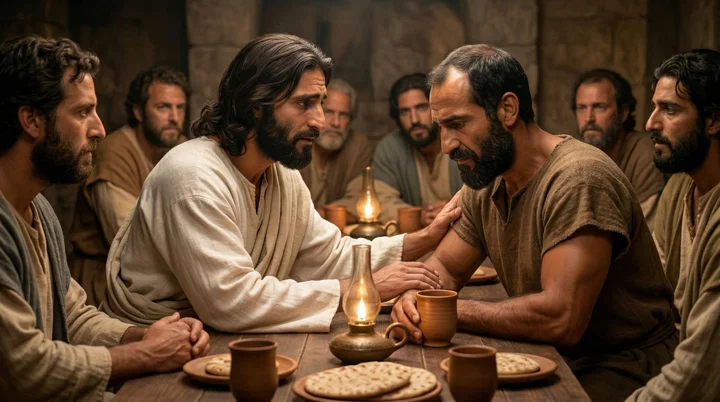

Cross-references 20 of 50
- Luke 22:61-62
And the Lord turned, and looked upon Peter. And Peter remembered the word of the Lord, how he had said unto him, Before the cock crow, thou shalt deny me thrice.
Jesus’ look recalls Peter’s denial and leads him to weep bitterly.
- John 21:15-17
So when they had dined, Jesus saith to Simon Peter, Simon, son of Jonas, lovest thou me more than these? He saith unto him, Yea, Lord; thou knowest that I love thee. He saith unto him, Feed my lambs.
Jesus restores Peter and commissions him to care for his followers.
- Matthew 26:33-35
Peter answered and said unto him, Though all men shall be offended because of thee, yet will I never be offended.
Peter’s confident vow of loyalty is recalled before his failure and repentance.
- Mark 14:29-31
But Peter said unto him, Although all shall be offended, yet will not I.
Peter confidently vows not to deny Jesus, but Jesus warns of his coming denial.
- Matthew 26:74
Then began he to curse and to swear, saying, I know not the man. And immediately the cock crew.
Peter’s cursing denial illustrates the failure from which Christ’s prayer would restore him.
- Acts 4:8-13
Then Peter, filled with the Holy Ghost, said unto them, Ye rulers of the people, and elders of Israel,
Peter’s Spirit-filled boldness shows his conversion and strengthened witness for Jesus.
- Matthew 18:3
And said, Verily I say unto you, Except ye be converted, and become as little children, ye shall not enter into the kingdom of heaven.
Both texts connect conversion with the disciples’ spiritual readiness.
- Hebrews 7:25
Wherefore he is able also to save them to the uttermost that come unto God by him, seeing he ever liveth to make intercession for them.
Christ ever lives to intercede for and preserve his own.
- Matthew 26:41
Watch and pray, that ye enter not into temptation: the spirit indeed is willing, but the flesh is weak.
Prayer guards faith against temptation amid human weakness.
- Matthew 16:21-23
From that time forth began Jesus to shew unto his disciples, how that he must go unto Jerusalem, and suffer many things of the elders and chief priests and scribes, and be killed, and be raised again the third day.
Peter opposes Jesus’ prediction of his suffering and is rebuked.
- Acts 3:19
Repent ye therefore, and be converted, that your sins may be blotted out, when the times of refreshing shall come from the presence of the Lord;
Both connect conversion with repentance and the forgiveness of sins.
- John 17:20
Neither pray I for these alone, but for them also which shall believe on me through their word;
Jesus’ prayer for Peter extends to all who will believe through his followers.
- Mark 16:7
But go your way, tell his disciples and Peter that he goeth before you into Galilee: there shall ye see him, as he said unto you.
The risen Christ specifically remembers Peter and invites him to meet him.
- Acts 2:14
But Peter, standing up with the eleven, lifted up his voice, and said unto them, Ye men of Judæa, and all ye that dwell at Jerusalem, be this known unto you, and hearken to my words:
Peter boldly preaches to the assembled Jews at Pentecost.
- John 17:11
And now I am no more in the world, but these are in the world, and I come to thee. Holy Father, keep through thine own name those whom thou hast given me, that they may be one, as we are.
Jesus prays that the Father will keep his disciples, as he prays for Peter’s faith.
- Luke 22:46
And said unto them, Why sleep ye? rise and pray, lest ye enter into temptation.
Peter recalls Christ waking the sleeping disciples to pray in Gethsemane.
- Mark 14:30-31
And Jesus saith unto him, Verily I say unto thee, That this day, even in this night, before the cock crow twice, thou shalt deny me thrice.
Jesus foretells Peter’s denial despite Peter’s insistence that he will remain faithful.
- Acts 3:14
But ye denied the Holy One and the Just, and desired a murderer to be granted unto you;
Peter, restored after denying Christ, preaches to those who denied him.
- Luke 22:24
And there was also a strife among them, which of them should be accounted the greatest.
The disciples’ strife for greatest place shows their conversion was incomplete.
- Galatians 2:11-16
But when Peter was come to Antioch, I withstood him to the face, because he was to be blamed.
Peter’s later dissembling shows weakness remained after his faith was restored.
Commentary part 1 of 2
Each commentary is drawn from primary sources: the writings of Ellen G. White and Adventist pioneers and periodicals. Each commentary is separate. Its own words are not a quotation; follow the references to read the source passages.
Ellen G. White
104 sources
At the last supper Jesus warned Peter that Satan desired to sift him and the other disciples as wheat through severe testing, and assured him that he had prayed that his faith would not fail completely. ED 88.5Lt 65, 1894, par. 7–9EW 135.2ST Oct 19, 1882Ms 96, 1897, par. 16–17 When thou art converted means when Peter turned back in repentance after denying his Lord, and strengthen thy brethren commissions him as under-shepherd to feed and care for the flock, giving honor and influence but not supremacy over the others. CT 255.2ST Nov 4, 1886ST Nov 11, 18976RED 69.13SP 279.1–2 His prayer was rescuing love that did not abandon the foreseen sinner to despair but stood between Satan and the soul as Peter's only shelter, and that same intercession belongs to all severely tempted followers through the end of time. ST Nov 23, 1915Ms 109, 1898, par. 5–7ED 88.5Lt 61, 1898, par. 4–6COL 154.4–155.4 Peter fell through self-confident zeal without humility and self-knowledge, denying three times, but when broken by Christ's look he repented bitterly and rose a humble, self-distrustful man who stood firm before the very leaders where he had fallen. ED 88.5Lt 65, 1894, par. 7–9Lt 195, 1903, par. 3–7Ms 29, 1897, par. 15–17DA 712.1–713.1 Strengthening can follow only after such conversion and entire reliance on divine power, by shepherding with patience, sympathy and forgiving love, warning others from one's own painful experience. ST Nov 4, 1886Lt 61, 1898, par. 4–6Ms 52, 1899, par. 8AA 515.1–2RH Jul 25, 1912
Setting and Wording
The words were spoken at the last supper while Judas was devising plans to betray Him, just after Jesus had told the disciples that all of them would be offended because of Him that night.EW 135.2Ms 96, 1897, par. 16–17 Peter had then ardently affirmed that although all others should be offended he would not be, declaring himself ready to go with Jesus both into prison and to death.ED 88.5EW 135.2Lt 195, 1903, par. 3–7 He met faithful warning of his danger and coming defection with self-confidence instead of humility, and his confidence in his own loyalty did not keep him from failing when opposition came.Lt 6, 1880, par. 4–9Lt 33, 1879, par. 14–15Ms 82a, 1901, par. 32–40 Yet Jesus knew Peter would deny Him, knew the disciples would be offended and forsake Him in His humiliation, and therefore warned them to guard against temptation while continuing to educate and correct them without forcing the will.ST Oct 19, 1882Ms 96, 1897, par. 16–17Ms 82a, 1901, par. 32–40 Peter later remembered this warning and recognized how well Jesus knew his heart.ST Oct 19, 1882Lt 33, 1879, par. 14–15
Satan desired to have Peter and the disciples to sift them as wheat, meaning severe testing and temptation permitted by God that every true child of God undergoes.ED 88.5Lt 65, 1894, par. 7–9Lt 195, 1903, par. 3–7Ms 29, 1897, par. 15–17Ms 186, 1897, par. 34–39 The sure outworking of evil still unforsaken in self-trust could not be prevented, for to self-trust trial is defeat, and Peter did not recognize his own weakness but believed his spirit right when he needed to be changed to endure Christ's rejection, humiliation, condemnation and death.ED 88.5Lt 65, 1894, par. 7–9Lt 195, 1903, par. 3–7 The sifting exposes cherished pleasures that draw the mind from God and comes through striving for supremacy and traits that blind people to their defects.Lt 123, 1897, par. 6–9 The danger is greatest when a person is not standing in God's light, is mixed with the world, grows cold toward brethren, and acts in independence and self-will.Lt 123, 1897, par. 6–9 Applied to others under spiritual attack, the same testing warns that one can endanger brethren by example.Ms 29, 1897, par. 15–17Lt 123, 1897, par. 6–9
"I have prayed for thee, that thy faith fail not" means Jesus prayed that Peter's faith would not fail completely or utterly.ST Nov 23, 1915Ms 109, 1898, par. 5–7Lt 61, 1898, par. 4–6Lt 61, 1898, par. 7–9SG1 46.1 Peter fell and denied Him, but the prayer kept his failure from being final and from complete shipwreck, sheltering him from being overcome when Satan would otherwise have had his way.ST Nov 23, 1915Ms 109, 1898, par. 5–7Lt 61, 1898, par. 4–6Lt 141, 1898, par. 5 Christ's watchful intercession stood between Satan and the soul, pleaded for one whom Satan sought to destroy, and was Peter's only hope and the cause of his restoration and possibility of return.Ms 109, 1898, par. 5–7Lt 61, 1898, par. 4–6Lt 61, 1898, par. 7–9Lt 141, 1898, par. 5 In his deep humiliation and struggle after denying Jesus, Peter remembered the words spoken in the upper chamber, and the promise gave hope and steadied him in remorse because although Jesus foresaw his sin He did not abandon him to despair.ST Nov 23, 1915Lt 61, 1898, par. 7–9 The same care defeats Satan's efforts against those who trust in Him, teaching the need to recognize defects and depend on Christ's power and grace rather than self-confidence.Ms 109, 1898, par. 5–7Lt 61, 1898, par. 4–6
"When thou art converted" means when Peter turned back to Christ after his failure through repentance and transformation.ST Nov 11, 18976RED 69.13SP 279.1–2ST Oct 3, 1878 Jesus both foretold the fall and looked ahead to repentance and renewed service, praying for Peter when Satan sought to test the disciples and anticipating that after turning back he would strengthen his fellow believers.ST Nov 11, 18976RED 69.13SP 279.1–2ST Oct 3, 1878 Peter's confidence in himself was mistaken and he needed Christ's help to recognize weakness and trust more fully in Jesus, since Satan sought to lead him astray by exploiting his forward, impulsive nature.ST Nov 11, 18976RED 69.1 That conversion was shown afterward in distrust of self, courage through the Holy Spirit, renewed faithfulness in honoring Christ before the Sanhedrin, humility and repentance, and tender care for followers from remembrance of his own weakness.3SP 279.1–2ST Oct 3, 1878 Before that conversion John's checks when ardor and zeal led Peter too far did not reform his impetuous character, but after conversion only a mild caution was needed to check ardor, while zeal, boldness and energy remained and were needed for the cause, working together with John's winning patience, forbearance and deep devotedness.SG1 122.2
"Strengthen thy brethren" commissions the converted Peter as under-shepherd to feed Christ's sheep and lambs and care for the flock.CT 255.2ST Nov 4, 1886Lt 103, 1902, par. 7–8Lt 17, 1902, par. 9–11ST Nov 4, 1886 That period came at the seaside dining after the resurrection, when the transformation wrought in Peter was evident in no forward self-sufficient reply and no extravagant assurance of greater love but a humble appeal to Christ who knows all motives and all things, showing him humbled, repentant, and better prepared than ever to fill the office of shepherd.ST Nov 4, 1886ST Nov 4, 18863SP 233.1 To strengthen means to care for the flock with the love of Christ in the heart, without which knowledge, eloquence, benevolence, gratitude and zeal fail, and to deal with the transgressor with patience, sympathy, forgiving love and tenderness, remembering his own weakness and failure as Christ had dealt with him.ST Nov 4, 1886Lt 17, 1902, par. 9–11 The work includes serving as shepherds by educating people to understand the Word of God, helping every soul build on a sure foundation with the Word as counsellor, and presenting the gospel in its simplicity with the spirit and life of Christ so it becomes the power of God unto salvation.Lt 103, 1902, par. 7–8Lt 17, 1902, par. 9–11 Christ's forgiveness of the apostasy and trust in Peter to feed the flock gave him honor, authority, veneration, esteem and much influence in the church as an entirely converted man and close daily follower, but it did not give him supremacy over his brethren.ST Nov 4, 1886ST Nov 4, 18863SP 233.1
Christ's Praying Love
Jesus foresaw the denial yet did not abandon the denier to despair, and the prayer that faith should not fail completely was rescuing love reaching to save from deep waters as his hand had once reached to save on the waves.ST Nov 23, 1915ED 88.5ED 89.1–2 It was love that fails not nor forsakes, staying with the disciple in foreseen sin and suffering, a rebuke that is love, a blow that wounds to heal, and a warning that speaks hope.ST Nov 23, 1915ED 88.5PK 175.3 Though Peter fell through self-sufficiency and grievously sinned, he was not forsaken, and remembering that Jesus had prayed for him and promised his turning back and strengthening of his brethren gave him hope and steadied him in remorse.COL 154.4–155.4PK 175.3ED 89.1–2 The sin-pardoning Saviour accepted the repentance so born, and that same compassion to rescue reaches every soul that falls under temptation.COL 154.4–155.4
That intercession was Peter's only hope and shelter from being overcome, for had Satan been allowed his way there would have been complete shipwreck of faith.Ms 109, 1898, par. 5–7Lt 61, 1898, par. 4–6RH Dec 16, 1902 It was watchful, all-powerful and fitted to his need, standing between Satan and the soul and defeating Satan's efforts against those who trust, so that failure was not final and restoration became possible.Ms 109, 1898, par. 5–7Lt 61, 1898, par. 4–6Lt 61, 1898, par. 7–9RH Dec 16, 1902 When Peter could not help himself it helped him, saving completely those who come, and it pleads the cause of the failing disciple with wounded hands that bear his sin and offer righteousness as the ground of the plea.Lt 61, 1898, par. 7–9RH Dec 16, 1902Lt 47, 1891, par. 10–13 A disciple who has stumbled can thus be won back and restored to help others.RH Dec 16, 1902Lt 47, 1891, par. 10–13
Remembering the warning and the prayer, with Jesus' sorrowful, reproving yet loving and pardoning look, brought Peter to see his own ingratitude, falsehood and perjury while showing him mercy and forgiveness from one who knew his heart.DA 712.1–713.15RED 29.3–30.13SP 109.3–110.1ST Oct 19, 1882 That look melted him and saved him, moving him to bitter grief and weeping over denial with cursing and swearing after following at a distance to protect his own safety.5RED 29.3–30.1EW 138.2ST Oct 19, 1882 Remembering the words spoken in the upper chamber sustained hope of acceptance even after denial, and the prayer kept faith from failing completely so that, converted, he became ready to help and build up his fellow disciples.DA 712.1–713.1COL 154.4–155.4EW 138.2
The earnestness of that intercession is seen in whole nights spent in cold lonely places and on a lonely mountainside, bowed under heavy dew with the shadows of night gathering thickly, pouring out heart-longings with strong crying and tears while divinity was veiled in humanity.4T 529.3–4ST Feb 25, 1889DA 419.1–4 Just before death he withdrew by himself to intercede because he knew he would soon leave them alone to face a cold and cruel world of bitter hate, unbelief and persecution.ST Feb 25, 18892SP 270.3–271.23RED 64.1–3 Even with his own approaching agony, betrayal, condemnation, mocking and crucifixion before him, his tender love reached forward to encourage, strengthen and shield his companions, praying that in the fearful test and the hour of the power of darkness their faith would prove steadfast and his sufferings and death would not utterly overwhelm them with despair.ST Feb 25, 1889DA 419.1–42SP 270.3–271.23RED 64.1–3 That same prayerful care contrasts with self-reliance and failure to watch and pray, and in Gethsemane it then turned to his own tempted soul bearing the sins of the world and seeking strength to endure the test in behalf of humanity.DA 419.1–4DA 688.2–689.1
The prayer belongs not to Peter alone but to all disciples and followers through the end of time, embracing all who would believe and presenting their petitions before God.GW92 30.2–3Lt 31, 1897, par. 16–184T 529.3–4 It is fitted to the need of each person tried and tempted, giving courage to trust that Jesus is near and to stand against temptation, and covering assurance that they are not left helpless amid trial, persecution, hardship and spiritual conflict.Lt 31, 1897, par. 16–18Lt 90, 1906, par. 5Lt 16a, 1892, par. 6–8Ms 83, 1901, par. 14–15 Even now Jesus sees souls in their greatest need, pities those severely tempted, comes to their aid as heavenly Intercessor, stands close against Satan, and intercedes so that faith will endure and not be destroyed.GW92 30.2–3Lt 62, 1893, par. 8Lt 16a, 1892, par. 6–8 His help in greatest need therefore brings comfort, courage for victory over the world, and reason to trust rather than despair amid deception and resistance to forces that would turn the mind from God.Lt 16a, 1892, par. 6–8Ms 83, 1901, par. 14–154T 529.3–4
Peter's Fall and Conversion
Before his fall Peter was self-confident, presumptuous and ignorant of himself, believing his own spirit right and mistaking ardent zeal for conversion.Lt 65, 1894, par. 7–9Lt 195, 1903, par. 3–7Lt 12, 1861, par. 12–14Ms 3, 1861, par. 19–21ST Nov 11, 1897 His bold avowal that he was ready to go with Christ into prison and to death came from a grieved, loving heart which Christ who reads the heart discerned, yet he still needed to be changed in spirit before he could endure Christ's rejection, humiliation, condemnation and death.ED 88.5Lt 65, 1894, par. 7–9Lt 195, 1903, par. 3–7 To self-trust trial is defeat, and the sure outworking of evil still unforsaken in self-trust could not be prevented, so strength lies not in what poor finite beings suppose they can do but in what Christ will do for them through strong persevering faith and entire trust in Christ as Leader.ED 88.5Lt 195, 1903, par. 3–7
He met faithful warning with self-confidence, and when opposition came he fled with the others.EW 138.219MR 59.3–60.2Lt 33, 1879, par. 14–15 He then followed at a distance, and to protect his own safety denied three times with cursing and swearing that he knew not the Man.Lt 12, 1861, par. 12–14Ms 3, 1861, par. 19–21EW 138.2 When fear and caution gave place to self-confident carelessness he was left to feel his own weakness, for breaking connection with Christ leaves a person working in self-thinking, self-planning and for self with Christ eclipsed by thoughts centered on poor self.19MR 59.3–60.2Lt 25, 1880, par. 7Lt 33, 1879, par. 14–15 Whatever a person once was and whatever was once done successfully for Christ does not prevent such separation, and privilege only makes the resulting sin more aggravating.Lt 25, 1880, par. 7
He was not yet converted although he followed with much zeal, thought himself the most devoted follower, cut off the high priest's servant's ear in Gethsemane, and prayed and talked long and earnestly.Lt 12, 1861, par. 12–14Ms 3, 1861, par. 19–21 Outward zeal, much love in words, and long earnest praying and talking without humility, self-knowledge and God-trusting faith is not conversion.Lt 12, 1861, par. 12–14Ms 3, 1861, par. 19–21 Conversion came only when Jesus looked upon him in sadness and grief, breaking his heart to repentance.DA 712.1–713.1Lt 12, 1861, par. 12–14Ms 3, 1861, par. 19–21 Then boastful confidence was gone, he remembered the words spoken in the upper chamber, realized his weakness, wept bitterly in Gethsemane, sincerely repented and trusted in God for strength instead of in himself.Ms 29, 1897, par. 15–17Ms 186, 1897, par. 34–39Ms 3, 1861, par. 19–213T 416.2EW 138.2
That change was his conversion, and only then could he strengthen his brethren, for his denial had exposed natural character and weakness under pressure but his repentance was sincere and strength came where he had been weak.Ms 29, 1897, par. 15–17Ms 186, 1897, par. 34–39Ms 3, 1861, par. 19–21 After conversion he became a different, entirely converted man, distrustful of self, modest, humble and filled with the Holy Spirit, yet retaining the zeal, boldness and energy needed for the cause.3T 416.2ST Nov 11, 1897RH Jul 25, 19126RED 69.1 Balanced by John's patient forbearance, only a mild caution was needed to check his ardor.ST Nov 11, 18976RED 69.1 Before the same leaders Annas and Caiaphas and the Sanhedrin where he had denied his Lord he stood firm as a rock, courageous yet modest, unafraid of prison and death, honoring the name he had disowned and removing the stain of apostasy.ST Nov 11, 18976RED 69.1
The transformation was evident at the seaside dining after the resurrection, when the period of his charge to strengthen his brethren came.ST Nov 4, 1886DA 812.1–2 The close testing questions drew no forward self-sufficient reply and no extravagant assurance of greater love, but a humble appeal to Christ who knows all motives and all things.ST Nov 4, 1886DA 812.1–2 Because of his humiliation and repentance he was humbled and repentant and better prepared than ever before to fill the office of shepherd to the flock.ST Nov 4, 1886ST Nov 11, 18973SP 230.2–232.1RH Jul 25, 1912SG1 49.2 His remorseful return humbled him so that he became able to pity and sympathize with tempted, weak and erring people, warn the presumptuous, and strengthen those weak and erring.3T 416.2ST Nov 11, 18973SP 230.2–232.1
God permitted the fall because some lessons are learned only through failure, and the light that came from Peter's failure shows that a fall can lead to repentance and clearer understanding.ED 88.5Ms 29, 1897, par. 15–17 Christ did not spare the anguish yet did not leave him alone to its bitterness, but prayed that his faith would not fail utterly and looked after him through his trial.ED 88.5Ms 186, 1897, par. 34–39 Peter became a better man, learning his weakness and the believer's need of utter self-distrust and dependence on Christ, purified by trial as gold.Ms 29, 1897, par. 15–17AA 515.1–2RH Jul 25, 1912 When repentant and not hardened against light he could stand on vantage ground, with strength where he had been weak, prepared by experience of sin and suffering and repentance to know that amid temptation a person walks safely only in utter self-distrust relying on the Saviour.Ms 186, 1897, par. 34–39AA 515.1–24T 246.2
Charge to Strengthen Brethren
Spoken before the denial, the charge gave the call to act as an under-shepherd and pointed to a wide and effectual future work, both laboring for the conversion of unbelievers and strengthening believers in the faith of Christ.Ms 16, 1894, par. 33–34AA 515.1–2RH Jul 25, 1912 Christ anticipated the denial yet also anticipated restoration, praying that faith would endure the sifting and commissioning the fallen one after conversion to establish tempted and tried disciples.Ms 109, 1898, par. 17–18Ms 16, 1894, par. 33–34RH Sep 9, 1902Lt 24, 1895, par. 8–9 Failure did not prevent regaining his place, for converted and accepted and restored to his place among the twelve he was entrusted to feed the flock and to care for the people for whom Christ had given His life.Ms 109, 1898, par. 17–18AA 515.1–2RH Sep 9, 1902 His recovery gives reason to rejoice in mercy and in the hope made possible by the resurrection.Lt 24, 1895, par. 8–9
The call could be fulfilled only after self-renunciation and entire reliance on divine power.Lt 61, 1898, par. 4–6AA 515.1–2RH Jul 25, 1912 His experience of sin and suffering and repentance prepared him, for not until he learned his weakness could he know the believer's need of dependence on Christ.AA 515.1–2RH Jul 25, 1912 Amid the storm of temptation a person walks safely only in utter self-distrust relying on the Saviour, recognizing defects and depending on power and grace rather than self-confidence, since all-powerful intercession defeats Satan's efforts against those who trust.Lt 61, 1898, par. 4–6AA 515.1–2
Strengthening must follow conversion, for while in sin one is not fitted for the work.GW92 439.2–440.2Lt 142, 1902, par. 20–21Lt 29, 1886, par. 12 One spiritually blind, with unholy spirit and unchanged character, must first humble the heart, pray much, surrender the will, die to self, and gain living experience and communion with God, turning fully to God to put Him first above self and all else in wholehearted self-denying service.GW92 439.2–440.2Ms 52, 1899, par. 8Lt 23, 1890, par. 47–49 A changed character free from self and shaped by truth is needed before abilities can be safely used, otherwise those abilities may lead away from truth and Christ, teaching without change does not qualify for ministry, and laboring in darkness sows a harvest to be regretted.Lt 142, 1902, par. 20–21Lt 29, 1886, par. 12Lt 139, 1898, par. 4–8 Sin remains grievous in the sight of a holy God even when leading brethren have gone astray into strange paths, and their sin does not lessen personal guilt, for none is compelled to sin because others sinned and each must answer for himself.Lt 142, 1902, par. 20–21 Unconverted ministers should stop trying to help others and labor with their hands until converted, then they can strengthen the church.GW92 120.2SG4 280.3
To strengthen means to care for the flock with the love of Christ in the heart, without which knowledge, eloquence, benevolence, gratitude and zeal fail.ST Nov 4, 1886Ms 52, 1899, par. 8Lt 23, 1890, par. 47–49 It means feeding sheep and lambs, educating in the Word so souls build on a sure foundation with the Word as counsellor, teaching the Scriptures with patience and perseverance, caring for those young in faith and preparing them for usefulness and duty.Lt 3, 1892, par. 34–38Lt 103, 1902, par. 7–8Lt 17, 1902, par. 9–11 It means helping and supporting rather than forcing into hardship or driving toward Satan's ground, following public labor with personal effort by the fireside, visiting and instructing with sympathy and love instead of coldness, impatience and selfish ease.Lt 23, 1890, par. 47–49Lt 42, 1893, par. 5–9Lt 103, 1902, par. 7–8 It means dealing with the transgressor with patience, sympathy, forgiving love and tenderness while remembering one's own weakness and failure, pitying the tempted, sympathizing with the weak and erring, cautioning the presumptuous, and warning others to avoid one's own painful experience.ST Nov 4, 1886Lt 42, 1893, par. 5–9 Conversion brings real reformation, Christ's mind replacing an unholy spirit, love extending to all believers, and words and conduct becoming gentle rather than sharp or dictatorial, replacing criticism and desire for greatness with love and kindness visible in family and church and in valuing people and serving those in need.Ms 52, 1899, par. 8Lt 139, 1898, par. 4–8
The instruction remains the type and pattern for gospel workers, teachers, ministers, physicians and evangelists today, because Christ is the same yesterday, today and forever.Lt 3, 1892, par. 34–38Lt 103, 1902, par. 7–8Lt 17, 1902, par. 9–11 Converted workers are to speak with the spirit and life of Christ, presenting the gospel in its simplicity so it becomes the power of God unto salvation with the reward of seeing students won to Him.Lt 103, 1902, par. 7–8Lt 17, 1902, par. 9–11 Parents who turn to God are likewise to teach children and others, to help souls see truth and come to light, to warn and save the world, and to arouse zeal by making truth a living reality.Lt 103, 1902, par. 7–8Lt 17, 1902, par. 9–11 Feeding the lambs is necessary also to the worker's own growth in Christian life.Lt 3, 1892, par. 34–38
Counsel for Believers Today
Strength is not in what poor finite beings suppose they can do but in what Christ will do for them, so self-exalted reliance on own ability must be converted to humble dependence and entire trust in Christ as Leader with strong persevering faith.ED 88.5Lt 195, 1903, par. 3–7GW92 439.2–440.2 Safety comes from recognizing defects and depending on power and grace rather than self-confidence, from distrusting self and trusting God's wisdom, from cherishing a constant sense of weakness, watching unto prayer, keeping in the love of God under every circumstance, and becoming humble as little children.Lt 61, 1898, par. 4–619MR 59.3–60.2STMW7 13.1–2 Confidence that faith will never change or truth never be yielded gives no security, for to self-trust trial is defeat and the sure outworking of evil still unforsaken in self-trust cannot be prevented.ED 88.5STMW7 13.1–2 Carelessness and recklessness open the way for the foe to take possession, and only humble faith acting its part in cooperation with Christ's prayer keeps the feet secure.STMW7 13.1–2
Christ does not forsake those for whom He gave His life though they leave Him and are overwhelmed by temptation, for He looks on with pity and tenderness and remains their help in real spiritual conflict.Lt 50a, 1897, par. 1–5PK 175.3RH Oct 30, 1913 When Satan weaves a net for the feet and desires to have souls to sift them as wheat, Jesus prays that faith fail not utterly, stands between Satan and the soul, stands close against Satan, and has not surrendered the tempted to him.Lt 141, 1898, par. 5Lt 61, 1890, par. 1–2Lt 50a, 1897, par. 1–5Lt 68, 1895, par. 1–2 His Spirit still strives with them, a contrite heart is known and accepted, and those under attack are not to be discouraged nor heed the strife of tongues but keep the way of the Lord.Lt 61, 1890, par. 1–2 He is able to save to the uttermost those who come to Him, drawing near with grace, light and love as living Saviour and Advocate to deliver even one caught in spiritual bondage.Lt 141, 1898, par. 5Lt 68, 1895, par. 1–2
A fall and even threefold denial need not be final or hopeless, for Christ anticipated denial but also restoration, and remembers and pardons the humble contrite through the Spirit.Ms 109, 1898, par. 17–18Lt 98a, 1897, par. 1–6 One who repents, returns and is restored can be forgiven, brought back to faith, won back to Christ by His plea bearing sin and offering righteousness with wounded hands, and then commissioned to care for others for whom Christ gave His life.Ms 109, 1898, par. 17–18Lt 98a, 1897, par. 1–6Lt 47, 1891, par. 10–13 Failure did not prevent regaining place, and after genuine conversion the restored one should strengthen fellow believers so they avoid the painful experience he has had.Ms 109, 1898, par. 17–18Lt 33, 1899, par. 8 This was urged for a worker in the sanitariums who yielded to temptation, who while in sin was not fitted for the work and whose sin remained grievous though leading brethren went astray, since none is compelled to sin because others sin and each must answer for himself, and for Philip under attack, who by example could endanger others but by faithfulness after repentance could instead benefit his brothers.Lt 142, 1902, par. 20–21Lt 123, 1897, par. 6–9
Each one will be sifted as wheat, severely tempted and put in the furnace, yet faith need not fail and not one grain will fall.Lt 61, 1890, par. 1–2Lt 2, 1889, par. 13–15 The sifting does not consume but refines as gold seven times purified and purified from all dross, and Christ abiding in the soul watches His precious gold and will not allow it to be overcome but brings forth as purified gold and makes lessons lasting.Lt 61, 1890, par. 1–2Lt 2, 1889, par. 13–15 Because He lives believers shall live also.Lt 2, 1889, par. 13–15 God permits falling because some lessons are learned only through failure, and when the heart has not been hardened by disregard of great light, temptation and fall bring repentance, humble fervent prayer saves from death, and confession and restitution hide a multitude of sins, purifying by trial as fire purifies gold and setting on vantage ground to help others.Ms 115, 1902, par. 13
The verse teaches to pray for others that faith fail not, including new believers lest faith be confused, tempted souls, young people facing many temptations for whom Christ has tender sympathy and rejoices when Satan is prevented from controlling mind and will, a sister and her children, and the Wessels children who though not yet receiving Him may come to truth if they resist not the Spirit.Ms 59, 1900, par. 49–5019MR 329.2–330.2GW92 322.35MR 99.1Ms 55, 1896, par. 4–6 Such prayer encourages keeping faith and speaking faith even when circumstances seem impossible, looking to Christ rather than dwelling on darkness, and holding fast against impulsive un-Christlike actions when Satan watches for advantage.Lt 2, 1912, par. 8 Keeping faith firm means staying separate from the world because mingling drains strength, living near God in close communion, being diligent to make calling and election sure and holding fast what is attained, holding God's commandments and the faith of Jesus, and overcoming by the Lamb's blood and testimony in a cause that will triumph.Lt 8, 1850, par. 6 It means seeking eternal riches over earthly honor, following Him who became poor to make rich, pressing to the prize with faith in God, enduring trials with patience and much prayer to keep victory over darkness, keeping hope bright and zeal unquenched until judgment is victorious, doing human best then trusting the Lord for the impossible, and in suffering receiving grace to endure faithfully whatever the affliction.Lt 8, 1850, par. 6Lt 35, 1894, par. 8Lt 1a, 1895, par. 3Lt 200, 1903, par. 12
Faith must not fail when tithes, gifts and offerings seem insufficient, for lack in the treasury does not justify diverting means set apart to sustain the gospel to another purpose.Lt 40, 1897, par. 11–1213MR 284.3–285.1 The prayer keeps workers' faith from failing when tempted to hold to own plans and position instead of leaving larger work to others fitted for it, placing work on a higher plane.Lt 64, 1902, par. 9–11Lt 200, 1903, par. 12 Christ's care for Peter exemplifies tender sympathy and protection valuing souls so greatly He gave His life for them, and obedience to God's commandments prepares for immortality while a soul lost through sin is the greatest loss.14MR 72.4Ms 1, 1894, par. 10–11 His impulsive hasty self-confident conduct often reproved yet becoming a life of service and sacrifice testifies to grace, showing that conversion changes a hindrance into a help through abiding in Christ and growing in grace, and that learning Christ's lessons and remaining right with God would have kept firm in trial.Ms 14, 1894, par. 15Lt 130, 1898, par. 15–19MH 493.3–4
Sources