Matthew 21:1
And when they drew nigh unto Jerusalem, and were come to Bethphage, unto the mount of Olives, then sent Jesus two disciples,
Translations
And when they drew near to Jerusalem, and were come to Bethphage, to the mount of Olives, then sent Jesus two disciples,
King James Version, KJV Cambridge Paragraph Bible
And when they drew nigh unto Jerusalem, and were come to Bethphage, unto the mount of Olives, then sent Jesus two disciples,
And when they drew nigh to Jerusalem, and had come to Bethphage, to the mount of Olives, then Jesus sent two disciples,
Revised Version, American Standard Version
And when they drew nigh unto Jerusalem, and came unto Bethphage, unto the mount of Olives, then Jesus sent two disciples,
And when they came nigh to Jerusalem, and came to Bethphage, unto the mount of the Olives, then Jesus sent two disciples,
And when they drew near to Jerusalem and came to Bethphage, at the mount of Olives, then Jesus sent two disciples,
And, when they drew near unto Jerusalem, and came unto Bethphage, unto the Mount of Olives, then, Jesus sent forth two disciples;
Berean Standard Bible, Majority Standard Bible
As they approached Jerusalem and came to Bethphage on the Mount of Olives, Jesus sent out two disciples,
When they came near to Jerusalem and came to Bethsphage, to the Mount of Olives, then Jesus sent two disciples,
And when they were near Jerusalem, and had come to Beth-phage, to the Mountain of Olives, Jesus sent two disciples,
And when they drewe neere to Hierusalem, and were come to Bethphage, vnto the mount of the Oliues, then sent Iesus two disciples,
Douay-Rheims (Challoner revision)
And when they drew nigh to Jerusalem, and were come to Bethphage, unto mount Olivet, then Jesus sent two disciples,
Pictures
Cross-references
- Zechariah 9:9
Rejoice greatly, O daughter of Zion; shout, O daughter of Jerusalem: behold, thy King cometh unto thee: he is just, and having salvation; lowly, and riding upon an ass, and upon a colt the foal of an ass.
Foretells the humble King entering Jerusalem riding on a colt.
- Luke 19:29-40
And it came to pass, when he was come nigh to Bethphage and Bethany, at the mount called the mount of Olives, he sent two of his disciples,
Luke recounts Jesus’ approach from the Mount of Olives and his disciples’ praise during the entry.
- John 12:12-16
On the next day much people that were come to the feast, when they heard that Jesus was coming to Jerusalem,
Jesus enters Jerusalem amid a crowd’s welcome, fulfilling the sign of the coming King.
- Mark 11:1-10
And when they came nigh to Jerusalem, unto Bethphage and Bethany, at the mount of Olives, he sendeth forth two of his disciples,
Parallel account of Jesus’ entry into Jerusalem.
- Psalms 118:26
Blessed be he that cometh in the name of the LORD: we have blessed you out of the house of the LORD.
The crowd’s Hosanna echoes this welcome for the one who comes in the Lord’s name.
- Matthew 21:8-9
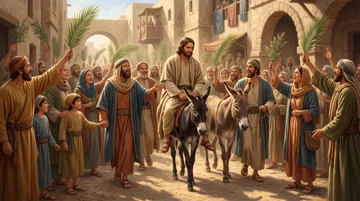
And a very great multitude spread their garments in the way; others cut down branches from the trees, and strawed them in the way.
The crowd honors Jesus with garments, branches, and cries of Hosanna.
- Luke 19:29
And it came to pass, when he was come nigh to Bethphage and Bethany, at the mount called the mount of Olives, he sent two of his disciples,
Places Jesus near Bethphage and the Mount of Olives as he sends two disciples.
- Luke 19:41-44
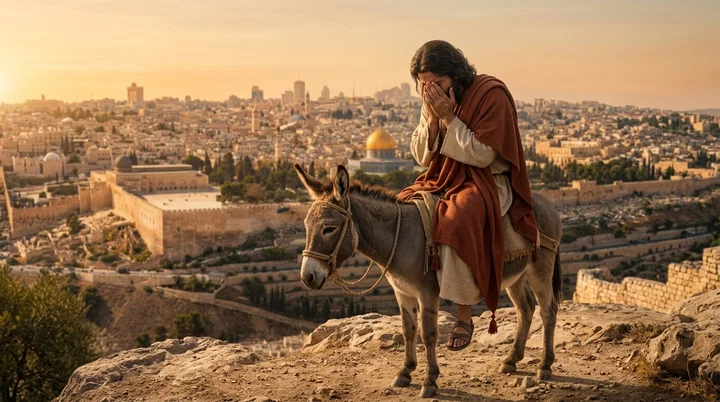
And when he was come near, he beheld the city, and wept over it,
Jesus weeps over Jerusalem and warns of its coming destruction.
- Matthew 21:12-13
And Jesus went into the temple of God, and cast out all them that sold and bought in the temple, and overthrew the tables of the moneychangers, and the seats of them that sold doves,
Describes Jesus driving merchants from the temple
- Isaiah 40:9-11
O Zion, that bringest good tidings, get thee up into the high mountain; O Jerusalem, that bringest good tidings, lift up thy voice with strength; lift it up, be not afraid; say unto the cities of Judah, Behold your God!
The prophecy of the Lord’s coming is identified with Christ’s entry into Jerusalem.
- John 12:17-18
The people therefore that was with him when he called Lazarus out of his grave, and raised him from the dead, bare record.
The people met Jesus because they heard he had raised Lazarus.
- Isaiah 62:11
Behold, the LORD hath proclaimed unto the end of the world, Say ye to the daughter of Zion, Behold, thy salvation cometh; behold, his reward is with him, and his work before him.
Cited with the prophecy of the King’s coming to Zion.
- John 12:19
The Pharisees therefore said among themselves, Perceive ye how ye prevail nothing? behold, the world is gone after him.
Records the rulers’ alarm as crowds followed Jesus.
Commentary
Each commentary is drawn from primary sources: the writings of Ellen G. White and Adventist pioneers and periodicals. Each commentary is separate. Its own words are not a quotation; follow the references to read the source passages.
Ellen G. White
28 sources
When He draws near to Jerusalem at Bethphage by the Mount of Olives He sends two disciples ahead to bring a colt never ridden for His entry.DA 569.3–4DA 569COS 91.1–5 It is the first day of the week at Passover time near the close of His final ministry, with multitudes joining Him including those drawn by the raising of Lazarus.DA 569.3–4COS 91.1–54RED 115.3 He who had always walked and long refused royal honors now deliberately presents Himself publicly as Israel's promised King and the world's Redeemer and accepts the crowd's homage in fulfillment of Zechariah 9:9.DA 569.1–2DA 569ST Jun 8, 1882EW 206.4DA 570.1–571.1 The demonstration directs all eyes to His crowning sacrifice as the antitypical Passover Lamb voluntarily set apart for the sins of the world, not claiming an earthly throne but faintly prefiguring His future coming in glory.2SP 384.1–385.14RED 116.1–117.2ST Jun 8, 18823SP 9.1 Amid the rejoicing His tears over the city are His last appeals of love to a people who reject Him and point to Jerusalem's doom, joining the lesson of the barren fig tree against outward profession without fruit.Lt 82, 1907, par. 93SP 20.1ST Jan 10, 1878Ms 5, 1882, par. 11ST Feb 15, 1899
Setting and Circumstances
When they drew nigh unto Jerusalem they had come to Bethphage unto the Mount of Olives, a short distance from the city, and then Jesus sent two disciples ahead to bring the colt for His entry.DA 569.3–4COS 91.1–54RED 115.3ST Jul 22, 18862SP 383.2 The animal is described as an ass and its colt, a young colt that no one had ridden.DA 569.3–44RED 115.32SP 384.1–385.1 The entry takes place on the first day of the week at Passover time, near the close of His final ministry, as He resumes His journey to Jerusalem to keep the feast.DA 569.3–4COS 91.1–54RED 115.3ST Jul 22, 18862SP 383.2 It is the beautiful season of the year when foliage is green, and the Mount of Olives is green and covered with varied foliage.DA 569.3–4Ms 128, 1899, par. 1 Multitudes join Him, including crowds from Bethany drawn by the raising of Lazarus and others on the way to the feast who keep joining Him, with many come from the surrounding regions hoping to see Jesus.DA 569.3–4COS 91.1–54RED 115.3Ms 128, 1899, par. 1
Though He had always traveled on foot, He now rides a donkey into Jerusalem, following the custom for a royal entry by Israel's kings.DA 5694RED 115.3DA 570.1–571.1 The procession is unlike a conqueror's parade, for it is made up of people He had delivered and healed, who praise Him for His works of mercy.ST Jun 8, 18824RED 120.22SP 384.1–385.1 Lazarus, restored from death, guides the animal on which He rides.4RED 120.2 Followers and onlookers celebrate with leafy branches, spreading garments and leafy branches in His path, waving palm branches, and shouting praise as they welcome Him with homage as Messiah and King.DA 569ST Jun 8, 18822SP 384.1–385.1
The Mount of Olives setting was hallowed by His presence, prayers, and tears, and its slopes echoed with the crowd's joyful shouts when He entered Jerusalem.3SP 250.3Ms 128, 1899, par. 1 Nearby Bethany gave Him rest at Lazarus's home, and at the foot of the mount lay Gethsemane, where He would agonize alone before His trial.3SP 250.3 His need to borrow a stranger's animal shows His humility, while His precise directions for obtaining it show His divinity.DA 569.3–4 Though in this one triumphant scene of His earthly life He might have appeared escorted by heavenly angels and heralded by the trumps of God, He remained true to the life of humiliation He had accepted, bearing the burden of humanity till His life was given for the life of the world.DA 569.3–4ST Jun 8, 1882DA 571.2–4
Messiahship and Redemptive Purpose
This sending of the two disciples begins His public presentation as Israel's promised King, heir to David's throne, and the world's Redeemer.DA 569.1–2DA 569ST Jun 8, 18822SP 384.1–385.1DA 570.1–571.1 After long refusing royal honors He now deliberately draws attention to Himself, choosing to ride in amid public homage and accepting the crowd's welcome as Messiah and King.ST Jun 8, 18822SP 384.1–385.1DA 570.1–571.14RED 116.1–117.2 Riding an animal used by Israel's kings followed the custom for a royal entry, and His royal reception did not mean He was claiming an earthly throne.DA 570.1–571.14RED 116.1–117.2
The entry fulfills prophecy, especially Zechariah 9:9 foreseen also by Isaiah.DA 569.1–2EW 206.4DA 570.1–571.14SP 253.2Ms 151, 1899, par. 5 Prophecy must be fulfilled, so that if the multitude were silenced even the stones would cry out.1T 57.3–58.1 The disciples are carrying out God's purpose in it, though they do not yet understand its full meaning.4SP 253.2
The demonstration is staged to direct all eyes to His crowning sacrifice ending His mission to a fallen world.2SP 384.1–385.14RED 116.1–117.2ST Jun 8, 1882DA 571.2–4 As the antitypical Passover Lamb He by a voluntary act sets Himself apart as an oblation for the sins of the world, ordering the events preceding His great sacrifice to direct all people to the sacrifice itself.ST Jun 8, 1882DA 571.2–4 The startling public events before His death are ordered so all eyes follow His rapid progress to the final end, calculated to be the talk of every tongue and bring Him before every mind.ST Jun 8, 1882DA 571.2–4 The display was necessary so that in all future ages the church would make His death for the sins of the world a subject of deep thought and study, with every fact connected to it verified beyond doubt.ST Jun 8, 1882 After His crucifixion people would connect the entry with His trial and death, search the prophecies, recognize Him as Messiah, and be multiplied as converts in all lands.ST Jun 8, 1882DA 571.2–4
The ride shortly before His crucifixion faintly prefigures His future coming as Zion's King in glory, when angels and saints rejoice.2SP 384.1–385.14RED 116.1–117.23SP 9.1 The disciples, friends of Jesus, and people mistake the ride into the capital for a sign He will proclaim Himself King of the Jews, assert earthly royal power, take David's throne, and free Israel from Rome and its oppressors.DA 569.3–44RED 115.3EW 206.4DA 570.1–571.14SP 253.2 Excitement spreads and raises the hopes of the people to the highest pitch, with the disciples expecting Him to be crowned king.4RED 115.31T 57.3–58.1 Their hopes are shattered when He is crucified and buried, with high hopes disappointed and the darkness of death closing about them in a disappointment greater than that of later believers.EW 206.41T 57.3–58.14SP 253.2 His resurrection revives their hopes, and only then do they understand that prophecy had also foretold His suffering and rising, while He remains true to His promises with sweet consolation to His people and rich reward for the true and faithful.EW 206.41T 57.3–58.14SP 253.2
Judgment and Present Lessons
The triumphal entrance that begins at Bethphage near Jerusalem points to Jerusalem's coming doom, for amid the crowd's rejoicing Christ's tears over the city were His last appeals of love and compassion to a people who rejected Him.3SP 20.1ST Jan 10, 1878 That warning of judgment was joined with the cleansing of the temple and the judgment pronounced upon the barren fig tree.ST Jan 10, 1878
The whole chapter beginning here is a powerful lesson to be studied, joining the riding into Jerusalem just before the lesson of the barren fig tree.Lt 82, 1907, par. 9Ms 5, 1882, par. 11ST Feb 15, 1899 The tree's showy leaves symbolized Jerusalem and the Jewish nation, whose outward religious profession concealed separation from God, pride, and apostasy and left them unable to recognize their Redeemer.ST Feb 15, 1899 In the same sense the fruitless tree represents professed servants of God who bear no fruit in their lives, and its blighting represented God's righteous anger and Jerusalem's destruction.Lt 82, 1907, par. 9ST Feb 15, 1899
Preaching Christ's riding into Jerusalem exalts Jesus and lifts Him up, showing that salvation is through Jesus lifted up and not by law.Lt 27, 1880, par. 8 So lifted up He draws hearers to conviction, to baptism, and to uniting with the church.Lt 27, 1880, par. 8 Such preaching urges hearers to let the word take hold upon their souls and to do their part well, so they may stand acquitted when the judgment sits and the books are opened and every account is balanced.Lt 29, 1880, par. 22–23 It shows the Son of God come to this world to draw all men to Himself, whose coming brings not peace but a sword.Ms 5, 1882, par. 11 His followers must therefore walk in the light of His example without questioning the cost in labor, trial, and suffering, each maintaining the truth in its purity and pushing the triumphs of His cross to extend His kingdom.Ms 5, 1882, par. 11
Sources
Pioneers and periodicals
53 sources
Jesus and his disciples had come to Bethphage by the Mount of Olives near Jerusalem, only a few days before his suffering and death near the close of his ministry.ST Sep 27, 1899ST Sep 27, 1899ST Nov 8, 1883 On arriving there he sent two disciples ahead to bring a colt for him to ride, beginning his triumphal ride into the city.ST Sep 27, 1899ST Oct 5, 1904ST May 9, 1878 In that lowly ride on an ass's colt he entered Jerusalem as the promised King, Messiah and Son of David, welcomed with rejoicing crowds, spread garments, palm branches and shouts of praise.ST Jun 8, 1882ST Oct 5, 1904ST Mar 27, 1901 The humble entry fulfilled Zechariah's prophecy of the King coming meek to the daughter of Zion riding upon an ass and a colt.ST Oct 5, 1904RH Nov 18, 1862ST May 9, 1878 He deliberately staged this demonstration to draw all eyes to himself before his death and call attention to his crowning sacrifice for a fallen world.ST Jun 8, 1882
Place and Timing
When they drew nigh unto Jerusalem they were come to Bethphage, unto the Mount of Olives, with Bethphage near Bethany on the way toward the city.ST Jun 8, 1882ST Sep 27, 1899ST Sep 27, 1899ST Mar 27, 1901ST May 9, 1878 Jesus and his disciples were near Jerusalem at Bethphage by the Mount of Olives as they approached the city, and the verse opens the account of the triumphal entry.ST Jun 8, 1882ST Sep 27, 1899ST Sep 27, 1899ST Mar 27, 1901ST
The event took place in Jerusalem in A.D. 31, thirty-three years after Jesus' birth.ST Sep 27, 1899 It stands near the close of his ministry and only a few days before his sufferings and death and his crucifixion.ST Nov 8, 1883ST Feb 14, 1878RH Mar 17, 1859ST Aug 13, 1902
It belongs to the last week of his life on earth, at Passover time, as they approached for the Passover.ST Jul 22, 1886ST Aug 13, 1902ST Apr 14, 1898 It is commemorated as Palm Sunday beginning Holy Week, the day after the last Sabbath he spent on earth.ST Dec 23, 1886ST Aug 1, 1916ST Aug 1, 1916
About five months had passed since the preceding period, and during that interval Lazarus was raised.ST Apr 14, 1898 In consecutive Bible history from creation down to the time of the apostles the verse stands between the sending out of the twelve disciples and the last Passover in the week of Christ's passion.ST Apr 14, 1898RH Jan 6, 1910
The verse is a historical record of a real event, not a legend, belonging to the Gospel account of the approach to Jerusalem.RH Mar 8, 1906 It marks the point at which the triumphal entry begins and the beginning of the events leading to the triumphant ride into the city.ST Nov 28, 1878 That entry closes the treatment of his first advent and of his life and mission.
Sending Two Disciples
When they had come to Bethphage by the Mount of Olives near Jerusalem, Jesus sent two disciples on ahead to procure the animal for His entry and bring a colt.ST Jul 22, 1886ST Sep 27, 1899ST May 9, 1878ST Apr 12, 1905RH Feb 16, 1869 The sending took place as they drew near the city on the way toward it for the Passover, with the disciples accompanying Him.ST Jul 22, 1886ST Sep 27, 1899ST May 9, 1878ST Apr 12, 1905RH Feb 16, 1869 It was the deliberate act by which He began His entry into Jerusalem in the role of King.ST Oct 5, 1904ST May 9, 1878RH Feb 16, 1869
This riding was the only recorded occasion on which Jesus rode during His travels, except in a boat.ST Oct 5, 1904ST Apr 12, 1905 He rode a humble, unridden ass, and His careful directions about finding that lowly animal show that even a colt had a place in His service.ST Oct 5, 1904ST Apr 12, 1905ST
The sending marks the beginning of the events leading to His triumphal ride into the city.ST May 9, 1878ST Aug 27, 1912ST Mar 14, 1906ST Nov 28, 1878 It opens the remarkable public demonstration that followed, with its welcome, its cleansing of the temple, and the lessons connected with it.ST May 9, 1878ST Dec 16, 1886ST Aug 27, 1912 It therefore marks the setting for the time when the disciples were close to Jesus as the triumph began.ST Mar 14, 1906ST Nov 28, 1878
Humble Royal Entry
Matthew 21:1 begins the entry into Jerusalem in the role of King, as the promised King and Messiah, the Son of David and heir to David's throne.ST Jun 8, 1882ST Oct 5, 1904STST Aug 13, 1902RH Sep 18, 1855 As He draws near by Bethphage at the Mount of Olives and sends two disciples ahead to procure the colt, the account opens into a rejoicing procession with crowds, palm branches, spread garments laid in the path, and cries of praise.ST Jun 8, 1882ST Oct 5, 1904STST Aug 13, 1902RH Sep 18, 1855 The multitude hails Him as Son of David and King and expects His kingdom to be established then, and their rejoicing is not wrong, for if the people were silent the stones would cry out.ST Mar 27, 1901ST Aug 13, 1902RH Sep 18, 1855 He rides thus so that the word spoken by the prophet about the King coming to the daughter of Zion meek and riding upon an ass and a colt would be fulfilled.ST Oct 5, 1904ST Mar 27, 1901RH Mar 17, 1859
He comes lowly on an ass and a colt, in everyday attire rather than gorgeous robes, in the manner of Israel's kings signifying peace.RH Nov 18, 1862ST Mar 27, 1901ST Apr 12, 1905RH Mar 17, 1859ST Mar 25, 1903 He enters as Prince of Peace and as burden-bearer for the people, not as a hero of war and display and pomp borne on the people's shoulders.ST Mar 27, 1901ST Apr 12, 1905ST Feb 6, 1901ST Mar 25, 1903 The ride is meek and humble, fulfilling the prediction that the Messiah would ride into Jerusalem on a young ass as a sign of humility.RH Nov 18, 1862ST Mar 27, 1901RH Mar 17, 1859 The entry is marked by self-denying love, in contrast with the brutal force displayed in worldly political processions.ST Feb 6, 1901ST Mar 25, 1903
It is majestic in appearance and benign in countenance, with Jesus of Nazareth in the midst of a mighty host moving over the Mount of Olives toward the city, the One foretold by prophets, worshiped by angels, and anointed by God.RH Nov 25, 1873 The whole city is moved to ask who this is, and the answer is Jesus of Nazareth.RH Nov 25, 1873 This was the one time in His life when He permitted such open demonstrations of honor to have full sway, receiving a measure of the honor and adoration due Him.STST Jul 22, 1886 Even His directions about finding the humble animal show that even a colt had a place in His service.ST
The people's joy praises God for the mighty works they had seen, including healings, cleansing of lepers, restored sight, and raised dead, and even children join in praising God for His power shown in helping suffering people. The welcome is chiefly prompted by the report that He had raised Lazarus from the dead, and it forms a remarkable public demonstration shortly before His sufferings and death.ST Dec 16, 1886 The scene is also recorded in the other Gospels.ST The people's actions accord with prophecy, but the rulers reject Him and the multitude's faith weakens when He does not meet their expectations, linking the welcome with their later rejection.ST Mar 27, 1901ST
Prophecy Fulfilled
The approach to Jerusalem at Bethphage by the Mount of Olives, with the sending of two disciples ahead to procure a colt, begins the humble entry into the city that fulfills the prediction that the Messiah would ride in as King.ST Oct 5, 1904RH Nov 18, 1862ST May 9, 1878RH Jun 24, 1858RH Mar 17, 1859 The word spoken by the prophet is fulfilled in the King coming to the daughter of Zion meek and riding upon an ass and upon a colt, lowly upon a donkey as a sign of humility.ST Oct 5, 1904RH Nov 18, 1862ST Nov 8, 1883RH Mar 17, 1859 This was the only time during His travels that He rode, except in a boat, and the imperative form of the prophecy describes an event to occur at its appointed time, to be understood literally and not as already imminent when written.ST Oct 5, 1904ST May 9, 1878 It took place near the close of His ministry only a few days before His sufferings and crucifixion, and it formed part of the ample evidence that He was the Messiah and heir to David's throne, together with fulfilled prophecies, miracles, pure life and teaching, and the raising of Lazarus who had been dead four days.ST Nov 8, 1883RH Mar 17, 1859 Though the crowd hoped He would immediately take David's throne, within days He was crucified and the disciples were scattered.RH Mar 17, 1859
The shout of the vast multitude following Him into Jerusalem on the colt was put into the people by God, by the Spirit of prophecy spoken long before and present at the time.ST Feb 4, 1903 That Spirit commanded the daughter of Jerusalem to shout because her King comes to her, so the triumph was no empty sound but genuine praise for a great victory achieved or about to be achieved.ST Feb 4, 1903
The passage beginning here fulfills the prophecy that the stone which the builders rejected has become the head stone of the corner.RH May 10, 1860RH May 10, 1860 It is taught that the day which the Lord has made is resurrection day, the first day of the week divinely appointed in place of the seventh-day Sabbath to commemorate the resurrection.RH May 10, 1860 By contrast it is also taught that the same record of fulfillment says nothing about resurrection day or the seventh day and gives no support for a change of the Sabbath.RH May 10, 1860
Hope and Disappointment
The disciples, crowds and followers acclaimed him as Son of David and King, spreading branches and garments before him in honor to royalty, because they expected him to take David's throne at that time, establish his kingdom over Judah and Jerusalem, defeat their enemies and reign then as a temporal king.RH Sep 18, 1855RH Jul 25, 1865ST Dec 3, 1874RH Aug 26, 1915RH Feb 16, 1869 They did not understand that he was about to die on the cross, and the homage he allowed strengthened that mistaken expectation.ST Dec 3, 1874ST Jul 27, 1882RH Aug 26, 1915 Their expectation about when the Messiah's kingdom would be realized was disappointed, but their rejoicing was not wrong.RH Sep 18, 1855RH Feb 16, 1869 Jesus affirmed that if the people were silent the stones would cry out, for their actions and hosannas fulfilled prophecy.RH Sep 18, 1855RH Feb 16, 1869
Their great enthusiasm showed they were moved by what they saw rather than by faith, proclaiming his triumphal entry without understanding how events would unfold.ST Mar 27, 1901RH Jun 29, 1911 Yet their proclamation was nevertheless the message appointed for that time, and their mistaken ideas about the event did not prevent them from fulfilling Scripture.RH Jun 29, 1911RH Feb 16, 1869RH Aug 24, 1869 Their hope was disappointed, for instead of a royal throne he went within days to an ignominious death on the cross and was laid in Joseph's tomb.RH Mar 17, 1859ST Aug 13, 1902RH Jul 25, 1865ST Jul 27, 1882 The disciples were scattered, and their grief and disappointment were especially bitter so soon after the triumph they had witnessed and escorted shortly before his crucifixion.RH Mar 17, 1859RH Jul 25, 1865ST Mar 24, 1887RH Jul 6, 1869
The entry looked like defeat because Christ was not made king then but was crucified a few days later by his bitterest enemies.ST Aug 13, 1902ST Feb 4, 1903 Yet his crucifixion was his real coronation and triumph over the powers of darkness on Calvary's cross, sealing the doom of Satan, his principles, his kingdom and himself.ST Feb 4, 1903 The disciples did not understand this and were disappointed when they should have been shouting happy, while Satan understood the significance of that triumphant death better than they did.ST Feb 4, 1903 Their disappointment threatened their faith, but it was part of God's plan and does not by itself prove a teaching false.RH Jul 25, 1865
They were nevertheless blessed because they had received the truths they had heard.ST Jul 27, 1882 The risen Christ corrected their understanding and gave Peter work to do, and then the gospel work began.ST Jul 27, 1882 Their mistaken views while loyal to Christ do not justify rejecting the gospel they preached.RH Feb 14, 1871RH Feb 26, 1867 Their experience illustrates how the 1844 believers' hope of seeing Christ return in glory was followed by a time of waiting, distinguishing those who remained faithful through disappointment in loyalty to Christ from those who did not love Christ and his appearing.RH Apr 20, 1916RH Feb 26, 1867
Purpose and Aftermath
The approach to Jerusalem opens a demonstration deliberately staged to draw all eyes to Jesus just before his death and to call attention to the crowning sacrifice that ended his mission to a fallen world.ST Jun 8, 1882 As crowds assembled at Jerusalem to celebrate the Passover, he as the antitypical Lamb by a voluntary act set himself apart as an oblation, ordering the events preceding his great sacrifice to direct all people to the sacrifice itself so that all eyes would follow his rapid progress to the final end.ST Jun 8, 1882 The display was necessary so that in all future ages the church would make his death for the sins of the world a subject of deep thought and study, with every fact connected with it verified beyond doubt.ST Jun 8, 1882 The startling events were calculated to be the talk of every tongue and to bring Jesus before every mind, so that after his crucifixion they would be connected with his trial and death, searched prophecies would reveal him as the Messiah, and converts would be multiplied in all lands.ST Jun 8, 1882 Though in this one triumphant scene of his earthly life he might have appeared escorted by heavenly angels and heralded by the trumps of God, he remained true to the life of humiliation he had accepted, bearing the burden of humanity till his life was given for the life of the world.ST Jun 8, 1882
The entry welcomed the first advent just as heralds of the second coming would announce Christ's return.ST Aug 1, 1916 It occupied its place in a chain of events and was recognized and proclaimed as the fulfillment by a people raised up to announce it.ST Aug 1, 1916 It is connected with his final triumph when he enters his kingdom to reign.ST Apr 14, 1898 From the Mount of Olives he viewed Jerusalem, then entered the temple and with mighty power drove out the merchants and money-changers.ST Aug 27, 1912ST Feb 14, 1878 Together with the judgment on the barren fig tree, the entrance pointed to Jerusalem's coming doom, and his tears over the city were his final appeals of love and compassion.ST Jan 10, 1878 The people failed to heed God's warning and to recognize their privileges, and their time of probation was nearly over.ST Feb 14, 1878
After receiving public regal honors he cleansed the temple, showing that God's temple must be cleansed before he takes up his abode in it, which also applies to the believer as God's temple.ST Mar 27, 1901 The showy leaves of the barren fig tree just after the entry symbolized Jerusalem and the Jewish nation, whose outward religious profession concealed separation from God, pride, and apostasy, leaving the people unable to recognize their Redeemer.ST Feb 15, 1899 Its blighting represented God's righteous anger and Jerusalem's destruction.ST Feb 15, 1899 In the wider chapter he attends to his Father's business by coming to the husbandmen of the entrusted vineyard to require the returns due its owner, which they refused to give when authorized collectors came.ST Nov 20, 1884 The favorable welcome that could quickly turn shows that the friendship of the world is dangerous and should not be trusted too much,ST Jul 30, 1894 and the setting marks a time when the disciples were close to him.ST Mar 14, 1906
Sources