Luke 19:29
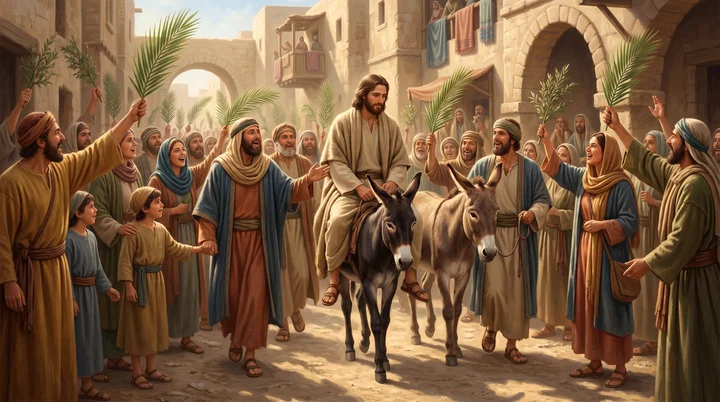
And it came to pass, when he was come nigh to Bethphage and Bethany, at the mount called the mount of Olives, he sent two of his disciples,
Translations
And it came to pass, when he was come near to Bethphage and Bethany, at the mount called the mount of Olives, he sent two of his disciples,
King James Version, KJV Cambridge Paragraph Bible
And it came to pass, when he was come nigh to Bethphage and Bethany, at the mount called the mount of Olives, he sent two of his disciples,
And it came to pass, when he had come nigh to Bethphage and Bethany, at the mount called the mount of Olives, he sent two of his disciples,
And it came to pass, when he drew nigh unto Bethphage and Bethany, at the mount that is called the mount of Olives, he sent two of the disciples,
And it came to pass, when he drew nigh unto Bethphage and Bethany, at the mount that is called Olivet, he sent two of the disciples,
And it came to pass, as he came nigh to Bethphage and Bethany, unto the mount called of the Olives, he sent two of his disciples,
And it came to pass as he drew near to Bethphage and Bethany at the mountain called [ the mount] of Olives, he sent two of his disciples,
And it came to pass, as he drew near unto Bethphage, and Bethany, unto the mount which is called the Mount of Olives, he sent off two of his disciples,
Berean Standard Bible, Majority Standard Bible
As He approached Bethphage and Bethany at the Mount of Olives, He sent out two of His disciples,
When he came near to Bethsphage and Bethany, at the mountain that is called Olivet, he sent two of his disciples,
And it came about that when he got near Beth-phage and Bethany by the mountain which is named the Mountain of Olives, he sent two of the disciples,
And it came to passe, when hee was come neere to Bethphage, and Bethania, besides the mount which is called the mount of Oliues, he sent two of his disciples,
Douay-Rheims (Challoner revision)
And it came to pass, when he was come nigh to Bethphage and Bethania, unto the mount called Olivet, he sent two of his disciples,
Pictures
Cross-references
- Zechariah 9:9
Rejoice greatly, O daughter of Zion; shout, O daughter of Jerusalem: behold, thy King cometh unto thee: he is just, and having salvation; lowly, and riding upon an ass, and upon a colt the foal of an ass.
Jesus’s lowly ride into Jerusalem fulfilled the prophecy of the King arriving on a colt.
- Mark 11:1-10
And when they came nigh to Jerusalem, unto Bethphage and Bethany, at the mount of Olives, he sendeth forth two of his disciples,
A parallel account of Jesus sending two disciples and entering Jerusalem amid the crowd’s praise.
- John 12:12-16
On the next day much people that were come to the feast, when they heard that Jesus was coming to Jerusalem,
Recounts Jesus’ entry into Jerusalem, the crowd’s welcome, and the disciples’ later understanding of its prophecy.
- Matthew 21:1-11
And when they drew nigh unto Jerusalem, and were come to Bethphage, unto the mount of Olives, then sent Jesus two disciples,
Parallel account of Jesus sending disciples for the animals and entering Jerusalem.
- Luke 19:40
And he answered and said unto them, I tell you that, if these should hold their peace, the stones would immediately cry out.
Jesus says the stones would cry out if his disciples were silent.
- Psalms 118:25-26
Save now, I beseech thee, O LORD: O LORD, I beseech thee, send now prosperity.
The crowd’s Hosanna acclamation and blessing echo these words.
- Matthew 21:5-9
Tell ye the daughter of Sion, Behold, thy King cometh unto thee, meek, and sitting upon an ass, and a colt the foal of an ass.
Jesus enters as the prophesied King, welcomed with Hosanna.
- Luke 19:41-44
And when he was come near, he beheld the city, and wept over it,
Jesus weeps over Jerusalem and warns of its coming destruction.
- Luke 19:38
Saying, Blessed be the King that cometh in the name of the Lord: peace in heaven, and glory in the highest.
The disciples hail Jesus as the coming King and bless him.
- John 11:1
Now a certain man was sick, named Lazarus, of Bethany, the town of Mary and her sister Martha.
Bethany is identified as Lazarus’s home, where Jesus raised him.
- Luke 24:50-51
And he led them out as far as to Bethany, and he lifted up his hands, and blessed them.
Jesus later led the disciples toward Bethany and ascended from the Mount of Olives.
- Zechariah 14:4
And his feet shall stand in that day upon the mount of Olives, which is before Jerusalem on the east, and the mount of Olives shall cleave in the midst thereof toward the east and toward the west, and there shall be a very great valley; and half of the mountain shall remove toward the north, and half of it toward the south.
Christ returns to the Mount of Olives to restore all things.
- John 12:17-18
The people therefore that was with him when he called Lazarus out of his grave, and raised him from the dead, bare record.
The crowd welcomes Jesus because they heard he raised Lazarus from the dead.
- Isaiah 62:11
Behold, the LORD hath proclaimed unto the end of the world, Say ye to the daughter of Zion, Behold, thy salvation cometh; behold, his reward is with him, and his work before him.
Cited with the prophecy of the King coming to Zion.
- Matthew 21:10
And when he was come into Jerusalem, all the city was moved, saying, Who is this?
The crowd asks who Jesus is as he enters Jerusalem.
- Matthew 24:1-3
And Jesus went out, and departed from the temple: and his disciples came to him for to shew him the buildings of the temple.
Jesus teaches about the temple’s destruction and his coming from the Mount of Olives.
- 2 Kings 9:13
Then they hasted, and took every man his garment, and put it under him on the top of the stairs, and blew with trumpets, saying, Jehu is king.
Garments spread for Jesus recall the honor given to a king.
Commentary
Each commentary is drawn from primary sources: the writings of Ellen G. White and Adventist pioneers and periodicals. Each commentary is separate. Its own words are not a quotation; follow the references to read the source passages.
Ellen G. White
20 sources
Jesus was come nigh to Bethphage and Bethany at the Mount of Olives as He approached Jerusalem for the Passover, and from there He sent two of His disciples ahead.DA 569.3–4DA 569DA 569.1–2DA 570.1–571.14RED 115.3
They were to bring an ass and its colt, a foal upon which no one had ever sat, and upon their word that the Lord had need of them the owners let them go, and the disciples spread their garments upon the colt and set Him upon it though He had always traveled on foot.DA 569.3–4ST Jun 8, 18824RED 116.1–117.2DA 570.1–571.14RED 115.3
That sending began His public triumphal procession into Jerusalem as Messiah and promised King in the manner of an Israelite king, whose trophies were people He had delivered, healed, and raised.DA 569.1–24RED 120.2COS 91.1–5
For the first time He accepted public homage, while the disciples and the ever-growing multitude spread garments in His path, strewed and waved olive and palm branches as emblems of victory, and shouted hosannas and blessings to God for all His mighty works, in fulfillment of prophecy about the Messiah's royal arrival.Ms 123, 1909, par. 21–22ST Jun 8, 1882EW 206.41T 57.3–58.1
Many took this to mean He would take David's throne, assert royal power, drive out the Romans and restore Israel as an independent nation, and their hopes ended in bitter grief at His crucifixion until they revived at His resurrection.DA 569.3–4ST Jun 8, 1882EW 206.41T 57.3–58.14SP 253.2
The ride led to His solemn weeping from the crest of Olivet over the doomed city that rejected His mercy in coming to die that sinful man might not perish, seeing beyond Jerusalem to an impenitent world doomed to destruction.Ms 54, 1886, par. 4–7Ms 85, 1893, par. 3Lt 80, 1890, par. 4
Setting and Preparation
Jesus had come nigh to Bethphage and Bethany, at the Mount of Olives, as He approached Jerusalem for the Passover.DA 569.3–4DA 569DA 569.1–2COS 91.1–5EW 206.4 From that place He sent two of His disciples ahead toward the city to prepare for His entry as the promised King.DA 569.3–4DA 569.1–2ST Jun 8, 1882COS 91.1–5ST Jul 22, 1886
It was the first day of the week, and He resumed His journey to Jerusalem for the feast accompanied by multitudes who had flocked to Bethany to see Him and were eager to witness His entry.4RED 116.1–117.24RED 115.32SP 383.2 The season was beautiful, with rejoicing nature, green hills, leafy groves, trees in verdure, and fragrant blossoms.4RED 115.3Ms 128, 1899, par. 1 Many other people on their way to keep the feast continually joined them, and the crowd was enlarged and made especially large and enthusiastic by those who hoped to see Him after the raising of Lazarus.4RED 116.1–117.24RED 115.32SP 383.2Ms 128, 1899, par. 1
Though the distance was short, He sent the two disciples a short distance ahead to bring an ass and its colt, the foal of an ass upon which no one had ever sat, that He might ride into Jerusalem.DA 569.3–44RED 116.1–117.24RED 115.32SP 383.2 Their errand followed His precise directions, and the owners readily released the animals when told the Lord had need of them.DA 569.3–4 From there the animals were brought at His command for Him to ride into the city, beginning the public scene of His entry.COS 91.1–5DA 570.1–571.1ST Jul 22, 1886
He had always chosen to travel on foot, so His choice now to ride puzzled the disciples.DA 569.3–44RED 116.1–117.24RED 115.32SP 383.2 They spread their garments on the colt that no one had ridden before and set Him upon it.DA 569.3–4ST Jun 8, 18824RED 116.1–117.22SP 384.1–385.1 Yet the act brightened their hearts with hope that He was about to enter the capital to proclaim Himself King of the Jews and assert His royal power and establish His kingdom.DA 569.3–4ST Jun 8, 18824RED 116.1–117.24RED 115.32SP 383.2
Royal Entry and Significance
The sending of the two disciples begins His public triumphal procession into Jerusalem as Messiah and promised King.DA 569.1–2COS 91.1–5 He enters in the manner of an Israelite king, riding the colt they bring.DA 570.1–571.1 It is unlike the pageants of earthly conquerors, for its trophies are people He has delivered and healed.4RED 120.2 Those rescued from Satan, the blind, the dumb, the healed, widows and orphans, cleansed lepers, and people raised from the dead praise God and honor Him as King, with Lazarus guiding the animal that carries his Liberator.4RED 120.2
For the first time He now accepts the public homage He had never before permitted.4RED 116.1–117.22SP 384.1–385.1 No sooner is He seated than the multitude hails Him as Messiah their King with a loud shout of triumph and hosannas.4RED 116.1–117.2 The people give Him the worship of happy hearts, spreading outer garments as a carpet in His path and strewing leafy branches of olive and palm.4RED 116.1–117.22SP 384.1–385.1 They cut and wave palm boughs, nature's emblem of victory, with no royal standards or outward pomp.4RED 116.1–117.22SP 384.1–385.1 The disciples loudly bless God by repeating the healings, the raisings of the dead, and all the mighty works they can remember.Ms 123, 1909, par. 21–22
The multitude continually increases with those hastening to join, and crowds come out from Jerusalem to meet and conduct Him, greeting Him with palm branches and sacred song.4RED 116.1–117.22SP 384.1–385.1 Their shouts of triumph and hosannas are echoed from hills and valleys.2SP 384.1–385.1 The display astonishes spectators who knew He had heretofore refused kingly honors and declared His kingdom was not of this world.4RED 116.1–117.22SP 384.1–385.1 Even the temple evening service is forsaken as the priests sound the trumpet to few responders, while the rulers say in alarm that the world has gone after Him.4RED 116.1–117.22SP 384.1–385.1DA 570.1–571.1
The entry fulfills prophecy about the Messiah's royal arrival, fulfilling Zechariah's prophecy.EW 206.4DA 570.1–571.1 This praise has to sound because prophecy must be fulfilled.Ms 123, 1909, par. 21–22 When priests and elders demand the multitude be stilled, He refuses, for prophecy has to be fulfilled even if the stones had to cry out.1T 57.3–58.1
Many take the homage as proof He will be acknowledged at Jerusalem as King of Israel.ST Jun 8, 18822SP 384.1–385.1 The disciples hope brightens that He is about to enter the capital and proclaim Himself King of the Jews and take David's throne with royal power.1T 57.3–58.14RED 116.1–117.2 Many expect Him to drive out the Roman armies, deliver Israel from its oppressors, and restore it as an independent nation.DA 570.1–571.14SP 253.2
Those high royal hopes end a few days later in grief when He is crucified and buried, the Master they believed would reign stretched on the cruel cross above mocking Pharisees.1T 57.3–58.14SP 253.2 It is a bitter disappointment with darkness of death closing about them, greater than the disappointment of later believers who waited for His coming.1T 57.3–58.1 Yet their hopes revive when He rises and appears to them.EW 206.4 The entry nevertheless fulfills prophecy and serves God's purpose, and He stays true to His promises with sweet consolation and rich reward for the true and faithful.1T 57.3–58.14SP 253.2
The ride leads to His weeping on the crest of Olivet over the doomed city.Ms 54, 1886, par. 4–7 He weeps because His mercy and love are rejected.Ms 54, 1886, par. 4–7 His coming to Jerusalem shows His mercy and love in dying for sinful man so that he might not perish in his sins.Ms 54, 1886, par. 4–7 In that weeping He sees beyond the destruction of Jerusalem to an impenitent world doomed to destruction.Ms 85, 1893, par. 3 The account is a solemn event that makes a solemn impression and is associated with people coming forward to renew their effort to follow Him, relying on His strength.Ms 85, 1893, par. 3Lt 80, 1890, par. 4
Sources
Pioneers and periodicals
33 sources
He came near to Bethphage and Bethany at the Mount of Olives on his way to Jerusalem for the Passover only days before his suffering and death, and there he sent two disciples ahead to bring the animal for his entry.ST Sep 27, 1899ST Nov 8, 1883ST Sep 27, 1899ST Sep 17, 1894 It was a borrowed, unridden colt, and his riding was the only such riding in his travels, done in the manner of Israel's kings yet as the Prince of Peace, for the ass signified peace while the horse was for war.ST Jun 8, 1882ST Apr 12, 1905RH Nov 4, 1873 In this he fulfilled Zechariah's prophecy of the King coming lowly and meekly riding upon an ass, with the details of the colt and the errand prepared beforehand to complete it.RH May 16, 1912ST Jun 5, 1879ST May 9, 1878 The people welcomed him with garments and palm branches, hosannas and praise for his mighty works as Messiah and King coming in the Lord's name, an homage he accepted even as he wept over Jerusalem because it did not know the things of its peace and its praise would soon turn to cries for his death.ST Jun 8, 1882STST Jun 22, 1882ST Nov 3, 1898 Because the disciples thought the kingdom of God should immediately appear, he spoke the parable of the nobleman going away to receive a kingdom and return, showing his departure to the Father, his priestly work and reception of the kingdom when judgment is finished, and his return to gather his people and slay those who would not have him reign.ST Sep 16, 1889ST Nov 27, 1879ST Sep 12, 1895RH Sep 18, 1855
Setting and Triumphal Entry
And it came to pass when he was come nigh to Bethphage and Bethany, at the mount called the Mount of Olives, as he approached Jerusalem, and from there he sent two of his disciples ahead to carry out his instructions for the entry into the city.ST Jul 22, 1886ST Sep 27, 1899ST Sep 27, 1899ST Sep 17, 1894ST This begins the account of his directions for obtaining the humble colt he would ride into Jerusalem, and it introduces his triumphant entry.STST The scene belongs to the last week of his life, as he journeyed to Jerusalem for Passover only a few days before his suffering, crucifixion and death.ST Jul 22, 1886ST Nov 8, 1883ST Feb 14, 1878 It took place near the end of his ministry, shortly before his entry into Jerusalem.ST Nov 8, 1883ST Feb 14, 1878
The approach lay in the familiar landscape between Bethany and Jerusalem, likely by the footpath from Bethany over the summit of the Mount of Olives.ST Nov 3, 1898ST Nov 17, 1898 From the mount he saw the city, and the crowd went down through the valley and up to the city gate.ST Feb 14, 1878ST Nov 3, 1898 He later entered the temple and drove out the traders and money changers and merchants.ST Feb 14, 1878ST Nov 3, 1898 The two disciples were sent to obtain the animal he would ride, a borrowed, unridden colt or ass.ST Jun 8, 1882ST Apr 12, 1905RH Nov 4, 1873 This was the only occasion recorded of his riding during his travels, and he rode in the manner of Israel's kings.ST Apr 12, 1905
The ass represented peace in contrast to the horse used especially for war, so he entered as the Prince of Peace.ST Apr 12, 1905 His use of a borrowed animal reflects his poverty and freedom from covetousness.RH Nov 4, 1873 The entry was triumphant and joyful, with the people laying garments and olive and palm branches in his path, waving palm branches as signs of victory, and shouting hosannas.ST Jun 8, 1882STST Nov 28, 1878 They celebrated the mighty works they had witnessed, including healing the sick, raising the dead and raising Lazarus, and welcomed him as Messiah, King, and the one coming in the Lord's name.ST Jun 8, 1882ST
He accepted this public homage as a measure of the honor and adoration due to him.ST Jun 8, 1882ST It was the one instance in his life when he allowed the multitudes full sway in showing him honor.ST Jul 22, 1886 The disciples took it as a sign that he would be acknowledged as King in Jerusalem.ST Jun 8, 1882 At this point Jerusalem could still repent and be saved, though its day of mercy was nearly over and judgment was approaching.STST Jun 22, 1882 He responded with sorrow and weeping over the city because it had failed to recognize what would bring it peace and faced destruction, and the crowd's praise would soon turn to cries for his death.STST Nov 3, 1898ST Apr 21, 1909 The account is one of the parallel accounts of the triumphal entry, to be connected with his final, glorious triumph when he enters his kingdom to reign.ST Apr 14, 1898ST Jan 18, 1899
Prophecy Fulfilled in Entry
The entry fulfills Zechariah's prophecy of the coming King arriving humbly, lowly and meekly riding on an ass, colt or donkey, amid shouting and hosannas.RH May 16, 1912ST May 9, 1878RH Dec 11, 1866ST Nov 8, 1883RH Mar 17, 1859 The sending of the two disciples from near Bethphage and Bethany at the Mount of Olives to obtain the colt, with all its details ready beforehand, helped complete that fulfillment.RH May 16, 1912ST Jun 5, 1879 God's prophetic word does not fail, and the people's welcome of Jesus as King completed the prophecy.RH May 16, 1912
The fulfillment was partial, for his riding into Jerusalem fulfilled the promise that the King would come lowly, while the further promise of his worldwide dominion and the end of war remains to be fulfilled.RH Dec 11, 1866 The prophecies he had fulfilled, together with his miracles, pure life and teaching, and raising of Lazarus, showed that he was the Messiah, heir to David's throne, Son of God, and King of Israel.ST Nov 8, 1883 The disciples' actions in acclaiming the promised King obeyed prophecy's command, even though they misunderstood what his kingship would mean and expected him to reign in Jerusalem and immediately take David's throne.ST Jun 5, 1879RH Mar 17, 1859 Within days he was crucified and the disciples were scattered, so the people's hope of an immediate enthronement was not fulfilled.RH Mar 17, 1859
Kingdom Expected Yet Delayed
As he drew near Bethphage and Bethany at the Mount of Olives, the disciples thought the kingdom of God should immediately appear, and to correct that impression he spoke the parable of the nobleman and of the pounds.ST Sep 16, 1889ST Nov 27, 1879RH Sep 18, 1855 They proclaimed the King's coming at the right time but wrongly expected the kingdom to appear immediately, because they could not see from prophecy that Christ must suffer before coming in his kingdom.ST Nov 20, 1884RH Sep 18, 1855 Only after their disappointment did they understand this distinction between his suffering and his reign.ST Nov 20, 1884
The correction did not fully remove the impression, for when they entered Jerusalem they hailed him as Son of David and rejoiced before him as a king in his triumph with palm branches and shouts.ST Sep 16, 1889ST Nov 27, 1879 They would not have done so if they had realized he was going into the city to be condemned and crucified as a malefactor.ST Sep 16, 1889ST Nov 20, 1884ST Nov 27, 1879 Their mistaken expectation about timing did not make their praise wrong, for if they had been silent the stones would have cried out.RH Sep 18, 1855
The parable presents him as a nobleman who goes away to receive a kingdom and then returns, showing his departure to the Father, his priestly work there, his reception of the kingdom when the judgment is finished, and his return to gather his people and bring the kingdom that will never end.ST Sep 12, 1895 That receiving is the closing event of his priestly ministry when he comes to the Father and has the heathen given him for inheritance and the uttermost parts of the earth for possession, which is also the time of the marriage of the Lamb.RH Apr 15, 1858 Its preparation does not depend on human effort, for the kingdom is Christ's.ST Sep 12, 1895
His enemies who would not have him reign over them will be brought forth and slain in his presence.RH Apr 15, 1858 This is not the conversion of the nations but the dashing of them in pieces like a potter's vessel, accomplished by his second advent and its accompanying judgments.RH Apr 15, 1858 During his absence he carries on a trading business left in his servants' hands, and on his return he demands a strict account from everyone.ST Nov 20, 1884 The pounds are gifts of the Spirit, given by the same giver, at the same time, to the same people, and for the same purpose as the talents in Matthew 25.ST Jul 8, 1889
Sources