Translations
Now in the morning as he returned into the city, he hungry.
King James Version, KJV Cambridge Paragraph Bible
Now in the morning as he returned into the city, he hungered.
Now in the morning as he was returning into the city, he was hungry.
Revised Version, American Standard Version
Now in the morning as he returned to the city, he hungered.
and in the morning turning back to the city, he hungered,
But early in the morning, as he came back into the city, he hungered.
And, early, returning into the city, he hungered;
Berean Standard Bible, Majority Standard Bible
In the morning, as Jesus was returning to the city, He was hungry.
Now in the morning, as he returned to the city, he was hungry.
Now in the morning when he was coming back to the town, he had a desire for food.
And in the morning, as he returned into the citie, he was hungrie,
Douay-Rheims (Challoner revision)
And in the morning, returning into the city, he was hungry.
Pictures
Cross-references
- Mark 11:12-14
And on the morrow, when they were come from Bethany, he was hungry:
Parallel account of Christ and the fig tree.
- Mark 11:20-21
And in the morning, as they passed by, they saw the fig tree dried up from the roots.
The disciples see the fig tree withered after Christ cursed it.
- Luke 13:6-9
He spake also this parable; A certain man had a fig tree planted in his vineyard; and he came and sought fruit thereon, and found none.
The fruitless fig tree warns of judgment and the need to bear fruit.
Commentary
Each commentary is drawn from primary sources: the writings of Ellen G. White and Adventist pioneers and periodicals. Each commentary is separate. Its own words are not a quotation; follow the references to read the source passages.
Ellen G. White
46 sources
In the morning as He returned from Bethany to Jerusalem He hungered, and that hunger led Him to seek fruit on a leafy tree that proved barren.DA 580DA 580.2–581.2Ms 88, 1899, par. 5–73SP 19.23SP 20.1 His hunger was hunger of soul for the fruits of righteousness in Israel, for love to God and man, self-sacrifice, compassion and zeal for the salvation of others.DA 582.3–583.2DA 584.1ST Jul 21, 1909 The leafy but fruitless tree represented the Jewish nation, covered with profession and ceremony yet bearing nothing to His glory, and with mournful reluctance He pronounced its doom as a sign of Jerusalem's coming judgment.ST Feb 21, 18783SP 20.1Lt 35, 1895, par. 8–9STMW7 59.2–3Lt 109, 1899, par. 36–37 The same barren tree stands as a living warning to Christian churches to the end of time that profession without practice and without fruit brings condemnation.ST Feb 21, 1878Ms 32, 1898, par. 11–12Ms 65, 1912, par. 2–3 The fruit for which Christ still hungers and searches in His followers, workers and institutions today is piety, unselfish service, character and good works, for only fruit and not outward show will meet the need of the world and fulfill God's will.Lt 202, 1908, par. 3–4Ms 32, 1898, par. 11–12ST Feb 15, 189918MR 199.4–200.2Lt 120, 1907, par. 1–2
Time, Place, and Setting
In the morning as He returned into the city He hungered, and that hunger opens the fig-tree episode that follows.DA 5803SP 20.1Ms 131, 1902, par. 9–10 His hunger leads Him to seek fruit on a tree that looks fruitful but proves barren.3SP 19.2Ms 131, 1902, par. 9–10 The return places Him on the way back to Jerusalem in the morning, hungry at the start of that encounter.DA 5803SP 19.23SP 20.1
The return was after withdrawing to Bethany and spending the night there.DA 580.2–581.2Ms 88, 1899, par. 5–7 It was on the way from Bethany to Jerusalem.18MR 199.4–200.2Lt 45, 1891, par. 5–6 That night had been spent in prayer on the Mount of Olives.RH Feb 13, 1900
The verse belongs to the journey and ride into Jerusalem for His triumphal entry.Lt 82, 1907, par. 9Ms 5, 1878, par. 19–21Ms 5, 1882, par. 11 It is presented together with the barren fig tree and the cleansing of the temple as a subject of instruction.ST Jan 10, 1878Ms 5, 1878, par. 19–21 Like the entry and the cleansing, the blighting of the tree pointed to Jerusalem's doom.ST Jan 10, 1878 The return began a significant object lesson that revealed Israel's true condition and the retribution awaiting Jerusalem.DA 580.2–581.2
Meaning of His Hunger
His hunger on the way to the city was hunger for the fruits of righteousness in Israel, for love toward God and toward people, for self-sacrifice and compassion, for zeal for God and for concern for the salvation of others.DA 582.3–583.2DA 584.1ST Jul 21, 1909 He came seeking food from the tree as He came seeking that fruit from a people entrusted with gifts and privileges to bless the world, but pride and self-sufficiency had kept them from sharing truth or serving others.DA 584.1ST Jul 21, 1909 Their barrenness therefore exposed profession without repentance, faith, obedience, and fruitful service as vain pretense hateful to Him.DA 584.1
That same hunger continues as His present searching for fruit from ministers and people, from followers and workers and institutions.Lt 202, 1908, par. 3–418MR 199.4–200.2Lt 120, 1907, par. 1–2Ms 62, 1896, par. 41–44 As He then sought fruit on a tree covered with foliage, so now He seeks righteousness in those who profess to serve Him, and finds many offering only a mass of pretentious foliage and leaves of profession because they have left their first love and fallen into spiritual blindness, hardness of heart, and stubbornness of mind.Lt 202, 1908, par. 3–418MR 199.4–200.2 What He seeks is virtue revealed in the lives of His workers that saves souls unto eternal life, character and good works rather than empty profession, for only fruit-bearing branches meet the needs of the world and fulfill God's will for the human family.Lt 202, 1908, par. 3–4Lt 120, 1907, par. 1–2Ms 62, 1896, par. 41–44 Where commercial enterprises take over, institutions fall into the condition of that barren tree, showing leaves but no fruit to meet His need, yet He still searches in them for fruit, and those who teach the gospel of salvation must feed the sheep with pure provender so its saving power is represented in every place.Lt 202, 1908, par. 3–4Lt 120, 1907, par. 1–2
His hunger was hunger of soul for response from the Jewish nation to His message and ministry in their behalf, and finding no fruit to satisfy it brought Him sorrow and discouragement over their wicked spirit and refusal to come.Lt 214, 1899, par. 9–10 Believers who labor with faith and hope and earnest persevering entreaties to draw souls to Jesus and then meet disappointment after doing all that is possible can understand that sorrow.Lt 214, 1899, par. 9–10 They are to consent to be partakers with Him in His sufferings, resting and trusting and believing while the Holy Spirit works with souls.Lt 214, 1899, par. 9–10
His hunger also stands for the hunger of the people themselves for spiritual fruit they ought to have received but did not receive from an apparently flourishing tree.Ms 65, 1912, par. 12 Their spiritual necessities were not supplied to satisfy them, though He had pledged His life to save them by His grace and righteousness.Ms 65, 1912, par. 12
Israel and Coming Judgment
The leafy but fruitless tree was the kingdom of Israel, the Jewish nation standing out in proud superiority as a religious nation, clothed with pretentious leaves of profession.Lt 35, 1895, par. 8–9STMW7 59.2–3Ms 65, 1912, par. 31–32 Those leaves were the outward evidences of abundant religious life, their religious ceremonies and traditions, their rich temple with its mitered priests officiating in the morning and evening sacrifices, with abundance of ceremonies and instrumental music.Ms 65, 1912, par. 31–32 They were consumers but not producers, bearing no fruit to repay the Lord for all His love and care and gracious mercy and for His gifts and privileges, and bearing no fruit to His glory nor blessing to the world.Ms 65, 1912, par. 31–32ST Jul 21, 1909 Pride, vain-glory, selfishness, and self-sufficiency kept them from sharing the truth or serving others, though Israel had received God's gifts and privileges so that it might bless the world.Ms 65, 1912, par. 31–32ST Jul 21, 1909 What the pretentious leaves hid was flaunted as green foliage in the face of an offended God.Ms 65, 1912, par. 31–32
The nation proudly claimed a goodness and virtue it might have had but had no right to claim, because it had forfeited the promises of God.Ms 65, 1912, par. 1 Those promises are plainly connected with willing obedience and can be fulfilled only when His people hearken to His commandments and walk in the way of His appointment.Ms 65, 1912, par. 1 Refusing to pass on blessing meant no longer receiving it, so the barren fig tree portrayed Israel's sin and the punishment of losing God's grace.ST Jul 21, 1909 He came hungering at the most solemn time of responsibility for the Jewish nation, when the guilty generation that rejected Him was facing the closing of warning, expostulation, forbearance and patience, with blessing given and withdrawn.Lt 35, 1895, par. 8–9 Though cursed of God it still lived as the Jews lived for forty years after this event yet was dead, continuing as a people yet spiritually dead.Lt 35, 1895, par. 8–9STMW7 59.2–3
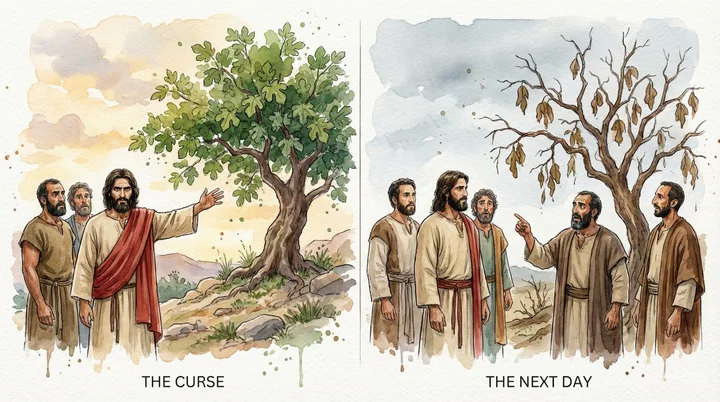
With mournful reluctance He pronounced words of doom upon the pretentious but fruitless tree, and under the curse of an offended God the tree withered and died.Lt 109, 1899, par. 36–37Lt 80, 1901, par. 13 It became a seared, withered, blasted tree, withered to its roots, left to symbolize the Jewish nation.ST Aug 15, 1878Lt 109, 1899, par. 36–37 Its doom symbolizes the sentence and downfall of the Jewish nation and represents the judgment that comes upon those who reject His mercy.ST Feb 21, 1878ST Aug 15, 1878 The barren fig tree blighted on that morning visit was a sign pointing to Jerusalem's doom, and like His triumphal entrance and the cleansing of the temple its blighting pointed to that doom.3SP 20.1ST Jan 10, 1878
By contrast the other trees representing the Gentiles were not covered, leafless and making no pretension to having the knowledge of God, because their time of fruit-bearing had not yet come.Lt 35, 1895, par. 8–9STMW7 59.2–3 The tree's curse and withering represented the Jewish nation, whose downfall was made sure.Lt 45, 1891, par. 5–6 His tears over Jerusalem were for those who would soon suffer, not for Himself.Lt 45, 1891, par. 5–6
Warning to Professing Christians
The withering of the barren tree is a parable and a living warning to Christian churches to the end of earth's history, in every age, with a lesson for all times and for all nations, kindreds, tongues, and peoples, that religious profession without practice and without fruit brings condemnation and judgment.ST Feb 21, 1878Ms 32, 1898, par. 11–12Ms 65, 1912, par. 2–3ST Feb 15, 1899 Its leaves picture outward profession concealing inward sin and deformity, to be formal, selfish, boastful, and hypocritical, to go through the form of worship and make a show of religion without repentance, faith, obedience, and the fruit of a holy life, which is hollow pretense and vain, worthless barrenness.3SP 19.2DA 584.1Lt 45, 1891, par. 9–11Lt 16, 1888, par. 44–45Lt 50, 1878, par. 3 Luxuriant leaves do not prove fruitfulness, for the Lord searches critically for good fruit and will expose hypocrisy and spiritual barrenness.Lt 45, 1891, par. 9–11
The image describes religious leaders whose careful observance of outward customs concealed hearts filled with malice and no fruits of holiness.SLP 236.1–2 It marks Pharisees and hypocrites whose fruit is briers and thorns, and pretenders who profess to have come out from the world and left its works of darkness, whom God has made repositories of His law, yet who flaunt apparently flourishing branches in the very face of the Almighty while cherishing impure thoughts, unholy imaginings, unsanctified desires, and base passions.Ms 9, 1880, par. 37–42Ms 9, 1880, par. 43–46 The soul temple for which He paid the price of His own blood is seen degraded, desecrated, and defiled with deeds of darkness and sin, its Godlike chambers converted into a robber's haunt and den of thieves, and the soul that has been wept over, entreated, and borne with becomes doomed and blighted, a monument of avenging wrath.Ms 9, 1880, par. 37–42 God hates the fruit borne upon such a tree, while true repentance however great the guilt is never spurned.Ms 9, 1880, par. 37–42Ms 9, 1880, par. 43–46
Its doom applies to professed believers in the last days who claim greater light than every other people yet whose daily life and unholy character belie their profession of godliness.7MR 171.1–2Lt 16, 1888, par. 44–45 They show pride and selfishness, peevish fretfulness, frivolity, discontent, uncharitableness and censoriousness, thinking evil and speaking evil of brethren, with no inward crucifixion of sin, no mold of Christ upon them, and chambers of the soul desecrated to Satan's control.7MR 171.1–2 Such profession is hateful to Christ, and an openly sinful person is in a more favorable condition before God and less guilty than a professing Christian who bears no fruit to His glory.3SP 19.2DA 584.1ST Jul 21, 1909Ms 9, 1880, par. 37–42
The act is a lesson to reform while there is still time and to walk in the light while having the light.7MR 171.1–2Lt 80, 1901, par. 13Lt 16, 1888, par. 44–45 It calls such to be zealous and repent with true contrition of heart, to humble the heart before God, confess sins, and be converted before it is forever too late, so sins may be blotted out and the name retained in the Lamb's book of life.7MR 171.1–2Lt 16, 1888, par. 44–45
Fruit God Requires Today
The fruit for which He hungers is piety, self-denial, self-sacrifice, compassion for others, and zeal for God to save people from unbelief and ruin.Ms 32, 1898, par. 11–12ST Feb 15, 1899 It is love for God and for people, unselfish service, character and good works, and the principles of goodness and sympathy and love which are the principles of heaven.ST Jul 21, 190916MR 330.1Ms 62, 1896, par. 41–44 Only such fruit, not profession, will meet the needs of the world and fulfill God's will for the human family, and He is not pleased when His human agencies utterly fail to fulfill the purposes for which they were created.Lt 202, 1908, par. 3–4Lt 195, 1899, par. 2–3 When those principles are revealed in human lives, Christ is formed within, the hope of glory.16MR 330.1 Then the joy of Christ is in the souls of the members, which they can offer as a sweet oblation to God.16MR 330.1
God demands every power of man subservient to Him and accepts no divided sacrifice, while eternal interests are neglected for earthly and temporal things.Lt 109, 1899, par. 36–37 A tree with leaves but no fruit represents people who profess faith yet do nothing useful for God, whose neglected responsibilities leave their lives barren of service.ST Aug 22, 1878 They are like an unproductive tree that takes space and shades trees that could bear fruit, and such professed service without lives bearing fruit to His glory is worthless.Lt 82, 1907, par. 9ST Aug 22, 1878 Gorgeous apparel, fine singing, instrumental music, beautiful music, and splendid decorations without that fruit are like the branches of the unfruitful tree that bore nothing but pretentious leaves, and they do not win heaven's approval.16MR 330.16MR 321.3 Churches fast being converted to the world and bearing nothing but leaves will be unmasked as He unmasked the fig tree, while a congregation that may be the poorest in the land, without music or outward show, but possessing these principles is accepted.16MR 330.16MR 321.3
The warning applies to churches that trample on God's law, despise the Sabbath as His memorial and sign, exalt a rival sabbath, disregard His law, and treat His covenant with His commandment-keeping people as worthless, bringing destruction upon themselves like the Jewish nation.Ms 32, 1898, par. 11–12ST Feb 15, 1899 By contrast, those who walk in the way of God's commandments will be like a flourishing fig tree full of fruit.Ms 65, 1912, par. 2–3 All who keep the commandments in truth and integrity reveal that they are under God's rule and dependent upon Him for temporal and spiritual victories, so that with His presence, favor, goodness, and riches of grace as protection and salvation His people are safe although they may suffer persecution for truth's sake.Ms 65, 1912, par. 2–3
A worker must develop and use the abilities God has given so the Master finds real fruit rather than leaves.Ms 122, 1899, par. 7–9 The human helpers and resources God raises up from age to age by His appointed means for His people, as an inexhaustible fountain of wisdom and strength, will not prove fraudulent if they themselves do not defraud the Lord as those represented by the barren tree did.Ms 65, 1912, par. 11 Those who stand as teachers of the gospel of salvation must feed sheep with pure provender so the gospel's saving power is represented in all places, because only fruit-bearing branches will meet the world's need.Lt 202, 1908, par. 3–4 When commercial enterprises take over, institutions come into the condition of the barren tree He found, with nothing but a show of leaves and no fruit to meet His need, and Christ still searches in institutions for that fruit.Lt 120, 1907, par. 1–2
He is the Son of God come to this world to draw all men to Him, come not to send peace but a sword.Ms 5, 1882, par. 11 His glorious example requires followers to walk in His light without questioning the cost in labor, trial, and suffering, with a work for each and all to maintain truth in its purity, push the triumphs of His cross, and extend His kingdom.Ms 5, 1882, par. 11 He comes to professed representatives who for years have spread their roots far and worked to destroy the influence of the messages the Lord gives His servants, and finds nothing but leaves of profession of righteousness and no fruit bearing for Christ.Lt 202, 1908, par. 3–4 Many meet Him with a mass of pretentious foliage and nothing but leaves to offer, because they have left their first love and fallen into spiritual blindness, hardness of heart, and stubbornness of mind.18MR 199.4–200.2
Sources
Pioneers and periodicals
24 sources
In the morning Jesus was returning to Jerusalem on Monday, three days before the Passover, hungry after the night on the Mount of Olives and on his way to the temple, and his hunger led him to seek food from the fig tree in full leaf where winter figs could be expected.ST Oct 4, 1899ST Dec 16, 1886RH Jan 17, 1871ST Jun 3, 1908 His hunger also was his longing to find in Israel the fruit of righteousness, love to God and man, self-sacrifice, compassion, and zeal for the salvation of others.ST Jul 21, 1909ST Jul 15, 1908RH Oct 7, 1873 The barren tree withered under his word as the sentence and doom of the Jewish nation, whose time of acceptance was past and whose day had set into night though temple worship still went on outwardly unchanged.ST Feb 21, 1878ST Jan 10, 1878RH Aug 18, 1874 Its leaves without fruit show that profession without godly deeds is not genuine faith, but a fruitless pretense that deserves to wither.ST Feb 21, 1878RH Feb 13, 1900RH Jan 17, 1871 That withering is a solemn warning to churches and Christians in every age that God requires a life of unselfish service, and that outward religion without repentance, obedience, and fruit for his glory is hateful to Christ and invites judgment.ST Feb 15, 1899RH Jan 17, 1871RH Jan 25, 1906
Time, Place, Hunger
In the morning as he returned into the city of Jerusalem he hungered, setting the scene for his approach to the leafy fig tree.RH Feb 13, 1900ST Oct 4, 1899ST Dec 16, 1886RH Jan 17, 1871 It was Monday morning, the third day before the Passover, after a night spent in prayer on the Mount of Olives and after the events of his entry into Jerusalem and the cleansing of the temple, while on his way to the temple and before his confrontation with the chief priests and elders.RH Feb 13, 1900ST Dec 16, 1886ST Dec 23, 1886 After hungering and cursing the fig tree he cleansed the temple, taught, answered questions, healed the sick, and denounced hypocrisy, and the next day, Tuesday, the disciples saw the tree dried up from its roots.
The verse belongs to Matthew 21's account of Jesus coming to Jerusalem and weeping over the city, an account also found in Mark 11 and John 12 and given most fully in Luke 19, coming before the institution of the Lord's Supper.ST The blighting of the barren fig tree, like the triumphal entrance and the cleansing of the temple, pointed to Jerusalem's doom.ST Jan 10, 1878
His hunger explains why he looked for fruit on the fig tree and came to it to find food.ST Jul 21, 1909RH Jan 17, 1871 Because the tree was already in full leaf, he could expect it to bear winter figs that ripen in early spring and hoped to gather some, though one account describes him seeing the tree in the middle of summer without fruit.RH Jan 17, 1871ST Jun 3, 1908
His hunger also represents his longing for fruit from his own people and his desire to find in Israel the fruits of righteousness: love for God and people, self-sacrifice, compassion, zeal for God, and concern for others' salvation.ST Jul 21, 1909ST Jul 15, 1908 It is the Master coming to every life looking for fruit to satisfy him.RH Oct 7, 1873
Judgment on Israel
On Monday morning Jesus returned hungry to Jerusalem while on his way to the temple.ST Dec 16, 1886ST Dec 16, 1886 Seeing a fig tree in leaf but bearing no fruit, he cursed it and it withered.ST Dec 16, 1886ST Dec 16, 1886 Its fruitlessness illustrated the fate awaiting the hypocritical priests and rulers, for because they were unfaithful and bore no fruit of good works God's curse would fall on them in coming judgment.ST Dec 16, 1886ST Dec 16, 1886
The barren tree in receiving judgment and withering, even withering instantly to its roots shortly before his passion, symbolizes the sentence and downfall and doom of the Jewish nation and Jerusalem.ST Feb 21, 1878ST Jan 10, 1878RH Apr 2, 1908 Like the triumphal entrance and the cleansing of the temple, its blighting pointed to Jerusalem's doom.ST Jan 10, 1878 Her accepted time was over, her appointed crisis past, and her day of salvation set into irrevocable night.RH Aug 18, 1874 Yet to mortal eyes no change was visible, for the leaf of her natural life was still glossy green, the sun still shone and rain fell and dew came down, the temple was not closed, the white-robed Levites still thronged its courts, the singers still sang, and the high priest still sprinkled the holiest altar year by year with unavailing sacrifice.RH Aug 18, 1874 The year of respite for God's people was over and their doom was fixed, so that fruit would grow on her no more and therefore the fire was kindled for the burning and the ax uplifted against the encumbering trunk.RH Aug 18, 1874RH Apr 2, 1908
Israel had received God's gifts and privileges so that it might bless the world, but pride and self-sufficiency kept it from sharing the truth or serving others.ST Jul 21, 1909 The barren fig tree portrayed Israel's sin and the punishment of losing God's grace, for refusing to pass on blessing meant no longer receiving it.ST Jul 21, 1909 Withered to its roots, the blighted tree represents the judgment that comes upon those who reject Christ's mercy.ST Aug 15, 1878ST Jul 21, 1909
Warning to Christians
The leafy fig tree with no fruit shows that profession without practice is fruitless.ST Feb 21, 1878RH Feb 13, 1900RH Jan 17, 1871ST Feb 19, 1902 A profession without deeds is not genuine faith, and the fruitless tree deserved to wither.RH Feb 13, 1900RH Jan 17, 1871ST Feb 19, 1902 The test reveals the difference between genuine devotion, which bears fruit in unselfish deeds, and empty profession.ST Feb 21, 1878RH Feb 13, 1900RH Jan 17, 1871
Lack of fruit means absence of piety, holiness, self-denial, self-sacrifice, compassion for others, zeal for God, and desire to save people from unbelief and ruin.ST Feb 21, 1878ST Feb 15, 1899ST May 15, 1884 It is outward appearance of godliness hiding selfishness, hypocrisy, malice and evil while outwardly observing religious customs, and failure to bless others with good works.ST Feb 21, 1878ST May 15, 1884 Neglected responsibilities leave life barren of service, like an unproductive tree that takes space and shades trees that could bear fruit.ST Feb 21, 1878ST Aug 22, 1878 The warning applies to churches that disregard God's law and treat His covenant with His commandment-keeping people as worthless, for like the Jewish nation they bring destruction upon themselves.ST Feb 15, 1899
The withering curse on the pretentious foliage is a solemn acted lesson, impressed on the disciples by a word.RH Jan 17, 1871RH Jan 25, 1906 It warns Christian churches in every age and applies to all churches and Christians, for outward appearance without fruit invites judgment.ST Feb 15, 1899RH Jan 17, 1871RH Jan 25, 1906 God expects a life of unselfish service to others, and religious profession without repentance, faith, obedience, or fruit for God is a vain pretense hateful to Christ.ST Jul 21, 1909RH Jan 25, 1906ST Feb 19, 1902 Even an open sinner is less guilty than someone who professes to serve God but bears no fruit to His glory.ST Jul 21, 1909
Leaves without fruit means a life with no harvest of golden thought, no obedience to work in the vineyard, no seed sown with care, and no speaking to others of a Saviour's love, of Zion above, of golden streets, of the river of life.RH Oct 7, 1873 As sowing is so reaping is, and the one who bears nothing but leaves will at the setting sun and at the river of death have only withered leaves instead of golden sheaves, and will bow in shame and fear to hear the Master's call.RH Oct 7, 1873 Every living thing in God's universe from moss to man has a definite place and a work to perform and an inbuilt determination to do something, push upward and outward, and become full-grown and fruitful.RH Jan 17, 1871ST Jun 3, 1908 The contrast of a tree loaded with fruit against a tree with withered and dry branches urges even children to do missionary work suited to their age and locality, to name someone outside their own relatives to bring to Jesus, to unite in prayer for those named, and to pray to become better workers for Him.RH Oct 7, 1873ST Jun 3, 1908RH Nov 12, 1914
Sources