Matthew 21:19
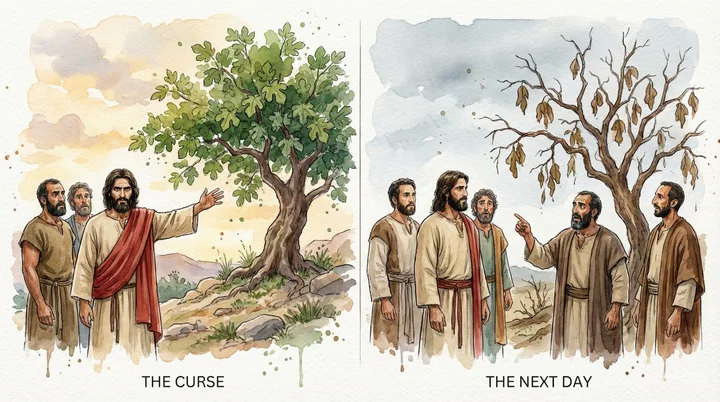
And when he saw a fig tree in the way, he came to it, and found nothing thereon, but leaves only, and said unto it, Let no fruit grow on thee henceforward for ever. And presently the fig tree withered away.
Translations
And when he saw a fig tree in the way, he came to it, and found nothing thereon, but leaves only, and said to it, Let no fruit grow on you henceforward for ever. And presently the fig tree withered away.
King James Version, KJV Cambridge Paragraph Bible
And when he saw a fig tree in the way, he came to it, and found nothing thereon, but leaves only, and said unto it, Let no fruit grow on thee henceforward for ever. And presently the fig tree withered away.
And when he saw a fig-tree in the way, he came to it, and found nothing on it, but leaves only, and said to it, Let no fruit grow on thee henceforth for ever. And immediately the fig-tree withered.
Revised Version, American Standard Version
And seeing a fig tree by the way side, he came to it, and found nothing thereon, but leaves only; and he saith unto it, Let there be no fruit from thee henceforward for ever. And immediately the fig tree withered away.
and having seen a certain fig-tree on the way, he came to it, and found nothing in it except leaves only, and he saith to it, 'No more from thee may fruit be — to the age;' and forthwith the fig-tree withered.
And seeing one fig-tree in the way, he came to it and found on it nothing but leaves only. And he says to it, Let there be never more fruit of thee for ever. And the fig-tree was immediately dried up.
and, seeing one fig-tree by the way, he came up to it, and nothing, found he thereon, save leaves only,—and he saith unto it—No more, from thee, let fruit spring forth, unto times age-abiding,—and the fig-tree, instantly withered away.
Berean Standard Bible, Majority Standard Bible
Seeing a fig tree by the road, He went up to it but found nothing on it except leaves. “ May you never bear fruit again!” He said. And immediately the tree withered.
Seeing a fig tree by the road, he came to it and found nothing on it but leaves. He said to it, “ Let there be no fruit from you forever!”Immediately the fig tree withered away.
And seeing a fig-tree by the wayside, he came to it, and saw nothing on it but leaves only; and he said to it, Let there be no fruit from you from this time forward for ever. And straight away the fig-tree became dry and dead.
And seeing a figge tree in the way, he came to it, and found nothing thereon, but leaues onely, and said to it, Neuer fruite grow on thee henceforwards. And anon the figge tree withered.
Douay-Rheims (Challoner revision)
And seeing a certain fig tree by the way side, he came to it, and found nothing on it but leaves only, and he saith to it: May no fruit grow on thee henceforward for ever. And immediately the fig tree withered away.
Pictures
Cross-references
- Luke 13:6-9
He spake also this parable; A certain man had a fig tree planted in his vineyard; and he came and sought fruit thereon, and found none.
The fruitless fig tree faces judgment, yet receives time and care to bear fruit.
- Mark 11:12-14
And on the morrow, when they were come from Bethany, he was hungry:
A parallel account of Christ cursing the fig tree.
- Mark 11:20-21
And in the morning, as they passed by, they saw the fig tree dried up from the roots.
The cursed fig tree is found withered from its roots the next morning.
- John 15:4-6
Abide in me, and I in you. As the branch cannot bear fruit of itself, except it abide in the vine; no more can ye, except ye abide in me.
Branches bear fruit by abiding in Christ; branches without fruit wither.
- Matthew 7:16-20
Ye shall know them by their fruits. Do men gather grapes of thorns, or figs of thistles?
A tree is known by its fruit; a fruitless profession is exposed.
- Galatians 5:22-23
But the fruit of the Spirit is love, joy, peace, longsuffering, gentleness, goodness, faith,
Names the spiritual qualities expected as genuine Christian fruit.
- John 15:2
Every branch in me that beareth not fruit he taketh away: and every branch that beareth fruit, he purgeth it, that it may bring forth more fruit.
Both depict the removal of what bears no fruit.
- John 15:8
Herein is my Father glorified, that ye bear much fruit; so shall ye be my disciples.
Bearing much fruit glorifies the Father.
- Matthew 3:10
And now also the axe is laid unto the root of the trees: therefore every tree which bringeth not forth good fruit is hewn down, and cast into the fire.
Both depict judgment on a tree that bears no fruit.
- Matthew 21:33-41
Hear another parable: There was a certain householder, which planted a vineyard, and hedged it round about, and digged a winepress in it, and built a tower, and let it out to husbandmen, and went into a far country:
The vineyard parable portrays the nation as failing to produce fruit and facing judgment.
- Mark 11:11
And Jesus entered into Jerusalem, and into the temple: and when he had looked round about upon all things, and now the eventide was come, he went out unto Bethany with the twelve.
Places the preceding evening in Jerusalem before Jesus returned to Bethany.
- Luke 6:43-44
For a good tree bringeth not forth corrupt fruit; neither doth a corrupt tree bring forth good fruit.
The fruit reveals the nature of the tree.
- Matthew 17:20
And Jesus said unto them, Because of your unbelief: for verily I say unto you, If ye have faith as a grain of mustard seed, ye shall say unto this mountain, Remove hence to yonder place; and it shall remove; and nothing shall be impossible unto you.
grouped as further teaching on faith
- Mark 4:39
And he arose, and rebuked the wind, and said unto the sea, Peace, be still. And the wind ceased, and there was a great calm.
Christ’s word controls nature.
Commentary
Each commentary is drawn from primary sources: the writings of Ellen G. White and Adventist pioneers and periodicals. Each commentary is separate. Its own words are not a quotation; follow the references to read the source passages.
Ellen G. White
84 sources
Hungry on the way from Bethany to Jerusalem, he came to a fig tree whose leaves promised fruit, searched it thoroughly from top to bottom, and finding nothing but leaves, not even buds, doomed it to permanent fruitlessness so that it withered almost at once to its roots.Ms 88, 1899, par. 5–7Ms 17, 1897, par. 10Ms 123, 1899, par. 5Ms 7a, 1886, par. 12–13STMW10 20.1 The barren tree was impenitent Israel in that generation, a richly favored and outwardly religious nation that consumed privileges without producing what was sought.Ms 88, 1899, par. 5–7Ms 43, 1897, par. 21–23RH Feb 13, 1900ST Nov 13, 1893Lt 35, 1895, par. 8–9 Its luxuriant leaves were mere profession and outward display — ceremonies, temple service, pride and formalism — concealing the absence of the fruit he hungered for, which is love to God and man shown in self-sacrifice, compassion, mercy, truth and unselfish service.Ms 43, 1897, par. 21–23DA 582.3–583.2Ms 32, 1898, par. 11–12Ms 65, 1912, par. 31–32Ms 65, 1912, par. 1 Its withering was its self-chosen ruin, grace withdrawn and left to perish in Jerusalem's destruction, and it stands as an acted parable for every professing church and person to the end of time.DA 580.2–581.2Ms 43, 1897, par. 21–23ST Feb 21, 1878Ms 32, 1898, par. 11–12ST Feb 15, 1899 Profession with great light brings greater responsibility, so those who bear leaves only are registered as cumberers of the ground, and a life that through long probation produces nothing may at last hear the irrevocable sentence that no fruit grow on it henceforward forever.Ms 7a, 1886, par. 12–135T 352.1ST Jun 24, 18894T 385.2–386.1ST Aug 15, 1878
Words and Occasion
On the way from Bethany to Jerusalem, being hungry, he came to a fig tree standing in the way.Ms 123, 1899, par. 5Ms 7a, 1886, par. 12–13Lt 45, 1891, par. 5–6 He searched it thoroughly from topmost branch to lowest bough, and its promising, luxuriant leaves gave reason to expect fruit.Ms 123, 1899, par. 5Ms 7a, 1886, par. 12–1316MR 329.2 Yet he found nothing thereon but leaves only, not even buds or blossoms.Ms 88, 1899, par. 5–7Ms 123, 1899, par. 5Ms 7a, 1886, par. 12–13Lt 11, 1864, par. 23–2416MR 329.2
He pronounced permanent fruitlessness upon it, that no fruit grow on it henceforward forever.Ms 17, 1897, par. 10Ms 80, 1901, par. 1Ms 123, 1899, par. 5 The sentence was spoken with mournful reluctance, yet under the curse of an offended God the tree withered almost immediately, to its roots.Ms 88, 1899, par. 5–7Ms 7a, 1886, par. 12–13Lt 109, 1899, par. 36–37Lt 80, 1901, par. 13 It became a seared, withered, blasted tree, left as a symbol of judgment.STMW10 20.1Lt 109, 1899, par. 36–37ST Jul 21, 1909
The withering is a significant acted parable and object lesson revealing true condition and retribution.DA 580.2–581.2DA 582.3–583.2 It was given for all times and for all nations, kindreds, tongues and peoples, that everyone should heed.Ms 65, 1912, par. 2–3 It belongs with the triumphal entry into Jerusalem, which foreshadows his future coming in glory.DA 580.1 It shows the Son of God come to draw all men unto him, whose coming brings not peace but a sword, calling his followers to walk in the light of his example and maintain truth in purity at any cost of labor, trial and suffering.Ms 5, 1882, par. 11
His hunger represented soul-hunger for the fruit his people ought to have supplied to satisfy those he pledged his life to save by grace and righteousness.Ms 65, 1912, par. 12Lt 214, 1899, par. 9–10 His diligent search is the earnest seeking with which he still comes to every professed follower looking for fruit to reward his search.Lt 112, 1900, par. 13–14 That earnestness was seen in his unremitting labors on earth for the hope of Israel, in solemn warnings and gracious invitations, in anxious work to convince the people he was their Redeemer, in making himself of no reputation and taking the form of a servant to become the ladder and the Way by which they may climb to heaven.Lt 112, 1900, par. 13–14 It was also seen in his sorrow and disappointment that so few responded to all done in their behalf, a disappointment shared by those who labor with him and partake in his sufferings to draw souls.Lt 214, 1899, par. 9–10
Israel's Failure and Doom
The withered tree stood for impenitent Israel, the Jewish nation and kingdom in the generation when he was in their midst.Ms 88, 1899, par. 5–7RH Feb 13, 1900Lt 35, 1895, par. 8–9STMW7 59.2–3Ms 65, 1912, par. 31–32 It pictured a people once chosen and richly favored who had failed to do the work appointed them and bore continually less fruit until they failed to carry out his plans.Ms 88, 1899, par. 5–7RH Feb 13, 1900Ms 126, 1899, par. 6–8 Clothed with leaves, it stood out in proud superiority as a religious nation, making profession without practice.Ms 88, 1899, par. 5–7RH Feb 13, 1900Ms 65, 1912, par. 31–32 Like a fruitless tree unfit for the orchard, a people created and redeemed to bear fruit for his glory and the good of others had become all outward promise and pretension.Ms 88, 1899, par. 5–7RH Feb 13, 1900
Its luxuriant, pretentious leaves were outward religious display concealing the absence of what he sought.DA 582.3–583.2Ms 65, 1912, par. 31–32Ms 123, 1899, par. 6–716MR 330.1 They were abundant outward evidences of religious life — ceremonies, traditions, a rich temple with mitered priests officiating in morning and evening sacrifices, and instrumental music.Ms 65, 1912, par. 31–32Ms 123, 1899, par. 6–716MR 330.1 Gorgeous apparel, fine singing, forms and fine clothing could not take the place of holiness and unselfishness.Ms 123, 1899, par. 6–716MR 330.1 Beneath the show lay hypocrisy, pride, love of the world, vain-glory and selfishness, with lack of humility, love and benevolence.DA 582.3–583.2Ms 65, 1912, par. 31–32 The nation proudly claimed goodness and virtue it might have had but had forfeited, for the promises belong only to willing obedience in walking in the way of his appointment.Ms 65, 1912, par. 1
He came to it seeking the fruits of righteousness — self-sacrifice, compassion, goodness, mercy, truth, sympathy and love, with zeal for God and concern for the salvation of others.DA 582.3–583.2ST Jul 21, 1909Ms 123, 1899, par. 6–716MR 330.1 Though given every opportunity and privilege to show the way of life, they were consumers but not producers, withholding entrusted blessings and truth from the world and refusing to minister to others.Ms 43, 1897, par. 21–23DA 582.3–583.2Ms 65, 1912, par. 31–32ST Jul 21, 1909 Their failure was a failure to understand his mission and receive heaven's light, with love for God and fellow men eclipsed by pride and self-sufficiency.Ms 43, 1897, par. 21–23ST Nov 13, 1893 Had they kept his law they would have done the same unselfish work he did.Ms 43, 1897, par. 21–23
Its blighting was the retribution and ruin they brought upon themselves.DA 580.2–581.2Ms 43, 1897, par. 21–23ST Feb 21, 1878DA 584.2 Grace withdrawn, they were given up as joined to idols and left to perish in the destruction of Jerusalem.Ms 43, 1897, par. 21–23 The blighted tree was a sign pointing to Jerusalem's doom, revealing its true condition and certain downfall.DA 580.2–581.23SP 20.1ST Jan 10, 1878 The curse displayed the destruction determined by those who failed to profit from heaven's blessings after every advantage, and formal, selfish, boastful profession with leaves but no good works to bless others received its sentence.ST Feb 21, 1878DA 584.2
That rejecting generation was especially guilty, and though the people lived on for forty years after, they were already spiritually dead.Lt 35, 1895, par. 8–9STMW7 59.2–3 Warning, expostulation, forbearance and patience through judgments and blessings given and withdrawn were about to close, leaving them responsible for their own destruction.Lt 35, 1895, par. 8–9 By contrast the Gentiles were like trees not covered and leafless, making no pretension to knowledge of God, because their time of fruit-bearing was not yet.Lt 35, 1895, par. 8–9STMW7 59.2–3
The same fruitlessness marked its leaders, Pharisees and hypocrites, whose outward religious forms lacked holiness.SLP 236.1–2Ms 9, 1880, par. 37–42 Their careful observance of customs and avoidance of ritual pollution concealed souls defiled by iniquity, with malice shown even in treating an attempt to kill as justifiable.SLP 236.1–2 Their fruit was briers and thorns, cloaking iniquity and especially licentiousness under profession of godliness, while professing to have come out from the world as repositories of his law.Ms 9, 1880, par. 37–42Ms 9, 1880, par. 43–46 Flaunting outward profession in the very face of the Almighty while cherishing impure thoughts, unholy imaginings, unsanctified desires and base passions, they bore fruit hateful to heaven and exulted over by Satan.Ms 9, 1880, par. 37–42Ms 9, 1880, par. 43–46
Leaves and Fruit Defined
Leaves without fruit mean a profession of religion and faith that has the appearance of life but no living godliness.Ms 17, 1897, par. 10STMW10 20.14T 614.1ST May 9, 1878Ms 62, 1896, par. 41–44 It is a show of godliness, with outward duties and religious activity, yet without inward victory and heart-holiness.ST May 9, 1878Ms 62, 1896, par. 41–44Lt 118, 1896, par. 5–6 Lives under that profession may appear connected with God while showing no evidence that Christ is in them and they are in Christ.ST May 9, 1878Ms 62, 1896, par. 41–44Lt 118, 1896, par. 5–6 Such profession is worthless to Christ, and its barrenness when He looks for fruit brings His curse upon individuals and churches who know truth in theory but do not experience its power or do the work given them.Ms 17, 1897, par. 10STMW10 20.14T 614.1Ms 62, 1896, par. 41–44Lt 118, 1896, par. 5–6
The fruit He seeks is genuine spirituality and holiness shown in unselfish service.ST Feb 21, 1878Ms 123, 1899, par. 6–718MR 199.4–200.2Ms 131, 1902, par. 9–1016MR 330.1 It is piety, self-denial, self-sacrifice, compassion, and zeal to save others from unbelief and ruin, shown in goodness, mercy, truth, sympathy and love.Ms 32, 1898, par. 11–12Ms 123, 1899, par. 6–716MR 330.1 These are the principles of heaven and the fruits of the Spirit — love, joy, peace, patience, kindness, goodness, faith, meekness and self-control — with righteousness that feeds His sheep and blesses others.18MR 199.4–200.2Ms 131, 1902, par. 9–1016MR 330.1 Forms, ceremonies, gorgeous apparel, fine singing, fine clothing, instrumental music and outward display cannot take their place nor call forth heaven's approval, for even the poorest congregation without music or outward show offers a sweet oblation when Christ is formed within as the hope of glory and His joy is in the soul.Ms 123, 1899, par. 6–716MR 330.1 True faith therefore bears fruit in good works, deeds of mercy and sincere devotion, serving others in the world rather than withdrawing from it, while prayer and teaching of Bible truth are not accepted service when first love is lost and the heart is blind and hard.ST Feb 21, 187818MR 199.4–200.2
Empty pretense is hateful to Him.3SP 19.2DA 584.1ST Feb 21, 1878ST Jul 21, 1909 Profession of serving God and outward appearance of godliness without the fruits of service is vain, for leaves without repentance, faith and obedience, with merely waiting, praying or claiming godliness while living for self instead of helping others, do not meet what He expects in obedience, righteousness, mercy, unselfish service and love.3SP 19.2DA 584.1ST Feb 21, 1878ST Jul 21, 1909 An open sinner is in a more favorable condition before God, less guilty and with more hope, than a professing Christian who bears no fruit to His glory.3SP 19.2DA 584.1ST Feb 21, 1878ST Jul 21, 1909
A tree was created to bear fruit, and a fruitless tree is unfit for the orchard.Ms 88, 1899, par. 5–7RH Feb 13, 1900 Likewise people were created and redeemed to bear fruit for His glory and the good of others, not to remain all outward promise and pretension while lacking good works.Ms 88, 1899, par. 5–7RH Feb 13, 1900 God is not pleased when they fail to fulfill the purpose for which they were created, but through the help He provides fallen beings can do what He expects, walking and working and living by faith in the Son of God.RH Feb 13, 1900RH Apr 15, 1909Lt 195, 1899, par. 2–3 The granted time of probation is the opportunity to bear that fruit rather than remain barren.Ms 88, 1899, par. 5–7RH Feb 13, 1900
Warning to Professed Churches
The withered tree stands as a warning to every Christian church to the end of earth's history and in every age.Ms 32, 1898, par. 11–12ST Feb 15, 18994SP 200.1–2GC88 315.1–2GC 315.3–316.1 A church may be covered with outward signs of religion, with boastful forms and pretentious observance for leaves, yet bear no fruit of true humility, penitence, repentance and faith or the graces of the Spirit.ST Feb 15, 18994SP 200.1–2GC88 315.1–2GC 315.3–316.1 In their place are pride, formalism, vainglory, selfishness and oppression, and when such a church refuses the light given it and fails to meet the conditions of the promises and live up to its privileges and duties, its vital godliness withers.4SP 200.1–2GC88 315.1–2GC 315.3–316.1 The fruit sought is piety, self-denial, self-sacrifice, compassion for others and zeal for God to save souls from unbelief and ruin, and outward display without it brings condemnation.Ms 32, 1898, par. 11–12ST Feb 15, 1899
It illustrates the fate of ministers and people who neglect their God-given work and mission.5T 257.2ST Aug 22, 1878 Though professing His name they produce no useful service, like leafy trees taking up ground and shading trees that could bear fruit, and outward appearance without the required fruit brings loss and risks judgment.5T 257.2ST Aug 22, 1878 The warning is especially urgent when little time remains and much work is still to be done.5T 257.2 Disappointment at results is no excuse for indifference or giving up doing good for others.3T 525.2
The same condition is found in those who for years have spread their roots far while bearing no fruit for Christ and working to destroy the influence of the messages given to His servants, for mere profession of righteousness does not meet the needs of the world nor fulfill God's will for the human family.Lt 202, 1908, par. 3–4 It is found in false shepherds and churches that look prosperous but remain in unbelief, reject light, and do not nourish the flock with pure provender, their impressive appearance worthless without good fruit under His close and critical search.Lt 202, 1908, par. 3–4Lt 45, 1891, par. 9–11 It is brought about when commercial enterprises for gain enter His institutions, working counter to the purpose for which they were established, detracting from the influence desired to attend the work and resulting in spiritual loss.Lt 120, 1907, par. 1–2 Still He searches His institutions for fruit, which is the virtue revealed in the lives of His workers that tells in the saving of the soul unto eternal life, and those who stand as teachers of the gospel are commanded to feed His sheep so its saving power shall be represented in all places.Lt 202, 1908, par. 3–4Lt 120, 1907, par. 1–2
The curse for fruitlessness threatened the church at Battle Creek, because although important institutions were planted among them they brought forth no fruit and those in responsible positions were not circumspect lest their influence be on the wrong side, yielding to worldly influence rather than the Spirit.TBC1882 70.3–71.1 The same sentence of permanent fruitlessness can fall on members who remain unfruitful after a season of special spiritual opportunity such as a camp-meeting, marking them for death rather than life and to be dreaded and avoided.Ms 80, 1901, par. 1 Its neglect is seen in trampling on God's law and treating His covenant with His commandment-keeping people as worthless, in disregard for the Sabbath sign while exalting a rival sabbath.Ms 32, 1898, par. 11–12ST Feb 15, 1899 It is seen in failing to recognize the signs of the times and neglecting the light and privileges given, including the message of Christ's coming, for without responsive faith and obedience destruction is brought upon self.ST Feb 15, 18994SP 200.1–2
Those who walk in the way of the commandments in truth and integrity will be like a flourishing fig tree, full of fruit.Ms 65, 1912, par. 2–3 They reveal to the world that they are under His rule and dependent upon Him for temporal and spiritual victories.Ms 65, 1912, par. 2–3 With His presence and favor His people are safe although they may suffer persecution for truth's sake, and His goodness and the riches of His grace are their protection and salvation.Ms 65, 1912, par. 2–3
Accountability in Judgment
The withered tree shows that display without yield invites judgment, for its leaves gave reason to expect fruit yet none was found, and it withered to its roots under the sentence that it would never bear fruit again.Ms 7a, 1886, par. 12–13 It stood for a people given truth to share with the world who produced nothing in return, and the same lesson reaches everyone, since profession, advantages, privileges and great light bring greater responsibility to live by the light received.Ms 7a, 1886, par. 12–13 Religion without practice is vain, and impressive appearance and profession are worthless without good fruit, for His search for fruit is close and critical.Ms 7a, 1886, par. 12–13Lt 45, 1891, par. 9–11 Those who bear leaves only presume too much upon mercy while neglecting warnings, privileges and holy trust, and for that presumption they are cursed like the tree.4T 385.2–386.1 The warning falls especially on false shepherds and prosperous-looking churches that do not nourish the flock or bear spiritual fruit.Lt 45, 1891, par. 9–11
The cursing is God's judgment upon professed children of truth who bear no fruit, though they are not vile and basely corrupt.4T 385.2–386.1 They are registered as cumberers of the ground because they do not put to use the talents entrusted to them.4T 385.2–386.1 They make self supreme and labor only for selfish interests, are not rich toward God, profess to serve Christ yet bring no souls to Him, withhold both the means lent them and themselves, and occupy an irresponsible position toward His work and cause.4T 385.2–386.1 That irresponsible position places them on the left hand.4T 385.2–386.1
It is His sentence upon fruitless professors in the last days who please self and serve the world, the flesh and the devil while keeping a form of worship.Ms 10, 1899, par. 14–15 No form of worship or religious service can supply the want of reconciliation with God, for only regenerating grace enables men and women to abide in Christ and work His works.Ms 10, 1899, par. 14–15 Those determined to do as they please despise and reject His counsels against their own souls, endanger the church by their influence, and deride those who bear testimony against them.Ms 10, 1899, par. 14–15 He then gives them up to their own lusts and idols and receives none of their service.Ms 10, 1899, par. 14–15 He works through His ministers as He worked through Moses, ratifying in heaven their judgments and decisions to be produced at the last great day, and He pronounces upon the fruitless the same words as upon the barren tree, that no fruit grow henceforth forever.Ms 10, 1899, par. 14–15 Their condemnation is irrevocable, though they bear the name of Christian and go through a form of service whose true state is known to none but God who searches all things.Ms 10, 1899, par. 14–15
As the tree withered, so a person who rejects offered mercy, disregards present privileges and warnings, and continues in disobedience becomes spiritually blighted and faces righteous judgment.ST Aug 15, 1878 The leafy but fruitless tree represents professed followers who appear active but bear no spiritual fruit, and the warning is that the fruitless will be condemned as useless.ST Jun 24, 1889 A life spared through years of probation but producing nothing may hear the Master's sentence that no fruit grow henceforward forever, so the life should be changed while there is still time.5T 352.1
Leaves without fruit represent a life that appears active but produces no unselfish good works, and the withered tree warns that such a fruitless life will be exposed when judgment examines its record and probation ends.Lt 46a, 1874, par. 31–34 True fruit includes self-denial for others, giving up self-gratification, and bearing responsibilities from principle for God's glory.Lt 46a, 1874, par. 31–34 Such acts can erase the record standing against a person's name.Lt 46a, 1874, par. 31–34
Call to Fruitful Living
To live the law is to do unselfish work for others as Christ did in ministering to those around Him, for no one can live that law without ministering to others.Ms 43, 1897, par. 21–23DA 584.1 Those who live for self are like the tree with leaves but no fruit, making every pretension while fruitless, with love for God and fellow men eclipsed by pride and self-sufficiency and determined to walk in a selfish way.Ms 43, 1897, par. 21–23DA 584.1 Such empty pretense of serving God without fruits of service is vain and hateful to Him, and an open sinner is less guilty and has more hope than one who professes to serve God but bears no fruit to His glory.DA 584.1 The tree stands as a warning to every nation, family, and individual never to be forgotten, because refusal to minister to others brings ruin upon self as when the favored nation that had every opportunity was given up as joined to idols and left to perish.Ms 43, 1897, par. 21–23
The half-converted on whom Christ looks in vain for faithful service are as a tree whose boughs hang upon the side of truth while its roots are firmly bedded in the earth and strike out into the barren soil of the world.4T 155.3 What is necessary is thorough conversion to follow and obey, not a submission born of circumstances or terror as with terrified Israel when the power of the Infinite was revealed, but deep and heartfelt repentance and renunciation of sin.4T 155.3 A show of religious life without practical godliness, and a profession of sanctification without humble, meek, lowly devotion truly given to God, is empty like that pretentious tree searched and found to have only leaves.Lt 50, 1878, par. 3
Disappointment at the results of effort is no excuse for becoming indifferent or giving up doing good for others.3T 525.2 True faith bears fruit in good works, deeds of mercy and sincere devotion to God, using God-given opportunities to imitate Christ through unselfish deeds and serving others in the world rather than withdrawing from it.ST Feb 21, 1878ST Feb 21, 1878 Formal, selfish, boastful, or hypocritical religion has leaves of outward devotion but blesses no one, representing hypocrisy, selfishness, pride, and abuse of sacred privileges, and its withering shows the judgment facing such profession.ST Feb 21, 1878ST Feb 21, 1878 Human eyes may not distinguish genuine devotion from its counterfeit, but God sees beneath appearances and reveals character under trial as He searches His followers for this fruit.ST Feb 21, 1878ST Feb 21, 1878
Fruit instead of leaves only comes when the Master seeking fruit is not disappointed, for outward appearance is not enough without cultivated powers put to work to lead others to truth.CEv 53.1MC 17.1GW92 349.1Ms 122, 1899, par. 7–9 Young men must appreciate the intellectual faculties God has given and cultivate them with utmost care, since exercise strengthens, enlarges and expands the mind, and heart-culture kept with it keeps character well balanced.MC 17.1GW92 349.1Ms 122, 1899, par. 7–9 The means of improvement are within reach of all, and resolute purpose sanctified by the grace of Christ accomplishes wonders.MC 17.1GW92 349.1 That fruit is doing all in power with Jesus and holy angels to save souls, win minds to investigate truth, and sow the seed of truth beside all waters.CEv 53.1GW92 349.1
In contrast to cursed barrenness, those who cherish grace grow spiritually and bear fruit, receiving commendation and blessing rather than the curse pronounced on the tree.Ms 164, 1899, par. 27 A life destitute of fruit like the tree is the life of one who neglects to feed the hunger of the soul with Scripture, leaving the soul weak and strengthless and unable to do the will of God.1MR 368.4–369.2 The cure is to seek the Lord most earnestly while reading His rich promises and applying them, so that instead of remaining a barren consumer of comfort from human beings one becomes a provider.1MR 368.4–369.2
The lesson reaches children whose lives show leaves but no fruit, not even buds or blossoms, where God looks for fruit and finds none.Lt 11, 1864, par. 23–24 What is required is wholehearted submission to God and willingness to give up every sinful pleasure and wrong.Lt 11, 1864, par. 23–24 It reached Emma, whose life had amounted to nothing fruitful though she could do good works and become useful, and unless she leave self behind, dedicate herself to God and live to bless others, no good works will follow her when her life ends and her memory will soon perish.Lt 47a, 1874, par. 17 It likewise warns some of the human helpers and resources raised up for His people who defraud the Lord, for God is an inexhaustible fountain of wisdom and strength who from age to age raises up such agencies by His appointed means, and these God-given agencies will not prove fraudulent if they themselves do not defraud Him.Ms 65, 1912, par. 11
The fruitless tree with its withering is a rebuke and warning to formalists and boasting hypocrites whose lives deny their profession, representing people who profess to serve God and belong to the church but bear no fruit in life to God's glory.Lt 82, 1907, par. 9GW92 22.24T 403.2 Its leaves represent pretentious outward profession and show of religion without the work of grace in the heart, concealing lives without Christlike character, godly fruit, and inward victory over sin while remaining inactive, worldly, and unfruitful.FE 50.17MR 171.1–24T 403.2Lt 72, 1878, par. 6–7 Unless they repent, their place as His people will be taken away, for such formalism and hypocrisy bring rebuke and judgment.GW92 22.24T 403.2 The call is to repent of lukewarmness and reform while walking in light before it is too late, showing faith through fruitful lives, lest the tree's doom fall.7MR 171.1–2Lt 72, 1878, par. 6–7
Sources
Pioneers and periodicals
74 sources
Jesus found a fig tree full of leaves but with no fruit, sentenced it never to bear fruit again, and it presently withered away.ST Oct 4, 1899ST Dec 16, 1886 This happened on Monday morning as he left Bethany for Jerusalem, and it was found dried up from the roots the next morning when he returned to teach in the temple for the last time.RH Jan 29, 1914RH Jan 17, 1871RH Jan 29, 1914 The barren tree was an acted parable of Israel's doom, whose luxuriant outward religious show without godliness represented a nation and its priests and rulers bearing no fruit God required and facing rejection and ruin.ST Feb 21, 1878ST Jan 10, 1878ST Dec 16, 1886RH Mar 29, 1864RH Feb 16, 1905 Its leaves mean outward profession, appearance and show, while its missing fruit is active service, good works, love to God and others, self-denial, compassion and obedience.ST Oct 4, 1899ST Mar 18, 1897RH Jan 17, 1871RH Jan 17, 1871RH Jul 25, 1871 The withering therefore warns every church and every Christian in every age against profession without practice, and stands with the following verses as an object lesson of the power of faith that can do the same and greater works.RH Feb 13, 1900ST Jun 24, 1889ST Apr 16, 1896RH Jan 25, 1906ST Jul 30, 1912
Words and Setting
Jesus came to a fig tree in leaf by the way, found nothing on it but leaves only, pronounced that no fruit would ever grow on it again, and presently the tree withered away.ST Oct 4, 1899ST Dec 16, 1886 Its leafy appearance without fruit showed barrenness beneath an outward show.ST Oct 4, 1899 The cursing took place on Monday morning, the second day of Passion Week, as he left Bethany to return to Jerusalem.RH Jan 29, 1914 That Monday was the third day before the Passover, and on that same day he cleansed the temple, taught, and healed the sick.
The tree was found dried up from its roots the next morning, Tuesday, when he returned to Jerusalem to teach in the temple for the last time.RH Jan 17, 1871RH Jan 29, 1914 The disciples' notice of it shows the event was meant as solemn instruction.RH Jan 17, 1871 It had leaves but no fruit although it was not yet the season for figs.RH Jan 29, 1914RH Jan 17, 1871 It was prematurely in leaf, and since some trees bore winter figs ripening in early spring, fruit might have been expected to be gleaned from it.RH Jan 17, 1871
The phrase for ever renders a word that can mean an age or an indefinite period.RH Mar 6, 1855 The same curse is phrased in Mark 11:14 as hereafter for ever.RH Mar 6, 1855 The scene stands within the Matthew 21 account, which is told most fully in Luke 19 and is also told in Mark 11 and John 12.ST
The doom was spoken the day after Jesus wept over Jerusalem and just before his passion.RH Aug 18, 1874RH Apr 2, 1908 It marked the end of a period of special care and opportunity after seeking fruit, the year of respite being over and the tree's doom fixed.RH Apr 2, 1908 Though the accepted time was over, outward life looked unchanged, with the temple still standing open and priests, singers, and yearly sacrifices continuing another half century in apparent peace, the leaf of natural life staying glossy green while no fruit would ever grow again.RH Aug 18, 1874
Judgment on Israel
The withering fig tree was an acted parable of Israel's doom, its sentence and downfall pictured in the blighting of the tree that pointed to Jerusalem's ruin.ST Feb 21, 1878ST Jan 10, 1878ST Jul 21, 1909RH Feb 16, 1905 The tree was struck after being found with leaves but no fruit, and its withering showed the nation's sentence for failing to bear what was sought from it.ST Feb 21, 1878ST Jul 21, 1909
Its luxuriant and promising leaves without fruit represented the Jewish nation's outward religious show without godliness and without the fruits God required.ST Jul 21, 1909RH Feb 16, 1905 Those required fruits were love for God and for others, self-sacrifice, compassion, zeal for God, and care for the salvation of others.ST Jul 21, 1909 The display concealed a failure to bear good works that would bless others.ST Feb 21, 1878
The tree pictured in particular the hypocritical priests and rulers who kept outward forms of worship yet were unfaithful and bore no good works, so that God's curse was about to fall on them.ST Dec 16, 1886ST Dec 16, 1886 The kingdom would be taken from those Jews who did not keep God's law and given to a nation that would keep it.RH Mar 29, 1864
The Jews therefore had no continuing special claim to God's favor.RH Sep 9, 1858 The nation appeared proud and pious, yet lacked the spiritual fruit that would have come from recognizing and welcoming Christ, understanding His mission, and receiving heaven's light.ST Nov 13, 1893 Like an empty vine it had leaves and outward show but no fruit for God, spending its strength upon itself rather than producing what God desired.ST May 11, 1891
Unlike the leafy tree, the leafless trees represented the Gentiles, whose time for fruit had not yet come and who had not professed to serve God.RH Feb 16, 1905 Israel had received far greater blessings, opportunities, and privileges, and was accountable for abusing them and withholding the truth from the world.ST Jul 21, 1909RH Feb 16, 1905 Its privileges increased its guilt, and when grace was withdrawn those who refused to share blessings would no longer receive them.ST Jul 21, 1909RH Feb 16, 1905
The final pronouncement left outward life looking unchanged, for the accepted time was over and the day of salvation had set even while the temple still stood open with priests and singers and yearly sacrifices continuing another half century in apparent peace.RH Aug 18, 1874 The leaf of natural life stayed glossy green with sun and rain and dew, but no fruit would ever grow again, so that burning with fire and cutting with the lifted ax against the encumbering trunk were made certain.RH Aug 18, 1874 Spoken the day after weeping over Jerusalem and just before the passion, the cursing and immediate withering marked the end of a period of special care and opportunity after seeking fruit, showing that the year of respite was over and the doom fixed.RH Aug 18, 1874RH Apr 2, 1908
Christ longed for fruit from His own people, and the fig tree with leaves only reveals His desire that they bear fruit.ST Jul 15, 1908 Its being found with only leaves and then cursed so that it withered illustrates the decay of virtue among people.ST Jun 28, 1905
Leaves and Fruit
Leaves are outward profession, appearance and show without works, while the missing fruit is active, useful service and good works.ST Oct 4, 1899ST Aug 17, 1882RH Oct 27, 1868 The tree was cursed not for bearing bad fruit but for bearing no fruit at all.RH Mar 13, 1856 Outward beauty and usefulness as shade are not enough, for the Master looks for fruit that can serve others, and outward signs of life or connection do not prove that a person bears fruit.ST Mar 18, 1897RH Jul 25, 1871 A tree can look alive and yet be fruitless, having leaves but no fruit, and its withering after the sentence shows barrenness beneath an outward show.ST Oct 4, 1899ST Mar 18, 1897
Sound circumstances, respectability, ordinary morality, social duties and a good reputation are only leaves.RH Jan 17, 1871RH Jan 17, 1871 The distinctively Christian fruit is real prayer, love for God, unselfish sympathy and kindness toward others, self-denial, patience, gentleness, meekness and humility.RH Jan 17, 1871RH Jan 17, 1871 That fruit is also described as love, joy, peace, patience, kindness, goodness, faith, meekness and self-control, and a life with only the leaves of profession and no such fruit is under curse like the withered tree.ST Jul 10, 1901 One who professes Christianity but lacks this fruit is in a dangerous condition, outwardly alive yet inwardly dead.RH Jan 17, 1871RH Jan 17, 1871
Leaves are sin committed while conscience slept, promises made but never kept, hatred, strife, idle words instead of earnest deeds, and sowing tares and weeds with no garnered sheaves.RH Sep 1, 1859ST Jul 3, 1884 A wasted life with leaves only reaps only toil and pain, with no harvest of golden thought, no seed sown with careful hand, no obedience to the call to work ere darkness fall, and no word spoken of a Saviour's love and of Zion above.RH Sep 1, 1859RH Oct 7, 1873 Such a life withers and ends in shame, and meeting the Master with only withered leaves means standing humble and mute before the Saviour who looks for perfect fruit.RH Sep 1, 1859ST Jul 3, 1884RH Oct 7, 1873
Leaves picture people who profess to be guided by God's word, know the evidences of faith, and appear impressive and flourishing with heavenly benefits, yet are destitute of fruit and lack a living connection with heaven.ST Feb 24, 1881ST Sep 4, 1879ST Jun 24, 1886 They flaunt foliage while Christ as Master searches and finds nothing.ST Feb 24, 1881 Fruitful Christians in contrast are connected with heaven and intelligent in the things of God, meditating on God's truth and love, feasting on the words of life, and hearing preaching with burning hearts.ST Feb 24, 1881ST Jun 24, 1886
Leaves without fruit represent profession lacking good works, the sanctifying influence of truth, and evidence that Christ is in them.ST May 9, 1878RH Jun 22, 1911 Boasting of holiness and spiritual riches while turning from God's law and humble obedience does not satisfy the Master who searches for fruit.RH Jun 22, 1911 Outward claims and displays of attainment do not satisfy when a life turns from the law, and profession may deceive people but the Lord seeks real fruit, with unfruitfulness facing everlasting unfruitfulness.RH Jun 22, 1911RH Jun 13, 1871
Fruit and blossoms mean being not only a hearer but a doer of the word: imparting light received, working with Christ to advance truth and save souls, growing strong enough to stand alone and lead others, helping make others Christians, and doing missionary work suited to age and locality.ST Sep 4, 1879ST Sep 4, 1879ST Oct 14, 1889 Those who after embracing the truth and years of experience still depend on others to hold them up and are incapable of helping others to the light are like the barren tree.ST Sep 4, 1879ST Sep 4, 1879 Merely refraining from wrongdoing, depending on ministers to hold one up, or neglecting entrusted work is fruitlessness, leaving nothing to show for opportunities and gifts.ST Sep 4, 1879ST Oct 14, 1889
Human eyes may not distinguish genuine devotion from counterfeit, but God sees beneath appearances and reveals character under trial.ST Feb 21, 1878 Profession may deceive people, but the Lord seeks real fruit, so genuine profession must be accompanied by the power of a renewed life, with faith producing works and profession leading to action.ST Mar 8, 1899ST Feb 19, 1902RH Jun 13, 1871 A profession of faith without deeds is not genuine Christianity, and failure to offer light and help may drive seekers to despair.ST Mar 8, 1899ST Feb 19, 1902 True Christians use God-given opportunities to imitate Christ through good works and unselfish deeds to bless others.ST Feb 21, 1878
Fruit-bearing is the appointed labor and definite work of the tree, and barrenness brings judgment.ST Jun 3, 1908 The tree seen with leaves only and failing its work of producing was cursed, teaching the blessing and obligation of labor.ST Jun 3, 1908 Even a peace congress with promises but no good result is worse than the barren fig tree with leaves but no fruit.ST Nov 26, 1912
Faith and Power
Together with the verses that follow it, the withering stands as an object lesson demonstrating the power of faith, to be read alongside the prayer in Luke 17:5-19, Lord, increase our faith.ST Apr 16, 1896ST Jul 30, 1912 At the word spoken against it, the life force sending rich juices through trunk and branch and leaf ceased, so that the tree withered.RH Jan 29, 1861 That act was a perfect exercise of faith and supernatural power over nature, standing with calming the waves, upholding Peter on the water, and drawing the tribute-money fish to Peter's hook, and it was taught as an example that followers with faith can do the same and even greater things, proving that the power of faith with spiritual heavenly gifts continues to the end of time and is not obsolete.RH Jan 29, 1861
The tree withered when God's moment-by-moment sustaining power was withdrawn. The tree does not live by strength of its own, and in the same way a person does not stand in the Christian life by acquired strength but depends continually on divine life. Blighting the fruitless fig tree was one of the works done on earth, yet the withering of the tree is a lesser work than the miracles of grace that transform human hearts.RH Aug 7, 1913
Warning to Believers
The leafy but fruitless tree stands as a warning in every age against making a profession of faith without practicing it, for it represented impenitent Israel and its lesson reaches every church and every Christian.RH Feb 13, 1900ST Jun 24, 1889RH Jan 25, 1906 People are created and redeemed to bear fruit for God's glory and the good of others, and the granted time of probation is the opportunity to bear it rather than remain barren.RH Feb 13, 1900RH Apr 15, 1909 Christ provides what is needed for this work, so that through the help God gives fallen human beings can walk and work and live by faith in the Son of God.RH Feb 13, 1900RH Apr 15, 1909 Those who appear active but bear no spiritual fruit will be condemned as useless, since outward appearance without the fruit God seeks brings judgment.ST Jun 24, 1889RH Jan 25, 1906
The tree pictures people who are only half-converted and half-hearted, on whom Christ looks in vain for the fruit of faithful service.ST Jan 20, 1881 It is a life divided between serving God and worldly concerns, with neither success nor joy in either service, lived only for self and for show.RH Nov 18, 1909RH Aug 12, 1915 Such members have profession without whole-hearted conversion, with boughs hanging over on the church side of the wall while roots stay on the world's side, and even their leaves of profession are brown and dusty.ST Jan 20, 1881 That lack of fruit is unfaithfulness in attending church and prayer meeting, readiness to spend on worldly luxury and display rather than on the Lord's work, and failure in self-denying generosity to send missionaries and help fellow pilgrims, whereas whole-souled fruit is complete control of the affections by Christ, shown in doing good as a luxury and giving up personal indulgence to advance God's work.ST Jan 20, 1881
The tree is the professed Christian and the church, and the missing fruit is active, self-denying Christian labor and useful service.ST Aug 22, 1878ST Aug 28, 1879 Selfish, inert Christians who must be roused to activity, whose training has been neglected, are fruitless trees and the great hindrance to the church, raising the question what their harvest will be when the Lord seeks fruit from them.ST Aug 28, 1879 Those who profess His name yet neglect responsibility and work for God take up ground and shade trees that could bear fruit.ST Aug 22, 1878 It also pictures professed believers not connected with God who do not follow on to know the Lord, with sickly faith and dwarfed and defective experience, content to receive little from God's storehouse when far richer blessings are offered, keeping too low a standard without vital godliness or heart holiness, so that unless they cherish the light on their pathway they will have darkness, and great will be the darkness.ST Jul 3, 1879
Its withering shows how hateful to Christ are hypocrisy, selfishness, pride, hollow pretense, and abuse of sacred privileges.ST Feb 21, 1878ST Feb 21, 1878ST Jul 21, 1909 Merely waiting, praying, or claiming godliness is not enough, for Christ expects a life bearing the fruits of true godliness in obedience, righteousness, mercy, unselfish service, and love.ST Feb 21, 1878 Those who profess to honor God's law yet lack repentance, faith, and obedience, living for themselves instead of helping others, make an empty profession hateful to Him.ST Feb 21, 1878ST Jul 21, 1909 The open sinner is in a more favorable condition before God and less guilty than a professing Christian who bears no fruit to His glory.ST Feb 21, 1878ST Jul 21, 1909
With mournful reluctance Jesus pronounced its doom, and under God's curse it withered into lasting fruitlessness.RH Sep 26, 1854 The barren tree represents a church that has received great light and abundant opportunity to bear fruit but has become selfish and loveless, and without repentance and renewed godliness a fruitless church faces judgment and removal of its standing before God. Those who remain unfruitful face His curse of everlasting unfruitfulness, for profession may deceive people but the Lord seeks real fruit.RH Jun 13, 1871 It illustrates the hopeless, fixed condition of a soul from whom the Holy Spirit has departed after rejecting Christ's atoning sacrifice and despising God's grace, love, and patience.RH Sep 26, 1854
Like the tree, the person who rejects Christ's offered mercy, disregards present privileges and warnings, and continues in disobedience becomes spiritually blighted and faces righteous judgment.ST Aug 15, 1878 Having nothing but leaves means a wasted life that grieves the Spirit: sin committed while conscience slept, promises made but never kept, hatred and strife, idle words instead of earnest deeds, and sowing tares and weeds so that there are no garnered sheaves and only toil and pain are reaped.RH Sep 1, 1859 Retracing lost and misspent days leaves memory with no veil to screen the past.RH Sep 1, 1859 Meeting the Master with withered leaves means standing humble and mute before the Saviour who looks for perfect fruit, hearing His word, Nothing but leaves.RH Sep 1, 1859ST Jul 3, 1884
True faith bears fruit in good works, deeds of mercy, and sincere devotion to God, serving others in the world rather than withdrawing from it.ST Feb 21, 1878 Outward appearance without the fruit of useful work leaves a person unprepared to meet the Master at final judgment, so the call is to work while there is time and gather a harvest rather than spend life on passing pleasures, empty hopes, and fading dreams.ST Feb 21, 1878 Bearing fruit means becoming better workers for Him by doing missionary work suited to age and locality, naming specific people outside one's own relatives to bring to Jesus, uniting in prayer for them, and doing something active for them.RH Nov 12, 1914 Evil is not to be accepted as God's will through laziness or indifference but is to be overcome with good, for Christ cursed the tree that bore no fruit for the world's refreshing.ST Aug 25, 1887
The withered tree after bearing leaves but no fruit pictures spiritual withering that prayer can reverse, making the tree fresh and green again.RH Dec 7, 1869 The same lesson reaches those who flourish outwardly but produce nothing useful: the Master searches for fruit, outward signs of life without fruit are insufficient and bring judgment, and the plea is for more time to bear it before judgment falls.RH Feb 16, 1911 God looks for piety, self-denial, self-sacrifice, compassion for others, zeal for Him, and a deep desire to save people from unbelief and ruin.ST Feb 15, 1899 Such genuine profession must be accompanied by the power of a renewed life, for one who fails to offer light and help to seekers may drive them to despair.ST Mar 8, 1899 Churches that trample on God's law and treat His covenant with His commandment-keeping people as worthless bring destruction upon themselves.ST Feb 15, 1899
Christ comes to every individual examining what he is doing for fruit, and frequently finds neither fruit nor blossoms but only leaves.ST Sep 4, 1879 Leaves mean an apparently flourishing profession that receives heavenly benefits and hears the word while bearing nothing, while fruit and blossoms mean being not only a hearer but a doer of the word, imparting light received, working with Christ to advance truth and save souls, and growing strong enough to stand alone and lead others as one was led.ST Sep 4, 1879 Those who after embracing truth and years of experience still depend on others to hold them up and cannot help others to light are like the tree Jesus cursed.ST Sep 4, 1879 At meeting Him believers will either be doing all they can and receive approval as good and faithful servants, or be found fruitless with nothing to show for opportunities and gifts.ST Mar 18, 1880ST Oct 14, 1889 Wasted days, sins, broken promises, idle words, and strife leave nothing of lasting value, and those who meet Him with only signs of an unfruitful life face His judgment.ST Jul 3, 1884
Those baptized into the name of the Holy Spirit intend to bear the Spirit's fruit in a life of service, and a life bearing no such fruit denies that profession.RH Sep 26, 1912 Leaves without fruit represent profession producing no deeds, for love for God must be shown by actions, especially obedience to His commandments.ST Aug 19, 1886 The tree's outward beauty and usefulness as shade are not enough, because the Master looks for fruit that can serve others.RH Jul 25, 1871 Applied to people who have received care and opportunity, flourishing without producing good fruit is vain and calls for fruitfulness in righteousness and love before judgment brings swift decay.RH Jul 25, 1871RH Jul 6, 1869 Its leaves represent pretension without the godly life and fruits of holiness that should accompany outward religion.ST May 15, 1884
Sources