Mark 11:20
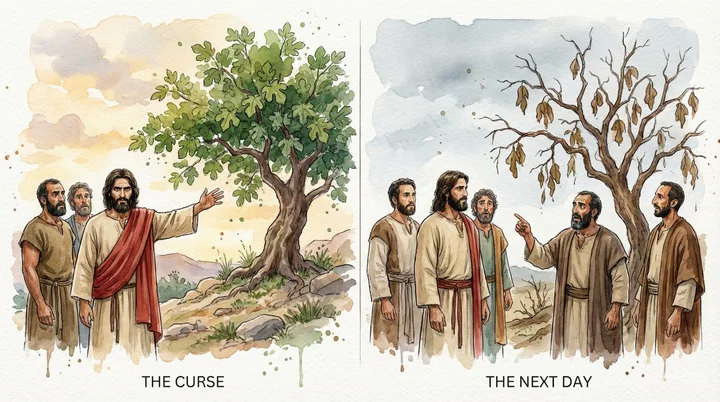
And in the morning, as they passed by, they saw the fig tree dried up from the roots.
Translations
American King James Version, King James Version, KJV Cambridge Paragraph Bible
And in the morning, as they passed by, they saw the fig tree dried up from the roots.
And in the morning, as they passed by, they saw the fig-tree dried up from the roots.
Revised Version, American Standard Version
And as they passed by in the morning, they saw the fig tree withered away from the roots.
And in the morning, passing by, they saw the fig-tree having been dried up from the roots,
And passing by early in the morning they saw the fig-tree dried up from the roots.
And, passing by early, they saw the fig-tree, withered from its roots;
Berean Standard Bible, Majority Standard Bible
As they were walking back in the morning, they saw the fig tree withered from its roots.
As they passed by in the morning, they saw the fig tree withered away from the roots.
And when they were going by in the morning, they saw the fig-tree dead from the roots.
And in the morning as they iourneyed together, they saw the figge tree dried vp from the rootes.
Douay-Rheims (Challoner revision)
And when they passed by in the morning they saw the fig tree dried up from the roots.
Pictures
Cross-references
- Mark 11:12-14
And on the morrow, when they were come from Bethany, he was hungry:
Jesus curses the fruitless fig tree, which is shown withered the next morning.
- Matthew 21:17-19
And he left them, and went out of the city into Bethany; and he lodged there.
Matthew account of the same cursing
- Luke 13:6-9
He spake also this parable; A certain man had a fig tree planted in his vineyard; and he came and sought fruit thereon, and found none.
The withered fig tree echoes the warning that a fruitless tree faces judgment.
- Mark 11:14
And Jesus answered and said unto it, No man eat fruit of thee hereafter for ever. And his disciples heard it.
Jesus pronounced that the tree would bear no fruit.
- Matthew 21:20-22
And when the disciples saw it, they marvelled, saying, How soon is the fig tree withered away!
The withered fig tree prompts Jesus’ teaching on faith and prayer.
- Luke 17:6
And the Lord said, If ye had faith as a grain of mustard seed, ye might say unto this sycamine tree, Be thou plucked up by the root, and be thou planted in the sea; and it should obey you.
same teaching on faith moving a tree
- Matthew 17:20
And Jesus said unto them, Because of your unbelief: for verily I say unto you, If ye have faith as a grain of mustard seed, ye shall say unto this mountain, Remove hence to yonder place; and it shall remove; and nothing shall be impossible unto you.
listed together as further light on faith
- Isaiah 61:3
To appoint unto them that mourn in Zion, to give unto them beauty for ashes, the oil of joy for mourning, the garment of praise for the spirit of heaviness; that they might be called trees of righteousness, the planting of the LORD, that he might be glorified.
Israel is called a planting of the LORD, trees of righteousness for his glory.
Commentary
Each commentary is drawn from primary sources: the writings of Ellen G. White and Adventist pioneers and periodicals. Each commentary is separate. Its own words are not a quotation; follow the references to read the source passages.
Ellen G. White
24 sources
In the morning on the way toward the city they saw the tree completely withered from its roots to its branches, with blasted branches and drooping leaves, and Peter called attention to it.Ms 32, 1898, par. 1–3Ms 21, 1902, par. 29–303SP 18.1–2 Its full foliage had promised fruit because fruit appears before the leaves, but it had only leaves, so its barrenness stood exposed beneath its show of life.Ms 32, 1898, par. 1–3Lt 16, 1888, par. 43 Unlike His other works, which were ever to restore and not to destroy, this was given as at once a parable and a miracle for the instruction of the disciples, opening to them the true condition of Israel and the retribution to fall on Jerusalem after its last appeal had been in vain.DA 580.2–581.2ST Feb 15, 1899Ms 21, 1902, par. 31–32 The leafy but fruitless tree symbolized the Jewish nation, favored above others with every spiritual advantage yet yielding pretension without humility, love and benevolence, and its withering dried up from the roots showed what the people would become in complete destruction when the grace of God was removed from them.DA 582.3–583.23SP 18.1–2ST Feb 15, 1899DA 584.1ST Jul 21, 1909 Its doom warns professed Christians and churches who appear godly but bear no fruit, for God looks for piety, self-denial, compassion and yearning to save others, and outward form and deceptive leaves cannot hide barrenness from Him.ST Feb 21, 18783SP 19.2ST Feb 21, 1878Ms 32, 1898, par. 11–12Lt 16, 1888, par. 43
Morning Discovery and Meaning
In the morning after the curse, as they passed by on the way between Jerusalem and Bethany toward the city, they saw the tree completely withered from its roots to its branches.Ms 32, 1898, par. 1–3Ms 21, 1902, par. 29–303SP 18.1–2ST Feb 21, 1878 Its blasted branches and drooping leaves showed the withering in full, and Peter called attention to it, bidding Him behold that the tree He had cursed had withered away.ST Feb 15, 1899ST Feb 21, 1878 A fig tree's fruit appears before its leaves, so its full foliage had promised fruit, but it had only leaves, and its barrenness was thus exposed beneath its show of life.Ms 32, 1898, par. 1–3Lt 16, 1888, par. 43
The withering was a singular act unlike all His other ways and works, which were ever to restore and not to destroy, as He scattered mercy in words of counsel and deeds of goodness, for He came not to condemn the world but that the world through Him might be saved.ST Feb 15, 1899 So the disciples could not understand His punishing a tree for its barrenness and asked Him to declare to them the parable of the fig tree.DA 580.2–581.2ST Feb 15, 1899 It was given as at once a parable and a miracle for the instruction of the disciples shortly before He was to leave them, to be ever remembered.DA 580.2–581.2Ms 21, 1902, par. 31–32 By this significant object-lesson He opened to them what they did not yet see: the hatred of the Jews to Christ and to what it would lead, the true condition of Israel, and the retribution that was to fall upon Jerusalem after the last appeal had been in vain and the priests and rulers had rejected Him.DA 580.2–581.2
The leafy but fruitless tree is an acted parable and symbol of the Jewish nation, professing allegiance to God and favored above others with every spiritual advantage.DA 582.3–583.23SP 18.1–2Ms 21, 1902, par. 31–32 Brought from Egypt to become trees of righteousness for God's glory, it yielded pretension without humility, love and benevolence, and did not profit by its blessings.DA 582.3–583.2Ms 21, 1902, par. 31–32 Beneath profession of piety and religious display, pride, oppression, hypocrisy, iniquity and sin ruled, while showy leaves without fruit concealed an unfruitful life.3SP 18.1–2ST Feb 15, 1899ST Feb 21, 1878 Through pride and apostasy the nation separated from God until it lost the ability to recognize its Redeemer.ST Feb 15, 1899 The other trees represent the Gentiles, who made no profession of knowing God and whose time to bear fruit had not yet come.STMW7 59.2–3
Judgment on Israel
The total withering of the tree, dried up from the roots, shows complete destruction and what the Jewish people would become when the grace of God was removed from them.DA 582.3–583.2DA 584.1ST Jul 21, 1909 In the barren tree could be read both their sin and its punishment, for by refusing to impart blessing in self-sacrifice and service they would no longer receive blessing and would bring ruin upon themselves.DA 582.3–583.2ST Jul 21, 1909 Its barrenness with pretentious appearance represented those professing to serve God but bearing no fruit in service to others.DA 584.1
Its withering pictures a doomed people under judgment, displaying God's righteous anger in sentence and downfall.DA 580ST Feb 15, 1899 It points to the coming destruction of Jerusalem and its temple after the people rejected Christ and the temple courts were desecrated for unlawful gain.Ms 32, 1898, par. 1–3ST Feb 15, 1899ST Feb 21, 1878 The showy leaves without fruit, with impressive religious ceremonies and claims of piety, hid pride, oppression, apostasy and iniquity instead of good fruit, and the nation had separated from God until it could not recognize its Redeemer.Ms 32, 1898, par. 1–3ST Feb 15, 1899ST Feb 21, 1878 Its sudden destruction from roots to branches, blighted and completely withered, was a sign of Jerusalem's coming doom.ST Feb 21, 1878ST Jan 10, 1878
The dumb, unconscious tree was made a responsible agent to show the terrible result of fruitlessness.Ms 21, 1902, par. 31–32 Its withering testifies to Christ's disappointment because the nation bore no fruit and to the punishment that must come, in perfect harmony with His words over Jerusalem about the peace hid from its eyes in its day.Ms 21, 1902, par. 31–32 That nation had been favored with every spiritual advantage and brought from Egypt to become trees of righteousness for God's glory, but did not profit by its blessings, and for more than a thousand years abused God's mercy and invited His judgments, thus determining its own destruction.Ms 21, 1902, par. 31–32 The nation continued to live for forty years after the event, but was spiritually dead with leaves of religious profession and no fruit, and the judgment fell on the generation that rejected Jesus.Lt 35, 1895, par. 8–9STMW7 59.2–3
Warning to Professing Christians
The withered tree stands as a sentence upon all who profess godliness yet bear no fruit, warning professed Christians and churches alike that outward show will fail when tested.ST Feb 21, 18783SP 19.2ST Feb 21, 1878 Formal, selfish, boastful and hypocritical professors are included in that warning, for God looks beneath appearance and discerns the difference between genuine devotion and hypocrisy.ST Feb 21, 18783SP 19.2 Pretentious hypocrites will be brought low, because hollow pretense and hypocrisy are hateful to Christ.3SP 19.2ST Feb 21, 1878 Religious forms, ceremonies, claims and worship without repentance, faith, obedience and merciful, unselfish service to others are vain and bear nothing to God's glory.3SP 19.2DA 584.1 Genuine Christians use their God-given opportunities to imitate Christ by good works and unselfish deeds, while an open sinner is in a better condition before God and less guilty than one who professes godliness without fruit.ST Feb 21, 18783SP 19.2DA 584.1
What God looks for is fruit, namely piety, self-denial, self-sacrifice, compassion, zeal for God and a deep yearning of soul to save fellow men from unbelief and ruin.Ms 32, 1898, par. 11–12 Outward knowledge and religious form cannot take the place of His inward work of repentance and faith, and deceptive leaves cannot hide barrenness.Lt 16, 1888, par. 4321MR 167.3 With mournful reluctance the words of doom were pronounced, and the tree withered and died under the curse of an offended God.Lt 80, 1901, par. 13 Its fate is a personal call to heed Christ and be converted, to reform while there is still time and to walk in the light while having the light.Lt 80, 1901, par. 1321MR 167.3 One who despises offered mercy and warnings, persists in disobedience, and has the heart desecrated by sin becomes like that blighted tree, withered to the roots under righteous judgment.ST Aug 15, 1878 Those who claim great spiritual light and display leaves of godliness while marked by sin and lacking Christlike character face the same doom.21MR 167.4–168.1
The act stands as a living warning appeal to all Christian churches, to repeat its lesson in every age to the close of this earth's history.Ms 32, 1898, par. 11–12 The present condition of the churches is like that in Christ's day, fruitless while trampling the law of Jehovah and making the memorial of God, the sign between Him and His commandment-keeping people, a thing of naught to be despised, while a rival spurious sabbath is exalted.Ms 32, 1898, par. 11–12 The dead tree also represents some of God's appointed human helpers and resources for His people who defraud the Lord.Ms 65, 1912, par. 11 From age to age God raises up such helpers out of His inexhaustible fountain of wisdom and strength, and these God-given agencies will not prove fraudulent if they themselves do not defraud Him as those represented by the barren tree have done.Ms 65, 1912, par. 11
Sources
Pioneers and periodicals
22 sources
On Tuesday morning as they walked from Bethany to Jerusalem, the disciples saw the tree Jesus had cursed the day before completely dead, dried from its roots to its branches by the power of his word.ST Feb 23, 1915ST Feb 22, 1877RH Jan 29, 1914ST Oct 4, 1899 Its full leaves had promised fruit, since figs come before leaves, so its barren show was deceptive, and Peter remembered his words and marveled at how quickly it had withered.ST Feb 15, 1899RH May 22, 1913ST Feb 22, 1877RH Jan 17, 1871RH Jan 17, 1871 The leafy but fruitless tree represented the Jewish nation and its priests and teachers, whose ceremonies and claims of piety hid pride, apostasy and iniquity.ST Feb 15, 1899RH May 22, 1913RH Jan 17, 1871 Its withering from the roots was an acted parable of God's curse and righteous anger, a sign of their coming downfall and the destruction of Jerusalem.ST Feb 21, 1878ST Feb 15, 1899ST Feb 21, 1878ST Feb 23, 1915RH Jan 17, 1871 It warns fruitless professors who bear leaves of outward religion without genuine fruit that barrenness will be exposed and brought low, and its withering prompted his lesson on the power of faith in prayer.ST Feb 21, 1878ST Feb 21, 1878ST Aug 15, 1878ST Dec 16, 1886ST Mar 3, 1909
Time and Details
The disciples found the tree dried up from the roots on Tuesday morning, the morning after he had cursed it and cleansed the temple on Monday.RH Jan 29, 1914ST Dec 16, 1886 That Tuesday was the second day before the Passover, when he returned to Jerusalem and taught in the temple throughout the day, answering questions and denouncing hypocrisy.RH Jan 29, 1914 It was his last day of teaching there, and he then left the temple for the last time.RH Jan 29, 1914
They saw it as they passed by on the foot-path from Bethany to Jerusalem over the summit of the Mount of Olives, the day after the triumphal entry.RH Jan 17, 1871ST Nov 17, 1898 By the next morning the tree was completely dead, dried from its roots to its branches, and its complete withering showed that the pronounced judgment had taken full effect through the power of his word.ST Feb 23, 1915ST Feb 22, 1877ST Dec 16, 1886ST Oct 4, 1899RH Mar 13, 1900 Its full leaves made fruit reasonable to expect, since figs appear before the leaves, so its leafy but fruitless show was deceptive.RH May 22, 1913ST Feb 22, 1877
Peter remembered what he had said and marveled at how quickly it had withered, with its blasted branches and drooping leaves.ST Feb 15, 1899RH Jan 17, 1871 The unmistakable sight made the disciples recall his action and attend to its solemn lesson, yet they could not understand his punishing a tree for its barrenness and asked him to declare to them its parable.ST Feb 15, 1899RH Jan 17, 1871 The withering was a singular act unlike all his other ways and works, which were ever to restore and not to destroy by scattering mercy in words of counsel and deeds of goodness, since he came not to condemn the world but that the world through him might be saved.ST Feb 15, 1899 When he spoke the tree withered and died at once, demonstrating that nature obeyed his word as evidence that he is God, in contrast to human disobedience that leaves humanity out of harmony with God.ST Aug 23, 1899
Symbol and Judgment
The leafy but fruitless tree stood for the Jewish nation and its leaders, priests and teachers, who claimed to serve God yet bore Him no fruit.RH May 22, 1913RH Jan 17, 1871 Separated from God by pride and apostasy, they kept impressive ceremonies and claims of piety that hid pride, oppression and iniquity, and they had lost the power to recognize their Redeemer.ST Feb 15, 1899ST Feb 21, 1878 Its full leaves without fruit pictured outward religious profession and forms without deeds, the mere appearance of faith without genuine spiritual and moral fruit.ST Feb 22, 1877RH Jan 17, 1871RH Jan 17, 1871 A living life bears love, prayer, kindness, self-denial, patience, gentleness, meekness and humility, and profession lacking these is in danger and finds no favor with Christ.RH May 22, 1913RH Jan 17, 1871
Its destruction was an acted parable of judgment upon fruitful-looking but barren profession.RH Jan 17, 1871 Its withering shows the fearful result of lying under God's curse and displays His righteous anger against Jerusalem.ST Feb 15, 1899ST Feb 23, 1915 Withered completely from the roots, it was the sentence and downfall of the Jewish nation, the sign of the coming destruction and doom of Jerusalem.ST Feb 21, 1878ST Feb 15, 1899ST Feb 21, 1878ST Jan 10, 1878 Its ruin shows both sin and its punishment when God's grace was removed, for because they refused to share the blessings entrusted to them, they would no longer receive them.ST Jul 21, 1909
It warns professed Christians and pretentious hypocrites who appear godly but bear no fruit.ST Feb 21, 1878ST Feb 21, 1878 Outward display cannot hide barrenness from the Lord, who sees beneath appearance, and when tested the difference between genuine devotion and hypocrisy is exposed.ST Feb 21, 1878ST Feb 22, 1877 The fruitless will be brought low, withered to the roots under God's righteous judgment like the blighted tree, which is the fate of those who despise offered mercy and warnings, persist in disobedience, and have the heart desecrated by sin.ST Feb 21, 1878ST Aug 15, 1878
Faith and Application
The complete withering showed the effect of Jesus' word and prompted his lesson about faith in prayer.ST Dec 16, 1886ST Mar 3, 1909 Found the next morning dried up from its roots, the tree illustrated the lesson on faith and the power of faith.ST Dec 16, 1886ST Mar 3, 1909 It gives further light on the apostles' prayer, Lord, increase our faith, and on the Lord's answer that faith as a grain of mustard seed can command a tree to be plucked up and planted and be obeyed.ST Apr 16, 1896 The disciples had heard his words and should have trusted them as fully as Jesus trusted the power of God's word to accomplish what it declared.RH Mar 13, 1900 Their surprise at seeing the result showed they had not done so, and the withered tree illustrates having the same faith in God's word that God himself has in it.RH Mar 13, 1900
The tree withered when God's sustaining power was withdrawn, showing that its life did not continue by any strength of its own. Likewise a person's spiritual life depends moment by moment on divine life and cannot stand by acquired strength. Genuine Christian life uses God-given opportunities to imitate Christ through good works and unselfish deeds, bearing love, prayer, kindness, self-denial, patience, gentleness, meekness, and humility.ST Feb 21, 1878RH May 22, 1913RH Jan 17, 1871 Profession without such performance finds no favor with Christ and is in danger, for when tested outward appearance cannot hide barrenness from the Lord who sees beneath it and exposes the difference between genuine devotion and hypocrisy.ST Feb 21, 1878RH May 22, 1913RH Jan 17, 1871
Its withering under judgment is applied as a warning that failing to return the Lord's tithe brings one under God's curse, illustrating the fearful result of being under that curse down even to the roots.ST Feb 23, 1915 The same withering is applied to self-willed or fruitless people whom God tries, punishes, disciplines, and withers because they had nothing but leaves, and they are still to trust in His faithfulness.ST May 31, 1910 One who despises offered mercy and warnings and persists in disobedience, with a heart desecrated by sin, becomes like that blighted tree, withered to the roots under God's righteous judgment.ST Aug 15, 1878
Sources