Translations
American King James Version, King James Version, KJV Cambridge Paragraph Bible, Webster Bible
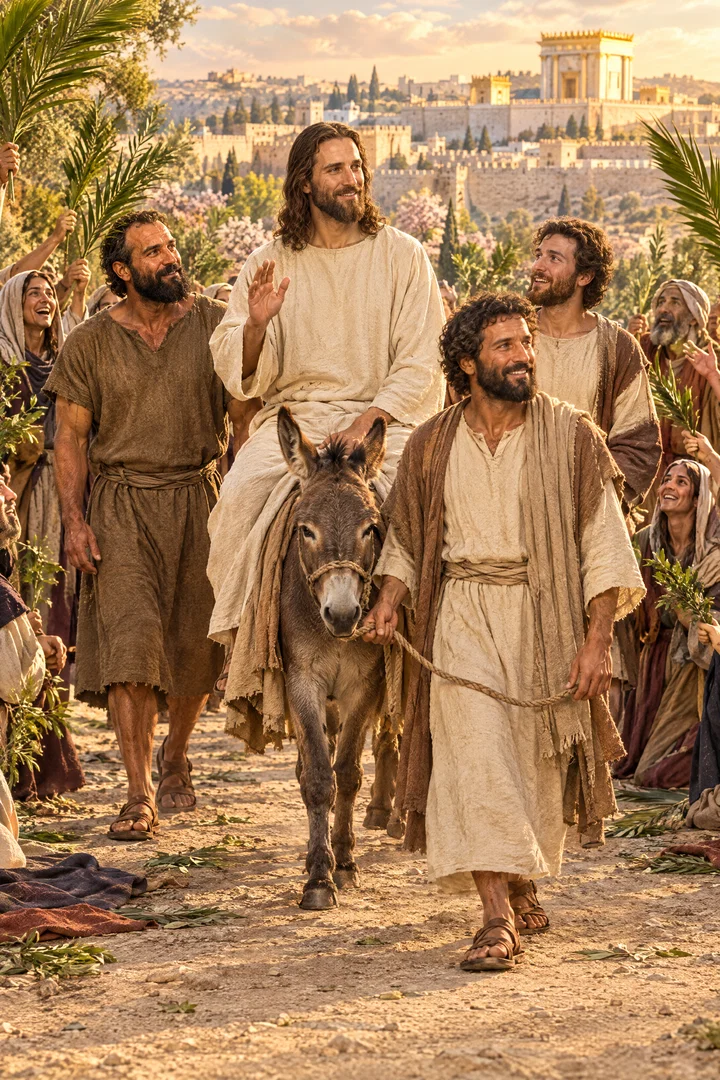
And the disciples went, and did as Jesus commanded them,
Revised Version, American Standard Version
And the disciples went, and did even as Jesus appointed them,
And the disciples having gone and having done as Jesus commanded them,
But the disciples, having gone and done as Jesus had ordered them,
And the disciples, went, and did as Jesus directed them;
Berean Standard Bible, Majority Standard Bible
So the disciples went and did as Jesus had directed them.
The disciples went and did just as Jesus commanded them,
And the disciples went and did as Jesus had given them orders,
So the disciples went, and did as Iesus had commanded them,
Douay-Rheims (Challoner revision)
And the disciples going, did as Jesus commanded them.
Pictures
Cross-references
- Zechariah 9:9
Rejoice greatly, O daughter of Zion; shout, O daughter of Jerusalem: behold, thy King cometh unto thee: he is just, and having salvation; lowly, and riding upon an ass, and upon a colt the foal of an ass.
Foretells the Messiah’s humble entry into Jerusalem riding a donkey.
- Mark 11:1-7
And when they came nigh to Jerusalem, unto Bethphage and Bethany, at the mount of Olives, he sendeth forth two of his disciples,
The disciples carry out Jesus’ instructions and obtain the colt for his entry into Jerusalem.
- John 12:12-16
On the next day much people that were come to the feast, when they heard that Jesus was coming to Jerusalem,
Describes Jesus’ entry into Jerusalem and the crowd’s royal welcome, fulfilling prophecy.
- Luke 19:29-35
And it came to pass, when he was come nigh to Bethphage and Bethany, at the mount called the mount of Olives, he sent two of his disciples,
The disciples carry out Jesus’ instructions to bring the colt for his entry into Jerusalem.
- Luke 19:36-40
And as he went, they spread their clothes in the way.
parallel entry where stones would cry out
- John 12:17-18
The people therefore that was with him when he called Lazarus out of his grave, and raised him from the dead, bare record.
Witnesses and reports of Lazarus’s raising drew people to meet Jesus.
- Psalms 118:26
Blessed be he that cometh in the name of the LORD: we have blessed you out of the house of the LORD.
The crowd used this psalm in praising Jesus as king.
Commentary
Each commentary is drawn from primary sources: the writings of Ellen G. White and Adventist pioneers and periodicals. Each commentary is separate. Its own words are not a quotation; follow the references to read the source passages.
Ellen G. White
28 sources
The verse records two disciples fetching the ass and its colt for Jesus to ride, obtained through a stranger's kindness after they said the Lord had need of them, just as He had foretold in precise directions that revealed His divinity.DA 569.3–44RED 115.3ST Jul 22, 1886 They placed their garments on the colt and seated Him upon it while garments and leafy branches were spread in His path, fulfilling Zechariah's prophecy of Jerusalem's lowly King coming to Zion riding on a donkey in humble yet triumphant royal procession.DA 569.1–2DA 569ST Jun 8, 1882COS 91.1–5 Their obedience enabled Him to enter amid public acclaim as Messiah and King with Hosannas to the Son of David, which the disciples took as a sign He would be crowned on David's throne to overthrow Rome and free Israel as a temporal prince.ST Jun 8, 1882EW 206.44RED 116.1–117.2DA 570.1–571.11T 57.3–58.1 The entry was deliberate to draw public attention to Him as Redeemer before His sacrifice at Passover, when He presented Himself as the antitypical Passover Lamb who voluntarily set Himself apart to give His life for the world.ST Jun 8, 1882DA 571.2–4 Within days those earthly hopes were disappointed at His death on the cross, yet revived when He rose so they understood prophecy had also foretold His suffering, and the verse means doing one's assigned part well and faithfully exactly as He commands.4RED 115.3EW 206.41T 57.3–58.14SP 253.2Lt 29, 1880, par. 22–23
Entry Into Jerusalem
The verse records two disciples carrying out Jesus' directions to bring the ass and its colt for His entry into Jerusalem.DA 569.3–44RED 115.3ST Jul 22, 1886 The animals were obtained through a stranger's kindness after the disciples said the Lord had need of them, just as Jesus had foretold.DA 569.3–4 His precise directions in the matter revealed His divinity.DA 569.3–4 Though puzzled that He chose to ride, they obeyed, and their obedience provided the animal on which He would ride as He approached the city, while their errand stirred hopes among His friends that He would claim kingship in the city.4RED 115.3ST Jul 22, 1886
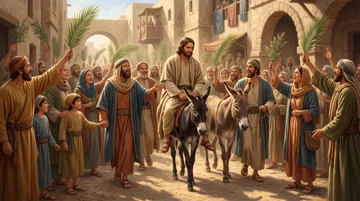
They placed their garments on the colt for Him and seated Jesus upon it.ST Jun 8, 1882COS 91.1–5 They spread garments and leafy olive and palm branches in His path as He prepared to enter Jerusalem.ST Jun 8, 1882 The crowd acclaimed Him as Messiah and King, and the disciples took His acceptance of this homage as a sign that He would be acknowledged as Israel's king.ST Jun 8, 1882
The procession belonged to Jesus' entry into Jerusalem and was unlike the triumphs of earthly conquerors.4RED 120.2 Its trophies were people Jesus had delivered and healed, who praised God and honored Him.4RED 120.2 Lazarus, raised from the dead, guided the animal on which Jesus rode.4RED 120.2
The entry took place as Christ journeyed to Jerusalem for His triumphal entry and rode into the city.Lt 82, 1907, par. 9DA 569Lt 113, 1886, par. 16–18 He rode into the city on the colt at Passover, in a humble yet triumphant coming as King.DA 569COS 91.1–5 It occurred in the beautiful season of the year when many visitors had gathered for the feast.Ms 128, 1899, par. 1 The triumphant ride shortly before His trial was associated with the Mount of Olives, whose slopes echoed the joyful shouts of the crowd.3SP 250.3
The crowd witnessing the special scene included people Jesus had healed and raised from the dead.Ms 7a, 1886, par. 1–2 Interest in Jesus had been greatly stirred by His raising of Lazarus from the dead.Ms 128, 1899, par. 1
Prophecy and Expected King
The obedient fetching of the ass and colt made possible the promised King's entry into Jerusalem as heir to David's throne, fulfilling Zechariah's prophecy of a lowly King coming to Zion riding on a donkey.DA 569.1–2COS 91.1–5DA 570.1–571.1 The scene was a humble yet triumphant coming as King, with the disciples placing their garments on the colt and seating Jesus upon it.DA 569COS 91.1–5 The colt itself was an animal used by Israel's kings, and the ride followed the custom of a royal procession, though in lowly form.DA 570.1–571.1
The entry also fulfilled what Isaiah foresaw, accomplished amid the praises and rejoicing of the people.Ms 7a, 1886, par. 1–2Ms 151, 1899, par. 5 Those who witnessed and joined the special scene did not know they were fulfilling Isaiah's prophecy.Ms 7a, 1886, par. 1–2
Their preparation enabled Jesus to enter the city amid public acclaim as Messiah and King.ST Jun 8, 18824RED 116.1–117.2 They placed their garments on the colt for Him and spread garments and leafy olive and palm branches in His path, while people flocked from the region crying Hosanna to the Son of David.ST Jun 8, 18821T 57.3–58.1 The disciples took His acceptance of this homage as a sign that He would be acknowledged as Israel's king.ST Jun 8, 1882 When priests and elders wanted the multitude stilled, Jesus declared that if they held their peace even the stones would cry out, for prophecy must be fulfilled.1T 57.3–58.1
The disciples and followers mistakenly expected Him to take an earthly kingdom and reign as a temporal prince, to be crowned and reign on David's throne.EW 206.41T 57.3–58.14SP 253.2 They looked for Him to overthrow Roman rule, restore Israel, and free Israel from its oppressors.DA 570.1–571.14SP 253.2 Within days those high hopes were disappointed when they saw their beloved Master die and be buried, stretched upon the cruel cross above mocking, taunting Pharisees, with the darkness of death closing about them.EW 206.41T 57.3–58.1 That disappointment was greater than the Advent disappointment, yet their hopes revived when He rose and appeared to them.EW 206.41T 57.3–58.1 Only then did they understand that prophecy had also foretold His suffering and resurrection, and that Christ was true to His promises, with sweet consolation to His people and rich reward to the true and faithful.1T 57.3–58.14SP 253.2
The entry was deliberate to draw public attention to Him as Redeemer before His coming sacrifice.ST Jun 8, 1882DA 571.2–4 It took place at Passover, when Jesus presented Himself as the antitypical Passover Lamb who voluntarily set Himself apart as an offering for the world's sins to give His life for the world.ST Jun 8, 1882DA 571.2–4 Though He could have entered with heavenly angels and divine trumpets, He remained humble and bore humanity's burden until He gave His life, and His death was meant to remain a subject of deep thought and study.ST Jun 8, 1882 The events before His death were meant to lead people to follow them through to His death and later to search and examine the prophecies that identified Him as Messiah.ST Jun 8, 1882DA 571.2–4
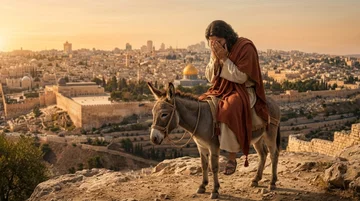
Amid the rejoicing and hosannas the triumphal entrance pointed to Jerusalem's coming doom, together with the temple cleansing and the barren fig tree.3SP 20.1ST Jan 10, 1878 Jesus' tears as He looked over Jerusalem were His last pleadings of rejected love and compassion for the city.3SP 20.1ST Jan 10, 1878 The triumphal ride itself foreshadowed His coming in the clouds of heaven with power and glory, amid the triumph of angels and the rejoicing of the saints.3SP 9.1
Obedience and Present Application
The verse means doing one's assigned part well and faithfully, for the two disciples did exactly what Jesus commanded in bringing the colt for His entry, though they were puzzled that He chose to ride.4RED 115.3Lt 29, 1880, par. 22–23 Their errand stirred hopes among His friends that He would claim kingship in the city.4RED 115.3 Preaching the account of Matthew 21:1-11 exalts Jesus and lifts Him above all, showing that His followers honor Him highly.Lt 27, 1880, par. 8 It answers the charge of being saved by law by making Christ Himself central, and when proclaimed before a large crowd it convinces hearers and draws them to faith and baptism and uniting with the church.Lt 27, 1880, par. 8
The story holds listeners with close attention and calls them to let the word take hold upon their souls.7MR 32.2 That faithful obedience is what enables the word spoken about Christ to take hold upon souls, so that workers do their part well and stand acquitted when the judgment sits and the books are opened and every account is balanced to show who is saved, and some hearers are saved through faithful work.7MR 32.2Lt 29, 1880, par. 22–23 Taught together with the barren fig tree, the account shows the Son of God coming to the world to draw all men to Him.Ms 5, 1882, par. 11 His coming brings not peace but a sword, and His followers must walk in the light of His glorious example without questioning the cost in labor and trial and suffering, with a work for each and all to maintain the truth in its purity and to push the triumphs of His cross and extend His kingdom.Ms 5, 1882, par. 11
Belonging to Christ's journey to Jerusalem for His triumphal entry and triumphal entrance, the event was taught together with the temple cleansing and the barren fig tree and pointed to Jerusalem's doom.Lt 82, 1907, par. 9ST Jan 10, 1878Ms 5, 1882, par. 11 The chapter warns that profession of service to God without a fruitful life is like the pretentious fig tree that bore no fruit.Lt 82, 1907, par. 9 The rejoicing and hosannas surrounded His final pleadings of love and compassion for the city, shown when He wept over it.ST Jan 10, 1878
Sources
Pioneers and periodicals
42 sources
The disciples obeyed Jesus' command to obtain the animals, especially the colt, on which He would ride into Jerusalem in the last week of His life only a few days before His suffering and crucifixion.ST Apr 14, 1898ST Apr 14, 1898ST Oct 5, 1904ST Nov 8, 1883 Their obedient action brought about the predicted sign of the Messiah's humble entry, fulfilling Zechariah 9:9 that Jerusalem's King would come meekly riding on a young ass.ST Oct 5, 1904RH Nov 18, 1862ST Jun 9, 1898 The disciples and crowd welcomed Him expecting Him then to take David's throne and reign in a literal kingdom, but instead of being enthroned He entered Jerusalem to die, being crucified a few days later rather than crowned.ST Jun 8, 1882ST Jun 5, 1879ST Apr 8, 1903ST Aug 13, 1902RH Mar 17, 1859 Their experience of being right in action but wrong about the event to follow is the same pattern as the Advent believers in 1844 who were right about the time but wrong about the event, yet as the entry truly fulfilled prophecy despite the error, so the 1844 proclamation truly announced the judgment hour.ST Jun 5, 1879ST Apr 8, 1903RH Jun 29, 1911 The entry was His deliberate act of self-denying love to draw public attention to Him before His sacrifice, as the antitypical Passover Lamb voluntarily setting Himself apart as an offering for the world's sins in humility rather than worldly splendor.ST Jun 8, 1882ST Feb 6, 1901ST Mar 25, 1903
Setting and Obedient Action
The disciples went and did as Jesus commanded them, setting out to obtain the animals for His entry into Jerusalem, especially the colt on which He would ride.ST Apr 14, 1898ST Apr 14, 1898ST Oct 5, 1904RH Nov 18, 1862ST Apr 12, 1905 Their task was to procure the animal and bring it for His use, carrying out His instructions exactly as He directed them.ST Apr 14, 1898ST Apr 14, 1898ST Oct 5, 1904ST Apr 12, 1905ST Dec 23, 1886 In doing so they prepared for His entry into the city.ST Apr 12, 1905ST Dec 23, 1886ST Apr 14, 1898
Two disciples were sent to bring the colt, and they placed their garments upon it to prepare it for Jesus to ride as the meek King foretold by the prophet.ST Jun 8, 1882ST Jul 22, 1886ST Oct 5, 1904 They spread garments and leafy olive and palm branches in His path as He approached the city during Passover.ST Jun 8, 1882ST Jul 22, 1886
This obedience belongs to Jesus' triumphal entry into Jerusalem in the last week of His life on earth, near the close of His ministry only a few days before His suffering, crucifixion and Passover.ST Nov 8, 1883ST Feb 14, 1878RH Jul 6, 1869ST Apr 14, 1898 It was His rejoicing procession over Olivet toward Jerusalem thirty-three years after His birth.RH Nov 25, 1873 It is commemorated as the Palm Sunday account beginning a week-long observance from the Fiesta of Ramos on April 5 through Holy Thursday the 9th, Holy Friday the 10th, Holy Saturday the 11th, and Easter Sunday the 12th.ST Nov 8, 1883ST Feb 14, 1878RH Jul 6, 1869ST Apr 14, 1898 It foreshadows His final triumph when He enters His kingdom to reign.ST Apr 14, 1898
The scene was marked by public rejoicing, with the people spreading garments and tree branches on the road and praising God for His mighty works in healing the sick, cleansing lepers, giving sight to the blind and raising the dead, with children joining in the praise.ST Jun 8, 1882 The crowd welcomed Him with hosannas, acclaiming Him as Messiah, King and Son of David.ST Jun 8, 1882STRH Sep 18, 1855 On this striking occasion before Gethsemane He allowed the multitudes to express their honor to Him without restraint.ST Jul 22, 1886 The event included Jesus viewing Jerusalem from the Mount of Olives and entering the temple with mighty power, where He drove out the money changers and merchants.ST Feb 14, 1878
The same entry is also told in Mark 11 and John 12, with the fullest account given in Luke 19.ST It closes the account of His first advent beginning with John the Baptist and setting forth His life, miracles, teachings and life-work.
Prophecy Fulfilled in Entry
The disciples going and doing as commanded brought about the predicted sign of the Messiah's humble entry, fulfilling Zechariah 9:9 that Jerusalem's King, Zion's king, would come meekly and humbly riding on a young ass, a colt.ST Oct 5, 1904RH Nov 18, 1862ST Jun 9, 1898RH Jul 4, 1871ST May 9, 1878 They obtained the colt and brought it and placed their garments on it to prepare it for Jesus to ride as the meek King foretold by the prophet.ST Oct 5, 1904 This entrance into Jerusalem to present Himself as Israel's king took place near the close of His ministry, only a few days before His crucifixion.ST Nov 8, 1883 The imperative form of Zechariah's prophecy did not mean the event was near when Zechariah wrote.ST May 9, 1878
The prophetic command to rejoice and shout was itself a prediction that the people would do so at the appointed time.RH Jul 4, 1871 The shout was put into the people by God both by the Spirit of prophecy spoken long before saying shout and behold thy King cometh, and by His Spirit at the time moving them in the line of duty and by divine impulse in obedience to that command.ST Jun 5, 1879RH Jul 4, 1871ST Feb 4, 1903 The action had to take place because prophecy had to be fulfilled in its appointed place in a chain of events, so that if the disciples and multitude had held their peace the very stones would have cried out and shouted.ST Jun 5, 1879ST Apr 8, 1903ST Aug 1, 1916 Matthew recognized the triumphal entry with its great multitude as that true fulfillment, with people recognizing and proclaiming its significance.ST Jun 5, 1879ST Aug 1, 1916
The prophecies He fulfilled, together with His miracles and pure life and teaching and raising Lazarus from the dead, had given ample proof of His identity as Messiah and Son of God.ST Nov 8, 1883 His rejoicing procession over Olivet toward Jerusalem came thirty-three years after His birth, with Jesus seated on an ass in the midst of a mighty host, majestic in appearance and benign in countenance, identified as Jesus of Nazareth foretold by prophets, worshiped by angels and anointed by God, so that the whole city was moved to ask who He is.RH Nov 25, 1873 His coming proves the Holy Spirit meant what Zechariah foretold to be understood literally.RH Nov 25, 1873
Matthew 21:1-12 also fulfills Psalm 118:22-24 about the stone the builders rejected becoming the head stone of the corner.RH May 10, 1860 The day which the Lord made in that prophecy is resurrection day.RH May 10, 1860 This proves the Sabbath was changed by divine appointment from the seventh to the first day of the week to commemorate the resurrection as greater than creation.RH May 10, 1860
The triumphal entry in the last week of His life on earth foreshadows His final triumph when He enters His kingdom to reign.ST Apr 14, 1898
Mistaken Hope and Disappointment
The disciples and the multitude welcomed Him expecting Him then to take possession of a literal kingdom and be acknowledged as Israel's king to reign forever.ST Jun 8, 1882ST Aug 13, 1902RH Mar 17, 1859RH Jul 25, 1865ST Dec 3, 1874 They looked for Him to claim David's throne at that entry, and the people's Hosanna carried that same expectation rather than any thought that He was about to die.RH Mar 17, 1859ST Dec 3, 1874RH Feb 16, 1869 The disciples took His acceptance of their homage as the sign that He would now be owned as king, and their enthusiasm was moved more by what they saw than by faith.ST Jun 8, 1882 The crowd's acclaim and joyful spreading of garments and branches reflected the hope that He would be crowned king, yet that hope rested on the mistaken belief that the Messiah's kingdom would be established then.ST Aug 13, 1902RH Sep 18, 1855RH Jul 25, 1865
Instead He entered Jerusalem to die and not to reign, going to the cross rather than to enthronement.ST Jun 5, 1879ST Apr 8, 1903ST Jul 27, 1882 Only a few days after the triumph He was crucified rather than crowned, escorted in triumph and then plunged into bitter disappointment at His death.ST Jun 5, 1879ST Aug 13, 1902RH Jul 25, 1865RH Jul 6, 1869 The only throne to which He then went was the cross, and instead of being hailed as king in a royal palace He was laid as a lifeless form in Joseph's new sepulcher.ST Jun 5, 1879ST Jul 27, 1882 Their hopes died with Him in a disappointment tenfold heavier than their joy, threatening their faith, making them a reproach to scoffers, and leading many to question whether He was Messiah.ST Jun 5, 1879ST Apr 8, 1903ST Jul 27, 1882
They did not fully understand the event until after Jesus rose from the dead, was glorified in heaven, and sent the Comforter.ST Jun 5, 1879RH Jul 4, 1871 Then they understood these things better and were begotten again to a lively hope.ST Jun 5, 1879 After His resurrection He corrected their understanding and entrusted Peter with caring for His followers, and gospel work began in earnest.ST Jun 5, 1879 What had been disappointment gave place to clearer sight once the Spirit enlightened them.ST Jun 5, 1879RH Jul 4, 1871ST Feb 4, 1903
Their error about an immediate kingdom did not make the prophetic fulfillment false, nor did it make God's work in the event false.ST Jun 5, 1879ST Nov 20, 1884 The actions of the disciples and the proclamation of the crowd truly fulfilled prophecy at the appointed time, though they expected God's kingdom to appear immediately.ST Nov 20, 1884RH Jun 29, 1911RH Feb 16, 1869 The rejoicing and praise were fitting even in their misunderstanding, and that praise could not be silenced.ST Jun 5, 1879RH Sep 18, 1855 So their mistaken views give no ground for rejecting the gospel they afterward preached.ST Jun 5, 1879
Though He was crucified by His bitterest enemies, which looked like signal defeat, His crucifixion was His real coronation and His triumph over the powers of darkness on Calvary's cross.ST Feb 4, 1903 The disciples who obeyed His command and shared the entry did not understand this victory, and were disappointed instead of shouting in joy over it.ST Feb 4, 1903 That triumphal entrance, together with the cleansing of the temple and the barren fig tree, pointed to Jerusalem's doom.ST Jan 10, 1878 The rejoicing and hosannas surrounded His final pleadings of love and compassion for the city, shown when He wept over it.ST Jan 10, 1878ST Feb 4, 1903
Pattern for Advent Disappointment
The disciples obeyed the command and hailed Jesus as King on His entrance into Jerusalem in fulfillment of prophecy, and their action had to take place because prophecy had to be fulfilled, so that if they had held their peace the very stones would have cried out.ST Apr 8, 1903 They expected Him to take a throne and reign and redeem Israel, but He entered Jerusalem to die and not to reign, so they were bitterly disappointed and became a reproach to scoffers.ST Apr 8, 1903 Their experience of fulfilling prophecy while being right in action but wrong about the event to follow, sweetness followed by bitterness, is the same pattern as the Advent believers in 1844 who were right about the time but wrong about the event.ST Apr 8, 1903
The going and doing as commanded was part of the true fulfillment of Zechariah 9:9 when Jesus rode into Jerusalem with a great multitude, done in the line of duty and by divine impulse in obedience to the prophetic command to shout, so that if they had held their peace the stones would have shouted.ST Jun 5, 1879 They truly fulfilled the prophecy even though they wrongly thought He would then enter upon His reign in Jerusalem and dwell with them forever, so that when He was crucified a few days later instead of enthroned their hopes died and they were woefully disappointed.ST Jun 5, 1879RH Jun 29, 1911 After Christ rose from the dead, was glorified in heaven, and sent the Comforter, they understood these things better and were begotten again to lively hope.ST Jun 5, 1879 Their error and disappointment did not frustrate or void the fulfillment but were used by God to aid it, proving that the 1844 proclamation of the hour of judgment was likewise truly fulfilled despite error leading to disappointment.ST Jun 5, 1879 The disciples and the people proclaimed the triumphal entry in fulfillment of prophecy even though their expectations were mistaken, just as the pre-1844 advent proclamation announced the judgment hour despite misunderstanding what the opening of the judgment meant.RH Jun 29, 1911
The followers expected Him to establish His kingdom there and rejoiced as He rode into the city, honoring Him as King and shouting praise, though they misunderstood the nature of the event.RH Jul 25, 1865RH Aug 24, 1869 They wrongly expected Him to take David's throne then, and their hopes were soon bitterly disappointed when He was put to death and crucified instead, which saddened them and threatened their faith.RH Jul 25, 1865RH Aug 24, 1869 This disappointment was part of God's plan, and their mistaken expectations did not prevent them from fulfilling Scripture.RH Jul 25, 1865RH Aug 24, 1869 The Advent people likewise proclaimed the prophetic message but misunderstood how it would be fulfilled.RH Aug 24, 1869 After His resurrection He corrected their understanding and entrusted Peter with caring for His followers, beginning the gospel work in earnest. The loyalty of the disciples amid the events surrounding His entry matches the loyalty of believers who continued to trust the Advent message after the disappointment of 1844, even though they did not yet understand the sanctuary subject.RH Feb 26, 1867
Christ's Mission and Character
The entry was deliberate to draw public attention to Him before His coming sacrifice.ST Jun 8, 1882 It prepared people to follow the events leading to His death and afterward to search the prophecies identifying Him as Messiah.ST Jun 8, 1882 As the antitypical Passover Lamb He voluntarily set Himself apart as an offering for the world's sins, and His death was to remain a subject of deep thought and study.ST Jun 8, 1882 Though He could have entered with heavenly angels and divine trumpets, He remained humble and bore humanity's burden until He gave His life for the world.ST Jun 8, 1882
The triumphal entry stands as a token of self-denying love, in contrast with worldly political displays grounded in force.ST Feb 6, 1901 Humbly riding the colt in everyday clothes, He did not have the people bear Him on their shoulders in splendor.ST Mar 25, 1903 He Himself was the burden-bearer for the people, sustaining the burdened and giving rest to the heavy laden.ST Mar 25, 1903
It was a striking event before Gethsemane.ST Jul 22, 1886 On that occasion He allowed the multitudes to express their honor to Him without restraint.ST Jul 22, 1886 Matthew 21 shows the Saviour as a business man come as special agent of His Father.ST Nov 20, 1884 The Father had planted a vineyard and let it out to husbandmen, and when the husbandmen refused to make returns when called upon by authorized collectors, the Son Himself came to attend to the business.ST Nov 20, 1884
Following and Warning
Matthew 21:6 shows the disciples going and doing as Jesus commanded in preparation for His triumphal entry, and in that obedience it illustrates what it means to follow Jesus by carrying out His directions and escorting Him in triumph.ST Mar 14, 1906 The obedience belongs to His triumphant ride into Jerusalem shortly before His crucifixion.ST Feb 14, 1878 That ride included His viewing of Jerusalem from the Mount of Olives and His entering the temple, where He drove out the money changers and merchants with mighty power.ST Feb 14, 1878
Jerusalem's people failed to heed God's warning and to recognize their privileges, and their time of probation was nearly over.ST Feb 14, 1878 The same warning applies to people in the present.ST Feb 14, 1878 The warm public reception given at the entry is a further warning that expressions of goodwill can quickly turn, so that the friendship of the world is not a safe basis for confidence.ST Jul 30, 1894
Sources