Matthew 21:5
Tell ye the daughter of Sion, Behold, thy King cometh unto thee, meek, and sitting upon an ass, and a colt the foal of an ass.
Translations
Tell you the daughter of Sion, Behold, your King comes to you, meek, and sitting on an ass, and a colt the foal of an ass.
King James Version, KJV Cambridge Paragraph Bible
Tell ye the daughter of Sion, Behold, thy King cometh unto thee, meek, and sitting upon an ass, and a colt the foal of an ass.
Tell ye the daughter of Sion, Behold, thy King cometh to thee, meek, and sitting upon an ass, and a colt the foal of an ass.
Revised Version, American Standard Version
Tell ye the daughter of Zion, Behold, thy King cometh unto thee, Meek, and riding upon an ass, And upon a colt the foal of an ass.
'Tell ye the daughter of Zion, Lo, thy king doth come to thee, meek, and mounted on an ass, and a colt, a foal of a beast of burden.'
Say to the daughter of Zion, Behold thy King cometh to thee, meek, and mounted upon an ass, and upon a colt the foal of an ass.
Tell ye the daughter of Zion, Lo! thy King, is coming unto thee, meek and mounted upon an ass, and upon a colt the foal of a toiling ass.
Berean Standard Bible, Majority Standard Bible
“ Say to the Daughter of Zion,
‘ See, your King comes to you,
gentle and riding on a donkey,
on a colt, the foal of a donkey.’”“ Tell the daughter of Zion,
behold, your King comes to you,
humble, and riding on a donkey,
on a colt, the foal of a donkey.”Say to the daughter of Zion, See, your King comes to you, gentle and seated on an ass, and on a young ass.
Tell ye the daughter of Sion, Beholde, thy King commeth vnto thee, meeke and sitting vpon an asse, and a colte, the foale of an asse vsed to the yoke.
Douay-Rheims (Challoner revision)
Tell ye the daughter of Sion: Behold thy king cometh to thee, meek, and sitting upon an ass, and a colt the foal of her that is used to the yoke.
Pictures
Cross-references
- Zechariah 9:9
Rejoice greatly, O daughter of Zion; shout, O daughter of Jerusalem: behold, thy King cometh unto thee: he is just, and having salvation; lowly, and riding upon an ass, and upon a colt the foal of an ass.
Foretells Zion’s King arriving humbly on a colt.
- Luke 19:29-40
And it came to pass, when he was come nigh to Bethphage and Bethany, at the mount called the mount of Olives, he sent two of his disciples,
Jesus enters Jerusalem on a colt as the people praise him, and he affirms their acclamation.
- John 12:14-15
And Jesus, when he had found a young ass, sat thereon; as it is written,
Jesus’ entry on a donkey fulfills the picture of the promised humble king.
- Mark 11:1-10
And when they came nigh to Jerusalem, unto Bethphage and Bethany, at the mount of Olives, he sendeth forth two of his disciples,
Parallel account of Jesus’ entry into Jerusalem.
- Psalms 118:26
Blessed be he that cometh in the name of the LORD: we have blessed you out of the house of the LORD.
The crowd’s welcome echoes the blessing of the one who comes in the Lord’s name.
- Isaiah 62:11
Behold, the LORD hath proclaimed unto the end of the world, Say ye to the daughter of Zion, Behold, thy salvation cometh; behold, his reward is with him, and his work before him.
Announces to Zion that her salvation and King are coming.
- Luke 19:35-38
And they brought him to Jesus: and they cast their garments upon the colt, and they set Jesus thereon.
Jesus enters Jerusalem riding a colt as the King, fulfilling the prophecy of his meek entry.
- 2 Samuel 7:12-16
And when thy days be fulfilled, and thou shalt sleep with thy fathers, I will set up thy seed after thee, which shall proceed out of thy bowels, and I will establish his kingdom.
Promises the enduring royal line and the promised King’s everlasting reign on David’s throne.
- Luke 19:41-44
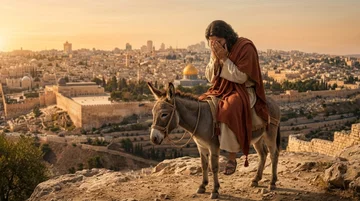
And when he was come near, he beheld the city, and wept over it,
Jesus’ entry is accompanied by grief over Jerusalem’s coming rejection and destruction.
- Matthew 21:9
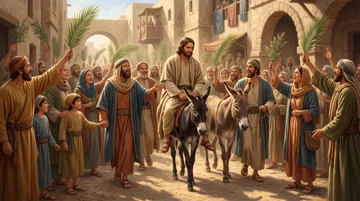
And the multitudes that went before, and that followed, cried, saying, Hosanna to the Son of David: Blessed is he that cometh in the name of the Lord; Hosanna in the highest.
same colt ride and welcoming shout
- Luke 19:37
And when he was come nigh, even now at the descent of the mount of Olives, the whole multitude of the disciples began to rejoice and praise God with a loud voice for all the mighty works that they had seen;
The crowd rejoices and praises God as Jesus approaches Jerusalem.
- John 12:16
These things understood not his disciples at the first: but when Jesus was glorified, then remembered they that these things were written of him, and that they had done these things unto him.
The disciples understood the entry’s fulfillment after Jesus was glorified.
- Matthew 11:29
Take my yoke upon you, and learn of me; for I am meek and lowly in heart: and ye shall find rest unto your souls.
Jesus is described as meek and lowly in heart.
- Matthew 27:35-50
And they crucified him, and parted his garments, casting lots: that it might be fulfilled which was spoken by the prophet, They parted my garments among them, and upon my vesture did they cast lots.
Jesus’ triumphal entry was followed by his crucifixion.
- John 12:17-18
The people therefore that was with him when he called Lazarus out of his grave, and raised him from the dead, bare record.
The crowd’s testimony about Lazarus’s resurrection drew people to meet Jesus.
- John 6:15
When Jesus therefore perceived that they would come and take him by force, to make him a king, he departed again into a mountain himself alone.
same effort to make Jesus an earthly king
- 1 Kings 1:33-35
The king also said unto them, Take with you the servants of your lord, and cause Solomon my son to ride upon mine own mule, and bring him down to Gihon:
Solomon rides in a royal procession to be proclaimed king.
Commentary
Each commentary is drawn from primary sources: the writings of Ellen G. White and Adventist pioneers and periodicals. Each commentary is separate. Its own words are not a quotation; follow the references to read the source passages.
Ellen G. White
31 sources
The verse belongs to Jesus' triumphal entry into Jerusalem near the close of His ministry, shortly before His crucifixion and His cleansing of the temple.DA 569.3–43SP 20.13SP 9.1 As He went up to the Passover He sent two disciples to bring the colt that had never been ridden, while the multitudes spread garments on the road, waved palm branches, and cried Hosanna to the Son of David, hailing Him as Messiah and King.DA 569.3–4Ms 7a, 1886, par. 1–2ST Jun 8, 18824RED 120.22SP 384.1–385.1 He accepted this public homage and would not still the multitude, because prophecy must be fulfilled, even declaring that if they held their peace the stones would cry out.ST Jun 8, 1882DA 570.1–571.11T 57.3–58.1 He comes as the promised Messiah and heir to David's throne, yet meek and lowly upon an ass without outward royal splendor or pomp, unlike the victories of earthly conquerors.GC 99.3–100.1GC88 99.3–100.1DA 569DA 569.1–2COS 91.1–5 The crowds took the ride as a sign He would take David's throne, drive out Rome, and establish a temporal kingdom, a hope shattered at the cross and understood in its prophetic purpose only after He rose, for His public entry as King directed attention to His coming voluntary death as the offering for the sins of the world and dimly foreshadowed His future coming in the clouds of heaven with power and glory.DA 569.3–4COS 91.1–54RED 116.1–117.2ST Jun 8, 18823SP 9.1
The Entry Into Jerusalem
The verse belongs to the triumphal entry into Jerusalem near the close of His ministry, shortly before His crucifixion and before His trial.DA 569.3–43SP 9.1ST Jan 10, 18783SP 250.3 It places that riding of the colt brought by two disciples just before His cleansing of the temple.DA 569.3–4ST Feb 15, 1899 His choice to enter the city riding fulfilled the prophecy of the King's coming and marked Him as the promised King.DA 569.3–4
As He went up to the Passover He who had usually traveled on foot sent two disciples to bring the colt for Him to ride.4RED 115.3ST Jul 22, 1886 It was the foal of an ass that had never been ridden.ST Jun 8, 1882 The humble beast He rode was guided by Lazarus, whom He had raised from the dead.4RED 120.2
Many gathered because He had raised Lazarus, and people flocked from all the region about.1T 57.3–58.1 Among them were trophies of His healing work, including the formerly crippled, blind, and leprous, and those raised from the dead.Ms 7a, 1886, par. 1–2 They spread their garments on the road, raised palm branches, bowed before Him, and welcomed Him by crying Hosanna to the Son of David and hailing Him as Messiah and King.ST Jun 8, 18822SP 384.1–385.11T 57.3–58.1DA 546COS 90
Jesus accepted this public homage.ST Jun 8, 1882DA 570.1–571.1 When the priests and elders asked Him to still the multitude He refused, because prophecy must be fulfilled, declaring that if they held their peace even the stones would cry out.1T 57.3–58.1 The entry took place while the proud and apostate Jewish nation had lost the power to recognize its Redeemer.ST Feb 15, 1899 Amid the rejoicing Jesus wept over Jerusalem in His last pleadings of love and compassion, and the entry together with the cleansing of the temple and the fig tree pointed to the city's doom for rejecting Him.3SP 20.1ST Jan 10, 1878
The Meek Promised King
Tell ye the daughter of Sion speaks of Jesus coming to Zion and Jerusalem as the promised Messiah and King, the heir to David's throne, in fulfillment of the prophecy given more than five hundred years earlier.DA 569.1–2COS 91.1–54SP 253.2 He had long refused royal honors, yet now He accepted the people's homage as Messiah and King, entering in keeping with prophecy and with the custom of royal entry.DA 569.1–2DA 570.1–571.1 The crowd honored Him with garments spread on the road, palm branches, and joyful praise, hailing Him as Messiah and King.DA 5692SP 384.1–385.1 His arrival was marked by lowliness rather than royal display, for He came meekly and humbly, lowly and sitting upon an ass without outward royal splendor, pomp, or display.DA 569DA 569.1–2COS 91.1–5
Unlike the victories of earthly conquerors, His triumphal procession was made glorious by trophies of a different kind, for the people around Him were trophies of His loving work, praising God for deliverance and healing.4RED 120.2 The humble beast He rode was guided by Lazarus, whom He had raised from the dead.4RED 120.2 His disciples followed in travel-worn clothes and with bare feet, adding to the picture of travel-worn simplicity.GC 99.3–100.1 That humble arrival stands in contrast with display of wealth, rank, power, and authority, showing the difference between Christ's character and the pride, arrogance, and ambition of those claiming to serve Him.GC 99.3–100.1GC88 99.3–100.1GC 100.2
The disciples and crowds took the ride as a sign He was about to proclaim Himself King of the Jews, take David's throne in Jerusalem, display royal power, drive out Rome, and establish a temporal kingdom for political liberation and restoration of Israel as an independent nation.DA 569.3–4COS 91.1–54RED 115.3DA 570.1–571.1 Jesus accepted this public homage, which His disciples took as a sign that their hope of His being acknowledged as Israel's King in Jerusalem would be fulfilled.ST Jun 8, 1882 That hope mistook the nature of His kingdom, and within days it was shattered when they saw Him suffer and die on the cross.EW 206.4DA 570.1–571.14SP 253.2 They could understand the prophetic purpose of these events only after He rose from the dead, when disappointment revived into hope and consolation, for they lost their Saviour in death but found Him again.EW 206.44SP 253.2
His public entry as King directed attention to His coming voluntary death as the antitypical Passover Lamb, willingly set apart as an offering and sacrifice for the sins of the world.ST Jun 8, 1882DA 571.2–4 The joyful welcome and homage publicly identified Him as Messiah and drew the people's attention to Him before that sacrifice.4RED 116.1–117.2ST Jun 8, 1882 The events surrounding the entry were meant to be remembered and examined alongside His trial and death, so that afterward the prophecies would confirm Him as Messiah and lead people to search and recognize Him.ST Jun 8, 1882DA 571.2–4 The procession also faintly prefigures His future coming as King.4RED 116.1–117.2 That ride was a dim foreshadowing of His future coming in the clouds of heaven with power and glory, accompanied by angels and the rejoicing of the saints, when His words about being blessed when He comes in the Lord's name will be fulfilled.3SP 9.1
Prophecy Fulfilled And Preached
The entry fulfills the prophecy of the King's coming given by Zechariah and Isaiah more than five hundred years earlier.DA 569.3–4DA 569.1–2COS 91.1–5 The multitude unknowingly fulfilled that prophecy as they gathered to witness the entry, including people He had healed—the formerly crippled, blind, and leprous, and those raised from the dead—who joined the crowd in praise.DA 569.3–4Ms 7a, 1886, par. 1–2 His choice to enter riding the colt brought by two disciples marked Him as the promised King and heir to David's throne, though He had long refused royal honors.DA 569.3–4DA 569.1–2 The prophetic details were fulfilled exactly, giving clear evidence that He was sent by God and is the center of Israel's kingdom.DA 569.3–4DA 569.1–2COS 91.1–5 The people took the ride as a sign He would claim royal power, take David's throne, display royal display reversed into lowliness, and establish a temporal kingdom for political liberation from Rome and deliverance from oppressors.DA 569.3–4COS 91.1–54SP 253.2 That hope was shattered within days when He suffered and died on the cross, and the disciples could understand its prophetic purpose only after He rose, when lost hope revived as they lost their Saviour in death but found Him again.EW 206.44SP 253.2
In the same chapter the pretentious fig tree represents professed servants of God who belong to the church but bear no fruit in their lives to God's glory.Lt 82, 1907, par. 9 The picture of the King coming meekly to Jerusalem on His journey at the time of the triumphal entry stands in contrast with the longing to see the rejected Christ crowned and seated on His throne.Lt 82, 1907, par. 9
Preaching Christ's riding into Jerusalem exalts and lifts up Jesus, shows trust in Him rather than salvation by law, and moves hearers to baptism and uniting with the church.Lt 27, 1880, par. 8 Such preaching calls hearers to let the word take hold upon their souls, to do their part well, and to stand acquitted in the day of final accounts when the judgment sits and the books are opened and everyone's account is balanced.7MR 32.2 It carries the solemn thought that speaker and hearers may never meet again until that day, with the searching question whether any in that congregation will be saved through the words spoken to them.7MR 32.2
The verse shows Christ riding in as the Son of God come to this world to draw all men unto Him.Ms 5, 1882, par. 11 His coming brings not peace but a sword.Ms 5, 1882, par. 11 His followers must therefore walk in the light of His glorious example without questioning the cost in labor and trial and suffering, with a work for each one to maintain the truth in its purity and push the triumphs of His cross and extend His kingdom.Ms 5, 1882, par. 11
Sources
Pioneers and periodicals
69 sources
Tell ye the daughter of Sion of the entry of Jesus into Jerusalem in the last week of his life, only days before his suffering and death, when he sent two disciples for a colt, rode upon it while the multitude spread garments and branches and cried Hosanna to the Son of David, on purpose that the word spoken by the prophet should be fulfilled.ST Jun 8, 1882ST Oct 5, 1904ST Jan 17, 1900RH Nov 25, 1873 It fulfills what Zechariah wrote more than four hundred years before, that Zion's King comes just, bringing salvation, lowly and riding upon an ass and a colt the foal of an ass.ST Sep 27, 1899RH Jun 24, 1858 His meek and lowly manner, in common dress without soldiers or worldly pomp, and upon an ass that stands for peace and patience rather than a horse of war, declared him the Prince of Peace and Israel's true manner of a king, and not a conquering hero of force and display.RH Nov 18, 1862ST Sep 27, 1899ST Mar 27, 1901ST Feb 6, 1901ST Mar 25, 1903 It was the one time he allowed the multitude full freedom to honor him openly and accepted public homage as Messiah, King of Zion and heir of David's throne, with miracles, holy life and the raising of Lazarus giving clear evidence that he was sent of God.ST Jun 8, 1882ST Dec 10, 1894ST Nov 8, 1883ST Apr 12, 1905 The disciples and the crowd hailed him because they looked for him then to take David's throne, free Israel from Rome and reign forever, so when he went to the cross instead of a crown their triumph turned to bitter disappointment, yet their rejoicing was still right and the prophecy truly fulfilled, and after his resurrection and the coming of the Comforter they understood and hoped again, even as the Advent proclamation at the end of the 2300 years was due for its time though joined with mistaken expectation and disappointment in 1844.ST Jun 5, 1879ST Apr 8, 1903RH Mar 17, 1859RH Jul 25, 1865 Though rejected then and crucified, his cross was his real coronation and triumph over darkness, and he will yet be established on David's throne to reign forever, so the entry points forward to his final triumph and personal return to deliver his children.RH Apr 29, 1862ST Nov 8, 1883ST Feb 4, 1903RH Aug 12, 1862RH Dec 1, 1859
Words and Historical Setting
The verse belongs to the entry into Jerusalem near the close of his ministry, only a few days before his suffering and death.ST Nov 8, 1883ST Feb 14, 1878 It took place in the last week of his earthly life on his final journey to Jerusalem for the Passover.ST Jul 22, 1886ST Apr 14, 1898 It provides the setting for his final instruction to his disciples and the prediction that they would soon be scattered.ST Jan 17, 1900
He sent two disciples to bring the colt, they put their garments on it, and he rode on it.ST Oct 5, 1904 The colt had never been ridden.ST Jun 8, 1882 The most part of the multitude spread their garments in the way and others cut branches from trees and spread them in the way.ST Jun 8, 1882ST Oct 5, 1904 Those going before and behind cried Hosanna to the Son of David, Blessed is he that cometh in the name of the Lord, Hosanna in the highest.ST Oct 5, 1904 When he came into Jerusalem the whole city was stirred asking Who is this, and the answer given was This is the Prophet Jesus from Nazareth of Galilee.ST Oct 5, 1904RH Nov 25, 1873
This riding was done on purpose so the word spoken by the prophet would be fulfilled.ST Oct 5, 1904 It was the only time he rode an animal apart from traveling by boat and the only recorded time he rode in contrast to his usual travels.ST Oct 5, 1904ST Apr 12, 1905 It was the one occasion when he allowed the multitudes full freedom to honor him openly and accepted public homage as Messiah and King.ST Jun 8, 1882ST Jul 22, 1886
Meek and lowly describes a humble entry welcomed especially by common people.RH Nov 18, 1862 He was clothed in everyday attire rather than gorgeous robes, refused to be borne on the shoulders of the people, and needed no bodyguard of soldiers for protection.ST Mar 25, 1903 He came as the burden-bearer for the people rather than laying burdens on them.ST Mar 25, 1903 His entrance was in self-denying love, unlike the force and military display and worldly pomp on which worldly kingdoms and rulers rely.ST Feb 6, 1901ST May 21, 1885
The ass and its colt, unlike a horse used especially for war, symbolized peace.ST Sep 27, 1899ST Mar 27, 1901ST Apr 12, 1905 The animal also represented industry and patience.ST Aug 2, 1899 Riding them presented him as the Prince of Peace and not a conquering hero arriving for display.ST Sep 27, 1899ST Mar 27, 1901ST Apr 12, 1905 Riding in this manner was also the manner of Israel's kings and the customary way a king of the Jews rode when about to be crowned, declaring his Messiahship to those who recognized the sign.ST Apr 12, 1905ST Sep 13, 1910
Prophecy and Its Fulfillment
The entry fulfills Zechariah's prophecy, spoken more than four hundred years earlier, that Zion's King comes just and bringing salvation, lowly and riding upon an ass and upon a colt the foal of an ass.ST Sep 27, 1899RH Jun 24, 1858RH May 10, 1915ST May 9, 1878 That prophecy was not announcing an event near in Zechariah's own time but foretold a future event to occur when its appointed time came, including both the meek manner of entering Jerusalem and the manner of his birth.RH Jan 15, 1861ST May 9, 1878 Jesus' riding into Jerusalem is that appointed fulfillment, identifying him as the promised King coming to his people.ST Sep 27, 1899RH Jan 15, 1861RH May 10, 1915
The prophetic details were to be fulfilled exactly and literally through real events.ST Dec 10, 1894RH Nov 25, 1873 Near the close of his ministry, only a few days before his suffering and death, he presented himself as Israel's king, the Messiah and heir to David's throne.ST Jun 5, 1879ST Nov 8, 1883 His miracles, the purity of his life and teaching, and his raising of Lazarus after four days in the grave gave ample evidence of his identity and clear evidence that he was sent by God and was the center of Israel's kingdom.ST Dec 10, 1894ST Nov 8, 1883 What Zechariah foretold about the King coming on an ass was intended by the Holy Spirit to be understood literally and was literally fulfilled, showing Scripture fulfilled through real events and supporting the expectation that Christ will personally and visibly return, establish a kingdom, and reign.RH Nov 25, 1873RH Aug 12, 1862
Zechariah's command to rejoice and shout foretold the joyful welcome, and the disciples and a great multitude fulfilled it when they shouted in his honor upon his entrance into Jerusalem.ST Jun 5, 1879RH Jul 4, 1871ST Apr 8, 1903 They did so by divine impulse in obedience to the prophetic command, hailing Christ as King.ST Jun 5, 1879ST Apr 8, 1903 God's people had the privilege of helping fulfill the prophecy by carrying out his will, and the prophecy had to be fulfilled so that if they had held their peace the very stones would have shouted and cried out and done the work.ST Jun 5, 1879ST Apr 8, 1903RH Sep 18, 1855RH Feb 16, 1869
He entered in humility and not with the display of heavenly power he could have had, in order to draw attention to himself before his voluntary death as the antitypical Passover Lamb, the sacrifice for the sins of the world.ST Jun 8, 1882 The events surrounding the entry were meant to be remembered and examined alongside his trial and death, so that the prophecies would then confirm that he was the Messiah.ST Jun 8, 1882 The triumphal entry on Palm Sunday was identifiable both as a link in a chain of events and because a people were raised up to recognize, proclaim, and announce it.ST Aug 1, 1916ST Aug 1, 1916 It is kept as the Fiesta of Ramos, opening a week of observances including Holy Thursday, Holy Friday, Holy Saturday, and Easter Sunday.ST Aug 1, 1916ST Aug 1, 1916ST Feb 11, 1903
Mistaken Hopes and Disappointment
The disciples, the crowd and the people escorted him in triumph and hailed him as king because they expected him then to enter upon his reign in Jerusalem, to take David's throne then and there, to be crowned and to rule from Israel's throne.ST Jun 5, 1879ST Dec 3, 1874RH Aug 26, 1915 They looked for him to deliver them from Roman rule, to dwell with them forever, to free Israel and make it the leading nation, and to destroy his enemies.ST Dec 3, 1874RH Aug 26, 1915RH Jun 2, 1859 Their royal welcome was shaped by that hope and by recalling the mighty works they had seen, including healings, cleansing of lepers, restored sight, and raised dead. The homage he permitted strengthened that expectation, so that they understood his kingship as the immediate establishment of a material kingdom rather than understanding that he was soon to die.ST Dec 3, 1874RH Aug 26, 1915
He did not come to take a throne and reign but to die, so within days he was crucified at Calvary instead of enthroned and crowned, was laid in Joseph's tomb, and the disciples were scattered.ST Apr 8, 1903ST Aug 13, 1902RH Mar 17, 1859ST Jul 27, 1882 The disciples escorted him in triumph shortly before his crucifixion, supposing he was riding to Jerusalem to take possession of the kingdom and throne of his father David, and they did not understand that in a few hours he would hang on the cross and expire while nature was convulsed.RH Mar 17, 1859RH Jun 2, 1859ST Mar 24, 1887 Their triumph turned to bitter disappointment and mourning and weeping, for they thought he was to redeem Israel and were disappointed when he died and became a reproach to scoffers.ST Apr 8, 1903RH Jun 2, 1859ST Mar 24, 1887 The shock and the contrast between their hope and what happened made his death a profound disappointment and made it hard for them to understand how he could be the Messiah, so that many lost hope and they were left woefully disappointed that he had not redeemed Israel.ST Jun 5, 1879ST Aug 13, 1902
Their mistaken expectation about when the kingdom would be set up and what event would follow did not make their recognition of him as king false, did not void the fulfillment, and did not make the prophecy or their work a failure.RH May 5, 1874RH Mar 17, 1859RH Jul 25, 1865 Their rejoicing and praise were still right, as shown by the word that even the stones would cry out if the people were silent, and their proclamation was right for that time in its timing and prophetic basis although they misunderstood it.RH Sep 18, 1855ST Nov 20, 1884RH Jun 29, 1911 That disappointment was part of God's plan and does not show the teaching about his coming was false.RH Jul 25, 1865 They were nevertheless blessed because they had received the truths they heard, even while proclaiming his entry and fulfilling prophecy though they misunderstood what his coming meant and were disappointed in their expectations.ST Jul 27, 1882RH Jun 29, 1911
After Christ rose from the dead, was glorified in heaven, and sent the Comforter, they understood these things better and were begotten again to a lively hope by his resurrection.ST Jun 5, 1879 This experience explains the disappointment of 1844, when heralds proclaimed the coming judgment hour at the end of the 2300 years with a mistaken expectation that the Lord would come, yet still gave the message due to the world at that time.RH Jan 27, 1916 As the disciples rejoiced yet were saddened when expectations failed while still fulfilling Scripture, so the Advent people proclaimed the end of prophetic time while misunderstanding what would happen, with disappointment concerning the manner of fulfillment and not the fundamental features.RH Jan 27, 1916RH Aug 24, 1869 The disciples' loyalty when his unpopular manner of coming led others to reject him parallels the loyalty of believers after the Advent disappointment.RH Feb 26, 1867
The people rejected him because this humble manner of coming and the manner of his birth did not suit their expectations, the rulers rejected him, and the multitude's faith weakened when he did not meet their expectations.ST Mar 27, 1901RH Jan 15, 1861 The crowds were moved by sight rather than faith, even while their public honors were inspired by the hope that he would take the position of king.ST Mar 27, 1901 Goodwill from the world that welcomed him did not ensure lasting loyalty and can quickly turn, and should not be trusted too much.ST Jul 30, 1894 Their failure to recognize the appointed time brought judgment upon Jerusalem.RH Jan 15, 1861
If they had received him God would have protected their city and the temple would have been a house of prayer for all nations, but because they rejected and crucified him the temple would be burned and the city destroyed.ST Apr 19, 1883 He foresaw this with sorrow and tears as he looked on Jerusalem amid palms and joyful hosannas, and his tears were his final appeal of love and compassion to a city that rejected him.ST Jan 10, 1878ST That entrance, together with the cleansing of the temple and the blighting of the barren fig tree, pointed to Jerusalem's doom.ST Jan 10, 1878 The entry occurred while the Jewish nation, proud and apostate, had lost the power to recognize its Redeemer, and those rulers who rejected him when he declared his Messiahship in the customary manner of a king of the Jews about to be crowned brought swift destruction upon themselves.ST Feb 15, 1899ST Sep 13, 1910
Kingship Doctrine and Future Hope
The verse declares Jesus to be the promised King of Zion and King of Israel, the promised Messiah and Son of David, the King foretold by prophets, worshiped by angels and anointed by God, coming to his own people.ST Sep 27, 1899RH Dec 16, 1862RH Nov 25, 1873RH Sep 18, 1856 His riding meekly on an ass and its colt fulfilled prophecy and explains why the welcome and rejoicing accompanied his entry into Jerusalem.ST Sep 27, 1899RH Nov 25, 1873RH Sep 18, 1856 Near the close of his ministry, only a few days before his suffering, he thus presented himself as Israel's king, the Messiah and heir to David's throne.RH Apr 29, 1862ST Nov 8, 1883 Though the disciples who praised him and welcomed him in the Lord's name were disappointed that he did not then reign as an earthly prince, he will be established on David's throne and reign over his people forever, and the entry points ahead to his final triumph when he enters his kingdom to reign.RH Apr 29, 1862ST Nov 8, 1883
His first coming therefore included a literal, personal arrival as King riding on an ass in fulfillment of Scripture.RH Nov 25, 1873RH Aug 12, 1862 That fulfillment through real events supports the expectation that Christ will personally and visibly return, establish a kingdom, and reign.RH Aug 12, 1862 His arrival appeared to end in defeat because he was crucified within days, but the cross was his real coronation and his triumph over the powers of darkness.ST Feb 4, 1903 By his death he sealed the doom of Satan, his principles, and his kingdom, though the disciples did not understand this triumph at the time.ST Feb 4, 1903
The verse is cited as evidence that the kingdom would be taken from Jews who did not keep God's law and given to a nation that would keep it.RH Mar 29, 1864 One reading holds that the entry in Matthew 21:1-12 fulfills the prophecy of the rejected stone become the head of the corner and shows the resurrection day to be the day the Lord made for rejoicing and gladness, proving by divine appointment the change of the Sabbath from the seventh to the first day of the week.RH May 10, 1860 The opposite reading holds that the same account gives no basis for saying the Sabbath was changed, because it does not mention the Sabbath or a change of day.RH May 10, 1860
The verse is applied to the movements of earthly powers as signs that the King is coming, watched alongside the budding fig tree as signs of his approach.RH Oct 14, 1858 It gives the joyful announcement that the King is coming to bring deliverance to his children.RH Dec 1, 1859 That soul-cheering message of his nearness is what believers long to hear proclaimed by watchmen, making them rejoice and cry for him to come quickly while listening eagerly for the sound of his chariot wheels.RH Dec 1, 1859
Scriptural Links and Daily Lessons
The same scene of the entry into Jerusalem is told also in Mark 11, Luke 19, and John 12, with Luke giving the fullest account of it, and the institution of the Lord's Supper was the next event of importance after this scene.ST The account belongs to the treatment of his first advent and marks his triumphal entry into Jerusalem as the closing event in the account of his life and mission.ST The Gospel account treats that triumphal entry as historical and rejects the claim that it is legendary.RH Mar 8, 1906
He is presented here as a meek King, and his meekness is the model for the meek who are promised the earth as their inheritance.RH Sep 20, 1853 That meekness means being humble, modest, not self-seeking, and lowly in heart.RH Sep 20, 1853 Those born of God's Spirit share his spirit, being penitent, obedient, and devoted to truth and righteousness, and they are often poor and persecuted.RH Sep 20, 1853
The entry gives him a measure of the honor and adoration due to him as the coming King riding humbly on an ass and its colt.ST The directions concerning the animal show that even a colt could serve his purpose, drawing the lesson that he can use boys as well.ST The triumphal entry is therefore invoked as an example of following him with him in every circumstance, not only in moments of glory but also in suffering.ST Mar 14, 1906 The disciples escorted him in triumph shortly before his crucifixion, and their later grief at seeing him crucified shows that the entry did not prevent disappointment and trial in the lives of his followers.ST Mar 24, 1887
Sources