Matthew 25:11
Afterward came also the other virgins, saying, Lord, Lord, open to us.
Translations
American King James Version, King James Version, KJV Cambridge Paragraph Bible, Webster Bible, American Standard Version
Afterward came also the other virgins, saying, Lord, Lord, open to us.
Afterward come also the other virgins, saying, Lord, Lord, open to us.
and afterwards come also do the rest of the virgins, saying, Sir, sir, open to us;
Afterwards come also the rest of the virgins, saying, Lord, Lord, open to us;
But, afterwards, came the other virgins also, saying—Lord! Lord! open unto us!
Berean Standard Bible, Majority Standard Bible
Later the other virgins arrived and said, ‘ Lord, lord, open the door for us!’
Afterward the other virgins also came, saying, ‘ Lord, Lord, open to us.’
After that the other virgins came, saying, Lord, Lord, let us in.
Afterwards came also the other virgins, saying, Lord, Lord, open to vs.
Douay-Rheims (Challoner revision)
But at last come also the other virgins, saying: Lord, Lord, open to us.
Pictures
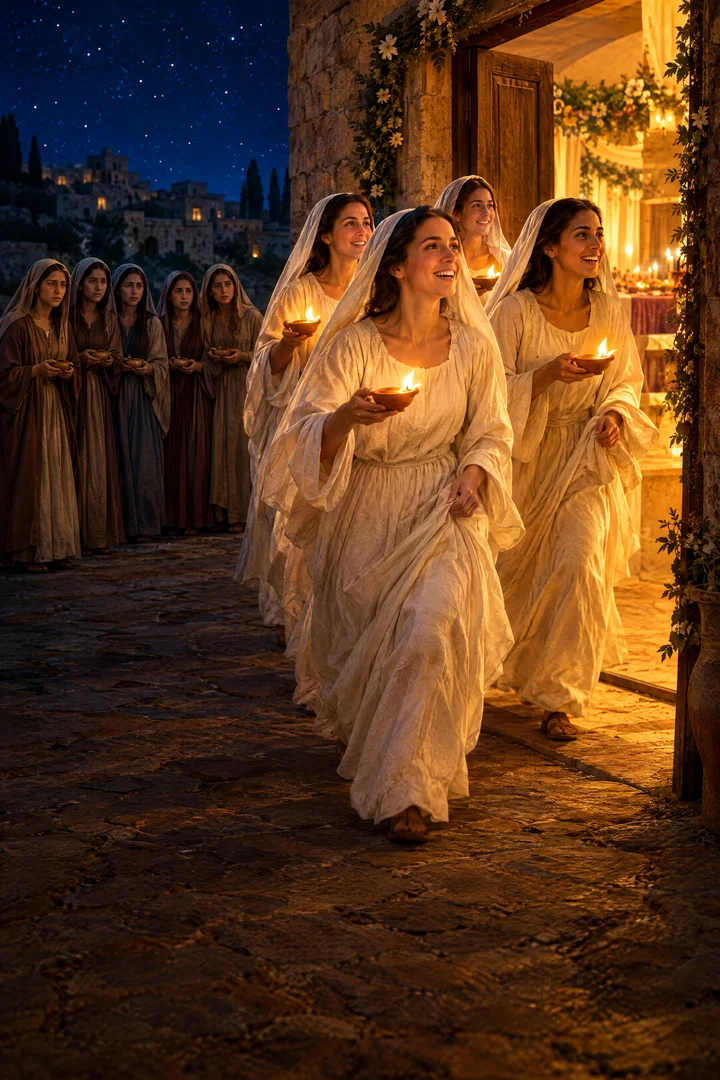
Cross-references 20 of 30
- Luke 12:35-36
Let your loins be girded about, and your lights burning;
Describes servants waiting for their Lord’s return from the wedding.
- Matthew 25:6
And at mid night there was a cry made, Behold, the bridegroom cometh; go ye out to meet him.
The midnight cry announces the Bridegroom’s arrival and calls the virgins to meet him.
- Revelation 19:9
And he saith unto me, Write, Blessed are they which are called unto the marriage supper of the Lamb. And he saith unto me, These are the true sayings of God.
shut out from partaking
- Luke 13:25
When once the master of the house is risen up, and hath shut to the door, and ye begin to stand without, and to knock at the door, saying, Lord, Lord, open unto us; and he shall answer and say unto you, I know you not whence ye are:
People seek entrance after the master has shut the door.
- Matthew 7:21-23
Not every one that saith unto me, Lord, Lord, shall enter into the kingdom of heaven; but he that doeth the will of my Father which is in heaven.
Those who cry “Lord, Lord” but do not obey are rejected by Christ.
- Revelation 3:7-8
And to the angel of the church in Philadelphia write; These things saith he that is holy, he that is true, he that hath the key of David, he that openeth, and no man shutteth; and shutteth, and no man openeth;
The open door contrasts with the parable’s shut door and is linked to Christ’s sanctuary ministry.
- Matthew 25:4
But the wise took oil in their vessels with their lamps.
The wise virgins bring oil for their lamps, unlike the foolish.
- Matthew 24:42-44
Watch therefore: for ye know not what hour your Lord doth come.
Both passages urge readiness because the Lord’s coming is unexpected.
- Luke 12:36
And ye yourselves like unto men that wait for their lord, when he will return from the wedding; that when he cometh and knocketh, they may open unto him immediately.
Faithful followers wait ready for their Lord’s return from the wedding.
- Revelation 19:7-8
Let us be glad and rejoice, and give honour to him: for the marriage of the Lamb is come, and his wife hath made herself ready.
The Lamb’s wedding calls for readiness and a clean wedding garment.
- Matthew 25:5
While the bridegroom tarried, they all slumbered and slept.
The bridegroom’s tarrying represents the delay before the expected advent.
- Luke 13:26-27
Then shall ye begin to say, We have eaten and drunk in thy presence, and thou hast taught in our streets.
People plead for admission but are told they are unknown.
- Matthew 22:1-14
And Jesus answered and spake unto them again by parables, and said,
The wedding guests are examined for the wedding garment before the marriage.
- Mark 13:35-37
Watch ye therefore: for ye know not when the master of the house cometh, at even, or at midnight, or at the cockcrowing, or in the morning:
Both urge readiness because the Lord’s coming is unexpected.
- Luke 14:16-24
Then said he unto him, A certain man made a great supper, and bade many:
The urgent invitation to the feast echoes the call to enter the marriage supper.
- Luke 12:37
Blessed are those servants, whom the lord when he cometh shall find watching: verily I say unto you, that he shall gird himself, and make them to sit down to meat, and will come forth and serve them.
Blesses the servants Christ finds watching when he comes.
- Matthew 7:21
Not every one that saith unto me, Lord, Lord, shall enter into the kingdom of heaven; but he that doeth the will of my Father which is in heaven.
Calling the Lord does not ensure acceptance or entry into the kingdom.
- Matthew 25:7
Then all those virgins arose, and trimmed their lamps.
Trimming the lamps depicts readiness among the virgins.
- Isaiah 22:22
And the key of the house of David will I lay upon his shoulder; so he shall open, and none shall shut; and he shall shut, and none shall open.
Christ’s authority to open and shut fulfills the shut-door imagery.
- Matthew 7:7
Ask, and it shall be given you; seek, and ye shall find; knock, and it shall be opened unto you:
Knocking echoes the promise that the door will be opened.
Commentary part 1 of 2
Each commentary is drawn from primary sources: the writings of Ellen G. White and Adventist pioneers and periodicals. Each commentary is separate. Its own words are not a quotation; follow the references to read the source passages.
Ellen G. White
62 sources
Afterward the unready virgins come to the shut wedding door pleading for entrance, are refused and left outside in darkness in the blackness of night.COL 405.1Ms 25, 1908, par. 16Ms 92a, 1898, par. 1–3 The plea belongs to the wedding procession in which ten virgins go out to meet the bridegroom, slumber during delay, rise at the midnight cry, trim their lamps, and the ready enter with him to the supper before the door is shut.4SP 242.3GC88 398.4–400.1ST Nov 20, 1884 The shut door marks the close of probation and the withdrawal of mercy, when characters are settled and seeking entrance comes too late.Lt 7, 1869, par. 3–5GC 429.1Lt 3, 1847, par. 6–7 The pleading virgins are professed Christians living just before the second coming who have lamps and vessels and know the theory of truth, yet about half are unready through worldliness, neglect of prayer and obedience, and hidden sin.Ms 4, 1898, par. 5ST Sep 24, 1912 Their lamps are the Word of God shining in life, and the lacking oil is the Holy Spirit and grace received into the purified heart, which is inward righteousness, love and Christlike character that cannot be borrowed or imparted from another at the last moment.Ms 4, 1898, par. 5RH Feb 3, 1903ST Aug 6, 1894ST Sep 17, 1912Ms 72, 1895, par. 1–2 Readiness must therefore be secured now by awaking, watching, trimming the lamp and keeping daily connection with God in working, waiting and holy living, for the end will come unexpectedly like a thief.Ms 25, 1908, par. 16Ms 9, 1891, par. 45–46ST Mar 17, 1898CET 51.1Ms 174, 1905, par. 12
Story Setting and Outcome
Afterward the other virgins come to the shut wedding door pleading to be let in, and they are refused with the answer that they are not known, and are left standing outside in the empty street in the blackness of night in darkness.COL 405.1Ms 92a, 1898, par. 1–3Ms 79, 1897, par. 3–4Ms 136, 1903, par. 5Ms 2, 1883, par. 11 Five were wise with oil in their vessels with their lamps, and five were foolish with no oil so that their lamps went out, and while the foolish went to buy oil the Bridegroom came and those who were ready went in with Him to the marriage and to the marriage supper and the feast, and the door was shut.COL 405.1Ms 92a, 1898, par. 1–3Ms 79, 1897, par. 3–4Ms 136, 1903, par. 5Ms 2, 1883, par. 11 The foolish reach the banqueting hall after the bridal procession has entered and after the Bridegroom has come, with their plea meeting unexpected denial from the master of the feast, because they were unprepared when He came and slumbered with no oil in their lamps when the call came that He was coming.Ms 92a, 1898, par. 1–3Ms 79, 1897, par. 3–4Ms 136, 1903, par. 5Ms 2, 1883, par. 11 Having a name in the church book will not secure entrance into the kingdom of heaven, for the parable portrays the spiritual condition of the church at Christ's second coming and its shut-door plea warns that the present is the trading time in which God-given capabilities must be used for the Master.Ms 25, 1908, par. 16Ms 79, 1897, par. 3–4 Readiness means close, critical self-examination of how opportunities have been used, how the Lord's talents are traded, and whether they are put out to the exchangers, with God rewarding every servant who works with self-denying, self-sacrificing zeal for the salvation of souls, and each one who has denied self and purified the soul through belief of the truth beginning at once to do missionary work for those perishing in their sins.Ms 25, 1908, par. 16 With the signs of the times fulfilling and the churches generally slumbering, the picture should cause trembling and comes as a solemn warning to every church showing the danger of those whose works do not correspond to their profession of faith, warning to learn from their experience and not be found unready and to examine whether they are ready.Ms 79, 1897, par. 3–4Ms 136, 1903, par. 5Ms 2, 1883, par. 11
The verse belongs to the parable of the ten virgins awaiting the bridegroom at an evening wedding procession, told by Christ to His disciples while looking on such a party.4SP 242.3GC88 398.4–400.1ST Nov 20, 1884GC 400.1–401.21T 53.3–54.3 It includes going out to meet Him, delay, slumbering and sleeping, the midnight cry announcing His approach, trimming lamps, the wise entering with Him to the marriage supper, and the door shut.4SP 242.3GC88 398.4–400.1GC 400.1–401.2 The discourse was given shortly before entering Gethsemane and is recorded in Matthew 24 and 25, and it also includes the parable of the talents.ST Nov 20, 1884 The going out represents the widespread proclamation of the first message, and the delay represents the passing of the expected time, the disappointment, and the ensuing delay.4SP 242.3 A time of waiting and slumber is followed by the Bridegroom's arrival, which is connected with the anticipated coming of the Lord, was supported by arguments from prophecy and the sanctuary types, aroused believers, and is linked to the 1844 midnight cry announcing His coming.GC88 398.4–400.1GC 400.1–401.21T 53.3–54.3 The wise virgins respond when His approach is announced, with spiritual discernment and grace still active in them, and the place of the verse in the parable contrasts their readiness with the other virgins' late arrival during His delay.
The shut door marks the close of probation and the end of mercy, when seeking entrance and mercy comes too late and characters are finally settled, and after grace, pardon and access are withdrawn there is no remedy.Lt 7, 1869, par. 3–5GC 429.1GC88 429.1 After the door has shut, those who were unready cry to the Lord for admission, but their plea is not accepted and they cannot enter the marriage feast.Lt 7, 1869, par. 3–5 The verse warns against delaying preparation or letting earthly concerns and excuses take priority over seeking the kingdom of heaven and Christ's righteousness, pictured as the wedding garment.Lt 7, 1869, par. 3–5 The cry of the rejected virgins arriving after the door has been shut was understood as depicting people seeking mercy when the door of probation had closed, pointing to a time shortly before Christ's coming, and in 1844 Adventists thought the expected date might mark the beginning of that time and that probation had ended before Christ's coming.GC 429.1GC88 429.1 That application was mistaken, for the later sanctuary understanding showed that 1844 marked a change in Christ's ministry, not the end of the opportunity for forgiveness, since the close of one part of His ministry did not end His intercession or close all access to mercy.GC 429.1GC88 429.1 The coming of the Bridegroom means Jesus rising from His mediatorial throne and going into the holiest place in heaven as Bridegroom to receive His kingdom and to cleanse the sanctuary, and not His coming to this earth to deliver His people on the tenth day of the seventh month, and this heavenly coming settles the shut door.Lt 3, 1847, par. 6–75MR 95.3–97.2 The parable is associated with those who went out to meet the Bridegroom in 1844, some of whom were later deceived by false shepherds and lost clarity about what they believed.5MR 91.4
Meaning of Lamp and Oil
The lamp carried to meet the bridegroom is the Word of God, the Bible as a lamp to the feet and a light to the path, borne in vessels which are the heart itself.COL 408.2–3Ms 174, 1905, par. 12COL 406.3–408.1 Its light is truth made visible in life and witness, to shine in moral darkness and guide others toward the bridegroom's home, the city of God and the marriage feast.COL 414.1–2ST Jul 20, 1915 That light must be kept trimmed, replenished, refreshed and burning brightly through the night of waiting, and the present call is to trim lamps and keep them alight with rejoicing.COL 414.1–2Ms 174, 1905, par. 12
The oil in the vessels with the lamps is the Holy Spirit and the grace of Christ, holy oil and golden oil emptied from the two olive trees through the two golden pipes by the two anointed ones that stand by the Lord of the whole earth.COL 408.2–3Lt 94, 1898, par. 10–15COL 406.3–408.1 It is received only into vessels prepared for it, into clean, pure and sanctified souls in open communion with God, and it is the Spirit of life in Christ Jesus in living faith, love, patience and power.ST Aug 6, 1894ST Sep 17, 1912Ms 72, 1895, par. 1–2 Without the Spirit, knowledge of Scripture is of no avail, for theory of truth alone cannot quicken the soul, sanctify the heart, transform the character, or enable men to distinguish truth from error amid Satan's temptations.Lt 25, 1895, par. 4Lt 16, 1895, par. 26COL 408.2–3 Where the oil is present it keeps the lamp burning, sustains a shining witness, nourishes daily experience, and forms God's character in the followers of Christ for service to those in darkness.ST Aug 6, 1894ST Sep 17, 1912Lt 25, 1895, par. 4COL 414.1–2ST Jul 20, 1915
That oil is also the inward character of Christ's righteousness, the white robe and wedding garment, hourly communion with truth, righteousness and mercy in meekness, lowliness, gentleness, tenderness, sympathy and love.Lt 7, 1869, par. 3–514MR 122.2–123.1Ms 9, 1891, par. 38–39Lt 94, 1898, par. 10–15 Those who keep truth in the outer court, cherish hereditary and cultivated traits that misrepresent Christ, walk in sparks of their own kindling and live for self cannot keep their vessels replenished.Lt 94, 1898, par. 10–15Ms 144, 1898, par. 9 Mere profession, familiarity with commands and promises, lamps and knowledge, and outward service are worthless without it, and those lacking it are unfit for fellowship with Christ and for entrance to the marriage supper of the Lamb.Lt 7, 1869, par. 3–514MR 122.2–123.1Ms 72, 1895, par. 1–2Ms 9, 1891, par. 38–39Ms 144, 1898, par. 9
Identity of Other Virgins
The others who come afterward pleading for entrance to the marriage feast when the crisis comes are ease-loving, world-loving professed Christians who hid their light and mingled with the world until their light went out and they lost all power to shine.Ms 4, 1898, par. 5ST Sep 24, 1912 They are church members living just before the second coming, in the evening of earth's history, divided into five wise who are ready and five foolish who are unready, so about half are ready and half are unready.Ms 72, 1895, par. 1–2ST Aug 13, 1894Ms 47, 1895, par. 1–3 They all have a call, a name, lamps, vessels, and an apparent waiting, and for a time no difference appears between them.Ms 72, 1895, par. 1–2ST Aug 13, 1894Ms 47, 1895, par. 1–3 They have a real interest in the gospel and know the theory of truth and the standard of righteousness, including great light with abundant opportunities and continuous privileges, the invitation that all things are now ready, and the light on justification by faith and the imputed righteousness of Christ, yet they treat life-giving truth as unessential and think theoretical knowledge is all that is required.ST Sep 24, 1912ST Aug 13, 1894Ms 47, 1895, par. 1–3 They are not doers of the Word, for they neglect Scripture, cherish hidden sin, lack the grace needed for a purified life, and are without vital connection with God and open communion with Him, so profession and expectation cannot replace obedience to the truth.ST Sep 24, 1912Ms 72, 1895, par. 1–2ST Aug 13, 1894
They are careless, self-satisfied, cold and backslidden professors who expect to enter heaven but find the door closed, who trust their feelings and human wisdom instead of searching Scripture, and who must obey the truth, examine life by God's standard of righteousness, seek cleansing from hidden sin, and perfect holiness.ST Sep 24, 1912ST Aug 13, 1894 They did not continue to provide themselves with the oil of grace, were hushed to slumber and made careless about their light by the peace and safety cry, and because character is not transferable they cannot go in with the wise and are refused as unknown.Ms 4, 1898, par. 5Ms 144, 1898, par. 9Ms 47, 1895, par. 1–3 Having a name in the church book will not secure entrance, for the present is the trading time in which God-given capabilities must be used for the Master with close, critical self-examination of how opportunities have been used and whether talents are put out to the exchangers.Ms 25, 1908, par. 16Lt 20a, 1893, par. 23–26 Those who cling to selfishness and serve their own interests, who have not lived faithfully for God or laid up treasure in heaven, will appeal to be let in yet their claim will not secure entry, and the closed gate will mark their exclusion.Ms 25, 1908, par. 16Lt 20a, 1893, par. 23–26 Each one who has denied self and purified the soul through belief of the truth will begin at once to do missionary work for those perishing in sin, and God rewards every servant who works with self-denying, self-sacrificing zeal for the salvation of souls.Ms 25, 1908, par. 16Ms 144, 1898, par. 7
They are not open sinners who make no profession, but those who claim to be children of God and church members claiming to be Christians while not practicing the truth.Ms 144, 1898, par. 7Ms 144, 1898, par. 9 They remain in character the same as before they claimed to believe the truth, living for self and pleasure instead of seeking to save souls ready to perish, with no burden for souls, not denying self, not lifting the cross, seeking an enjoyable time with the world, robbing God of time and talents, refusing to yield to any authority, holding worldly principles, wearing a mask, criticizing and opposing reproof, and walking in sparks of their own kindling rather than the sacred fire from God.Ms 4, 1898, par. 5Lt 20a, 1893, par. 23–26Ms 144, 1898, par. 7Ms 144, 1898, par. 9 They have not taken Christ as Counsellor, have not walked in the light of His Word but have worked their own way, have not come under His yoke, have not used prayer and obedience, and are ruled by self-love, so with empty vessels they cannot keep their lamps replenished, their piety wanes, and their light becomes darkness.ST Aug 13, 1894ST Aug 13, 1894Ms 144, 1898, par. 9 By that false profession they seduce many and do great harm to others and mislead them, in contrast to Christians in deed and in truth who live and work to restore the moral image of God in man and prove that a consecrated life is a power for good while sin results only in weakness and eternal ruin.Ms 144, 1898, par. 7Ms 144, 1898, par. 9 They made excuses and neglected to respond when they heard the invitation, left weak in faith and unstable in experience, and awake to their defects only when too late, lacking the living testimony of those worked by the Holy Spirit who walk in the light and impart it to others.Ms 4, 1898, par. 5ST Aug 13, 1894Ms 47, 1895, par. 1–3
Prophetic Fulfillment in Advent History
The parable illustrates the Adventist experience, in which going out to meet the bridegroom was the widespread proclamation of the first message.4SP 242.3GC 426.2–427.2GC88 426.2–427.2 The midnight cry announcing the coming aroused believers, and it was supported by arguments from prophecy and the sanctuary types, with the 1844 cry specifically announcing the Bridegroom's coming.4SP 242.3GC 400.1–401.21T 53.3–54.3 The delay was the passing of the expected time, the disappointment, and the ensuing waiting and slumber before the coming.4SP 242.3GC 400.1–401.2GC 426.2–427.2 The Bridegroom's coming is Christ's coming to the Ancient of days in heaven in the holiest to receive His kingdom and to cleanse the sanctuary, not His return to earth.GC 425.3–426.1GC 426.2–427.2GC88 426.2–427.2 The ready enter by faith as they follow His work in the heavenly sanctuary, while the foolish are those with a knowledge and theory of truth but lacking the grace of God and therefore shut out of the marriage when the door closes.GC 425.3–426.1GC 426.2–427.2GC88 426.2–427.2
The delay takes time in order to test and prove who has the real, genuine righteousness of Christ and who can bear with patience, waiting and watching and working with greater diligence rather than waiting in idle expectancy.Ms 9, 1891, par. 21–2210MR 272.1–210MR 266.2 It is an expression of Christ's patience giving time to repent and giving people opportunity to hear the last message of mercy, including the third angel's message as the last testing message to the world.Ms 92a, 1898, par. 7–10Ms 9, 1891, par. 21–2210MR 266.2 Many who went forth under the first and second angels expecting to live to see Christ coming in the clouds refused the third angel's message and thus lacked the supply of grace and the provision essential to join the company walking in the light and to stand the test of delay.16MR 269.3Ms 92a, 1898, par. 7–10Ms 9, 1891, par. 21–22 Had all acted their part as wise virgins, the message would ere this have been proclaimed to every nation, kindred, tongue, and people.16MR 269.3 From the perspective of eternity the waiting period will seem short, and no reckoning of figures or symbols or types can make known with definiteness the very period of the coming, so the signs are to be studied because they show He is at the door; to be among the wise and not among those shut out requires remembering how truth was received and heard, holding fast and repenting, watching, keeping garments undefiled and overcoming so as to walk with Christ in white with names kept in the book of life.Ms 9, 1891, par. 21–22Ms 92a, 1898, par. 2810MR 266.2
Character Cannot Be Transferred
No one can give to another the inward preparation the verse demands, for character is not transferable and grace cannot be borrowed or imparted from person to person.Ms 4, 1898, par. 5RH Feb 3, 1903ST Aug 6, 1894ST Sep 17, 1912Lt 25, 1895, par. 4 The wise cannot supply oil to the foolish, so each must obtain it by personal experience with the Holy Spirit before the judgment.Ms 4, 1898, par. 5ST Aug 6, 1894ST Sep 17, 1912Lt 25, 1895, par. 4Lt 16, 1895, par. 26 That oil is the grace of Christ and of God in the heart, the Holy Spirit's grace and the Spirit of life, received day by day as living faith, love, and patience while following Jesus and keeping the light burning.Ms 4, 1898, par. 5RH Feb 3, 1903ST Aug 6, 1894ST Sep 17, 1912Lt 25, 1895, par. 4 It sustains a shining witness, prepares a person to meet the bridegroom, and forms character in God's likeness.ST Aug 6, 1894ST Sep 17, 1912Lt 25, 1895, par. 4
Those who cry for entrance afterward are ease-loving, world-loving professed Christians who hid their light and mingled with the world until their light went out and they lost all power to shine.Ms 4, 1898, par. 5RH Feb 3, 1903ST Aug 6, 1894 They did not continue to provide themselves with the oil of grace nor cherish Christ's grace, neglected to keep oil in their lamps, and were hushed to slumber and made careless about their light by the peace and safety cry.Ms 4, 1898, par. 5RH Feb 3, 1903ST Aug 6, 1894ST Sep 17, 1912Lt 16, 1895, par. 26 Their plea at the marriage feast and supper of the Lamb comes when the crisis and final emergency have arrived, after the door has closed.Ms 4, 1898, par. 5ST Aug 6, 1894ST Sep 17, 1912Lt 25, 1895, par. 4Lt 16, 1895, par. 26 It is answered with rejection, and they cannot go in with the wise.Ms 4, 1898, par. 5ST Aug 6, 1894ST Sep 17, 1912
What was neglected during probationary time cannot be made up at the last moment, for spiritual preparation cannot be acquired in the final emergency and last-minute effort cannot replace continuing daily preparation.RH Feb 3, 1903ST Aug 6, 1894ST Sep 17, 1912Lt 25, 1895, par. 4Lt 16, 1895, par. 26 Those whose lamps are going out are not ready, and when they seek entrance then they find it too late to secure what they neglected.Ms 4, 1898, par. 5ST Aug 6, 1894ST Sep 17, 1912Lt 25, 1895, par. 4Lt 16, 1895, par. 26 After probation has ended, character and readiness for the call cannot be secured.RH Feb 3, 1903Lt 25, 1895, par. 4Lt 16, 1895, par. 26
Call to Present Readiness
Readiness must be secured now before the door shuts, for the end is near and will come unexpectedly like a thief, and no one can count on a long tomorrow or postpone preparation until lamps are going out.Ms 9, 1891, par. 45–46ST Mar 17, 1898ST Sep 24, 1912 Believers must awake from sleep, watch and remain spiritually alert, trim lamps, fill vessels with oil, and maintain a complete, living connection with God every day.Ms 9, 1891, par. 45–46ST Mar 17, 1898ST Sep 24, 1912 The lamp must keep burning, fed with holy oil, and its light must shine on the path of others, for profession and expectation cannot replace obedience to the truth and a purified life.ST Mar 17, 1898ST Sep 24, 1912 The danger is that of being unready when the bridegroom comes, like careless, spiritually cold professors who know the theory of truth yet neglect Scripture, cherish hidden sin, trust feelings instead of searching Scripture, and lack the grace needed, and who may expect to enter heaven but find the door closed.Ms 9, 1891, par. 45–46ST Sep 24, 1912 Earnest prayer for a genuine experience and clear evidence of acceptance by God belongs to true expectation of Christ's coming, while heaven's welcome is not earned by status or pride but received through humble faith and love.CET 51.1COL 404.2 Those who have become cold and backslidden need to seek God, cleanse themselves from sin, and perfect holiness rather than remain without vital connection.ST Sep 24, 1912
Genuine readiness blends working, waiting, watching and praying rather than idle expectancy or excited bustle neglecting piety.Ms 174, 1905, par. 12ST Nov 20, 1884Lt 6, 1907, par. 5 Having a name in the church book will not secure entrance into the kingdom, for the present is the trading time in which God-given capabilities must be used for the Master with self-denying, self-sacrificing zeal for the salvation of souls.Ms 25, 1908, par. 16EDFCP 25.2 Readiness means close, critical self-examination of how opportunities have been used, how the Lord's talents are traded, and whether they are put out to the exchangers, with each one who has denied self and purified the soul through belief of the truth beginning at once to do missionary work for those perishing in sins.Ms 25, 1908, par. 16EDFCP 25.2 Lamps are Bibles, but without the oil of grace which is the Holy Spirit they cannot decide for obedience; the wise shake off sleep, arise, trim their lamps, refresh them and reflect the light with rejoicing, while the foolish only see their defects when too late and lose the chance to enter the marriage supper.Ms 174, 1905, par. 12Lt 6, 1907, par. 5Ms 80, 1905, par. 8 Waking, trimming lamps and becoming ready includes studying the Bible to understand truth as it is in Jesus, keeping thoughts, motives and desires in obedience to God, keeping lamps supplied and light bright, sharing present truth, awakening others to danger and need of Christ, and receiving pardon for past neglect.Ms 174, 1905, par. 12Lt 6, 1907, par. 5Ms 80, 1905, par. 8 Sanctification is the duty of every Christian under individual responsibility that cannot be vested in another, requiring skill, efficiency and ability as home missionaries at home, in family, in church and in world, with God in the reckoning requiring improvement of every talent and counting mere retention of capital without trading as unfaithful service.Ms 25, 1908, par. 16EDFCP 25.2
The warning applies particularly to ministers, teachers, physicians, parents and workers entrusted with great light.STBk 9.1Lt 6a, 1893, par. 12–13ASCOP 24.1STOM 7.35T 20.2–21.1 Having lamps is not enough without the oil of grace that makes them burn and give light, which is grace, the Spirit of life in Christ Jesus abiding in the heart, keeping faith alive and shining through living faith and love.STBk 9.1Lt 6a, 1893, par. 12–13STOM 7.3STA 9.1 The highest profession, ordination to ministry, appointment as superintendent or teacher, teaching ability or eloquence cannot supply oil to feed the lamp so it sends forth clear rays, and one entrusted with high responsibilities may still lack heavenly light and not be linked with Christ.Lt 6a, 1893, par. 12–13ASCOP 24.15T 20.2–21.1 Ministers without heartfelt piety and devotion fail to let life shine through good works as well as words, and those who pass year after year without absorbing the truth they have been taught so they cannot give it to others show the foolish condition unfit for ministry.ASCOP 24.1STOM 7.35T 20.2–21.1 Just enough religion to deaden conscience, deceive senses and ruin the soul, just enough outward show to have a name to live while dead, ruins the soul, and readiness for the soon coming requires cooperation of the human agent with the divine instead of going one's own way to do one's own pleasure and remaining unyoked with Christ.STBk 9.1Lt 6a, 1893, par. 12–13STA 9.1
Sources