Translations
American King James Version, King James Version, KJV Cambridge Paragraph Bible, Webster Bible
And five of them were wise, and five were foolish.
Revised Version, American Standard Version, Bible in Basic English
And five of them were foolish, and five were wise.
and five of them were prudent, and five foolish;
And five of them were prudent and five foolish.
Now, five of them, were foolish, and, five, prudent.
Berean Standard Bible, World English Bible
Five of them were foolish, and five were wise.
Five of them were wise, and five were foolish.
And fiue of them were wise, and fiue foolish.
Douay-Rheims (Challoner revision)
And five of them were foolish, and five wise.
Pictures
Cross-references 20 of 22
- Matthew 25:6
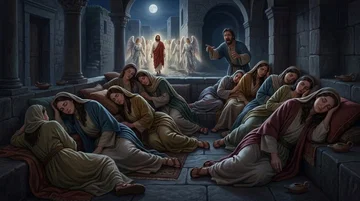
And at mid night there was a cry made, Behold, the bridegroom cometh; go ye out to meet him.
The midnight cry announces the Bridegroom’s coming and awakens the virgins.
- Matthew 25:10-12
And while they went to buy, the bridegroom came; and they that were ready went in with him to the marriage: and the door was shut.
The wise enter the marriage, while the unready arrive after the door is shut and are refused entry.
- Luke 12:35-36
Let your loins be girded about, and your lights burning;
Also calls servants to keep their lamps burning while waiting for their master’s return from a wedding.
- Matthew 25:14-30
For the kingdom of heaven is as a man travelling into a far country, who called his own servants, and delivered unto them his goods.
Both parables teach readiness through faithfully using what God has entrusted.
- Revelation 19:9
And he saith unto me, Write, Blessed are they which are called unto the marriage supper of the Lamb. And he saith unto me, These are the true sayings of God.
The prepared virgins enter the wedding celebration.
- Matthew 25:13
Watch therefore, for ye know neither the day nor the hour wherein the Son of man cometh.
The parable’s contrast between wise and foolish virgins leads to a warning to watch for Christ’s coming.
- Matthew 7:24-27
Therefore whosoever heareth these sayings of mine, and doeth them, I will liken him unto a wise man, which built his house upon a rock:
Both contrasts distinguish the wise from the foolish by their response to Christ’s words.
- Matthew 25:7
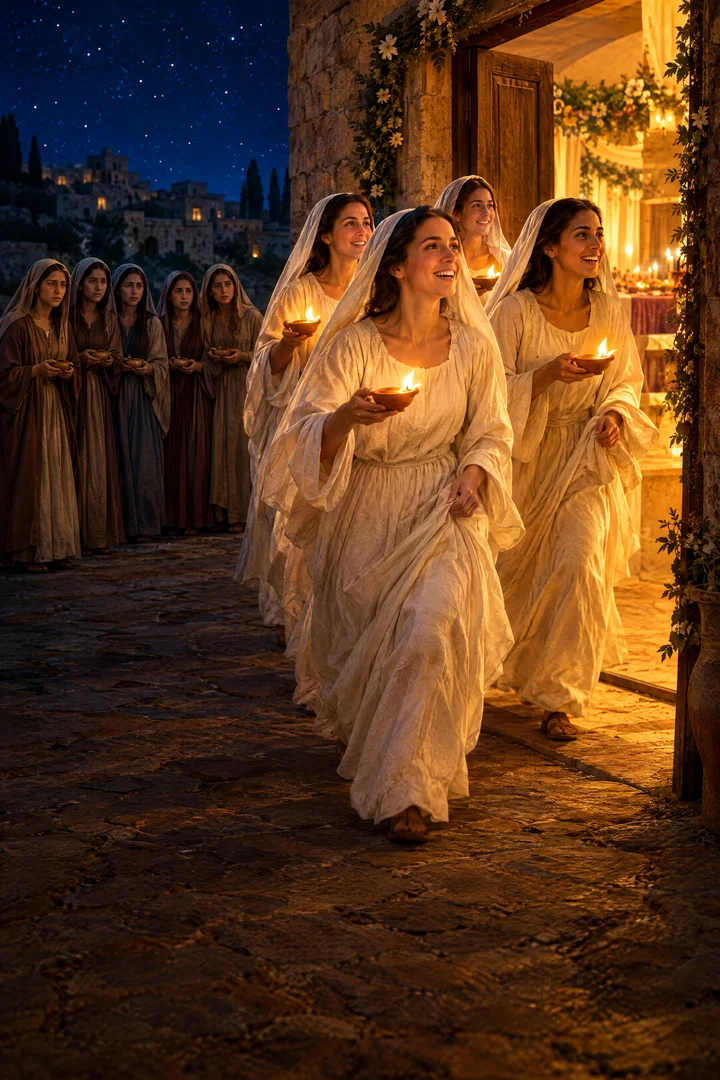
Then all those virgins arose, and trimmed their lamps.
The virgins trim their lamps as they prepare for the bridegroom.
- Matthew 25:8-9
And the foolish said unto the wise, Give us of your oil; for our lamps are gone out.
The foolish virgins’ lack of oil is exposed when they ask the wise for some.
- Matthew 24:45-51
Who then is a faithful and wise servant, whom his lord hath made ruler over his household, to give them meat in due season?
The faithful and unfaithful servants illustrate readiness for the master’s return.
- Matthew 25:12
But he answered and said, Verily I say unto you, I know you not.
The unprepared virgins are denied entry when Christ says he does not know them.
- Luke 12:37
Blessed are those servants, whom the lord when he cometh shall find watching: verily I say unto you, that he shall gird himself, and make them to sit down to meat, and will come forth and serve them.
Christ blesses servants found watching when he comes.
- Matthew 25:9
But the wise answered, saying, Not so; lest there be not enough for us and you: but go ye rather to them that sell, and buy for yourselves.
The wise virgins cannot supply the foolish with the oil they lack.
- Luke 19:12-27
He said therefore, A certain nobleman went into a far country to receive for himself a kingdom, and to return.
The parable of the pounds complements the lesson on accountability in the parable of the talents.
- Luke 12:36
And ye yourselves like unto men that wait for their lord, when he will return from the wedding; that when he cometh and knocketh, they may open unto him immediately.
Both portray people waiting for the returning Lord or Bridegroom.
- Matthew 22:1-14
And Jesus answered and spake unto them again by parables, and said,
The wedding parable links the marriage supper with preparation and judgment of the guests.
- Matthew 25:11
Afterward came also the other virgins, saying, Lord, Lord, open to us.
The foolish virgins plead to be admitted after the door is shut.
- Matthew 25:31-34
When the Son of man shall come in his glory, and all the holy angels with him, then shall he sit upon the throne of his glory:
Both describe separation at Christ’s coming.
- Luke 13:25-27
When once the master of the house is risen up, and hath shut to the door, and ye begin to stand without, and to knock at the door, saying, Lord, Lord, open unto us; and he shall answer and say unto you, I know you not whence ye are:
The shut door and rejection echo the fate of the unready virgins.
- Revelation 19:7-8
Let us be glad and rejoice, and give honour to him: for the marriage of the Lamb is come, and his wife hath made herself ready.
The church’s readiness is linked with wearing Christ’s righteousness.
Commentary part 1 of 2
Each commentary is drawn from primary sources: the writings of Ellen G. White and Adventist pioneers and periodicals. Each commentary is separate. Its own words are not a quotation; follow the references to read the source passages.
Ellen G. White
164 sources
Jesus tells of ten attendants waiting at night with lamps for the bridegroom to bring the bride to the feast, as part of His teaching on the Mount of Olives about His second coming.COL 405.1ST Nov 20, 1884COL 404.2ST Aug 6, 1894COL 406.2
Five are wise and five are foolish, outwardly alike in profession and expectation, but divided by whether they have taken oil with their lamps and are ready when the call comes after long delay and slumber.1T 53.3–54.3COL 405.2–406.1ST Sep 17, 1912ST Feb 17, 1890COL 408.2–3
The lamps are the word of God and the outward profession of its light, and the oil is the grace of God and the Holy Spirit, the righteousness and character of Christ nourished day by day, which cannot be borrowed from another.GC 393.2–394.1GC88 393.1–394.1GC 425.3–426.1Ms 72, 1895, par. 1–2Ms 174, 1905, par. 12
That waiting and midnight cry met its fulfillment in the proclamation of Christ's soon coming and the disappointment and delay culminating in the summer and autumn of 1844, when the wise followed Christ by faith into His work in the heavenly sanctuary and the foolish rested on theory without grace.4SP 242.3GC 400.1–401.2GC 425.3–426.1GC 426.2–427.25MR 97.3
Therefore every professed believer must now examine which class he is in and secure the oil while probation lasts through prayer, searching Scripture, and vigilant working for souls, for after the bridegroom comes character cannot be made or changed and the door is shut.Ms 79, 1897, par. 3–4ST Sep 17, 1912ST Sep 17, 1912ST Apr 21, 1898Lt 16, 1895, par. 26
Wedding Setting and Context
The verse belongs to an evening wedding custom in which a company of attendants waits with lamps to join the bridegroom's torchlight procession from the bride's father's house to his own home for the feast and wedding supper.COL 405.1ST Aug 6, 1894ST Sep 17, 1912 It is part of a parable about truths connected with the second coming and the kingdom of God.ST Aug 6, 1894ST Sep 17, 1912 A Jewish marriage feast of this kind is a solemn and joyful occasion, and marriage itself is a divine institution.3RED 13.3–14.1
The parable was told to the disciples on the Mount of Olives as part of the discourse in Matthew 24 and 25, given shortly before entering Gethsemane.ST Nov 20, 1884ST Sep 17, 1912 Christ spoke it while looking upon a party waiting for the bridegroom, to illustrate the experience of the church that shall live just before His second coming.COL 406.2 It presents the need to be ready, waiting and watching for that coming, and joins readiness with vigilant, unselfish labor, since neither prayerful meditation alone nor continual activity alone is sufficient for Christian fitness.ST Nov 20, 1884ST Nov 20, 1884 Among those waiting for the Bridegroom some were wise and some foolish, and the midnight cry awakened them all to seek a living experience for themselves rather than relying on one another.COL 404.2SG1 141.1
The ten are divided equally, five wise and five foolish.1T 53.3–54.3COL 405.2–406.1ST Sep 17, 1912ST Aug 6, 1894ST Feb 17, 1890 Their wisdom or folly is shown by preparation for a long wait and delay: the wise brought oil to replenish their lamps and had oil in reserve in their vessels, while the foolish had lamps but not enough oil and had not prepared.COL 405.2–406.1ST Sep 17, 1912ST Aug 6, 1894ST Feb 17, 1890 Though appearing alike in profession and outward form, the foolish professed faith without grace and genuine conversion.ST Feb 17, 1890 When the bridegroom came the prepared attendants were ready to join the procession and enter the marriage feast, but the unprepared were left behind and outside, and the door was shut.COL 405.2–406.1ST Aug 6, 1894ST Feb 17, 1890 The warning to sleeping virgins is therefore to wake, trim lamps, and fill vessels with oil in renewed consecration and spiritual readiness.Lt 58, 1906, par. 1–3
The parable includes a going out, then a delay and time of waiting and sleep, followed by the midnight announcement that the bridegroom is coming and the call to go out to meet him.4SP 242.3GC88 398.4–400.1GC 400.1–401.21T 53.3–54.3 The delay represents the passing of the expected time and the disappointment that tried devotion and zeal, when believers lost some fervor like virgins who slept.4SP 242.3 That order agrees with prophecy and the Old Testament types pointing to the autumn of 1844, when the cry heralded by thousands swept like a tidal wave through cities, villages, and remote places until the waiting people were fully aroused to searching of heart, confession of sin, forsaking the world, persevering prayer, and preparation to meet the Lord.GC88 398.4–400.1GC 400.1–401.2 The delay expresses patience, giving time to repent, and will seem short when viewed from eternity; the waiting time is a period of probation in which the wise keep lamps trimmed and burning and are found watching when He comes.10MR 266.25T 485.1
Meaning of Lamps and Oil
The lamps are the Bible, the word of God which is a lamp to the feet and a light to the path.GC 393.2–394.1GC88 393.1–394.1COL 406.3–408.1 All ten virgins go out with lamps and vessels, meaning all have a knowledge of the Scriptures, have heard the message of Christ's near approach, and confidently expect His appearing.COL 408.2–3 The lamp is also the light of truth received and the outward profession and semblance of religion, the appearance of giving light.Ms 35, 1891, par. 32–33Lt 6a, 1893, par. 12–13 Even lamps which are their Bibles are of no avail without oil in the vessels with them, for without the Spirit a knowledge of His word cannot quicken the soul or sanctify the heart or transform the character, even where commands and promises are familiar.COL 408.2–3Ms 174, 1905, par. 12 Without the enlightenment of the Spirit men cannot distinguish truth from error and fall under temptation, and without this oil all outward preparation is worthless, even the highest profession or appointment to sacred office.COL 408.2–3Lt 6a, 1893, par. 12–13
The oil in vessels with the lamps is God's grace and the Holy Spirit with renewing, regenerating and enlightening power.GC 393.2–394.1GC88 393.1–394.1RH Feb 3, 1903 It is the oil of the grace of Christ, the Spirit of life abiding in the heart in living connection with Him, so that the lamp sends forth clear rays.ST Aug 6, 1894Lt 6a, 1893, par. 12–13 The wise are those who have faith and love and patience, whose experience day by day is nourished by the Spirit, who do not conform to the world, who love God and truth for its own sake, and who constantly receive grace from the Source of all spiritual power.ST Sep 17, 1912ST Aug 6, 1894 The foolish have lamps but no oil because they have neglected grace, are satisfied with a theory of truth, and their characters cannot withstand the test.GC 425.3–426.1RH Feb 3, 1903 No birth, descent, membership, theory, or human wisdom can supply what is lacking, for it is just enough outward show to have the name to live while dead to deaden the conscience, deceive the senses, and ruin the soul.Lt 6a, 1893, par. 12–13
As golden oil flowed from the two olive trees through golden pipes into the bowl and into the lamps that gave light to the sanctuary, so the Spirit is imparted from the holy ones that stand in God's presence to human instrumentalities consecrated to His service.COL 406.3–408.1 Abundant provision has been made for every soul through the two anointed ones who stand by the Lord of the whole earth, yet without connection with heavenly agencies the lamps go out and the work is superficial, weak and ineffective.RH Sep 17, 1908 The oil the wise have is the Holy Spirit, taken by the two olive trees and emptied as golden oil into clean, pure, sanctified souls that are prepared to receive it through humbleness of mind.Lt 98a, 1897, par. 58–59Lt 108, 1898, par. 10–11 God's people must trim their lamps and receive the holy oil from the two olive branches representing the Spirit's power, so their witness is ready and effective.Lt 59, 1900, par. 9 The supply must not be postponed until the cry announces the Bridegroom, for it will then be too late to replenish burned-out lamps.ST Sep 17, 1912ST Aug 6, 1894
When received, the oil makes God's word a transforming power that forms God's character in those who receive it.COL 414.1–2ST Jul 20, 1915 Thus prepared with oil in their vessels, their lamps burned steadily through the night, honoring the bridegroom and lighting the way to his home and wedding feast.COL 414.1–2ST Jul 20, 1915 Their lives are to glorify God and light the way to the city of God and the marriage supper of the Lamb, shining into the world's darkness.COL 414.1–2ST Jul 20, 1915 The lamp represents a believer whose self is surrendered and who receives the Holy Spirit, and that personal consecration lets the light guide sinners, so that one prepared, faithfully burning lamp can do more good than a showy procession of lights.6T 116.1 The wise are Christ's true followers whose lamps are filled with holy oil from the divine altar to carry light to those in darkness, receiving His grace and newly unfolding truth to pass on to others, with words and actions that are an example to believers and bring conviction to unbelievers.Lt 226, 1907, par. 2Ms 59, 1902, par. 71
Two Classes in the Church
The ten represent the church living in the evening of earth's history just before the second coming.COL 406.2Ms 144, 1898, par. 1Ms 92a, 1898, par. 20 They are professed believers watching for the Lord's appearing and seeking to be acknowledged as the Lamb's wife.Ms 144, 1898, par. 1Ms 92a, 1898, par. 20 The division into five wise and five foolish shows the condition of that church as part prepared and part unprepared spiritually.Ms 79, 1897, par. 3–4ST Sep 17, 1912 All go out with lamps and vessels, meaning all have knowledge of the Scriptures, have heard the message of Christ's near approach, and confidently expect His appearing.COL 408.2–3 A time of waiting intervenes in which faith is tried, and when the midnight announcement of the Bridegroom is heard many are unready because they have no oil in their vessels with their lamps and are destitute of the Holy Spirit.COL 408.2–3 Without the Spirit knowledge of His word is of no avail, for theory of truth where commands and promises are familiar cannot quicken the soul or sanctify the heart or transform the character, and without His enlightenment men cannot distinguish truth from error and fall under temptation.COL 408.2–3
Both classes appear outwardly alike for a time in profession, expectation, and outward form, with no visible difference.ST Feb 17, 1890COL 408.2–316MR 270.3–271.2 Those holding truth in unrighteousness look like the wise, as tares closely resemble wheat.16MR 270.3–271.2 All claim to be Christians and to serve God, all have a name and a call and a lamp and start apparently prepared and watching, but five are true and five are false.16MR 274.2Ms 92a, 1898, par. 33–35 No human can now distinguish between them nor has authority to say who is wise and who is foolish, because men cannot read the heart from which evil thoughts, murders, adulteries, fornications, thefts, false witness and blasphemies proceed and defile the man, and where every plant not planted by the Father will be rooted up.16MR 270.3–271.2 Angels know them by their fruits and will make no mistake in gathering the wheat from among the tares to counterwork those who fight against the truth.16MR 270.3–271.2 A person's conduct and conversation reveal the true condition before God, and a time will come when the door will be shut and the two classes will be fixed.ST Sep 17, 1912ST Feb 17, 189016MR 270.3–271.2 That division stands as a solemn warning to every church.
The division does not describe open sinners who make no profession of loving God and keeping His commandments.Ms 144, 1898, par. 7Ms 144, 1898, par. 5Ms 144, 1898, par. 6 It describes those who claim to be children of God and church members while not practicing the truth.Ms 144, 1898, par. 7Ms 144, 1898, par. 5 The foolish have heard and assented to the truth but have not brought it into daily life nor secured faith that works by love and purifies the soul.Ms 144, 1898, par. 5 They are not doers of the Word or keepers of God's commandments despite opportunities and privileges to gain light and knowledge.Ms 144, 1898, par. 5 They take God's promises for granted while not living as Christ enjoins, treating mere profession as enough, presuming they are saved and crying peace when there is no peace.Ms 92a, 1898, par. 33–35 True wisdom requires denying self, taking up the cross daily and following Christ, doing and teaching even the least commandments with a righteousness exceeding outward religion, in a lifetime work of sanctification without presuming final attainment.Ms 92a, 1898, par. 33–35
Half are ready and half unready, five wise and five foolish, and this equal proportion reflects the expected balance among professed believers.Lt 86, 1895, par. 2Ms 47, 1895, par. 1–37MR 148.1–221MR 61.6 Many who have received great light, opportunities, and privileges have only theoretical knowledge of the truth, which is not enough, for they must be doers of the Word.Lt 86, 1895, par. 2Ms 47, 1895, par. 1–3 The wise are worked by the Holy Spirit, walking in the light on justification by faith and the imputed righteousness of Christ and imparting it to others, while the foolish think theoretical knowledge is enough, make excuses for neglecting the gospel invitation to come, and lose much.Ms 47, 1895, par. 1–3 The foolish are slumbering people who in ignorance consider themselves wise while their lamps are going out without them realizing it.Lt 234, 1906, par. 13–16Lt 90, 1907, par. 11 When they awake to their true condition it will be too late to obtain a fresh supply of oil, and believing oneself ready does not ensure true readiness to meet the Bridegroom.Lt 234, 1906, par. 13–167MR 148.1–2Lt 90, 1907, par. 11 Those wanting oil are found surprised and dismayed, without oil, left outside the wedding banquet with the door shut, showing such presumption to be most perilous to the soul.16MR 274.2Ms 92a, 1898, par. 33–35
Fulfillment in the 1844 Movement
Going out to meet the bridegroom is the widespread response to the first angel's message and the midnight cry announcing Christ's soon coming.GC88 393.1–394.1Ms 92a, 1898, par. 1–316MR 267.1–2 Under that proclamation believers preached His appearing and were compelled to leave the churches, while the call to go out to meet the Bridegroom was to be heard by the whole world.GC88 393.1–394.1Ms 92a, 1898, par. 1–316MR 267.1–2 The midnight cry announcing the bridegroom was heralded by thousands of believers and swept like a tidal wave through cities, villages, and remote country places until the waiting people of God were fully aroused.GC 400.1–401.2 They were led to deep searching of heart, confession of sin, forsaking of the world, persevering prayer, and preparation to meet the Lord, in connection with the announcement that the bridegroom is coming and the call to go out to meet him.GC 400.1–401.21T 53.3–54.3CET 50.4
The time of waiting and sleep after the cry is the passing of the expected time, the disappointment, and the delay that followed the movement under the first message.4SP 242.3GC88 398.4–400.1 As the delay continued believers lost some zeal and devotion, like the virgins who slept, and the waiting period tested whether they had genuine righteousness in Christ and could patiently wait, watch, and keep working.4SP 242.3Ms 9, 1891, par. 21–2210MR 272.1–2 Lacking a supply of grace to endure the test of the long wait, the foolish began to think that the Master was not coming.Ms 9, 1891, par. 21–2210MR 272.1–2 The delay is an expression of Christ's patience, giving people time to repent, and the waiting will seem short when viewed from eternity, while the wise keep their lamps trimmed and burning.10MR 266.2
In the summer and autumn of 1844 the two classes became distinct when the bridegroom's coming was proclaimed.GC 425.3–426.1GC 426.2–427.2GC88 426.2–427.2GC88 426.1 The wise looked with joy for His appearing and diligently prepared to meet Him.GC 425.3–426.1GC 426.2–427.2GC88 426.2–427.2GC88 426.1 The foolish acted from fear and impulse and were satisfied with a theory of truth but lacked God's grace.GC 425.3–426.1GC 426.2–427.2GC88 426.2–427.2
The wise had both Scriptural knowledge and the Spirit and grace of God, patiently sought clearer light through trial, and followed Christ by faith into His work in the heavenly sanctuary.GC 425.3–426.1GC 426.2–427.2GC88 426.2–427.2GC88 426.1 They made the provision essential to join the company walking in the light that had come to them and accepted the third angel's message, keeping God's commandments and the faith of Jesus, ready to enter the marriage supper of the Lamb.16MR 269.3Ms 92a, 1898, par. 7–10 If all who claimed to believe had acted their part as wise virgins the message would already have gone to every nation, kindred, tongue, and people.16MR 269.3 The foolish went forth to meet the Bridegroom under the first and second angels' messages but had theory without grace and refused the third angel's message, the last testing message to be given to the world, and many who accepted the first and second messages were therefore unprepared.GC 425.3–426.116MR 269.3Ms 92a, 1898, par. 7–10
The bridegroom's coming is Jesus rising from His mediatorial throne and going into the Most Holy Place in heaven as Bridegroom to receive His kingdom.5MR 97.3Lt 3, 1847, par. 6–7 It does not mean His coming to this earth to deliver His people on the tenth day of the seventh month, and this heavenly coming settles the shut door.5MR 97.3Lt 3, 1847, par. 6–7 Those who went forth to meet the Bridegroom in 1844 included people who afterward were deceived by false shepherds until they did not know where they were or what they believed, and who are now coming out upon the truth alongside those who never heard the Advent doctrine.5MR 91.4Lt 4, 1850, par. 4 Those who would be among the wise must not rest without the abiding witness that their ways please God.5MR 91.4Lt 4, 1850, par. 4 The oil in the lamps of the professed churches is now almost consumed and has not been replenished, yet that desperate closed-door position has not yet been reached, and there is still time to obtain the gold of truth, faith, and love and the white raiment of Christ's righteousness before probation ends.Ms 143, 1901, par. 5–10
The midnight cry and the bridegroom's coming are distinct parts of the travel of the Advent band.Lt 3, 1847, par. 3–5 The midnight cry was shown in December 1844, when it had been given up as in the past and was thought to be future by most of the band.Lt 3, 1847, par. 3–5 The bridegroom's coming was not shown until February following, and the light given on the midnight cry was to be delivered to the band, whose Bridegroom-coming message was understood as future before the vision of that message.5MR 95.3–97.2Lt 3, 1847, par. 3–5
Character of the Wise Virgins
The wise studied Scripture to learn the truth and sought purity of heart and life, gaining a personal faith working by love that endured disappointment and delay when the expected coming did not occur.GC 393.2–394.1GC88 393.1–394.1Ms 72, 1895, par. 1–2 They did not act from impulse and emotion or rely on another's faith, but obtained a thorough grasp of truth and a genuine work of grace, with the oil of grace in vessels with lamps.GC 393.2–394.1GC88 393.1–394.1GC 425.3–426.1 They keep their lamps filled and burning by prayerfully studying the Word with an obedient heart, being watchful over words and careful in behavior, so they hear the midnight cry and are ready to respond.Ms 74, 1899, par. 7Ms 7, 1898, par. 33–3420MR 180.2–3 Humble, diligent searching guided by the Holy Spirit enables them to discover the treasures of God's Word that surface reading misses, and to live as strangers and pilgrims whose citizenship is above, united with Christ's heart and clothed with His righteousness.Ms 7, 1898, par. 33–3420MR 180.2–3
They have faith, love and patience nourished day by day by the Holy Spirit, and their experience continually grows through a living connection with Christ.RH Feb 3, 1903ST Sep 17, 1912ST Aug 6, 1894Lt 44, 1876, par. 11Lt 116, 1901, par. 12–14 They do not conform to the world in careless inattention and do not put off daily preparation, but follow Jesus wherever He leads, bringing truth into heart and mind and learning daily more of Him.RH Feb 3, 1903ST Sep 17, 1912ST Aug 6, 1894 They love God and love truth for truth's sake alone and not merely for its clear arguments, their conversation is in heaven from whence they look for the Lord Jesus Christ, and they talk much of His coming.ST Aug 6, 1894 So constantly receiving grace from above from the Source of all spiritual power, their faith burns brightly like a trimmed lamp, their desire for peace and joy keeps increasing, and they are ready when the Bridegroom comes.RH Feb 3, 1903ST Aug 6, 1894Lt 117, 1901, par. 4
They keep their light burning through good works, learning Christ's ways, and receiving inward adornment by holy grace sent from heaven, for baptism alone does not make anyone wise or ready.Ms 92a, 1898, par. 1916MR 271.3 They do and teach even the least of the commandments, deny self daily, wash their robes and make them white in the blood of the Lamb, and show meekness, tenderness, sympathy and love instead of hiding light or resting in theory.Ms 92a, 1898, par. 28Ms 92a, 1898, par. 21–22Ms 109, 1898, par. 14–16 Their hearts have received moral restoration to the very depths of the hidden springs, so practical daily life testifies the work is genuine, and clinging to old habits and worldly ideas and customs would show the oil is not kept in the vessel.Ms 92a, 1898, par. 1916MR 271.3Ms 92a, 1898, par. 21–22Ms 109, 1898, par. 14–16 They accept the messages of mercy including the third angel's message and keep God's commandments and the faith of Jesus, ready to enter the marriage supper of the Lamb.Ms 92a, 1898, par. 7–10
They blend vigilant waiting, working, watching, praying and resting in the Lord, increasing constantly in spiritual power through genuine Christianity rather than idle expectancy or restless bustle to the neglect of personal piety.5T 276.212MR 213.2–214.1 They keep lamps trimmed by unceasing watchfulness and earnest prayer, living in hourly contact and conscious communion with the principles of truth, righteousness and mercy, and improve every opportunity and increase gifts by use.Lt 66, 1895, par. 4–5Lt 75, 1896, par. 10 That readiness is not spending all time in waiting, meditation and contemplation, but having quiet prayerful hours apart from bustle to commune with God and learn His will while blending personal piety with earnest energetic warning to clear the King's highway.12MR 213.2–214.1Ms 43, 1909, par. 17 Awake from sleep, they pray as never before that the burden of souls may rest on them, humble the heart, understand the needs of a perishing world, and let the light of truth shine into the byways and hedges to warn of the near approach of the end.Lt 75, 1896, par. 10Ms 43, 1909, par. 17
Their lamps give steady witness because their spiritual life is replenished through Christ's grace and the Holy Spirit, their discernment is not lost in slumber, their affections are set on heavenly things, and they discern God as the source of supply.ST Aug 13, 1894ST Sep 24, 1912 With God's love shed abroad in the heart, their lights burn steadily through the night, they glorify God, honor the Bridegroom and light His way, and like their Master they seek and save the lost.ST Aug 13, 1894ST Sep 24, 1912COL 414.1–2ST Jul 20, 1915 The Holy Spirit uses God's word as a transforming power to form God's character in them, so their lives point toward the city of God and the marriage supper of the Lamb and bless others in darkness.ST Mar 17, 1898COL 414.1–2ST Jul 20, 1915 One faithfully burning lamp does more good than a showy procession, for their faith is shown in prayerful communion, devoted work, and light shared with others, receiving newly unfolding truth to pass on.ST Mar 17, 1898
They are real Christians who have life in themselves, unseen principles, open communion with God, and the character that gives entrance into the marriage supper, marked by personal faith working by love, firm reliance, willing obedience and consecration that neither birth nor descent nor church membership can supply.Ms 72, 1895, par. 1–2Ms 41, 1902, par. 33–36 They have perfected a Christian character, washed their robes white, and their hearts have been transformed by God's power rather than merely professing or assenting without living by the word.Ms 92a, 1898, par. 28Ms 92a, 1898, par. 21–22 They are partakers of the divine nature, complete in Jesus Christ, perfect without spot and blameless, with human nature placed on vantage ground with God before the heavenly universe and the fallen world, made possible because Christ gave His life that all might be wise.Ms 92a, 1898, par. 29–32 Prepared vessels shine as lights because God Himself supplies the holy oil if the vessel is prepared by true conversion, understanding relation to the law of God, conversion and new birth with the old life of selfishness dead and the Christ-life revealed in word, practice and disposition.Ms 41, 1902, par. 33–36Lt 44, 1900, par. 4–5
They anticipate delay and provide for emergency by filling their flagons with oil, so their lamps are supplied from the flagons and are not left to go out when the call comes.16MR 267.3Ms 92a, 1898, par. 4–6 The foolish lack this foresight and make no provision for disappointment or delay, and find their lamps going out and themselves outside when the door is shut.16MR 267.3Ms 92a, 1898, par. 4–6 Handling sacred truth, the wise separate from the world which would eclipse the light, hold the truth in righteousness, appreciate its value and sacredness, and maintain close vital connection with the pure sacred springs from which life must be derived.Ms 16, 1890, par. 66–68 Sanctified by the truth and pervaded by a deep abiding sense of its importance, they with wisdom from God carry it into the highways and byways of life, making it their meat and drink to obey the truth and pass the precious light to others.Ms 16, 1890, par. 66–68
Character of the Foolish Virgins
The foolish have lamps without oil, a theory of truth and outward assent without grace, acting from impulse and passing emotion and from fear rather than love, relying on the faith of others while lacking a thorough grasp of truth and a genuine work of grace in the heart.GC 393.2–394.1GC88 393.1–394.1GC 425.3–426.1GC 426.2–427.2GC88 426.2–427.2 Self-love leaves them without the grace the oil represents, so they treat life-giving truth as unessential and remain in blindness, ignorance and weak faith with a wavering experience founded on uncertain principles.GC 393.2–394.1GC88 393.1–394.1ST Aug 13, 1894 When delay and trial come their faith fails and their light grows dim, because readiness grounded in God's grace is distinguished from mere profession of truth.GC 393.2–394.1GC88 393.1–394.1GC 426.2–427.2 The wise have both Scriptural knowledge and the Spirit and grace of God and patiently seek clearer light, while the foolish are satisfied with theory alone.GC 425.3–426.1GC 426.2–427.2GC88 426.2–427.2
They are careless, indolent, self-satisfied and lukewarm professors who expect to enter heaven but have not purified their souls through obedience to the truth, trusting their feelings, neglecting Scripture, and lacking a vital connection with God and the oil of grace.ST Sep 24, 1912ST Aug 13, 1894 They live for pleasure and follow others, lovers of pleasure more than lovers of God, surfeited and drunken with the cares of this life so that the day comes upon them as a thief, holding lax and loose principles and keeping natural hereditary tendencies as choice treasures.Lt 121, 1896, par. 9–1014MR 122.2–123.1Ms 9, 1891, par. 45–46 They stand directly in the path of sinners and hinder conversion, mingling selfishness and self-indulgence with God-given capabilities so that strange fire eclipses the purity, holiness and divine origin of the sacred fire.Lt 121, 1896, par. 9–10 They are half with Christ and half with the world, given to self-indulgence, sensual practices, dress, amusement and business absorption, harming others and seducing many, advocating Christ in truth with much activity yet not representing Him nor doing His words, never letting light shine so as to suit worldly men.Lt 121, 1896, par. 9–1014MR 122.2–123.1Ms 9, 1891, par. 45–46ST Sep 24, 1912 Even those who have Bibles and can distinguish true from false influence are carried away by such corrupting, deceiving characters who present a nice appearance as if wise in Bible lore, and hidden sins remain until character is tested by God's standard of righteousness and cleansed in perfecting holiness.Lt 121, 1896, par. 9–10ST Sep 24, 1912ST Aug 13, 1894
Though they have received great light and knowledge, they sleep with lamps but no oil in their vessels, cold and spiritually senseless with feeble, waning piety as the world faces its final crisis.ST2 22.5STA 68.1STOM 54.1STBk 68.1STA 77.3–4 Their decline comes from neglecting Scripture, prayer and the ordinances of grace, feeling no need of Christ's mediatorial work, and mistaking a condemning spirit for insight while piety fades.ST2 22.5STA 68.1STOM 54.1STM2 6.5 Their lamps without oil show lack of the spiritual life and power needed for the coming crisis, and they must awake and trim their lamps and hold fast to present truth.STA 77.3–43MR 361.2–4
Many are ministers, workers and teachers with privileges who year after year fail to absorb the truth and therefore cannot give to others what they have not received, and if they persist they should not remain in ministry.STBk 9.1ASCOP 24.1STOM 7.3 They have lamps but lack the oil of grace that makes the lamp burn and give light, lacking consecration and heart piety and failing to practice Christ's lessons of meekness, tenderness, sympathy and love in daily life.STBk 9.1STOM 7.3Ms 168, 1898, par. 16–18Lt 71, 1895, par. 30 They are active in God's work yet follow the foolish course by not filling vessels with grace, showing a false religion without His lowliness and gentleness, and needing faith that works by love and purifies the soul with prayer and solemn concern for salvation.STBk 9.1Ms 168, 1898, par. 16–18Lt 71, 1895, par. 30 They delay securing oil and risk finding it too late when the end comes.ASCOP 28.1
Their lamps burn dim, flicker and go out for want of oil, and they awake too late to obtain it, surprised and disappointed at the cry and unready to meet the Bridegroom.ST Aug 6, 1894Lt 60, 1898, par. 34Ms 82, 1896, par. 69MR 205.2–206.2 While they go to buy, the prepared go in with the bridegroom to the marriage supper and the door is shut, and coming afterward to the banqueting hall they are denied entrance with I know you not and left outside in the empty street in the blackness of night, unable to partake of the marriage supper of the Lamb.ST Sep 17, 1912ST Aug 6, 189415MR 229.1Lt 60, 1898, par. 34 To be foolish is to slumber and sleep instead of keeping the vessel filled and trimmed and burning brighter by earnest daily work, self-denial, cross-bearing, trading with talents, and sinking the empty vessel into the fullness of God's love with Christ within as a well of water springing up unto everlasting life.Ms 82, 1896, par. 69MR 205.2–206.2 There is no evidence they obtained oil before arriving too late, for they did not live the truth nor obtain from God the wisdom and grace that makes complete in Christ.ST Sep 17, 1912Lt 60, 1898, par. 34
Some make science everything and trust much to powers inherent in man and nature, entangled in skepticism so that the power and glory of God are not exalted, wandering under spiritualistic deception without realizing their condition.3MR 361.2–43MR 336.2Lt 18, 1892, par. 7–11 Having no oil means counting the ordinances of grace that keep faith alive as not vitally important, seeing no necessity for the instrumentalities God employs to keep lamps burning, and feeling no need of Christ's mediatorial work from which comes whatever illuminates the understanding and warms the heart.3MR 336.2Lt 18, 1892, par. 7–11 Foolishness is human wisdom unsanctified day by day, while continued self-indulgence and sensual practices darken understanding, blur spiritual vision, make truth and warnings ineffective, reveal a diseased character too late, and show outward religious service without conversion of heart in envy, evil thoughts, harmful speech, vanity and pride.Ms 10a, 1898, par. 8–10Lt 37a, 1903, par. 8–9Lt 22, 1893, par. 16–19Lt 18, 1892, par. 7–11
Grace Cannot Be Borrowed
The oil of grace and the character it forms cannot be passed from one person to another nor borrowed at the last moment, for each must gain a personal experience with Christ through humbleness, wearing His yoke and learning of Him.Ms 72, 1895, par. 1–2Lt 114, 1895, par. 5–6Lt 79, 1897, par. 3Lt 64a, 1895, par. 8–11 The five wise are real Christians who have life in themselves, the oil of grace in their vessels with their lamps, unseen principles, open communion with God, and the character that gives entrance into the marriage supper of the Lamb and marks them as those the Lord knows and whose works He acknowledges.Ms 72, 1895, par. 1–2STMW7 54.1–2 The five foolish are spurious believers who profess without possessing that grace, living connection, and obedient character, and so are unfit for the marriage supper, for neither birth nor descent nor church membership can supply what is lacking.Ms 72, 1895, par. 1–2Lt 114, 1895, par. 5–6Lt 64a, 1895, par. 8–11 The difference is personal faith in the Word working by love, true preference, firm reliance, willing obedience and consecration that binds the life with Christ, a solid experience that grows into knowledge nourished by earnest prayer and faith in Christ.Ms 72, 1895, par. 1–2Lt 79, 1897, par. 3 All are represented as sleeping virgins with lamps, which are their Bibles, but the foolish lack the oil of grace, which is the Holy Spirit, needed to use the lamps to decide to obey the truth, to discern clear light or accept it and join the procession.Ms 174, 1905, par. 12STMW7 54.1–2
When the foolish begin to see their defects they try to buy from the wise or borrow another person's experience and knowledge of grace, but spiritual readiness and character, which is Christ's righteousness and a character purified from sin, cannot be transferred.Ms 174, 1905, par. 12Lt 114, 1895, par. 5–6Lt 79, 1897, par. 3Lt 64a, 1895, par. 8–11 Before they can obtain what they seek the bridegroom comes and their chance to trim their lamps and enter into the joy of going into the marriage supper is gone.Ms 174, 1905, par. 12 Those who have lamps must trim them by obtaining the oil of grace, refreshing their lamps and reflecting the light with rejoicing.Ms 174, 1905, par. 12 Hearing the message and having a lamp are not enough; each person must obtain oil for themselves before Christ comes, for at the judgment He will separate the obedient from the disobedient and it will be too late for the unprepared to acquire what they lack.Lt 64a, 1895, par. 8–11
That preparation must be secured now during probationary time, by day while working, watching and waiting, because after the cry and the coming it is too late to trim lamps or gain fitness to join the procession.ST Apr 21, 1898Lt 16, 1895, par. 26Lt 25, 1895, par. 4COL 413.2 The wise bring oil in vessels with their lamps while the foolish bring none, showing that outwardly sharing the same expectation does not mean all are prepared.ST Apr 21, 1898Lt 16, 1895, par. 26 Readiness cannot be supplied by others at the last moment and must be maintained while the bridegroom delays, for all must watch because the time of His coming is unknown.ST Apr 21, 1898 Those who neglect the day of salvation and neglect the grace of God in their hearts may seek entrance to the marriage supper too late and find the door shut, for once probation has ended it is too late to gain fitness.Lt 16, 1895, par. 26Lt 25, 1895, par. 4 The foolish fail to keep their lamps shining through good works while they wait and do not form characters in the likeness of God, so they are unready when the call comes.Lt 25, 1895, par. 4
They cannot become ready by waking when the cry Behold the Bridegroom is heard and then trying to replenish empty lamps, for keeping Christ apart from the life here leaves a person unfitted for His companionship in heaven.COL 413.2 Many are slumbering people who in ignorance consider themselves wise while their lamps are going out without realizing it, and when they awake to their true condition it will be too late to obtain a fresh supply of oil.Lt 234, 1906, par. 13–1621MR 30.3 The whole chapter develops the principles of eternal justice by which works will be judged from the books according to character and fitness for the kingdom as members of the royal family, children of the heavenly King.Lt 12, 1893, par. 4–7 The lamps mean a knowledge of the truth and an outward appearance of giving light, while the oil in the vessels means receiving the grace of God, a living connection with God, being vitalized by His Holy Spirit, saving faith with Christ as a personal Saviour, growing in grace and knowledge, and being doers of His words.Lt 12, 1893, par. 4–7
The distinction is revealed when the bridegroom comes: the prepared can join the wedding procession, but the unprepared are left outside, and there is no evidence that the foolish obtained oil before arriving too late.ST Sep 17, 1912ST Aug 6, 1894 While they went to buy oil the wise went in with the bridegroom to the marriage supper and the door was shut, and when the foolish came to the banqueting hall they were denied entrance, told I know you not, and left outside in the empty street in the blackness of night.15MR 229.1 Their condemnation was not especially for revolting crimes and outbreaking sins but for neglecting to do what they might and ought to have done because they lacked the moral qualifications Christ made every provision to place within reach by clothing divinity with humanity to bring moral power to fallen man to become a laborer together with God, transformed in character by beholding Christ.Lt 12, 1893, par. 4–7 Outward association with the wedding party does not ensure preparation, for the unready may neglect preparation, make excuses, and discover only after the door is shut that they have lost the opportunity to enter.ST Aug 6, 1894Lt 7, 1869, par. 6–7 Readiness requires more than self-righteousness or postponed intentions, for the wedding garment is Christ's righteousness and genuine preparation bears fruit in faithful service, at whose coming character cannot be made or changed and the righteous and wicked are finally separated.Lt 64a, 1895, par. 8–11Lt 7, 1869, par. 6–7
Call to Watch and Work
The division into five wise and five foolish presses a personal question upon every hearer, which side am I on, and calls for examination of standing before God while the marriage supper of the Lamb draws near.Ms 79, 1897, par. 3–4ST Sep 17, 1912ST Aug 6, 1894ST Sep 17, 1912 Conduct and conversation reveal the true condition, for the wise are spiritually prepared with oil in their vessels and enter with the bridegroom to the wedding, while the foolish neglect the oil of grace and are left outside when the door is shut.Ms 79, 1897, par. 3–4ST Sep 17, 1912ST Sep 17, 1912ST Aug 6, 1894ST Aug 6, 1894 The choice must be made now to be among the wise, because the day and hour of the Lord's coming are unknown and vigilance alone keeps one ready.Ms 79, 1897, par. 3–4ST Aug 6, 1894ST Sep 17, 1912ST Aug 6, 1894ST Aug 6, 1894
The summons is to awake, trim the lamps and keep them burning with a supply of holy oil, acting as those expecting their Lord.LSEGW 425.3Ms 80, 1905, par. 1–25T 276.2STE 147.1–149.1Lt 19, 1904, par. 7–8 That readiness means waiting watchfully while faithfully working, guarding against spiritual decline, rejecting sophistry and skepticism and vain speculation, and giving the whole self to God.Lt 29, 1897, par. 11Ms 80, 1905, par. 1–25T 276.2Ms 80, 1905, par. 10 Light is to be kept clear and steady through prayer, searching of Scripture, public worship and fellowship, and through precious past experience renewed, lest faith in the present truth be threatened and the lamp go out.LSEGW 425.3Ms 80, 1905, par. 1–2STE 147.1–149.1Ms 80, 1905, par. 10 To say I am not ready reveals the peril, for while there is still time the vessels must be filled and the lamps kept supplied with the oil of grace.5T 276.2STE 147.1–149.1Lt 19, 1904, par. 7–8
Readiness joins personal piety with unselfish labor, for the present is trading time in which God-given capabilities must be used for the Master and talents put out to the exchangers.Ms 25, 1908, par. 16Ms 9, 1891, par. 45–46ST Aug 6, 1894 A name in the church book will not secure entrance, but close critical self-examination of how opportunities have been used, a living daily connection with God, and grace today will keep from being surfeited and drunken with the cares of this life so that the day does not come as a thief.Ms 25, 1908, par. 16Ms 9, 1891, par. 45–46RCOC 123.3 Each one who denies self and is purified through belief of the truth at once begins missionary work for the perishing, diffusing every ray, digging deeper, bringing souls to the Master, and working with self-denying zeal while it is day because night comes when no one can work.Ms 25, 1908, par. 16Ms 9, 1891, par. 45–46AA 55.2 Those without that living connection to the source of growth will not be ready to receive added grace when the time of need comes, and their lamps go out for lack of oil.RCOC 123.3AA 55.2
The same keeping of the lamp trimmed and burning belongs in the home circle, where every member must be on the wise side with the vessel constantly replenished so temporal interests and earthly talk do not supplant eternal interest and the need of the soul.ST Sep 10, 1894Ms 80, 1901, par. 4Lt 145, 1893, par. 10–11 Fathers are to awake as laborers together with God, representing the divine Lawgiver by establishing upright principles, preoccupying the soul with what forms pure character, and like Abraham commanding household after them to keep the way of the Lord in justice and judgment, so that clear rays shine in the home and reach neighbors and the beams of the Sun of Righteousness brighten darkness.EDFCP 25.2ST Sep 10, 1894 Mothers are to reform character, humble hearts, overcome defects, pray more, and receive faith working by love that purifies the soul, and then the inner lamp shines in faithful consecrated work for children.ST Sep 10, 1894Ms 80, 1901, par. 4 Teachers are to be lights by Christian character to students, their homes, neighborhoods and the world, canvasser-evangelists are to keep witness bright amid moral darkness by circulating publications with the warning messages, and every Christian and church must fulfill this personally in a pure uplifting sanctified life that cannot be left to a minister.EDFCP 25.2STE 55.4–56.1Ms 94, 1903, par. 43
The end is near as a thief, with the time of trouble and Armageddon at hand and destroying angels already permitted, so guilty repose and sleep must give place to understanding God's will.RH Feb 3, 1916EW 46.1Ms 81, 1908, par. 9–10Lt 19, 1887, par. 14–15 Profession of truth or agreement with its teachings, even knowledge of the theory of the third angel's message, is not enough without genuine conversion, for the lamp must be supplied with the oil of Christ's grace to sustain spiritual life and make light shine.RH Feb 3, 1916Ms 81, 1908, par. 9–10Lt 19, 1887, par. 14–15Lt 1c, 1890, par. 25 All must repent, confess, humble hearts, be converted, make every effort to avoid decline, keep garments spotless with eyes on Jesus and faith reaching into the heavenly sanctuary, overcome defects, stop complaint and gloom, and receive sacred zeal that bears the fruits of the Spirit in willing obedience.RH Feb 3, 1916EW 46.1Lt 19, 1887, par. 14–15Lt 1c, 1890, par. 25Lt 29, 1897, par. 11
Sources