Translations
American King James Version, King James Version
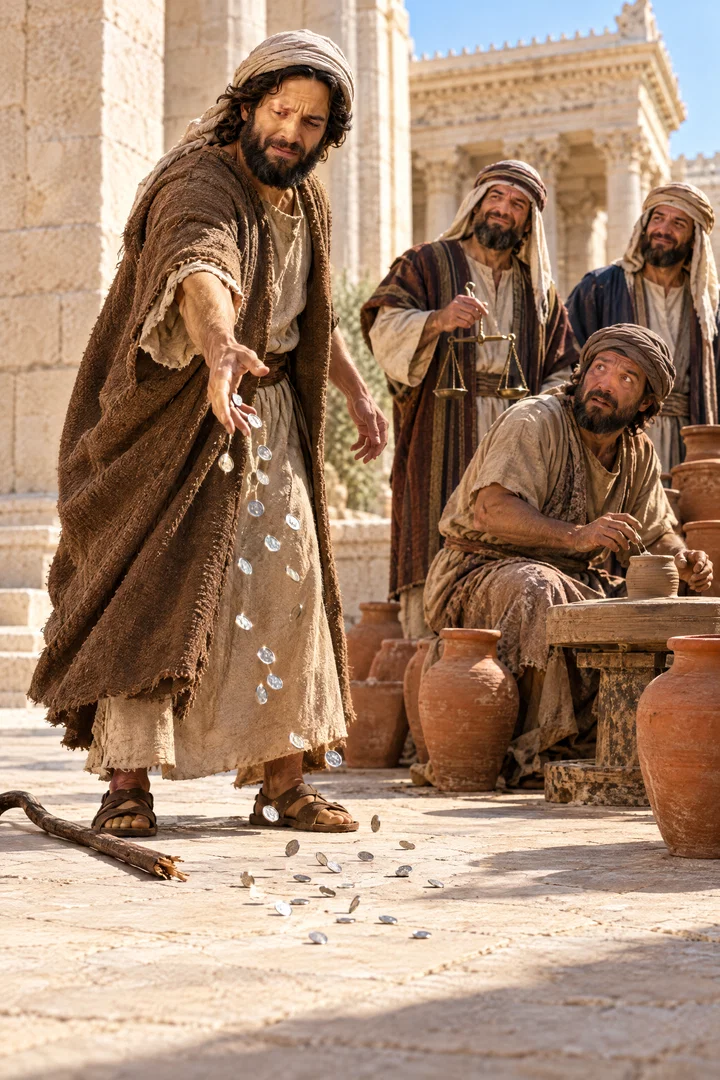
And gave them for the potter’s field, as the Lord appointed me.
and gave them for the potter’s field, as the Lord appointed me.
And gave them for the potter's field, as the Lord appointed me.
Revised Version, American Standard Version
and they gave them for the potter’ s field, as the Lord appointed me.
and gave them for the field of the potter, as the Lord did appoint to me.'
and they gave them for the field of the potter, according as [ the] Lord commanded me.
And gave them for the field of the potter, as, the Lord, directed me.
Berean Standard Bible, Majority Standard Bible
and they gave them for the potter’ s field,
as the Lord had commanded me.”and they gave them for the potter’ s field,
as the Lord commanded me.”And they gave them for the potter's field, as I had word from the Lord.
And they gaue them for the potters fielde, as the Lord appointed me.)
Douay-Rheims (Challoner revision)
And they gave them unto the potter’s field, as the Lord appointed to me.
Pictures
Cross-references
- Zechariah 11:12-13
And I said unto them, If ye think good, give me my price; and if not, forbear. So they weighed for my price thirty pieces of silver.
The thirty pieces of silver are cast to the potter, echoing their use for the potter’s field.
- Acts 1:18
Now this man purchased a field with the reward of iniquity; and falling headlong, he burst asunder in the midst, and all his bowels gushed out.
Judas acquired the field with his reward for wrongdoing.
- Matthew 26:14-16
Then one of the twelve, called Judas Iscariot, went unto the chief priests,
Judas agrees to betray Jesus for thirty pieces of silver.
- Jeremiah 19:1-13
Thus saith the LORD, Go and get a potter’s earthen bottle, and take of the ancients of the people, and of the ancients of the priests;
Jeremiah’s prophecy uses a potter’s vessel and associates the place with judgment.
- Matthew 27:3-5
Then Judas, which had betrayed him, when he saw that he was condemned, repented himself, and brought again the thirty pieces of silver to the chief priests and elders,
Introduces Judas’s actions before the field-purchase account.
Commentary
Each commentary is drawn from primary sources: the writings of Ellen G. White and Adventist pioneers and periodicals. Each commentary is separate. Its own words are not a quotation; follow the references to read the source passages.
Ellen G. White
4 sources
This verse belongs to the account of Judas, whose betrayal of Jesus ended in his death.5RED 68.2ST Jul 18, 1878 He hanged himself on a tree in a retired place on the way to Calvary.5RED 68.2 His weight broke the cord, and his falling body was horribly mangled and being devoured by dogs, a most revolting spectacle to those passing by.5RED 68.2 After his body was found in that horribly mangled condition, it was ordered to be buried at once.5RED 68.2ST Jul 18, 1878
The sight stopped for a time the loud triumphant shouts over Jesus and lessened the noisy mockery, leaving many with pale faces and fearful thoughts.5RED 68.2 His fate was understood as retribution for the blood of Jesus already beginning to visit those guilty of it, and it made Jesus' accusers afraid that retribution was already coming upon them.5RED 68.2ST Jul 18, 1878 The thirty pieces of silver were used to buy the potter's field.Ms 29, 1909, par. 12–173SP 126.3
This buying of the field fulfilled the word of the Lord spoken through the prophet.Ms 29, 1909, par. 12–17 Specifically, it was a direct fulfillment of Zechariah's prophecy about the silver paid for God's Son and cast to the potter in the house of the Lord.3SP 126.3
Sources
Pioneers and periodicals
20 sources
The verse records that the thirty pieces of silver paid as the price for Jesus were given for the potter's field, as the Lord had appointed, when Judas sold his Lord for the price of a slave and then cast the money into the temple and the priests used it to buy the field for the burial of strangers.RH Nov 18, 1862RH Sep 9, 1902ST Oct 21, 1930ST Sep 20, 1910ST Dec 10, 1902 With the preceding verse it forms a quotation credited to Jeremiah, though its wording about the thirty pieces, the one valued by Israel, and the potter in the house of the Lord is found in Zechariah 11:12-13.RH Jun 26, 1860ST Oct 26, 1882RH Sep 9, 1902 The difference is explained as a general way of citing the prophets, or because Zechariah stood in the division of the writings headed by Jeremiah, while others hold it to be a copyist's error for Zechariah's name.RH Jun 26, 1860ST Oct 26, 1882RH Sep 9, 1902 It belongs to the crucifixion as the great sacrifice for human sin that brought the ceremonial system of sacrifices and offerings to an end, and to the fulfillment of the rejected Messiah whose rejection opened salvation to the Gentiles.ST Dec 10, 1902ST Oct 11, 1905 The money itself did not betray Jesus but Judas did, so his thirty pieces stand as wages of corruption that cannot bring blessing home, and his remorse without repentance ended in despair and death.ST Jul 18, 1878ST Jun 24, 1913ST Mar 6, 1884ST Aug 30, 1905
Attribution to Jeremiah
Together with the preceding verse it forms a quotation credited to Jeremiah, though its wording about the thirty pieces of silver, the price of the one valued by the children of Israel, given for the potter's field as the Lord appointed, is found in Zechariah 11:12-13.RH Jun 26, 1860ST Oct 26, 1882RH Sep 9, 1902ST Nov 25, 1908ST Sep 16, 1913 The attribution can reflect the loose or general way prophetic writings were cited, including by a broader title or by Jeremiah's name, and the exact reason is not established.RH Jun 26, 1860 The name Jeremiah is correct because the Jews divided the Old Testament into three parts called the Law, the Psalms, and Jeremiah, with the third division beginning with Jeremiah and including Zechariah and the other prophets, so every quotation from that division goes under Jeremiah's name.ST Oct 26, 1882
The name Jeremy in the citation is an error of the copyist for Zechariah.RH Sep 9, 1902 The prophecy may have been written by an earlier Zechariah, identified with Zechariah son of Jeberechiah in Isaiah 8:2, and a copyist may have confused the names.RH Jun 8, 1911 It is also possible that Jeremiah wrote material later lost from his prophecy but available in Jesus' time.ST Sep 16, 1913
This difference in attribution does not weaken the testimony about Jesus or the divine authority of the record, nor the moral, meaning, and inspiration of the chapters.RH Jun 26, 1860ST Sep 16, 1913 It does not change the prophecy's meaning or its prediction of Christ's kingdom, the great day of the Lord, and the punishment of the wicked.ST Nov 25, 1908
Betrayal Price Fulfilled
The verse shows that the Messiah's price was to be thirty pieces of silver, to be cast to the potter in the house of the Lord, and all this was done when Judas betrayed his Master.RH Nov 18, 1862 It records the fulfillment of Zechariah's prophecy that the silver would be given for the potter's field, as one of the prophecies about Jesus' betrayal and death fulfilled on the day of His crucifixion.ST Oct 21, 1930 Jesus was valued by the children of Israel at thirty pieces of silver and that price was given for the potter's field as the Lord appointed, fulfilling that He would be prized at thirty pieces and the silver cast to the potter in the house of the Lord.RH Sep 9, 1902
The fulfillment came when Judas negotiated with the priests and sold his Lord for thirty pieces of silver, the price of an ordinary slave, then in horror and remorse returned the money, cast it into the temple, and the priests bought a potter's field with it.RH Sep 9, 1902ST Sep 20, 1910 The Lord was sold like a slave for temple money, and the money paid for Him was used to buy sacrifices.ST Dec 24, 1894 The purchase of the potter's field belongs in the account of Judas, though it was likely made after the crucifixion, with the priests buying it with the money that had belonged to Judas as the wages of his wrongdoing, so the field could also be described as bought by Judas.ST Oct 26, 1882 The thirty pieces paid for Jesus' life were used to buy the potter's field, where strangers were buried.ST Dec 10, 1902
The payment fulfills the prophecy of the rejected Messiah and accompanies Israel's rejection as God's chosen nation, after which salvation came to the Gentiles.ST Dec 10, 1902 That price paid in connection with Christ's rejection stands set against the truth that Christ poured out His blood for every soul.ST Dec 10, 1902ST Oct 11, 1905 The events surrounding Judas's betrayal and death fulfilled what Scripture had appointed; his confession after the deed did not undo his chosen course, and his remorse ended in despair and suicide.ST Jun 24, 1913 His betrayal ended in his death, his body found horribly mangled and ordered buried at once, which made Jesus' accusers fear retribution was already coming for those guilty of His blood.ST Jul 18, 1878ST Jun 24, 1913
Doctrine and Moral Application
Matthew 27:10 belongs to the account of Jesus' crucifixion, which was the great sacrifice for human sin and the event that brought the ceremonial system of sacrifices and offerings to an end. The condemnation surrounding the verse shows religious leaders joining with the state and using civil power against Jesus because He rejected their traditions made into law. A church united with the state can thus oppose God and seek to punish even Christ for refusing its religious ordinances.
The trial surrounding the verse shows the chief priests and elders rejecting light, covering truth with error and confusion, and misleading the people against the truth in Matthew 27:1-26.RH Jun 13, 1865 That same crime was repeated in greater measure by the Protestant churches in 1865 in rejecting the greater light of God's holy law and the testimony of the Old and New Testaments concerning fulfilled prophecy for the last perilous days.RH Jun 13, 1865 They ignored those truths and warned people against those who spread them as heresy and fanaticism, proving their Christianity a counterfeit with a worm at the root eating out its vitality.RH Jun 13, 1865
The verse belongs to the account of Judas Iscariot and Pilate setting themselves against the Rock of God's word and lifting puny hands against His plans and precepts.ST Jul 15, 1908 They are numbered with Nimrod, the Pharaohs, Sennacherib, Agag, Belshazzar, Alexander, Antiochus, Herod, Nero and others whose names are written in hopeless doom and live only in infamy for opposition to truth.ST Jul 15, 1908 Their names would have been lost in oblivion had they not been associated with opposition to truth, while the men are dead and the Rock stands.ST Jul 15, 1908
The silver itself did not betray Jesus; Judas was responsible for the betrayal, so blame belongs to the person who acts, not to the money.ST Aug 30, 1905 Judas's thirty pieces are wages of corruption and money gained by betrayal, not bread fit to bring home to one's family.ST Mar 6, 1884 Earning a living through moral corruption therefore betrays Christ and harms the very people one claims to support, and such wages cannot be brought home without moral shame.ST Mar 6, 1884 The potter's field is an image of where the saloon's products end: unlike ordinary goods displayed for sale, liquor brings destruction and is figuratively buried in a place associated with death.ST
Sources