Matthew 27:11
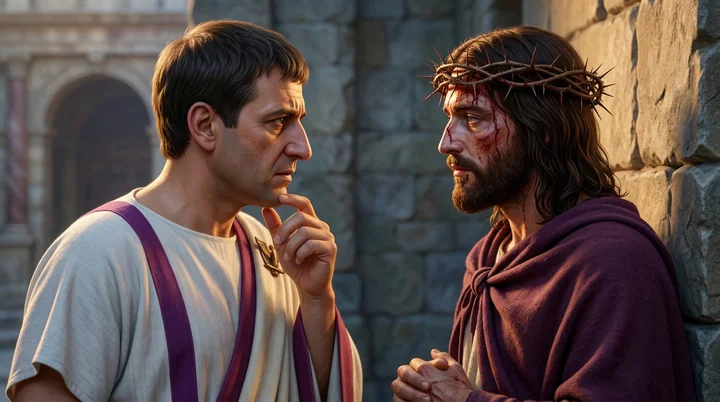
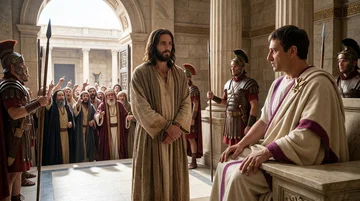
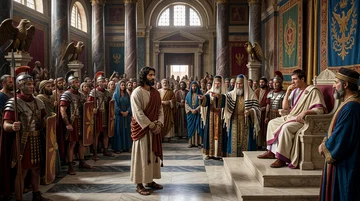
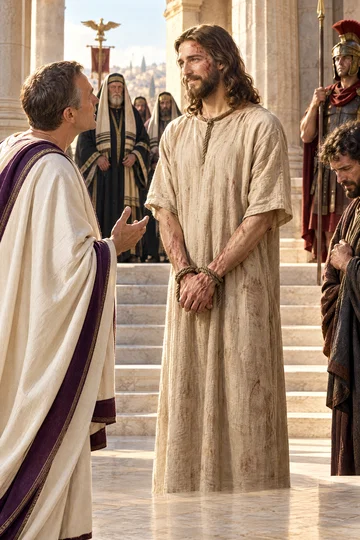
And Jesus stood before the governor: and the governor asked him, saying, Art thou the King of the Jews? And Jesus said unto him, Thou sayest.
Translations
And Jesus stood before the governor: and the governor asked him, saying, Are you the King of the Jews? And Jesus said to him, You say.
King James Version, KJV Cambridge Paragraph Bible
And Jesus stood before the governor: and the governor asked him, saying, Art thou the King of the Jews? And Jesus said unto him, Thou sayest.
And Jesus stood before the governor: and the governor asked him, saying, Art thou the King of the Jews? And Jesus said to him, Thou sayest.
Revised Version, American Standard Version
Now Jesus stood before the governor: and the governor asked him, saying, Art thou the King of the Jews? And Jesus said unto him, Thou sayest.
And Jesus stood before the governor, and the governor did question him, saying, 'Art thou the king of the Jews!' And Jesus said to him, 'Thou sayest.'
But Jesus stood before the governor. And the governor questioned him, saying, Art thou the King of the Jews? And Jesus said to him, Thou sayest.
Now, Jesus, stood before the governor; and the governor questioned him, saying—Thou, art the king of the Jews? And, Jesus, said—Thou, sayest.
Berean Standard Bible, Majority Standard Bible
Meanwhile Jesus stood before the governor, who questioned Him: “ Are You the King of the Jews?”“ You have said so,” Jesus replied.
Now Jesus stood before the governor; and the governor asked him, saying, “ Are you the King of the Jews?”Jesus said to him, “ So you say.”
And Jesus was before the ruler, who put a question to him, Are you the King of the Jews? And Jesus said to him, You say so.
And Iesus stood before ye gouernour, and the gouernour asked him, saying, Art thou that King of the Iewes? Iesus said vnto him, Thou sayest it.
Douay-Rheims (Challoner revision)
And Jesus stood before the governor, and the governor asked him, saying: Art thou the king of the Jews? Jesus saith to him: Thou sayest it.
Pictures
Cross-references 20 of 25
- John 18:33-37
Then Pilate entered into the judgment hall again, and called Jesus, and said unto him, Art thou the King of the Jews?
Pilate asks whether Jesus is king, and Jesus explains his kingdom.
- Luke 23:2-3
And they began to accuse him, saying, We found this fellow perverting the nation, and forbidding to give tribute to Cæsar, saying that he himself is Christ a King.
Jesus is accused of claiming kingship, then questioned by Pilate about being King of the Jews.
- Matthew 27:24
When Pilate saw that he could prevail nothing, but that rather a tumult was made, he took water, and washed his hands before the multitude, saying, I am innocent of the blood of this just person: see ye to it.
Pilate acknowledges Jesus’ innocence but washes his hands and fails to protect him.
- Mark 15:2
And Pilate asked him, Art thou the King of the Jews? And he answering said unto him, Thou sayest it.
Records Pilate’s question about Jesus’ kingship and Jesus’ reply.
- John 19:9-11
And went again into the judgment hall, and saith unto Jesus, Whence art thou? But Jesus gave him no answer.
grouped as trial answer texts
- Matthew 27:20-21
But the chief priests and elders persuaded the multitude that they should ask Barabbas, and destroy Jesus.
The crowd chooses Barabbas for release instead of Jesus.
- Luke 23:13-16
And Pilate, when he had called together the chief priests and the rulers and the people,
Pilate finds no fault in Jesus, as in his examination before the governor.
- Luke 23:8-11
And when Herod saw Jesus, he was exceeding glad: for he was desirous to see him of a long season, because he had heard many things of him; and he hoped to have seen some miracle done by him.
Jesus is questioned before Herod, who mocks him and sends him back to Pilate.
- Matthew 27:19
When he was set down on the judgment seat, his wife sent unto him, saying, Have thou nothing to do with that just man: for I have suffered many things this day in a dream because of him.
Pilate’s wife warns him not to harm Jesus.
- Matthew 27:26
Then released he Barabbas unto them: and when he had scourged Jesus, he delivered him to be crucified.
Jesus is scourged before Pilate hands him over for crucifixion.
- John 18:37
Pilate therefore said unto him, Art thou a king then? Jesus answered, Thou sayest that I am a king. To this end was I born, and for this cause came I into the world, that I should bear witness unto the truth. Every one that is of the truth heareth my voice.
Jesus affirms his kingship and explains the purpose of his coming.
- John 19:12-15
And from thenceforth Pilate sought to release him: but the Jews cried out, saying, If thou let this man go, thou art not Cæsar’s friend: whosoever maketh himself a king speaketh against Cæsar.
The claim that Jesus is King of the Jews recurs in Pilate’s trial.
- Mark 15:4-5
And Pilate asked him again, saying, Answerest thou nothing? behold how many things they witness against thee.
Pilate marvels that Jesus remains silent in the face of accusations.
- Matthew 27:37
And set up over his head his accusation written, THIS IS JESUS THE KING OF THE JEWS.
The written accusation identifies Jesus as King of the Jews.
- Matthew 27:27-31
Then the soldiers of the governor took Jesus into the common hall, and gathered unto him the whole band of soldiers.
Jesus is humiliated and mocked before his crucifixion.
- Isaiah 53:7
He was oppressed, and he was afflicted, yet he opened not his mouth: he is brought as a lamb to the slaughter, and as a sheep before her shearers is dumb, so he openeth not his mouth.
Describes the Messiah’s silence before his accusers.
- Matthew 27:2
And when they had bound him, they led him away, and delivered him to Pontius Pilate the governor.
Identifies Jesus’ delivery to Pilate before this hearing.
- John 18:29-31
Pilate then went out unto them, and said, What accusation bring ye against this man?
The leaders bring Jesus before Pilate and seek his execution.
- Luke 23:4
Then said Pilate to the chief priests and to the people, I find no fault in this man.
summarizes Pilate's verdict of no fault
- Matthew 26:57-68
And they that had laid hold on Jesus led him away to Caiaphas the high priest, where the scribes and the elders were assembled.
Jesus is brought before Caiaphas before appearing before Pilate.
Commentary
Each commentary is drawn from primary sources: the writings of Ellen G. White and Adventist pioneers and periodicals. Each commentary is separate. Its own words are not a quotation; follow the references to read the source passages.
Ellen G. White
9 sources
Jesus stood as a bound prisoner before Pilate, the Roman governor, inside the judgment hall, while the Jewish leaders and the crowd remained outside and pressed the governor to carry out their will.COS 137.2–138.4Ms 29, 1909, par. 12–17DA 723.1–724.1RH Nov 11, 1915 The priests and rulers would not enter the hall because they feared ceremonial defilement before the Passover, though murderous hatred had already defiled their hearts.DA 723.1–724.1 When Pilate asked whether He was the King of the Jews, Jesus answered, Thou sayest, in words that affirmed and acknowledged His kingship.COS 137.2–138.4Ms 29, 1909, par. 12–173SP 130.2–131.25RED 50.2–51.1ST Jul 4, 1878
That acknowledgment did not mean He was seeking to establish an earthly throne in opposition to Caesar.ST Jul 4, 1878 The priests, with Caiaphas and the other accusers, falsely treated His answer as an admission that He sought to set up a throne in Judah against Caesar.3SP 130.2–131.25RED 50.2–51.1ST Jul 4, 1878 The related charge that He opposed paying tribute to Caesar was false, for He had plainly approved giving to Caesar what belongs to Caesar.COS 137.2–138.4 He did not directly answer Pilate's underlying question about kingship in the sense Pilate meant it, but asked him privately whether he raised it of himself or on the Jews' accusations, giving Pilate opportunity to recognize his own conviction and seek truth.5RED 50.2–51.1
He stood before Pilate pale, bruised, weakened and exhausted from suffering, yet with noble bearing and calmness and a radiant countenance.3SP 130.2–131.25RED 50.2–51.1ST Jul 4, 1878 Pilate saw in Him no sign of guilt, fear, defiance or sedition, but goodness, nobility, calmness and dignity, and that bearing left Pilate doubtful of the accusations against Him.3SP 130.2–131.2DA 723.1–724.15RED 50.2–51.1 Remembering reports of His works in healing the sick and raising the dead, Pilate resolved to ask what charges the Jews brought against Him.DA 723.1–724.1
The exchange belongs to His humiliation and condemnation in the judgment-hall trial, in which Pilate failed to do justice though Jesus was innocent.Ms 29, 1909, par. 12–174RED 102.2–103.1DA 394.2–3 He is the true Passover lamb, and the leaders' rejection of Him emptied the feast of its meaning.DA 723.1–724.1 The crowd that had hailed Him as king now reviled Him and called for His crucifixion, and this reversal made His condemnation a severe test for His disciples, for which He had prepared His faithful followers so they would not be overwhelmed when He was betrayed and condemned.4RED 102.2–103.1DA 394.2–3 His stand before this hostile power is an example of trust in God's word and faithfulness amid opposition.RH Nov 11, 1915
Sources
Pioneers and periodicals
30 sources
Jesus stood before Pontius Pilate, the Roman governor of Judea, after the chief priests and elders had condemned Him and sought His death, since the power of life and death rested with Rome, in the closing scenes of His trials on the day of His crucifixion.ST Oct 26, 1882RH Feb 13, 1872RH Feb 11, 1862 When the governor asked whether He was King of the Jews, His answer, Thou sayest, calmly affirmed that Pilate had spoken truly.ST Jul 4, 1878ST May 19, 1898ST Jan 17, 1911 His kingship was real, for He was King of the universe who had laid aside His royal prerogative to become the sacrifice for sin, yet it was spiritual and not of this world, establishing His kingdom in the hearts of those who love truth rather than an earthly throne against Caesar.ST Jul 4, 1878ST May 19, 1898ST Jan 17, 1911 Pale, bruised and bound, He stood noble, calm and steadfast, answering without fear or shame, and His dignified composure and silence before false charges astonished Pilate and bore witness to a power higher than Rome knew.ST Jul 4, 1878ST Oct 27, 1898RH Feb 27, 1872RH May 5, 1863 Arraigned before hostile power and delivered to be crucified though declared innocent, He left an example of bearing suffering, shame and loss in faithfulness to God, so that His followers brought before unjust rulers and civil tribunals may find satisfaction in being treated as He was.RH Nov 11, 1915RH Mar 26, 1861RH Jul 30, 1867RH Aug 14, 1860
Trial Before the Governor
Jesus stood before the Roman governor Pontius Pilate, governor of Judea, after the chief priests and elders had condemned him and sought his death.ST Oct 26, 1882RH Feb 11, 1862 A sentence from the Roman governor was necessary before proceeding to execution because the power of life and death was vested in him.RH Feb 11, 1862 This detail agrees with the political order, customs and institutions of that period as known from Tacitus and Josephus and shows the minute accuracy of the Gospel history.RH Feb 11, 1862 The governor asked whether he was the King of the Jews, and he answered, Thou sayest.ST Oct 26, 1882
The verse belongs to the closing scenes of his trials before his crucifixion and burial. It falls within the day of his crucifixion, which included his trial before Pilate, condemnation, suffering and death.RH Feb 13, 1872 That day on which he died for sinful humanity was more momentous than any other day in his history and was the day on which he showed his love for humanity above all others.RH Feb 13, 1872
The trial was a mock trial under the color of public justice in which his very judge declared him innocent yet still delivered him to be crucified.RH Nov 18, 1862 Those who condemned him professed to look for the Messiah, though they had been entrusted with the prophecies of his coming and those prophecies had been minutely fulfilled in him.ST Jun 9, 1898 The Jewish council used threats and intimidation to obtain the Roman governor's approval for the unjust and illegal trial of an innocent man.ST Jun 9, 1898
Pilate called together the chief priests and rulers and people, examined him before them and found no fault touching the accusations, nor had Herod who sent him back found anything worthy of death in him.ST Mar 13, 1901 He proposed to chastise and release him, and spoke again desiring to release him rather than Barabbas who was cast into prison for insurrection and murder.ST Mar 13, 1901 He asked a third time what evil he had done, finding no cause of death in him, but when the crowd cried out together for Barabbas and was instant with loud voices asking that he be crucified, their voices prevailed and Pilate gave sentence that what they asked should be done.ST Mar 13, 1901
The crowd demanded his death and accused him of claiming to be King of the Jews, and when Pilate asked what crime he had committed they answered only by shouting for his crucifixion while Jesus alone remained calm amid the turmoil and appeared innocent.RH Jul 16, 1861 Jew and Gentile joined together in hatred against him in the Roman hall at Pilate's judgment-seat where he was mocked and beaten, crowned and wounded.RH Nov 12, 1872 The last scene of his life on this earth also included standing before Herod's judgment-seat and bearing bitter sarcasm, cruel jest, buffet, spitting, the crown of thorns, the old purple robe, and the final tragedy of the crucifixion.RH Jun 10, 1862 Pondering it in solemn, tearful mood separates the soul from earthly things and points upward to heaven, while it exposes the cruelty, madness and folly of sin and the cruelty of the master whom the world acknowledges.RH Jun 10, 1862
The religious leaders had joined with the state, and he was condemned to death because he did not submit to their traditions which they had enacted as civil law. Caiaphas and the other leaders presented his answer as an admission of guilt, claiming it meant he sought to establish a throne in Judah against Caesar.ST Sep 30, 1886 They used that claim to urge Pilate to sentence him to death.ST Sep 30, 1886
The verse shows God presenting the gospel in its glorious perfection before great Rome, with Jesus standing for the gospel and Pilate standing for Rome as part of God's effort to save rulers.ST Oct 27, 1898 Christ's dignified bearing, so unlike the criminals Pilate knew, trusting in a power higher than Pilate knew and remaining unresentful and unresisting under unproved charges, malignity, scourging and insult, convinces Pilate that before him stands one more than man and appeals to him to do right whatever the consequences.ST Oct 27, 1898 Pilate remains undecided because he fears the Jews, yet God does not leave him but makes one more effort through his loved wife Claudia Procula by giving her a dream-vision of Christ warning Pilate to have nothing to do with that righteous man.ST Oct 27, 1898 Then Pilate refuses to identify himself with the suffering innocent one and seeks to escape responsibility and ease conscience by delivering Jesus to the mob and washing his hands in water.ST Oct 27, 1898
King of the Jews Affirmed
"Thou sayest" is an affirmation that what Pilate has said is true, an acknowledgment in a calm, soft voice that he is indeed King of the Jews.ST Jul 4, 1878ST May 19, 1898ST Jan 17, 1911
He is King of the universe, though he had for a time laid aside his royal prerogative in order to teach righteousness and to become the sacrifice for sin.ST May 19, 1898
His kingship was real even though he stood as a bound prisoner, yet it was spiritual and not of this world, establishing a kingdom in the hearts of those who love truth.ST May 19, 1898ST Jan 17, 1911
It was no seeking to set up an earthly throne in opposition to Caesar, as the priests falsely represented it, while Pilate met the claim with derision and demanded where his armies were.ST Jul 4, 1878ST May 19, 1898ST Jan 17, 1911
He stood before Pilate pale, bruised and exhausted, yet noble and calm.ST Jul 4, 1878
He stood undaunted, answering without fear or shame, courageous and steadfast in truth, with a courage joined to the gentleness, innocence and peace of a lamb.ST Jul 4, 1878RH May 5, 1863
His steady composure and bearing, and his silence under the false charges, astonished Pilate.RH Feb 27, 1872
His calm self-possession in the judgment hall exemplifies repose as a steady mind sustained by faith in God even amid turmoil and pressure.RH Feb 27, 1872ST Jul 29, 1886
He chose to answer the governor's question at his trial, in contrast with other questions at his trial which he refused to answer.ST May 6, 1897
He spoke with Pilate in a language common to them both, which proves his ability to speak the Greek of his period.RH May 20, 1915
He knew enough of the other languages used in Palestine to converse with him.ST Mar 10, 1881
Syriac, or West Aramaic, was the language of the common people and the one he commonly spoke, Latin was used in official life, Greek in polite intercourse, and Hebrew remained familiar through the Scriptures.ST Mar 10, 1881
Example Warning and Appeal
The Lord of life arraigned before the governor facing suffering and shame is an example of bearing suffering, shame and loss rather than turning away from them.RH Mar 26, 1861 Standing before Pilate's judgment hall under an unjust ruler belongs to the path of suffering that Christians follow when they take up the cross and follow Christ.RH Jul 30, 1867 Christian perfection includes following Christ to stand before an unjust governor, rather than consisting in extraordinary revelations or joyful spiritual experiences.RH Jul 30, 1867RH Aug 14, 1860
His standing before hostile power while Jewish priests and rulers press the governor to carry out their will is an example of trust in God's word and faithfulness amid opposition.RH Nov 11, 1915 As the divine Master stood before a civil governor, his disciples and followers can find satisfaction if they too are brought before civil tribunals, since they are being treated as he was.RH Nov 11, 1915
Reading the account of his sufferings before the governor subdues pride and removes discontent.ST Apr 17, 1879 Pondering the last scene of his life on this polluted earth — sitting at Pilate's bar together with standing before Herod's judgment-seat, bearing bitter sarcasm, cruel jest, buffet, spitting, the crown of thorns, the old purple robe, and the final tragedy of the crucifixion — in solemn, tearful mood separates the soul from earthly things and points upward to heaven.RH Jun 10, 1862 It exposes the cruelty, madness and folly of sin and the cruelty of the master whom the world acknowledges.RH Jun 10, 1862 Going before Pilate and enduring the judgment hall represents willingness to go with him as far as Gethsemane and Pilate's court, but not the complete consecration represented by the sacrifice that gives its life at Calvary.ST Sep 12, 1900
The rejection of the light given them in him by the chief priests and elders, who misled the people at his trial before the governor, is the pattern for the rejection of greater light now.RH Jun 13, 1865 Protestant churches now reject God's holy law and the testimony of the Old and New Testaments concerning the fulfillment of prophecy and the truths for the last perilous days, cover those truths with error and confusion, and warn the people against those who spread them as heresy and fanaticism.RH Jun 13, 1865 Pilate in his dealing with Jesus as King of the Jews stood against the word of God and against truth, belonging with those who lifted hands against God's plans and precepts and set themselves against the Rock of the word.ST Jul 15, 1908 His name lives only in infamy, written in hopeless doom, and he is dead while the Rock stands.ST Jul 15, 1908 Christ standing before Pilate in humility in the scene of Christ before Pilate stands in contrast with the Pope, and this contrast serves as an appeal to Catholics and Protestants.RH Dec 28, 1911RH Dec 21, 1911
Sources