Zechariah 11:12
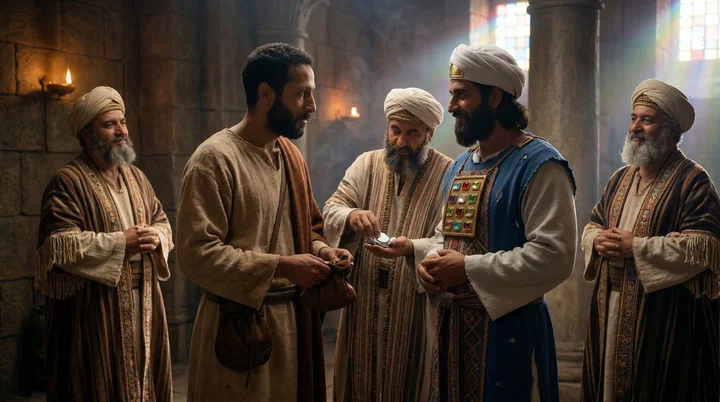
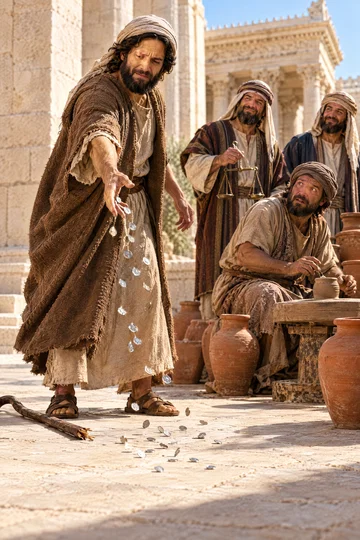
And I said unto them, If ye think good, give me my price; and if not, forbear. So they weighed for my price thirty pieces of silver.
Translations
And I said to them, If you think good, give me my price; and if not, forbear. So they weighed for my price thirty pieces of silver.
King James Version, KJV Cambridge Paragraph Bible
And I said unto them, If ye think good, give me my price; and if not, forbear. So they weighed for my price thirty pieces of silver.
And I said to them, If ye think good, give me my price; and if not, forbear. So they weighed for my price thirty pieces of silver.
Revised Version, American Standard Version
And I said unto them, If ye think good, give me my hire; and if not, forbear. So they weighed for my hire thirty pieces of silver.
And I say unto them: 'If good in your eyes, give my hire, and if not, forbear;' and they weigh out my hire — thirty silverlings.
And I said unto them, If ye think good, give [ me] my hire; and if not, forbear. And they weighed for my hire thirty silver-pieces.
Then said I unto them, If it be good in your eyes, give me my wage, and, if not, forbear. So they weighed out my wage, thirty pieces of silver.
Berean Standard Bible, Majority Standard Bible
Then I told them, “If it seems right to you, give me my wages; but if not, keep them.” So they weighed out my wages, thirty pieces of silver.
I said to them, “If you think it best, give me my wages; and if not, keep them.” So they weighed for my wages thirty pieces of silver.
And I said to them, If it seems good to you, give me my payment; and if not, do not give it. So they gave me my payment by weight, thirty shekels of silver.
And I said vnto them, If ye thinke it good, giue me my wages: and if no, leaue off: so they weighed for my wages thirtie pieces of siluer.
Douay-Rheims (Challoner revision)
And I said to them: If it be good in your eyes, bring hither my wages: and if not, be quiet. And they weighed for my wages thirty pieces of silver.
Pictures
Cross-references
- Matthew 27:9-10
Then was fulfilled that which was spoken by Jeremy the prophet, saying, And they took the thirty pieces of silver, the price of him that was valued, whom they of the children of Israel did value;
Judas’s betrayal payment and its use fulfill Zechariah’s prophecy of the silver price.
- Matthew 26:15
And said unto them, What will ye give me, and I will deliver him unto you? And they covenanted with him for thirty pieces of silver.
Judas agrees to betray Jesus for thirty pieces of silver.
- Exodus 21:32
If the ox shall push a manservant or a maidservant; he shall give unto their master thirty shekels of silver, and the ox shall be stoned.
Sets thirty pieces of silver as compensation for a slave.
- Matthew 27:3-5
Then Judas, which had betrayed him, when he saw that he was condemned, repented himself, and brought again the thirty pieces of silver to the chief priests and elders,
Judas returns the thirty pieces of silver and confesses his betrayal.
- Mark 14:10-11
And Judas Iscariot, one of the twelve, went unto the chief priests, to betray him unto them.
Judas seeks to hand Jesus over, and the priests promise him money.
- Exodus 30:12-16
When thou takest the sum of the children of Israel after their number, then shall they give every man a ransom for his soul unto the LORD, when thou numberest them; that there be no plague among them, when thou numberest them.
The half-shekel payment is described as the price of redemption.
- John 12:4-6
Then saith one of his disciples, Judas Iscariot, Simon’s son, which should betray him,
Judas’s greed is exposed during Mary’s anointing of Jesus.
Commentary
Each commentary is drawn from primary sources: the writings of Ellen G. White and Adventist pioneers and periodicals. Each commentary is separate. Its own words are not a quotation; follow the references to read the source passages.
Ellen G. White
18 sources
The shepherd asks those he has led for his wages, and they weigh out for him thirty pieces of silver.Ms 23, 1898, par. 5–9DA 716 That sum was the price of a slave, a paltry and contemptuous valuation that marked the rejection of the Lord and the price set upon the Son of God for humiliation and death.5RED 46.2–33SP 126.3Ms 120, 1897, par. 1–2COS 133.2DA 716.2–3 It was fulfilled when Judas, one of His own disciples, sold his divine Master to the priests and rulers for that exact amount, and the money afterward cast down in the house of the Lord stood as a testimony to Christ's innocence.5RED 46.2–3ST Jun 27, 18783SP 81.35RED 3.2DA 716 His covetous love of money led him to persist against every call to repentance until remorse came too late, making his betrayal of the Lord of glory a warning of the ruin that follows one cherished sin.ST Jun 27, 1878ED 150.2–4Ms 2, 1883, par. 15–16ST Nov 17, 1909Lt 63a, 1893, par. 18–21
Rejected Shepherd Prophesied
The verse belongs to the prophecy of the rejected shepherd, in which the shepherd asks the people to give him his price if they think good, and they value him at thirty pieces of silver.Ms 23, 1898, par. 5–9DA 716 In that setting the poor of the flock recognize the Lord's word, while the shepherd's covenant is signified and the staff are broken.Ms 23, 1898, par. 5–9 The thirty pieces of silver named as his price was the price of a slave.Ms 120, 1897, par. 1–2COS 133.2DA 716.2–3 To value him at that sum was to betray the Lord of glory to humiliation and death.Ms 120, 1897, par. 1–2
That sum was a paltry valuation, marking the rejection of the Lord.ST Jun 27, 18783SP 81.3SLP 277.25RED 3.2 It was the price assigned to God's Son, the Lord of life and glory sold by one of His own disciples.5RED 46.2–35RED 3.2 The amount itself, and the act of weighing it out, foretold the betrayal by Judas.Ms 120, 1897, par. 20 What was foretold was fulfilled in prophetic vision in the events surrounding the trial of Jesus, when Judas agreed to betray Him and sold Him to the priests and rulers for thirty pieces of silver.5RED 46.2–33SP 126.3ST Jun 27, 18783SP 81.3COS 132 The thirty silver pieces were then cast to the potter in the house of the Lord, directly fulfilling the prophecy and becoming a testimony to His innocence.3SP 126.3ST Jun 27, 1878
Betrayal Motive and Warning
The weighing of thirty pieces of silver was fulfilled when one of His own disciples agreed to betray Him to the priests and rulers for that sum.3SP 81.35RED 3.2DA 716ST Jun 27, 1878 In that bargain the divine Master, the Lord of life and glory, was sold for silver at a paltry price.3SP 81.35RED 3.2ST Jun 27, 1878 Love of money and covetousness, with a selfish character, led Judas to make the betrayal.ST Jun 27, 1878Lt 63a, 1893, par. 18–21 He expected Jesus to escape His captors and display His power.ST Jun 27, 1878 When Jesus instead submitted to abuse and death, Judas understood the full weight of his act and was filled with remorse.ST Jun 27, 1878
He sold Christ for thirty pieces of silver after repeatedly resisting efforts to awaken his conscience and lead him to repentance.Ms 2, 1883, par. 15–16 His refusal to surrender and confess led to his ruin.Ms 2, 1883, par. 15–16 His betrayal of the Lord of glory for thirty pieces of silver stands as a warning of the ruin that can follow one cherished sin.ED 150.2–4ST Nov 17, 1909 It is presented as a warning of the ruinous result of sin.ED 150.2–4ST Nov 17, 1909
Sources
Pioneers and periodicals
30 sources
The shepherd who asks for his wages stands for Christ in His ministry to the Jews, and the thirty pieces weighed out to Him was the price of a common slave, a paltry sum showing how little His own people valued their Lord and Master.ST Dec 24, 1894ST Sep 20, 1910ST Nov 8, 1883ST Oct 26, 1882ST Mar 25, 1897 The prophecy foretold in plain terms that the Messiah would be sold for that sum into the hands of His persecutors, and it was fulfilled literally at His first advent as recorded in Matthew 26:14-15.RH Nov 18, 1862RH Jun 24, 1858RH Mar 8, 1915 Judas bargained with the chief priests to deliver Jesus to them, and after being rebuked over Mary's anointing he sold his Master for the thirty pieces they weighed out.ST Dec 10, 1902RH Dec 10, 1867ST Sep 20, 1899 In remorse he cast the money into the temple, and the priests took that price of blood, which had come from the temple funds, and bought the potter's field for strangers, leaving it a testimony to His innocence.ST Jun 27, 1878ST Sep 20, 1910RH Sep 9, 1902 Judas fell through love of money and covetousness, and his selling of the Lord of glory warns that all who reject Christ for base gain repeat his ruinous betrayal.ST Jun 27, 1878ST Nov 17, 1909RH Aug 21, 1913
Shepherd, Flock, and Price
The shepherd in the prophecy stands for Christ's ministry to the Jews.ST Nov 8, 1883 Israel's spiritual leaders are the shepherds of God's flock, called feeders because their office means both leading and feeding, and their utter unfitness for feeding God's flock stands condemned by this, while that leading and feeding is the work Jesus claims as the good shepherd.ST Jul 1, 1886 The breaking of the staff Beauty signifies that Christ's protection of Jerusalem would be withdrawn when the Jews rejected him as their king.ST Nov 8, 1883
The speaker asks whether the people will pay him and accepts their decision, whether to give his price or to forbear, and they weigh out thirty pieces of silver as his price.ST Oct 26, 1882 That sum weighed out as his price was the price of an ordinary slave, a paltry sum showing how the Lord and Master was valued by the leaders and by the people.ST Sep 20, 1910ST Mar 25, 1897RH Aug 21, 1913 He was sold like a slave for that amount, and the money used to buy him was temple money used for purchasing sacrifices.ST Dec 24, 1894
The verse shows God's people turning against him despite his goodness and betraying the One who came to save them.ST Feb 11, 1897
Betrayal Foretold and Fulfilled
The verse foretells that the Messiah would be sold for thirty pieces of silver into the hands of his persecutors.RH Nov 18, 1862ST Oct 21, 1930ST Jan 7, 1897 It is one of the prophecies of his first advent and earthly experiences, fulfilled literally according to its plain meaning as recorded in Matthew 26:14-15.RH Jun 24, 1858RH Mar 8, 1915RH Dec 16, 1862 Jesus Christ was sold for that predicted sum, and the money paid for his betrayal was the price named in the prophecy.RH Nov 18, 1862RH Dec 10, 1867ST Oct 21, 1930
The fulfillment came when Judas offered to sell Jesus and bargained with the priests and Levites to betray him.ST Dec 10, 1902RH Dec 10, 1867ST Sep 13, 1905 They weighed out thirty pieces of silver for him to deliver Jesus, setting that price for the Son of God's life.ST Dec 10, 1902ST Sep 20, 1899ST Sep 13, 1905 After being rebuked for calling Mary's anointing a waste, Judas went to the chief priests, whose words fulfilled what was spoken centuries earlier.ST Sep 20, 1899ST Jan 10, 1911ST Nov 22, 1910
In remorse Judas returned the money to those who had bribed him and cast it into the temple.ST Jun 27, 1878ST Sep 20, 1910RH Sep 9, 1902 The priests used it to buy the potter's field as a burial place for strangers.ST Sep 20, 1910RH Sep 9, 1902 That money was temple money used for purchasing sacrifices, was regarded as the price of Jesus' blood, and became a testimony to his innocence.ST Jun 27, 1878ST Dec 24, 1894
This verse, together with the next, is the source of Matthew's account of the thirty silver pieces given for the potter's field in Matthew 27:9-10.ST Oct 26, 1882ST Nov 25, 1908RH Sep 9, 1902 The speaker asks whether the people will pay him and accepts their decision, and they weigh out thirty pieces of silver as his price.ST Oct 26, 1882 It stands in a prophecy whose general subject is Christ's kingdom, the great day of the Lord, and the punishment of the wicked.ST Nov 25, 1908
The wording Matthew attributes to Jeremiah may be explained because Jeremiah may have spoken the same prophecy in a writing that has not survived.ST Oct 25, 1910 Zechariah 11-14 may originally have been part of Jeremiah's writings and later been placed under Zechariah's name.ST Oct 25, 1910 The name Jeremiah may also reflect a general prophetic reference or a traditional title for the prophetic writings, and the prophecy concerns the Messiah's suffering.RH Jun 26, 1860 Those who held the other explanation taught that the reference in Matthew to Jeremiah is a copyist's error, since the prophecy is from Zechariah.RH Sep 9, 1902
This rejection of Jesus accompanied Israel's rejection as God's chosen nation to represent him.ST Dec 10, 1902 Israel's fall brought salvation to the Gentiles.ST Dec 10, 1902
Warnings for Today
The thirty pieces weighed out mark the price for which Judas sold his divine Master, and love of money and covetousness led him to make that bargain.ST Jun 27, 1878 He expected Jesus to escape from his captors and display his power, but when Jesus submitted to abuse and death Judas understood the full weight of what he had done and was filled with remorse.ST Jun 27, 1878 That selling of the Lord of glory for thirty pieces of silver stands as a warning of the ruinous result of sin, fulfilling the picture of a people valuing him at the price of a slave.ST Nov 17, 1909RH Aug 21, 1913 Some in every age repeat this betrayal by rejecting Christ for something base.RH Aug 21, 1913
Christ could have offered more to secure the loyalty of the betrayer, but chose self-denial rather than purchase it.ST Oct 10, 1911 The weighing out of the price measures what truth was valued at.ST Apr 10, 1907 Purses of thirty pieces of silver are still used as a price for the perversion of truth.ST Apr 10, 1907
The price also serves as an image of corrupt wages, for earning a family's bread through wrongdoing betrays Christ in the poor and weak. No one can rightly bring home the wages of corruption. The silver itself had no moral character, but Judas was responsible for betraying Jesus.ST Aug 30, 1905
Sources