Matthew 27:9
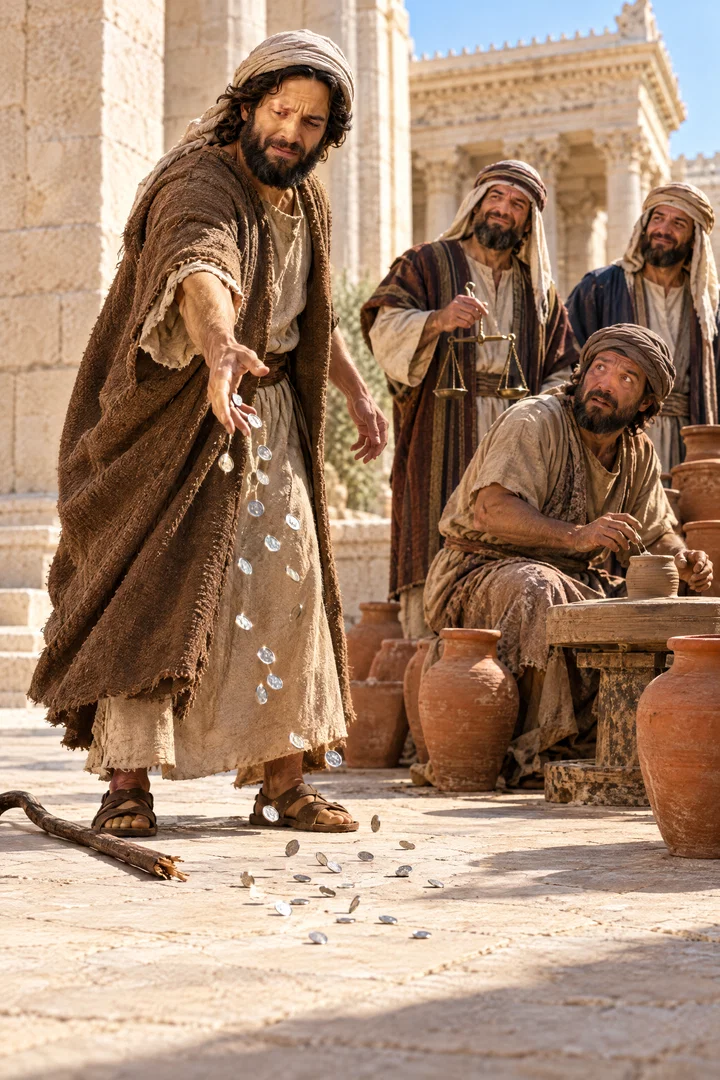
Then was fulfilled that which was spoken by Jeremy the prophet, saying, And they took the thirty pieces of silver, the price of him that was valued, whom they of the children of Israel did value;
Translations
American King James Version, King James Version
Then was fulfilled that which was spoken by Jeremy the prophet, saying, And they took the thirty pieces of silver, the price of him that was valued, whom they of the children of Israel did value;
Then was fulfilled that which was spoken by Jeremie the prophet, saying, And they took the thirty pieces of silver, the price of him that was valued, whom they of the children of Israel did value;
Then was fulfilled that which was spoken by Jeremiah the prophet, saying, And they took the thirty pieces of silver, the price of him that was valued, whom they of the children of Israel did value;
Then was fulfilled that which was spoken by Jeremiah the prophet, saying, And they took the thirty pieces of silver, the price of him that was priced, whom certain of the children of Israel did price;
Then was fulfilled that which was spoken through Jeremiah the prophet, saying, And they took the thirty pieces of silver, the price of him that was priced, whom certain of the children of Israel did price;
Then was fulfilled that spoken through Jeremiah the prophet, saying, 'And I took the thirty silverlings, the price of him who hath been priced, whom they of the sons of Israel did price,
Then was fulfilled that which was spoken through Jeremias the prophet, saying, And I took the thirty pieces of silver, the price of him that was set a price on, whom [ they who were] of the sons of Israel had set a price on,
Then, was fulfilled, that which was spoken through Jeremiah the prophet, saying: And they took the thirty pieces of silver, as the value of him whom they had valued, whom they had valued, of Israel’s sons,—
Berean Standard Bible, Majority Standard Bible
Then what was spoken through Jeremiah the prophet was fulfilled:
“ They took the thirty pieces of silver,
the price set on Him by the people of Israel,Then that which was spoken through Jeremiah the prophet was fulfilled, saying,
“ They took the thirty pieces of silver,
the price of him upon whom a price had been set,
whom some of the children of Israel priced,Then came true that which was said by Jeremiah the prophet, And they took the thirty bits of silver, the price of him who was valued by the children of Israel;
(Then was fulfilled that which was spoken by Ieremias the Prophet, saying, And they tooke thirtie siluer pieces, ye price of him that was valued, whom they of ye children of Israel valued.
Douay-Rheims (Challoner revision)
Then was fulfilled that which was spoken by Jeremias the prophet, saying: And they took the thirty pieces of silver, the price of him that was prized, whom they prized of the children of Israel.
Pictures
Cross-references
- Zechariah 11:12-13
And I said unto them, If ye think good, give me my price; and if not, forbear. So they weighed for my price thirty pieces of silver.
Prophesies the thirty pieces of silver paid for Jesus and their casting to the potter.
- Matthew 26:14-15
Then one of the twelve, called Judas Iscariot, went unto the chief priests,
Judas agrees to betray Jesus for thirty pieces of silver.
- Matthew 27:5
And he cast down the pieces of silver in the temple, and departed, and went and hanged himself.
Judas returns the silver and hangs himself.
- Acts 1:18
Now this man purchased a field with the reward of iniquity; and falling headlong, he burst asunder in the midst, and all his bowels gushed out.
Says Judas bought the field; the money was his wages.
- Exodus 21:32
If the ox shall push a manservant or a maidservant; he shall give unto their master thirty shekels of silver, and the ox shall be stoned.
Thirty shekels was the prescribed compensation for a slave.
- Acts 1:25
That he may take part of this ministry and apostleship, from which Judas by transgression fell, that he might go to his own place.
Judas’s death is described as going to his own place.
- Matthew 26:20-75
Now when the even was come, he sat down with the twelve.
The passage recounts the events leading to Christ’s death.
Commentary
Each commentary is drawn from primary sources: the writings of Ellen G. White and Adventist pioneers and periodicals. Each commentary is separate. Its own words are not a quotation; follow the references to read the source passages.
Ellen G. White
4 sources
The thirty pieces of silver paid for Jesus fulfilled prophecy, being the price that Israel's leaders assigned to the one they valued.Ms 29, 1909, par. 12–17 The act with the thirty pieces fulfilled Zechariah's prophetic vision of the trial of Jesus and the price placed upon him.3SP 126.3 Judas's confession testified to Jesus' innocence.3SP 126.3
Judas died by his own hand by hanging from a tree; the cord broke, his falling body beneath the tree was mangled, and his remains were ordered buried at once.5RED 68.2ST Jul 18, 1878 The hanging was from a lifeless tree in a retired place on the way to Calvary, his own weight breaking the cord, and before burial his horribly mangled body was being devoured by dogs.5RED 68.2
His death was seen as retribution for the betrayal and the blood of Jesus, bringing fearful thoughts to the crowd and to those who had condemned Jesus, as retribution seemed already to be falling upon them.5RED 68.2ST Jul 18, 1878 The sight of that retribution stopped for a time the loud triumphant shouts of the crowd as they hurried Jesus away, leaving quieter mockery and many pale faces.5RED 68.2
Sources
Pioneers and periodicals
25 sources
The verse declares fulfilled the prediction that the Messiah would be valued by the children of Israel at thirty pieces of silver and that the silver would be cast to the potter in the house of the Lord.RH Nov 18, 1862 Judas sold his Lord to the priests for that price, the price of a slave, then in remorse cast the money into the temple, and the priests used it to buy the potter's field for the burial of strangers, which is counted as Judas buying it because it was bought with his wages of betrayal after the crucifixion.RH Sep 9, 1902ST Oct 21, 1930ST Sep 20, 1910ST Oct 26, 1882 The words named for Jeremy are found in Zechariah 11:12-13, where the name Jeremiah stands at the head of the prophetic division beginning with Jeremiah, while others hold the name to be a copyist's confusion of abbreviations and still others that Jeremiah spoke the same prophecy in a writing since lost or in Zechariah 9-14 which once belonged to him.RH Jun 26, 1860ST Oct 26, 1882RH Sep 11, 1860ST Oct 25, 1910ST Sep 16, 1913 The difference in the prophet's name does not discredit the testimony to Christ, for an incidental detail no more overthrows inspired authority than uncertainty over lesser facts.RH Jun 26, 1860ST Nov 25, 1908 The price men set to drive Love from them stands against Christ's gift of His blood for every lost soul, and Judas was not compelled by foreknowledge or by the silver itself, for money has no character and the guilt was his own in choosing selfishness unto despair, a warning that money gained by wickedness and by harming the poor and weak is the tainted wages of betraying Christ in their person.ST Jun 24, 1913ST Oct 11, 1905ST Aug 30, 1905ST Mar 6, 1884
Quotation, Price, and Fulfillment
The verse declares fulfilled the prediction that the Messiah would be sold for thirty pieces of silver, the price of him that was valued by the children of Israel, and that the silver would be cast to the potter in the house of the Lord.RH Nov 18, 1862 Judas negotiated with the priests and sold his Lord for thirty pieces of silver, the price of an ordinary slave and the price set on Jesus by Israel's leaders.RH Sep 9, 1902ST Sep 20, 1910ST Dec 10, 1902 When appalled by what he had done he returned the money and cast it into the temple, and the priests used it to buy the potter's field, where strangers were buried.RH Sep 9, 1902ST Oct 21, 1930ST Sep 20, 1910ST Dec 10, 1902
The fulfillment belongs to Matthew's account of Judas and the use of the money he returned.ST Oct 26, 1882 The potter's field was bought after the crucifixion, and to say Judas bought it means it was bought with the money that belonged to him as the wages of his betrayal.ST Oct 26, 1882 The words quoted under the name of Jeremy the prophet are found in Zechariah, not in Jeremiah, specifically the passage about the thirty pieces of silver given for the potter's field as the Lord appointed in Zechariah 11:12-13.RH Jun 26, 1860ST Oct 26, 1882RH Sep 11, 1860ST Oct 25, 1910RH Sep 9, 1902
The name Jeremiah may reflect a broad or loose way of citing the Prophets, a running title for prophetic sections, or a name used for predictions about the Messiah's suffering.RH Jun 26, 1860 The Old Testament was divided into three parts, the Law, the Psalms, and Jeremiah, with the third division beginning with Jeremiah and including Zechariah and the other prophets, so every quotation from that division goes under the name Jeremiah which stood at its head.ST Oct 26, 1882 The attribution can also be explained by the Jewish practice of calling the prophetic section of Scripture Jeremiah because it began with that book, by Matthew quoting the prophet without naming him as in other passages, and by the fact that some ancient manuscripts and translations omit the prophet's name.RH Sep 11, 1860
The name Jeremy is an error of the copyist, who confused abbreviated names for Zechariah and Jeremiah.RH Sep 11, 1860RH Sep 9, 1902 Matthew's attribution to Jeremiah may reflect a name mistakenly copied from Isaiah 8:2, where Zechariah son of Jeberechiah is named.RH Jun 8, 1911 Jeremiah may have spoken the same prophecy in a writing that has since been lost, to which the Jews of Jesus' time still had access.ST Oct 25, 1910ST Sep 16, 1913
Zechariah 9 through the end of the book, including chapters 9-14, may have originally belonged to Jeremiah and later been placed under Zechariah's name in a manuscript that became separated from Jeremiah's writings.ST Oct 25, 1910ST Sep 16, 1913ST Aug 22, 1911 This is supported by the claim that their language resembles Jeremiah's, that the phrase the burden of the word of the Lord is associated with Jeremiah, that Jeremiah's spirit was in Zechariah, and that Zechariah 9-11 drew on Jeremiah, which is why some textual critics assign those chapters to Jeremiah.RH Sep 11, 1860ST Oct 25, 1910ST Sep 16, 1913ST Aug 22, 1911 The difference in attribution does not discredit Matthew's testimony about Jesus Christ or affect the prophecy.RH Jun 26, 1860ST Nov 25, 1908 An incidental detail such as uncertainty about how many people were baptized does not disprove inspired authority, and the prophecy belongs to a section of Zechariah that predicts Christ's kingdom, the day of the Lord, and the punishment of the wicked.RH Jun 26, 1860ST Nov 25, 1908
This fulfillment at the crucifixion, when the money paid for Jesus whom Israel's leaders valued was cast into the temple and used to buy the potter's field, is one of many ancient prophecies completed during the events of that single day.ST Oct 21, 1930
Doctrine and Moral Application
The thirty pieces of silver belong with silver as the biblical symbol of redemptive value, for Christ's redeeming merit is the ground on which the church rests, and its foundation is provided by God and not by human effort.ST Mar 18, 1897 He was valued at thirty pieces of silver, the price Judas set for him, and the price men gave to drive Love from them stands against his gift of his blood for every lost soul.ST Oct 11, 1905 The temple money used to buy sacrifices became the payment for selling him as a slave for the price set on him.ST Dec 24, 1894 The verse is part of the account of the Messiah being cut off in the midst of the seventieth week, when the Lord of the Sabbath was nailed to the cross as the great sacrifice for human sin.
Matthew 27 is evidence that Jesus was crucified at the last Passover he attended, in A.D. 31, a date used to calculate the length and timing of his ministry.ST Dec 23, 1897 Judas's confession after the deed shows he could have acted differently, for Scripture's foreknowledge did not compel him to sin, and he had opportunities to repent up to nearly the time his plans were completed, but selfishness shaped his character and his remorse ended in despair and suicide.ST Jun 24, 1913 After his betrayal his body was found beneath the tree where he had hanged himself, and after the cord broke his fall mangled his body and it was ordered buried, bringing fearful thoughts to those who had condemned Jesus as retribution for his betrayal and as if Jesus' blood were already falling upon them.ST Jul 18, 1878 The chapter's account of Christ's sufferings subdues pride and removes discontent.ST Apr 17, 1879
The church-state union in Christ's time used civil power to condemn Jesus to death because he did not submit to religious traditions made into civil law, illustrating how an empowered church may oppose God when people refuse its ordinances. The verse belongs to the trial of Jesus before the chief priests and elders, who rejected the light given them, misled the people, and covered truth with error and confusion, and that rejection is the same crime committed in 1865 by the Protestant churches and Christendom, only greater because the light they reject about God's holy law and the fulfillment of prophecy in the Old and New Testaments for the last perilous days is greater, while they call those truths heresy and fanaticism and spread a counterfeit Christianity marked by deceivableness.RH Jun 13, 1865 Judas and Pilate set themselves against the word of God and its plans and precepts, standing with Nimrod, the Pharaohs, Sennacherib, Agag, Belshazzar, Alexander, Antiochus, Herod, Nero and others whose names would have been lost in oblivion except for opposition to truth and now live only in infamy, yet the men are dead while the Rock of the word still stands.ST Jul 15, 1908
Judas's betrayal was not caused by the thirty pieces of silver themselves, for money has no character, and the guilt belonged to Judas, the man who betrayed Jesus.ST Aug 30, 1905 The thirty pieces of silver are the wages of corruption for betraying Christ, and taking money through wickedness betrays Christ in the person of the poor and weak.ST Mar 6, 1884 Bringing home money earned by betraying morality and harming the weak is like carrying home Judas's tainted payment, which no one can rightly bring home as support for a family.ST Mar 6, 1884
Sources