Translations
American King James Version, King James Version, Webster Bible
And he opened his mouth, and taught them, saying,
and he opened his mouth, and taught them, saying,
Revised Version, American Standard Version
and he opened his mouth and taught them, saying,
and having opened his mouth, he was teaching them, saying:
and, having opened his mouth, he taught them, saying,
and, opening his mouth, he began teaching them, saying:—
Berean Standard Bible, Majority Standard Bible
and He began to teach them, saying:
He opened his mouth and taught them, saying,
And with these words he gave them teaching, saying,
And he opened his mouth and taught them, saying,
Douay-Rheims (Challoner revision)
And opening his mouth, he taught them, saying:
Pictures
Cross-references
- Luke 6:17-20
And he came down with them, and stood in the plain, and the company of his disciples, and a great multitude of people out of all Judæa and Jerusalem, and from the sea coast of Tyre and Sidon, which came to hear him, and to be healed of their diseases;
A parallel account of Jesus teaching the gathered multitude.
- Matthew 7:28-29
And it came to pass, when Jesus had ended these sayings, the people were astonished at his doctrine:
The people are astonished at Jesus’ authoritative teaching after the sermon.
- Luke 6:20-49
And he lifted up his eyes on his disciples, and said, Blessed be ye poor: for yours is the kingdom of God.
A parallel account of Jesus’ teaching to the people.
- Matthew 4:25
And there followed him great multitudes of people from Galilee, and from Decapolis, and from Jerusalem, and from Judaea, and from beyond Jordan.
Jesus’ teaching and healing drew the multitude that heard Him.
- Matthew 5:17-20
Think not that I am come to destroy the law, or the prophets: I am not come to destroy, but to fulfil.
Christ continues the teaching begun in the sermon with instruction about the law and its commandments.
- Deuteronomy 18:18
I will raise them up a Prophet from among their brethren, like unto thee, and will put my words in his mouth; and he shall speak unto them all that I shall command him.
Christ is the promised prophet who speaks God’s words.
Commentary part 1 of 2
Each commentary is drawn from primary sources: the writings of Ellen G. White and Adventist pioneers and periodicals. Each commentary is separate. Its own words are not a quotation; follow the references to read the source passages.
Ellen G. White
120 sources
The verse opens the Sermon on the Mount and introduces the Beatitudes that describe the character, principles, and rewards of those who belong to the heavenly kingdom.Lt 258, 1907, par. 12–14Lt 202, 1908, par. 7–11Lt 86, 1908, par. 7–12Lt 39, 1895, par. 25 He spoke after going up into the mountain and sitting down, with His disciples gathered close beside Him in an inner circle, while the assembled multitudes also listened.Lt 202, 1908, par. 7–11Ms 49, 1912, par. 10–15Ms 129, 1907, par. 13–26Lt 8, 1910, par. 4–8Ms 241, 1902, par. 6–7 He taught plainly, simply, and distinctly with divine authority, so that even the poor, unlearned, and ordinary people could grasp His meaning.Ms 187, 1903, par. 2–5Lt 96, 1902, par. 12–147T 269.4–55T 253.2–254.1Ms 187, 1903, par. 6–10 Instead of the earthly glory and political freedom many expected, He set forth the principles of His kingdom of divine grace, unfolding the same law proclaimed at Sinai and showing how it is to be lived in heart and life.DA 299.34RED 56.2ST Apr 19, 1877Ms 8, 1902, par. 9–10 His words are golden treasures of truth to be studied, cherished, and obeyed in every detail as the standard for building Christlike character and finding true happiness.Ms 201, 1898, par. 8–9Ms 201, 1898, par. 11ST May 10, 1910Lt 48, 1911, par. 5–6Lt 202, 1908, par. 12
Setting and Audience
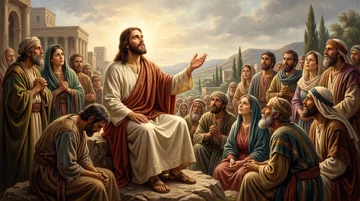
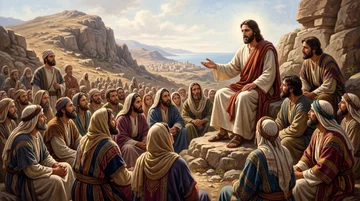
And he opened his mouth to teach after seeing the multitudes, going up into a mountain, sitting down, and having His disciples come to Him, with the multitudes also present to hear the blessings on the poor in spirit, those who mourn, the meek, those who hunger and thirst after righteousness, the merciful, the pure in heart, the peacemakers and those persecuted for righteousness, the call to be the salt of the earth and the light of the world whose good works glorify the Father in heaven, and the declaration that He came to fulfil the law and the prophets and that righteousness must exceed that of the scribes and Pharisees to enter the kingdom of heaven.Lt 202, 1908, par. 7–11Ms 49, 1912, par. 10–15Lt 8, 1910, par. 4–8Ms 55, 1909, par. 1–3Ms 36, 1898, par. 6–8 The sermon was especially for the disciples, but the multitude also heard it, after the apostles were appointed, as Jesus sat on a level place on the mountainside with the disciples and the crowd gathered around Him.DA 298.2–3
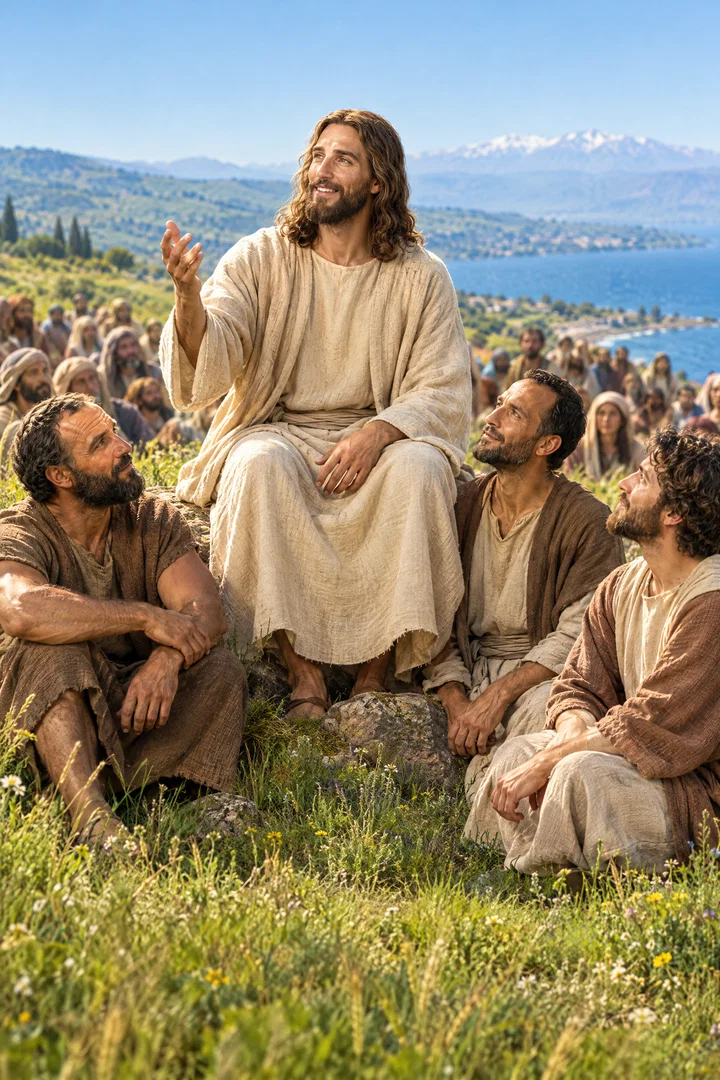
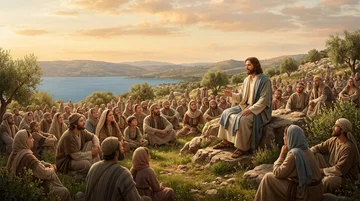
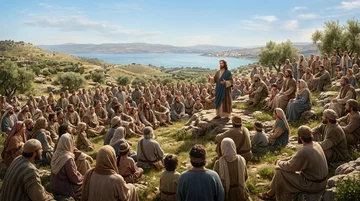
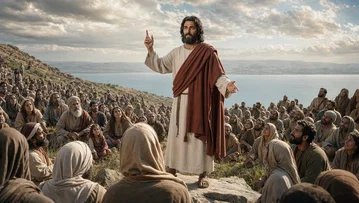
The teaching was given outdoors on a mountainside a short distance from the Sea of Galilee or Lake of Gennesaret, on a grassy high plain overlooking the lake, beneath trees and groves, where open fields could hold the crowds.ST Dec 11, 1879ST Dec 19, 1916STMH 52.2ST Apr 19, 1877 It was a level place described as a peaceful and beautiful setting, unlike the fearful signs at Sinai, whose words would carry His teaching down through the ages to explain how God's law is to be lived out in practical life in clear, simple, forceful words.ST Dec 11, 1879 That unnamed mountain beside the Lake of Gennesaret becomes the Mount of Blessing and mount of the beatitudes, replacing Gerizim, because Israel fell short of the high ideal set before her and another than Joshua must guide God's people to the true rest of faith, and the words come as a benediction to a sinning and sorrowing world. The lessons are grasped by sitting in imagination with the disciples on the mountainside and entering into the thoughts and feelings that filled their hearts, which gives the words new vividness and beauty and gathers their deeper lessons. Jesus often taught outdoors and withdrew with His disciples to quiet places, preferring open-air settings such as fields, groves, and lakesides, where familiar features of nature could illustrate divine truth, turn thoughts from artificial things, and lead hearers from the works of creation to God and the principles of His kingdom in lessons of simplicity, faith, and self-denial.ST Dec 19, 1916MH 52.2ST Apr 19, 1877
A night of prayer and communion with the Father preceded this important work of teaching, for He resorted to the solitude of the mountains to seek communion with God before some great trial or important work, so that divine communion leads to acts of power.MH 509.1ST Aug 31, 1915 The sermon followed the calling of the twelve to the apostolate, with the disciples called up into the mount with Him before going out on their mission.ST Dec 19, 1916ST Jul 27, 1915 He rose long before daybreak on the shores of Lake Gennesaret near Capernaum to meditate and pray and refresh His spiritual strength by communion with God while the disciples were still sleeping, and as soon as it was day crowds who had learned where He was hastened to the lakeside anxious to hear the word of truth.Ms 60, 1902, par. 1–218MR 83.1–2
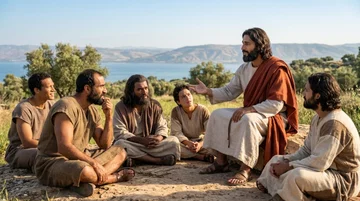
The discourse was spoken especially for the disciples, who were drawn close beside Him in an inner circle so the truths would be firmly impressed on them and their attention would not be diverted.4RED 56.2ST Apr 19, 18772SP 203.2 He withdrew from the turmoil of crowded cities, sat with His disciples close beside Him, and taught slowly and distinctly so that the Holy Spirit would impress His words on their memories, that they would neither miss nor misinterpret, but would remember clearly, receive the truth from Him, and later repeat, write, and carry it to people who did not know it in every land and age.Ms 129, 1907, par. 13–26Ms 241, 1902, par. 6–72SP 203.2 Its words remain a guide to the faithful and their work, beginning with the Beatitudes and continuing through the call to be the earth's salt and the world's light, whose good conduct is to make truth visible and bring glory to God.Ms 129, 1907, par. 13–26 While directed especially to His disciples in setting out the principles governing His kingdom of divine grace rather than the earthly glory and political freedom many expected, its words were also meant for the assembled crowd.4RED 56.2ST Apr 19, 18772SP 203.2
Those who heard included a large mixed gathering and great multitudes that followed Him from Galilee, Decapolis, Jerusalem, Judea, and beyond Jordan after His Galilean preaching and healing.ST Feb 4, 1897Lt 193, 1901, par. 9–12ST Oct 17, 1895 His teaching was not reserved for those who already knew the way of life, but brought truth to people in ignorance and error, widened concern to include sinful, suffering people in distant regions, and removed human and territorial distinctions.DA 298.1Ms 64, 1894, par. 10 It clearly defines the experience all may gain in the things of God, gives light that leaves no excuse for walking in the mist of uncertainty, confusion, and unbelief, and through the Spirit bringing the world in touch with Christ continually wins men and women to truth, because God expects great things of every believer.Lt 193, 1901, par. 9–12 It addressed their need for salvation and the kingdom of God, gave righteousness first importance, explained the claims of God's law by distinguishing its commandments from human traditions, and brought comfort to people seeking forgiveness amid continued care for the sick and afflicted.ST Oct 17, 1895
His acts of sympathy in healing the sick had stirred deep interest in His work and prepared the people to listen to His teaching.STB 814.1SSP 39.1RH Jul 23, 1914 The Sermon on the Mount is a discourse of instruction for His followers, giving precious instruction to His disciples as Jesus taught with clear authority, explained the Old Testament Scriptures, and proclaimed the gospel.STB 814.1SSP 39.1RH Jul 23, 1914 The gospel was first proclaimed not in imposing churches but in humble and open places, including from a fisherman's boat, upon a mountainside, in the plain, and by the highway, in keeping with His coming to earth to be cradled in a manger.ST Jun 7, 1883 He spoke from mountains, boats, deserts, and busy roads, and used opportunities such as the Jewish festivals to direct people's attention from outward ceremony to heavenly things and eternity.CT 261.4 His humble manner, without royal display or earthly pomp, was part of His example and showed that profound, burning truths could be taught without outward grandeur.5T 253.1
Manner of Teaching
He opened His mouth to teach plainly and simply, clearly and with emphasis, slowly and distinctly and with solemn convincing force, so that even the poor and unlearned, ordinary people and those of little understanding could grasp His meaning.Lt 96, 1902, par. 12–147T 269.4–55T 253.2–254.1LC1 66.11RED 66.1 There was nothing vague or hard to understand in His instruction, and no long complicated reasoning to obscure it.Lt 96, 1902, par. 12–147T 269.4–519MR 259.1–3 His words carried heavenly authority and offered eternal life, and the truths He taught endure as light in a darkened world and a sure foundation for faith and practice.5T 253.2–254.1
He spoke with divine authority as the great Teacher and Master-teacher, conscious of His own power and mission and greatness, representing the soul of universal goodness.Ms 187, 1903, par. 6–107T 268.2STE 10.1 The words He gave were entrusted to Him by the Father and came from God, carrying heaven's authority, giving mankind the law of duty with heaven's light and hope and comfort in despondency, and presenting God's truth with His own authority.7T 268.2ST Dec 30, 1913CT 439.1STE 10.1 He spoke with clearness and power, fullness and abundant assurance, words to come down to the present time as a treasure of goodness, precious and full of encouragement.Ms 187, 1903, par. 6–10 From His divine lips fell benedictions showing Him to be the fountain of all goodness, with the prerogative to bless and impress every mind present, engaged in His peculiar sacred province with the treasures of eternity at His command and no control in disposing them, so that it was no robbery for Him to act in the office of God.Ms 187, 1903, par. 6–10 He had brought into the world every blessing essential to the happiness and joy of every soul, and before that vast assembly He presented the riches of the grace of heaven, the accumulated treasures of the eternal, everlasting Father, longing to refine and purify and sanctify a people who would receive and impart His instruction through belief of the truth, the breath of the higher life.Ms 187, 1903, par. 6–10 There He specified who should be subjects of His heavenly kingdom, proclaiming publicly His choice of subjects and assigning them their place in His service as united with Himself, identifying the character of those who belong to the heavenly kingdom.Ms 187, 1903, par. 2–5Ms 187, 1903, par. 6–10 The blessings that follow are Christ's greeting to the whole human family, not to believers only, expressing heaven's peace and joy and welcome.Ms 187, 1903, par. 2–5ST Dec 30, 1913 His words contain nothing nonessential and are simple enough for a child to study without misunderstanding or being misled, and the mount of beatitudes symbolizes the spiritual elevation on which He stood, giving ennobling saving truth and assurance of hope and bringing relief by saving souls through His own righteousness.CT 439.1STE 10.1
He illustrated the law of God and the living matchless principles of truth by things familiar to His hearers, often by objects and happenings visible around Him as He spoke and by features of nature, bringing them home to minds and consciences.Ms 104, 1898, par. 120MR 241.1–2LC1 66.11RED 66.1 His lessons were made vivid and memorable by familiar figures, simple and beautiful illustrations from nature, and simple touching words rather than lofty eloquence, so that even the weakest could grasp His meaning.LC1 66.11RED 66.1 He preferred open-air settings such as fields and groves and lakesides, where familiar scenes from nature could illustrate divine truth and lead hearers from the works of creation to God and from the created world to its Creator.ST Apr 19, 18774RED 52.2–3 Some who heard and believed on that occasion endured, so that those very hearers were among the thousands converted in a day after His resurrection from the tomb and ascension to the Father.Ms 104, 1898, par. 120MR 241.1–2
His opening words were strange and new, contrary to all the people had ever heard from priest or rabbi, with nothing to flatter pride or feed ambitious hopes for earthly glory, and no word to flatter men of highest authority or worldly dignitaries.Ms 187, 1903, par. 6–10 The sweetness of divine love flowed from His presence and His words fell gently to refresh hearts, and He read the secrets of the soul yet came near with tender compassion, so that hearts opened to Him. His teaching held listeners spellbound while the Holy Spirit unfolded to them a lesson humanity in all ages needs to learn. He presented the traits of character to be possessed by the peculiar people who will compose the royal family in the kingdom of heaven, those who shall become heirs of God and joint-heirs with Himself, who as a peculiar distinguished and blessed people trade upon the Lord's gifts and share with Him in the blessing and glory and honor that will ever come to Him.Ms 187, 1903, par. 6–10 He spoke of those who shall suffer for His name's sake as receiving a great reward in the kingdom of heaven, with the dignity of One having unlimited authority and all heavenly advantages to bestow upon those who receive Him as Saviour.Ms 187, 1903, par. 6–10
He taught rather than preached a sermon after the modern style of sermonizing, for His discourse was Bible instruction, the inculcation of important truths, giving the educating plan of teaching instead of sermonizing.Ms 91, 1891, par. 53–55 Everything received from God comes through His Word as the Spirit impresses it upon the heart, and abiding in Christ comes by knowing His Word and doing it.Ms 91, 1891, par. 53–55 He plainly instructed the people in practical godliness and distinctly outlined their duty, making truth clear and compelling to the conscience through direct teaching and illustrations.Ms 24, 1891, par. 8819MR 259.1–3 He illustrated truth in all its bearings and commended it to the conscience, drawing things both new and old from His treasure-house to illustrate and enforce truth, touching the heart and awakening sympathy.19MR 259.1–3 His teaching comes right to the point with clearness and earnestness, without long farfetched complicated reasoning, reading every heart as an open book, and without forcing anyone to believe, leaving hearers free to accept or reject it.Ms 24, 1891, par. 8819MR 259.1–3
His poverty and humility enabled Him to teach humility and gave hope to the lowly, for He taught a kingdom of righteousness and peace in the heart, not the political restoration many expected.DA 138.1–3 His humble manner, without royal display or earthly pomp, was part of His example and showed that profound burning truths could be taught without outward grandeur.5T 253.1
Contents of Sermon
This opening line introduces the Sermon on the Mount and the Beatitudes that follow it.Lt 258, 1907, par. 12–14Lt 202, 1908, par. 7–11DA 298 Those blessings describe the characteristics, principles, and rewards of those the Lord calls blessed and who belong to the heavenly kingdom.Lt 258, 1907, par. 12–14Lt 202, 1908, par. 7–11Ms 187, 1903, par. 2–5Ms 69, 1907, par. 4–6 They give plain directions and virtues to be sought through faith, prayer, and earnest study of Scripture, expressing heaven's peace and joy with divine authority to bless and instruct.Lt 258, 1907, par. 12–14Ms 187, 1903, par. 2–5 The blessings are pronounced on the poor in spirit, those who mourn, the meek, those who hunger and thirst after righteousness, the merciful, the pure in heart, the peacemakers, and those persecuted for righteousness.Lt 202, 1908, par. 7–11Lt 8, 1910, par. 4–8Ms 55, 1909, par. 1–3 The promises in Matthew 5:3-5 are to be gathered up and considered in discouragement and hard, close times by those in this world who love and fear God.Ms 132, 1909, par. 1–2
The teaching continues through the call to be the salt of the earth and the light of the world, whose good works lead people to glorify the Father in heaven.Lt 202, 1908, par. 7–11Lt 86, 1908, par. 7–12Ms 129, 1907, par. 13–26 Withdrawn from the turmoil of crowded cities, Christ taught so the Holy Spirit would impress His words on memory for later repetition and writing for the world, and His words remain a guide to the faithful and their work, with good conduct making truth visible and bringing glory to God.Ms 129, 1907, par. 13–26 It declares He came to fulfil the law and the prophets and that righteousness must exceed the righteousness of the scribes and Pharisees to enter the kingdom of heaven.Lt 202, 1908, par. 7–11
Instead of promising the earthly glory, political freedom, display of power, and restoration many expected, He set out in the Beatitudes the principles governing His kingdom of divine grace.4RED 56.2ST Apr 19, 18772SP 203.22SP 204.14RED 56.1 The discourse disappointed hopes for a great display of power concerning the new kingdom, for freedom from the yoke of bondage, and for restoration of ancient glory.2SP 204.1 He thereby corrected false ideas about His kingdom and character and taught the conditions of entering the kingdom without directly attacking the people's errors, laying out foundational principles that matter to people in every age.DA 299.32SP 204.1
The blessings are Christ's greeting to the whole human family, not only to believers, expressing heaven's welcome, light, hope, and comfort in despondency as a voice from God giving the law of duty.ST Dec 30, 1913 He turns from people favored by the world to a distinct people seeking the righteousness He alone can give, gives them heaven's treasures without restriction, and makes the faithful His heirs.Ms 137, 1897, par. 3–4 The blessings portray the judgment when He will assign rewards to the faithful, including a great reward in heaven to those who suffer for His name and are treated falsely and opposed as the prophets were.Lt 204, 1907, par. 8–10Ms 137, 1897, par. 3–4 The whole fifth chapter of Matthew is full of precious instruction, figures, and plans to be studied and acted upon, to be read and written upon the tablets of the soul.ST May 10, 1910 Its instruction is valuable for people of every age and should be read often in the family and practiced in daily life, including making the golden rule and mutual honor rules for family conduct.ST Sep 23, 1886
Doctrine of Law
The sermon sets forth the very principles spoken through Moses, delineating duties to God and to fellow men in much stronger and clearer lines because through disobedience men had become confused in regard to God's claims.20MR 115.1–2STMW9 58.1–2Lt 73, 1896, par. 46 Its words give a clear and definite expression of God's will, worth frequent reflection and dwelling upon, so that those willing to do God's will can know whether a doctrine is from God.18MR 348.1–2Lt 181, 1901, par. 6 The pure gospel there explains God's holy law, and its words are to be received as bread for the soul and followed especially in heart-purity and love, searched, read carefully, and studied most diligently.STMW9 58.1–2Ms 26, 1899, par. 29–30
Though spoken in loving accents beneath a quiet summer sky on the mount of beatitudes, it unfolds the same principles of God's law proclaimed at Sinai amid thunder, fire, and awe. It magnifies and makes honorable the same law Christ Himself had proclaimed from Mount Sinai to His chosen people in the wilderness wandering, having laid aside the glory He had with the Father before the world was and clothed Himself with humanity to minister to men.ST Feb 4, 1897 Its lessons explained the broad principles of God's law and called for more than formal worship, requiring purity of life, a right character, and practical obedience expressed in daily life, which prepared the disciples to carry out their commission to preach the gospel.Ms 8, 1902, par. 9–10 Keeping God's commandments there means manifesting love for God and for fellow men in daily life, the love on which the law and the prophets hang, instilling His own love for humanity in hearts, sowing seeds of truth that produce holiness and beauty of character with a purifying influence reaching through time into eternity, including the duty to care for the poor and not oppress or exploit others.ST Feb 4, 1897ST Jun 11, 1896
It explains how God's law is to be lived in practical life, showing its far-reaching claims over the heart and life, for the state of the heart regulates the life and character and new converts must be impressed with these principles or labor for them will be lost.Ms 8, 1902, par. 9–10Lt 7, 1886, par. 34 The law as taught from the mount reaches far beyond outward actions, condemning every evil action and requiring perfect obedience.ST Mar 4, 1897ST Jan 9, 1912 Its teaching restored the law's true light and dignity, presenting truths not new in their proper meaning and with the force of revelation, astonishing both religious teachers and ordinary people.SCE 7.1 It removed human traditions, interpretations, and added rules of priests and rulers that had obscured the law, bringing its meaning into line with Scripture and true religion and distinguishing God's commandments from human traditions, amid care for the sick and afflicted and comfort to people seeking forgiveness, salvation, and the kingdom of God with righteousness given first importance.Ms 80, 1896, par. 4ST Mar 26, 1896ST Oct 17, 1895
It opposed the doctrines and practices of the self-righteous scribes and Pharisees and their human traditions, correcting their false picture of God as stern and without compassion, mercy, or love, and revealing God's paternal love and paternal relation to humanity, restoring confidence in Him.FE 309.1STE 199.2–3 It expressed principles already shown in Christ's life but not understood by the people, exposing the contrast between His spirit and methods and those of the rabbis who claimed zeal for the law while seeking self-glory, teaching that love of self makes a person a transgressor of the law, with principles applying to people in every age.ST Apr 7, 1909 Christ also exemplified that law in His sinless life.ST Jan 9, 1912 It reveals truth about the laws of God's government and gives full instruction in enduring principles of duty and the character required of disciples, attainable through the help God provides to those who seek it by faith so they may share in the divine nature and be complete in Christ, discerning and decisively removing every defect of character and making every action an act of devotion in continued obedience and service.Lt 195, 1899, par. 16–17Lt 117, 1896, par. 20–21
Its moral law presented in its true light is the standard by which other teachers' words are to be tested, so teaching that does not agree with God's Word is false and should be rejected, and practicing its lessons helps people avoid false paths and gain heaven.Ms 80, 1896, par. 4 It gives a definition of true sanctification, with Christ's holy life as the example of what followers are to be: crucified and buried with Him, then made alive by His Spirit and filled with His life.4MR 351.3Lt 153, 1902, par. 23 Its lessons in practical obedience are still binding, for Christ was the foundation of the Jewish economy and when type met antitype in His death the need for sacrificial offerings ceased, but His Mount of Blessing teaching did not cease.Lt 39, 1899, par. 12 Modern Israel has far greater light than ancient Israel, having both the instruction given through Moses that the difference between the sacred and the common must be strictly observed and what God has set apart as sacred must ever be respected as sacred, and Christ's binding instruction in practical obedience.Lt 39, 1899, par. 12
Christ lived every phase of that sermon before He gave it to His hearers, so the Beatitudes are His deeds, given as lessons to be practiced to correct misunderstanding of God and show His true character.Lt 81, 1894, par. 10–11 The great Teacher there expounds the law He Himself gave as immutable, whose binding claims cannot be abolished or altered to suit humanity's fallen condition, for Jesus died to save sinners, not to give people license to break the law.Lt 16, 1892, par. 20–21 That exposition of the precepts of the law was given because He knew that some who were departing from the law would return to allegiance and become representatives of the Son and the Father, bearing His image and superscription instead of remaining false christs who are Christians only in name.ST Oct 17, 1895 The Jewish people's failure to walk in the light God had given separated them from Him, with darkness coming upon them in proportion to the light they had allowed to shine on their path, and their misunderstanding and disobedience brought ruin, a history many claiming to believe the truth today will repeat unless they speedily repent.Lt 81, 1894, par. 10–11ST Mar 26, 1896
Study and Obedience
The blessings that follow are wonderful golden treasures of truth and instruction, and every symbol in them has value for experimental knowledge of the highest worth.Ms 201, 1898, par. 8–9 They are to be read, believed, written upon the tablets of the soul, searched diligently, and brought into practical life rather than only dimly appreciated.Ms 201, 1898, par. 8–9Ms 201, 1898, par. 11ST May 10, 1910 Messengers especially are to see their real value and understand the true position they occupy, manifesting them when proved and tried by working them out in their own lives and experience.Ms 201, 1898, par. 8–9
The lessons are to be studied, cherished as sacred, and obeyed in every detail.Lt 48, 1911, par. 5–6 They are to be received with a humble, teachable, and contrite spirit, and prayerful study prepares those who receive light to share truth and light with others.Lt 202, 1908, par. 12Lt 96, 1902, par. 15Lt 208a, 1902, par. 23 Receiving them in this way brings conversion, removes rebuke for past wrongs, brings joy and peace, strengthens through Christ, and conforms life, desires, and habits to God's will.Lt 202, 1908, par. 12Lt 96, 1902, par. 15 Doing them develops Christlike character, transforms character, and teaches followers to show forth His virtues and praise God.Ms 201, 1898, par. 11Lt 48, 1911, par. 5–6
That doing forms unity, love, and Christian fellowship among followers instead of evil thinking, faultfinding, accusing, worrying, destroying confidence in brethren, and standing before the world as fractious and faultfinding.Ms 151, 1902, par. 8–9 It means receiving Christ as personal Saviour, doing His work and following His way, becoming members of the royal family, laboring together with God, washing robes of character white in the blood of the Lamb, representing the Saviour in word and deed with a Christlike example, and employing the mouth in thanksgiving to God rather than gathering jots and tittles of evil and using speech to destroy.Ms 151, 1902, par. 8–9 Failure to spend time learning the lesson and to obey it brings condemnation, and God cannot cooperate with those who disobey and regard their own way as better than His.Ms 151, 1902, par. 8–9
The teaching sets the standard for building a Christlike character and clearly defines the experience all may gain in the things of God.Ms 72, 1895, par. 3Lt 193, 1901, par. 9–12 Its wonderful words give light that leaves no excuse for walking in uncertainty, confusion, and unbelief, since God expects great things of every believer.Lt 193, 1901, par. 9–12 Its words carry divine power through the Holy Spirit to people of every station, and when received, learned, practiced, and shared they lead to salvation, continually winning men and women to truth as the Spirit brings the world into touch with Christ.Ms 139, 1906, par. 6–8Lt 193, 1901, par. 9–12 The discourse is heaven's blessing to the world and a voice from the throne, giving the law of duty, heaven's light, and hope and comfort in despondency.7T 268.2 Through faith hearers can reach its standard, form righteous characters, and be complete in Christ, for its principles are for every age and class and remain powerful through all time.7T 268.2ST Dec 30, 1913
The mount itself symbolizes the spiritual elevation on which Christ stood, and His words contain nothing nonessential.CT 439.1 They are so clear and simple that even a child can study them without misunderstanding or being misled.CT 439.1STE 10.1 Coming from God with heaven's authority and His own authority, they give ennobling saving truth and assurance of hope, and bring relief, joy, and peace by saving souls through His own righteousness.CT 439.1STE 10.17T 270.1 They offer the bread and water of life to those hungering for spiritual truth, bringing conviction that calls people to leave sin and habits out of harmony with it.Ms 3, 1878, par. 12–13 Those who feel their poverty are blessed as they come to One able and rich in mercies who supplies them, desiring a better world and another kingdom and unsatisfied with the earthly element and the atmosphere of those who do not love God and keep His commandments, and parents are to train children in obedience to God's commandments that all may glorify God.Ms 167, 1904, par. 10–11
The attributes taught, when cherished, bring peace and joy, and living the principles develops the blessed qualities Christ blesses and brings His blessing.14MR 211.3Lt 163, 1902, par. 6–7Lt 55, 1897, par. 26–29 Hearing must lead to doing, for only those who obey obtain eternal life, and those qualities are gained by carrying godly principles into daily life.Lt 163, 1902, par. 6–7Lt 55, 1897, par. 26–29 Obeying leads disciples to seek perfection of Christian character and to become lights in the world, through whom God makes His will and saving truth known to those in darkness who lack knowledge of the way of life and salvation.SBAWP 5.3ST Jul 31, 18792T 631.2–3ST Apr 2, 1894 Its principles are to guide every action in spreading truth, reforming character, and working for the good of others while trusting God with results.ST Jan 16, 1879
The lessons are to be lived out in practical conduct and business life by all who take Christ's yoke with full determination to obey, and such living makes a deeper and more lasting impression than preaching alone.6T 472.1RH May 6, 1902Ms 18, 1901, par. 9–10RH Oct 23, 1900 In business this means renouncing the bag of deceitful weights, despising fraud and tricks in trade, earning money not to hoard but to put into circulation, holding an abiding sense of partnership in the heavenly firm and duty to trade on God-given talents, realizing adoption into God's family, and acting toward all as Christ acted on earth.RH Oct 23, 1900Ms 147, 1899, par. 17 Workers are thus to speak modestly and hide self in Christ, gaining a healthy symmetrical experience and a life hid with Christ in God with clearer light for following Christ as the light of the world.RH Oct 23, 1900 His sanctified, Christlike words and way equip followers to meet the adversary.Lt 80, 1906, par. 8–10 The highest education is to follow in His footsteps and pattern after His example in living connection with Him as laborers together with God, as He took unlearned fishermen from boats and nets, ministered from place to place, gathered disciples about Him on a rock or elevated place for instruction until hundreds listened, and calls even those who suppose they know all worth knowing to sit humbly at His feet and learn of Him who gave His life to redeem a fallen world.Ms 39, 1909, par. 5–6
The teaching explains what God values most and what brings true happiness for today, spoken first to disciples and also for learning now.COS 63.2–64.1 Yet there is mourning over lost souls, including millions yet unborn who will multiply evil, reject His pleadings, and withhold the glory He would receive by imparting the divine nature to them.Lt 147, 1903, par. 10 Some who heard and believed on that occasion endured, being among the thousands converted in a day after His resurrection and ascension.Ms 104, 1898, par. 120MR 241.1–2 The verse belongs to the Sermon on the Mount and directs attention to that teaching.Lt 39, 1895, par. 25
Sources