Numbers 11:9
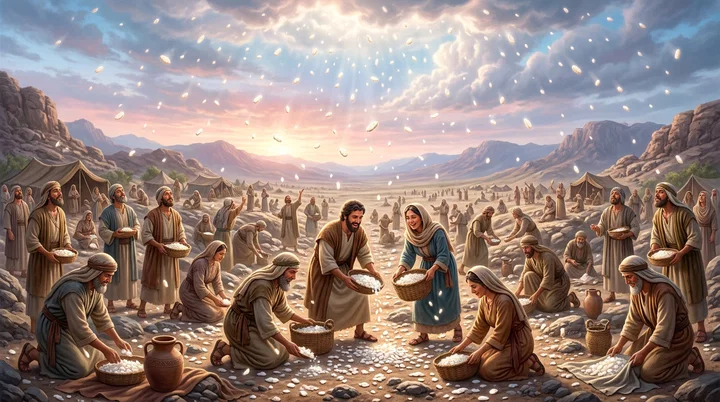
And when the dew fell upon the camp in the night, the manna fell upon it.
Translations
And when the dew fell on the camp in the night, the manna fell on it.
King James Version, KJV Cambridge Paragraph Bible, Webster Bible, Revised Version, American Standard Version
And when the dew fell upon the camp in the night, the manna fell upon it.
And in the descending of the dew on the camp by night, the manna descendeth upon it.
And when the dew fell upon the camp by night, the manna fell upon it.
When the dew came down upon the camp by night, the manna came down thereupon.
Berean Standard Bible, Majority Standard Bible
When the dew fell on the camp at night, the manna would fall with it.
When the dew fell on the camp in the night, the manna fell on it.
When the dew came down on the tents at night, the manna came down with it.
And when the dewe fell downe vpon the hoste in the night, the Man fell with it)
Douay-Rheims (Challoner revision)
And when the dew fell in the night upon the camp, the manna also fell with it.
Pictures
Cross-references
- Exodus 16:4-5
Then said the LORD unto Moses, Behold, I will rain bread from heaven for you; and the people shall go out and gather a certain rate every day, that I may prove them, whether they will walk in my law, or no.
Both describe God providing manna from heaven in the wilderness.
- Psalms 78:24-25
And had rained down manna upon them to eat, and had given them of the corn of heaven.
Describes manna as food rained down from heaven and called angels’ food.
- Exodus 16:12-14
I have heard the murmurings of the children of Israel: speak unto them, saying, At even ye shall eat flesh, and in the morning ye shall be filled with bread; and ye shall know that I am the LORD your God.
Both describe manna arriving with the morning dew, contrasted with its later second giving.
- Numbers 11:18-20
And say thou unto the people, Sanctify yourselves against to morrow, and ye shall eat flesh: for ye have wept in the ears of the LORD, saying, Who shall give us flesh to eat? for it was well with us in Egypt: therefore the LORD will give you flesh, and ye shall eat.
God answers their demand for meat with a month-long provision that becomes loathsome.
- Numbers 11:4
And the mixt multitude that was among them fell a lusting: and the children of Israel also wept again, and said, Who shall give us flesh to eat?
Israel craves flesh despite receiving manna.
- Exodus 16:35
And the children of Israel did eat manna forty years, until they came to a land inhabited; they did eat manna, until they came unto the borders of the land of Canaan.
Israel ate manna throughout its wilderness years.
- Joshua 5:12
And the manna ceased on the morrow after they had eaten of the old corn of the land; neither had the children of Israel manna any more; but they did eat of the fruit of the land of Canaan that year.
Manna ceased after Israel entered the land.
- Psalms 105:40
The people asked, and he brought quails, and satisfied them with the bread of heaven.
Recalls God providing manna and quails in the wilderness.
- Psalms 78:18-21
And they tempted God in their heart by asking meat for their lust.
Israel tests God by demanding food and doubting his power to provide.
- Exodus 16:3
And the children of Israel said unto them, Would to God we had died by the hand of the LORD in the land of Egypt, when we sat by the flesh pots, and when we did eat bread to the full; for ye have brought us forth into this wilderness, to kill this whole assembly with hunger.
The Israelites wished they had died in Egypt before receiving manna.
- John 6:5-13
When Jesus then lifted up his eyes, and saw a great company come unto him, he saith unto Philip, Whence shall we buy bread, that these may eat?
Jesus feeds a multitude, recalling God’s provision of manna for Israel.
- Psalms 78:26-31
He caused an east wind to blow in the heaven: and by his power he brought in the south wind.
Describes the second giving of food in the wilderness.
- Exodus 16:8
And Moses said, This shall be, when the LORD shall give you in the evening flesh to eat, and in the morning bread to the full; for that the LORD heareth your murmurings which ye murmur against him: and what are we? your murmurings are not against us, but against the LORD.
Both texts connect wilderness complaints with murmuring against God.
- 1 Corinthians 10:6
Now these things were our examples, to the intent we should not lust after evil things, as they also lusted.
Israel’s craving for food warns against evil desire.
Commentary
Each commentary is drawn from primary sources: the writings of Ellen G. White and Adventist pioneers and periodicals. Each commentary is separate. Its own words are not a quotation; follow the references to read the source passages.
Ellen G. White
3 sources
The verse belongs to Israel's wilderness journey, when God freely rained bread from heaven and provided manna as food they could eat freely.SG4 121.3–122.1LC1 136.2Lt 224, 1908, par. 6–7 That manna was angels' food.Lt 224, 1908, par. 6–7 Yet it did not satisfy them, and they were dissatisfied with the provision, longing for flesh meats with mourning and murmuring and demanding meat.SG4 121.3–122.1Lt 224, 1908, par. 6–7 In response the Lord granted their request and gave that vast multitude quails in abundance to gratify their appetite.SG4 121.3–122.1Lt 224, 1908, par. 6–7
Eating the flesh brought the result of transgression, for God worked no miracle to preserve life but sent a plague while the flesh was still between their teeth that destroyed thousands of their number, with many dying while eating it.SG4 121.3–122.1Lt 224, 1908, par. 6–7 By letting appetite control them they were overcome through indulgence of appetite, which displeased God.SG4 121.3–122.1LC1 136.2 Nearly all who left Egypt died in the wilderness before reaching Canaan without reaching it.LC1 136.2 The lesson is temperance in eating and drinking, for becoming health reformers and practicing health reform gives clearer minds to discern what affects the salvation of the soul.Lt 224, 1908, par. 6–7
Sources
Pioneers and periodicals
24 sources
When the dew settled over the camp at night, manna settled upon it to supply Israel with bread from heaven before they lusted for flesh.ST Dec 17, 1912RH Mar 12, 1867RH Sep 8, 1874 It was grain from heaven, supernaturally sent to feed millions daily for forty years, which could be boiled or baked yet melted in the sun.ST Dec 17, 1912RH Sep 8, 1874 That provision kept God's unchanged purpose for a simple vegetable diet, to wean Israel from flesh for their good and restore them toward health and holiness.RH Jun 25, 1914RH Dec 21, 1911RH Dec 21, 1905 Israel answered it with murmuring and longing for Egypt, craving fish, vegetables, and flesh-pots to gratify perverted appetite and showing doubt of God's promises and power.ST Apr 22, 1889RH Apr 17, 1879RH Jun 26, 1860 In long-suffering mercy God granted flesh to satisfy their insistence, but their greedy eating brought plague and leanness of soul as an admonition against unbelief, lust, and murmuring.RH Jul 25, 1907RH Feb 28, 1907
Nightly Manna and Setting
When the dew fell upon the camp in the night, the manna fell upon it, supplying Israel's wilderness food before they lusted for flesh.ST Dec 17, 1912RH Mar 12, 1867RH Sep 8, 1874RH Jul 10, 1916RH Apr 9, 1867 Numbers 11:7-9 describes that manna by its substance, color, taste, timing, and preservation.ST Dec 17, 1912RH Sep 8, 1874 It was grain from heaven, the bread of the mighty, supernaturally sent when God commanded the skies above and opened the doors of heaven.ST Dec 17, 1912 It fed three million people daily six times a week, winter and summer, for forty years, could be boiled or baked yet melted in the sun, and was not a natural sweet sap from tamarisk trees.ST Dec 17, 1912
The verse belongs to the second giving of quails, which came a year after the first giving in the Wilderness of Sin and after the mixed multitude became weary of manna.ST Apr 22, 1889 In that account Israel lusted after flesh and the Lord sent quails for a full month, bringing them from the sea and letting them fall by the camp as it were two cubits high.RH Jan 11, 1915 That is about three feet high upon or above the face of the earth so anyone could take as many as he chose, not packed solid three feet deep over a territory forty miles across.RH Jan 11, 1915
The verse belongs to the account when Moses complained of excessive burdens and the Lord relieved him by having him gather seventy men of the elders of Israel to the tabernacle and taking of the Spirit upon Moses to endow the whole company.RH Mar 22, 1870 It stands in the part of Numbers from chapter 9 to chapter 24 that tells of the ceremonies, service, wanderings, and murmurings of Israel.ST Mar 4, 1913 That portion shows the strict order God kept among His children so they would learn and form systematic character.ST Mar 4, 1913 The nightly fall of manna for forty years was a weekly miracle that publicly testified to the Sabbath, but the Israelites became so hardened that they treated this heavenly bread as an ordinary event and murmured against it, showing little regard for its Sabbath testimony.RH Jan 7, 1862
Diet, Murmuring, and Warning
God's nightly provision of bread from heaven kept His original and unchanged purpose for a vegetable diet, for flesh from even healthy animals is not man's natural food, formed no part of the original diet given to the human race, and formed no part of the wilderness provision except as allowed after repining and murmuring.RH Jun 25, 1914RH Dec 21, 1911ST Mar 3, 1914 His intention was to remove flesh from Israel's diet for their good and to wean them toward health and holiness, though He could have given flesh as easily as manna, and the manna fell on the camp at night when the dew fell as the food supplied while that weaning work went forward.RH Dec 21, 1905ST Mar 3, 1914RH Dec 21, 1905 The manna was a single, simple, wholesome and nourishing food given because it was best for them, better suited to their wants than the feverish diet of Egypt.RH Jul 10, 1916RH Apr 9, 1867ST Mar 3, 1914 It was meant to bring perverted appetite into a healthy state so they could enjoy the food originally provided for man in Eden, the fruits of the earth given to Adam and Eve, and it was suited to promote physical, mental and moral strength.ST Mar 3, 1914RH Nov 2, 1905 While they lived on it there was no feebleness, disease or infirmity among them, yet after eating manna their bodies were unprepared for flesh, which soured and caused flatulence.RH Apr 9, 1867ST Mar 3, 1914 In kind long-suffering mercy God also provided manna as wholesome and nutritious food to teach a good lesson of His power and care that ought to have been remembered.ST Feb 25, 1886
Israel met that provision with peevishness, fretfulness and murmuring, complaining about their diet and longing for the food eaten in Egypt, including fish, cucumbers, melons, leeks, onions, garlic and the flesh-pots.ST Apr 22, 1889RH Apr 17, 1879RH Jun 26, 1860 Although God provided food without their labor, they were dissatisfied and craved other foods to gratify appetite, murmuring against Moses and Aaron and wishing they had died in Egypt.ST Jun 10, 1875ST Feb 25, 1886 Their appetite did not reliably show what was best for them, and their desire for flesh and return to familiar eating habits were associated with rebellion and with perverted appetite in eating and drinking for self-gratification.RH Nov 2, 1905ST Jun 10, 1875 Weariness of manna meant continual looking back with desire for things left behind, which eclipsed the promised land of milk and honey and showed doubt of God's promises of the land and doubt of His power to supply present food.ST Apr 22, 1889 That looking back marks one who begins the Christian life yet looks back with longing, showing a double-minded and unstable heart, lack of faith and consecration, and prizing earth above heaven and temporal things above eternal.ST Apr 22, 1889
In long-suffering mercy God also sent flesh to satisfy their lust and to cure them of longing, but only because of persistent repining, murmuring and insistence.ST Mar 3, 1914ST Feb 25, 1886 The quails were given to show that their demand was wrong, not because flesh was the best food.RH Apr 9, 1867 Their greedy eating of the quail brought plague, disease, leanness of soul, and suffering from intemperance and was not for their greatest good, and the people blamed Moses for not warning them of the result.RH Jul 25, 1907RH Dec 21, 1905ST Mar 3, 1914 The account illustrates the consequences of lust and stands as an admonition against unbelief and hardness of heart.RH Feb 28, 1907 It teaches that God knew best how to lead and provide for His people, and that their murmuring against His provision brought a painful lesson intended to correct them and teach His power and care.RH Jun 20, 1871
The sharing with the seventy elders at the tabernacle, when the Spirit upon Moses was taken to endow the whole company, is a testimony to the gifts and graces possessed by Moses, yet in it Moses suffered a great loss of divine help.RH Mar 22, 1870 If God calls to great labors He gives great grace, and it is wiser to cheerfully bear heavy burdens than to meet the loss of that help.RH Mar 22, 1870 The history warns that persisting in demanding and insisting on having what God has denied is most dangerous, and obtaining by other power what God refused to give brings disaster.RH Jan 29, 1914 So it will happen if the churches compel the state to grant the Sunday law that Jehovah refused to grant.RH Jan 29, 1914
Sources