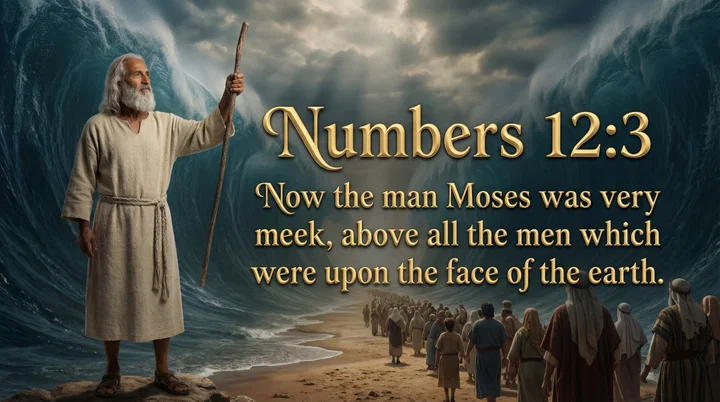
Numbers 12:3
(Now the man Moses was very meek, above all the men which were upon the face of the earth.)
Translations
(Now the man Moses was very meek, above all the men which were on the face of the earth.)
King James Version, KJV Cambridge Paragraph Bible
(Now the man Moses was very meek, above all the men which were upon the face of the earth.)
(Now the man Moses was very meek, above all the men who were upon the face of the earth.)
Now the man Moses was very meek, above all the men which were upon the face of the earth.
Now the man Moses was very meek, above all the men that were upon the face of the earth.
And the man Moses [is] very humble, more than any of the men who [are] on the face of the ground.
But the man Moses was very meek, above all men that were upon the face of the earth.
Now, the man Moses, was patient, exceedingly,—above all the sons of earth, who were on the face of the ground.
Berean Standard Bible, Majority Standard Bible
Now Moses was a very humble man, more so than any man on the face of the earth.
Now the man Moses was very humble, more than all the men who were on the surface of the earth.
Now the man Moses was more gentle than any other man on earth.
(But Moses was a verie meeke man, aboue all the men that were vpon the earth)
Douay-Rheims (Challoner revision)
( For Moses was a man exceeding meek above all men that dwelt upon earth)
Pictures
Cross-references 20 of 48
- Numbers 20:10-12
And Moses and Aaron gathered the congregation together before the rock, and he said unto them, Hear now, ye rebels; must we fetch you water out of this rock?
Moses’ angry disobedience at the rock contrasts with his meekness.
- Numbers 16:1-3
Now Korah, the son of Izhar, the son of Kohath, the son of Levi, and Dathan and Abiram, the sons of Eliab, and On, the son of Peleth, sons of Reuben, took men:
Korah and his supporters accused Moses and Aaron of taking authority for themselves.
- Exodus 33:11
And the LORD spake unto Moses face to face, as a man speaketh unto his friend. And he turned again into the camp: but his servant Joshua, the son of Nun, a young man, departed not out of the tabernacle.
Moses’s meekness accompanies face-to-face friendship with God.
- Matthew 11:29
Take my yoke upon you, and learn of me; for I am meek and lowly in heart: and ye shall find rest unto your souls.
Christ describes himself as meek and lowly, presenting a greater pattern of meekness than Moses.
- Matthew 5:5
Blessed are the meek: for they shall inherit the earth.
Moses exemplifies the meekness Jesus blesses with the promise of inheriting the earth.
- Psalms 25:9
The meek will he guide in judgment: and the meek will he teach his way.
God guides and teaches the meek.
- Numbers 12:8
With him will I speak mouth to mouth, even apparently, and not in dark speeches; and the similitude of the LORD shall he behold: wherefore then were ye not afraid to speak against my servant Moses?
God rebukes Aaron and Miriam for speaking against Moses, whose unique communion with God accompanies his meekness.
- Numbers 12:13
And Moses cried unto the LORD, saying, Heal her now, O God, I beseech thee.
Moses prays for the sister who provoked him.
- Acts 7:22
And Moses was learned in all the wisdom of the Egyptians, and was mighty in words and in deeds.
Moses is described as learned in Egyptian wisdom.
- Hebrews 11:24-26
By faith Moses, when he was come to years, refused to be called the son of Pharaoh’s daughter;
Moses chose affliction with God’s people over Egypt’s honor and pleasures.
- Exodus 32:32
Yet now, if thou wilt forgive their sin—; and if not, blot me, I pray thee, out of thy book which thou hast written.
Moses pleads for Israel, offering his own life for their forgiveness.
- 1 Peter 2:23
Who, when he was reviled, reviled not again; when he suffered, he threatened not; but committed himself to him that judgeth righteously:
Christ patiently endured reviling and suffering without retaliation.
- Exodus 32:11-14
And Moses besought the LORD his God, and said, LORD, why doth thy wrath wax hot against thy people, which thou hast brought forth out of the land of Egypt with great power, and with a mighty hand?
Moses pleads with God to spare Israel from destruction.
- Deuteronomy 34:5-6
So Moses the servant of the LORD died there in the land of Moab, according to the word of the LORD.
Records Moses’ death and burial, in connection with his later resurrection.
- 1 Peter 3:4
But let it be the hidden man of the heart, in that which is not corruptible, even the ornament of a meek and quiet spirit, which is in the sight of God of great price.
Both prize a meek and quiet spirit.
- Exodus 2:11-17
And it came to pass in those days, when Moses was grown, that he went out unto his brethren, and looked on their burdens: and he spied an Egyptian smiting an Hebrew, one of his brethren.
His early impulsive actions contrast with the meekness he later displayed.
- Exodus 3:1-6
Now Moses kept the flock of Jethro his father in law, the priest of Midian: and he led the flock to the backside of the desert, and came to the mountain of God, even to Horeb.
Moses hides his face in reverence before God at the burning bush.
- Deuteronomy 34:10
And there arose not a prophet since in Israel like unto Moses, whom the LORD knew face to face,
Both describe Moses’ face-to-face relationship with God.
- Psalms 37:11
But the meek shall inherit the earth; and shall delight themselves in the abundance of peace.
Promises that the meek will inherit the earth.
- Exodus 10:29
And Moses said, Thou hast spoken well, I will see thy face again no more.
Moses answers Pharaoh’s threat calmly, showing that meekness and courage coexist.
Commentary
Each commentary is drawn from primary sources: the writings of Ellen G. White and Adventist pioneers and periodicals. Each commentary is separate. Its own words are not a quotation; follow the references to read the source passages.
Ellen G. White
53 sources
The verse declares that Moses was very meek above all the men upon the face of the earth, singular in humility as the meekest of the human family.SG4 20.21SP 287.2Lt 7, 1894, par. 18–22 His meekness was unassuming lowliness that distrusted self and made God his counselor, showing itself in mildness, patience, gentleness under wrong, generosity to the erring, and humble endurance of murmuring and provocation.PP 382.4–383.1PP 251.2–252.1ST Feb 19, 1880ST Mar 24, 1909Lt 87, 1896, par. 33 It was not his nature, for he was naturally impatient and forceful, but he became patient, reverent, humble and teachable through forty years keeping sheep in Midian, where pride and self-sufficiency were swept away and he learned to care for the weak and wayward.Ms 11, 1903, par. 9–11SG4 39.21SP 313.1PP 248.3ST Jan 16, 1893 Because of that meekness God chose him as visible leader and chief governor, spoke with him face to face plainly and not in visions or dreams, and when Miriam and Aaron murmured against him from jealousy God vindicated him and struck Miriam with leprosy until Moses himself prayed for her healing.SG4 20.21SP 287.2Ms 165, 1899, par. 34–35ST Aug 19, 18801SP 313.1 Yet even the meekest man failed at the waters of Meribah when provoked to anger he spoke as if he would bring water and smote the rock instead of speaking to it, and for thus exalting self and not sanctifying God he was barred from Canaan, which warns all who bear God's work to cultivate his humility and guard against self-exaltation.Lt 188, 1903, par. 36–40Ms 165, 1899, par. 34–35Ms 65, 1906, par. 25–304T 369.2MC 14.3–15.1
Meaning of Meekness
Numbers 12:3 testifies that Moses was very meek above all men upon the face of the earth, singular in humility, the meekest and most humble of the human family.SG4 20.21SP 287.2Lt 7, 1894, par. 18–22Ms 165, 1899, par. 34–35ST Jan 13, 1898 His meekness stood out among all people and stood in contrast to the murmuring against him, and it is given as the reason the Lord was displeased with Miriam and Aaron for speaking against him and defended Moses as His chosen and faithful servant entrusted with a heavy burden.SG4 20.21SP 287.2Lt 28, 1859, par. 17–19 Their complaint sprang from jealousy and self-originating resentment and ambition, claiming equal authority and believing he considered himself superior, while human judgments of him did not agree with God's view of him.Lt 7, 1894, par. 18–22PP 382.4–383.1Lt 28, 1859, par. 17–19 God honored him not for training gained in the Egyptian court but because of his meekness, talking with him face to face as a man talks with a friend, and the same holds for all who carry forward God's work.Ms 165, 1899, par. 34–35
His meekness meant humility and unassuming lowliness, without pride, recognizing his own weakness and making God his counselor rather than trusting in himself.PP 382.4–383.1PP 251.2–252.1 It was formed through severe discipline and close connection with God, after struggling to uproot pride and habits shaped by Egypt, until he became mild in spirit, patient, generous toward those who erred, kind, reverent, and humble in his dealings with others.ST Feb 19, 1880 It remained his brightest trait amid murmuring, reproach, and provocation, and was reflected in his reverent response when called at the burning bush.PP 251.2–252.14T 368.1 His humility was joined with generosity, nobility, sound judgment, and fully developed qualities, so that his life embodied the truths and standards he taught and enabled him to exhort others effectively and speak from the heart.Ms 24, 1887, par. 55
Meekness as described in the verse means patience and gentleness under wrong.ST Mar 24, 1909 Genuine humility is not a fitful effort to conquer self by human strength but a grace to be cherished by those who desire to see God's glory.Lt 87, 1896, par. 33
The description was given under inspiration of the Holy Spirit.ST Mar 24, 1909 In Moses' time this character was not prized by heathen or Jews, so the statement that he was the meekest man on earth would have excited pity or contempt rather than praise or being regarded as condemnation.ST Mar 24, 1909 Yet meekness is a precious grace, among the first qualifications for Christ's kingdom, whose divine beauty is revealed in Jesus' own life and character.ST Mar 24, 1909 It is learned from Christ through Christian experience, including the school of affliction.
How Moses Became Meek
Meekness was not Moses' nature, for he was naturally impatient, yet he was chosen to deliver Israel and trained as a general, at first supposing that deliverance would come by force, so that he killed an Egyptian who was smiting an Israelite.Ms 11, 1903, par. 9–11SG4 39.21SP 313.1 He then fled to Arabia, to Midian, and kept sheep for forty years, where his pride and self-sufficiency were swept away.Ms 11, 1903, par. 9–11PP 248.3 In that solitary wilderness life with God, seeing God's majesty in the mountains showed him his own weakness and the insignificance of Egypt's gods, while the simplicity of shepherd life removed the effects of Egypt's luxury and ease.Ms 11, 1903, par. 9–11PP 248.3
Through long discipline and severe trial in close connection with God he firmly grasped God's grace and humbly sought and pleaded for wisdom from heaven until he was strengthened and overcame his impatience.SG4 39.21SP 313.1ST Feb 19, 1880 After struggling to uproot pride and habits shaped by Egypt, he became mild in spirit, patient, reverent, humble, teachable, generous toward those who erred, and kind, with strong faith in the God of Jacob.ST Feb 19, 1880PP 248.3Ms 51, 1895, par. 2–3 Through that long discipline he learned humility until he became teachable and fit for God to guide and trust with Israel's leadership, not trying to control the Holy Spirit but himself controlled by the Spirit.18MR 224.1–2Ms 51, 1895, par. 2–3
He became the meekest man on earth by the grace of Christ, which never makes a person proud or lifted up in self but makes him meek and lowly in heart as he learns of the divine Master.ST Jan 16, 189312MR 363.1 He did not gain it at once but by forty years in Midian learning to be a good shepherd by caring for the weak, guiding the wayward, and seeking the wandering, having humbled his soul before God and learned his lesson at the feet of Jesus.ST Jan 16, 189312MR 363.1 That shepherd training fitted him to be a general to lead Israel out of Egypt and to care for God's flock by nourishing the weak, instructing the wayward, and bringing the lost back to the fold, living as seeing the invisible God and learning daily in the school of Christ.ST Jan 16, 189318MR 224.1–2
God Defended His Servant
The declaration that Moses was very meek above all men stands in the midst of murmuring against him by Miriam and Aaron.1SP 287.2RH Aug 14, 1900Lt 28, 1859, par. 17–19 Their complaint sprang from jealousy and envy, from ambition and self-originating resentment.Lt 7, 1894, par. 18–22PP 382.4–383.1RH Aug 14, 1900Lt 28, 1859, par. 17–19 They claimed equal authority with him, as if God spoke through them no less than through him.PP 382.4–383.1PP 425.4 They believed he considered himself superior to them and resented the prominence given him.Lt 7, 1894, par. 18–22Lt 28, 1859, par. 17–19
He bore a heavy burden as the chosen instrument to carry out God's will and purposes.Ms 201, 1898, par. 1–51SP 288.1Lt 28, 1859, par. 17–19 God's Spirit was upon him, and God had placed him in his prominent position and laid the burden of the work upon him.1SP 288.1Lt 28, 1859, par. 17–19 Human judgments of him did not agree with God's view of him as chosen and faithful.1SP 287.2Lt 7, 1894, par. 18–22
To complain against him was irreverence not only to him but to God who had chosen him.ST Aug 19, 18801SP 288.1 The Lord was displeased with the speaking against His exceptionally meek servant and revealed His wrath in defense of him.SG4 20.21SP 287.21SP 288.1 The cloud was removed from the tabernacle and did not return until Miriam was removed from the camp, for she was struck with leprosy.ST Aug 19, 18801SP 288.1 Moses did not retaliate but pleaded with God for her healing.ST Aug 19, 1880RH Aug 14, 1900 She remained shut outside the camp seven days, and Israel did not journey until she was brought back.ST Aug 19, 1880
The rebuke of Miriam and Aaron and the declaration of Moses' standing were meant as a warning to all Israel, not to those two alone.1SP 296.1PP 396.3 Their recorded murmuring stands as a rebuke to all who yield to jealousy and complain against those upon whom God lays the burden of His work.1SP 288.1 Miriam's punishment served as a warning against rebelling against God's established leadership and chief governor.1SP 296.1
God Honored Moses Highly
God honored Moses not for the training he had gained in the Egyptian court but because of his meekness.Ms 165, 1899, par. 34–35 He was specially chosen as the visible leader and chief governor of Israel, one of the Lord's representatives since the days of Adam who kept alive the influences imparted from heaven.18MR 224.1–2ST Jan 13, 1898 He was illustrious for spirituality and moral excellence, and for his self-sacrificing zeal he received the testimony that he was the meekest and most humble of all the human family.ST Jan 13, 1898
God distinguished him from other prophets and declared him greater than a prophet.PP 396.3 He talked with him face to face as a man talks with a friend, directly and plainly and not through visions, dreams, or dark sayings.Ms 165, 1899, par. 34–35ST Aug 19, 1880PP 396.3 He led him in a special manner and revealed His glory to him as to no other person on earth.1SP 313.1
Through long years of discipline Moses learned humility until he became teachable and fit for God to teach, guide, and trust with the leadership of Israel.18MR 224.1–2Ms 51, 1895, par. 2–3 He lived as seeing the invisible God and learned daily in the school of Christ.18MR 224.1–2 His meekness meant that he did not try to control the Holy Spirit but was himself controlled by the Spirit.18MR 224.1–2Ms 51, 1895, par. 2–3 That teachable humility helps explain why he received divine wisdom and guidance.PP 384.2
His humility and forbearance, joined with love for God, piety, zeal, and faith greater than that of any other man on earth, gave him great influence among Israel.1SP 342.1SG4 57.3 He wisely directed matters concerning the people's religious life.1SP 342.1 His meekness and humility brought him honor from God, and he faithfully carried out the high and sacred responsibilities entrusted to him.ST Aug 14, 1884
His meekness did not make him unfaithful nor lessen the authority God had given him.ST Aug 19, 1880 Though his shepherd's life had been more peaceful, he remained in the position and authority God had given him until God dismissed him.3T 342.2
Meekness Did Not Prevent Failure
The meekest man on earth could not by meekness and unselfish care quell the people's insubordination, even with his best efforts, but instead faced jealousy, suspicion and slander.3T 342.2PP 396.1 Though his shepherd's life had been more peaceful, he remained in the position and authority given him until dismissed.3T 342.2
His meekness did not prevent anger when he saw Israel's apostasy, for he was zealous for God's glory and, seeing the people break the law by worshiping an idol, cast down the stone tablets.3T 341.1 Meekness did not keep him from acting with bold persistence when Israel's welfare and interests were at stake, for he set aside natural timidity and persistently pleaded with God to spare and not destroy the people, even when offered exaltation through their destruction and the raising of a better people in their place.3T 297.4RH Jul 29, 1873 Meekness could coexist with plainly recalling wrongdoing when directed by God for the people's humbling, for he repeatedly recounted Israel's sins and defended his leadership when their murmuring required it, and before his death reminded them of their rebellion and of his anguished pleas for them, that they might remember their sins and God's unappreciated mercy.3T 319.2–320.1
Even he was still tempted, with Satan tempting him to take for himself glory that belonged to God.LC1 47.1–2ST Jun 11, 1874LC1 136.2
He long bore with the rebellion and obstinacy of Israel, proved by long endurance, but at last on the borders of the promised land at the waters of Meribah his patience gave way when the water ceased and the people forgot God's long supply and murmured instead of walking by faith.Lt 188, 1903, par. 36–40Ms 65, 1906, par. 25–30FE 508.5–509.4RH Aug 23, 1906 Made angry by continual murmurings and reproaches, he was provoked into anger and impatience and let them provoke him.4T 369.2RH Aug 23, 1906Ms 187, 1907, par. 8 When told to speak to the rock that it would give its waters, he spoke as though he and Aaron would provide the water, saying in effect whether he would bring water from the rock, and angrily smote the rock twice with the rod instead of speaking to it as directed.Lt 188, 1903, par. 36–404T 369.2FE 508.5–509.4Ms 187, 1907, par. 8
By giving prominence to self and glory to himself he failed to believe God and to sanctify Him and show Him as holy in the eyes of Israel, taking God's place before the people.Lt 188, 1903, par. 36–404T 369.2FE 508.5–509.4Ms 187, 1907, par. 8 His sin marred his role as a representative of Christ.4T 369.2 For this one sin of forgetfulness and carelessness he was judged to die with rebellious Israel before crossing the Jordan and was barred from entering Canaan, and his long record of faithfulness did not atone for it, his honored position making the failure more serious.Lt 188, 1903, par. 36–404T 369.2FE 508.5–509.4Ms 187, 1907, par. 8
From this God's people are to learn that when self is exalted and given prominence God's work is neglected and He is dishonored, that His name and His alone is to be magnified on the earth, and that He will work counter to those who work counter to Him and work against them and manifest His displeasure.Lt 188, 1903, par. 36–40Ms 65, 1906, par. 25–30 The account teaches that even a meek and faithful person must guard against self-exaltation and loss of self-control, and that sin brings consequences regardless of past service.4T 369.2 His experience is a solemn lesson and warning to those in positions of responsibility against dishonoring God, especially school presidents.Ms 65, 1906, par. 25–30FE 508.5–509.4
Following Moses' Example
Those who carry forward God's work, if they desire to be honored by God, must be humble and distinguished from all others by humility like Moses, for he was singular in humility, the meekest of men and the greatest man who ever stood as leader of God's people, and the one noted for meekness can be trusted for Christ to reveal Himself to the world through him without any threads of selfishness woven in.Ms 165, 1899, par. 34–35 God's workers should cultivate exceptional meekness like his as they seek to follow Christ's example.MC 14.3–15.1GW92 343.25T 396.2CEv 43.1–2 Canvassers in particular should cultivate it by following his example.MC 14.3–15.1GW92 343.25T 396.2CEv 43.1–2 That meekness is to be copied by the canvasser, together with chastity like Joseph and temperance like Daniel, and when this character is present a power will attend him wherever he goes.Ms 122, 1899, par. 2–6
The verse means meekness learned by humbling, showing what Moses became through trial and training from pride and self-sufficiency to patience, reverence, and humility, and it teaches the need to learn humility and meekness, to put away self-sufficiency and walk humbly before God.Ms 11, 1903, par. 9–11 It teaches helping one another all that is possible, being careful not to drive a soul in peril further from Christ, and speaking and acting as God's little children, not as men who would kill.Ms 11, 1903, par. 9–11 The history of Miriam and Aaron speaking against Moses when he was very meek requires guarding sacredly the interests of one another.Lt 14a, 1898, par. 10–13 A course like theirs — criticizing and condemning brethren, giving loose rein to the tongue in evil surmising and seeking to be first, putting human estimate upon God's messengers and disparaging their work and cutting away the influence God appointed them to have — meets the signal displeasure of God, puts one out of sympathy with God and angels, and brings the same judgment from God in return for things that dishonor His name.Lt 14a, 1898, par. 10–13
The record of their murmuring from jealousy stands as a rebuke to all who yield to jealousy and complain against those upon whom God lays the burden of His work, since complaint against such a chosen burden-bearer with God's Spirit upon him is irreverence not only to him but to God Himself who chose him and brought God's wrath.1SP 288.1 His humility was joined with generosity, nobility, sound judgment, and fully developed qualities, and his life embodied the truths and standards he taught, enabling him to exhort others effectively and speak from the heart.Ms 24, 1887, par. 55 That exceptional meekness was a spirit of humility and patience developed through years of toil and waiting in Midian.PP 384.2 It enabled him to bear accusations, unbelief, and murmuring without complaint, and prepared him to face pride and envy from those who should have supported him, while his teachable humility helps explain why he received divine wisdom and guidance.PP 384.2
Sources
Pioneers and periodicals
71 sources
Moses was gentle and patient beyond all others on earth, mild in temper, slow to take offense, forbearing under injury, submissive to God and teachable under reproof.ST Feb 12, 1885ST May 4, 1915ST Jul 9, 1874 He was not so by nature, being quick and impetuous by birth and hardened by Egypt's wisdom, but he became so through long discipline with God, above all in forty years as a humble shepherd in Midian learning patience, self-distrust and dependence.ST Feb 12, 1885ST Feb 11, 1897ST Apr 5, 1899ST Nov 27, 1901ST May 19, 1914 That lowliness was the secret of his fitness to lead Israel, to speak with God face to face, and to bear murmuring without retaliation, putting self aside to plead for Miriam and even offering his own life for the rebellious people.ST Aug 19, 1880RH Jun 12, 1913RH Aug 20, 1857ST May 4, 1915ST Feb 11, 1897 His gentleness was not weakness but humble strength with courage before Pharaoh and against sin, yet when provoked to anger he spoke rashly and struck the rock at Meribah, taking glory to himself and for that was barred from bringing Israel into the land.ST Feb 12, 1885ST Apr 25, 1906RH Apr 10, 1866ST Mar 23, 1882RH Sep 1, 1868 He stands second only to Christ the perfectly meek Redeemer as the pattern all are to emulate, and to murmur against such a chosen servant is to murmur against God Himself who vindicates him.RH Jun 25, 1872RH Aug 20, 1857RH Mar 7, 1907ST Feb 12, 1885ST Jul 9, 1874
Wording and Authorship
The English wording is mistranslated, for the verse does not boast that Moses was very meek above all men on the face of the earth but declares that he was depressed or afflicted more than any man of that land.RH Apr 2, 1861 His affliction was the great burden of caring for and governing the Israelites, with their ingratitude and rebellion against both God and himself, so the verse is no boastful claim of his own meekness.RH Apr 2, 1861
The verse stands as a parenthesis in what Moses wrote that could have been added by Joshua, just as with the last chapter of Deuteronomy, since a preface, introduction, appendix or notes can be added to a book without taking the book away from its writer, though God could also have inspired Moses to write the statement about himself.ST Jan 24, 1900 Its modest self-reference shows that he wrote the Pentateuch without drawing attention to himself as its author, despite his great merit and noble character and exceptional meekness.ST Jan 24, 1900RH Feb 15, 1870
The verse was written under the inspiration of the Holy Spirit as part of the early history contained in the five books of Moses, which is not done away but remains to be known, and meekness there is patience and gentleness under wrong.ST Mar 24, 1909RH Nov 26, 1861 It was written for admonition and good, for learning and as ensample upon whom the ends of the world are come.RH Aug 20, 1857RH Mar 7, 1907RH Feb 28, 1907 It teaches that meekness is a characteristic of the Christian to be studied and emulated, among the first qualifications for Christ's kingdom, whose divine beauty is revealed in Jesus' own life and character, with great blessings promised to those who practice it, for the Lord takes pleasure in His people and will beautify the meek with salvation, a virtue men in this age have lost sight of and do not appreciate.ST Mar 24, 1909RH Aug 20, 1857RH Nov 26, 1861 In Moses' time this character was not prized by heathen or Jews, so his statement that he was the meekest man on earth would have excited pity or contempt rather than being regarded as condemnation, and popular preachers urge it as a last resort to detain honest souls from obeying the Lord by turning from the Sabbath of the Lord our God.ST Mar 24, 1909RH Aug 20, 1857 It stands in the account of the ceremonies, service, wanderings and murmurings of the children of Israel, with the very strict order God kept among His people because they needed to learn, so that in carrying out system they would form a systematic character, including how Israel doubted God after the spies reported high walls and tall giants and talked of difficulties until discouragement settled into certainty of failure and anger at Caleb and Joshua, an unbelief and hardness of heart that tempts God.ST Mar 4, 1913RH Feb 28, 1907 It shows Moses as the leader God called and ordained to lead Israel from Egyptian bondage to Canaan, records Aaron and Miriam speaking against him and God manifesting displeasure at speech against His leader, proving that speaking against Moses was not speaking against the human instrument but against God and brought fearful judgment, with the need and importance of a God-appointed leader and that God still leads His people by human instrumentalities through whom He speaks His will.RH Mar 7, 1907
Setting in Numbers
Numbers 12:3 stands in the account of Numbers 11-14 of the ceremonies, service, wanderings and murmurings of Israel.RH Apr 17, 1879ST Mar 4, 1913 Some disobeyed by complaining because they could not live like the world and by lusting after the food they had been accustomed to eat in Egypt.RH Apr 17, 1879 After the spies reported high walls and tall giants they talked of difficulties until discouragement settled into certainty that they could not succeed and into anger at Caleb and Joshua for saying they could.RH Feb 28, 1907 That unbelief and hardness of heart withdrew the Lord's protecting care so that they wandered in the wilderness until all but Caleb and Joshua and the children had perished without entering the promised land, though they had started from Egypt with the Lord with them and many miracles wrought for them.RH Apr 17, 1879RH Feb 28, 1907 The very strict order God kept among His people in this history was because they needed to learn, so that in carrying out system they would form a systematic character, and it was caused to be written for admonition upon whom the ends of the world are come, so that those in God's work now should be of good courage and not say we can't.ST Mar 4, 1913RH Feb 28, 1907
In Numbers 12 Aaron and Miriam spoke against Moses and challenged his standing, including complaint about his marriage to an Ethiopian woman.RH Dec 17, 1901ST Mar 31, 1909 They said the Lord had spoken also by them, placing their prophetic work on a par with his, though God had given Moses the leading place among His prophets and recognized him as Israel's chief and leading prophet with a responsibility and standing distinct from other leaders.RH Aug 10, 1916RH Apr 26, 1906RH Nov 1, 1906 Aaron fully shared in the wrong-doing against Moses.ST Mar 31, 1909 The Lord heard their challenge to Moses' standing and addressed the three of them from the tabernacle, giving the serious lesson that God hears words spoken against others.ST Mar 31, 1909
Their attack came from envy and jealousy, for Moses stood above them in place because he was worthy and well fitted for it, yet they could not bear to have anyone above them.ST May 6, 1889ST Apr 29, 1913 Their selfish hearts were pained and discontented at his superiority, they thought themselves qualified to do some things better than he, and they thought their only hope of being exalted was to bring Moses down.ST Apr 29, 1913 His modest and unassuming meekness invited this opposition, even so slow at times that others thought Israel needed a leader that could lead. So Korah, Dathan and Abiram rose up concluding they should share the government as men of importance, Aaron feeling as the oldest he should be most respected, and Miriam feeling because she had cared for Moses as a babe and put him in the little ark of bulrushes he should give her attention and consideration. The Lord vindicated His exceptionally meek servant amid that jealousy.
God approved Moses amid Israel's murmuring and the rebellion of Miriam and Aaron, and defended His own chosen servant against their contempt and defaming.ST Feb 17, 1909RH May 26, 1863 He distinguished Moses from other prophets, with whom He makes Himself known in vision and speaks in a dream or dark sayings, by speaking with Moses directly and plainly and mouth to mouth as one faithful in all His house and by permitting him to behold the similitude of the Lord.ST Aug 19, 1880RH Nov 1, 1906 Moses was a prophet and more than a prophet, a messenger with a message of reproof to the erring and of encouragement to the meek and lowly, so that to speak against Moses was to speak against God's servant and to refuse God's one infallible voice.RH Nov 1, 1906 The same rebuke and displeasure visited for that contempt will be visited now upon those who show contempt for God's chosen servants, defame them and presume to usurp their office as overseers, except they repent, because God establishes peace and order, not confusion, and will not forego His own choice to accept man's preference.RH May 26, 1863
Miriam was smitten extremely with leprosy made white as snow, a disease imperiling the life of all who touched her, over which Aaron sorrowed deeply.ST Jun 17, 1889ST Mar 31, 1909 Moses put aside concern for himself and prayed to God for her, and his prayer was needed for her healing and restoration.ST Aug 19, 1880RH Jun 12, 1913RH Apr 26, 1906 She remained outside the camp seven days and Israel did not journey until she returned, showing that one person's sin can delay God's people.ST Aug 19, 1880RH Jun 12, 1913 The punishment shows the sacredness of God's ordinances and how particular God is that everything be performed exactly, that God is no respecter of persons so that the greatest among men will be treated even as the lowest with strict justice, that no outward provocation is an excuse for sin, and that the root of sin is wholly in the heart of man.ST Jun 17, 1889 Amid these repeated rebellions and punishments, including Miriam's chastening at Hazeroth, Moses is presented as possessing great mental power, sound judgment and admirable fidelity.ST May 23, 1911
Meaning of Meekness
The verse means Moses possessed meekness in a remarkable degree above all men on earth.ST Feb 12, 1885ST Jul 9, 1874ST May 6, 1889ST Jun 8, 1882 Meekness is mildness and gentleness of temper, not easily provoked or irritated, forbearing under injuries, soft, gentle, yielding, patient and gentle from religious motives.ST Mar 24, 1909ST Feb 12, 1885ST Jul 9, 1874ST Jun 8, 1882 It is submissiveness not to evil but to the divine will, a humble and teachable spirit open to light and not rebelling against reproof.ST Feb 12, 1885ST May 4, 1915ST May 6, 1889ST Aug 29, 1895 It was written under inspiration of the Holy Spirit, and in Moses' time this character was not prized by heathen or Jews, so the declaration would have excited pity or contempt rather than praise.ST Mar 24, 1909 His desire to be taught led him to depend on God's presence, and God honored him by speaking with him face to face.ST May 4, 1915ST May 6, 1889
Meekness is not effeminacy, weakness, instability, or being soft, pliable and yielding to everything.ST Feb 12, 1885ST Aug 29, 1895 It is strength shaped by humility, true dignity consisting in humbleness of mind, with fortitude, courage, endurance and invincible confidence born from above.RH Apr 10, 1866ST Nov 20, 1901ST Aug 29, 1895 Moses proved this as a great general and leader of mighty armies of fierce warriors, a place no effeminate man could fill, courageous before Pharaoh and at Sinai, unafraid of people and able to confront powerful wrongdoers.ST Feb 12, 1885RH Apr 10, 1866 His quiet endurance without complaint or reply when affronted by those closest to him, and his earnest prayer for Miriam, show his meekness was most clearly tested there, while mildness and fortitude dwelt together in him.RH Apr 10, 1866 Though holding very high office and enjoying close fellowship and great honor from God, he was not puffed up with pride, did not try to make people look up to him because of position, and when its honor was assailed never sought to enforce respect but left that to the Lord.RH Sep 1, 1868ST Nov 20, 1901
Moses stands together with Christ as one of two outstanding examples and patterns of that grace, the pattern all Christians must share.ST Feb 12, 1885ST Aug 29, 1895 He is second only to Jesus the meek and lowly Redeemer, to be learned from as a model alongside Christ who was meek and lowly of heart.ST May 6, 1889ST Aug 29, 1895 His meekness illustrates the Christlike character of one who does not retaliate when reviled or threaten when suffering, and therefore marks those who will receive the promised future inheritance of the earth.ST Jul 9, 1874 Because God guides the meek in judgment and teaches them His way, God could reveal His way to Moses in an especial manner, greatly enlighten his mind, and honor him above all other prophets.ST May 6, 1889 In this he was a type of the greater Teacher to come, the meek and lowly One who brings the true Israel from bondage of sin to the heavenly country.ST May 6, 1889 Christ was infinitely meeker than Moses and than all the meekest men in the world, for Christ alone is perfect and combines all virtues while Moses' virtues were accompanied by imperfections and he once spoke rashly.ST Jun 8, 1882RH Feb 19, 1861
Training That Formed Meekness
Moses was not meek by nature, but was naturally quick, impetuous, hasty, hot-headed and given to resenting injuries.ST Feb 12, 1885ST May 19, 1914 Though learned in all the arts and wisdom of Egypt, he was not thereby prepared for God's use.ST May 19, 1914RH Apr 4, 1907 His gentleness and forbearance came afterward through long discipline, severe schooling, and communion with God.ST Feb 19, 1880ST Jan 16, 1893ST Feb 12, 1885RH Apr 4, 1907 It came by the grace of Christ, which never makes one proud or lifted up in self but makes one meek and lowly in learning of the divine Master, as he struggled to uproot pride and habits shaped by Egypt.ST Feb 19, 1880ST Jan 16, 1893
He graduated as the meekest man through a forty years' apprenticeship as a humble shepherd in the far-off land of Midian.ST Apr 5, 1899ST Nov 27, 1901ST May 19, 1914 That was the school of adversity, solitude, changing surroundings and bitter disappointment, where Egyptian learning and power could not fit him but humble shepherd life and lack of worldly advancement could.RH Jun 16, 1904ST May 19, 1914 Caring for helpless, weak, wayward and wandering sheep taught him patience, tenderness, love for the erring, and how to nourish the weak, instruct the wayward and seek the wandering.ST Feb 19, 1880ST Jan 16, 1893RH Jun 16, 1904 He learned awareness of human weakness and of God's greatness, wisdom and love, with distrust of self and dependence like a little child, while unlearning the pride and self-sufficiency formed at Pharaoh's court.ST Apr 5, 1899RH Jun 16, 1904 That time was not lost but among the most valuable of his career, and having finished his long course he was ready to be commissioned as visible leader at the exact time Israel's affliction had prepared them to receive mercy.ST Nov 27, 1901ST May 19, 1914
Even this meek man needed mellowing and training through affliction for grander work.ST Sep 9, 1889 His righteous wrath had led to violence in slaying a man, and would probably have led him to attempt deliverance by force, which would mean defeat and destruction.ST Sep 9, 1889 His meekness was also shaped by diligent and prayerful teaching from his godly mother until he was twelve, in harmony with the command to teach God's words diligently to children, working itself out through his whole life, and by time apart for rest amid trial.ST Oct 30, 1879ST Oct 30, 1901 Yet his schooling in adversity was still not finished, for a still bitterer disappointment lay ahead in being kept from leading Israel over the Jordan.ST May 19, 1914
Meekness in Leadership
Moses' meekness above all men on earth was the secret of his success and power as God's favored servant chosen to lead Israel from Egyptian bondage to Canaan and to make known God's statutes and laws.RH Aug 20, 1857RH Apr 29, 1862ST Feb 28, 1906 Because he was humble and teachable with ambition overcome, God could use him as an instrument without danger of self-exaltation, and his desire to be taught led him to depend on God's presence for everything, recognizing his own wisdom, strength and skill could not deliver.ST May 4, 1915RH Apr 29, 1862ST Apr 5, 1899 So enlightened and understanding what God revealed, he was honored above other prophets to speak face to face as with a friend and to bear trials with undaunted courage.ST May 4, 1915ST Feb 11, 1897RH Aug 20, 1857 He stands among the Lord's representatives since Adam illustrious for spirituality, as the greatest man favored to talk with God face to face, and as a type of those who will share in the first resurrection.ST May 4, 1915RH May 17, 1860 His forty years of humble shepherding in Midian after training in Egyptian wisdom and authority prepared him for this work, making him willing to be led like a little child and thus qualified to lead Israel through the wilderness as a deliverer who himself followed God's counsel.ST Feb 11, 1897ST Apr 5, 1899
His meekness appeared when he put aside self and prayed to God for Miriam after her sin brought judgment, with Israel not journeying until she was restored, showing one person's sin can delay God's people.ST Aug 19, 1880RH Aug 14, 1900RH Jun 12, 1913 It appeared in pleading persistently for the rebellious people and asking forgiveness even when God offered to destroy them and exalt him, in enduring grumbling, threats and setbacks without retaliation or complaint, and in leaving contention to God while continuing his work.RH Aug 14, 1900ST Feb 11, 1897RH Apr 10, 1866ST Apr 1, 1889 It appeared in not envying Eldad and Medad when they prophesied but wishing all could receive God's Spirit, in willingly dividing burdens and honors with the council of seventy, and in remaining teachable, unselfish, tender and forgiving though honored by God above other prophets and used in mighty miracles.ST Feb 11, 1897ST May 6, 1889 It appeared in humbly accepting godly counsel such as Jethro the priest of Midian's wise advice about appointing judges rather than insisting on his own way, and in praying for God to forgive even when Aaron and Miriam plotted against him on a tender and embarrassing point.ST Feb 11, 1897ST May 6, 1889 His quiet endurance under affront from those closest to him, with earnest prayer for Miriam's healing after she was struck with leprosy, shows his meekness was most clearly tested there, while his courage before Pharaoh and at Sinai shows mildness and fortitude can dwell together.ST Aug 19, 1880RH Apr 10, 1866
His meekness did not make him unfaithful or lessen the authority God had given him, for true meekness obeys God's commands rather than men's traditions, as Moses was meek yet faithful in all God's house.ST Aug 19, 1880RH Aug 20, 1857 It did not mean abandoning his post or setting aside entrusted leadership, for even the best efforts of the meekest man could not quell insubordination, and he could not leave his position until God released him but waited for God to dismiss him.RH Nov 12, 1903ST Sep 9, 1880 It did not keep him from sternly reproving Israel for sin from love, confronting wrong, and holding the dignity of position while God guarded its honor.ST Nov 20, 1901ST Apr 1, 1889 Though holding very high office he did not try to make people look up to him because of position, and when its honor was assailed by ignorant and vicious men he never sought to enforce respect but left that to the Lord on the principle that he that humbleth himself shall be exalted.ST Nov 20, 1901 Speaking against such a chosen servant was irreverence toward God who had chosen him, and God defended him by distinguishing him from other prophets to whom He makes Himself known in vision and dream and dark sayings, by speaking with him directly and plainly.ST Aug 19, 1880
Yet his meekness did not prevent failure when once provoked by the people he gave way to anger and impatience and spoke unadvisedly and rashly in disobedience to God's command.RH Aug 23, 1906ST Apr 25, 1906 At Kadesh and the waters of Meribah and strife, instead of speaking to the rock as commanded he struck it and spoke as though he and Aaron would provide the water, taking to himself glory belonging to God alone and not naming the Lord.ST Mar 23, 1882RH Sep 13, 1906RH Mar 25, 1873 By that proud neglect his long endurance failed through letting self take prominence, dishonoring God before Israel who had seen his failure.RH Aug 23, 1906RH Mar 25, 1873 God corrected him directly without removing his prophetic gift, but barred him and Aaron from bringing Israel into the land so that he saw the Promised Land only from afar and did not enter it.RH Sep 13, 1906RH Mar 25, 1873
With all his meekness he received no portion of the earth as reward, for before he became so meek he might have inherited the throne of Egypt but chose privation and affliction with God's people rather than its treasures.ST Oct 12, 1904ST Sep 5, 1900 By faith he saw greater riches in the reproach of Christ and believed the promises to Abraham, Isaac and Jacob could not be broken, looking forward to the recompense of reward, yet was not even permitted to enter the typical promised land to enjoy a temporary possession.ST Oct 12, 1904 He led Israel out of Egypt in a single night without battle while the Egyptians urged departure, in fulfilment of God's promise which no earthly power could prevent.RH Mar 2, 1916 Amid repeated rebellions and punishments he possessed great mental power, sound judgment and admirable fidelity, gave up Egypt's honor, wealth and pleasures in devotion and sacrifice, and showed himself a man of peace weary of conflict even after Pharaoh angrily threatened him.ST Dec 7, 1904ST May 23, 1911ST Sep 5, 1900 Though the greatest man favored to talk with God face to face, he has lain thousands of years where no man knows his sepulcher, a comfort to those grieving a husband, child or friend lying in an unknown unmarked spot with no marble to speak of worth or guide to the resting place.RH May 17, 1860
Warning and Example
To reproach the chosen servant is to challenge the wisdom of the choice itself, for to speak against the human instrument is to speak against God who speaks His will through human instrumentalities.RH Jun 25, 1872RH Mar 7, 1907RH Nov 1, 1906 God establishes peace and order, not confusion, guards the reputation of the one He has chosen, and visits rebuke and displeasure upon contempt, defaming of His choice, and presuming to usurp the overseer's office, except there is repentance.RH Jun 25, 1872RH Mar 7, 1907RH May 26, 1863 All who sympathize with rebellion cut themselves off, as all who sympathized with Satan in his rebellion were cast out with him, and those who take sides with rebels against faithful leaders show themselves unworthy of fellowship.RH Mar 7, 1907RH Nov 18, 1862 To oppose the leading prophet whom God has called and ordained is grievous sin bringing fearful judgment, a lesson for all Israel and for those upon whom the ends of the world are come on the need and importance of having a God-appointed leader, for God still leads by such voices and His one infallible voice is not to be refused.ST Aug 19, 1880RH Mar 7, 1907RH Nov 1, 1906RH May 26, 1863
A spirit of rebellion or murmuring cannot be tolerated among God's people, and even meek, patient, self-sacrificing service does not prevent jealous accusation and revolt.RH Nov 12, 1903RH Nov 18, 1862RH Mar 10, 1868 God had warned Israel through the judgment on Miriam that Moses held a distinctive place and that speaking against him was not to be taken lightly, an instruction applying to all Israel and not to Aaron and Miriam only, yet Korah, Dathan and Abiram afterward accused him of seeking authority for himself and rose against him.RH Nov 12, 1903RH Nov 12, 1903RH Mar 10, 1868 Even the best efforts of the meekest man on earth could not quell insubordination, and he could not set aside or leave the leadership God had entrusted until God released him.RH Nov 12, 1903RH Nov 12, 1903 This opposition of Pharaoh and the Egyptians, then of nearly all Israel, belongs to the standing pattern in which true religion is opposed by false religion.RH Nov 12, 1903RH Mar 10, 1868
Meekness is a godly character to be desired, asked for, possessed, studied and emulated, more fully taught by a life than by treatise, and the record of the one very meek above all men was written for admonition and good.RH Aug 20, 1857ST May 4, 1915RH Sep 20, 1853 It is among the first qualifications for Christ's kingdom, the beauty the Lord puts upon His people when He beautifies the meek with salvation, the Christlike character of the one who when reviled does not retaliate and when suffering does not threaten, and therefore the character of the heirs of the promised future inheritance of the earth.RH Aug 20, 1857ST Jul 9, 1874ST May 6, 1889 It is a teachable spirit that depends on God's presence, by which God guides in judgment, teaches His way, reveals His way in especial manner, greatly enlightens the mind, and grants understanding of what is revealed, even honoring above other prophets and making a type of the greater meek and lowly Teacher to come who brings the true Israel from bondage of sin to the heavenly country.ST May 4, 1915ST Jul 9, 1874ST May 6, 1889 It is what true education develops for daily life and for missionary and shepherd work in nourishing the weak and seeking the lost, and it is set before canvassers together with the chastity of Joseph and the temperance of Daniel.RH Aug 20, 1857ST Jul 9, 1874RH Feb 6, 1908 What was written is real flesh-and-blood illustration of God's ordinary working that all may experience today, for there is no respect of persons, and the standard remains, as Borromeo is set forth as a Moses in meekness, an Abel in innocence, an Enoch in purity, a Jacob in labors and an Elias in zeal.RH Aug 20, 1857ST May 4, 1915RH Feb 6, 1908
Those placed under meek leaders must pray for them and support them in every good word and work.ST May 6, 1889 Good counsel is to be offered in the fear of God, which the humble and teachable will receive in the same spirit, fitting and strengthening them as God fits those on whom He lays responsibility to fulfill duty and bear it.ST May 6, 1889 If the counsel is not followed there should be no disappointment or offense and no murmuring or faultfinding, but continued prayer and labor to support those in authority, since the advice may not be best and it may not be God's time nor His providence able to use the present instruments to apply it effectually.ST May 6, 1889
Sources