Translations
American King James Version, Webster Bible
My servant Moses is not so, who is faithful in all my house.
King James Version, KJV Cambridge Paragraph Bible
My servant Moses is not so, who is faithful in all mine house.
My servant Moses is not so; he is faithful in all mine house:
My servant Moses is not so; he is faithful in all my house:
not so My servant Moses; in all My house he [is] stedfast;
Not so my servant Moses: he is faithful in all my house.
Not so, my servant Moses,—In all my house, trusty, is he:
Berean Standard Bible, Majority Standard Bible
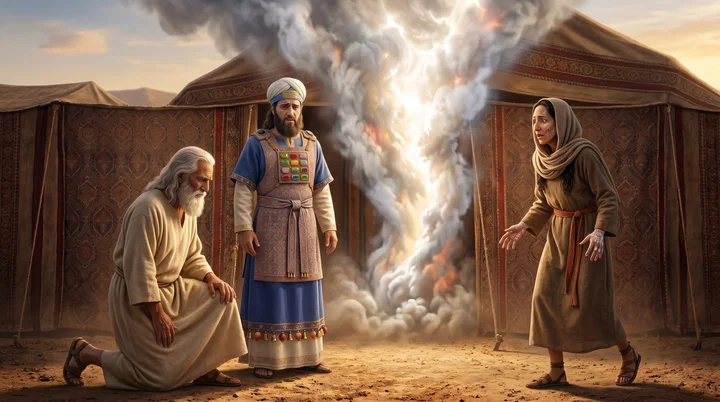
But this is not so with My servant Moses;
he is faithful in all My house.My servant Moses is not so. He is faithful in all my house.
My servant Moses is not so; he is true to me in all my house:
My seruant Moses is not so, who is faithfull in all mine house.
Douay-Rheims (Challoner revision)
But it is not so with my servant Moses a who is most faithful in all my house:
Pictures

Cross-references 20 of 39
- Exodus 33:11
And the LORD spake unto Moses face to face, as a man speaketh unto his friend. And he turned again into the camp: but his servant Joshua, the son of Nun, a young man, departed not out of the tabernacle.
Both describe the Lord speaking with Moses face to face.
- Numbers 16:3
And they gathered themselves together against Moses and against Aaron, and said unto them, Ye take too much upon you, seeing all the congregation are holy, every one of them, and the LORD is among them: wherefore then lift ye up yourselves above the congregation of the LORD?
Korah’s faction challenges the authority God gave Moses.
- Hebrews 3:5
And Moses verily was faithful in all his house, as a servant, for a testimony of those things which were to be spoken after;
Moses is faithful in God’s house as a servant, foreshadowing what was to come.
- Numbers 12:2
And they said, Hath the LORD indeed spoken only by Moses? hath he not spoken also by us? And the LORD heard it.
Aaron and Miriam question whether God spoke only through Moses.
- Deuteronomy 34:10
And there arose not a prophet since in Israel like unto Moses, whom the LORD knew face to face,
Confirms that the Lord knew Moses face to face.
- Numbers 12:3
(Now the man Moses was very meek, above all the men which were upon the face of the earth.)
Moses is described as exceptionally meek before God vindicates him.
- John 5:46-47
For had ye believed Moses, ye would have believed me: for he wrote of me.
Jesus says believing Moses’ writings leads to believing him.
- Exodus 33:20
And he said, Thou canst not see my face: for there shall no man see me, and live.
No one can see God’s face and live, clarifying Moses’ face-to-face speech.
- Hebrews 3:6
But Christ as a son over his own house; whose house are we, if we hold fast the confidence and the rejoicing of the hope firm unto the end.
Moses serves in God’s house, while Christ rules over his own house.
- Exodus 18:13-16
And it came to pass on the morrow, that Moses sat to judge the people: and the people stood by Moses from the morning unto the evening.
Moses faithfully judges the people and makes God’s statutes and laws known.
- Numbers 20:12
And the LORD spake unto Moses and Aaron, Because ye believed me not, to sanctify me in the eyes of the children of Israel, therefore ye shall not bring this congregation into the land which I have given them.
Moses is judged for failing to honor God before Israel.
- Hosea 12:13
And by a prophet the LORD brought Israel out of Egypt, and by a prophet was he preserved.
Moses led Israel out of Egypt and preserved them as a prophet.
- Exodus 24:9-10
Then went up Moses, and Aaron, Nadab, and Abihu, and seventy of the elders of Israel:
Aaron had seen God with Moses before sinning.
- Hebrews 3:2
Who was faithful to him that appointed him, as also Moses was faithful in all his house.
Also describes Moses as faithful.
- Hebrews 3:3
For this man was counted worthy of more glory than Moses, inasmuch as he who hath builded the house hath more honour than the house.
builder has more glory than the house
- Numbers 12:13
And Moses cried unto the LORD, saying, Heal her now, O God, I beseech thee.
Moses prays for Aaron and Miriam.
- Exodus 32:32
Yet now, if thou wilt forgive their sin—; and if not, blot me, I pray thee, out of thy book which thou hast written.
Moses offers himself for the people’s sake.
- Deuteronomy 34:5
So Moses the servant of the LORD died there in the land of Moab, according to the word of the LORD.
Moses is called the Lord’s servant, and the verse records his death.
- Numbers 12:15
And Miriam was shut out from the camp seven days: and the people journeyed not till Miriam was brought in again.
Miriam’s exclusion delayed Israel’s departure seven days.
- Exodus 4:15-16
And thou shalt speak unto him, and put words in his mouth: and I will be with thy mouth, and with his mouth, and will teach you what ye shall do.
God used Moses as spokesman
Commentary
Each commentary is drawn from primary sources: the writings of Ellen G. White and Adventist pioneers and periodicals. Each commentary is separate. Its own words are not a quotation; follow the references to read the source passages.
Ellen G. White
20 sources
God declared Moses a faithful steward over His whole household, entrusted with all that belongs to Him and given a prominent place as His chosen leader bearing His Spirit.1SP 287.2Ms 201, 1898, par. 1–5PP 384.3 He was set above ordinary prophets and fellow leaders, for while to others God makes Himself known in vision and dream, with Moses He spoke directly and openly and plainly as with a friend, granting nearer communion and sight of the divine form.1SP 287.2SG4 20.2Lt 7, 1894, par. 18–22Lt 88, 1894, par. 14–17PP 382.4–383.1 That word answered the challenge of Aaron and Miriam to his authority, and to complain and speak against him was irreverence and disloyalty to God Himself that provoked His anger.1SP 287.2SG4 20.2Lt 88, 1894, par. 14–17 Miriam's leprosy was set as a warning to all Israel to fear to oppose or murmur in jealousy against God's chosen servant.1SP 287.2Lt 7, 1894, par. 18–22SG4 27.1–2 The same rebuke falls on later believers who resent and criticize those on whom God lays the burden of His work, and though Moses was so honored his one transgression brought death to show that those most exalted are not excused but must give the strictest account.1SP 288.1Lt 28, 1859, par. 17–19Ms 69, 1912, par. 69–70
Moses Faithful Above Prophets
To be called faithful in all God's house means to be trustworthy in charge of all that belongs to God, entrusted with the work of His household.1SP 287.21SP 288.1Lt 28, 1859, par. 17–19 It means to hold a prominent place in that household as God's chosen instrument to carry out His will and purposes, as His appointed leader with appointed influence, upon whom He placed His Spirit.Ms 201, 1898, par. 1–5PP 384.31SP 288.1Lt 28, 1859, par. 17–19Lt 14a, 1898, par. 10–13
The declaration sets Moses above ordinary prophets and above the other leaders with him.1SP 287.2Lt 88, 1894, par. 14–171SP 295.1–2 It answers the dispute over whether Aaron and Miriam shared his authority, affirming his exceptional faithfulness and explaining why they were rebuked for speaking against the leader God had appointed.1SP 287.2Lt 88, 1894, par. 14–17PP 382.4–383.11SP 295.1–2
While God makes Himself known to a prophet in a vision or speaks in a dream, with Moses He spoke directly and openly and plainly rather than in obscure or dark sayings.1SP 287.2SG4 20.2Lt 7, 1894, par. 18–22ST Aug 19, 1880RH Aug 14, 1900 He was granted nearer communion than visions and dreams, speaking mouth to mouth, beholding the divine form, and conversing as with a friend by which to instruct Israel.1SP 287.2SG4 20.2ST Aug 19, 1880RH Aug 14, 1900PP 384.3
His faithfulness was shown in selfless care for Israel and in accepting God's choice of Joshua without jealousy while instructing the people to respect their new leader.ST Jan 13, 1881 His role was unique as prophet and ruler who also officiated as priest and received counsel directly from God, whereas after him Israel's rulers sought counsel through the high priest.ST Jan 13, 1881
Speaking Against God's Appointee
Moses stands above ordinary prophets as one trustworthy in charge of all that belongs to God, faithful in all His household and given a prominent trust as God's chosen instrument to carry out His will and purposes.1SP 287.2SG4 20.2Lt 88, 1894, par. 14–17Ms 201, 1898, par. 1–5ST Aug 19, 1880 Unlike prophets to whom God makes Himself known in a vision or speaks in a dream, God speaks with Moses directly and openly, mouth to mouth, plainly rather than in obscure or dark sayings, and grants him to see the divine form.1SP 287.2SG4 20.2ST Aug 19, 1880RH Aug 14, 1900 Because God chose and appointed Moses to bear responsibility and lead the people, speaking and complaining against him was irreverence and disloyalty and an offense against God Himself who had chosen him.1SP 287.2SG4 20.2Ms 201, 1898, par. 1–5ST Aug 19, 1880RH Aug 14, 1900 Those who spoke against him failed to recognize and respect God's appointment, and the Lord revealed His displeasure toward them and His anger was kindled against them.1SP 287.2Lt 88, 1894, par. 14–17Ms 201, 1898, par. 1–5RH Aug 14, 1900
God's answer to the jealous challenge of Aaron and Miriam, declaring Moses' faithfulness and plain, mouth-to-mouth communion rather than revelation through visions, dreams, and dark sayings, should have made them afraid to speak against him.1SP 287.2Lt 7, 1894, par. 18–22 God's rebuke of Miriam and Aaron for speaking against Moses, with God's anger kindled against them, was a warning that they should not have spoken against him.1SP 287.2Lt 7, 1894, par. 18–22SG4 27.1–2 Miriam's leprosy and her punishment warned all Israel not to oppose God's chosen and specially appointed servant, not to rebel against his authority, and not to give way to jealousy and complaints against him.SG4 27.1–21SP 296.11SP 295.1–2SG4 27.3 Miriam's case stands as a warning to those tempted to rebel against him.1SP 296.11SP 295.1–2SG4 27.3
The declaration that God spoke with Moses mouth to mouth and the warning against speaking against Moses were instruction for all Israel and not only for Aaron and Miriam.PP 396.3 Aaron's joining Miriam in envy and murmuring against Moses marred the record of his otherwise noble life.PP 425.4
Warnings for Later Believers
The jealousy and murmuring of Miriam and Aaron against Moses stand as a rebuke to all who resent or criticize those on whom God lays the burden of His work.1SP 288.1Lt 28, 1859, par. 17–19 To be called faithful in all His house means to be God's chosen servant entrusted with the work of His household and given a prominent place in it, so that complaining against such a one is irreverence toward God Himself.1SP 288.1Lt 28, 1859, par. 17–19 Those who do not share the burdens God assigns should not stand ready to criticize the one who bears them.Lt 28, 1859, par. 17–19
Criticizing, condemning, looking with contempt upon, or disparaging God's messengers and cutting away their influence meets God's signal displeasure.Lt 14a, 1898, par. 10–13 Believers must therefore guard sacredly one another's interests and must not put their own estimate upon God's workers or their missionary work merely because they do not work after human plans.Lt 14a, 1898, par. 10–13 Giving loose rein to the tongue in criticism and condemning puts a person wholly out of sympathy with God and angels.Lt 14a, 1898, par. 10–13 Much criticism is born of evil surmising and of seeking to be first, and as a person judges others in little things so God will judge that person for things that dishonor His name.Lt 14a, 1898, par. 10–13 Those in responsibility must be doers of His word in little as well as large things, and the leaven of Pharisaism, criticism, and accusing must be purged from the heart before receiving God's approval as faithful.Lt 14a, 1898, par. 10–13
Though Moses was honored by God, spoken with as a man speaks with his friend, used to instruct Israel, and faithful in all God's house, his one transgression brought the penalty of death.Ms 69, 1912, par. 69–70 This proves God's impartiality, and was meant to put fear of breaking His law in Israel and to show that those He honors most are not excused when they leave the right way.Ms 69, 1912, par. 69–70 Those most exalted and carrying the heaviest responsibilities must give the strictest account for words and actions, because their least deviation is watched and copied by others as permission to go further.Ms 69, 1912, par. 69–70
Sources
Pioneers and periodicals
55 sources
God spoke these words to rebuke Aaron and Miriam for speaking against Moses out of jealousy and envy at his superiority and position above them, with no good reason for contempt.ST Mar 31, 1909ST Apr 29, 1913RH May 26, 1863 The declaration means Moses was faithful in all God's house, obeying in everything given him to do and carrying out his instructions with no way of his own.ST May 6, 1889RH Aug 20, 1857ST Feb 28, 1906RH Nov 27, 1913 He stands incomparably above every other prophet, for while God made Himself known to others through visions and dreams, with Moses He spoke mouth to mouth, plainly and face to face as a man speaks with a friend.ST May 6, 1889RH Jan 14, 1873RH Sep 4, 1860RH Aug 10, 1916 Moses in this high place is a type of Christ, yet stands below Jesus, who as builder of the house has more glory than the house and is over His people as Son.RH Feb 19, 1861ST Jan 17, 1906RH Aug 20, 1901 Speaking against such a chosen leader is irreverence toward God who chose him and gave him authority, a grievous sin bringing fearful judgment, and the same rebuke rests on those who defame God's proven overseers now.ST Aug 19, 1880RH Nov 12, 1903RH Mar 7, 1907RH Nov 18, 1862RH May 26, 1863
Setting of Divine Rebuke
The verse belongs to God's rebuke of Aaron and Miriam for speaking against Moses, answering their challenge to his unique standing when God heard their words and called them to account.ST Mar 31, 1909 He was set above them because he was worthy and well fitted for the place as God's own choice as overseer, faithful in everything entrusted to him, so they had no good reason to treat him with contempt.ST Apr 29, 1913RH May 26, 1863 Their attack sprang from jealousy and envy at his superiority and position above them, for they could not bear to have anyone above them, and the sight of his superiority and success pained their selfish hearts and made them discontented.ST Apr 29, 1913 Thinking their only hope of being exalted was to bring Moses down, they took action against him and defamed him, and that defaming brought God's rebuke and displeasure, because God is not the author of confusion but of peace and order.ST Apr 29, 1913RH May 26, 1863 The same holds now: those who defame God's chosen servants and presume to usurp their office as overseers over the flock will meet God's rebuke and displeasure unless they repent, for God will not give up His own choice to accept man's preference.RH May 26, 1863
The rebuke came because they spoke against Moses for his marriage to an Ethiopian woman, and the Lord came down in the pillar of the cloud and stood in the door of the tabernacle and called Aaron and Miriam forth.RH Dec 17, 1901 His anger was kindled against them, He departed, the cloud departed from off the tabernacle, and Miriam became leprous, white as snow.RH Dec 17, 1901 That leprosy imperiled the life of all who touched her, and Aaron, who fully shared the guilt of that wrongdoing against his faithful brother, sorrowed deeply over his beloved sister.ST Mar 31, 1909 Moses prayed for her and her restoration followed, supporting the lesson that those who serve alongside a leading prophet must respect his God-given responsibility and that God does not abandon a faithful servant even in old age.RH Apr 26, 1906 That sin was a lapse from rectitude which God forgave, and a great trial by which Aaron was disciplined and made a different, tested man who afterward served faithfully as priest.ST Mar 31, 1909
The chapter illustrates jealousy and the Lord's vindication and approval of Moses as God's faithful servant, showing Moses as faithful throughout God's household in contrast to Miriam and Aaron's foolish complaint against him.ST Feb 17, 1909 Their challenge brought a striking consequence for Miriam in her chastening, and the account shows Moses' exceptional fidelity amid Israel's repeated rebellions and punishments.ST May 23, 1911 The account belongs to the wilderness history of Numbers 11-14, where Israel disobeyed by wanting to live like the world, complained and lusted after the food eaten in Egypt, and continued to murmur until the Lord's protecting care was withdrawn.RH Apr 17, 1879 They then wandered in the wilderness until all but Caleb and Joshua and the children perished without entering the promised land, and his faithfulness during Israel's forty years of testing in the wilderness is connected with the provocation that followed Israel's unbelief while journeying toward Canaan.RH Apr 17, 1879RH Feb 14, 1865
The account of God's displeasure with Aaron and Miriam, Miriam's leprosy, and Moses' prayer for her shows the seriousness of sin among God's people and its effects on their progress.RH Jun 12, 1913 It shows the holiness of God's work and how particular God is that everything shall be performed exactly.ST Jun 17, 1889 The punishment that followed Miriam's sin shows the sacredness of His ordinances.ST Jun 17, 1889
Meaning of Faithful Service
Moses is declared faithful in all God's house, faithful throughout God's household in a way unlike an ordinary prophet and unique among Israel's prophets.ST May 6, 1889ST Oct 6, 1887RH Sep 21, 1916 He held a uniquely high standing at the head of the prophetic era and the ancient theocracy through whom God's rule was maintained, honored by God above other men as the great leader who brought God's people from Egypt to Canaan.ST May 6, 1889ST Oct 6, 1887 He was set above Aaron and Miriam because he was worthy and well fitted for the place, and this faithfulness and standing are why they should have feared to speak against him.ST May 6, 1889ST Apr 29, 1913 After the Fall he alone among God's servants spoke with God face to face, yet his faithfulness did not keep him from death, for he died in Moab.ST Oct 6, 1887RH Sep 21, 1916
His faithfulness meant obeying God's commands in everything given him to do and making known God's statutes and laws to the people.RH Aug 20, 1857ST Feb 28, 1906 He carried out the instructions God gave him, seeking no way of his own and no ease of life, and with one exception did just what he was given to do, which made him dependable and fit for God's work.RH Nov 27, 1913 He did not yield to the traditions of men, though called from tending Jethro's flocks in Midian to lead two million people through the Red Sea and through the wilderness forty years, though permitted to behold God's glory when He descended on Mount Sinai and to speak with the Lord mouth to mouth and see the Lord's form.RH Aug 20, 1857
His faithfulness is shown in serving God rather than people, seeking God's glory, loyalty to principle, earnestness in work, and duty performed as in God's sight.ST Feb 15, 1905RH Sep 24, 1903 It is shown in continuing his work despite opposition and false accusations, praying for those who wronged him, and pleading for God to save His people and uphold His promises.ST Feb 15, 1905 It is shown in carrying out God's command against Israel's apostasy and refusing to yield to weak leadership, for which God commended him and did not reprove him for righteous indignation.RH Mar 5, 1908
Though learned in all the wisdom of the Egyptians and belonging to God's chosen people, he remained the meekest man on the face of the whole earth, meek, teachable, unselfish, tender and forgiving.RH Aug 20, 1857ST May 6, 1889 He was not above taking advice from Jethro the priest of Midian, did not envy Eldad and Medad when they prophesied but wished all could receive God's Spirit, and was willing to divide his burdens and honors with the council of seventy.ST May 6, 1889 His selfless care for Israel appeared in praying for God to forgive Aaron and Miriam when they plotted against him on a tender and embarrassing point, and in accepting God's choice of Joshua without jealousy and instructing the people to respect their new leader.ST Jan 13, 1881ST May 6, 1889 His role was unique, for he was prophet and ruler, also officiated as high priest, and received counsel directly from God, whereas after him Israel's rulers sought counsel through the high priest.ST Jan 13, 1881
Meekness enables its possessor to be faithful in the Lord's house by obeying all His righteous commands.RH Aug 20, 1857 Keeping God's commands gives right to partake of the fruit of the tree of life and to enter in through the gates of the city of God.RH Aug 20, 1857 God calling Moses My servant designates Moses's faithfulness, and the same expression His servant given to John marks John's faithfulness as like that of Moses.ST Oct 22, 1902 The title servant reveals noble character and is a position so honorable that even angels delight in it, while servant is a general term for a faithful member of God's household and does not by itself mean a person held in involuntary slavery.RH May 30, 1865ST Oct 22, 1902
Moses Above Other Prophets
Moses was not as other prophets, but faithful throughout God's household with a uniquely high standing among Israel's prophets.ST May 6, 1889RH Aug 10, 1916 He stood at the head of the prophetic era and the ancient theocracy through whom God's rule was maintained, and incomparably above every other person in God's work, whether prophet, priest, or king.RH Jan 12, 1911 As leading prophet he held a position above all other prophets, with a responsibility laid on no other man or set of men, answerable in a special sense to God alone, so that kings, rulers, priests and apostles obeyed God's voice when instructed through him.RH Aug 10, 1916 Although chosen with Aaron and Miriam to lead Israel from Egyptian bondage, he was recognized as the chief leader by whom Israel was brought out and preserved, and even Miriam herself as a prophetess was not permitted to criticize him or place her work on a par with his.RH Aug 10, 1916
To other prophets God made Himself known through visions and dreams and in dark sayings, but with Moses He spoke mouth to mouth, plainly and apparently, face to face as a man speaks with a friend.RH Jan 14, 1873RH Sep 4, 1860ST Nov 3, 1898RH Jun 23, 1903 He was permitted to speak with God mouth to mouth and face to face as a person speaks with a friend, in a manner different from the revelations given to other prophets.RH Jun 23, 1903RH Feb 3, 1910 In this direct converse He showed him the divine likeness and form, allowing him to behold the Lord's form rather than in visions, dreams, or dark sayings.ST Nov 3, 1898 Moses alone in Old Testament story after the Fall was brought face to face with Jehovah in counsel as one friend converses with another, while all others with whom heavenly intercourse was held must be content to receive it through a vision or in a dream.ST Dec 22, 1914RH Sep 21, 1916
This makes evident the mystery of God's voice, that His process of declaring His will over mortal mind to control intellectual faculties is as potent and as unsearchable as His process of speaking over unorganized matter to call world elements into being.ST Dec 22, 1914 This special face-to-face manner of speaking was direct, familiar, audible and articulate speech, yet it does not mean Moses literally saw God's face.RH Jan 14, 1873RH Sep 4, 1860 He saw the glory and the cloud that represented God's presence, but not God's unveiled face or full glory, which would consume him in mortal form.RH Jan 14, 1873RH Sep 4, 1860ST Apr 29, 1908 The cloud could be seen, but the face possessing more dazzling brightness than a thousand suns could not be seen unveiled, which resolves how Moses could speak face to face yet could not see God's face.RH Jun 18, 1861
The great and dreadful God came down wrapped in a cloud of glory and Moses was permitted to draw near and converse with Him, mouth to mouth, even apparently, face to face as a person speaks directly with a friend.RH Jun 18, 1861RH Jun 8, 1869 This direct converse proves God is a person having form and parts, distinct from speech in dark sayings.RH Jun 18, 1861RH Jun 8, 1869 The distinction honors Moses above other prophets because of his personal faithfulness, not because the Scriptures given through him are more inspired or more truly revelation than those given through Daniel, Isaiah, Jeremiah, or any other prophet.ST May 6, 1889 The difference in the way God revealed Himself is a distinction between the men themselves, not between their writings, for the writings of all the prophets are equally inspired by the same God and the same Spirit.ST May 6, 1889
Moses was more than a channel for transmitting truth; his own mind was divinely enlightened and illuminated so that he understood what he spoke and wrote as fully as mortal limits allowed.ST May 6, 1889 He received not only inspiration but direct revelation and divine illumination, knowing what he spoke and wrote as fully as mortal limits allowed. The enlightenment of a prophet's mind is one thing and the inspiration of his writings is another, and the other prophets did not fully grasp their own writings but wrote for generations to come.ST May 6, 1889 His faithfulness throughout God's household is cited as evidence that God spoke to him.ST Jan 15, 1885
Through that closeness mighty miracles were wrought through him, as he talked with God face to face as a man talks to his friend.ST May 6, 1889 He was not merely a prophet but more than a prophet, a messenger with a message of reproof to the erring and encouragement to the meek and lowly.RH Nov 1, 1906 His work includes more than the word prophet signifies and must be recognized as such, for refusing to recognize the voice of God through him alone as infallible brings destruction.RH Nov 1, 1906 He did not set himself up as leader but God called and ordained him as His faithful servant over His house and as overseer to lead Israel from Egyptian bondage to Canaan, with Miriam and Aaron having no good reason to treat him with contempt.RH Mar 7, 1907RH May 26, 1863 The need and importance of having such a leader is shown by Israel worshiping the golden calf while Moses was away forty days.RH Mar 7, 1907
Christ Greater Than Moses
Moses stands distinct among the prophets, and in that distinction he is a type of Christ, while Jesus as the Prophet like Moses likewise foretold events literally.ST Jan 17, 1906 He does not stand opposed to Christ but by God's Spirit testified of Christ, serving only as a servant for a testimony of things to be spoken afterward.RH Jul 26, 1870
Moses is superior to all other prophets in his direct and immediate intercourse with God, for other prophets receive divine communications through dreams and visions, but Moses receives everything from the mouth of God.RH Feb 19, 1861 He holds a high place in the history of God's kingdom, yet his place is that of servant of the Lord.ST Jan 7, 1903 Jesus Christ outshone Moses as the sun outshines all other luminaries in the doctrines He revealed, the precepts He taught, the miracles He wrought, and the life and example He exhibited, bringing grace and truth and declaring God whom no man has seen.RH Feb 19, 1861 The prophets received their commission from the supernatural sphere, but Jesus came Himself from that sphere, and Moses as servant stands below Jesus, who is Son of God not merely by gracious rank as angels and Israelites are called sons of God, but by inner substance as the only-begotten Son who has truly seen God.ST Jan 7, 1903
Moses was faithful in all God's house, and he is set beside Christ to show how much greater Christ is as apostle and high priest.RH Aug 20, 1901 Christ originated the Jewish economy and is worthy of more glory than Moses, because he who built the house has more glory than the house.RH Aug 20, 1901 Christ is over His people, and His people are His house, a living temple.RH Aug 20, 1901
God did not speak to Moses by dream or vision as to other prophets, but face to face as a man talks with his friend, revealing His similitude to His servant.ST Aug 21, 1901 God placed authority in Moses and used him as His own spokesman as He used no other, so that Moses' office carried the very authority of God.ST Aug 21, 1901 The indwelling glory of God's word received by faith beamed forth from Moses' countenance.ST Aug 21, 1901 To receive his words as from God meant life and to reject them meant death.ST Aug 21, 1901 Christ's words were received from God the same as those of Moses, and rightly received Moses' words gave not mere law but grace and truth, even as believers receive in Jesus Christ.ST Aug 21, 1901
Warning Against Opposing Leaders
Speaking against Moses was irreverence toward God who had chosen him and given him authority not to be treated as self-appointed, for he did not set himself up but was called and ordained to lead Israel from Egyptian bondage to Canaan as faithful servant over His house.ST Aug 19, 1880RH Nov 12, 1903RH Mar 7, 1907 His faithfulness and special closeness made the attack upon him an attack upon God Himself, a grievous and dangerous sin bringing fearful judgment, as shown when God manifested displeasure and judged Aaron and Miriam and Miriam became leprous.ST Aug 19, 1880RH Mar 7, 1907RH May 20, 1873 The need and importance of such a leader was shown when Israel worshiped the golden calf during the forty days Moses was away.RH Mar 7, 1907 To question a leader God has chosen is therefore dangerous.RH May 20, 1873
Even Miriam, herself a prophetess, and Aaron, himself a prophet through whom the Lord spoke in vision and dream, were not permitted to criticize Moses or place their work on a par with his.RH Aug 10, 1916RH Nov 1, 1906 Moses held position as leading prophet above all other prophets, faithful in all God's house, with whom God spoke mouth to mouth rather than through visions, dreams, or dark sayings, and placing their work on his level brought God's rebuke for speaking against His servant.ST Aug 19, 1880RH Aug 10, 1916RH Nov 1, 1906 Although Aaron and Miriam were chosen with Moses to lead Israel from bondage, God recognized Moses as the chief leader by whom Israel was brought out and preserved.RH Aug 10, 1916 He was more than a prophet, a messenger with reproof for the erring and encouragement for the meek and lowly, whose work is more than the word prophet signifies and must be recognized as such.RH Nov 1, 1906
God's distinction of Moses and warning against speaking against him were instruction for all Israel, not only Aaron and Miriam, giving all reason to fear to speak against one with whom God dealt so directly as visible leader.RH Nov 12, 1903ST Sep 9, 1880 A spirit of rebellion or murmuring cannot be tolerated among God's people, and those who side with the murmurer against proven leaders put themselves outside fellowship, just as all who sympathized with Satan in rebellion were cast out with him.RH Nov 18, 1862 The same holds now: those who defame God's chosen servants and presume to usurp their office as overseers over the flock will meet God's rebuke and displeasure unless they repent, for God is not author of confusion but of peace and order and will not give up His own choice to accept man's preference.RH May 26, 1863
Such murmuring springs from dissatisfaction with one's own position, from envy pained by another's superiority and success, from desire to gain honor by lessening confidence in leaders, or from desire to hide one's own faults by attacking those better.RH Jun 25, 1872ST Apr 29, 1913 Aaron and Miriam envied Moses because he was worthy and well fitted for the place set above them, and thinking their only hope of exaltation was to bring him down, they took action against him out of selfish, discontented hearts.ST Apr 29, 1913 Such efforts defeat themselves by revealing selfishness and malice and forfeit any call to greater work.RH Jun 25, 1872 Pointing to real or supposed errors in such a chosen instrument through whom God speaks to save His people weakens confidence in God's work, questions God's wisdom in choosing him, and dishonors God, whose reputation He guards with jealous care as one of the few in each generation who come near the Lord to speak through them to the world for salvation.RH Jun 25, 1872 God Himself knows his faults and alone may withdraw His Spirit and put another in his place while He retains him.RH Jun 25, 1872
God lays on a leading prophet a responsibility laid on no other man or set of men, in a special sense answerable to God alone, so that kings, rulers, priests and apostles obey the voice of God when instructed through him.RH Aug 10, 1916 Those who serve alongside must respect that God-given trust, knowing God does not abandon a faithful servant even in old age, as shown when Miriam's leprosy followed the grievous sin of challenging Moses and Moses' prayer brought her restoration.RH Aug 10, 1916RH Apr 26, 1906 God always leads His people by human instrumentalities and speaks His will through chosen servants, men or women, so it is not the human person that is followed but the voice of God spoken through His servant.RH Mar 7, 1907 Refusing to recognize that voice alone as infallible brings destruction.RH Nov 1, 1906
Broader Lessons and Links
The rebuke came because complaint was made against Moses for having married an Ethiopian woman.RH Dec 17, 1901 The Lord came down in the pillar of the cloud and stood in the door of the tabernacle and called Aaron and Miriam forth, His anger was kindled against them, He departed, the cloud departed from off the tabernacle, and Miriam became leprous, white as snow.RH Dec 17, 1901 Being exercised over the color line and complaining against respect for Ethiopians brings the Lord's own rebuke and punishment.RH Dec 17, 1901
The passage about visions and dreams and speaking mouth to mouth provides a biblical precedent for visions, the condition of Sister White in vision being the same as that of those to whom God gave visions in ancient times.RH Jul 29, 1873 God calling Moses My servant designates his faithfulness, and the same expression His servant given to John marks John's faithfulness as like that of Moses.ST Oct 22, 1902 The title servant reveals noble character and is a position so honorable that even angels delight in it.ST Oct 22, 1902 Though part of the account of Aaron and Miriam's serious mistakes and God's distinction of Moses, who had spoken with God face to face, he too failed in the supreme test of giving God the glory.RH Feb 24, 1916
Sources