Numbers 16:40
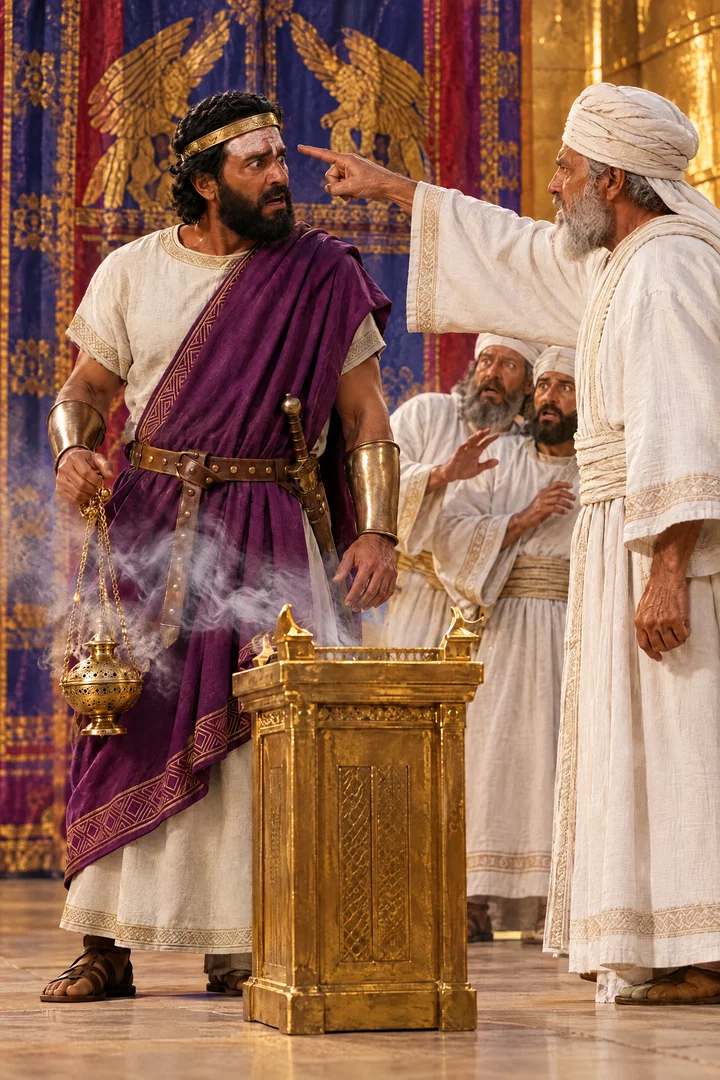
To be a memorial unto the children of Israel, that no stranger, which is not of the seed of Aaron, come near to offer incense before the LORD; that he be not as Korah, and as his company: as the LORD said to him by the hand of Moses.
Translations
To be a memorial to the children of Israel, that no stranger, which is not of the seed of Aaron, come near to offer incense before the LORD; that he be not as Korah, and as his company: as the LORD said to him by the hand of Moses.
To be a memorial unto the children of Israel, that no stranger, which is not of the seed of Aaron, come near to offer incense before the LORD; that he be not as Korah, and as his company: as the LORD said to him by the hand of Moses.
to be a memorial unto the children of Israel, that no stranger, which is not of the seed of Aaron, come near to offer incense before the Lord; that he be not as Korah, and as his company: as the Lord said to him by the hand of Moses.
To be a memorial to the children of Israel, that no stranger, who is not of the seed of Aaron, should come near to offer incense before the LORD; that he may not be as Korah, and as his company: as the LORD said to him by the hand of Moses.
to be a memorial unto the children of Israel, to the end that no stranger, which is not of the seed of Aaron, come near to burn incense before the LORD; that he be not as Korah, and as his company: as the LORD spake unto him by the hand of Moses.
to be a memorial unto the children of Israel, to the end that no stranger, that is not of the seed of Aaron, come near to burn incense before Jehovah; that he be not as Korah, and as his company: as Jehovah spake unto him by Moses.
a memorial to the sons of Israel, so that a stranger who is not of the seed of Aaron doth not draw near to make a perfume before Jehovah, and is not as Korah, and as his company, — as Jehovah hath spoken by the hand of Moses to him.
as a memorial to the children of Israel, that no stranger who is not of the seed of Aaron come near to burn incense before Jehovah, that he be not as Korah, and as his band, — as Jehovah had said to him through Moses.
a memorial unto the sons of Israel, That no stranger, who is not of the seed of Aaron, shall draw near to offer incense before Yahweh,—lest he become like Korah and like his assembly, As spake Yahweh by the hand of Moses with regard thereto.
Berean Standard Bible, Majority Standard Bible
just as the LORD commanded him through Moses. This was to be a reminder to the Israelites that no outsider who is not a descendant of Aaron should approach to offer incense before the LORD, lest he become like Korah and his followers.
to be a memorial to the children of Israel, to the end that no stranger who isn’t of the offspring of Aaron, would come near to burn incense before the LORD, that he not be as Korah and as his company; as the LORD spoke to him by Moses.
To be a sign, kept in memory for ever by the children of Israel, that no man who is not of the seed of Aaron has the right of burning spices before the Lord, so that he may not be like Korah and his band: as the Lord said to him by the mouth of Moses.
It is a remembrance vnto the children of Israel, that no stranger which is not of the seede of Aaron, come neere to offer incense before the Lord, that he be not like Korah and his company, as the Lord said to him by the hand of Moses.
Douay-Rheims (Challoner revision)
That the children of Israel might have for the time to come wherewith they should be admonished, that no stranger or any one that is not of seed of Aaron should come near to offer incense to the Lord, lest he should suffer as Core suffered, and all his congregation, according as the Lord spoke to Moses.
Pictures
Cross-references 20 of 24
- Numbers 16:1-35
Now Korah, the son of Izhar, the son of Kohath, the son of Levi, and Dathan and Abiram, the sons of Eliab, and On, the son of Peleth, sons of Reuben, took men:
Korah’s company rebelled against the appointed leaders and was judged, explaining the memorial warning.
- Leviticus 10:1-2
And Nadab and Abihu, the sons of Aaron, took either of them his censer, and put fire therein, and put incense thereon, and offered strange fire before the LORD, which he commanded them not.
Nadab and Abihu are judged for offering incense contrary to the Lord’s instructions.
- 1 Corinthians 10:11
Now all these things happened unto them for ensamples: and they are written for our admonition, upon whom the ends of the world are come.
Israel’s recorded experiences serve as examples and warnings for later believers.
- Numbers 16:31-33
And it came to pass, as he had made an end of speaking all these words, that the ground clave asunder that was under them:
The earth opens and swallows Korah and his company.
- Numbers 16:35
And there came out a fire from the LORD, and consumed the two hundred and fifty men that offered incense.
Fire consumed the 250 men who offered incense.
- 2 Chronicles 26:16-18
But when he was strong, his heart was lifted up to his destruction: for he transgressed against the LORD his God, and went into the temple of the LORD to burn incense upon the altar of incense.
Uzziah is rebuked for unlawfully entering the sanctuary to burn incense.
- Numbers 16:49
Now they that died in the plague were fourteen thousand and seven hundred, beside them that died about the matter of Korah.
The plague followed the judgment on Korah and struck those who sided with him.
- Exodus 30:9
Ye shall offer no strange incense thereon, nor burnt sacrifice, nor meat offering; neither shall ye pour drink offering thereon.
Forbids offering unauthorized incense on the altar.
- Numbers 20:26
And strip Aaron of his garments, and put them upon Eleazar his son: and Aaron shall be gathered unto his people, and shall die there.
Aaron’s orderly succession contrasts with Korah’s rebellion.
- Numbers 16:5-7
And he spake unto Korah and unto all his company, saying, Even to morrow the LORD will shew who are his, and who is holy; and will cause him to come near unto him: even him whom he hath chosen will he cause to come near unto him.
Moses sets a test to show whom the Lord has chosen.
- Numbers 3:10
And thou shalt appoint Aaron and his sons, and they shall wait on their priest’s office: and the stranger that cometh nigh shall be put to death.
gives same ban on strangers nearing priest's office
- Numbers 18:7
Therefore thou and thy sons with thee shall keep your priest’s office for every thing of the altar, and within the vail; and ye shall serve: I have given your priest’s office unto you as a service of gift: and the stranger that cometh nigh shall be put to death.
gives same ban on strangers nearing priest's office
- Jude 1:11
Woe unto them! for they have gone in the way of Cain, and ran greedily after the error of Balaam for reward, and perished in the gainsaying of Core.
Both texts name Korah as an example of rebellion.
- Numbers 16:2
And they rose up before Moses, with certain of the children of Israel, two hundred and fifty princes of the assembly, famous in the congregation, men of renown:
Identifies the leaders and prominent supporters who rose against Moses.
- Numbers 16:26
And he spake unto the congregation, saying, Depart, I pray you, from the tents of these wicked men, and touch nothing of theirs, lest ye be consumed in all their sins.
The people are told to separate from the rebels.
- Hebrews 7:18-19
For there is verily a disannulling of the commandment going before for the weakness and unprofitableness thereof.
this priesthood law is what is disannulled
- Exodus 28:1
And take thou unto thee Aaron thy brother, and his sons with him, from among the children of Israel, that he may minister unto me in the priest’s office, even Aaron, Nadab and Abihu, Eleazar and Ithamar, Aaron’s sons.
Aaron and his sons are appointed to minister as priests.
- Hebrews 7:12
For the priesthood being changed, there is made of necessity a change also of the law.
A change of priesthood requires a change in the law governing who may offer incense.
- Exodus 30:7
And Aaron shall burn thereon sweet incense every morning: when he dresseth the lamps, he shall burn incense upon it.
Aaron burns incense on the altar.
- Hebrews 7:28
For the law maketh men high priests which have infirmity; but the word of the oath, which was since the law, maketh the Son, who is consecrated for evermore.
identifies this law making Aaronic high priests
Commentary
Each commentary is drawn from primary sources: the writings of Ellen G. White and Adventist pioneers and periodicals. Each commentary is separate. Its own words are not a quotation; follow the references to read the source passages.
Ellen G. White
13 sources
The censers of Korah's company had been made holy by being presented before the Lord, so their metal was beaten into a covering for the altar to stand as a lasting sign that no one outside the seed of Aaron may come near to burn incense before the Lord lest he share the fate of Korah and his company.Lt 39, 1899, par. 23Lt 9, 1895, par. 7PP 398.2SG4 33.1 That memorial answers the claim that all the congregation is holy and therefore free to take the priestly office for itself.PP 398.2 The uprising was the same pride and ambition that moved Lucifer against the government of heaven, working through envy, distrust and desire for position until in rejecting Moses and Aaron as God's appointed leaders the rebels rejected God Himself.PP 403.3 Their destruction stands as a recorded warning that rebellion against God's appointed order ends in ruin, yet even after that judgment the people still charged Moses and Aaron with killing the Lord's people, showing how rebellion blinds and hardens the heart.Lt 156, 1897, par. 3–65T 66.23T 353.1Lt 12a, 1893, par. 22–24 So the verse warns against entering sacred service without God's appointment, for work kindled by self will not endure while only what God kindles abides.Lt 9, 1895, par. 7Lt 34, 1899, par. 42–44Lt 120, 1900, par. 24–25
Censers as Lasting Memorial
The censers taken up by Korah's followers had become hallowed because they had been presented before the Lord, and their metal was beaten into a covering for the altar to stand as a sign and memorial to Israel.SG4 33.1 That memorial ordains that no stranger who is not of the seed of Aaron is to come near to offer incense before the Lord, lest he become as Korah and as his company and share their fate and judgment.Lt 39, 1899, par. 23Lt 9, 1895, par. 7PP 398.2SG4 33.1RH Mar 4, 1915 The account is given as a lesson calling for careful, prayerful attention to rebellion and its consequences.Lt 39, 1899, par. 23
True service must use only the holy fire God provides, for service mixed with self will not endure, while work done in God will endure.Lt 9, 1895, par. 7 The same restriction of priestly service to Aaron's family was later violated when Uzziah entered the sanctuary to burn incense.RH Mar 4, 1915 The history including this memorial gives instruction fitting for the present time to keep the whole flock from being fed with errors that would cause them to go astray.Lt 224, 1903, par. 1–2 In this way the memorial answers the rebels' claim that the whole congregation was holy and equally entitled to authority, rejecting the idea that such holiness made anyone free to take up the priestly office.PP 398.2
Rebellion Against Appointed Order
The rebellion of Korah, Dathan, and Abiram worked out on a narrower stage the same spirit that produced Satan's rebellion in heaven.PP 403.3 Pride and ambition prompted Lucifer to complain of the government of God and to seek the overthrow of the order established in heaven, and since his fall his object has been to infuse the same envy and discontent and the same ambition for position and honor into men.PP 403.3 He worked upon Korah, Dathan, and Abiram to arouse the desire for self-exaltation and to excite envy, distrust, and rebellion.PP 403.3 By rejecting Moses and Aaron as men of God's appointment they rejected God as their leader, and while murmuring against Moses and Aaron they blasphemed God, yet they were so deluded as to think themselves righteous and to regard those who faithfully reproved their sins as actuated by Satan.PP 403.3 Their fate warns against rebellion disguised as spiritual guidance and against leaders who gain support through secrecy, falsehood, and evil surmising.Lt 156, 1897, par. 3–6
Resisting God's appointed counsel repeats their rebellion, for they stubbornly trusted their own judgment over that of Moses.5T 66.2Lt 12a, 1893, par. 22–24 Their history warns against resisting or undermining God's servants when they carry out the duty of correcting wrongdoing.5T 66.2Lt 12a, 1893, par. 22–24 Even after God's judgment destroyed the leaders, rebellion remained when the survivors wrongly accused Moses and Aaron of killing the people of the Lord.5T 66.2Lt 12a, 1893, par. 22–24 That persistence shows that rebellion can bring fearful deception and leave people hard to convince.5T 66.2Lt 12a, 1893, par. 22–24
The fate of Korah and his company stands as a recorded memorial that rebellion against God's appointed order leads to destruction, and Israel was not to repeat their example of unbelief.Lt 156, 1897, par. 3–63T 353.1 The failures of Israel and their consequences were recorded to admonish later believers not to follow that example.Lt 156, 1897, par. 3–63T 353.1
Faithful Service and Application
The memorial stands as a warning against approaching God's service without His appointment and against rebellion and unauthorized service in sacred work.Lt 34, 1899, par. 42–44Lt 120, 1900, par. 24–25 Service mixed with self and kindled from self will not stand or endure, while work done in God and with what God kindles will endure, so worshippers must use what God provides and kindles rather than anything else, including any strange or unholy fire.Lt 9, 1895, par. 7Lt 120, 1900, par. 24–25 The account is given as a lesson calling for careful, prayerful attention to rebellion and its consequences, for it records that only those descended from Aaron were authorized to offer incense before the Lord and that anyone else who approached to do so would share the fate of Korah and his company.Lt 39, 1899, par. 23 In a crisis it calls for decisive action and for separating evil workers from the Lord's work, since those who resist God's warnings and persist in evil must have their hearts changed.Lt 34, 1899, par. 42–44
The restriction of priestly service to Aaron's family was later violated when Uzziah entered the sanctuary to burn incense.RH Mar 4, 1915 The whole account through Numbers 16:1-50, including this memorial that no stranger outside the seed of Aaron come near to offer incense lest he be as Korah and his company, gives instruction appropriate for the present time to keep the whole flock from being fed with errors that would cause them to go astray.Lt 224, 1903, par. 1–2
Sources
Pioneers and periodicals
41 sources
The beaten censers were spread as a covering for the altar to stand forever as a memorial that no outsider outside Aaron's seed is to come near to offer incense before the Lord lest he perish as Korah and his company did.RH Feb 17, 1916ST Apr 22, 1889ST May 20, 1889ST Jun 4, 1874 Becoming as Korah was far more than unlawfully offering incense, for in opposing Moses whom God had appointed to lead Israel it opposed God Himself and called in question His whole order and authority.RH Nov 1, 1906RH Mar 7, 1907RH Jan 17, 1865RH Jul 25, 1907 That rebellion will be repeated among God's people before the heavenly Canaan, when self-exalted accusers who claim all are holy stir strife and make war with those who keep the commandments of God and the faith of Jesus.RH Jul 4, 1907RH Mar 27, 1900RH Jul 4, 1907 The barring of every stranger from the priest's office belonged not to the Ten Commandments but to the carnal law of the Aaronic priesthood, which had of necessity to be changed and disannulled for Jesus of Judah to arise priest after the similitude of Melchizedek.RH Aug 9, 1870 Its fate remains a lasting warning that safety is in submission to God's appointed ways, in reverence for what He has made holy, and in refusing to weaken faith in the Testimonies He sends to separate rebels from Israel.RH Nov 1, 1906RH Feb 28, 1856RH Apr 21, 1868RH Mar 15, 1870RH Jul 4, 1907
Censers Made Memorial Covering
The censers belonging to Korah's fellow conspirators and followers were made into broad plates as a covering for the altar, to stand forever as a memorial to the children of Israel reminding future generations of their dishonorable and rebellious course.ST Sep 9, 1880ST May 20, 1889ST Jun 4, 1874ST Dec 4, 1884 That covering warned that no stranger who is not of the seed of Aaron, no one outside Aaron's family and descendants, may come near to offer incense before the Lord, lest he become as Korah and as his company and share their fate and judgment.RH Feb 17, 1916ST Apr 22, 1889RH Jul 25, 1907ST Sep 9, 1886ST Feb 20, 1912 This was as the Lord said to him by the hand of Moses, keeping the censers as a memorial that unauthorized worship and rebellion against God's appointed work and priesthood bring destruction, and that disregarding the Lord's specific requirements has serious consequences.RH Feb 17, 1916ST Apr 22, 1889RH Jul 25, 1907ST Jun 4, 1874RH Feb 3, 1852
The rebellion took place after most of the vessels of the sanctuary were already made, so the same account of making the brazen altar from their brazen censers is placed by anticipation in the Septuagint at Exodus 39:22.ST Mar 26, 1896 The judgment so memorialized was that the earth opened her mouth and swallowed Korah, Dathan, Abiram and all persons who sympathized with them, while fire from the Lord consumed the two hundred and fifty men, princes of the assembly famous in the congregation and men of renown, that offered incense after gathering against Moses and Aaron in terrible apostasy and murmuring against God's chosen leaders in desire for the priesthood.ST Apr 22, 1889RH Sep 14, 1916 It stands as one of the successive judgments by which the unbelieving generation died in the wilderness over forty years, not all at one time or in one place.RH Sep 14, 1916
God-appointed memorials are intended to bring His works and authority to remembrance, as the Sabbath is a sign that the Lord is God and Creator.ST Dec 4, 1884 The sad and awful record of Numbers 16-19 speaks for itself as one of God's object-lessons to teach the true way. Those in the great house of the Lord are thereby called to take a course to be vessels unto honor and not vessels with an ignominious history as a memorial.
Nature Of Korah's Rebellion
Opposing Moses, whom God had appointed to lead Israel out of the false religions of Egypt, was opposition to God Himself and brought fearful judgment on the rebels.RH Mar 7, 1907RH Jan 17, 1865 To envy those appointed to lead God's people, to despise their authority, to speak evil of dignities, and to murmur against them and against correction is to despise dominion and to despise and murmur against God, whose work they serve.RH Jan 17, 1865RH Jan 17, 1865 God shows His disapproval in the destruction of such murmurers and in the backsliding and fall of all who follow the same course.RH Jan 17, 1865
Korah, Dathan, Abiram with two hundred and fifty princes of the assembly, famous in the congregation and men of renown and prominence, gathered themselves together against Moses and against Aaron in terrible apostasy.RH Jul 4, 1907RH Sep 14, 1916 They claimed all the congregation are holy and the Lord is among them, meaning they themselves were just as holy as Moses and Aaron.RH Jul 4, 1907 They accused Moses and Aaron of needlessly exalting themselves above the people, of restricting the liberties of Israel, and of making themselves princes over them though they had no thought of exalting themselves but were doing faithfully the work the Lord gave them.RH Jul 4, 1907
Their wish for change was from a selfish standpoint to become leader instead of Moses and to exalt himself, which was Korah's chief aim.RH Jul 4, 1907 He hoped to change the government of Israel and to set aside Moses and Aaron as a one-man power that brought them into bondage to men with disaster to follow.RH Jul 4, 1907 He claimed God had opened the matter to him and authorized him to make a change in the government before it was too late, while the two hundred and fifty felt they had not been exalted as they should have been and inferred that all were holy and able to govern themselves without leaders and prophets because all were prophets.RH Jul 4, 1907 That self-exaltation brought his ruin as well as that of his sympathizers as a warning not to be as Korah and his company.RH Jul 4, 1907
Becoming as Korah and his company meant far more than unlawfully offering incense; it meant calling in question Moses' entire leadership while still admitting that the Lord had brought Israel from Egypt and had been with them in the wilderness and had used Moses as an instrument.RH Nov 1, 1906RH Jul 25, 1907 It meant striking at the organization of the church in the wilderness, refusing to recognize the order and authority God had established, and bringing in anarchy among the people of God.RH Jul 25, 1907 It meant placing their own work on a par with his, trusting their own holy impressions and convictions as the Spirit of God, and accusing Moses of doing his works of his own mind and lifting himself above the congregation.RH Nov 1, 1906RH Jul 25, 1907 It meant claiming that his personal opinions and prejudices and the influences of others were so intermingled with the Lord's leadings that men must decide for themselves what was human and what was divine.RH Jul 25, 1907 Their end teaches the deceitfulness of the human heart and the danger of placing confidence in impressions and convictions.RH Nov 1, 1906
Their sin was stubbornness in their own opinions, deciding their judgment was better than that of Moses and that he was doing his works of his own mind to the great injury of Israel.RH Nov 1, 1906RH Apr 21, 1868RH Jul 4, 1907 They rejected God's ways by rejecting the counsel of Moses, choosing to work out their own more convenient and agreeable way from carnal hearts instead of beating in unison with God's ways and plans.RH Apr 21, 1868 They excited jealousy and dissatisfaction toward those at the head of the work, questioned the gifts and disregarded instruction given through vision, sought to turn aside the counsel of God to suit themselves, lessened the confidence of God's people in the Testimonies, and warred against the means God ordained to keep corruptions out of the church, which is rebelling against God as certainly as Korah, Dathan, and Abiram did.RH Jul 4, 1907 They sailed through life boasting that wisdom, power, and might were their own without acknowledging the God of Israel, and their pride closed the avenues of the soul to the Spirit of God.RH Oct 22, 1901
They murmured against God's chosen leaders and their desire for the priesthood was sin against God, and only those descended from Aaron could approach to offer incense.ST Apr 22, 1889 They murmured at Moses, threatened to kill him, and rebelled against his authority.ST Nov 11, 1880 Their lack of submission brought swift destruction and stands to expose what is in the heart and what must be overcome in order to prepare for what is coming.RH Apr 21, 1868
Rebellion Repeated In Last Days
The rebellion of Korah, Dathan, Abiram and the two hundred and fifty princes will be repeated in the last days among God's people before they enter the heavenly Canaan.RH Jul 4, 1907RH Jul 4, 1907 They murmured against the leaders God had chosen to deliver Israel from the false religions of Egypt and rejected Moses and Aaron, and because Moses was the leading prophet they in rejecting him rejected the spirit of prophecy also.RH Jul 4, 1907 The two hundred and fifty were famous men of renown and prominence in the congregation who felt they had not been exalted as they should have been, and they inferred that all were holy and able to govern themselves without leaders and prophets because all were prophets, so that Moses and Aaron needlessly exalted themselves above the people.RH Jul 4, 1907 Moses and Aaron had no thought of exalting themselves but were doing faithfully the work the Lord gave them, while Korah hoped to change the government of Israel and set aside Moses and Aaron as a one-man power that restricted the liberties of Israel and brought them into bondage to men with disaster to follow.RH Jul 4, 1907 He argued the people were as holy as the leaders and Moses had no right to make himself a prince over them, claiming God had opened the matter to him and authorized him to make a change in the government before it was too late, yet his wish for change was from a selfish standpoint to become leader instead of Moses and exalt himself, which was his chief aim, and that self-exaltation brought his ruin as well as that of his sympathizers as a warning not to be as Korah and his company.RH Jul 4, 1907
The memorial against becoming as Korah and his company applies now to professed believers left to themselves who have no regard for true principles yet stay among the congregation, whom the people cannot discern, who accuse the brethren and make war with those who keep the commandments of God and the faith of Jesus.RH Mar 27, 1900 They stir strife among brethren and hatred against ministers so that ministers are constantly called to settle difficulties, while remaining in the churches to war against the true people of God as Korah, Dathan, Abiram and the two hundred and fifty princes did.RH Mar 27, 1900 That warring within the church is the work of Revelation 12:17, not to be put off until the image is completed but being done now by the dragon through such accusing and warring.RH Mar 27, 1900
The destruction stands as a memorial lesson warning those in these days who put forth the first claim to self-made holiness, the blasphemous claim of sinless purity, and thrust themselves forward as leaders of God's people. Korah, Dathan and Abiram said all the congregation are holy, meaning they themselves were just as holy as Moses and Aaron, and then found fault with and rebelled against the leaders God had placed over His people. Moses answered that tomorrow the Lord will show who are His and who are holy, and on the morrow the Lord destroyed Korah and all his company to make manifest who were accepted and who were condemned.
The same God is now doing a special work equal to leading Israel through the desert in giving the third angel's message to prepare a faultless remnant for translation, and that work will be accomplished harmoniously under His direction.RH Jul 2, 1857RH Apr 13, 1911 He carries His work forward through orderly succession of His chosen instruments, as when Aaron's garments were put upon Eleazar and Moses laid hands upon Joshua, and poor fallible leaders may fail and be orderly replaced.RH Jul 2, 1857RH Apr 13, 1911 He will never be driven to perfect His work by means of a rebellion in the camp, but overrules such factions for the good of His children and to manifest those who are approved.RH Jul 2, 1857RH Apr 13, 1911 Those who rebel against God's chosen instruments as Korah did will perish in their gainsaying with a punishment as dreadful as that in the wilderness, even though judgment against an evil work is not now speedily executed.RH Jul 2, 1857RH Apr 13, 1911
Priesthood Law And Change
The law laid down here shut the priest's office and the offering of incense before the Lord to Aaron and his seed alone, barring every stranger from coming near.RH Mar 4, 1915RH Aug 9, 1870 It was set as a memorial to Israel that no one who was not of Aaron's line should approach to offer incense, lest he become as Korah and his company.RH Mar 4, 1915RH Aug 9, 1870
That restriction was no part of the Ten Commandments as the moral code that still convinces of sin, but belonged to the carnal law by which Aaron and his sons were made priests, governing priesthood and priestly service.RH Aug 9, 1870 If it were still in force it would forbid Jesus Christ, who sprang from Judah, from being priest, so of necessity it had to be changed and disannulled for Christ to arise as priest after the similitude of Melchizedek.RH Aug 9, 1870 That priestly service was restricted to Aaron's family is shown when Uzziah violated it by entering the sanctuary to burn incense.RH Mar 4, 1915
The same chapter shows the appointed priest offering incense with prayer to make atonement for the people, when Aaron stood between the living and the dead and the plague was stopped.RH Nov 1, 1906RH Feb 19, 1901 That plague killed fourteen thousand seven hundred murmurers who said Moses had killed the people of the Lord.RH Nov 1, 1906RH Feb 19, 1901 Prayer alone was not sufficient; the incense had to accompany it.RH Feb 19, 1901
Light From Other Scriptures
Korah and his company went down alive into sheol when the earth swallowed them up while they were yet alive.RH May 19, 1874RH May 5, 1874RH Apr 20, 1869ST Jun 23, 1881 Sheol is identical with hades.RH May 5, 1874 That hades lies beneath in the earth, embracing the interior of the earth as the region of the dead and the place of every grave.RH May 19, 1874RH May 5, 1874RH Apr 20, 1869
In Moses' day it was present truth to confess Moses as a leader appointed of God.ST Jul 12, 1883 Those who rejected him were slain and those who accepted him were saved.ST Jul 12, 1883 Faith in God's past work, such as Noah's warning of the flood, does not save when the present truth God is doing in one's own time is rejected, for salvation depended on believing and following God's present work through Moses, and those who refused it, as Korah, Dathan and Abiram and the two hundred and fifty with many of the people did, were destroyed.ST Jul 12, 1883ST Jul 4, 1878
Moses met determined unbelief and bitter opposition even from God's chosen people, who murmured at him, threatened to kill him, and rebelled against his authority.RH Jul 7, 1874ST Nov 11, 1880ST Feb 22, 1877 Those same men professed the strongest faith in Noah and his work.ST Nov 11, 1880ST Feb 22, 1877 Acknowledging God's work in an earlier age does not replace trusting the message and the messengers God sends in one's own age, nor the special message and additional truths He sends in one's own day.RH Jul 7, 1874ST Nov 11, 1880ST Feb 22, 1877 After a work is done, the sacrifices made, the opposers put down, the victory won, and the event proved it was of God, it is easy and costs no sacrifice, no risk, and no living faith to profess faith in that past truth and shout for the victorious party.ST Nov 11, 1880ST Feb 22, 1877 Saving faith is faith that accepts God's special message in one's own day at personal cost.ST Nov 11, 1880ST Feb 22, 1877
Warning For Faithful Living
The fate of Korah stands as an individual example of swift destruction brought by lack of submission to God, when the earth swallowed Korah, Dathan and Abiram and fire burned the two hundred and fifty princes who offered incense, left as a memorial and most solemn warning not to rise up against God's chosen messenger and become as Korah and his company.RH Nov 1, 1906ST Dec 13, 1883RH Apr 21, 1868 Their ruin came because they placed their own work on a par with Moses, claimed all the congregation are holy and the Lord is among them, trusted their own holy impressions and convictions as the Spirit of God, accused Moses of doing his works of his own mind and lifting himself above the congregation, and chose to work out their own more convenient and agreeable way from carnal hearts instead of beating in unison with God's ways and plans.RH Nov 1, 1906RH Apr 21, 1868 Their end, followed by the death of fourteen thousand seven hundred in the plague who murmured that Moses had killed the people of the Lord, exposes what is in the heart and what must be overcome in order to prepare for what is coming, teaching the deceitfulness of the human heart and the danger of placing confidence in impressions and convictions, and showing that disobedience to God's command has serious consequences.RH Nov 1, 1906ST Dec 13, 1883RH Apr 21, 1868
The judgment serves as a lasting warning and example for later generations, for those who reject God's appointed leadership and oppose His work face judgment.RH Feb 28, 1856RH Mar 15, 1870 It warns especially against irreverence toward what God has made holy, showing the seriousness of approaching God's worship without due reverence, since even priests set apart for sacred service were not free to treat holy things as common.RH Feb 28, 1856RH Mar 15, 1870
Safety is in refusing to touch the rebellion and in recognizing only one infallible voice, the voice of God through Moses.RH Nov 1, 1906 It is found in beating in unison with God's ways and plans rather than rejecting the counsel of Moses to work out one's own way from the carnal heart.RH Nov 1, 1906RH Apr 21, 1868
The chapter illustrates the strict order God established among Israel for their instruction.RH Feb 28, 1856ST Mar 4, 1913 God can overrule rebellious factions for the good of His people without allowing them to defeat His work.RH Feb 28, 1856
Unless the searching, plain, straight testimony that separates rebels from Israel lives in the church, the curse of God will rest upon His people as surely as upon ancient Israel because of their sins.RH Jul 4, 1907 The rebellion was stubbornness in their own opinions, deciding their judgment was better than that of Moses and that Moses was doing great injury to Israel, exciting jealousy and dissatisfaction toward those at the head of the work, questioning the gifts and disregarding instruction given through vision, seeking to turn aside the counsel of God to suit themselves, lessening the confidence of God's people in the Testimonies, and warring against the means God ordained to keep corruptions out of the church, which is rebelling against God as certainly as Korah, Dathan and Abiram did.RH Jul 4, 1907 Weakening faith in the Testimonies leads to skepticism about the vital points of faith and the pillars of the position, then doubt as to the Holy Scriptures, then the downward march to perdition.RH Jul 4, 1907
Sources