Numbers 20:11
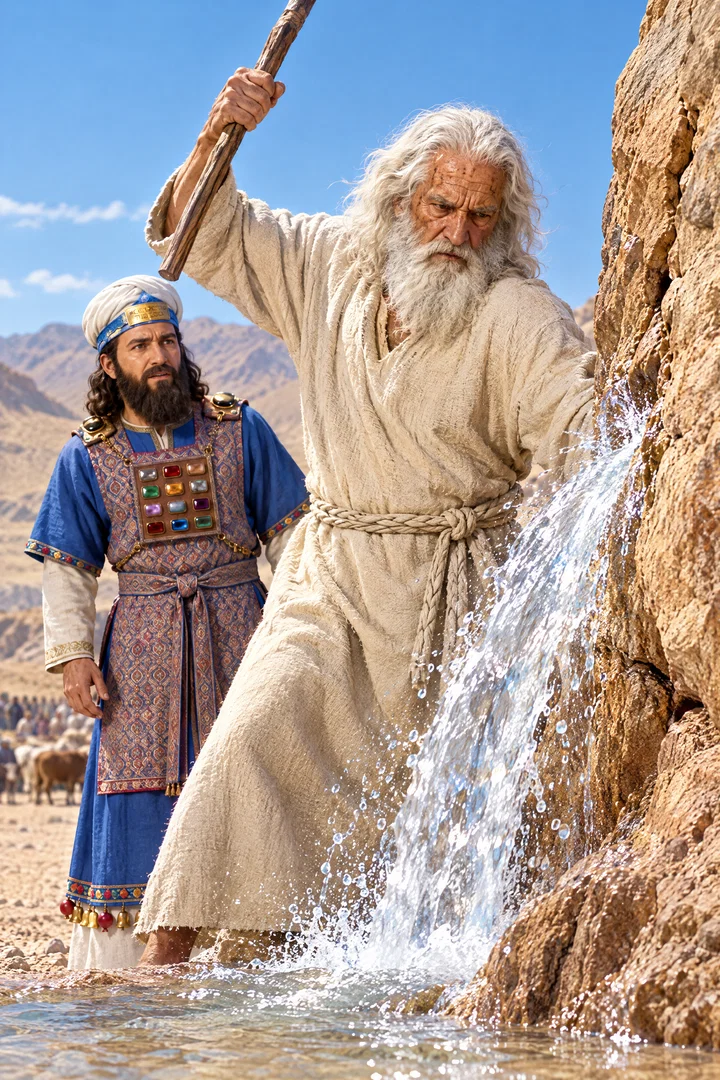
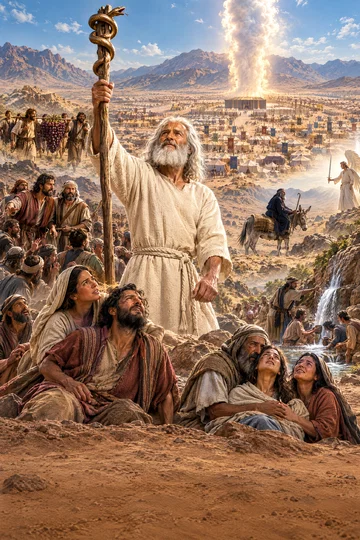
And Moses lifted up his hand, and with his rod he smote the rock twice: and the water came out abundantly, and the congregation drank, and their beasts also.
Translations
American King James Version, King James Version
And Moses lifted up his hand, and with his rod he smote the rock twice: and the water came out abundantly, and the congregation drank, and their beasts also.
And Moses lift up his hand, and with his rod he smote the rock twice: and the water came out abundantly, and the congregation drank, and their beasts also.
And Moses lifted his hand, and with his rod he smote the rock twice: and the water came out abundantly, and the congregation drank, and their beasts also.
Revised Version, American Standard Version
And Moses lifted up his hand, and smote the rock with his rod twice: and water came forth abundantly, and the congregation drank, and their cattle.
and Moses lifteth up his hand, and smiteth the rock with his rod twice; and much water cometh out, and the company drink, also their beasts.
And Moses lifted up his hand, and with his staff smote the rock twice, and much water came out, and the assembly drank, and their beasts.
And Moses lifted high his hand and smote the cliff with his staff, twice,—and there came forth water in abundance, and the assembly and their cattle, did drink.
Berean Standard Bible, Majority Standard Bible
Then Moses raised his hand and struck the rock twice with his staff, so that a great amount of water gushed out, and the congregation and their livestock were able to drink.
Moses lifted up his hand, and struck the rock with his rod twice, and water came out abundantly. The congregation and their livestock drank.
And lifting up his hand, Moses gave the rock two blows with his rod: and water came streaming out, and the people and their cattle had drink enough.
Then Moses lift vp his hande, and with his rod he smote the rocke twise, and the water came out aboundantly: so the Congregation, and their beastes dranke.
Douay-Rheims (Challoner revision)
And when Moses had lifted up his hand, and struck the rock twice with the rod, there came forth water in great abundance, so that the people and their cattle drank,
Pictures
Cross-references
- Exodus 17:6
Behold, I will stand before thee there upon the rock in Horeb; and thou shalt smite the rock, and there shall come water out of it, that the people may drink. And Moses did so in the sight of the elders of Israel.
Moses struck the rock, and water flowed for Israel.
- 1 Corinthians 10:4
And did all drink the same spiritual drink: for they drank of that spiritual Rock that followed them: and that Rock was Christ.
The rock Moses struck is identified as Christ.
- Deuteronomy 32:51-52
Because ye trespassed against me among the children of Israel at the waters of Meribah-Kadesh, in the wilderness of Zin; because ye sanctified me not in the midst of the children of Israel.
Moses is barred from entering Canaan after his failure to honor God at Meribah.
- Psalms 106:32-33
They angered him also at the waters of strife, so that it went ill with Moses for their sakes:
Israel’s provocation at Meribah led Moses to speak rashly and disobey.
- Numbers 20:3-5
And the people chode with Moses, and spake, saying, Would God that we had died when our brethren died before the LORD!
The people’s complaint provoked Moses to strike the rock.
- John 4:14
But whosoever drinketh of the water that I shall give him shall never thirst; but the water that I shall give him shall be in him a well of water springing up into everlasting life.
Christ gives living water that quenches spiritual thirst and springs up into everlasting life.
- John 7:37
In the last day, that great day of the feast, Jesus stood and cried, saying, If any man thirst, let him come unto me, and drink.
Christ invites the thirsty to come to Him and drink.
- 1 Corinthians 10:11
Now all these things happened unto them for ensamples: and they are written for our admonition, upon whom the ends of the world are come.
Israel’s experiences, including Moses’ failure, serve as examples and warnings for later believers.
- Deuteronomy 3:23-27
And I besought the LORD at that time, saying,
Moses' prayer to enter Canaan is denied because of Meribah
- Numbers 20:3
And the people chode with Moses, and spake, saying, Would God that we had died when our brethren died before the LORD!
The people’s cry begins the strife.
- Numbers 20:24
Aaron shall be gathered unto his people: for he shall not enter into the land which I have given unto the children of Israel, because ye rebelled against my word at the water of Meribah.
Aaron’s death fulfills the consequence of the rebellion at Meribah.
- Isaiah 32:2
And a man shall be as an hiding place from the wind, and a covert from the tempest; as rivers of water in a dry place, as the shadow of a great rock in a weary land.
Describes Christ as a hiding place and source of water.
- Deuteronomy 1:37
Also the LORD was angry with me for your sakes, saying, Thou also shalt not go in thither.
links exclusion from land to this sin
- Genesis 14:7
And they returned, and came to En-mishpat, which is Kadesh, and smote all the country of the Amalekites, and also the Amorites, that dwelt in Hazezon-tamar.
identifies the springs as En-Mishpat
- Deuteronomy 4:21
Furthermore the LORD was angry with me for your sakes, and sware that I should not go over Jordan, and that I should not go in unto that good land, which the LORD thy God giveth thee for an inheritance:
Moses recalls God’s judgment that he would not enter the land.
- Revelation 22:17
And the Spirit and the bride say, Come. And let him that heareth say, Come. And let him that is athirst come. And whosoever will, let him take the water of life freely.
abundant water means free offer to all
- Psalms 61:2-4
From the end of the earth will I cry unto thee, when my heart is overwhelmed: lead me to the rock that is higher than I.
The Rock is a refuge, sheltering those who trust in him.
- Isaiah 12:3
Therefore with joy shall ye draw water out of the wells of salvation.
Meribah illustrates drawing its water
Commentary
Each commentary is drawn from primary sources: the writings of Ellen G. White and Adventist pioneers and periodicals. Each commentary is separate. Its own words are not a quotation; follow the references to read the source passages.
Ellen G. White
70 sources
God commanded Moses to speak to the rock before Israel so it would give water for the people and their animals, but instead he called them rebels and lifted his hand to strike the rock twice with the rod without command.Ms 9, 1903, par. 10–17SG4 38.1–21SP 309.2–3Ms 120, 1909, par. 15–16 God still caused water to gush out abundantly in mercy, yet the blow showed shaken faith and failure to honor Him, putting self forward and giving the impression the leaders themselves brought the water.Ms 9, 1903, par. 10–17FE 508.5–509.4SG4 38.1–24T 369.21SP 309.2–3 Judgment fell at once that Moses and Aaron would not lead the congregation into the promised land, making clear that honored position magnifies guilt and does not excuse sin.Ms 9, 1903, par. 10–17FE 508.5–509.4SG4 38.1–24T 369.2RH Jul 29, 1873 Moses repented and was forgiven, but the earthly entrance was still denied, and after death he was raised by Christ over Satan's claim and taken to heaven.Ms 9, 1903, par. 10–17RH Dec 31, 1903ST Jun 7, 18771SP 336.23RED 118.2–119.1 The rock pointed to Christ, from whose death the water of life would flow to a thirsty world, and the failure stands as a warning that even long faithfulness does not excuse angry self-exaltation or deviation from God's word.RH Jan 7, 1904Ms 120, 1909, par. 15–16PK 173.3Ms 60, 1902, par. 43–44PP 411
Wilderness Test Setting
The long-standing living stream that had flowed beside Israel's encampment for years ceased just before they entered Canaan to prove whether they would trust divine providence and walk for a little time by faith instead of sight.Ms 9, 1903, par. 10–17PP 414.1–2RH Dec 31, 1903RH Aug 23, 19061SP 309.1 It was a renewed trial of faith to see if they would endure or again murmur, coming when Moses was weary after forty years of wandering and his faith for a moment lost hold.1SP 309.1 The test fell at Kadesh in sight of the hills of Canaan, only a few days' march from the promised land and a little distance from Edom, at the very place where God had proved them soon after leaving Egypt.ST Sep 30, 18801SP 309.1PP 413.3–4PP 478.2–479.1 The water first brought from the rock there had continued until just before they came again to the rock.1SP 309.1
They were about to pass by the appointed route through the well-watered, fertile country of Edom to Canaan, with promise of unmolested passage and opportunity to buy food and sufficient water for the host.PP 413.3–4 The cessation of the miraculous flow should therefore have been understood as a token that wilderness wandering was ended and a cause for rejoicing and evidence that the promise was being fulfilled.PP 413.3–4 Instead, as soon as the cry for water was heard they forgot the hand that had for many years supplied their wants, including power shown in giving water from the rock nearly forty years before.PP 414.1–21SP 309.2–3 They murmured against Moses and Aaron rather than turning to God for help, wishing they had died when their brethren died before the Lord in the rebellion of Korah, and charging that they had been brought up out of Egypt into the wilderness to die with their cattle in an evil waterless place with no seed or figs or vines or pomegranates and no water to drink.PP 414.1–21SP 309.2–3RH Dec 31, 1903
God's plan was to bring Israel frequently into strait places in their great necessity and then deliver them by His power, so that in need they would call upon Him for deliverance, recognize His special regard, fix their faith and trust in Him alone, and glorify His name.ST Jun 7, 18772SP 329.2–330.11SP 336.2SG1 42.2–43.1 He would answer by revealing His greatness and power, and their softened hearts, awakened gratitude, and solemn sacred awe gave favorable opportunity to adore and magnify His goodness and exalt Him as One whose threatenings never fail and whose promises are ever sure.1SP 336.2 But blinded by unbelief they made the cessation an occasion of doubt and murmuring, showing they had given up hope of possessing Canaan and clamored for the blessings of the wilderness.PP 413.3–4 The first trial exposed the same turbulent, unthankful spirit manifested by their fathers, and the same unbelieving spirit appearing in their children raised the question whether they too would fail of the promise.PP 414.1–2PP 417.4
It was the duty of the leaders to put forth every effort to bring about a better state and by unwavering faith and prompt decisive exercise of authority to set the test rightly before the people and quell the murmuring at Kadesh, but wearied and disheartened they made no effort to stem the current of popular feeling, and failure to check it promptly opened a train of evil.PP 417.4 Only two of that vast army who were above twenty years old when they left Egypt were found faithful enough to see the promised land, the rest having evil hearts of unbelief and being doomed by the Lord to fall in the wilderness for their transgressions.1SP 338.1 Because they had not trusted God they had to cross the desert again and drink from the miraculous spring; had they trusted Him they would not have needed it.PP 424.2 Their murmuring when the water ceased brought upon them the hardship of the journey around Edom, yet instead of recognizing that their own sin had made their lot harder they blamed God for their misfortunes.PP 428.1–2
Striking Instead Speaking
God's command was to take the rod, gather Israel together, and speak to the rock before their eyes so that it would give forth its water for the congregation and their beasts.1SP 309.2–3Ms 120, 1909, par. 15–16 That water was what Moses himself could never supply unless the Lord supplied it.Ms 120, 1909, par. 15–16 The requirement was exact, to speak and not to strike.1SP 309.2–3Ms 120, 1909, par. 15–16
Instead, after crying Hear now, ye rebels, and asking whether he and Aaron must fetch or bring water out of the rock for them, Moses lifted up his hand and smote the rock twice.Ms 9, 1903, par. 10–171SP 309.2–3RH Dec 31, 1903SG4 39.11SP 310.1 He struck with the rod of God when he had no command to strike it, disobeying the instruction to speak to it.Ms 9, 1903, par. 10–17SG4 38.1–21SP 309.2–3RH Dec 31, 1903Ms 120, 1909, par. 15–16 Wearied by continual murmuring, he spoke unadvisedly with his lips, taking the work to himself instead of declaring that God would show another evidence of His power.SG4 39.11SP 310.1
Though the charge ye rebels was true, his words were spoken from irritated human passion rather than holy indignation because God had been dishonored.Ms 9, 1903, par. 10–17RH Dec 31, 1903Ms 169, 1903, par. 11 His impatient, self-directed accusation took the reproof upon himself and grieved God's Spirit.Ms 9, 1903, par. 10–17RH Dec 31, 1903PP 417.1–3 Speaking truth in passion harmed the people and gave them excuse to question the divine authority behind his earlier reproofs.Ms 9, 1903, par. 10–17PP 417.1–3
God nevertheless caused the water to gush out and flow abundantly, and the congregation drank and their beasts also drank.Ms 9, 1903, par. 10–17SG4 38.1–21SP 309.2–3RH Dec 31, 1903ST Sep 30, 1880 That flow was an act of mercy and a gift from the living God at His word, not from idol gods or nature.SG4 38.1–21SP 309.2–3ST Sep 30, 1880ST Sep 30, 1880PP 417.1–3 It did not prove Moses had acted rightly, for by acting impatiently and failing to give God the glory he misrepresented who had power to provide and mingled human passion with God's work.ST Sep 30, 1880ST Sep 30, 1880PP 417.1–3
Unbelief Taking Glory
The stroke betrayed unbelief and distrust, as if a human act were needed to accomplish what God could do by His word alone, and as if the Lord would not do what He had promised.Ms 9, 1903, par. 10–171SP 309.2–3RH Aug 23, 1906ST Sep 30, 1880PP 417.4 Faith had been shaken by the murmuring and rebellion of the people when the water failed, and weariness and discouragement kept Moses and Aaron from stemming the current of popular feeling when unwavering faith and prompt, decisive exercise of authority might have quelled it and set the test rightly before the people.1SP 309.2–3RH Aug 23, 1906PP 417.4 It was their duty to put forth every effort to bring about a better state before asking God to work for them, yet the same unbelieving spirit that had condemned the first generation appeared in their children and raised the question whether they too would fail, and failure to check it promptly opened a train of evil.PP 417.4
Moses and Aaron did not believe God and did not sanctify, honor, magnify, and give Him glory and credit before Israel for causing water to flow again from the flinty rock.FE 508.5–509.4SG4 38.1–24T 369.2ST Sep 30, 1880SG4 39.1 They did not declare that God would show another evidence of His power, did not ascribe the power and glory to Him, and did not exalt Him before the people.FE 508.5–509.4SG4 38.1–24T 369.2ST Sep 30, 1880SG4 39.1 The abundant flow for the congregation and their beasts was mercy that did not make the disobedience right, and the failure to honor God brought displeasure and the judgment that they would not lead Israel into Canaan.FE 508.5–509.4SG4 38.1–2ST Sep 30, 1880EW 132.3–133.1SG1 41.1–42.1
They put themselves forward in God's place and gave prominence to self, presenting the miracle as their own work and leaving the impression that they themselves gave the water.FE 508.5–509.44T 369.2RH Aug 23, 1906ST Jun 7, 18772SP 329.2–330.1 In asking whether they must fetch water from the rock they appropriated to themselves the honor due to God and arrogated power that belonged to Him alone.4T 369.2RH Aug 23, 1906ST Jun 7, 18773RED 118.2–119.1ST Sep 30, 1880 That assuming to take God's place was the greatest sin in the act, marring the figure of Christ whom Moses represented.4T 369.2
Now aged and worn after long bearing with rebellion, Moses let patience give way when harassed by undeserved complaints, provoked and wrought up until he acted in irritated, offended, self-willed impatience and wrath from natural impulse.Ms 9, 1903, par. 10–174T 369.2RH Dec 31, 1903RH Aug 23, 1906ST Jun 7, 1877 With mind engrossed by ingratitude and waywardness he spoke unadvisedly, hastily, and presumptuously with his lips, crying in human passion rather than holy indignation though the charge of rebellion was true.Ms 9, 1903, par. 10–174T 369.2RH Dec 31, 1903SG4 39.1ST Jun 7, 1877 The double stroke revealed great weakness and marked lack of self-control, with a spirit like that of the murmurers when he should have been an example of forbearance and patience.Ms 9, 1903, par. 10–174T 369.2RH Dec 31, 1903
He forgot for the moment that their murmuring was against God and not himself, taking it as personal trial and dishonor and looking to self and appealing to his own sympathies.4T 369.2RH Jul 29, 1873PP 418.310MR 159.3–6 He failed to grieve that the Spirit of God was insulted and missed a golden opportunity at the very time God would mercifully display His glory to soften and subdue hearts and lead them to repentance.4T 369.2RH Jul 29, 1873 Instead of setting before the people their great guilt before God and showing His long-suffering and tender pity to soften hearts unto repentance, he claimed the power of opening the rock for himself.4T 369.2RH Jul 29, 1873PP 418.3
By striking and asking whether he and Aaron must bring out the water he made it appear that divine power belonged to human leaders and mingled human passion with God's work.ST Sep 30, 1880PP 417.1–3Ms 115a, 1897, par. 6Ms 1, 1895, par. 48–49 He misrepresented God before the people as His representative, gave them cause to question his leadership and excuse their own failures, and gave Satan opportunity to unsettle their faith.ST Sep 30, 1880PP 417.1–3Ms 115a, 1897, par. 6Ms 1, 1895, par. 48–49 His impatient, self-directed accusation grieved God's Spirit, harmed the people, and gave them an excuse to question the divine authority behind his earlier reproofs.ST Sep 30, 1880PP 417.1–3
It was his first sin after forty years of faithful labor, a momentary yielding to sudden temptation when labor seemed almost in vain, not wilful or deliberate sin or self-esteem.Ms 9, 1903, par. 10–17RH Dec 31, 1903 Wearied and disheartened just on the borders of the land, strength failed, will power weakened, and faith for the moment let go its hold on Infinite Power.Ms 9, 1903, par. 10–17RH Dec 31, 1903PK 173.3DA 120.2 At Satan's instigation he fell under Satan's power in that triumph of temptation, and it was not given to him to pronounce judgment against Israel.Ms 9, 1903, par. 10–17RH Dec 31, 1903SG4 57.42RED 23.2 That one transgression marred his otherwise illustrious and faithful life and brought him under the dominion of death.SG4 57.4
His honored position as God's teacher, example, and representative, highly favored with special views of God's majesty and brought into close relation with Him, did not lessen guilt but greatly magnified it.4T 369.2RH Jul 29, 18733T 302.1Lt 25, 1880, par. 71SP 312.2 His long life of fidelity could not atone for the present sin, and his departure from usual patience made the failure more conspicuous.4T 369.2Lt 25, 1880, par. 74T 370.1 God does not excuse sin in the exalted sooner than in the humble, but holds leaders accountable as He does those in humble positions, for all are judged according to privileges, light, and benefits bestowed.4T 369.2RH Jul 29, 18733T 302.14T 370.11SP 312.2
Exclusion Yet Forgiven
The sentence fell at once that Moses and Aaron must die with rebellious Israel before crossing the Jordan and would not bring the congregation into the land given them, because in striking twice instead of speaking they failed through unbelief to sanctify, honor and magnify God before Israel for causing water to flow again from the flinty rock.Ms 9, 1903, par. 10–17FE 508.5–509.4SG4 38.1–21SP 309.2–3RH Dec 31, 1903 Though water gushed out abundantly so that the congregation and their beasts drank, the gift came by mercy at God's word and did not prove the act right, but made history to show God as a firm ruler who in no case justifies sin and lays the same punishment on the exalted as on the lowly.Ms 9, 1903, par. 10–174T 369.21SP 309.2–3 Their guilt was not wilful or deliberate sin or self-esteem but a momentary yielding to sudden temptation when patience gave way under long bearing with rebellion, followed by immediate heartfelt contrition which the Lord accepted; Moses confessed his sin, implored pardon, humbly accepted the severe affliction without murmuring at the decree, and was forgiven, yet punishment could not be remitted because of the harm among the people and the home in the promised land he longed for was denied.Ms 9, 1903, par. 10–17RH Dec 31, 19031SP 336.2Lt 174, 1902, par. 12–1410MR 151.3
Though Moses begged to go over, the Lord refused lest pardoning open disobedience before Israel make light of His Word, would not hear his earnest prayer to see the good land beyond Jordan, the goodly mountain, and Lebanon, told him it was enough and to speak no more of the matter, and commanded him to go to the top of Pisgah and look westward and northward and southward and eastward upon the land with his eyes since he would not go over Jordan.Ms 120, 1909, par. 15–164T 370.11SP 331.2SG4 53.3 Instead he was to charge Joshua and encourage and strengthen him, for Joshua would go over before the people and cause them to inherit what Moses would only see.1SP 331.2SG4 53.3 That one transgression marred his otherwise illustrious and faithful life and brought him under the dominion of death, costing him entrance into earthly Canaan and translation to heaven without seeing death, which God would have granted had he remained steadfast.SG4 57.41SP 342.2–3SG1 42.2–43.1
He passed through death, but after remaining in the grave a short time Michael, who is Christ, with the angels that had buried him, came down, approached the grave where Satan and his angels were guarding the body and claiming it as rightful prey because of the sin, forced them back by glory and power with The Lord rebuke thee, prevailed in the contention, resurrected him before his body saw corruption, and bore him with a resurrected and glorified body to the courts of heaven to wait upon Christ and later to immortal life.ST Jun 7, 18772SP 329.2–330.13RED 118.2–119.1SG4 57.41SP 342.2–3 Moses humbly repented of the wrong so that no stain rested upon his character and his name stood untarnished in the heavenly book of records.1SP 342.2–3 God pronounced no judgment on the people whose wicked murmuring had provoked Moses and Aaron but let all reproof fall on them as His representatives because they had not honored Him, though Israel's own murmuring and complaining spirit had led Moses to deviate and Christ as invisible leader was the one truly transgressed against and offended and suffered most intensely and would bear their iniquities.10MR 151.3PP 418.3
Aaron was likewise barred from serving as high priest in Canaan, an especially grave consequence because his sacred office represented Christ.PP 425.4
Christ Satan Conflict
The rock struck in the wilderness symbolized Christ, the living Rock, by whose death the water of life would be made available to the thirsty world.Ms 60, 1902, par. 43–44 He is seen as the smitten rock with arms stretched wide, standing before dark towering rocks, with life-giving water gushing from clefts in the rock and spreading in bright streams across barren land.PP 411
The Son of God Himself was with Moses and Joshua to lead His chosen people to Canaan, and Christ Himself led the fathers through the wilderness for many years, teaching them His will through Moses His faithful servant whom God honored greatly.ST Feb 22, 1883Ms 169, 1903, par. 8 Yet Satan tempted even Moses the meek man to take to himself the glory that God claimed in giving water from the rock.LC1 47.1–22RED 32.2ST Feb 22, 1883RH Jul 28, 1874 Satan then boasted over that fall that even the Son of God who was with Moses and Joshua could not resist his power and finish that leading, because nearly all who left Egypt died in the wilderness, and by this God's purpose in salvation would be thwarted.LC1 47.1–22RED 32.2ST Feb 22, 1883RH Jul 28, 1874 Those fathers whom Christ so led were the fathers of the Hebrew people who crucified Christ, and Moses' smiting the rock was a mistake and a sin not to be lightly passed over, for God sees not as man sees.Ms 169, 1903, par. 8
In that overcoming of Moses at the rock Satan triumphed, marring an otherwise illustrious and faithful character by the sin of taking to himself before the people glory that belonged to God.2RED 23.21SP 342.2–3 That one transgression brought Moses under the dominion of death and kept him from entering the promised land and from translation to heaven without seeing death.1SP 342.2–3 Satan triumphed in causing the sin and afterward claimed Moses' body because of it.1SP 342.2–3
Moses' error belongs to the time just before Israel entered the promised land, when he erred near the end of his journey.SG1 168.1 It stands as a parallel to William Miller erring as he was nearing the heavenly Canaan.SG1 168.1
The striking twice that brought water abundantly for the congregation and their animals stands among the mighty acts through which God sustained Israel during the journey.ST Mar 31, 1881STB 112.3 The God who brought abundant water from a rock in the desert is therefore able also to provide water in Paradise Valley.STB 112.3
Example Warning Today
Those entrusted with God's work must not give prominence to self, for to exalt self is to neglect His work and dishonor Him, and His name alone is to be magnified by exalting righteousness and heaven's holy principles.FE 508.5–509.4RH Aug 23, 1906RH Aug 23, 1906 This applies with special force to presidents of schools and to one standing at the head of a school, who must not get above the real virtues and simplicity of the work or become ambitious to climb higher and higher, lest the Lord manifest His displeasure against failure to reach His standard.RH Aug 23, 1906RH Aug 23, 1906Lt 188, 1903, par. 42–44 He will work counter to those who work counter to Him, and He can do but little for one who takes to himself the glory for wisdom and power He bestowed and forgets to exalt the Giver.RH Aug 23, 1906Ms 69, 1912, par. 20 Those who have become unfaithful in this way need now to seek the Lord with deep humiliation of soul and be converted, that He may heal their transgressions.RH Aug 23, 1906
The stroke at the rock stands as a warning example for God's people upon whom the ends of the world are come, especially men who occupy positions of trust, of what it means to become angry.RH Jan 7, 1904 Those who today hold such trust must stop and consider, for Moses' loss of self-control in anger displayed a spirit unworthy of a leader of God's people and set a wrong example that gave the people grounds to excuse their own anger.RH Jan 7, 1904Ms 130, 1906, par. 9Ms 9, 1903, par. 18–19 God condemns a harsh, hasty, condemnatory spirit, and His rebuke proved that even a leader greatly honored by Him is accountable for such conduct.Lt 174, 1902, par. 12–14Ms 130, 1906, par. 9 Moses felt repentance for his anger, while there are those in God's service who give way to anger without that repentance and brace themselves to follow an unchristian course from one wrong to another.RH Jan 7, 1904Ms 9, 1903, par. 18–19 Murmurers in the churches who easily lose self-control, become irritated and provoked when crossed or when everything does not please them, and provoke one another to evil give loose rein to an unsanctified, irritable spirit and show they have not the light and love of God in their souls, so all must make diligent work for repentance.RH Jan 7, 1904Ms 9, 1903, par. 18–19
Satan assails the soul with the fiercest temptations at the time of greatest weakness, and by this policy he has gained many victories even over those who have stood long and valiantly for the right.PK 173.3DA 120.2Ms 15, 1908, par. 6 Moses failed just on the borders of the promised land after forty years wearied with the wandering, faithlessness and rebellion of Israel, when strength failed, will power weakened, and faith for the moment let go its hold upon Infinite Power and ceased to repose in God.PK 173.3DA 120.2Ms 15, 1908, par. 6RH Oct 30, 1913 He attacks weak points of character to shake confidence in God and to tempt to distrust God and question His love.DA 120.2Ms 15, 1908, par. 6 It warns that when encompassed with doubt, perplexed by circumstances, or afflicted by poverty or distress, confidence in God is most shaken.RH Oct 30, 1913
His trial was more severe than few will ever face, with very great burdens placed upon him under the greatest provocation, yet that pressure did not excuse his transgression.MYP 62.1–2 Though he had great spiritual light and enjoyed divine favor and blessing, he was still under sacred obligation to guard his spirit and exercise self-control, to walk humbly and plead in faith for God to direct every thought and control every impulse moment by moment.MYP 62.1–2 Neither earth nor hell can compel anyone to do evil, and the strongest temptation cannot excuse sin, for God had made ample provision and provided help so that by relying on His strength conquest is possible and Moses need not have been overcome or become the sport of circumstances.MYP 62.1–2 Satan seizes upon every blessing and trial to tempt and destroy if given the least advantage.MYP 62.1–2 Past service and spiritual privilege do not excuse self-reliance, for his sin was especially serious because he had been so favored and brought into close relation to God, and his departure from his usual patience made the failure more conspicuous; when people see a favored person's failure, they must not use it to excuse their own sin.Lt 25, 1880, par. 7
God's Word is precious and must be followed exactly to the letter by every soul, old and young, with no thought that deviation will come out just as well.Ms 120, 1909, par. 15–16 The people were complaining for lack of drink, which Moses could not supply unless the Lord supplied it, and the Lord commanded him to take the rod and speak to the rock so it would give water; yet provoked and wrought up by their unreasonable course, Moses forgot himself for the first time in a faithful and true life, asking whether he and Aaron must bring water, calling them rebels, and striking when he had no command to strike.Ms 120, 1909, par. 15–16 Though water came, the deviation brought terrible loss, for though Moses begged to go over into the land, the Lord refused, because pardoning open disobedience before Israel would make light of the Word of God.Ms 120, 1909, par. 15–16 This exactness includes keeping the seventh day as the Sabbath of the Lord thy God instead of substituting the first day for convenience.Ms 120, 1909, par. 15–16
The sin and failing at the rock stands written plainly and faithfully with the sins that overcame Noah, Lot, Abraham, David, Solomon, and others, and with Elijah sinking under trial, Jonah disobeying, Israel committing idolatry, Peter denying Christ, and Paul and Barnabas contending sharply, lifting the veil from the human heart and laying bare the faults and follies of believers.ST May 31, 19104T 12.1–3 Such faithful narration is required by the principles of justice for the benefit of all who read the Sacred Record, given as a warning to avoid unbelief and escape wrath and to teach that the wages of sin is death, that God's retributive justice never fails, and that He exacts strict regard for His commandments and is faithful to punish wrongdoing so that retribution follows sin.ST May 31, 19104T 12.1–3 It is kept as a lesson to all following generations to show where they struggled and fell, so readers avoid the recorded evil and imitate only righteousness.ST May 31, 19104T 12.1–3 Seeing where he struggled and fell, and that through God's grace he could gain fresh vigor to rise above his evil nature, encourages desponding hearts not to despair of excellence but to renew the conflict, press on, press over obstacles and conquer again, and to trust that God is as powerful to save from sin today and to pity, pardon and forgive the guilty, sorrowful, penitent, sin-sick soul and the repenting sinner as in the times of the patriarchs, prophets and apostles.ST May 31, 19104T 12.1–3
Sources
Pioneers and periodicals
64 sources
At Kadesh in the wilderness of Zin God told Moses to take the rod and speak to the rock before Israel so it would give water for the people and their cattle, but instead he cried out against the rebels and lifted his hand and struck the rock twice, and water still came out abundantly for the congregation and their beasts to drink.ST Jan 13, 1914STST Apr 25, 1906ST Jul 14, 1914RH Dec 9, 1909 His act was hasty disobedience done in anger and loss of self-control after long provocation, and it is counted as sin against God's perfect standard.RH Dec 31, 1903ST Sep 30, 1880ST Apr 25, 1906ST Sep 9, 1886RH Dec 9, 1909 By speaking as though he himself must bring water from the rock he took to himself glory belonging to God alone, failing to believe God and to sanctify and magnify Him before Israel.STST Sep 9, 1886ST Jun 17, 1886ST Oct 7, 1897 For this Moses and Aaron were barred from leading Israel into the promised land, yet the abundant flow did not approve the disobedience but was God's mercy, for His commands must be obeyed exactly.ST Sep 30, 1880ST Apr 25, 1906ST Sep 9, 1886ST Sep 10, 1902RH Dec 9, 1909 The rock is Christ, who was to be smitten once for all upon the cross and is not to be smitten again, so the second stroke marred that symbol, and now the thirsty need only speak to the Rock by confessing sin and asking in Jesus' name for the life-giving stream to flow freely.ST Oct 7, 1880ST Oct 7, 1880ST Jan 13, 1914ST Jul 23, 1912ST May 26, 1914
Setting and Events
The scene stands at Kadesh-Barnea, at Meribah in the wilderness of Zin, in the course of Miriam's death and Israel's journeying around Edom and the enemies met in the way.ST Sep 30, 1880STST Sep 9, 1886ST Feb 20, 1912RH Mar 25, 1873 It was there that Israel demanded water at Kadesh, and the murmuring of the people provoked Moses to speak rashly and to take glory to himself instead of giving glory to God.ST Sep 30, 1880STST Sep 9, 1886RH Mar 25, 1873 Commanded to take the rod, gather Israel together, and speak to the rock before their eyes so that it would give water for the people and cattle, he instead called the people rebels and asked if he and Aaron must fetch them water out of the rock, without even mentioning the Lord.ST Sep 30, 1880RH Mar 25, 1873
The long-standing stream that had supplied Israel for years had ceased in order to test whether they would trust God's providence and walk by faith instead of by sight before entering Canaan.RH Dec 31, 1903RH Aug 23, 1906ST Jul 14, 1914 The assembled hosts, left crazed with thirst, murmured against Moses and Aaron for bringing them and their cattle into a waterless evil place with no seed, figs, vines, or pomegranates, forgetting God's past provision.RH Dec 31, 1903RH Aug 23, 1906ST Jul 14, 1914 In place of speaking to the rock as commanded, Moses lifted up his hand, cried, Hear now, ye rebels; must we fetch you water out of this rock, and with the rod of God smote the rock twice.RH Dec 31, 1903ST Sep 30, 1880ST Jan 13, 1914ST Apr 25, 1906RH Dec 9, 1909 The rock was to be struck only once, and the extra stroke was not an unimportant detail.ST Jan 13, 1914ST Apr 25, 1906
Water nevertheless came out abundantly, and the congregation drank, and their beasts also.ST Sep 30, 1880STST Apr 25, 1906ST Mar 31, 1909RH Dec 9, 1909 The double stroke is set forth as bringing to light two new living fountains beside the original fountain that had dried up, living fountains and not wells, near the surface and of perpetual strength.STST Apr 25, 1906ST Jul 14, 1914 They are described as six feet deep and stoned up from the bottom with time-worn rocks, while the upper spring nearest the cliff, which still sometimes holds water, was the dried original fountain.ST Jul 14, 1914 Causing water to gush out of flinty rock was a most marvelous miracle, and the continued flow of that same stream day after day and month after month was no less a miracle than its first gush.ST May 30, 1895 The Israelites wondered at the sight and for a little while acknowledged God as the giver and felt thankful for the supply of their need, but it soon became an old story to them, and as they drank and went farther down the stream they forgot that it flowed from a dry rock and quenched their thirst without thinking that they were beholding the wonderful work of God.ST May 30, 1895
Nature of Disobedience
Moses was commanded to speak to the rock so that it would give water, but he lifted his hand and struck it twice instead, acting hastily and rashly in direct disobedience.ST Sep 30, 1880ST Oct 7, 1880ST Apr 25, 1906ST Sep 9, 1886ST Sep 10, 1902 That disobedience was counted as sin, a grievous failure to meet God's perfect standard and to carry out the Lord's command exactly.ST Oct 14, 1880ST Apr 25, 1906ST Sep 9, 1886ST Sep 10, 1902 Though water flowed abundantly and the congregation and their animals drank, the mercy of the supply did not make the act right and it marred the symbol of Christ who was to be offered once.ST Sep 30, 1880ST Oct 7, 1880ST Oct 14, 1880
He was by then aged and worn by long rebellion, and his patience gave way under severe strain when the long-standing stream ceased to test trust in God's providence before entering Canaan.RH Dec 31, 1903RH Dec 9, 1909RH Mar 13, 1866 Provoked in spirit by the people's unbelief, ingratitude, waywardness, complaints, backslidings and murmuring against being brought with their cattle into a waterless evil place with no seed, figs, vines or pomegranates, with his mind engrossed with them, he cried Hear now, ye rebels and smote the rock twice with the rod of God.RH Dec 31, 1903RH Dec 9, 1909RH Mar 13, 1866 His words were true but were spoken from human passion rather than holy indignation, from natural impulse, in anger, impatience, irritability and loss of self-control, a lapse from meekness and the one instance of irritability in his life.RH Dec 31, 1903ST Sep 30, 1880ST Sep 30, 1880RH Jan 7, 1904 By striking in anger and speaking in passion he grieved the Spirit of God, mingled human passion with God's work, gave the people cause to question his leadership, and harmed them by failing to sanctify God in their eyes.RH Dec 31, 1903ST Sep 30, 1880
He spoke and acted as though he himself would bring water from the rock, asking whether he and Aaron must fetch it out, and thereby took to himself glory that belonged to God alone.ST Sep 30, 1880RH Aug 23, 1906STST Jun 17, 1886 This failed to believe God and to sanctify, honor, magnify and give Him glory before Israel, misrepresenting who had power to provide the water.ST Sep 30, 1880RH Aug 23, 1906ST Sep 9, 1886ST Sep 10, 1902 The blow displayed unbelief, as though a human act were needed to accomplish what God could do by His word, arrogated to Moses and to human leaders divine power that belonged to God, and was presumption in speaking and striking as if on his own authority.ST Sep 30, 1880ST Sep 30, 1880ST Sep 30, 1880ST Jun 17, 1886 From the burning bush to Pisgah God alone was Lawgiver, and Moses did nothing of his own mind but only what the Lord sent him to do, so this self-assertive act proved he held no independent authority to set against Christ.ST Jun 17, 1886
The act at Meribah at the waters of strife was the shared sin of Moses and Aaron, with Aaron joining Moses in the wrong and yielding in weakness and weariness.ST Oct 14, 1880ST Oct 7, 1897ST Mar 31, 1909 Both dishonored God in it and both received punishment and were barred from bringing the congregation into the land given them.RH Aug 23, 1906ST Oct 7, 1897RH Dec 9, 1909 Contrary to Israel's constant complaint that they domineered over the people, they never put themselves and their authority in the place of God and His authority except when Moses smote the rock twice, which was the one time they assumed undue authority for themselves.RH Aug 1, 1907RH May 12, 1904
The people were the cause and occasion of his fall, yet being provoked does not excuse sin, for the real cause was in his own heart, otherwise nothing they could have done would have moved him.ST May 27, 1889ST Jun 17, 1889 God has no favorites and will not wink at sin in those who are dear to Him, but cannot tolerate evil no matter in whom it appears and requires exact obedience with impartial and strict justice even to the greatest among His people.RH Jan 12, 1869ST May 27, 1889ST Jun 17, 1889 The nearer God has come to a man by His presence, and the greater the wisdom, light, privilege and sacred responsibility given, the greater the sin if he speaks or acts wrong before Him, so that Moses' sin in striking in anger was even greater than that of the people and his long faithful service and prior blamelessness made the failure more aggravated rather than less serious.ST Oct 7, 1880RH Jan 12, 1869ST May 27, 1889
Judgment with Mercy
Because he struck instead of speaking as commanded, Moses was counted a sinner and was barred with Aaron from bringing the congregation into the land given them, not permitted to lead Israel into the promised land or to enter it himself. RH Dec 31, 1903ST Apr 25, 1906ST Sep 9, 1886ST Sep 10, 1902RH Dec 9, 1909 He saw it from Pisgah and Mount Nebo and died in Moab with rebellious Israel before crossing the Jordan, his earthly work ending at the Jordan. RH Dec 31, 1903RH Aug 23, 1906ST Sep 9, 1886ST Sep 29, 1881ST Aug 20, 1902 He had acted hastily when provoked by the people and failed to give God the glory and to carry out the Lord's command exactly. ST Sep 9, 1886ST Sep 10, 1902RH Dec 9, 1909 The event stands as a type and warning that disobedience to God's command can cost a person the heavenly Canaan. ST Apr 25, 1906
The abundant gushing of water for people and animals did not make the disobedience acceptable nor prove Moses had acted rightly. ST Sep 30, 1880ST Sep 30, 1880ST Oct 7, 1880RH Dec 9, 1909RH Jun 25, 1914 It was an act of God's mercy, while God's requirements must be obeyed exactly without carelessness or deviation, lest serious loss follow. ST Sep 30, 1880ST Sep 30, 1880RH Dec 9, 1909 By striking in anger and asking as though he and Aaron must bring out the water, Moses misrepresented who had power to provide, made divine power appear to belong to human leaders, mingled human passion with God's work, showed impatience and loss of self-control, gave cause to question his leadership, marred the symbol of Christ to be offered once, and dishonored God before Israel. ST Sep 30, 1880ST Sep 30, 1880ST Oct 7, 1880 His sin did not mean God had stopped leading Israel, yet he failed to meet God's perfect standard. RH Jun 25, 1914
Their guilt was sudden temptation overcome rather than wilful or deliberate sin or self-esteem. RH Dec 31, 1903 It was followed by immediate heartfelt contrition which the Lord accepted in forgiveness and abundant pardon, yet punishment could not be remitted because of the harm done among the people, so Moses was denied the home in the promised land he greatly longed for. RH Dec 31, 1903ST May 27, 1889 Long faithful service and prior blamelessness did not lessen the failure but made it more aggravated, for God requires exact obedience and duty faithfully according to light and privileges given, and does not excuse such sins in anyone, especially those given great light and sacred responsibilities. ST Oct 7, 1880ST Oct 7, 1880ST May 27, 1889ST Jun 17, 1889 God is impartial in judgment and will treat even the greatest among His people with strict justice and will not tolerate sin no matter in whom it appears, though He is merciful and gracious, forgiving iniquity and transgression and sin. ST May 27, 1889ST Jun 17, 1889 The people were the cause and occasion of the fall, yet being provoked does not excuse sin, whose root and real cause was in his own heart, and the sin was even greater than that of the people because he had all the light they had and more. ST May 27, 1889ST Jun 17, 1889
If it had not been for this one sin Moses would not only have been permitted to enter Canaan but, like Elijah, would have been translated without seeing death. ST Jun 7, 1877ST May 27, 1889 As it was he passed through death after climbing to glimpse the land, his exclusion being a chastisement and not a sending straight to heavenly glory as a reward. ST Jun 7, 1877ST Sep 29, 1881ST Aug 27, 1912ST Aug 20, 1902 The Son of God came down and resurrected him before his body saw corruption, prevailed when Satan contended with Michael for his body as his rightful prey, and bore him with resurrected and glorified body to the courts of heaven to wait upon Christ. ST Jun 7, 1877 He was raised shortly afterward to appear with Elijah at the transfiguration and was sent with a message of love to Christ, showing sincere repentance, submission, and abundant pardon, as his own written record of his sin also shows. ST May 27, 1889ST Aug 27, 1912ST Aug 20, 1902
God dealt tenderly with His faithful servant by giving him a divinely aided vision of the promise while reminding him of his mistake. RH Sep 13, 1906ST Aug 20, 1902 He did not deprive him of the gift of prophecy but through him pointed out Joshua through whom He would continue to lead Israel after his death, reserving to Himself the right to correct His servant the prophet rather than leaving it to the people, and His work continued through other leaders. RH Sep 13, 1906RH Jul 2, 1857 Moses's one wrong act marred an otherwise thorough preparation and kept him from earthly Canaan, and he died on Nebo, but was soon to awaken to a far more glorious inheritance. RH Jun 16, 1904RH Sep 13, 1906RH Jul 2, 1857
Christ the Smitten Rock
The rock struck at Kadesh to give drink to Israel and their cattle was a symbol of Christ, and the smitten rock giving water typifies and sets forth the person and work of the Lord Jesus Christ.ST Oct 7, 1880ST Jul 23, 1912ST Sep 23, 1886 Moses was merely to speak to the rock, for there was no we in bringing the water, since it was God alone leading Israel and undertaking for humanity and the water was to flow by God's power alone.ST Jul 23, 1912 Because the lesson that the power is of God and the instrument is nothing was so vital and important, forgetting it even once required in justice to God's grace and glory that Moses not be allowed into the promised land.ST Jul 23, 1912 Studying Christ in this rock is exceedingly profitable as part of seeing that every lesson in the Old Testament points to Him.ST Sep 23, 1886
The rock was to be smitten once for all, and the second stroke spoiled and marred that significance and symbol.ST Oct 7, 1880ST Oct 7, 1880ST Jan 13, 1914ST May 26, 1914ST May 26, 1914 The once-smitten Rock is Christ smitten upon Calvary's cross, offered once to bear sin and dying once for the sins of the world, and He is not to be sacrificed or smitten again.ST Oct 7, 1880ST May 26, 1914ST May 26, 1914 Though water still flowed abundantly and the congregation and their animals drank, the act in striking twice instead of obeying the command to speak dishonored God before Israel.ST Oct 7, 1880ST May 26, 1914 The extra stroke was not an unimportant detail, and a life of extraordinary achievement therefore ended in disappointment.ST Jan 13, 1914
After the rock had once been smitten, speaking to it was sufficient for water to gush out without repeating the outward act.ST May 26, 1914RH Feb 11, 1915ST May 26, 1914 Those who thirst must speak to the Rock instead of smiting it, by telling Him weariness of sin and longing for His righteousness, giving Him their sins, and He will clothe them with His righteousness.ST May 26, 1914 All who speak to Him confessing sins and claiming pardon receive the healing waters of salvation.ST May 26, 1914 Those seeking His grace need only ask in Jesus' name through penitential prayer, which brings Christ's wounds before God so that His life-giving blood flows afresh, as the rock's water did for thirsty Israel.ST Oct 7, 1880
The water that came out abundantly is the life-giving stream of salvation flowing freely by every encampment for all to drink.ST May 26, 1914 The waters of Meribah springing forth in copious streams to quench thirst picture how the water of life springs forth responsive to the touch of faith when the Scriptures are searched, to quench the thirst of perishing souls.ST May 26, 1914RH Dec 7, 1916
Warning to Believers
The stroke upon the rock stands as a type and warning that disobedience to divine command can forfeit the heavenly Canaan, for Moses struck twice after being told to speak and though water flowed abundantly for people and cattle his disobedience was counted as sin that barred him from leading Israel into the promised land.ST Apr 25, 1906 Even one so favored and entrusted with great responsibility could be overcome by temptation and fall into error, as men still strive and waver and fall today.ST May 31, 1910 His failure is faithfully preserved by the demands of justice for the good of all readers of the sacred record, to warn against unbelief, to teach escape from wrath, to teach that the wages of sin is death, that retributive justice never fails, and that God exacts strict regard for His commandments.ST May 31, 1910 The penalty laid on Moses shows that sin brings consequence because God remains holy and does not tolerate evil among His people. Seeing where he struggled and fell, and that by grace he could gain fresh vigor to rise above his evil nature, encourages desponding hearts to renew the conflict, press on, surmount obstacles, and trust that God is as powerful now to save from sin and to pity and forgive the repentant as in the days of patriarchs, prophets and apostles.ST May 31, 1910
The lesson presses with special force upon those in positions of responsibility and trust, particularly presidents of schools and any standing at the head of a school.RH Aug 23, 1906RH Jan 7, 1904RH Aug 23, 1906 On the borders of the promised land the supply of water ceased to test whether Israel would walk by faith rather than by sight, and after long bearing their rebellion and obstinacy Moses’ patience gave way when they forgot past provision and murmured against Moses and Aaron for bringing them into a waterless evil place.RH Aug 23, 1906 Instead of speaking to the rock as directed he smote it angrily in words giving prominence to self and implying that he and Aaron must fetch the water, an act that failed to believe God and to sanctify Him before Israel, neglected His work and dishonored Him, bringing immediate judgment that Moses and Aaron should die with rebellious Israel before crossing the Jordan and should not bring the congregation into the land.RH Aug 23, 1906 Such self-exaltation gives prominence to self instead of exalting righteousness and the holy principles of heaven, and it dishonors God and brings His displeasure, for He will work counter to those who work counter to Him and His name alone is to be magnified.RH Aug 23, 1906RH Aug 23, 1906 The danger is sharpest when one becomes ambitious to climb higher and higher and gets above the real virtues and simplicity of the work, and those thus unfaithful need now to seek the Lord with deep humiliation of soul and be converted that He may heal their transgressions.RH Aug 23, 1906
The same act warns God’s people upon whom the ends of the world are come what it means to become angry and to show a spirit unworthy of a leader, a failure that kept Moses from Canaan.RH Jan 7, 1904 Those in God’s service who give way to anger without the repentance Moses felt brace themselves to follow an unchristian course from one wrong to another, and murmurers in the church who easily lose self-control, grow irritated when all does not please them, and provoke one another to evil show they have not the light and love of God in their souls, so all must make diligent work for repentance.RH Jan 7, 1904 Even a failure that seems small by human standards is serious in a life otherwise marked by faithfulness, and therefore watchfulness and prayer are needed to avoid it.ST Oct 7, 1880 Provoked in spirit Moses acted rashly in a lapse from meekness that brought consequences under divine providence, warning against letting anger overcome restraint while showing that a fall does not rule out pardon upon repentance.RH Apr 10, 1866 His impatience came after long grief from repeated complaints and trials raised by the mixed multitude and the congregation, whose insult against God wore down the leaders until Moses grew impatient and Aaron in weakness and weariness yielded, proving that good men must withstand the spreading influence of unconverted complainers lest even the best and purest be worn down.RH Nov 25, 1873
The failure was the one moment of temptation and single strange exception in forty trying years of otherwise thorough preparation, faithful service, eminent self-forgetfulness and concern for salvation.ST Feb 15, 1905 Though naturally meek, Moses was not beyond temptation and danger under the responsibility of office, and at the rock he took to himself glory belonging to God alone and thereby lost part of the glory and honor belonging to his own position and work, an experience full of lessons for God’s people in these days.ST Mar 23, 1882 That one wrong act in striking the rock marred an otherwise thorough preparation and kept him from earthly Canaan, so that he died on Nebo but was soon to awake to a far more glorious inheritance.RH Jun 16, 1904 After forty years in the wilderness God had cut and shaped him from failure into the meekest man whose face shone with heaven’s light, and the single failure does not mean the preparation was lost, any more than time spent cutting a dull crystal into a shining diamond is lost.
The mistake was a human failing distinct from the divine message spoken through him.RH Feb 26, 1914 It came when Moses was weary after forty years of wandering and for a moment faith lost hold on God’s power, just before Israel reached the promised land. Wearied with faithlessness and rebellion on the very borders of promise, his will-power weakened and his faith failed and for a moment he lost hold on infinite power and yielded to temptation.RH Oct 30, 1913 So Satan assails the soul with fiercest temptations at the time of greatest weakness, so that even one who has stood long and valiantly for the right can fall, warning that when encompassed with doubt, perplexed by circumstances, or afflicted by poverty or distress, confidence in God is most shaken.RH Oct 30, 1913
Divine Provision Attested
Moses did nothing of his own mind from the burning bush to Pisgah, but only what the Lord sent him to do, for God alone was Lawgiver.ST Jun 17, 1886 The water came by God's power alone and the instrument was nothing, so there was no we about it, and to say Moses produced the water is as wrong as saying a preacher resurrects a dead church, since nothing but the voice of the Son of God can awaken the dormant soul sleeping in the church or in the tomb.ST Jul 23, 1912RH Apr 24, 1900 Only once in his lifetime, under sore provocation at Meribah, did he speak and strike as though he himself would bring water from the rock, and that one self-assertive act forfeited entrance into the promised land.ST Jun 17, 1886ST Nov 15, 1899 That exception proves he held no independent authority to set against Christ, for contrary to the constant complaint that Moses and Aaron domineered, they never put themselves and their authority in the place of God and His authority except when the rock was smitten twice.ST Jun 17, 1886RH Aug 1, 1907 Because the lesson that the power is of God and the instrument is nothing was so vital to God's grace and glory, forgetting it even once required in justice that he be publicly reproved by premature death and barred from going in.ST Jul 23, 1912ST Nov 15, 1899
The smiting brought abundant water from the rock, enough for the congregation and their animals and herds on wilderness journeys.ST Mar 31, 1881RH Aug 13, 1908ST May 13, 1913 It illustrates that God controls circumstances and can supply His children's needs and sustain His work even when outward conditions are unfavorable.RH Aug 13, 1908 At God's word living water came in answer to prayer as a gift from the living God, not the work of idol gods or forces of nature, among the mighty acts through which He sustained Israel.ST Mar 31, 1881RH Aug 7, 1913 That provision is recalled with gratitude where an unexpected spring emerged from solid dry clay at Andersonville and where a spring flowing from the rocks at Wuamasie was taken as answer to prayer for a suitable place for a permanent headquarters.RH Jul 9, 1867RH Jul 1, 1915
Even the sin of Moses, who spoke with God face to face, is not concealed but faithfully recorded and preserved.ST May 1, 1907ST The faithful narration of his one instance of irritability shows the power of sin even in a true servant of God and the weakness of human nature generally.ST Dec 21, 1915 This testifies to the truthfulness and inspiration of Scripture in contrast to secular biography that depicts only the good, and by the principles of justice it is required for the benefit of all who read the Sacred Record.ST May 31, 1910ST Dec 21, 1915 Seeing where he struggled and fell, and that through grace he could gain fresh vigor to rise above his evil nature, encourages desponding hearts that God is as powerful to pity, forgive, and renew the repenting sinner today as in the times of patriarchs, prophets, and apostles, while warning to avoid unbelief and escape wrath.ST May 31, 1910
The rod smiting the rock so that abundant streams flow to meet pressing need also pictures present duty.ST Feb 8, 1892 The rod is the urgent necessities of the hour, the rock is denominational resources, and the abundant water is abundant streams of revenue.ST Feb 8, 1892 When the rock is smitten the demands for publications are met, the truth is scattered, the final consummation is hastened, the warfare is ended, and the victory is won.ST Feb 8, 1892
Sources