Philemon 1:18
If he hath wronged thee, or oweth thee ought, put that on mine account;
Translations
If he has wronged you, or owes you something, put that on my account;
King James Version, KJV Cambridge Paragraph Bible
If he hath wronged thee, or oweth thee ought, put that on mine account;
If he hath wronged thee, or oweth thee aught, put that on my account;
Revised Version, American Standard Version
But if he hath wronged thee at all, or oweth thee aught, put that to mine account;
and if he did hurt to thee, or doth owe anything, this to me be reckoning;
but if he have wronged thee anything or owe anything [ to thee], put this to my account.
And, if he hath wronged thee at all or oweth thee aught, the same, unto me, do thou reckon:—
Berean Standard Bible, Majority Standard Bible
But if he has wronged you in any way or owes you anything, charge it to my account.
But if he has wronged you at all or owes you anything, put that to my account.
If he has done you any wrong or is in debt to you for anything, put it to my account.
If he hath hurt thee, or oweth thee ought, that put on mine accounts.
Douay-Rheims (Challoner revision)
And if he hath wronged thee in any thing, or is in thy debt, put that to my account.
Pictures
Cross-references
- 1 Peter 2:24
Who his own self bare our sins in his own body on the tree, that we, being dead to sins, should live unto righteousness: by whose stripes ye were healed.
Christ bears sins in the sinner’s place.
- Isaiah 53:5-6
But he was wounded for our transgressions, he was bruised for our iniquities: the chastisement of our peace was upon him; and with his stripes we are healed.
Christ bears the sinner’s punishment.
- Colossians 4:7-9
All my state shall Tychicus declare unto you, who is a beloved brother, and a faithful minister and fellowservant in the Lord:
Connects Onesimus with the letter sent to Colossae.
- Genesis 43:9
I will be surety for him; of my hand shalt thou require him: if I bring him not unto thee, and set him before thee, then let me bear the blame for ever:
Judah pledged himself to answer for Benjamin, as Paul offered to answer for Onesimus.
- Colossians 2:14
Blotting out the handwriting of ordinances that was against us, which was contrary to us, and took it out of the way, nailing it to his cross;
Christ takes the debt of sin upon himself and blots it out.
- Acts 7:60
And he kneeled down, and cried with a loud voice, Lord, lay not this sin to their charge. And when he had said this, he fell asleep.
Both ask that another’s wrongdoing not be charged against them.
- Hebrews 7:22
By so much was Jesus made a surety of a better testament.
Jesus is identified as surety of a better covenant.
Commentary
Each commentary is drawn from primary sources: the writings of Ellen G. White and Adventist pioneers and periodicals. Each commentary is separate. Its own words are not a quotation; follow the references to read the source passages.
Ellen G. White
4 sources
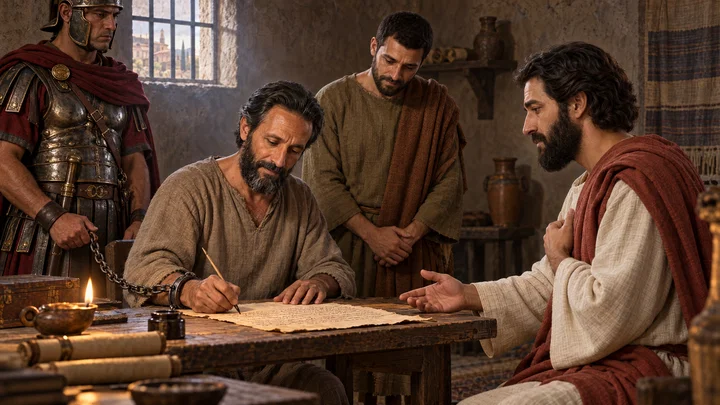
The pledge concerns Onesimus, a pagan slave who had wronged his master Philemon, a Christian believer in Colosse, and had escaped to Rome, where through Paul he confessed his sins and was converted to faith in Christ.AA 456.1–2 After his conversion he endeared himself to Paul by piety, sincerity, tender care for him, and zeal for the gospel.AA 456.1–2 He was counseled to return to Philemon without delay to beg forgiveness and plan for the future, and was sent back with Tychicus, who was carrying letters to churches in Asia Minor.AA 456.1–2 Though delivering himself up to the master he had wronged was a severe test, his genuine conversion led him not to turn aside from the duty.AA 456.1–2
In the verse Paul voluntarily steps between Onesimus and Philemon and takes the guilty servant's debt upon himself, promising to repay whatever loss was caused or sum was robbed.RH Dec 14, 1911SLP 286.3–287.2AA 456.1–2AA 458.2 He does this so that Onesimus might be spared punishment and restored to his former privileges.RH Dec 14, 1911SLP 286.3–287.2 As Onesimus had defrauded his master and had nothing with which to make restitution and could not repay him, so the sinner has robbed God of years of service owed to Him and has no means to repay or cancel the debt.RH Dec 14, 1911SLP 286.3–287.2AA 458.2
The verse thus illustrates Christ's love for the repentant sinner.RH Dec 14, 1911SLP 286.3–287.2AA 458.2 Jesus interposes Himself between the sinner and God and His just wrath, offering to pay the debt.RH Dec 14, 1911SLP 286.3–287.2AA 458.2 He asks that the sinner be spared and offers to suffer in the sinner's stead.RH Dec 14, 1911SLP 286.3–287.2AA 458.2
Sources
Pioneers and periodicals
9 sources
The verse belongs to Paul's letter about Onesimus, an escaped servant who was converted and sent back to his master Philemon.ST Jan 9, 1907ST Nov 7, 1900 Paul, aged and in prison at Rome, sends him with a letter commending him as a Christian brother to be received no longer as a servant but above a servant as a beloved brother.ST Nov 7, 1900 Onesimus was Philemon's runaway slave who had fled to Rome, perhaps having taken some of his master's goods, and after his conversion Paul persuaded him to return and face whatever punishment Philemon might impose.
By contrast, the debt does not prove Onesimus was enslaved, for he may have left an employment or contracted service arrangement while owing money, such as wages advanced to him.RH Apr 28, 1863RH Apr 28, 1863 The words for having wronged or owing mean a transferable financial or property obligation, such as loss from embezzling another's property, that could be charged to Paul's account, not a moral offense transferred to him.RH Apr 28, 1863RH Apr 28, 1863 Such a wrong by embezzling another's property is among offenses to be forgiven.RH Jun 16, 1863
Paul acts as a surety for Onesimus, voluntarily taking the liability on himself and putting in writing his promise to pay whatever Philemon might consider owed or lost when Onesimus ran away.ST Nov 7, 1900RH Jan 13, 1859 He does this even though Philemon himself was Paul's debtor.ST Jan 9, 1907 He does it so that Onesimus could be spared punishment and restored to former privileges, for a surety takes another person's place in responsibility, including paying a debt.RH Dec 14, 1911RH Jan 13, 1859
The verse illustrates Christ's love for the repentant sinner, in that humanity owes a debt to God it cannot pay, so Jesus interposes as surety and takes the debt onto his own account.RH Dec 14, 1911RH May 19, 1904 He pays it in full by suffering in the sinner's place, clears it away, and leaves the debtor forgiven, free, and restored.RH Dec 14, 1911RH May 19, 1904 The verse teaches practical Christian fellowship through willingness to make restitution for any perceived debt, which can prevent disagreement.ST Jan 9, 1907ST Nov 7, 1900
Sources