Translations
American King James Version, King James Version, KJV Cambridge Paragraph Bible, Webster Bible
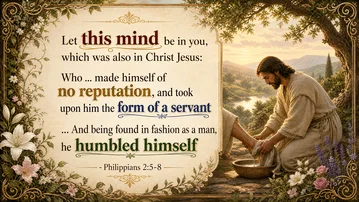
Let this mind be in you, which was also in Christ Jesus:
Revised Version, American Standard Version
Have this mind in you, which was also in Christ Jesus:
For, let this mind be in you that [is] also in Christ Jesus,
For let this mind be in you which [ was] also in Christ Jesus;
The same thing, esteem, in yourselves, which also, in Christ Jesus, [ye esteem],—
Berean Standard Bible, Majority Standard Bible
Let this mind be in you which was also in Christ Jesus:
Have this in your mind, which was also in Christ Jesus,
Let this mind be in you which was in Christ Jesus,
Let the same minde be in you that was euen in Christ Iesus,
Douay-Rheims (Challoner revision)
For let this mind be in you, which was also in Christ Jesus:
Pictures


Cross-references 20 of 106
- Matthew 11:29
Take my yoke upon you, and learn of me; for I am meek and lowly in heart: and ye shall find rest unto your souls.
Christ calls believers to learn his meek and lowly character.
- 2 Corinthians 8:9
For ye know the grace of our Lord Jesus Christ, that, though he was rich, yet for your sakes he became poor, that ye through his poverty might be rich.
Christ’s self-giving poverty exemplifies the humble mind believers are called to share.
- 1 Peter 2:21
For even hereunto were ye called: because Christ also suffered for us, leaving us an example, that ye should follow his steps:
Christ suffered, leaving an example for believers to follow.
- 1 Corinthians 2:16
For who hath known the mind of the Lord, that he may instruct him? But we have the mind of Christ.
Both speak of believers having the mind of Christ.
- Philippians 2:9-11
Wherefore God also hath highly exalted him, and given him a name which is above every name:
God exalts Christ after his humble obedience.
- Hebrews 2:17
Wherefore in all things it behoved him to be made like unto his brethren, that he might be a merciful and faithful high priest in things pertaining to God, to make reconciliation for the sins of the people.
Christ was made like his human brothers in all things.
- Romans 15:3
For even Christ pleased not himself; but, as it is written, The reproaches of them that reproached thee fell on me.
Christ did not please himself, giving believers an example of selfless service.
- Psalms 40:8
I delight to do thy will, O my God: yea, thy law is within my heart.
Christ’s mind delights in doing God’s will, with his law in his heart.
- 1 John 2:6
He that saith he abideth in him ought himself also so to walk, even as he walked.
Those who abide in Christ are to walk as he walked.
- John 13:14-15
If I then, your Lord and Master, have washed your feet; ye also ought to wash one another’s feet.
Christ humbly serves his disciples and gives them an example to follow.
- Hebrews 12:2
Looking unto Jesus the author and finisher of our faith; who for the joy that was set before him endured the cross, despising the shame, and is set down at the right hand of the throne of God.
Looking to Jesus, who endured the cross, presents him as the believer’s pattern.
- Matthew 16:24
Then said Jesus unto his disciples, If any man will come after me, let him deny himself, and take up his cross, and follow me.
Christ’s example calls his followers to deny themselves and follow him.
- 1 Corinthians 1:10
Now I beseech you, brethren, by the name of our Lord Jesus Christ, that ye all speak the same thing, and that there be no divisions among you; but that ye be perfectly joined together in the same mind and in the same judgment.
Both call believers to one mind and unity without divisions.
- Mark 10:45
For even the Son of man came not to be ministered unto, but to minister, and to give his life a ransom for many.
Christ came to serve rather than be served and gave his life for others.
- 1 Peter 4:1
Forasmuch then as Christ hath suffered for us in the flesh, arm yourselves likewise with the same mind: for he that hath suffered in the flesh hath ceased from sin;
Believers are urged to arm themselves with the same mind as Christ in suffering.
- Matthew 20:25-28
But Jesus called them unto him, and said, Ye know that the princes of the Gentiles exercise dominion over them, and they that are great exercise authority upon them.
Christ teaches greatness through serving others and giving himself.
- Romans 15:5-7
Now the God of patience and consolation grant you to be likeminded one toward another according to Christ Jesus:
Believers are called to share Christ’s mind, receive one another, and glorify God together.
- John 5:30
I can of mine own self do nothing: as I hear, I judge: and my judgment is just; because I seek not mine own will, but the will of the Father which hath sent me.
Christ seeks the Father’s will rather than his own, showing his dependence and humility.
- Galatians 2:20
I am crucified with Christ: nevertheless I live; yet not I, but Christ liveth in me: and the life which I now live in the flesh I live by the faith of the Son of God, who loved me, and gave himself for me.
Dying to self accompanies Christ living in believers and forming his mind in them.
- Romans 12:16
Be of the same mind one toward another. Mind not high things, but condescend to men of low estate. Be not wise in your own conceits.
Both call believers to share one mind and live humbly, avoiding conceit.
Commentary part 1 of 4
Each commentary is drawn from primary sources: the writings of Ellen G. White and Adventist pioneers and periodicals. Each commentary is separate. Its own words are not a quotation; follow the references to read the source passages.
Ellen G. White
408 sources
Let this mind be in you means believers are commanded to have Christ's humble, selfless, servant mind, shown in likemindedness and same love, doing nothing through strife or vainglory, esteeming others better than self and looking to others' interests as well as one's own.9T 274.2–275.1JIOKP 32.2–33.26T 399.1 That mind is defined by His pattern, who though in the form of God and equal with God made Himself of no reputation, took the form of a servant in human likeness, humbled Himself in obedience unto death on the cross, wherefore God highly exalted Him with a name above every name.9T 274.2–275.1Ms 27, 1911, par. 19–21Ms 17, 1911, par. 3–4 It is a meek, lowly, pure Spirit free of selfishness and self-glorification, shown in self-denial and self-sacrifice for others' good and in love that gives itself to seek and save the perishing.Lt 11, 1887, par. 14ST Aug 27, 1912ST Nov 20, 1884Lt 26, 1850, par. 7–8 It is received by every person through conversion and transformation by the Holy Spirit, by surrender of the will and dying to self, and by constantly beholding Christ and studying His life until changed into His image.ST Sep 3, 1902Ms 58, 1886, par. 4–7Lt 48, 1902, par. 25–27Lt 20, 1902, par. 18–19ST Jul 7, 1890 Having it cures self-seeking and control of others and brings unity, mercy, forbearance and pure speech, and it leads to obeying and working out salvation with fear and trembling while God works to will and do, in blameless life as lights in the world and in self-denying missionary service to the needy, tempted, sick and unentered places.Ms 17, 1911, par. 3–4Lt 120, 1903, par. 18–20Ms 80, 1898, par. 6–7Ms 1, 1899, par. 14–15Ms 82, 1898, par. 18–25
Verse Words and Context
The command is to have inwardly the same way of thinking that was in Christ Jesus, which is humility, meekness and selflessness expressed in unity and love rather than status-seeking.9T 274.2–275.1JIOKP 32.2–33.26T 399.1COL 248.1Ms 17, 1899, par. 12 That likemindedness means being of one accord and of one mind, having the same love flowing from consolation in Christ, comfort of love, fellowship of the Spirit, and tender mercy and compassion.Ms 17, 1899, par. 12Ms 27, 1911, par. 19–21Ms 116, 1904, par. 1–4Ms 129, 1907, par. 7–12Lt 187, 1903, par. 5–7 It is proved by doing nothing through strife or vainglory, but in lowliness of mind esteeming others better than self and looking not only to one's own interests but also to the interests of others.6T 399.1COL 248.1Ms 17, 1899, par. 12Ms 27, 1911, par. 19–21Ms 116, 1904, par. 1–4 To meet the mind of the Spirit of God in all things is to seek and fulfill this same mind in every movement submitted to self-examination.Ms 27, 1911, par. 19–21Ms 129, 1907, par. 7–12
That mind is defined by Christ's pattern in the verses that follow: though being in the form of God and equal with God by right, He claimed none of these things for Himself and did not grasp at equality.Ms 27, 1911, par. 19–21Ms 17, 1911, par. 3–4Ms 116, 1904, par. 1–4Ms 97, 1907, par. 14–15Ms 31, 1906, par. 12–13 He made Himself of no reputation, took the form of a servant, was made in the likeness of men and found in fashion as a man.9T 274.2–275.1Ms 27, 1911, par. 19–21Ms 17, 1911, par. 3–4Ms 116, 1904, par. 1–4Ms 97, 1907, par. 14–15 He humbled Himself and became obedient unto death, even the ignominious death of the cross.9T 274.2–275.1JIOKP 32.2–33.2Ms 27, 1911, par. 19–21Ms 17, 1911, par. 3–4Ms 97, 1907, par. 14–15 Wherefore God highly exalted Him and gave Him a name above every name, so that at the name of Jesus every knee in heaven and earth and under the earth should bow and every tongue confess that Jesus Christ is Lord, to the glory of God the Father.Ms 27, 1911, par. 19–21Ms 17, 1911, par. 3–4Ms 31, 1906, par. 12–13Lt 120, 1903, par. 18–20Lt 76, 1898, par. 16–17 His self-emptying humility and obedience are thus the standard for the believer's attitude toward others.9T 274.2–275.1Ms 97, 1907, par. 14–15Ms 31, 1906, par. 12–13
The exhortation sets a high standard that must not be passed over indifferently but must be guarded strictly, individually and collectively, by all who claim to believe.Ms 129, 1907, par. 7–12Lt 187, 1903, par. 5–717MR 317.2–3 It belongs to loving as brethren, being pitiful and courteous, showing universal humility and benevolence with self-denial and self-sacrifice in good works, with words sanctified by the Spirit and in accordance with gospel principles, so that the humble-minded, precious in God's sight, shine as blameless lights holding forth the word of life.Ms 129, 1907, par. 7–12Lt 76, 1898, par. 16–17Lt 96, 1894, par. 4 It is clear instruction of great importance for the present time, especially for leading brethren, to be earnestly heeded, fulfilled and thankfully obeyed, leaving no excuse for walking contrary to God's will.Lt 187, 1903, par. 5–717MR 317.2–3Lt 190, 1905, par. 5–6 It is to be studied together with the whole second and third chapters of Philippians without disregarding their lessons, and that chapter is needed for the education of all workers and should be brought before the people.Lt 187, 1903, par. 5–717MR 317.2–3Lt 190, 1905, par. 5–6 It is part of God's complete provision in Scripture to show how to obtain the crown of life and enter the joy of the Lord, calling the sinner to hear mercy and repent, and it belongs to being doers of His words, pure, loyal and true, prepared in the short time remaining before accounts are settled.Lt 76, 1898, par. 16–17Lt 96, 1894, par. 4
Having that mind leads to obedience and to working out one's own salvation with fear and trembling, while God works within both to will and to do of His good pleasure in humble dependence.Ms 17, 1911, par. 3–4Lt 130, 1901, par. 9–11Ms 33, 1892, par. 25–26Ms 12, 1902, par. 22–23Lt 67, 1900, par. 34–37 It requires walking as He walked and working as He worked in constant self-denial and daily reaching out to do others good, being renewed in the spirit of the mind day by day and reaching to the righteousness of Christ through the fullness of grace provided by His merits.Lt 130, 1901, par. 9–11Ms 33, 1892, par. 25–26Ms 12, 1902, par. 22–23 It forbids dull, sleepy, indifferent service as unsafe, and requires wrestling in earnest prayer to resist temptation and using bestowed grace to gain a vigorous Christianity.Ms 17, 1911, par. 3–4Ms 33, 1892, par. 25–26 It is expressed in willing obedience and unity, in doing all things without murmurings and disputings, being blameless and harmless as sons of God in the midst of a crooked and perverse nation, shining as lights in the world and advancing the gospel into new unentered places.Ms 129, 1907, par. 7–12Ms 12, 1902, par. 22–23Lt 120, 1903, par. 18–20Lt 67, 1900, par. 34–37
Christ's Humiliation and Exaltation
Though in the highest place in heaven, in the bosom of the Father as the Majesty of heaven in the form of God and equal with God, Christ laid aside glory, riches, honor and supremacy.MH 501.2–32T 424.3–426.2Lt 98, 1896, par. 46–50 He voluntarily subjected Himself to the humbling conditions of human life, assumed the responsibilities of a servant, took human nature to save the lost, and humbled Himself in obedience unto death, even the most ignominious, revolting, agonizing death of the cross.MH 501.2–32T 424.3–426.2ST Jul 16, 1896 That self-denying condescension in behalf of sinners means looking not only to one's own things but also to the things of others, and considering it banishes selfishness and produces gratitude and love with the deep sense of not being one's own, so that such a Master is not to be served from grudging, selfish motives.MH 501.2–3 For humanity's sake He gave up ease, became poor, accepted suffering and humiliation, worked without outward pomp for others, cared for His disciples, shared their poverty, denied Himself for their good, bore their burdens, and gave His life as the price of redemption, even pardoning the dying thief while dying Himself though He was source of all riches and heir of all things.Lt 98, 1896, par. 46–50Lt 71, 1901, par. 4ST Jul 16, 1896 Having this mind is therefore refusing jealousy, resentment and defense of dignity, not retaliating or threatening when insulted or made to suffer but entrusting self to the righteous Judge, dwelling on and speaking of His love and perfection rather than finding fault, and seeking to restore and help people in service to Him.2T 424.3–426.2Lt 98, 1896, par. 46–50Lt 71, 1901, par. 4
He humbled Himself lower and lower until there were no lower depths to reach, agonizing and dying the shameful death of the cross for guilty, condemned humanity.Lt 11, 1887, par. 20–23RH Sep 4, 19005T 16.2–18.1 This was to make atonement to lift humanity from moral defilement and also to set a pattern for every disciple, minister and layperson alike.Lt 11, 1887, par. 20–23RH Sep 4, 19005T 16.2–18.1 Looking to Calvary therefore rebukes self-important ideas, pride of talent and intellect, striving for supremacy, craving for human praise, exaltation, deference and respect, independence, selfish ambition, haughtiness, self-exaltation, selfishness, envy, jealousy, evil surmising, hatred and defilement.Lt 11, 1887, par. 20–23RH Sep 4, 19005T 16.2–18.1 Instead followers master self, cleanse the soul temple, open the heart for Jesus to come in, lift the cross and follow Him, hide the life with Christ in God, bear reproach and abuse without retaliation or revenge, and become partakers of the divine nature to escape corruption through lust, humbly adoring Jesus and never exalting self.Lt 11, 1887, par. 20–235T 16.2–18.1 Pride cannot exist in hearts hid with Christ, and those who do not learn His meekness and lowliness for benefiting others will find no place in the kingdom of God and risk His having died in vain for them.Lt 11, 1887, par. 20–23CTBH 78.1
His humility was not a low estimate of His character, abilities or worth, but coming down to fallen humanity to lift people to a higher life.3T 566.2–3CTBH 78.3FE 142.3Ms 5, 1875, par. 17 Though sinless He joined His divinity to fallen human nature, honoring what humanity can become through God's provision and participation in the divine nature.Lt 81, 1896, par. 14–18 He adapted Himself to the fallen condition, lived among the poor and overlooked, shared human experience, became poor, humbled Himself and obeyed even to death on the cross, giving an example of service, self-denial and missionary work without display.Lt 81, 1896, par. 14–18Ms 175, 1903, par. 14CTBH 78.1 His kingdom is therefore not ruled by striving for the highest position, and true disciples meet people where they are to help raise them up rather than competing for status, rank or outward appearance.3T 566.2–3CTBH 78.3FE 142.3Ms 5, 1875, par. 17 Pride must be subdued and the heart made tender by His Spirit so His character can be formed within, for heaven honors not wealth, status, authority or titles but those who follow Christ and make their duties honorable through character and grace.Lt 81, 1896, par. 14–18
The verse reveals the mystery of godliness, God made flesh: He who was truly God and in the form of God did not count equality with God as robbery but emptied Himself, took the form of a servant made in the likeness of men.STE 151.2Ms 107, 1897, par. 20–21Ms 22, 1895, par. 2–3 He is the divine Creator by whom all things were made and hold together and in whom all fullness dwells, revealing God's benevolence, mercy, long forbearance and example of perfect obedience.STE 151.2Ms 107, 1897, par. 20–21Ms 22, 1895, par. 2–3 Because of that humiliation God highly exalted Him above all with supreme authority, so that every being in heaven and on earth and under the earth will bow to Jesus and every tongue will confess Him as Lord to the glory of God the Father.Ms 107, 1897, par. 20–21 This truth holds new views and hidden treasures found by diligent searching, taxing the intellect, giving strength to mental ability, and what can be learned from it is never exhausted; having His mind is humility, obedient self-sacrifice and conformity to God's will after His perfect pattern, cheerfully obeying the Father as heaven enshrined in humanity.STE 151.2Ms 22, 1895, par. 2–3Ms 17, 1911, par. 6–8GW92 14.2 Those who fashion life and family by that pattern, count salvation bought at such cost too great to treat lightly, work it out daily without haphazard work, humble self under God's hand rather than seek self-exaltation, and sit meekly at His feet will be exalted by God in due time to stand beside Him with the crown of immortal glory.Ms 17, 1911, par. 6–8GW92 14.2
Incarnation Veiling Divinity
Christ laid aside royal glory, robe, crown, riches and kingly dignity and took the form of a servant in human likeness.RH Jun 15, 1905Ms 54, 1905, par. 11–12Ms 187, 1898, par. 26–31Ms 151, 1898, par. 20–25Ms 19, 1909, par. 9–10 He veiled His divinity with humanity but did not surrender it, retaining it while becoming human.RH Jun 15, 1905Ms 54, 1905, par. 11–12Ms 187, 1898, par. 26–31Ms 151, 1898, par. 20–25 He veiled His glory because sinful people could not bear to behold it unveiled.Ms 54, 1905, par. 11–12 He came as a divine-human Savior to stand at the head of fallen humanity, that humanity might touch humanity and divinity lay hold upon divinity.Ms 54, 1905, par. 11–12Ms 187, 1898, par. 26–31Ms 151, 1898, par. 20–25Ms 21a, 1895, par. 3 He shared the fallen race's experience from childhood to manhood and lived in perfect obedience even to death on the cross.RH Jun 15, 1905Ms 54, 1905, par. 11–12Ms 19, 1909, par. 9–10 That willingness to enter a disheartening field and endure indignity from those He came to save shows the mind believers are to arm themselves with in seeking the lost sheep to bring the wanderer from sin to the heavenly fold.Ms 19, 1909, par. 9–10Ms 21a, 1895, par. 3
That condescension was to raise degraded humanity so that people might become partakers of the divine nature.RH Jun 15, 1905Ms 54, 1905, par. 11–12ST Nov 25, 1897 Though He occupied the highest position in heaven in the bosom of the Father as Majesty in the form of God and equal with God, He voluntarily subjected Himself to the humbling conditions of human life and assumed the responsibilities of a servant in obedience unto the most ignominious, revolting and agonizing death of the cross.MH 501.2–3ST Sep 21, 1915Lt 105, 1893, par. 31–36 His incarnation and sacrifice reveal humanity's great value to God and the price paid to redeem people.Lt 105, 1893, par. 31–36 Reverently contemplating these truths softens, purifies and ennobles the heart and gives the mind new strength and vigor.MYP 263.2–3 Considering that amazing sacrifice banishes selfishness from the heart and produces gratitude and love with the deep sense of not being one's own, so that such a Master must not be served from grudging, selfish motives.MH 501.2–3ST Sep 21, 1915 United to Him by faith, believing and receiving Him, believers become part of Him, reflect God's image, reveal His glory and cooperate with Him in redemption and suffering until His character is fully represented in His chosen people.ST Nov 25, 1897
In humbling Himself He made atonement for the fallen race, giving Himself to save guilty people who could not save themselves.ST Dec 17, 1902Ms 47, 1902, par. 39Lt 71, 1901, par. 4ST Jul 7, 1890 Though source of all riches and heir of all things, He gave up all He possessed for sinners, and even while dying on the cross He pardoned the dying thief.Lt 71, 1901, par. 4 His meek and holy bearing of human sin opened the plan of salvation so that whoever believes may have everlasting life, and as beholders love Him they are changed into His image.ST Jul 7, 1890 Holiness is the fruit of that sacrifice and is promised because He died, and He longs to bestow it to make believers sharers in His own nature and to save those who by sin have separated themselves from God.ST Dec 17, 1902Ms 47, 1902, par. 39 They are called to choose His service, give themselves wholly into His control, learn meekness and lowliness, and learn how to do God's will.ST Dec 17, 1902Ms 47, 1902, par. 39 Because of that humiliation God highly exalted Him and gave Him a name above every name, so that every knee in heaven and on earth and under the earth will bow at the name of Jesus and every tongue will confess that Jesus Christ is Lord to the glory of God the Father.ST Dec 17, 1902Ms 47, 1902, par. 39
The mind to be in believers must be studied day by day from inspired words as the lesson book for traveling heavenward, for as representative of the human race He became Redeemer and Restorer in contrast to Satan the destroyer.Ms 67, 1898, par. 2–3 His great humiliation is to fill the mind by contemplating His divine character and His majesty and glory as the Highest and how He laid these aside and clothed His divinity with humanity, a self-denial and self-sacrifice that was the marvel of angels.15MR 25.2Lt 37, 1887, par. 20–21 This cures merely hearing the voice of man in preaching and going home with souls empty and unnourished and sitting in judgment on the sermon as a human effort.15MR 25.2Lt 37, 1887, par. 20–21 It calls instead for listening to the voice of God and bringing truth into the life so it has lasting effect.Lt 37, 1887, par. 20–21 Remembering the depth of His humiliation teaches believers to be subject to one another, to love others and value souls for whom He died, and to deny self in efforts to save the perishing.ST Oct 23, 1879
Nature of Christlike Mind
The mind to be in believers is the Spirit of Christ, which is meek and lowly, pure and undefiled, wholly free from selfishness, self-pleasing, self-conceit, self-glorification and pride.Lt 63a, 1893, par. 11–14Lt 11, 1887, par. 14Lt 63, 1893, par. 15–17Lt 46, 1880, par. 11–12 It shows itself in meekness, lowliness, humility, simplicity, gentleness, patience, teachableness, courtesy, devotion and consecration to God, in quiet unassuming manners, in gentle peaceful courteous conduct free from hasty words, rude actions, combativeness, firm self-assertion and self-esteem.Lt 11, 1887, par. 14ST Aug 27, 1912Lt 46, 1880, par. 11–12BS 13.12T 388.3–389.1 Having this Spirit proves belonging to Christ, as branches of the living Vine bear the parent stalk's fruit, producing unity and peace instead of difference and strife, and it means walking in the same spirit and steps as Jesus, who humbled Himself for humanity that believers might be exalted as sons and daughters of God and find rest of soul.Lt 11, 1887, par. 14Lt 26, 1850, par. 7–8 Young and aged alike are to show it, the aged growing mellow in disposition, for divine grace can sanctify character and soften stern traits.ST Aug 27, 1912 It makes labor acceptable to God and useful to His cause, finds a place in the hearts of His people, clothes with genuine not assumed dignity, brings His blessing and care, and seeks to excel not by belittling others' labors but in good works, following Him who though Majesty of heaven became a servant, did not avoid weariness, and traveled on foot teaching by the wayside.Lt 46, 1880, par. 11–12 It appears in constant works of mercy and shedding light on others' pathway without calling attention to personal virtue, self-denial, self-sacrifice or benevolence, seeking neither gain nor honor, performing even wonderful healings as quietly as possible and walking lowly.BS 13.1 This lowliness stands in direct contrast to religion of display — praying publicly, doing charity for effect, trumpeting good deeds, claiming to be without sin — and those who measure piety by display reject it as worthless and reject Christ because of it.BS 13.1 One may be correct on many points of truth yet lack this mind, and until converted and self dies he cannot bless any church, but sees faults in others, questions those who disagree, excuses those who agree, uses truth to quarrel and boast, and turns souls away so that his light is called darkness; when he sees himself as he is, corrects defects of character, dies to self and becomes teachable, he can let his light shine in good works that lead others to glorify the Father in heaven.2T 388.3–389.1
That mind is self-denial and self-sacrifice for others' good.ST Nov 20, 1884Lt 21, 1894, par. 11–13Ms 173, 1907, par. 5MC 17.2–317MR 90.4–91.3 He left the royal courts of heaven, stepped down from His throne, laid aside kingly crown, royal robe, glory and supremacy, clothed divinity with humanity, submitted to poverty and a death of shame to save a sinful race, becoming poor that through His poverty people might be made rich.Lt 98, 1896, par. 46–50ST Nov 20, 1884Ms 173, 1907, par. 5 He did this not that people might lead a life of worldly pleasure and extravagance but that they might follow His example of self-denial for others, to seek and save the perishing and exemplify disinterested benevolence.ST Nov 20, 1884 His incarnation was an act of self-sacrifice and His life one of continual self-denial, manifesting the highest glory of God's love in the sacrifice of His only-begotten Son who is the express image of His person.Lt 21, 1894, par. 11–13 Having this mind is both privilege and duty, and without self-denial and cross-bearing no one can be His disciple.Lt 21, 1894, par. 11–13Lt 16e, 1892, par. 31–33 That same mind must be in His workers, binding about their wants, living on the self-denial plan, giving all talents to God to be improved according to God's way and not their own ideas, working together with God in soul-saving with power and efficiency for the largest returns, never refusing to deny self for His sake, with the lesson learned in experience and not set aside for personal ideas and plans.Ms 173, 1907, par. 517MR 90.4–91.3
It is love that gives itself.Lt 30, 1895, par. 37–38Ms 4, 1899, par. 65RH Mar 19, 1901 Christ took human nature, joining divine power with human weakness, and humbled Himself to lift humanity and share His blessings, honor and glory with believers.Lt 30, 1895, par. 37–38 He who fills all heaven with splendor and is worshiped by the heavenly host came to earth as man that people might be exalted to share His glory, and having the same mind means sacrificing self so others may be lifted up.Ms 4, 1899, par. 65 He found joy in toil and suffering for others, and His followers find true happiness by following His example and living to do good to others. Christians reflect His image by denying self and sacrificing for one another, for without surrendering self they cannot love as He loved.Lt 30, 1895, par. 37–38 He took human nature to display God's glory through human happiness and gave His life for that purpose, and believers share in what He is and has, becoming heirs of God and joint-heirs with Him, called to cooperate in His saving work and make sacrifices to relieve those in need.RH Mar 19, 1901
Without this mind those claiming to be Christians are not Christians in character but misrepresent Christ and the truth, remain unconverted despite reputation, and cannot work with Him to draw people to Him.Lt 96, 1894, par. 4Lt 102a, 1897, par. 19Ms 23, 1894, par. 16–17 Mere profession deceives the soul, destroys truth by an unbelieving unsanctified life, and leaves its holder in hypocrisy, a constant denial of Christ rather than a confessing of Him, a cause of stumbling to others, keeping a selfish disobedient worldly spirit, doing half-and-half work and serving Mammon while the name is on the church books, unprepared to close earthly history and without God and without hope like the common sinner.Ms 23, 1894, par. 16–17Lt 16e, 1892, par. 31–33 Claiming to have advanced in Christian life is contradicted when conversation, influence and conduct do not reflect that mind.3T 336.4 Having it molds character after the divine likeness and puts love and tenderness in the soul.Lt 96, 1894, par. 4 It belongs to being doers of Christ's words, pure loyal and true to the highest interests, serving God with undivided affections, enthroning God in the heart while dethroning and expelling Satan, constantly looking to Christ and contemplating His character, loving the holy principles of God's law from the heart so that "I am a Christian" is the language of the heart, and thus being prepared in the short time remaining before accounts are settled for the Marriage Supper of the Lamb.Lt 96, 1894, par. 4Ms 23, 1894, par. 16–17
Christ Himself, though divine and equal with God, humbled Himself, took the form of a servant, became human and obeyed even to death on the cross, and is now confessed as Lord to the glory of God the Father, and His humility and self-giving love are the pattern for believers and the essential subject of preaching and contemplation.Ms 27, 1889, par. 7–11 He was wholly free of selfishness and did not live to please or glorify Himself, but lived to glorify God and save fallen humanity, giving up ease, honor, riches and supremacy, becoming poor, accepting suffering and humiliation and enduring death to save, so His life is the perfect pattern to study and imitate.Lt 63a, 1893, par. 11–14Lt 98, 1896, par. 46–50Lt 63, 1893, par. 15–17 Other Christians' failures should turn believers toward the Savior and strengthen resolve to become like Him, not lead them to copy those failures or dwell on them, for studying Christ rather than copying failings enables believers to resist temptations that would make them act inconsistently with His character.Lt 63a, 1893, par. 11–14Lt 63, 1893, par. 15–17 Following His example means dwelling on and speaking of His love and perfection rather than finding fault with others, and seeking to restore and help people.Lt 98, 1896, par. 46–50 Having His mind is looking at His life, studying His character and copying His pattern, for what He was in perfect humanity believers must be, forming characters for eternity, and as co-workers with Christ this includes sharing with Him in His suffering, with the light of truth shining in this important period leaving no excuse for a low standard.STA 96.1 It is living as Jesus lived not to please Himself, walking as He walked and working as He worked, and it must be carefully and prayerfully considered and put into active practice, confronting love of self-indulgence with the requirement to follow Him, and when obeyed it produces great reformation with righteousness and truth restored.Lt 29a, 1892, par. 7
Receiving Mind by Faith
Philippians 2:5 is God's invitation for every person to receive the mind of Christ by conversion and transformation, acknowledging no standard but the perfection of God's mind and will and requiring conformity to His will.ST Sep 3, 1902 Everyone who receives Christ as personal Saviour is privileged to possess all His righteous attributes, with Christ formed within as the hope of glory, the inward person renewed day by day even while the outward perishes, and the whole being including even the thoughts brought into captivity to Christ.ST Sep 3, 1902Ms 67, 1894, par. 6–8Ms 19, 1892, par. 4121MR 115.2 This learning of humility, self-denial, service and obedience rather than strife, vanity or self-interest comes through the Holy Spirit, since human goodness and righteousness do not arise from human effort alone.Lt 48, 1902, par. 25–27 No one is to submerge his mind in the mind of a fellow mortal or imitate any merely human model, even one nearly perfect, for defective human beings cannot impart perfection, but each is to look to the divine Example with individual faith and individual experience.ST Sep 3, 1902Lt 20, 1902, par. 18–19 Christ graciously adapted His life for universal imitation, uniting wealth and poverty, majesty and abasement, unlimited power with meekness and lowliness to be reflected in every soul who receives Him, so that through His merits and power fallen humanity can be lifted from depravity, purified, made holy in its sphere as the Father is holy, reflect the image of Jesus, and become a living witness of what men and women may become through grace.ST Sep 3, 1902
Receiving that mind requires thorough repentance, conversion and change of character, for a dedicated place of worship cannot substitute for cleansed hearts and God does not acknowledge people as His children without hearty repentance, confession of wrongs toward brethren and sisters, and shame before God for an unrighteous course.Ms 58, 1886, par. 4–7Ms 66, 1886, par. 32 Pride and self-sufficiency must be put aside and crucified, personal ideas and policies given up, self emptied and self dying, and the will brought into full agreement and harmony with God's will.ST Nov 21, 1892ST Jul 7, 1909Ms 33, 1892, par. 2 When people present themselves emptied of self, God supplies the place with the Holy Spirit and gives them of His fullness, for self cannot be retained and be filled with God, and this surrender ending the struggle of flesh against Spirit makes the person free indeed so he cannot be brought into servile bondage to sin.Ms 67, 1894, par. 6–8ST Nov 21, 1892 This abiding in Christ uproots self and belongs to overcoming and being among the worthy overcomers, requiring constant vigilant watch over mind and heart, no longer thinking own thoughts or doing own actions.Ms 33, 1892, par. 2 When Christ dwells in the heart, love, tenderness and compassion replace evil speaking, bitterness and strife, producing reverence, order, unity and a humble loving spirit that puts others before self.Ms 58, 1886, par. 4–7
That mind comes by keeping the divine picture of Christ constantly lifted up before the people and studied in His life, lessons and perfection of character, contemplating the Redeemer until changed into His image.ST Jul 7, 18908MR 182.3Ms 7, 1898, par. 4–6 The Christ to be beheld reflects no shadows, is clothed in the attributes and glories of Deity, is in the likeness of the infinite God, and meekly and holily bore human sins to open the plan of salvation so that whoever believes may have everlasting life.ST Jul 7, 18908MR 182.3 The more the eye looks upon Him, the more creature merit sinks into insignificance and the more sinful and abhorrent sin appears, while beholding draws admiration, attraction, charm and desire to be like Jesus until assimilation to His image and having His mind.8MR 182.3 To receive Jesus as He is — full of compassion, amiable, courteous, divinely polite, full of goodness and mercy and forgiveness of sins — and to behold Him transforms into His image in gratitude and heavenly love, producing ever-increasing confidence, hope, patience and courage, living connection with God, humble grateful confidence as an abiding principle, and contemplation of His character who first loved us that sweeps unbelieving fears away before living trusting faith.Lt 63, 1895, par. 51–53 To have that mind is to walk with God like Enoch, with the mind full of thoughts of Jesus as best Friend, growing into likeness with identity hid with Christ in God as a partaker of the divine nature escaped from corruption through lust.8MR 182.3Ms 198, 1899, par. 18–20
It is gained and kept by earnest wrestling prayer with God to resist temptation, by watching every action so nothing harms Christian experience, by beholding the true standard of character and seeking self-mastery by constant prayer and faith.Ms 19, 1892, par. 4121MR 115.2Ms 198, 1899, par. 18–20 It requires reading the Scriptures attentively to get their full meaning and doing what is written, not being discouraged by failure but asking forgiveness and trying again, so that by using the grace bestowed a vigorous Christianity is gained and dull, sleepy, indifferent service is left behind.Ms 19, 1892, par. 4121MR 115.2Ms 198, 1899, par. 18–20 In this way the peace and joy and fragrance of Christ are brought into daily thoughts and practical life, making a new creature whose heart, purpose and will are bound up with Christ to do good and only good.Ms 198, 1899, par. 18–20 The humble, meek, lowly mind ever cherishing the simplicity of Christ with self hid in Christ, which gives fitness for God's great work, is to be sought from God in prayer day and night with constant prayer, preparing believers to expect and endure the same cruel treatment He received as partakers of His sufferings without surprise when offenses come.Lt 24, 1880, par. 8Lt 258, 1899, par. 26 Everyone must labor with earnestness and dependence on God to keep the mind in the right channel so the mind of Jesus becomes their own, opening the heart to the light of the Sun of Righteousness so it enters and shines through the whole heart.Ms 15, 1894, par. 1
Having the mind that was in Christ is not forced by God but must be individually decided by falling on the Rock and being broken, by opening the proud heart to the Spirit of God, by having intellectual ability sanctified to the service of God, and by being under the transforming power of God with the mind renewed by the Holy Spirit.Ms 18, 1888, par. 15 It comes by drinking in the Spirit of God, which gives understanding of the character of sacrificial mission and work God gives to do and knowledge of Christ as the Burden-bearer who carries workers in that appointed work.Lt 63, 1894, par. 16 It means living by faith, resting on God's promises and receiving the fullness of Christ, whose promised presence sustains this life of faith.Lt 42, 1890, par. 13 It means daily seeking to have the mind of Christ in order to do His will in word and work, thus fulfilling the purpose of the eternal God and cooperating with Him in every measure He desires to carry out as His helping hand while living in this world.Ms 8, 1904, par. 10
Conversion changes character as a person enters personal relationship with Christ and receives His mind, turning from hereditary and cultivated tendencies and from the former mind to come under the molding influence of the Holy Spirit.Ms 38, 1897, par. 1–2Ms 139, 1907, par. 1–2 It requires educating oneself to believe all of God's Word as wonderfully and gloriously fulfilled, so personal doubts vanish before true discernment and the doubts of others are dispelled through assurance of faith.Lt 63, 1895, par. 51–53 For ministers and all workers it requires a deep work of the Holy Spirit and sanctification through the truth, giving up all selfishness to secure eternal life and bring the Spirit into life practice, showing the principles that governed His life in true humility of soul, meekness and lowliness instead of the sinner's character, and partaking of the self-denial and self-sacrifice that marked the Saviour's life as partakers of the divine nature.Ms 139, 1907, par. 1–2 Mind and body powers are then held in subjection to Christ as a precious trust to be used in His service so souls are impressed by the truths taught.Ms 139, 1907, par. 1–2 The verse requires taking Christ's mind by leaving self out and living by faith rather than relying on what can be seen.Lt 130, 1898, par. 36
Unity Humility Toward Others
Having the same mind cures the rising of self that tries to make other minds travel in the same lines with one's own opinions and ideas.Ms 80, 1898, par. 6–7 It forbids carrying out one's own ideas and plans without interruption, forbids holding one's own course, words and reasoning as right without need of modification, and requires submitting every movement to strict self-examination and comparing every principle of action with the principles of God's Word.Ms 1, 1899, par. 14–15Ms 82, 1898, par. 18–25 It requires counseling and working together in unity because in unity there is strength, rejecting selfishness and higher regard for one's own plans, opinions and work, refusing to act independently, and serving in oneness as Christ is one with the Father.Ms 1, 1899, par. 14–15Ms 82, 1898, par. 18–25ICEP 3.2–3 That mind must be trained to think Christ's thoughts and enlightened to understand God's will and way rather than personal will, so that followers learn Christ's methods of work, let Christ shape their thinking, subdue self and walk humbly, especially those in responsibility lest they lower the spiritual standard.9T 87.4Lt 276, 1907, par. 2–3
It puts away the desire to control others, with strong traits that lead to such control subdued by grace so workers serve freely and in harmony with brethren.RH Apr 23, 1908RCOC 98.1–2 It gives up jealousy, cruel purposes, harshness and the urge to rule over others, and instead sets a righteous example through loving, tender care, with that change beginning at home in how a husband treats his wife and a parent treats children, where authority over God's people is exercised as faithful, tender shepherding and not domination.Lt 109, 1893, par. 22–24 Where this mind and love rule, selfishness, suspicion, self-importance and arbitrary authority give way to peace and a changed spiritual atmosphere.Lt 16, 1902, par. 11–13 Bringing heart and mind into conformity to it is the opposite of a spirit of rulership that restricts religious liberty and retards conversion, requiring following given light and not bracing against reproof, since resisting light makes conformity harder and continuing in rulership unfits one to deal with sacred spiritual interests.Lt 86, 1908, par. 13
It is shown in likemindedness, same love, one accord and one mind, doing nothing through strife or vainglory, in lowliness esteeming others better than self and looking to others' interests as well as one's own.ST Oct 13, 1898 It appears in bowels of mercies, kindness, humbleness of mind, meekness, long-suffering, forbearing and forgiving as Christ forgave, putting on charity as the bond of perfectness, letting God's peace rule in the heart, being thankful, and letting Christ's word dwell richly in wisdom with teaching, admonishing and singing with grace in the heart.ST Oct 13, 1898 Received as heavenly truth into a wholly yielded heart cultivating heavenly affections, it deepens love, gives joyful communion with God and intense interest in others, and makes one tender, courteous, sympathetic, kind, forbearing and forgiving, never coarse, rough, hard-hearted, revengeful or bitter, free to express tenderness, sympathy and praise instead of cold reproof, affectionate in family and faithful in friendship with neither evil speaking nor evil thinking, making the earthly home a type of the heavenly home.ST Jul 3, 1893 It makes one better in every relationship and duty, incompatible with unkindness, churlish or overbearing disposition, murmuring, complaining and fretful passion, and it works together with God for peace by praying for the Spirit's molding influence, governing lips by kindness, refusing sour discourtesy, and staying true to profession, with angels hovering round.4T 347.1Lt 133, 1904, par. 17
It turns from strife and bitterness to put others before self with love, tenderness and compassion replacing evil speaking and bitterness, which requires thorough repentance, conversion and change of character with confession of wrongs toward brethren and shame before God, since no dedicated house can substitute for cleansed hearts and order in the church.Ms 58, 1886, par. 4–7Ms 66, 1886, par. 32 With this grace abiding, believers practice His lessons, value His mercy and love, and become peacemakers dealing with faults directly and privately rather than spreading discord.ST Oct 10, 1895 It meets disagreement calmly with self-control, kindness and courtesy, ruling out harsh speech, treating self as infallible, looking down on those who differ, and answering them as enemies with ridicule or jokes.GW92 389.2 It obeys every word of God and does justice to all, treating fellow workers with respect and kindness, bringing every word and thought into captivity, allowing no selfish, guileful, harsh or unbecoming speech, enduring wrong patiently without retaliation even under unjust and unreasonable trust, as Christ did no sin, spoke no guile, reviled not when reviled and threatened not when suffering.Ms 13a, 1891, par. 26–30 Learned under His yoke by denying self, lifting the cross, giving up wrong habits, disciplining self and parting with evil thinking and evil speaking, it makes words sweet and pure so they no longer wound souls, dishonor Christ with unhappy differences, or give the enemy place through divisive speech that keeps the church weak.Lt 169, 1904, par. 12–14
It represents Jesus in every circumstance by loving those who err with concern rather than neglect or contempt, remaining true to principle without revenge or retaliation, sacrificing hurt feelings and subduing self for their sake, contrary to self-love, self-righteousness and self-complacency.5T 343.2Lt 66, 1884, par. 2–6 In correcting wrongdoing it patiently maintains a high standard, rebukes sin firmly and gives it no approval while keeping hope alive for the wrongdoer.ICEP 1.2 Even when harmed, it treats erring brethren with love, mercy, tenderness and humility rather than coldness, caring for their souls, and when one has done wrong it corrects carefully, firmly and decisively in the Spirit of Jesus without selfish or improper feeling or word, while the wrongdoer owes humble confession to those oppressed.Lt 66, 1884, par. 2–6Ms 2, 1856, par. 6–7 It promotes unity, confidence and love, heals old wounds, refrains from accusation, suspicion and harsh speech, and becomes an advocate for the erring as Christ is the living Intercessor.Ms 129, 1901, par. 24–26
It means thinking as Christ thinks, looking not to selfish interest but to others' interests and needs, taking Christ alone as example rather than erring men even when ministers.2T 622.1–623.1 It forbids using brethren for personal profit through trafficking, trading and gathering unearned means, taking support from those who deprive themselves of comforts and necessaries, receiving from the less comfortable without sympathy, compassion or inquiry whether they can afford to help, and excusing such conduct because others do the same.2T 622.1–623.1 Obedience requires a transformed life free from covetousness and avarice, content with what one has, refusing to seek one's own wealth, ready to help rather than be helped, representing Christ as laborers together with God who help the tempted, weed harsh condemning words from conversation, refuse to sow doubt, learn His methods, believe the Word and live in full assurance without doubting brethren.2T 622.1–623.1Lt 58, 1895, par. 50–54 It rejects a demanding spirit over property and business shares that destroys the soul over not receiving its share, trusting the Lord who knows the trouble to set things in order, recognizing that a demanding heart misuses any share and wrongs self and others.Lt 18a, 1891, par. 11
It brings humble views of self and desire for true goodness rather than greatness, leading believers to work for the church's purity and well-being and to give up personal interests and desires rather than cause division.5T 242.2 As His glory and excellence are seen more clearly, one is brought low, freed from pride and self-exaltation, willing to regard even the lowest place in His service as honorable, dying to self, resisting praise and trust in human talent, and cherishing humble childlike faith relying on God as strength.TBC1882 57.2GW 323.1–2 Turning from self-importance and worldly success to humility rules out flattery, promotion-seeking, trust in finite ability and idolizing of talent, since measuring by merely human standards overestimates self and brings spiritual blindness and weakness.5T 75.2 Viewing self humbly puts the church's purity and well-being ahead of personal interests even at sacrifice to prevent division.
Where Christ formed within is practiced in His words, it shows itself in living in harmony on earth in kindness, love, courtesy and delicate regard toward one another instead of satisfaction with one's own ways and complaining of brethren.Lt 19, 1887, par. 8–9 Holding to peculiar ways and feeling justified in complaining proves His mind absent.15MR 156.1 Without this mind none will reach heaven, for those who cannot live in harmony now could not live through eternity in love and peace.Lt 19, 1887, par. 8–915MR 156.1 Having His mind means the heart in sympathy with His mind and purposes, evidencing His abiding in the soul with sensitivity to sin, tender conscience and growing sense of His preciousness.13MR 31.2
Sources