John 13:14
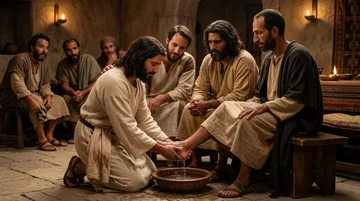
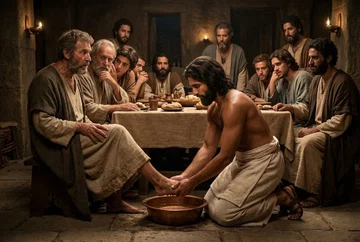
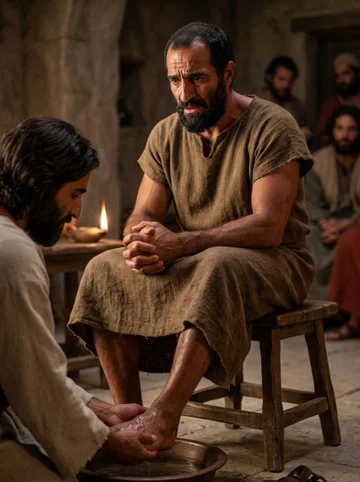
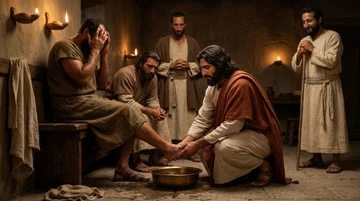
If I then, your Lord and Master, have washed your feet; ye also ought to wash one another’s feet.
Translations
If I then, your Lord and Master, have washed your feet; you also ought to wash one another’s feet.
King James Version, KJV Cambridge Paragraph Bible
If I then, your Lord and Master, have washed your feet; ye also ought to wash one another’s feet.
If I then, your Lord and Master, have washed your feet; ye also ought to wash one another's feet.
If I then, the Lord and the Master, have washed your feet, ye also ought to wash one another’ s feet.
If I then, the Lord and the Teacher, have washed your feet, ye also ought to wash one another’ s feet.
if then I did wash your feet — the Lord and the Teacher — ye also ought to wash one another's feet.
If I therefore, the Lord and the Teacher, have washed your feet, ye also ought to wash one another's feet;
If then, I, have washed your feet,—[I] The Lord, and, The Teacher, ye also, ought to wash, one another’s, feet;
Berean Standard Bible, Majority Standard Bible
So if I, your Lord and Teacher, have washed your feet, you also should wash one another’ s feet.
If I then, the Lord and the Teacher, have washed your feet, you also ought to wash one another’ s feet.
If then I, the Lord and the Master, have made your feet clean, it is right for you to make one another's feet clean.
If I then your Lord, and Master, haue washed your feete, ye also ought to wash one an others feete.
Douay-Rheims (Challoner revision)
If then I being your Lord and Master, have washed your feet; you also ought to wash one another’s feet.
Pictures
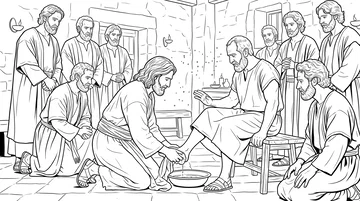
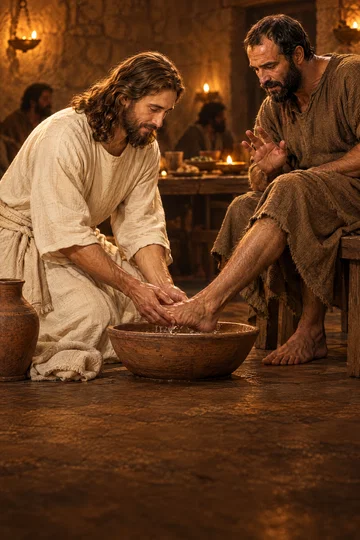
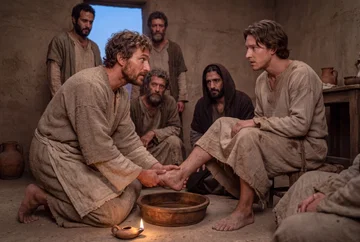
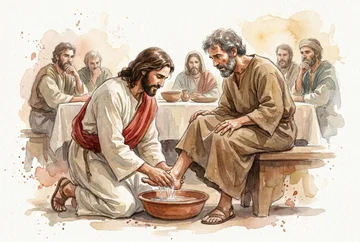
Cross-references 20 of 33
- Luke 22:24-27
And there was also a strife among them, which of them should be accounted the greatest.
Jesus answers the disciples’ dispute over greatness by teaching that true greatness is service.
- 1 Timothy 5:10
Well reported of for good works; if she have brought up children, if she have lodged strangers, if she have washed the saints’ feet, if she have relieved the afflicted, if she have diligently followed every good work.
Washing the saints’ feet is listed among a widow’s good works.
- John 13:8
Peter saith unto him, Thou shalt never wash my feet. Jesus answered him, If I wash thee not, thou hast no part with me.
Refusing Christ’s washing means having no part with him.
- Philippians 2:7
But made himself of no reputation, and took upon him the form of a servant, and was made in the likeness of men:
Christ humbled himself and took a servant’s form, reflecting the spirit shown in washing feet.
- John 13:4-5
He riseth from supper, and laid aside his garments; and took a towel, and girded himself.
Jesus washes the disciples’ feet as an example of humble service.
- John 13:7
Jesus answered and said unto him, What I do thou knowest not now; but thou shalt know hereafter.
The disciples do not yet understand the meaning of Jesus’ act, but will understand it later.
- Matthew 20:26-28
But it shall not be so among you: but whosoever will be great among you, let him be your minister;
Jesus teaches that greatness means serving others, as he came to serve.
- John 13:10
Jesus saith to him, He that is washed needeth not save to wash his feet, but is clean every whit: and ye are clean, but not all.
Those already washed need only their feet washed.
- Mark 10:45
For even the Son of man came not to be ministered unto, but to minister, and to give his life a ransom for many.
Christ came to serve rather than be served.
- Luke 7:38
And stood at his feet behind him weeping, and began to wash his feet with tears, and did wipe them with the hairs of her head, and kissed his feet, and anointed them with the ointment.
A woman washes Jesus’ feet with her tears and hair.
- Genesis 18:4
Let a little water, I pray you, be fetched, and wash your feet, and rest yourselves under the tree:
Abraham provides for guests to wash their feet, while Christ washes his disciples’ feet.
- Galatians 5:13
For, brethren, ye have been called unto liberty; only use not liberty for an occasion to the flesh, but by love serve one another.
Calls believers to serve one another in love, echoing Jesus’ example.
- Luke 22:27
For whether is greater, he that sitteth at meat, or he that serveth? is not he that sitteth at meat? but I am among you as he that serveth.
Jesus presents himself as one who serves.
- Luke 22:15
And he said unto them, With desire I have desired to eat this passover with you before I suffer:
The foot washing occurs at the Passover supper before Jesus suffers.
- John 13:2
And supper being ended, the devil having now put into the heart of Judas Iscariot, Simon’s son, to betray him;
Judas was present at the footwashing during the supper.
- Mark 9:35
And he sat down, and called the twelve, and saith unto them, If any man desire to be first, the same shall be last of all, and servant of all.
Jesus teaches that the greatest must serve all.
- Matthew 23:8
But be not ye called Rabbi: for one is your Master, even Christ; and all ye are brethren.
Believers are brethren under one Master, Christ.
- John 13:1
Now before the feast of the passover, when Jesus knew that his hour was come that he should depart out of this world unto the Father, having loved his own which were in the world, he loved them unto the end.
Love motivates Jesus’ act and frames his command.
- Matthew 10:24
The disciple is not above his master, nor the servant above his lord.
A servant is not greater than his Lord, supporting humble service.
- Luke 7:44
And he turned to the woman, and said unto Simon, Seest thou this woman? I entered into thine house, thou gavest me no water for my feet: but she hath washed my feet with tears, and wiped them with the hairs of her head.
Jesus contrasts customary hospitality foot-washing with the woman washing his feet.
Commentary part 1 of 2
Each commentary is drawn from primary sources: the writings of Ellen G. White and Adventist pioneers and periodicals. Each commentary is separate. Its own words are not a quotation; follow the references to read the source passages.
Ellen G. White
73 sources
On the night He was betrayed at His last supper with the disciples, their Lord though equal with God laid aside His garment and as a servant washed their feet, even the feet of His betrayer.Ms 19, 1897, par. 10Ms 54, 1897, par. 20–21DA 720.2DA 655.46MR 24.2–3 By saying they ought to do the same He gave a literal command and example to be believed and lived out, not as mere form, for no servant is greater than his Lord and those who know this are happy if they do it.Ms 139, 1902, par. 1Ms 19, 1897, par. 10Ms 35, 1897, par. 9–10Ms 2, 1859, par. 2–42MR 346.1–3 He thereby established foot washing as a continuing sacred ordinance of humility for His church in every country through all time, to be observed with the Lord's Supper as its preparation.Ms 35, 1897, par. 9–10Ms 19, 1892, par. 62Ms 33, 1892, par. 49SG3 225.2SCEV 37.1–2 In its observance Christ is sacredly present by His Holy Spirit to convict of sin, sweep away selfishness, soften and unite hearts, and bring mutual confession, forgiveness, reconciliation and unity before communion.Ms 35, 1897, par. 9–10Ms 19, 1897, par. 64–65Ms 19, 1892, par. 62Ms 33, 1892, par. 49RH Nov 4, 1902 It pledges believers to a life of humble loving ministry to one another and to all in need, including the erring and difficult, counting others better than self and serving without seeking honor or place.COS 107.4–108.32MR 59.1–33SP 84.2–4DA 651.2–4COS 109.1–3
Historical Setting
The command was given at the last Passover supper in the upper chamber on the last evening before death, on the night of betrayal, in the final week as preparation for coming suffering and separation, at the final gathering before the crucifixion.2MR 346.1–3Lt 336, 1906, par. 5–96MR 24.2–3Ms 113a, 1897, par. 15 It belonged to the last hours before the offering of Himself as a sacrifice for the world.6MR 24.2–3 It was instruction for the trial ahead.Lt 336, 1906, par. 5–9
The disciples came to that supper with selfish hearts heated by contention over who should be greatest, quarreling over honor and rank and position in the promised kingdom.GW92 245.3–246.26MR 24.2–3Ms 43, 1897, par. 24 Their whisperings were heard and their flushed faces seen, for they were stirred by Satan and argued even as the final lesson was given.GW92 245.3–246.26MR 24.2–34T 373.2 This lesson in humility and loving service was among the last given to them while they disputed who would be greatest.GW92 245.3–246.24T 373.2
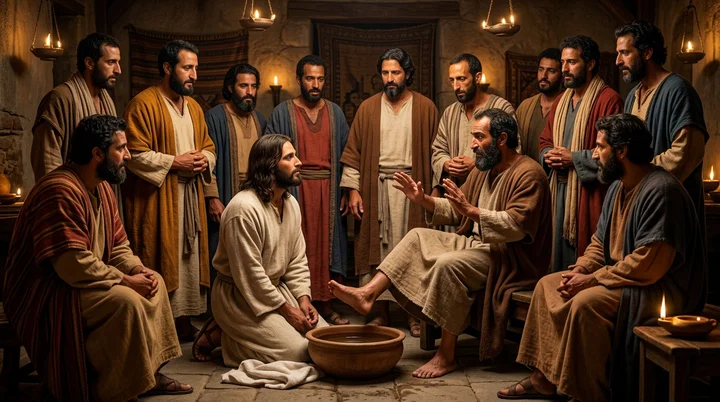
Without a word the Lord laid aside His outer garment and girded Himself with a towel as a servant and washed their feet to rebuke their strife and pride.6MR 24.2–3 The act opened their eyes and filled them with bitter shame and humiliation, showed them themselves in a new light, and left a memory kept as long as life lasted.6MR 24.2–3 Even Judas was washed and tenderly included, though he had already twice pledged to betray Him, and the feet that had been washed then went out to carry out the betrayal after refusal of that final appeal of love.DA 720.2DA 655.4Ms 120, 1897, par. 9
Words and Command
Though truly Master and Lord, One equal with God, He stooped to perform this menial lowly service for His disciples.Ms 19, 1897, par. 10Ms 43, 1897, par. 1–4Ms 54, 1897, par. 20–21DA 649.2 His exalted position did not diminish His dignity but gave grace and significance to the lowly act.Ms 54, 1897, par. 20–21DA 649.2 By it He makes Himself one with people of every rank and condition, showing that no one is too exalted to perform humble service.Ms 43, 1897, par. 1–4Ms 54, 1897, par. 20–21DA 649.2 The words ye also ought make His act a literal example and command to do just as He did to them.Ms 19, 1897, par. 10Ms 35, 1897, par. 9–10Ms 2, 1859, par. 2–42MR 346.1–3 It is to be believed and lived out, and is part of God's plainly outlined will for ministers to believe and live before fellow ministers.Ms 139, 1902, par. 1Ms 19, 1897, par. 10Lt 16j, 1892, par. 3 It is not to be treated in a mechanical way or as a mere form, but as an ordinance whose real object is to teach humility.Ms 19, 1897, par. 10 Because He did this, followers ought to wash one another's feet, bringing His words to remembrance on every such occasion.Ms 35, 1897, par. 9–10Ms 2, 1859, par. 2–42MR 346.1–3 The teaching in John 13-17 requires careful study and earnest practice, for neglecting it fails to honor God and Christ and withholds witness of His love.Lt 16j, 1892, par. 3
No servant is greater than his Lord, so servants are called to do as He did.Ms 19, 1897, par. 10RH Nov 4, 1902 Those who know these things are happy if they do them, and doing what He taught brings happiness.Ms 19, 1897, par. 10Ms 2, 1859, par. 2–42MR 346.1–3RH Nov 4, 1902DA 651.2–4 That happiness comes with the felt presence of the Lord in holy solemnity, melting the heart with gratitude and love.2MR 346.1–3 The simple rite carries a meaning that may not be readily seen or appreciated.Ms 14, 1895, par. 1–2DA 650.2–3 It was more than ordinary hospitality and more than the customary washing of dusty feet for guests and travelers.DA 650.2–3Ms 8, 1897, par. 10 It was more than a single outward act of cleansing, teaching how followers are to treat one another and to be like Christ in their dealings with each other.2MR 59.1–3Ms 43, 1897, par. 1–4
Ordinance and Communion
John 13:14 establishes foot washing as a continuing sacred ordinance of humility and unselfish ministry for all who believe, to be repeated by followers in every country and through all time as a standing ordinance for the whole church.Ms 35, 1897, par. 9–10SG3 225.2SCEV 37.1–2Ms 43, 1897, par. 24Lt 79, 1874, par. 7 It is to be kept in as exact following of the Lord's example as possible in obedience to the command to do as He did, to keep His people humble and separate from the world and from backsliding.SG3 225.2SCEV 37.1–2 The duty applies without exception and is not to be deferred because someone is counted unworthy, for even Judas was washed and given a place at the table.Ms 35, 1897, par. 11–12
The ordinance comes before the partaking of the emblems of Christ's death and is connected with the supper as preparation for commemorating His sufferings and death.Ms 19, 1892, par. 62Ms 33, 1892, par. 49SG3 225.2Ms 8, 1897, par. 10Ms 5, 1859, par. 1–2 It is to be kept together with the sacramental service of bread and cup, practiced frequently among believers, at the quarterly meeting and in Sabbath afternoon worship recalling the circumstances of its institution.Ms 5, 1859, par. 1–26MR 22.2Ms 180, 1898, par. 1 A congregation follows the example by washing one another's feet before partaking of the Lord's supper.Ms 19, 1892, par. 62Ms 33, 1892, par. 49Ms 5, 1859, par. 1–2
Joined with the supper it takes the place of the national Passover festival as a memorial service.Ms 43, 1897, par. 24 As Christ ate the Passover with His disciples He ended the sacrifices offered for four thousand years by presenting Himself, the pure spotless Lamb of God, as a sin offering.Ms 43, 1897, par. 24 It discharges believers from the cares and burdens of the ancient Jewish rites and ceremonies, which no longer possess any virtue because type meets antitype in Christ Himself as the authority and foundation of those ordinances and the great and only efficacious offering for the sins of the world, so that to continue them after the reception of the Gospel is without force and an insult to Jehovah.Ms 19, 1897, par. 18–19
It was Christ's last established ordinance in connection with the last supper, left because the disciples needed it for the heart and the moral and spiritual nature rather than the intellect.Ms 19, 1897, par. 18–19 It was ordained for a purpose to keep the humiliation of Christ and His example of humility before His followers, to call the Lord Jesus to mind and not be a mere form.Ms 35, 1897, par. 15Ms 35, 1897, par. 14 Keeping the ordinance pleases God, rebukes pride, and teaches and honors simplicity and humility in His children, encouraging humility and keeping hearts humble and tender toward one another.6MR 22.2Ms 35, 1897, par. 15
Christ delegated His power for it to His ministers, who are to superintend its observance to the close of time.Ms 35, 1897, par. 14 At His own appointments He meets with His people by His personal presence and energizes them.Ms 35, 1897, par. 14 He works on human hearts there even when the hearts and hands administering the ordinance are unsanctified.Ms 35, 1897, par. 14
Presence and Spiritual Work
God is sacredly near on every such occasion of foot-washing, and those who come are to bring His words to remembrance.Ms 35, 1897, par. 9–10Ms 35, 1897, par. 13 Christ is present by His Holy Spirit, with messengers from the throne listening to confession and forgiveness, while unseen witnesses including watching angels are present and the atmosphere of heaven surrounds the believers with holy solemnity to impress hearts.Ms 19, 1897, par. 64–65RH Nov 4, 190220MR 149.2–4 Doing this service puts believers in Christ's place and brings them into close relationship with the Lord, who is present on the occasion as witness.Ms 19, 1897, par. 64–65Ms 35, 1897, par. 13
The Holy Spirit is present to witness to and seal the ordinance, impress hearts and sweep away selfishness, so that striving for the highest place appears insignificant.Ms 19, 1897, par. 64–65RH Nov 4, 1902Ms 35, 1897, par. 13 He quickens the sensibilities of those who obey, turns their thoughts into spiritual channels, brings conviction to hearts and remembrance of committed sins with new distinctness, breaks up the fountains of the soul, energizes the mind, and breaks down every barrier of disunion and alienation.RH Nov 4, 1902 He convicts and softens hearts, unites believers, helps clear away what separates them, reveals the character of God the Father, awakens to the lessons symbolized, leads each participant to feel the pulse of conscience and bring penitential offerings, and guides every willing soul into all truth.Ms 19, 1897, par. 64–65Ms 19, 1897, par. 18–19Ms 35, 1897, par. 13
In the ordinance believers in spirit pass through the garden consecrated by the agony of Him who bore the sins of the world and witness the struggle by which reconciliation with God was obtained.RH Nov 4, 1902 The washing becomes a prayer that the feet washed may run in the way of God's commandments the whole length of the Christian road to stand on Mount Zion and walk the streets of gold.2MR 346.1–3 The washing is followed by partaking of communion in remembrance of the sufferings of the Saviour who paid a dear price to ransom sinners from the power of Satan and hopeless misery.2MR 346.1–3RH Nov 4, 1902
When rightly celebrated the service brings God's children into holy relationship to help and bless each other, and its meaning goes beyond the single outward act of cleansing to make the entire life one of humble, faithful ministry like Christ in dealing with one another.Ms 43, 1897, par. 1–4Ms 19, 1897, par. 64–65 Eating His body and drinking His blood belongs not merely to the sacramental service but to daily partaking of the bread of life that alone satisfies soul-hunger, by receiving His Word and doing His will.Ms 19, 1897, par. 18–19
Reconciliation Before Communion
The observance before the supper is a time to quiet controversy and controversies, to forgive injuries, to settle difficulties, and to put away malice and hatred and cherish neither.Ms 19, 1892, par. 62Ms 33, 1892, par. 49RH Nov 4, 190221MR 119.3 It clears away misunderstandings and breaks down every barrier of disunion and alienation, calling away from self-importance and pursuit of status toward service that brings humility and reconciliation.DA 650.4–651.1RH Nov 4, 1902 It was instituted for reconciliation one with another, so that those who gather at the communion table meet as equals, whatever their status or learning, as people purchased by Christ's blood.Ms 19, 1892, par. 62Ms 33, 1892, par. 49RH Nov 4, 190221MR 119.3
It is a test of humility and faithfulness and of loyalty, not merely customary washing of dusty feet for guests or travelers, and a season of self-examination to learn the true feelings of the heart toward God and one another.1SP 201.2–202.1SG3 225.2Ms 8, 1897, par. 10 In engaging in the humble duty pride and selfishness and hatred are brought to light and exposed.1SP 201.2–202.1SG3 225.2DA 650.4–651.1Ms 50, 1890, par. 12–13 It confronts the disposition to esteem self more highly than brother, to work and serve for self, to seek the highest place, and to harbor evil surmisings and bitterness of spirit over trifles, bringing man out of selfishness and down from self-exaltation into humility of spirit that will wash a brother's feet.Ms 35, 1897, par. 11–12
It is designed to bring mutual confessions and confession, increased forbearance and patience, forgiveness of one another's errors, and true love after the pattern of the love that died for disciples.1SP 201.2–202.1SG3 225.2DA 650.4–651.1 Its purpose is to teach humility and to bring believers together in unity by assimilating their hearts in oneness with Christ and fellowship with Him.DA 650.4–651.1Ms 75, 1898, par. 30–32 Remembering the humiliation leads to self-examination, confession, forgiveness, and unity among believers.DA 650.4–651.1
By recalling that humiliation, striving for the highest place and offense at brethren seeking it appear insignificant, and disputing gives way to shame.DA 650.2–3RH Nov 4, 1902 Each is corrected from desire for honor and rank and learns to regard the others as better than himself and to count others better than self.RH Nov 4, 1902ST May 23, 1878Ms 35, 1897, par. 11–12 So those who come together do so as equals purchased by Christ's blood, with pride, rivalry, and estrangement removed so the heart can enter fellowship with Him and receive the communion.Ms 19, 1892, par. 62Ms 33, 1892, par. 49DA 650.2–3
Neglect of its lesson leaves pride and self-sufficiency, evil thinking and speaking, contention and strife, scheming, faultfinding and criticizing.Ms 75, 1898, par. 30–32 Continued gossip, accusation, unkind talk, passing judgment, and self-assured conversation hurt souls and spoil God's work, and until cleansing by the Holy Spirit comes such counsels prove a detriment, becoming a savor of death unto death instead of a savor of life unto life, a handling of strange fire.Lt 264, 1902, par. 11 Neglect fails to honor God and withholds from the world a witness to His love, while the teaching lived out in practical life is the remedy and cure for dissension that fosters unity with one another and with Christ.Lt 16j, 1892, par. 321MR 346.1–3Lt 131, 1900, par. 1–3 Receiving its lesson softens and subdues the heart by grace, renews and sanctifies the energies, cleanses defilement, and turns believers from evil work against their brethren to good work for them in love.Lt 264, 1902, par. 11Ms 75, 1898, par. 30–32
Humble Service to Others
Because their Lord and Master stooped to wash their feet, His followers ought to wash one another's feet in the same humble loving spirit, serving one another rather than quarreling over honor or position and counting others better than themselves.COS 107.4–108.33SP 84.2–45RED 5.2–3Ms 115, 1902, par. 1–4 His act is more than a single outward cleansing, for it teaches how they are to treat one another, bringing them into holy relationship to help and bless each other through His grace and making the whole life one of humble faithful ministry.2MR 59.1–3Ms 43, 1897, par. 1–4 The command counters the selfishness dwelling in the natural heart, and when rightly understood and practiced it calls each person to be willing to help others.COS 107.4–108.3Ms 43, 1897, par. 1–4
That example rebukes pride, selfishness, self-importance and self-exaltation, and disputes over who is greatest and desire for honor and the highest place.COS 107.4–108.3Ms 102, 1904, par. 4–7Ms 115, 1902, par. 1–4Ms 8, 1897, par. 8–9 Those who serve as leaders must not seek to be first, but should walk humbly before God remembering what He has done through His Son, being pure, clean and consecrated in thought, spirit and practice.Ms 102, 1904, par. 4–7Lt 117, 1897, par. 8–10GW92 245.3–246.2 Wealth and status are no reason to be ashamed of serving, for One equal with God did not consider the lowly service beneath Him.Ms 43, 1897, par. 1–4GW92 245.3–246.2
The rite pledges those who take part to unselfish ministry, not only to fellow believers but to all who need help, following a life spent in helping and saving the needy and sinful.DA 651.2–4COS 109.1–3 True discipleship is not established by profession alone, for humble loving service kindles love in the heart and helps people understand His teaching, and doing what is known of this lesson brings happiness.DA 651.2–4Ms 54, 1897, par. 8–9
That service includes patient care for those at fault, the erring and sinful, and people who seem especially difficult and perverse, rather than rejection or discouragement.DA 655.4MH 493.3–4 Jesus washed the feet of Judas even though He knew Judas had already twice pledged to betray Him, tenderly including him and bearing with him as a final appeal of love offering the sinner opportunity to repent and be cleansed.DA 720.2DA 655.420MR 149.2–4 Those feet then went out to carry out the betrayal, and refusal of that appeal left his case decided.DA 720.2 Followers must not carelessly withdraw from someone in error and leave that person exposed to temptation, for the disciples' need for correction did not prevent Christ from serving them, and all but Judas were brought to repentance.DA 655.4 The duty applies without exception and must not be deferred because someone is considered unworthy, since human beings cannot read hearts or distinguish tares from wheat.20MR 149.2–4Ms 35, 1897, par. 11–12
The ordinance thus keeps fresh in remembrance that redemption is received upon conditions of humility and continual obedience, testing humility and faithfulness and pleasing God while teaching and honoring simplicity and humility.1SP 201.2–202.1SG3 225.26MR 22.2
Faithful Observance in Practice
The washing of feet and the sharing of bread and cup belong together apart by themselves among believers alone, separate from unbelievers and the wicked, lest reproach come upon the cause of God.Ms 14, 1850, par. 4–612MR 247.1–2 Shepherds are to keep both ordinances carefully and understandingly after the pattern of Christ taking His disciples away by themselves.Ms 14, 1850, par. 4–612MR 247.1–2 Even in private observance a Judas may at times appear and eat and drink to his own damnation, until God quickly makes him manifest and purges him out.Ms 14, 1850, par. 4–6
No one professing to be a Christian is to be excluded as unworthy, nor is the duty to be deferred on that ground, for Christ washed the feet of Judas and left him a place at the table knowing he would betray Him.20MR 149.2–4Ms 35, 1897, par. 11–12 Human beings cannot read the secrets of the soul nor distinguish tares from wheat, so all are to take part in the shared act.20MR 149.2–4Ms 35, 1897, par. 11–12Ms 6, 1859, par. 34 Unseen witnesses, including heavenly angels, are present at the service.20MR 149.2–4
Men and women observe separately, for a woman's feet are to be washed by a sister and a man has no business washing a woman's feet.Ms 131a, 1906, par. 11–135MR 192.1–3 Insisting on doing so by claimed divine direction is rejected.Ms 131a, 1906, par. 11–13 Sisters washing the feet of brethren is according to gospel order, glorifying God and humbling the doer when God lays that cross upon them, while for brethren to wash sisters' feet there is no biblical example.SCEV 37.1–2EW 95.2–96.1Lt 9, 1853, par. 7
The duty is to be performed judiciously, understandingly and thoughtfully, never made a tedious ceremony nor treated mechanically or as mere form, since its real object is to teach humility.Ms 19, 1897, par. 10SCEV 37.1–2EW 95.2–96.1Lt 9, 1853, par. 7 It is to be introduced into new places with carefulness and wisdom at a proper time and manner where people are uninformed about the Lord's example and teaching or are prejudiced against it through former teachers, lest messengers bring confusion.SCEV 37.1–2EW 95.2–96.1Lt 9, 1853, par. 7 Participation in feet washing was not treated as a required condition for partaking of communion.Lt 23a, 1893, par. 27–29 It is a standing ordinance for the whole church in large numbers, including youth and those just beginning to follow, belonging with solemn seasons of seeking the Lord and revival, where large united participation brings impressive influence, shows humility and intelligence, and marks right character and settling firmly into the work.Lt 79, 1874, par. 7
It is part of God's plainly outlined will for ministers to believe its teaching and live it out before fellow ministers, and especially gospel ministers ought to follow the servant example of their Lord and Master.Ms 139, 1902, par. 1GW92 245.3–246.2 The teaching of John 13-17 requires careful study and earnest practice, for neglecting it fails to honor God and Christ and withholds from the world a witness to God's love.Lt 16j, 1892, par. 3 That instruction is presented as the remedy and cure for dissension, fostering unity with one another and with Christ.21MR 346.1–3Lt 131, 1900, par. 1–34T 373.2
Washing the saints' feet is joined with the salutation of the saints, which those who have not believed in it should come into and practice.Lt 8, 1851, par. 19–22
Practicing this mutual service marks the faithful as people loved by God, a sealed perfectly united people in a happy holy state whose mutual love is shown also in the holy kiss.RH Jul 21, 18511T 59.1–2CET 58.2 When the wicked rage to imprison them and fall helpless, this fellowship is the evidence by which opposers know that God has loved them.RH Jul 21, 1851 Knowing and doing it brings happiness with new power and the felt presence of the Lord with holy solemnity, melting the heart and overflowing it with gratitude and love, renewing awareness of the Saviour, turning distress to peace and rejoicing, and bringing deep gratification.2MR 346.1–3Ms 6, 1859, par. 3–4 It gives humility and shared spiritual fellowship before God, advances spiritual work, and becomes a prayer that the feet washed may run in the way of God's commandments the whole length of the Christian road to stand on Mount Zion and walk the streets of gold, followed by communion in remembrance of the dear price paid to ransom sinners from Satan and hopeless misery.2MR 346.1–37MR 218.1
Sources
Pioneers and periodicals
270 sources
Jesus commands his followers to literally wash one another's feet with water, following his own act as Lord and Master as a binding example and continuing ordinance for all Christians.RH Apr 22, 1862ST Aug 5, 1886ST Sep 9, 1886 The duty is mutual and reciprocal among believers together, and it cannot be fulfilled by substituting some other humble service or by treating it only as a lesson to contemplate.ST Aug 5, 1886ST Sep 9, 1886RH Apr 22, 1862ST Jul 15, 1880 Because he humbled himself to serve them, his followers are to serve one another humbly in the same way, rejecting pride and rivalry and standing as equals under one Master.ST Aug 28, 1879ST May 13, 1889ST Jan 10, 1900RH Feb 24, 1859ST Mar 30, 1904 It is observed as a preparatory service immediately before the Lord's Supper, humbling participants, removing discord and pride, and bringing confession, forgiveness, unity and readiness to partake of the bread and wine.CO 43.4–5CO 45.1–2RH Jun 23, 1910ST Oct 5, 1882 Those who know these things and do them are blessed and happy, while willful refusal shows a heart out of harmony with God.ST May 13, 1889ST Oct 31, 1878ST Feb 22, 1910RH May 18, 1869
Words and Historical Setting
The word ought in the verse expresses binding duty and obligation owed to one another and to Christ, as strongly as must, leaving no room for excuses or dispute over words.ST Jul 15, 1886RH Jun 16, 1863ST Jul 8, 1880 It binds obedient children as fully as a parent's instruction to a son and as strongly as the charges to obey God and to love one another, calling for active exercise rather than dormant feeling.RH Jun 16, 1863ST Jul 8, 1880 It means what is fitting and necessary and what should be done, not an optional practice to omit when inconvenient, and it is the same duty as laying down lives for the brethren when called to do so.ST Aug 10, 1882ST Jun 18, 1896 It illustrates the kind of clear command that would be needed to establish an obligation, and must be taken as written and practiced in life because Jesus knew what was best.RH Jun 16, 1863ST Jul 8, 1880
The word for example means a pattern or copy to be imitated exactly as a pupil copies writing, and master means teacher.RH Jul 21, 1868ST Mar 29, 1899 The plea that the servant is not greater than his Lord means that if the Lord does this humble act the followers should do it, and doing as the Master did is to be esteemed a great honor.RH Jul 21, 1868ST Mar 29, 1899 An example is something to be imitated, and an outward action is not imitated by mental or verbal agreement that it is right.ST Mar 29, 1899
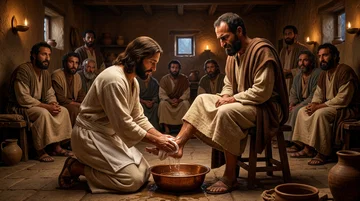
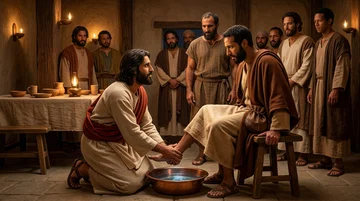
Though Lord and Master with all things given into his hands by the Father, knowing he came from God and went to God, Jesus rose from supper, laid aside his garments, girded himself with a towel, poured water into a basin, and washed and wiped the disciples' feet.RH Nov 4, 1902ST Feb 11, 1897 His act is given as an example that they should do as he did to them, making humble service the duty and true relationship between him and his disciples.ST Feb 11, 1897
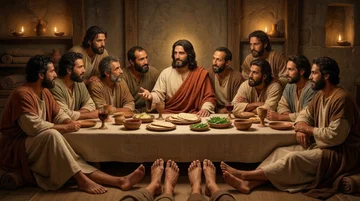
The account belongs to Jesus' Passover supper with his disciples on the proper day and time, the same evening as the Passover meal and the institution of the Lord's Supper.RH Aug 19, 1858ST Apr 2, 1912ST Nov 4, 1897 John alone among the evangelists records its institution, presenting a full account of the introduction of this Christian institution.STST Apr 20, 1915 John 13:1-30 stands as a parallel account of the meal Jesus shared with his disciples before his death, alongside the Gospel accounts in Matthew, Mark, and Luke and Paul's instructions about the Lord's Supper.ST May 12, 1898
The washing came before Jesus blessed and gave the bread and wine, during or near the beginning of the supper and not after the meal was entirely finished.CO 45.1–2ST Nov 15, 1883ST Feb 4, 1903 It was spoken at the beginning of the meal at virtually the last Passover ever celebrated when type met antitype in the slaying of the Lamb of God, with Jesus troubled in spirit spending the few quiet hours before Gethsemane for their benefit.ST Nov 15, 1883ST Oct 24, 1900 The washing took place after the Passover supper was ended but before the bread and wine of the Lord's Supper, and his words about a betrayer, recorded after the washing in John, place these ordinances in that order.CO 45.1–2RH Jul 21, 1868 One observance placed it after sunset when the Sabbath ended in imitation of the supper Christ instituted.RH Feb 12, 1857
The disciples had taken a full bath before the Passover supper, and one who has bathed is already clean yet still needs the feet washed in the act's intended sense.ST Jul 12, 1905ST Feb 7, 1884 This shows the washing was not for physical cleansing, nor is its importance less than partaking of the bread and wine.ST Feb 7, 1884
Though the disciples' rivalry gave the act its immediate occasion, it was given not only in response to strife but to prevent strife and keep their Lord in mind.ST Oct 5, 1882ST Oct 24, 1900 After three and one-half years of teaching meekness they still disputed who should be greatest and criticized one another to disqualify rivals, with selfishness and discord standing against the humility and unity needed for faithful service.ST Oct 5, 1882RH Feb 10, 1916ST May 18, 1904 Their rivalry over who would be greatest and their concern for places of honor at the table prompted Jesus to wash their feet and establish this practice, and the foot washing came right after their eager strife over greatness to rebuke worldly ambition for exaltation and chief positions.ST May 18, 1904ST May 21, 1896 Those coming into the church in after times, especially in the falling away of the last days, need it as well.ST Oct 24, 1900
Judas remained with Jesus and the disciples through the supper, dispute, and foot-washing.ST Jul 12, 1905 Jesus stooped to serve them and even washed the traitor's feet, beginning with Judas first, when the apostles because of ill feeling toward one another refused to do it.RH Nov 6, 1900RH Nov 20, 1913RH Jun 23, 1910 Though the glorious Son of God took the humble place of a servant, Judas later rebelled and gave himself over to Satan and left with sins unconfessed, sealing his doom.RH Jun 23, 1910RH Jan 4, 1906
The washing had no connection with physical uncleanness or need or failure of hospitality.RH Apr 22, 1862RH Feb 24, 1859ST Feb 7, 1884 Hosts did not wash guests' feet; the custom was to provide water for guests to wash their own feet, whereas Jesus himself washed theirs, so his act was not ordinary hospitality.RH Apr 22, 1862ST Feb 7, 1884 At that supper there was nothing to call for hospitality, since the disciples had shown no inhospitality and were themselves in no need of hospitality, so making the foot-washing a lesson of hospitality turns it into a strange digression from the events then transpiring.RH Feb 24, 1859 Christ's example in the circumstances defines what the washing was meant to teach, including humility and equality among believers.ST May 13, 1889RH Feb 24, 1859RH Jun 16, 1868
Literal Mutual Command
The verse lays a plain duty on followers to wash one another's feet in the literal act, taking the Lord and Master's own washing as the pattern to be practiced and continued as a church ordinance contained in Scripture by both example and precept, binding on all Christians and not on the apostles alone, and not to be reduced to a lesson in humility or hospitality to be understood or contemplated without doing.RH Apr 22, 1862ST Aug 5, 1886ST Sep 9, 1886RH Jul 28, 1863 The command is expressly given in Scripture and stands against neglect grounded in tradition, to be obeyed to the letter by doing exactly as Christ did, as with baptism, the Sabbath, the holy kiss, and anointing the sick, since humility is not learned by treating the act only as a lesson and never performing it.RH Jun 27, 1878RH May 16, 1854ST Mar 3, 1881 It does not teach hospitality or bodily cleansing, and what the washing was meant to teach, including humility and equality among believers, is defined by Christ's example in the circumstances in which he performed it.RH Feb 24, 1859RH Jun 16, 1868ST Feb 7, 1884RH Feb 24, 1859RH Jun 27, 1878 That ordinance expresses humble, loving service and true fellowship in Christ rather than ordinary hospitality, and one who has bathed is already clean yet still needs the feet washed in the act's intended sense, showing the washing was not for physical cleansing.ST Feb 20, 1901ST Feb 7, 1884RH Jun 27, 1878
The command cannot be satisfied by substituting some other humble act, for general humility, help, hospitality, service to the weak, boot-blacking, washing feet at home for cleanliness, admiring the lesson, or serving the poor, sick, or needy in other ways does not replace washing one another's feet together, and the command requires the specific literal act of washing with water itself done as he did.ST Aug 5, 1886ST Sep 9, 1886ST Sep 9, 1886ST Sep 9, 1886RH May 3, 1864 The duty is mutual and reciprocal among believers, not a one-sided act by clergy for believers nor a ceremony restricted to beggars, penitents, or another select class, since he washed the feet of all his disciples and connected the ordinance with the last supper, calling for mutual service.RH Apr 22, 1862ST Jul 15, 1880 Men ought to wash their brothers' feet and women their sisters' feet, each group by itself in separate divisions with carefulness, circumspection, decorum, decency and order, and a dainty application of a little water, a one-sided annual ceremony, washing only one foot of chosen persons with wiping and kissing, or blacking boots does not fulfill the reciprocal washing where believers wash one another's feet.ST Jun 13, 1900ST Jul 15, 1880ST Mar 30, 1904ST Sep 9, 1886 The instruction applies where several believers are together to observe the ordinance and cannot be carried out by one person alone, being a personal duty that another cannot perform by proxy, as no one can partake of the Supper for another or supply another's spiritual needs.RH Sep 25, 1856RH Feb 6, 1879
The described washing was a real transaction rather than merely a spiritual idea, an emblem of humility in which participants first wash themselves physically, then meet decently and in order, laying aside garments, girding with a towel, kneeling, asking permission, removing shoes, washing and wiping with singing, treating each other as equals regardless of wealth or learning, with basins, towels, buckets and water ready and kept quietly without confusion.ST Jan 3, 1884RH Nov 4, 1902ST Oct 31, 1878RH Mar 11, 1909RH Jul 22, 1909 The verse extends beyond foot washing to all service for one another that this act represents, and is a token of humility and brotherly love within the church belonging with the other things he instituted and taught followers to observe.ST Jul 26, 1883ST Mar 9, 1888 By contrast, those who held the other view taught that the example was an admonition for selfish rivalry over greatness, not a command to make footwashing a required part of the Lord's Supper, to be followed when similar strife arises.RH May 3, 1864
Humility Equality and Service
Because their Lord and Master humbled himself to wash their feet, followers are bound to serve one another humbly in the same way in self-denying, loving service, with humility necessary to discipleship.ST May 13, 1889ST Jan 10, 1900ST Mar 29, 1899ST Apr 19, 1905RH Jul 24, 1856 That obligation makes humble service the duty and true relation between him and his disciples, calling for no less humility than his own and rejecting pride and self-exaltation.ST Aug 28, 1879ST May 13, 1889 Even in sorrow and suffering his stooping to serve teaches self-forgetful love, and happiness comes from doing what was taught.ST Aug 28, 1879ST May 13, 1889
He stands as the perfect Pattern whose act is to be imitated in practice and not as mere theory or sentiment.RH Sep 1, 1868ST Jun 7, 1899RH Apr 1, 1858 In taking the place and form of a servant to wash his lowly companions' feet he emptied himself of rights and power, did not seek high estate, and established humility and esteeming others above self while rebuking ambition to be greatest.RH Sep 1, 1868ST Jun 7, 1899ST May 21, 1896 That humble, loving service is the pattern for washing one another's feet, an act of humility also to be performed for one another.RH Apr 1, 1858ST Jun 4, 1885 True greatness and authority are measured by such service.RH Aug 19, 1902
In answer to rivalry over who would be most honored, followers are to stop seeking rank and count others better than themselves.ST Feb 11, 1897 Humility and love for others bring strength and true dignity, while self-exaltation and pride bring weakness and discontent.ST Feb 11, 1897 In his kingdom greatness is measured by willing service even in the lowliest task when needed, and believers are equal as siblings under one Father and servants under one Master.ST Mar 30, 1904 Practiced in its true spirit the ordinance prevents caste and orders, since he alone is Master and all are brethren, bringing humble equal fellowship without castes, classes or walls of separation as members of one body who care for one another.ST Feb 20, 1901 It opposes pride, rivalry for superiority, and ranks or classes setting some over others, and human pride is no reason to abandon it; it is not for physical cleanliness but an emblem pointing back to what the Saviour did, developing humility and contrition and willingness to regard each other as equals and take a servant's place over social distinctions.ST Mar 30, 1904RH Jun 27, 1878 It is a beautiful example and express instruction for mutual care promoting harmony, with humility and equality among believers as its associated lessons and not merely hospitality suited to ancient customs.RH Feb 24, 1859RH May 16, 1871
That rule that followers must serve one another forbids claims of supremacy and stands opposite to chattelism, so no one is to enslave another or despise labor and the laborer.RH Oct 8, 1861 His washing embodies self-bestowing ministering service in the spirit of towel and basin and cool refreshing water, which tests every action and marks sonship in his kingdom.ST Mar 10, 1909 Credited service is measured by self-giving not outward alms, and forgetting this loses inspiration, growth and blessed exaltation, while learning and doing the lesson brings an open heart comprehending truth, the secret of divine immortal youth and infinite renewing of life, for the glory is in the doing.ST Mar 10, 1909
Humility is not thinking poorly of oneself, for he knew he was Lord and Master yet willingly took a low place in menial service, showing knowledge of character and abilities to be compatible with humility when willing to serve.ST Jan 1, 1885 No Christian is above any honest necessary work however lowly within strength and ability, and learning to fill a low place and proving faithful in lowly work fits one to fill a high place, since a servant is not above his Lord.ST Nov 17, 1881 His washing at the final gathering before the crucifixion makes humble service an honor and the pattern preparing for greater duties, to be copied rather than seeking greatness or exalting self, governing temper and conduct in patience and death to self.RH Mar 13, 1913ST Oct 25, 1883
His act sets the example of humble service and mutual love by which love for one another marks his disciples.RH Aug 17, 1869 It expresses humble loving care and tender concern and kindly treatment toward one another, and the oneness and tender self-giving care between him and his church in lowly service.RH Aug 17, 1869RH Mar 24, 1910ST Jun 3, 1913 Though the gulf between his divine greatness and their standing was vast, he washed all including Judas, teaching that particular friendships need not lead to exclusion or superiority and that love reaches beyond close companions.ST His patience toward Judas teaches bearing with fellow believers whose character is perverse, as he bore with them.ST Feb 9, 1915 He acted in humility while Judas experienced it as humiliation, showing pride turns service into an imposed affront but humility serves from a willing servant-hearted spirit.RH May 30, 1912
That serving mind is Christianity, the mind he wanted the disciples to have and wants all followers in all ages to have.ST May 21, 1896 This course overcomes the world, and those who continue with him in it will receive a prepared kingdom and a table therein, which makes worthwhile its temporary hardness, given right after eager strife over greatness to rebuke worldly ambition for exaltation and chief positions.ST May 21, 1896 God set the example of service before calling men to service, for he served in the household before ministry, gave his life as sacrifice upon the altar of service, and actually and personally served his immediate companions, so his whole life was service and he does not ask what he himself was unwilling to do.ST Apr 30, 1902 Serving as the Master served means coming as servants not as princes, with personal ambition set aside in the everyday opportunities and needs nearest at hand, growing as faithfully followed where he leads.RH Aug 11, 1910
That example calls missionaries to serve rather than act as lords, treating those served as brothers and identifying with them as far as reasonably possible, including adapting to their way of life when it poses no serious risk to health.ST Oct 15, 1894 It calls followers to make their work tender and loving even in lowly tasks, stooping to serve as he stooped.ST Oct 15, 1894RH Nov 18, 1902 The true spirit is not pride in performing a rite but love expressed in willing service, applying to ordinary menial duties and helping those in need, including caring for the sick, doing household tasks, teaching patiently, and kindly helping a fellow believer who is doing wrong.RH May 30, 1912 To do good to fellow believers and care for them with love is to serve him himself, as though they were his feet.RH Jun 26, 1860 That humble service should include strangers and lonely people at communion, seeking them out and waiting upon them as lovingly as a dear friend instead of ignoring them, bringing peace and rejoicing to both, as a holy ordinance expressing love and bringing edification and strength.RH Aug 4, 1863ST Jan 11, 1905 It is acted out when a Spaniard stoops to wash the feet of his American brother in humble fellowship, practiced in celebrating the Supper as mutual service accompanying commemoration of dying love.RH Jun 8, 1905RH Dec 8, 1863
Sources