Psalms 115:17
The dead praise not the LORD, neither any that go down into silence.
Translations
American King James Version, King James Version, Webster Bible
The dead praise not the LORD, neither any that go down into silence.
The dead praise not the Lord,
Neither any that go down into silence.The dead praise not the LORD, neither any that go down into silence;
The dead praise not Jehovah,
Neither any that go down into silence;The dead praise not Jah, Nor any going down to silence.
The dead praise not Jah, neither any that go down into silence;
The dead, cannot praise Yah, nor any that go down into silence;
Berean Standard Bible, Majority Standard Bible
It is not the dead who praise the LORD,
nor any who descend into silence.The dead don’t praise the LORD,
nor any who go down into silence,The dead do not give praise to the Lord; or those who go down to the underworld.
The dead prayse not the Lord, neither any that goe downe into the place of silence.
Douay-Rheims (Challoner revision)
The dead shall not praise thee, O Lord: nor any of them that go down to hell.
Pictures
Cross-references 20 of 72
- Ecclesiastes 9:5
For the living know that they shall die: but the dead know not any thing, neither have they any more a reward; for the memory of them is forgotten.
Both say the dead know nothing.
- Psalms 146:4
His breath goeth forth, he returneth to his earth; in that very day his thoughts perish.
At death, a person’s thoughts perish.
- Psalms 6:5
For in death there is no remembrance of thee: in the grave who shall give thee thanks?
The dead do not remember or give thanks to God.
- Isaiah 38:18-19
For the grave cannot praise thee, death can not celebrate thee: they that go down into the pit cannot hope for thy truth.
Contrasts the dead, who cannot praise God, with the living who praise and tell of his truth.
- Ecclesiastes 9:10
Whatsoever thy hand findeth to do, do it with thy might; for there is no work, nor device, nor knowledge, nor wisdom, in the grave, whither thou goest.
Both describe the grave as a place without work or knowledge.
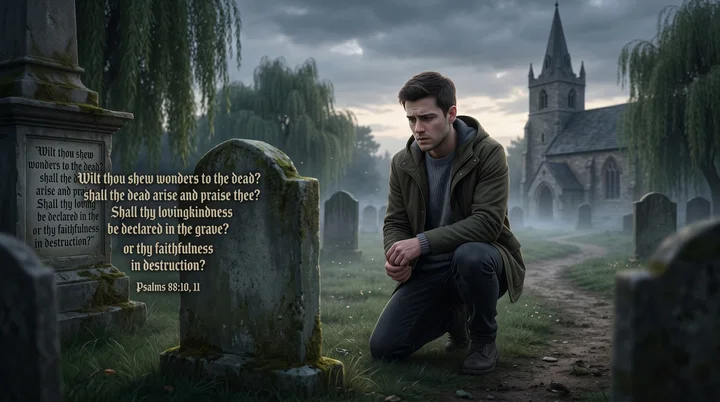
- Psalms 88:10-12
Wilt thou shew wonders to the dead? shall the dead arise and praise thee? Selah.
Asks whether the dead praise God or declare his faithfulness in sheol.
- Job 14:12
So man lieth down, and riseth not: till the heavens be no more, they shall not awake, nor be raised out of their sleep.
The dead lie asleep and do not awake until the heavens are no more.
- Acts 2:34
For David is not ascended into the heavens: but he saith himself, The LORD said unto my Lord, Sit thou on my right hand,
David is dead and buried and has not ascended to heaven.
- 1 Corinthians 15:18
Then they also which are fallen asleep in Christ are perished.
without resurrection the dead have perished
- Psalms 31:17
Let me not be ashamed, O LORD; for I have called upon thee: let the wicked be ashamed, and let them be silent in the grave.
Both describe the dead as silent in the grave.
- Job 14:21
His sons come to honour, and he knoweth it not; and they are brought low, but he perceiveth it not of them.
The dead are unaware of what happens to their children.
- 1 Thessalonians 4:16
For the Lord himself shall descend from heaven with a shout, with the voice of the archangel, and with the trump of God: and the dead in Christ shall rise first:
The dead in Christ rise when the Lord descends with God’s trumpet.
- Ecclesiastes 9:6
Also their love, and their hatred, and their envy, is now perished; neither have they any more a portion for ever in any thing that is done under the sun.
The dead have no further share in earthly affairs or emotions.
- Job 17:13-16
If I wait, the grave is mine house: I have made my bed in the darkness.
Describes the grave as the dead person’s home and their rest in the dust.
- 1 Corinthians 15:52
In a moment, in the twinkling of an eye, at the last trump: for the trumpet shall sound, and the dead shall be raised incorruptible, and we shall be changed.
The dead are raised at the last trumpet, when death’s silence ends.
- Acts 2:29
Men and brethren, let me freely speak unto you of the patriarch David, that he is both dead and buried, and his sepulchre is with us unto this day.
David is dead and buried, unlike Christ, who rose from the dead.
- Daniel 12:2
And many of them that sleep in the dust of the earth shall awake, some to everlasting life, and some to shame and everlasting contempt.
Describes the dead as sleeping in the dust until they awake.
- Psalms 146:2
While I live will I praise the LORD: I will sing praises unto my God while I have any being.
Praise is offered to God while the speaker lives, supporting that praise ceases at death.
- Isaiah 26:19
Thy dead men shall live, together with my dead body shall they arise. Awake and sing, ye that dwell in dust: for thy dew is as the dew of herbs, and the earth shall cast out the dead.
The dead are silent in the dust until they awake, rise, and sing.
- Psalms 119:175
Let my soul live, and it shall praise thee; and let thy judgments help me.
Only the living soul can praise God; the dead are silent.
Commentary
Each commentary is drawn from primary sources: the writings of Ellen G. White and Adventist pioneers and periodicals. Each commentary is separate. Its own words are not a quotation; follow the references to read the source passages.
Ellen G. White
11 sources
The dead do not praise the Lord, for they go down into silence and lie unconscious in the silence of the grave.GC88 545.2–547.14SP 364.3–365.2GC 545.2–546.1ST Apr 16, 1885ST Apr 16, 1885 In death there is no remembrance of God and in the grave none give Him thanks.GC 545.2–546.1ST Apr 16, 1885 In the very day of death man's thoughts perish.ST Apr 16, 1885GC 549.3
The grave cannot praise God and death cannot celebrate Him, as Hezekiah's song agrees, and those gone down into silence cannot hope for His truth; only the living praise Him.GC 545.2–546.1ST Apr 16, 1885 The dead know nothing more of anything done under the sun and have no more share in it.SG4 244.1ST Nov 13, 1884ST Apr 16, 1885GC 549.34SP 369.1 They cannot watch earthly life, know what happens on earth, communicate with friends on earth, give valuable information, or perform wonders.SG4 244.11T 298.1–2ST Jan 18, 1905ST Nov 13, 1884
This disproves the popular theology that the righteous dead enter heaven at death into bliss to praise God with an immortal tongue, and disproves the doctrine of consciousness in death built on natural immortality.GC88 545.2–547.14SP 364.3–365.2GC 545.2–546.1ST Apr 16, 1885 Neither the righteous go to their reward nor the wicked to their punishment at death.ST Apr 16, 1885GC 549.3 Those in the grave sleep until the resurrection, for the weary righteous a blessed rest in which time whether long or short feels but a moment, until the trump of God awakens them to glorious immortality with their thoughts resumed where they ceased at the pang of death.ST Apr 16, 1885GC 549.34SP 369.1
Claims that deceased loved ones return as spirits to speak and act, know everything, and commune with the living are deceptions and not messages from the dead.1T 298.1–2ST Jan 18, 1905ST Nov 13, 1884 They are a soul-destroying delusion worked by Satan with all deceivableness of unrighteousness.ST Nov 13, 1884 That he can do this is proved possible by his power to carry even Christ to the pinnacle of the temple and to an exceeding high mountain to show Him the kingdoms of the world, much more the human family far inferior in strength and wisdom.ST Nov 13, 1884
Sources
Pioneers and periodicals
87 sources
The dead cannot praise God because death brings them down into Sheol into utter unconscious silence where thought, memory, thanks and worship have ceased.STST Apr 5, 1905ST Jul 29, 1875ST Sep 15, 1881ST Mar 13, 1879 This includes all the dead alike, both righteous and wicked, who rest without knowledge of the living until the resurrection.RH Sep 28, 1869ST Sep 11, 1884ST Sep 19, 1911ST Jul 29, 1875 They have not gone to heaven to sing around the throne nor to torment to suffer, nor does any conscious soul live apart from the body to praise or to speak.ST Nov 25, 1886ST Nov 10, 1898RH Jul 28, 1859RH Oct 22, 1857ST Feb 10, 1881 Their praise will resume only when Christ calls them forth with trumpet and voice and raises the dead in Christ to immortality.ST Apr 3, 1907ST Jan 28, 1889ST Feb 10, 1881RH Sep 26, 1854 Praise therefore belongs to the living alone, who must bless the Lord now before death hushes the voice and ends testimony.RH Jul 18, 1865RH Mar 27, 1900RH Sep 28, 1869RH Dec 9, 1858RH Feb 13, 1900
Words and Setting
Psalm 115:17 belongs to Psalms 113 to 118, which were sung on paschal occasions, and was part of the praise sung just before betrayal, the agony of Gethsemane, and the darkness of the cross, sung in faith in a Father too wise to err and too good to be unkind while knowing the suffering ahead.ST Aug 21, 1893 The psalm contrasts God's power with the powerlessness of false gods and idols, assuring His people that He exercises His power for their good. Unlike discarded gods, He hears prayer.
Going down into silence means going to sheol, the state of the dead, which is the Old Testament name for what the New Testament calls hades.ST Jul 29, 1875ST Sep 15, 1881 It is a place of silence, darkness, secrecy, corruption, and utter unconsciousness, void of thought and knowledge.ST Jul 29, 1875ST Mar 13, 1879ST Jun 5, 1879 There none give praise, thanks, celebration, remembrance, or hope in God's truth.ST Mar 13, 1879ST Jun 23, 1881RH May 5, 1874 Even the righteous who gave their lives to honor Him do not remember Him there, for at death breath goes forth, the person returns to earth, and in that very day thoughts perish.ST Sep 15, 1881ST Jun 5, 1879 Only the living praise Him and make His truth known.ST Mar 13, 1879RH May 5, 1874
The words neither any prove the verse includes all the dead, not only the wicked dead.ST Jul 29, 1875 Both righteous and wicked alike go to Sheol and are silent and cannot praise God before the resurrection.RH Sep 28, 1869ST Sep 19, 1911ST Jun 23, 1881 The fathers who enjoyed God's blessings are dead and therefore cannot praise the Lord.ST Jul 8, 1930 So the righteous among the ancient patriarchs from Noah to Terah are not now praising God.RH Nov 2, 1869
Read with verse 18, the verse contrasts dead ancestors who cannot praise with the living we who bless the Lord from then on and forevermore.RH Jul 18, 1865RH Sep 28, 1869ST Jul 8, 1930 The living righteous bless the Lord forevermore, while those who go down into the grave are silent.RH Jul 18, 1865 Death is a state of silence, not conscious praise in an intermediate realm, and David would resume praising at the resurrection, continuing forevermore.RH Dec 9, 1858 The living, by contrast, praise God, pass on knowledge of His truth, and sustain relation to Him as His people.RH Sep 28, 1869RH Aug 27, 1872
The dead means real dead persons in the grave, not merely the spiritually dead.RH Apr 22, 1858 It means people in the state of death, whether buried, lost in the sea, or left unburied, who are dead in the Bible's sense of Hades or Sheol.RH Apr 25, 1865 It does not mean merely the body, because a living man's body does not praise the Lord either; praise comes from the soul, as in My soul doth magnify the Lord.ST Aug 19, 1875 Its reference applies to the responsible person, not merely to the body, for soul and body are both essential to the whole human being, and separating either leaves no complete individual person in which praise is possible.RH Feb 2, 1864ST Dec 19, 1900 The spirit or breath that returns to God does not carry consciousness, knowledge, wisdom, love, hatred, or envy, but returns as it was before life, without awareness, leaving the dead unconscious until the promised resurrection. Those who held that the dead in the verse are worshipers of idols rather than the dead generally set that reading beside the weight of teaching that it speaks of all the dead.RH Dec 8, 1859
Unconscious Silence in Death
The dead do not praise the Lord because death is silence, a sleep in which conscious activity, thought and praise have ceased until awakening.STRH Sep 26, 1865ST Apr 5, 1905RH Oct 4, 1864RH Nov 19, 1872 It is like a sound, dreamless sleep without dreaming, in which the sleeper is unconscious of all around him.ST Feb 10, 1881RH Oct 7, 1873 In that condition they are not praising God in bliss nor cursing Him in torture, and the righteous dead are not praising Him in heaven before the resurrection.STST Apr 5, 1905RH Nov 19, 1872 They remain unconscious until they are awakened, and take no conscious part in earthly affairs.ST Sep 11, 1884 Departed saints are not presently celebrating His praises, for they have gone into silence and cannot offer praise or thanksgiving while dead.RH Oct 4, 1864RH Nov 19, 1872
In that silence there is no remembrance of God and no thanks, no knowledge, no wisdom, no work, no device, and no feeling or emotion.STST Feb 10, 1881ST Jan 24, 1884 Thoughts perish in the very day the breath goes forth and man returns to earth, and love, hatred and envy perish with no portion in anything done under the sun.ST Jan 28, 1889STST Feb 10, 1881RH Oct 7, 1873 The dead are silent in the grave, unable even to remember God, so praising Him is impossible for them.ST Jan 24, 1884 They know nothing, cannot ascribe praise to the Lord, and do not know more than when alive.ST Jan 24, 1884 Left to themselves they would never live again.ST Jan 28, 1889
The dead know nothing of what happens to the living, even to dearest friends, whether they come to honor them or are brought low. They do not watch loved ones, hear words spoken about them, witness changes, visit friends, return to reveal secrets of death, or take part in earthly affairs between death and the general resurrection.ST Sep 11, 1884RH Feb 18, 1915ST Jan 24, 1884 One who cannot praise God in death is not listening to praise directed at himself, and cannot hear or know what is said about him. Claims that deceased loved ones speak and act are therefore deceptions, not messages from the dead, for the dead are not conscious spirits who know what happens on earth or communicate with the living. They have no interest in things on earth but sleep until called to life again.ST Jan 24, 1884
At death man returns to the condition before receiving the breath of life, going down into silence rather than up to conscious praise. When the breath of life leaves, the person is unable to think or praise God, remaining in silent sleep until the Archangel's trumpet breaks that sleep. The breath or spirit returns to God as it was before life, without consciousness, knowledge, wisdom, love, hatred or envy, and without awareness.ST Aug 19, 1875 While dead they are out of being and know nothing, for the breath goes forth, the man returns to his earth, and in that very day his thoughts perish.ST Aug 19, 1875 Left to themselves they would never live again, but they live in God's unfailing purpose, so He can speak of them as though they already exist.ST Jan 28, 1889
Death is the exact opposite of life, the cessation of continued conscious existence, as vision ceases without the eye when the brain loses vitality.ST Feb 10, 1881ST Aug 18, 1887 All who enter death enter silence in the grave, the land of forgetfulness where the dead know nothing and remember nothing, the dark where there is no work or knowledge or thought.ST Nov 25, 1886ST Feb 10, 1881RH Dec 23, 1862 It is blank unconsciousness, a darkness and forgetfulness with no remembrance, a deep repose in silence beneath the clod entered alike by friends and foes, rich and poor, high and low, like a dreamless sleep from which they will not awake till Christ shakes earth and heaven and the last trump rends the skies.ST Feb 10, 1881ST Aug 18, 1887RH Oct 7, 1873 It is the dreaded enemy to be feared, not a friend carrying the righteous to glory, the domain and wages of sin.ST Nov 25, 1886ST Oct 9, 1884 Though believers must pass through that land of darkness and valley of the shadow of death, God's rod and staff comfort them, for Christ went that way before them by dying and living again, and those whose trust and hope are in Him will come out of the place of the dead and live by Him.ST Nov 25, 1886
Resurrection and Future Praise
The righteous dead rest quietly asleep in Jesus in silent unconsciousness without remembrance, knowledge, thought, work, or share in earthly affairs, unable to enter His courts or glorify Him, until the Life-giver calls them forth to immortality.RH Sep 26, 1854ST Jan 24, 1884ST Aug 27, 1894RH May 16, 1907 Their praise resumes when they arise, when no voice but the voice of the Son of God breaks that sleep, when the Archangel's trumpet sounds and Christ descends from heaven and the dead in Christ rise.ST Apr 3, 1907RH Sep 26, 1854ST Aug 27, 1894RH May 16, 1907 Whether the sleep has been long or short it will feel but a moment when they are awakened.RH May 16, 1907
Without the resurrection God's purposes for humanity would perish when people die and human life and experience would end at death.ST Apr 3, 1907ST Jan 28, 1889ST Left to themselves the dead would never live again, but they live in God's unfailing purpose so that He can speak of them as though they already exist.ST Jan 28, 1889 Apart from resurrection even those fallen asleep in Christ remain perished, and faith and service would be vain, for death is the exact opposite of life, the cessation of continued conscious existence as vision ceases without the eye, a blank darkness and forgetfulness with no remembrance, work, device, knowledge, or wisdom.ST Feb 10, 1881ST May 15, 1884ST Aug 18, 1887 Only the living can praise Him, and only Christ's voice can awaken the silent grave.ST Apr 3, 1907STST May 15, 1884
Even David who wrote the words did not go to heaven at death to praise God, but fell asleep, was laid with his fathers, saw corruption, and had not ascended a thousand years later.ST Sep 15, 1881RH Apr 21, 1874 His hope, like Job's, was to sleep in death and then to awake with God's likeness at the resurrection of the just, to be awakened at the last day and then to be forever with the Lord.ST Sep 15, 1881RH Apr 21, 1874 Likewise the righteous among the ancient patriarchs from Noah to Terah are not now praising God in Heaven in His presence where there is fullness of joy, for no one can be fast asleep and at the same time enjoy that joy, but they sleep in dust awaiting awakening; the wicked dead likewise are not now suffering punishment but are silent in Sheol waiting for the decision of the Judgment.RH Nov 2, 1869 The Christian hope is therefore not going to Heaven at death but resurrection from the dead.
Since the dead cannot worship God or serve as His people while they remain dead, having gone down into silence, their future relation to Him depends on the resurrection.RH Mar 22, 1870ST Mar 11, 1880RH Aug 8, 1871 Only the living can sustain the relation of His people to Him, for God is not the God of the dead but of the living.ST Mar 11, 1880RH Aug 8, 1871 His still calling Himself the God of Abraham, Isaac, and Jacob centuries after their death proves those patriarchs must live again by resurrection, for though dead they live to Him in His purpose, and His having their names in the book of life and calling Himself their God is a sure pledge that they shall be made alive again to immortal life and die no more.RH Mar 22, 1870ST Mar 11, 1880RH Aug 8, 1871
In Sheol, which is the same place as Hades, even the righteous who gave their lives to honor Him do not remember Him, because death is silence, darkness, sleep and rest, a place with no knowledge and no thoughts.ST Jun 5, 1879RH Dec 22, 1868RH Jun 16, 1874 There is therefore no sadness, gloom, disappointment, tediousness, distress, or lapse of time to those whose thoughts have perished.ST Jun 5, 1879RH Dec 22, 1868RH Jun 16, 1874 Paul thus met no disappointment in Hades by not finding Christ there, since Christ had already risen and left it.ST Jun 5, 1879RH Dec 22, 1868
Since dead men are incapable of holding conversation or performing any act, Moses' dying and burial followed by his appearing and talking with Christ on the mount of transfiguration proves he had been raised from the dead by a special resurrection.ST Dec 21, 1882 The grave is a place of darkness and silence where the dead cannot report what they saw or experienced, and Lazarus's silence about the grave agrees with this, for the dead know nothing until they rise in the resurrection.ST Jan 3, 1911
Not in Heaven or Torment
The dead give no praise to God because all who enter death enter silence, and the direct answer to whether the dead praise the Lord is no.ST Nov 25, 1886ST Nov 10, 1898ST Apr 5, 1905RH Oct 4, 1864ST Aug 19, 1875 They go down to the silence of the grave, not up to continue praising and worshiping in heaven, and departed saints are not presently celebrating His praises.ST Nov 25, 1886ST Nov 10, 1898ST Apr 5, 1905RH Oct 4, 1864ST Aug 19, 1875 This disproves that at death a righteous person goes to heaven to join angels in holy song, to continue praising around the throne, to enjoy His presence, to range the universe as an immortal healthy being, or to keep a heavenly birthday, and it disproves that people go anywhere at death except to the place of the dead.ST Nov 25, 1886ST Nov 10, 1898RH Jul 28, 1859ST Apr 5, 1905RH Oct 4, 1864 That place is the grave, the land of forgetfulness where the dead know nothing and remember nothing, the dark where there is no work or knowledge or thought.ST Nov 25, 1886ST Aug 19, 1875ST Sep 15, 1881RH Apr 21, 1874ST Oct 23, 1893 Praise ends at death and belongs only to the living, which disproves the idea that a person praises God with nobler powers after the voice is lost in death.ST Nov 25, 1886ST Nov 10, 1898ST Apr 5, 1905ST Aug 19, 1875ST Apr 14, 1887 If the dead entered at once into reward and praise, faithfulness would still bring great advantage even without a resurrection, but there is no conscious praise or reward until the dead are raised.ST Aug 19, 1875ST Sep 15, 1881ST Oct 27, 1881ST Jan 7, 1889ST Oct 23, 1893
The saints receive their crowns at Jesus' appearing, not before, in contrast with the claim that the deceased are already enjoying heaven, singing with the redeemed, and wearing a crown of glory.RH Jul 28, 1859ST Sep 15, 1881ST Oct 27, 1881ST Jan 7, 1889ST Oct 23, 1893 They are not with Christ before His second coming, for His promise to return to receive His followers means they will be with Him when He comes, not by dying.RH Jul 28, 1859ST Sep 15, 1881ST Oct 27, 1881ST Jan 7, 1889ST Oct 23, 1893 Going down into silence is going to sheol, which is the Old Testament name for the same place the New Testament calls hades, where no one praises God because in death there is no remembrance of God.ST Nov 25, 1886ST Sep 15, 1881RH Nov 2, 1869RH Apr 21, 1874ST Oct 23, 1893 At death the breath goes forth, the person returns to earth, and in that very day thoughts perish, and man has no natural or inherent immortality by which the life principle God gives could think or praise apart from the body.ST Aug 19, 1875ST Sep 15, 1881ST Oct 27, 1881RH Apr 21, 1874ST Oct 23, 1893 Even David, who wrote the words, did not go to heaven at death to praise God, but fell asleep, was laid with his fathers, saw corruption, and had not ascended a thousand years later, with his hope, like Job's, to sleep in death and then to awake with God's likeness at the resurrection of the just.ST Sep 15, 1881RH Nov 2, 1869RH Apr 21, 1874 Death would be one long eternal sleep with no future life were it not for the hope of the resurrection at the last day, when immortality is bestowed and all who ever died must awake to life; this disproves the teaching that the righteous go to heaven at death, for if they did they would already be saved and would have no need of the resurrection.RH Jul 28, 1859ST Sep 15, 1881ST Oct 27, 1881ST Jan 7, 1889ST Oct 23, 1893
The dead are asleep, not praising God in a place of bliss or cursing Him in a place of torture.STRH Jan 14, 1915ST May 13, 1908RH Nov 2, 1869ST Mar 27, 1879 The righteous among the ancient patriarchs from Noah to Terah are not now praising God, for death is the end of life, ceasing to live, and the dead go down into silence.ST Apr 5, 1905RH Oct 4, 1864ST Sep 15, 1881RH Nov 2, 1869RH Apr 21, 1874 The wicked dead likewise are not now suffering punishment but are silent in sheol, waiting for the decision of the Judgment.STRH Jan 14, 1915ST May 13, 1908RH Nov 2, 1869ST Mar 27, 1879 There is no conscious state in misery or bliss between death and the resurrection, and therefore purgatory and masses offered to help the dead out of purgatory into heaven are disproved.STRH Jan 14, 1915ST May 13, 1908RH Nov 2, 1869 Though believers may have to pass through that land of darkness and valley of the shadow of death, God's rod and staff comfort them, for Christ went that way before them by dying and living again, and those whose trust and hope are in Him will come out of the place of the dead and live by Him.ST Nov 25, 1886
Abraham and Lazarus were not praising the Lord after death and before the resurrection.ST Dec 17, 1896ST Mar 30, 1882ST Aug 25, 1881ST Mar 27, 1879ST Aug 25, 1881 The incident described in the parable of the rich man and Lazarus could not take place immediately after death.ST Dec 17, 1896ST Mar 30, 1882ST Aug 25, 1881ST Mar 27, 1879ST Aug 25, 1881 In hades they are unconscious, incapable of feeling or emotion, with no memory or sense, for hades, the place of the dead in the nether parts of the earth, is a place of darkness and silence where even the righteous dead cannot praise the Lord and do not remember His name, with no wisdom, knowledge, work, or device.ST Dec 17, 1896ST Mar 30, 1882ST Aug 25, 1881ST Mar 27, 1879ST Aug 25, 1881 Therefore the seeing, remembering, planning, and conversing dead in the parable cannot be conscious disembodied spirits but are personified dead men made to speak and act as though alive.ST Dec 17, 1896ST Mar 30, 1882ST Aug 25, 1881ST Mar 27, 1879ST Aug 25, 1881 Their conversation does not prove the dead are conscious, just as blood crying, hire crying, stone crying out of the wall and beam answering, and trees talking and anointing a king do not prove blood, money, stones, timbers or trees are conscious beings; it is figurative speech to show how God regards human conduct.ST Mar 30, 1882ST Aug 25, 1881ST Mar 27, 1879ST Aug 25, 1881 The parable does not deny that those persons are dead and silent, but shows how worthless the honors and pleasures of this world sought in sin are when tested in the scales of God's judgment, and how those despised and downtrodden here who suffer as Christ's members shall at last be borne to the city of foundations on which the hopes and affections of Abraham centered.ST Mar 27, 1879ST Aug 25, 1881
Death is not the gate to endless joy, since the prophets looked to the resurrection of the just as the consummation of hope.ST Aug 19, 1875RH Dec 26, 1854ST Apr 14, 1887ST Dec 2, 1886RH Oct 20, 1874 Those who have died and been buried and gone down into silence do not praise the Lord, for a soul separated from the body in death cannot praise God.ST Aug 19, 1875RH Dec 26, 1854ST Apr 14, 1887ST Dec 2, 1886RH Oct 20, 1874 Death is not translation into heavenly life, but a state in which the dead are no longer conscious, and going to heaven at death is a false hope.ST Aug 19, 1875RH Dec 26, 1854ST Apr 14, 1887ST Dec 2, 1886RH Oct 20, 1874 Death is not a birth into a higher life or a gate to endless joy, but the result and wages of sin, the domain and land of the enemy, a land of forgetfulness and silence.RH Dec 26, 1854ST Apr 14, 1887ST Dec 2, 1886RH Oct 20, 1874 The doctrine of the natural immortality of the soul denies this truth and is the cornerstone of spiritualism.RH Oct 20, 1874 Immortality is not possessed now but is to be sought by patient continuance in well doing, is found only in the gospel of Christ, and is put on at the resurrection, when those dwelling in dust will awake and sing.RH Dec 26, 1854ST Apr 14, 1887RH Oct 20, 1874
No Immortal Soul or Spiritism
The verse proves that human beings do not possess immortality by nature in their present condition, not even the most holy person who has died.RH Oct 22, 1857ST Feb 10, 1881 Death is the exact opposite of life, the cessation of continued conscious existence, just as vision ceases without the eye, and the dead who go down into silence enter blank unconsciousness, darkness and forgetfulness with no remembrance, no work, no device, no knowledge, no wisdom, and with thoughts perished.ST Feb 10, 1881ST Jan 24, 1884 The life principle God gives does not think or praise apart from the body, for praise comes from the soul as in My soul doth magnify the Lord, yet a living man's body by itself does not praise, so the silence proves the whole person is unconscious and not a conscious soul living on in heaven.ST Oct 27, 1881ST Aug 19, 1875 Man made of earth turns to earth again with understanding, speech, tongue, eyes, ears and heart but with no added immortal soul, and immortality is to be sought, found only in Christ's gospel, put on at the resurrection and brought to light through the gospel.RH Oct 22, 1857ST Feb 10, 1881ST Oct 27, 1881 Without a resurrection even those fallen asleep in Christ remain perished, and the only continued existence is for the righteous who are alive when the Lord comes and are translated, with reward given at the resurrection and not at death.ST Feb 10, 1881ST Oct 27, 1881ST Nov 24, 1887
The dead therefore are not conscious participants in earthly affairs, do not know what happens on earth, do not know more than when alive, do not visit friends, have no interest in things on earth, and sleep until called to life again.ST Sep 11, 1884ST Jan 24, 1884 They cannot return to communicate, give knowledge, watch earthly life, give valuable information, or perform wonders, and they are silent, not actively praising God or conversing with the living.ST Sep 11, 1884RH Feb 24, 1859ST May 27, 1880 Claims that deceased loved ones speak and act are not messages from the dead but deceptions by impostors, devils working miracles, and invisible witnesses repeating private words.ST Sep 11, 1884ST Nov 24, 1887 This exposes Spiritualism as built on Satan's lie, Thou shalt not surely die, as opposed to the Bible and inspired by antichrist.ST Nov 24, 1887ST Nov 25, 1886
The dead have no conscious activity and cannot hear prayers or act to help, heal, save, guide or intercede for the living, having no part in events on earth between death and the general resurrection.RH Feb 18, 1915ST Nov 25, 1886ST Jan 31, 1906 There is no conscious state in misery or bliss between death and the resurrection, which disproves purgatory and masses offered to help the dead out of purgatory into heaven.RH Feb 18, 1915RH Jan 14, 1915ST Nov 25, 1886 Prayers to deceased saints are therefore of no avail, and so are prayers for the dead and the worship and invocation of saints.RH Feb 18, 1915ST Nov 25, 1886ST Jan 31, 1906
Those in the grave cannot repent and give glory to God, cannot preach, hear preaching, or respond, so preaching to the dead in the grave would be a hopeless mission with no possibility of response.ST Feb 11, 1889ST May 13, 1903 They are neither active preachers nor responsive hearers of the gospel, which bears on baptism for the dead.ST May 13, 1903ST Jul 17, 1901 This life is the time of probation, and death ends the opportunity to change character or to learn and love truth, so if truth is not learned before death it will never be learned, and a child who dies disobedient will be raised with that same disposition and cannot enter the kingdom.RH Oct 20, 1868ST Nov 25, 1886
Samuel did not consciously commune in death, for death is a state of silence, not conscious communion or praise.ST Oct 11, 1877RH Apr 7, 1868 The dead have no memory or awareness and take no part in anything done under the sun, remaining in death and darkness until the resurrection.ST Oct 11, 1877RH Apr 7, 1868 Witches and spirits cannot raise them or make them speak, because only God has power to raise the dead.ST Oct 11, 1877RH Apr 7, 1868
Praise Belongs to Living
Praise belongs to the living soul alone, for the dead do not praise but have gone down into the silence of the grave.RH Jul 18, 1865ST Aug 19, 1875STST Apr 14, 1887ST The living righteous bless from now on and forevermore, while a soul separated from the body in death cannot praise.RH Jul 18, 1865ST Apr 14, 1887 This was proved when Hezekiah was sick unto death and wept at going to the gates of the grave and not seeing the Lord in the land of the living, for to die would have sent him to the grave instead of to heaven.ST Oct 9, 1884 After fifteen years were added he praised because the grave cannot praise, death cannot celebrate, and they in the pit cannot hope for truth.ST Oct 9, 1884 David states this positively and clearly, confirming that praise ends at death and belongs only to the living.ST Aug 19, 1875ST Oct 9, 1884
It disproves the idea that a person praises with nobler powers after the voice is lost in death.ST Aug 19, 1875 If the dead entered at once into reward and praise, faithfulness would still bring great advantage even without a resurrection, but there is no conscious praise or reward until the dead are raised.ST Aug 19, 1875 Without a resurrection human life and experience would end at death.ST The dead know nothing and their thoughts perish at death.ST Death is therefore a dreaded enemy to be feared, not a friend that carries the righteous to glory, nor the gate to endless joys, and going to heaven at death is a false hope.ST Oct 9, 1884ST Apr 14, 1887 The true consummation of hope is the resurrection of the just, when those dwelling in dust will awake and sing.ST Apr 14, 1887
Death brings silence, and the dead can no longer speak or act as witnesses, for their voices are hushed so they no longer speak words of praise, give testimony, or carry out acts of mercy and love.RH Mar 27, 1900RH Mar 27, 1900 The verse therefore urges the living to praise through daily life and through words and deeds before death hushes voice and ends testimony.RH Mar 27, 1900RH Mar 27, 1900 While life remains each person should use it to praise and to make truth known, especially within families, while they are alive and before others die.RH Feb 13, 1900RH Mar 27, 1900 Believers should not postpone service but should witness in daily life and families, encourage others, avoid gossip, attend prayer meetings, help the poor and needy, and reach wandering souls while still alive.RH Mar 27, 1900
The direct answer to whether the dead praise is no, for all who enter death enter silence.ST Nov 25, 1886 This disproves that a righteous person at death goes to heaven and joins angels in holy song, and disproves that people go anywhere at death except to the place of the dead.ST Nov 25, 1886 That place is the grave, the land of forgetfulness where the dead know nothing and remember nothing, the dark where there is no work or knowledge or thought.ST Nov 25, 1886 These are the truth of God who made man and knows what is before and after him.ST Nov 25, 1886 Though believers may have to pass through that land of darkness and valley of the shadow of death, God's rod and staff comfort them, for Christ went that way before them by dying and living again, and those whose trust and hope are in Him will come out of the place of the dead and live by Him.ST Nov 25, 1886
Its statement is a biblical teaching that should be faced rather than excluded from worship as unsuitable, and doctrine should be brought into accord with it.ST Dec 8, 1914 Songs claiming that the righteous praise in heaven between death and the resurrection contradict the Bible's teaching about death and cannot acceptably praise God, because praise must be truthful.RH Apr 3, 1879 The ungodly will be brought to the silence of death, while the saints alone will live, so virtuous character must be formed to have immortality.RH Aug 23, 1870
Sources