Translations
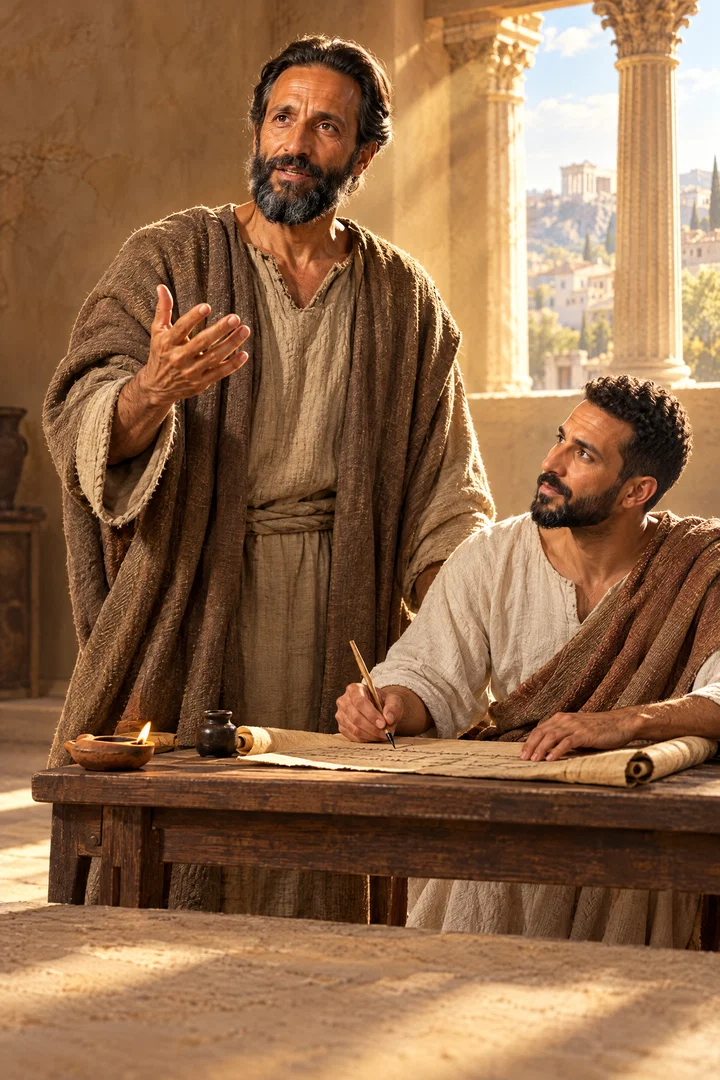
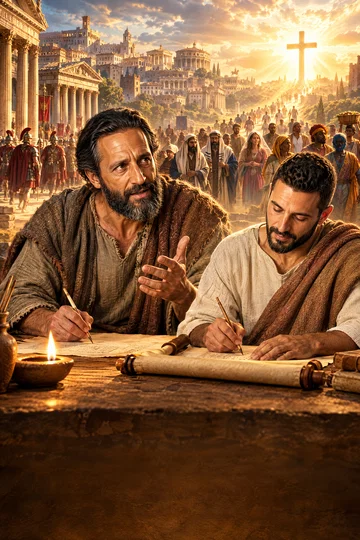
I Tertius, who wrote this letter, salute you in the Lord.
King James Version, KJV Cambridge Paragraph Bible, Webster Bible, Douay-Rheims (Challoner revision)
I Tertius, who wrote this epistle, salute you in the Lord.
Revised Version, American Standard Version
I Tertius, who write the epistle, salute you in the Lord.
I Tertius salute you (who wrote the letter) in the Lord;
I Tertius, who have written this epistle, salute you in [ the] Lord.
I, Tertius, who have written the epistle, salute you in the Lord.
Berean Standard Bible, Majority Standard Bible
I, Tertius, who wrote down this letter, greet you in the Lord.
I, Tertius, who write the letter, greet you in the Lord.
I, Tertius, who have done the writing of this letter, send love in the Lord.
I Tertius, which wrote out this Epistle, salute you in the Lord.
Pictures
Cross-references
- 2 Thessalonians 3:17
The salutation of Paul with mine own hand, which is the token in every epistle: so I write.
identifies handwritten salutation as token in every epistle
- 1 Corinthians 16:21
The salutation of me Paul with mine own hand.
shows Paul added salutation in his own hand
Commentary
Each commentary is drawn from primary sources: the writings of Ellen G. White and Adventist pioneers and periodicals. Each commentary is separate. Its own words are not a quotation; follow the references to read the source passages.
Pioneers and periodicals
7 sources
Tertius acted as Paul's amanuensis and scribe who wrote out the actual text of the epistle to the Romans and added his own greeting to its recipients in the Lord.RH Nov 13, 1900ST Apr 20, 1904RH May 26, 1868RH Jan 16, 1900 It was Paul's usual practice to dictate the body of a letter to an amanuensis and then add only the salutation signature with his own hand as the token of genuineness in every epistle, a safeguard made necessary because fraudulent letters were being circulated as from Paul.RH Nov 13, 1900 His greeting in the Lord expresses brotherhood, a prayer for blessing, and an offer of kindness.ST Apr 20, 1904
The verse belongs to the long list of personal greetings in Romans 16 that salutes many men and women in the Roman church by name.ST Sep 10, 1896ST Nov 22, 1910ST Jan 20, 1909 The many greetings reflect the makeup and history of the church at Rome, which was founded by Jews and proselytes from Jerusalem converted on the Day of Pentecost with others added afterward, and many of those greeted had met Paul on his travels.ST Nov 22, 1910 The names in that closing chapter include many women, showing that women are represented among those saluted.ST Sep 10, 1896ST Jan 20, 1909
The absence of Peter's name from that list shows that Peter was not in Rome at all when Paul wrote, and that if Peter was ever in Rome it was after Romans was written and long after the church there was established and flourishing, for Paul would not have omitted the chief person in the church, whom he knew from fifteen days together in Jerusalem.ST Sep 10, 1896 This silence is sufficient to settle that neither the church of Christ nor the church of Rome was founded upon Peter.ST Sep 10, 1896
Tertius served the gospel with pen and ink, and his work is a pattern for missions where writers are needed as messengers to carry the truth to benighted lands so the whole earth may be filled with the glory of God, alongside preachers of eloquence, practical helpers with needle and thread, givers with wealth, men with knowledge of law, and physicians with medicine.RH Jan 16, 1900
Sources