Ruth 1:20
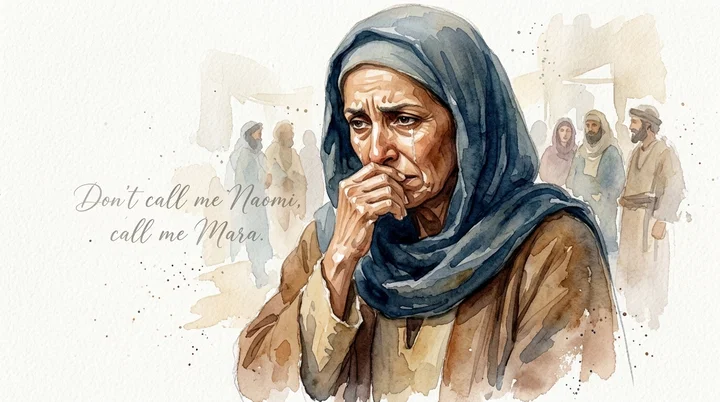
And she said unto them, Call me not Naomi, call me Mara: for the Almighty hath dealt very bitterly with me.
Translations
And she said to them, Call me not Naomi, call me Mara: for the Almighty has dealt very bitterly with me.
King James Version, KJV Cambridge Paragraph Bible, Revised Version
And she said unto them, Call me not Naomi, call me Mara: for the Almighty hath dealt very bitterly with me.
And she said to them, Call me not Naomi, call me Mara: for the Almighty hath dealt very bitterly with me.
And she said unto them, Call me not Naomi, call me Mara; for the Almighty hath dealt very bitterly with me.
And she saith unto them, 'Call me not Naomi; call me Mara, for the Almighty hath dealt very bitterly to me,
And she said to them, Call me not Naomi — call me Mara; for the Almighty has dealt very bitterly with me.
And she said unto them, Do not call me Naomi [="Sweet"],—call me Mara [="Bitter"], for the Almighty hath dealt very bitterly with me:
Berean Standard Bible, Majority Standard Bible
“Do not call me Naomi,” she replied. “ Call me Mara, because the Almighty has dealt quite bitterly with me.
She said to them, “Don’t call me Naomi. Call me Mara, for the Almighty has dealt very bitterly with me.
And she said to them, Do not let my name be Naomi, but Mara, for the Ruler of all has given me a bitter fate.
And she answered them, Call me not Naomi, but call me Mara: for the Almightie hath giuen me much bitternes.
Douay-Rheims (Challoner revision)
But she said to them: Call me not Noemi, ( that is, beautiful,) but call me Mara, ( that is, bitter,) for the Almighty hath quite filled me with bitterness.
Pictures
Cross-references
- Exodus 15:23
And when they came to Marah, they could not drink of the waters of Marah, for they were bitter: therefore the name of it was called Marah.
Marah’s bitter waters supply the image of bitterness.
- Ruth 4:14-15
And the women said unto Naomi, Blessed be the LORD, which hath not left thee this day without a kinsman, that his name may be famous in Israel.
The women celebrate the redeemer who restores Naomi’s life and family line.
- Ruth 1:16
And Ruth said, Intreat me not to leave thee, or to return from following after thee: for whither thou goest, I will go; and where thou lodgest, I will lodge: thy people shall be my people, and thy God my God:
Ruth’s pledge of loyalty belongs to the same story.
- Ruth 4:17
And the women her neighbours gave it a name, saying, There is a son born to Naomi; and they called his name Obed: he is the father of Jesse, the father of David.
The passage connects Ruth’s story with the lineage of kings.
- Deuteronomy 25:5-6
If brethren dwell together, and one of them die, and have no child, the wife of the dead shall not marry without unto a stranger: her husband’s brother shall go in unto her, and take her to him to wife, and perform the duty of an husband’s brother unto her.
The law preserves a dead man’s name and inheritance through a near relative.
Commentary
Each commentary is drawn from primary sources: the writings of Ellen G. White and Adventist pioneers and periodicals. Each commentary is separate. Its own words are not a quotation; follow the references to read the source passages.
Pioneers and periodicals
7 sources
The setting is near the close of the time of the judges, when Naomi and Ruth the Moabitess come to Bethlehem from Moab after famine had taken Naomi's family there.ST Oct 3, 1895ST Jul 10, 1901 Naomi had gone to Moab with her husband Elimelech and two sons during that famine, the sons married Orpah and Ruth, and Elimelech and the sons died there after those marriages.ST Oct 3, 1895 Their deaths in that foreign land left Naomi old, poor, and without a son to preserve the family inheritance and name, while Ruth chose to accompany her back.ST Oct 3, 1895ST May 6, 1897ST Jul 10, 1901
On their arrival at Bethlehem all the city was moved about them, and the women exclaimed and asked if this was Naomi.ST Oct 3, 1895 The verse is her reply to them upon that arrival with Ruth, made in answer to the exclamations of the inhabitants.ST Oct 3, 1895 She asks them not to call her Naomi but to call her Mara, for the Almighty has dealt very bitterly with her and made her life bitter.ST Oct 3, 1895 Naomi means pleasant and Mara means bitter, so the new name truly expressed her condition.ST Aug 26, 1889ST Nov 10, 1898
Her words express grief and oppressive sorrow over her losses, returning in poverty and bereaved of husband and sons.ST May 6, 1897ST Nov 10, 1898 Coming back amid the scenes of happier days sharpened her sense of loss. This expresses sorrow, not a lack of faith.ST Nov 10, 1898 Her statement that she went out full means her family was well-to-do and was not forced by drought or hard times to leave Bethlehem for Moab but could have remained like others.
In calling herself Mara she acknowledged that the Lord had not approved the move to live among the heathen for mercenary gain and for her sons to marry Moabite women. That disobedience was Elimelech's and his sons', yet He overruled it for good in the conversion of Ruth. Ruth's presence gave Naomi a last ray of hope because she still had kinsmen in Bethlehem.ST May 6, 1897 The verse belongs to the account of Ruth's choice that brings to view the private life of a devoted family in troublous times and shows the result of abiding faith in God and a consistent life.ST Dec 12, 1895 Mara, or Marah, thus becomes an image of sorrow and spiritual desolation that is turned toward hope as the weary soul receives pardon, comfort, and rest from Christ.ST Aug 26, 1889
Sources