Ruth 1:4
And they took them wives of the women of Moab; the name of the one was Orpah, and the name of the other Ruth: and they dwelled there about ten years.
Translations
American King James Version, King James Version, KJV Cambridge Paragraph Bible, Revised Version
And they took them wives of the women of Moab; the name of the one was Orpah, and the name of the other Ruth: and they dwelled there about ten years.
And they took to themselves wives of the women of Moab; the name of the one was Orpah, and the name of the other Ruth: and they dwelt there about ten years.
And they took them wives of the women of Moab; the name of the one was Orpah, and the name of the other Ruth: and they dwelt there about ten years.
and they take to them wives, Moabitesses: the name of the one [is] Orpah, and the name of the second Ruth; and they dwell there about ten years.
And they took them Moabitish wives; the name of the one was Orpah, and the name of the second Ruth: and they abode there about ten years.
And they took them wives, of the women of Moab, the name of the one, was Orpah, and, the name of the other, Ruth,—and they dwelt there, about ten years.
Berean Standard Bible, Majority Standard Bible
who took Moabite women as their wives, one named Orpah and the other named Ruth.And after they had lived in Moab about ten years,
They took for themselves wives of the women of Moab. The name of the one was Orpah, and the name of the other was Ruth. They lived there about ten years.
And they took two women of Moab as their wives: the name of the one was Orpah, and the name of the other Ruth; and they went on living there for about ten years.
Which tooke them wiues of the Moabites: the ones name was Orpah, and the name of ye other Ruth: and they dwelled there about ten yeeres.
Douay-Rheims (Challoner revision)
And they took wives of the women of Moab, of which one was called Orpha, and the other Ruth. And they dwelt there ten years.
Pictures
Cross-references
- Ruth 4:5-10
Then said Boaz, What day thou buyest the field of the hand of Naomi, thou must buy it also of Ruth the Moabitess, the wife of the dead, to raise up the name of the dead upon his inheritance.
Boaz redeems the inheritance and marries Ruth to preserve the dead man’s name.
- Deuteronomy 25:5-6
If brethren dwell together, and one of them die, and have no child, the wife of the dead shall not marry without unto a stranger: her husband’s brother shall go in unto her, and take her to him to wife, and perform the duty of an husband’s brother unto her.
A brother’s marriage duty preserves the deceased kinsman’s family line.
- Ruth 4:14-15
And the women said unto Naomi, Blessed be the LORD, which hath not left thee this day without a kinsman, that his name may be famous in Israel.
Naomi’s family line and life are restored through a redeemer.
Commentary
Each commentary is drawn from primary sources: the writings of Ellen G. White and Adventist pioneers and periodicals. Each commentary is separate. Its own words are not a quotation; follow the references to read the source passages.
Pioneers and periodicals
11 sources
Famine in Israel drove Elimelech with Naomi and their two sons from Bethlehem to sojourn in Moab, where the sons took Moabite wives, Orpah and Ruth, and the family dwelled there about ten years.RH Mar 16, 1916ST Apr 8, 1913ST Mar 31, 1909 Mahlon was joined to Ruth and Chilion to Orpah, and the marriages were childless before Elimelech and both sons died, leaving Naomi and Ruth widowed without a son or heir to preserve the family name and inheritance.ST May 6, 1897ST Nov 10, 1898RH Mar 12, 1908 The sojourn itself was disobedience undertaken when the family could have remained, and the taking of wives from an idolatrous heathen nation was an unholy alliance the Lord did not approve.ST May 6, 1897 God overruled that wrong course for good, using Naomi's sorrows to bring about Ruth's conversion to the true religion and to bring a Moabite woman into the family line of David and of Jesus as the mother of Obed, showing that God is no respecter of persons.ST Apr 8, 1913ST Mar 31, 1909RH Mar 5, 1914 The book thus introduced sets forth the nearest kinsman redeeming the inheritance, pointing to Christ who by becoming human became humanity's kinsman to redeem it.RH Sep 11, 1900
Setting and Events
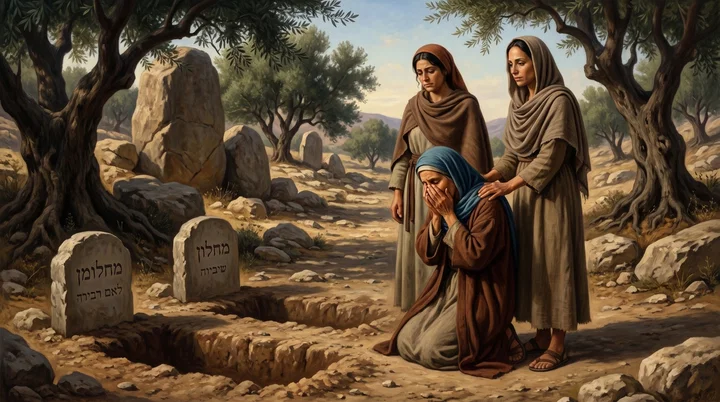
Famine in Israel drove the Bethlehemite Elimelech with his wife Naomi and their two sons Mahlon and Chilion to live in Moab. While the family sojourned there, the two sons took wives of the women of Moab, Orpah and Ruth, and the family dwelled there about ten years.RH Mar 16, 1916ST Apr 8, 1913ST Mar 31, 1909RH Sep 11, 1900 The particular pairings were Mahlon with Ruth and Chilion with Orpah.ST Nov 10, 1898
The marriages produced no children before Elimelech and both sons died in Moab.ST May 6, 1897RH Mar 12, 1908 Their deaths left Naomi without a son, and left Naomi and Ruth widowed without an heir to preserve the deceased family's name and inheritance.ST May 6, 1897RH Mar 12, 1908
After those deaths Naomi decided to return to Bethlehem when she heard conditions there were prosperous. Ruth went with her back to Bethlehem, where Ruth later married Naomi's kinsman and became the mother of Obed.ST Jul 10, 1901 The verse thus connects Bethlehem and its surrounding plain with the story of Boaz and Ruth and makes them places of particular biblical interest.ST Nov 17, 1898 The verse gives no indication that Ruth was grieving for children.ST Sep 4, 1901
Meaning and Significance
The sojourn in Moab was itself disobedience, undertaken for mere money when a well-to-do family could have remained in Bethlehem through the drought, and the Lord did not approve it. The sons' taking wives from among the Moabites, an idolatrous and heathen people, was further disobedience and an unholy alliance, and after dwelling there about ten years Elimelech and both sons died in that foreign land, leaving Naomi without a son to preserve the family name and inheritance.ST May 6, 1897 God overruled that wrong course for good, using Naomi's bitter experiences and sorrows in Moab to accomplish His purpose, notably in the conversion of Ruth to the true religion.RH Mar 5, 1914
Ruth, with Orpah, thus entered the household as a Moabite wife of one of Naomi and Elimelech's sons during the ten years in Moab, and her place in that family made her an ancestress of Jesus.ST Apr 8, 1913ST Mar 31, 1909 After the deaths of father and sons she went with Naomi back to Bethlehem, where she married Naomi's kinsman and became the mother of Obed, standing in the family line of David and Jesus.ST Jul 10, 1901 Her introduction as a Moabite woman who becomes part of the family line from which Christ comes shows that God is no respecter of persons and works through people beyond Israel.
The book so introduced sets forth the law by which the nearest kinsman could redeem an inheritance, and that provision points to Christ, who by becoming human became humanity's kinsman and could redeem it.RH Sep 11, 1900
Sources