Translations
American King James Version, King James Version, KJV Cambridge Paragraph Bible, Revised Version
And Elimelech Naomi’s husband died; and she was left, and her two sons.
Webster Bible, Darby Translation
And Elimelech Naomi's husband died; and she was left, and her two sons.
And Elimelech, Naomi’s husband, died; and she was left, and her two sons.
And Elimelech husband of Naomi dieth, and she is left, she and her two sons;
And Elimelech, husband of Naomi, died,—and she was left, she and her two sons.
Berean Standard Bible, Majority Standard Bible
Then Naomi’s husband Elimelech died, and she was left with her two sons,
Elimelech, Naomi’s husband, died; and she was left with her two sons.
And Elimelech, Naomi's husband, came to his end; and only her two sons were with her.
Then Elimelech the husband of Naomi died, and she remayned with her two sonnes,
Douay-Rheims (Challoner revision)
And Elimelech the husband of Noemi died: and she remained with her sons.
Pictures
Cross-references
- Ruth 4:3-10
And he said unto the kinsman, Naomi, that is come again out of the country of Moab, selleth a parcel of land, which was our brother Elimelech’s:
Boaz redeems Elimelech’s property and marries Ruth to preserve the deceased’s name.
- Ruth 1:8
And Naomi said unto her two daughters in law, Go, return each to her mother’s house: the LORD deal kindly with you, as ye have dealt with the dead, and with me.
Naomi bids her daughters-in-law return after the family’s loss.
- Ruth 4:14-15
And the women said unto Naomi, Blessed be the LORD, which hath not left thee this day without a kinsman, that his name may be famous in Israel.
Naomi’s family later received a kinsman redeemer and a restorer of life.
- Ruth 2:20
And Naomi said unto her daughter in law, Blessed be he of the LORD, who hath not left off his kindness to the living and to the dead. And Naomi said unto her, The man is near of kin unto us, one of our next kinsmen.
Naomi identifies Boaz as a near kinsman after Elimelech’s death.
- Matthew 1:5-6
And Salmon begat Booz of Rachab; and Booz begat Obed of Ruth; and Obed begat Jesse;
Ruth is named among Jesus’ ancestors.
- Deuteronomy 25:5-6
If brethren dwell together, and one of them die, and have no child, the wife of the dead shall not marry without unto a stranger: her husband’s brother shall go in unto her, and take her to him to wife, and perform the duty of an husband’s brother unto her.
A close relative was to preserve the dead man's name and inheritance.
- Deuteronomy 25:7-10
And if the man like not to take his brother’s wife, then let his brother’s wife go up to the gate unto the elders, and say, My husband’s brother refuseth to raise up unto his brother a name in Israel, he will not perform the duty of my husband’s brother.
The law addresses a kinsman’s duty to preserve the dead man’s name.
- Ruth 4:17-22
And the women her neighbours gave it a name, saying, There is a son born to Naomi; and they called his name Obed: he is the father of Jesse, the father of David.
Traces Ruth’s family line through Obed to David.
Commentary
Each commentary is drawn from primary sources: the writings of Ellen G. White and Adventist pioneers and periodicals. Each commentary is separate. Its own words are not a quotation; follow the references to read the source passages.
Pioneers and periodicals
10 sources
Elimelech died in Moab and left Naomi a widow with her two sons, Mahlon and Chilion, after the family had left Bethlehem for Moab because of famine in Israel about ten years before Naomi returned.RH Mar 16, 1916ST Nov 10, 1898
His death begins the line that runs through Ruth the Moabitess, who by marriage to Naomi's kinsman became mother of Obed and grandmother of David, and so entered the ancestry of Jesus as shown to descend from Abraham, showing God's care for the promised Seed and His providence toward a poor Moabite woman.RH Mar 16, 1916ST Apr 8, 1913ST Mar 31, 1909ST Jul 10, 1901
With Naomi widowed and then left with no son to hold the Bethlehem inheritance or keep the family name, only the nearest kinsman could redeem it, and that kinsman stands as a type of Christ, revealing beforehand that the Son of God must come in the same sinful flesh in which sin reigned so that grace would abound where sin abounded.ST Apr 8, 1913RH Sep 11, 1900ST May 6, 1897
The sojourn in heathen Moab was a disobedient move for gain, deepened by the sons marrying Moabite women, yet the Lord overruled it for good in the conversion of Ruth, and kept Naomi in His sight to turn her bitter bereavement and gloom into light.RH Jun 24, 1875RH Mar 5, 1914
Narrative Setting and Sequence
Elimelech, Naomi's husband, died in Moab and left her with their two sons, Mahlon and Chilion, after the family of four had left Bethlehem to sojourn in Moab because of famine in Israel about ten years before Naomi's return.RH Mar 16, 1916ST Nov 10, 1898 His death was the first bereavement, still leaving Naomi the comfort of her children.ST Nov 10, 1898 The move had left an inheritance in Bethlehem behind to settle in a foreign, idolatrous, heathen land.ST May 6, 1897 The family had gone out full and well-to-do and could have stayed through drought and hard times in Bethlehem.
The account belongs to a brief pastoral story of simple home life among Israel set in the time of the judges.ST Apr 8, 1913ST Mar 31, 1909 It is a peaceful contrast to the violence in Judges. In the order of Israel's history from the building of the tabernacle to the return of the ark, it comes after Gideon and Samson and before Child Samuel and the taking and sending back of the ark.RH Apr 28, 1904
The two sons then married the Moabite women Orpah and Ruth. After both sons also died, Naomi was bereaved of her whole immediate family.ST Nov 10, 1898ST Jul 10, 1901 She decided to return to Bethlehem with Ruth, one of her daughters-in-law, because she heard everything was prosperous there.ST Jul 10, 1901
Redemption and Messianic Lineage
The death of Naomi's husband in Moab leaves her with her two sons and begins the account of the family line that leads to David.RH Mar 16, 1916ST Jul 10, 1901 The account is a brief pastoral story set in the time of the judges that ends by tracing the ancestry of Jesus through a Moabite woman.RH Mar 16, 1916ST Mar 31, 1909 After the sons also died, Naomi returned to Bethlehem with Ruth, one of her daughters-in-law.ST Jul 10, 1901 Through Ruth's marriage to Naomi's kinsman, she became the mother of Obed, grandfather of David, and entered the family line through which Jesus was shown to descend from Abraham.ST Jul 10, 1901
The book presents simple home life among Israel and shows God's care for the promised Seed, in that Ruth became an ancestor of Jesus.ST Apr 8, 1913 It is a peaceful contrast to the violence in Judges, and the later story shows God's blessing on Ruth, a poor Moabite woman, and His providence in making her an ancestress of Christ.ST Apr 8, 1913
The death leaving Naomi and her two sons sets in motion the need for redemption by a near kinsman, since only the nearest kinsman could redeem the inheritance.RH Sep 11, 1900 Elimelech died after leaving his inheritance in Bethlehem and settling with his family in a foreign, idolatrous land.ST May 6, 1897 Naomi was left a widow, and after both sons also died she had no son to hold the inheritance or preserve the family name.ST May 6, 1897 Her poverty put the inheritance at risk, and her return to Bethlehem with Ruth opened a last hope because kinsmen remained there.ST May 6, 1897 The near kinsman serves as a type of Christ.ST Apr 8, 1913 That kinsman law revealed beforehand the central fact of the gospel that the Son of God must be manifested in flesh, in the very same kind of sinful flesh in which sin reigned, so that redeeming grace would abound where sin abounded and victory for man would be victory in man.RH Sep 11, 1900
Providence in Sorrow and Disobedience
Elimelech's removal to Moab was a move God did not approve, undertaken in disobedience to God for mere mercenary purposes in order to live among the heathen. His household went out from Bethlehem full and well-to-do, when they could have stayed through the drought and hard times at home. His sons added further disobedience by marrying Moabite women.
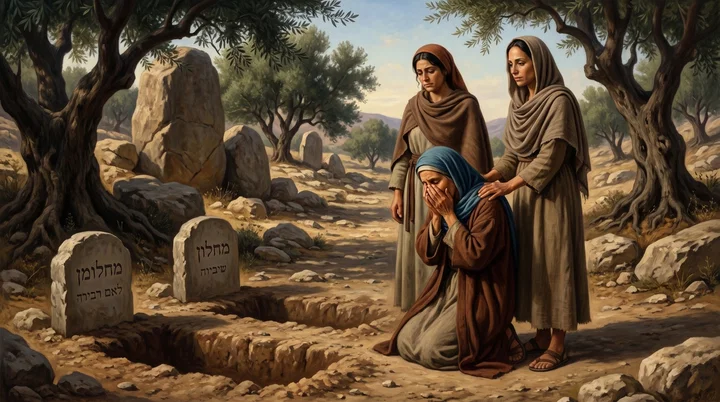
His death in Moab was an early bereavement that still left Naomi the comfort of her children.ST Nov 10, 1898 Their later deaths left her poor and bereaved, one of a mournful tearful group saying a long last farewell, with desolation reigning where joy had dwelt.RH Jun 24, 1875 On returning to Bethlehem amid the scenes of happier days she felt her loss keenly and called herself Mara, bitter, as the true expression of her condition.
The bereavement brought gloom and sorrow on this side of the grave as part of Naomi's bitter sorrow.RH Jun 24, 1875RH Mar 5, 1914 Yet God had her in His sight to turn her darkness into light, proving that shadows turn to sunlight at His touch and that He counts all tears.RH Jun 24, 1875 Hope therefore remains when life appears a vale of weariness and all around is dim.RH Jun 24, 1875 He used her suffering to carry out His purpose.RH Mar 5, 1914
The Lord overruled even that disobedient sojourn for good in the conversion of Ruth. The Story of Ruth to which this death belongs is to be told to children as a simple, pure, and connected Bible story.RH Apr 28, 1904 Practical moral lessons are to be woven in where a child could not draw them from the text alone.RH Apr 28, 1904
Sources