Ruth 1:5
And Mahlon and Chilion died also both of them; and the woman was left of her two sons and her husband.
Translations
American King James Version, King James Version, KJV Cambridge Paragraph Bible
And Mahlon and Chilion died also both of them; and the woman was left of her two sons and her husband.
And Mahlon and Chilion died also both of them; and the woman was left by her two sons and her husband.
Revised Version, American Standard Version
And Mahlon and Chilion died both of them; and the woman was left of her two children and of her husband.
And they die also, both of them — Mahlon and Chilion — and the woman is left of her two children and of her husband.
And Mahlon and Chilion died also, both of them; and the woman was left of her two children and of her husband.
And, they also, both, died, Mahlon and Chilion,—so the woman was bereft of her two sons, and of her husband.
Berean Standard Bible, Majority Standard Bible
both Mahlon and Chilion also died, and Naomi was left without her two sons and without her husband.
Mahlon and Chilion both died, and the woman was bereaved of her two children and of her husband.
And Mahlon and Chilion came to their end; and the woman was without her two sons and her husband.
And Mahlon and Chilion dyed also both twaine: so the woman was left destitute of her two sonnes, and of her husband.
Douay-Rheims (Challoner revision)
And they both died, to wit, Mahalon and Chelion: and the woman was left alone, having lost both her sons and her husband.
Pictures
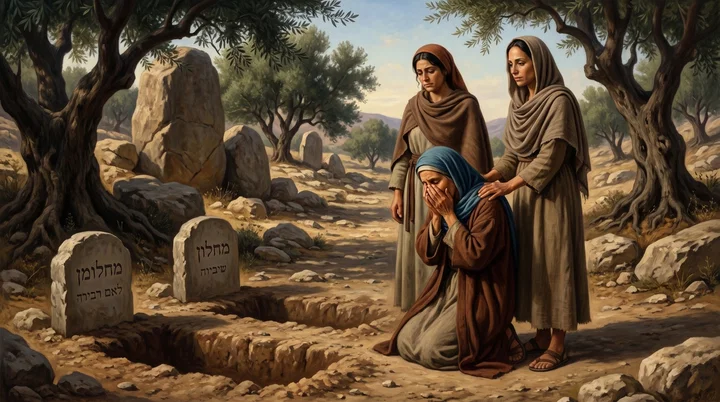
Cross-references
- Deuteronomy 25:5-6
If brethren dwell together, and one of them die, and have no child, the wife of the dead shall not marry without unto a stranger: her husband’s brother shall go in unto her, and take her to him to wife, and perform the duty of an husband’s brother unto her.
Sets out the duty to raise up an heir for a deceased kinsman.
- Ruth 4:5-10
Then said Boaz, What day thou buyest the field of the hand of Naomi, thou must buy it also of Ruth the Moabitess, the wife of the dead, to raise up the name of the dead upon his inheritance.
Boaz redeems the family property and marries Ruth to preserve the dead man’s name.
- Ruth 4:17
And the women her neighbours gave it a name, saying, There is a son born to Naomi; and they called his name Obed: he is the father of Jesse, the father of David.
Records Obed, Ruth’s son and David’s grandfather.
- Matthew 1:1-6
The book of the generation of Jesus Christ, the son of David, the son of Abraham.
Connects Ruth’s family line through David to Jesus.
- Leviticus 25:49
Either his uncle, or his uncle’s son, may redeem him, or any that is nigh of kin unto him of his family may redeem him; or if he be able, he may redeem himself.
A near kinsman could redeem the inheritance Naomi risked losing.
- Ruth 1:16-17
And Ruth said, Intreat me not to leave thee, or to return from following after thee: for whither thou goest, I will go; and where thou lodgest, I will lodge: thy people shall be my people, and thy God my God:
Ruth vows to remain with Naomi through life and death.
Commentary
Each commentary is drawn from primary sources: the writings of Ellen G. White and Adventist pioneers and periodicals. Each commentary is separate. Its own words are not a quotation; follow the references to read the source passages.
Pioneers and periodicals
6 sources
The verse closes a sojourn of about ten years in Moab, a foreign, heathen land, after the family went from Bethlehem to Moab because of famine in Israel.ST May 6, 1897ST Jul 10, 1901 After Elimelech's death, his two sons Mahlon and Chilion, who had married the Moabite women Orpah and Ruth, also both died without children.ST Nov 10, 1898RH Mar 12, 1908ST Jul 10, 1901 Their deaths left Naomi without husband or either son and left Ruth and Orpah as widows.ST May 6, 1897ST Nov 10, 1898RH Mar 12, 1908ST Jul 10, 1901
With no son left to preserve the family name and hold the inheritance, the family inheritance appeared lost and the family line in danger of ending.ST May 6, 1897RH Mar 12, 1908 That danger created the need for a near kinsman to fulfill the duty of a go'el by preserving the deceased family's name and inheritance.RH Mar 12, 1908 The verse leaves Naomi in Moab in poverty and bereavement, with desolation reigning where there had been joy.RH Jun 24, 1875 Having gone out full and well-to-do, she felt the hand of the Lord gone out against her, with no more sons and too old to marry again, a condition she herself called bitter under the name Mara.
The family had been able to remain in Bethlehem like others and was not forced by drought or hard times to leave. Elimelech left to live among the heathen for mere mercenary purposes in disobedience to God, and his sons further disobeyed by marrying Moabite women, a move the Lord did not approve. From that loss Naomi resolves to return to Bethlehem in the land of Judah on hearing everything was prosperous there.RH Jun 24, 1875 She urges her two daughters-in-law, still young women in girlhood's bloom, to go back to their homes and remain with their own people.RH Jun 24, 1875
The verse leaves her standing with them for a tearful last farewell on Moab's fertile plain of vintage and grain, palm-tops, and the river Arnon flowing to the Dead Sea.RH Jun 24, 1875 She later returned to Bethlehem with Ruth.ST Jul 10, 1901 Naomi's painful experiences in Moab are an example of how God uses human actions and sorrow to accomplish His eternal purpose.RH Mar 5, 1914 He overruled the disobedience for good in the conversion of Ruth, and He had them in His sight to turn darkness into light, counting all tears, so that shadows become sunlight and there is no cause to doubt when life appears dim and weary.RH Jun 24, 1875
Sources