Ruth 3:2
And now is not Boaz of our kindred, with whose maidens thou wast? Behold, he winnoweth barley to night in the threshingfloor.
Translations
And now is not Boaz of our kindred, with whose maidens you were? Behold, he winnows barley to night in the threshing floor.
King James Version, KJV Cambridge Paragraph Bible
And now is not Boaz of our kindred, with whose maidens thou wast? Behold, he winnoweth barley to night in the threshingfloor.
And now is not Boaz of our kindred, with whose maidens thou wast? Behold, he winnoweth barley to-night in the threshing-floor.
And now is there not Boaz our kinsman, with whose maidens thou wast? Behold, he winnoweth barley to-night in the threshing-floor.
And now is not Boaz our kinsman, with whose maidens thou wast? Behold, he winnoweth barley to-night in the threshing-floor.
and now, is not Boaz of our acquaintance, with whose young women thou hast been? lo, he is winnowing the threshing-floor of barley to-night,
And now, is not Boaz of our kindred, with whose maidens thou wast? Behold, he is winnowing barley in the threshing-floor to-night.
Now, therefore, is not, Boaz, of our kindred, with whose maidens thou hast been? Lo! he is winnowing the barley threshing-floor, to-night!
Berean Standard Bible, Majority Standard Bible
Now is not Boaz, with whose servant girls you have been working, a relative of ours? In fact, tonight he is winnowing barley on the threshing floor.
Now isn’t Boaz our kinsman, with whose maidens you were? Behold, he will be winnowing barley tonight on the threshing floor.
And now, is there not Boaz, our relation, with whose young women you were? See, tonight he is separating the grain from the waste in his grain-floor.
Now also is not Boaz our kinsman, with whose maides thou wast? beholde, he winoweth barly to night in the floore.
Douay-Rheims (Challoner revision)
This Booz, with whose maids thou wast joined in the field, is our near kinsman, and behold this night he winnoweth barley in the threshingfloor.
Pictures
Cross-references
- Ruth 2:20
And Naomi said unto her daughter in law, Blessed be he of the LORD, who hath not left off his kindness to the living and to the dead. And Naomi said unto her, The man is near of kin unto us, one of our next kinsmen.
Naomi identifies Boaz as a near kinsman.
- Deuteronomy 25:5-6
If brethren dwell together, and one of them die, and have no child, the wife of the dead shall not marry without unto a stranger: her husband’s brother shall go in unto her, and take her to him to wife, and perform the duty of an husband’s brother unto her.
Defines the duty to raise up offspring for a deceased kinsman.
- Ruth 4:5-10
Then said Boaz, What day thou buyest the field of the hand of Naomi, thou must buy it also of Ruth the Moabitess, the wife of the dead, to raise up the name of the dead upon his inheritance.
Boaz fulfills the kinsman’s duty after the nearer relative declines.
- Ruth 3:15
Also he said, Bring the vail that thou hast upon thee, and hold it. And when she held it, he measured six measures of barley, and laid it on her: and she went into the city.
Boaz gives Ruth six measures of barley at the threshing floor.
Commentary
Each commentary is drawn from primary sources: the writings of Ellen G. White and Adventist pioneers and periodicals. Each commentary is separate. Its own words are not a quotation; follow the references to read the source passages.
Pioneers and periodicals
3 sources
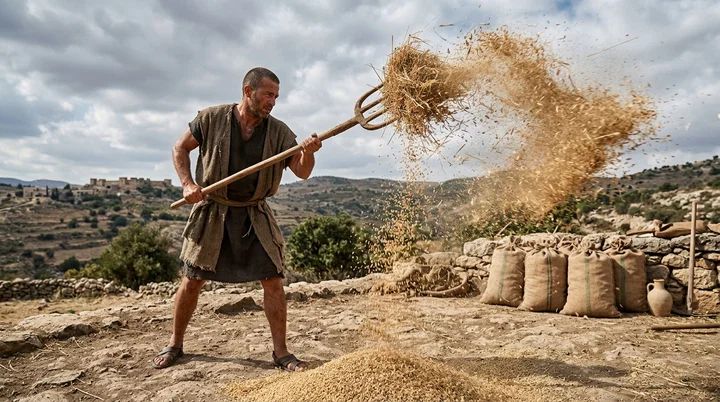
Boaz is the kinsman of Naomi and Ruth, found winnowing barley at the threshingfloor that night.ST Sep 23, 1886RH Mar 12, 1908 The winnowing was done on a breezy day by tossing the grain into the air so the wind carried away the chaff and the wheat could be gathered into the storehouse.ST Sep 23, 1886 This nighttime winnowing gives Naomi the occasion to direct Ruth to bring to Boaz's attention his duty as a deceased relative's nearest kinsman.RH Mar 12, 1908 That duty belonged to the nearest kinsman, whether a brother or a more distant relative.RH Mar 12, 1908 The account of Ruth and Boaz carries the lesson of the near kinsman as a type of the Lord.ST Apr 8, 1913
Sources