I was sent from Moscow to Siberia by the British and Foreign Bible Society, to scatter Bibles in that region. I was in the Siberian city of Irbit. In this place is held an annual fair. On my journey, I had lost all my Bibles, worth about a thousand dollars. For four weeks and more, I tried in vain to find them. The time during which the fair was held passed by, and my stock of Bibles had not been found. I became fearful of losing my position as a colporteur.
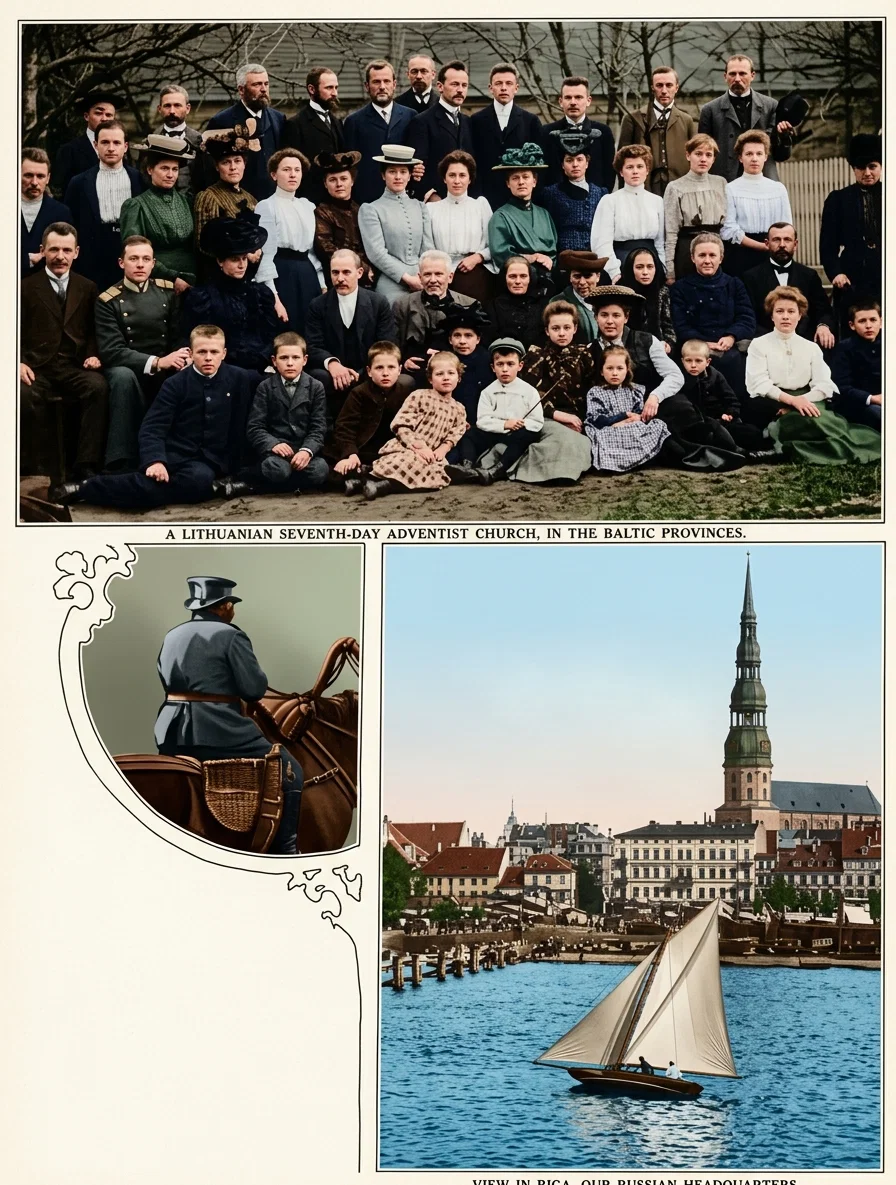
1. A LITHUANIAN SEVENTH-DAY ADVENTIST CHURCH,
IN THE BALTIC PROVINCES
2. VIEW IN RIGA, OUR RUSSIAN HEADQUARTERS
Finally I resorted to fasting and prayer. On the third day the Lord heard my prayer, and helped me find my books. It was said that the one who had been transporting them was slain, and that the books had been hidden in the woods. Wonderful to relate, after receiving these books, I was only one day in disposing of them all.
Near the place where I was stopping was a large railway shop, which had more than ten thousand employees. I asked the director if I might sell my books in this factory. At first, he did not wish to allow it. Then I wrote him a letter, in which I called attention to the fact that the book I was selling has in it the power to make a man better, so that he will not give himself up to drinking. The director replied that if the book I was offering for sale could make his employees better, he was willing that they should try it.
Upon arrival at the factory, I was given a man to assist me. With note-book and pencil he went with me through his factory. At first I attempted to explain the nature of the Bible I was offering for sale, and point out the importance of securing a copy; but the gentleman accompanying me said, “Do not take so much time.” And then, turning to the employee, he would say, “You must have the book.” In this way, we wrote down name after name. In this remarkable manner I was able to dispose of all the Bibles that had been sent me by the society.
This experience gave me courage to begin keeping the Sabbath of the Bible, the seventh day, which I had for some time believed to be God’s will, but had found it hard to begin alone, contrary to the tide of public opinion.
G. PERK.
Speaking to a Thousand Russian Priests
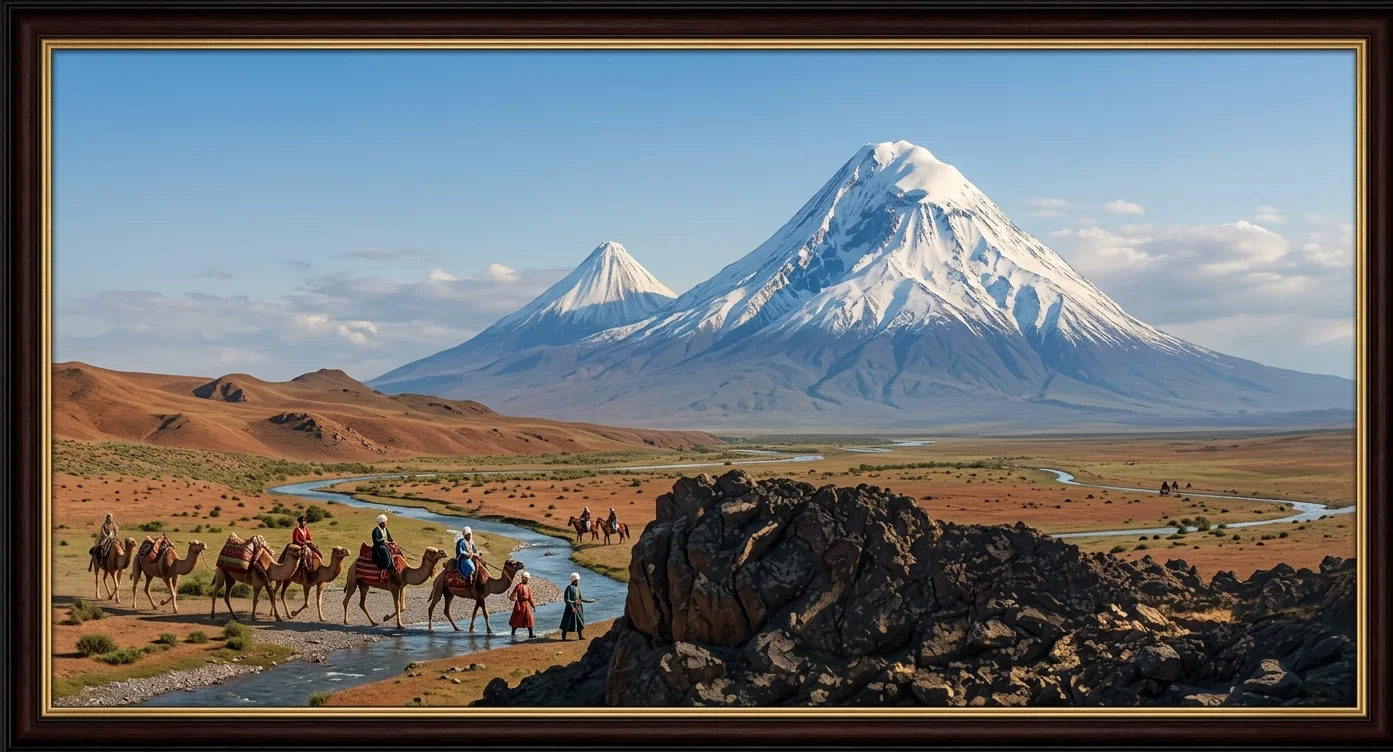
“THE MOUNTAINS OF ARARAT,” RUSSIAN CAUCASUS
Not often does a Protestant preacher have such an audience as the president of our Russian Union Conference addressed not long ago in Kief, the holy city of Russia, where thousands of pilgrims go annually to touch the relics of the Greek saints. Here the Russian Orthodox Church was holding a missionary congress, with a thousand priests in attendance.
They had passed resolutions condemning Seventh-day Adventists. The director of our work in Russia, J. T. Boettcher, asked the secretary if he might be permitted to speak to the congress. He writes:—
“The secretary went into the congress hall, and after a few minutes returned, and invited me to go into the meeting with him. There were all the dignitaries of the Russian Church assembled, with an archbishop acting as chairman.
“With my heart uplifted to God in prayer, I was permitted for an hour and a half to testify to the truth of God’s Word. At the close, some came forward and thanked me for what they had heard. The secretary said he would arrange for me to speak to the congress the next day on ‘The Immortality of the Soul.’
“At the appointed time, I was there, and found the wide corridors filled with people waiting to go in. At first all were admitted; but later on, as the crowd became too great, only the priests or missionaries who had tickets could get in. Never did I experience the help of the Lord more than on this occasion. At the close the missionaries invited me to take tea with them, so that they could hear more concerning the matter. This invitation I gladly accepted, and thanked God for this wonderful leading.”
In the Country of the Apostle Paul
By C. D. AcMoody
Tarsus is an ancient city. It was probably founded in the eighth or ninth century B. C. by Asshur-nasir-pal the Assyrian. It is located in a most fertile plain, and is the gateway to the great mountain pass, “The Cilician Gates,” leading through the Taurus Mountains and connecting Cilicia and Cappadocia.
Through Tarsus and this pass marched the armies of Cyrus and Alexander. It was the connecting link between the Mediterranean, and the Halys River and the Black Sea in the time of the Cæsars. The Turkish government has constructed a pike road through the pass, and it is now the great thoroughfare for the camel caravans between Kaisarieh (Cæsarea) and the sea. In making a recent journey through this region, eight days by carriage, we passed one caravan of over two hundred camels.
Augustus made Tarsus a free city. It ranked with15Antioch and Alexandria as a city of great learning. The nobility of Rome sent to Tarsus for tutors for their children. So Paul could well say, “I am a citizen of no mean city.”
But of late our attention has been especially called to Tarsus, Adana, and vicinity because of the atrocious massacres of last spring. During this time thousands of men, women, and children were slaughtered. Among these were six good devoted Armenian Seventh-day Adventist brethren, one of whom was the elder of our church at Adana, and one a young man of the same church who gave promise of becoming a successful evangelist. The latter was shot while on his knees in prayer. The superintendent of our Sabbath-school at Tarsus was driven from home and robbed of all his belongings. Thus suffering and earthly loss are endured for the gospel’s sake in the land of the apostle Paul.
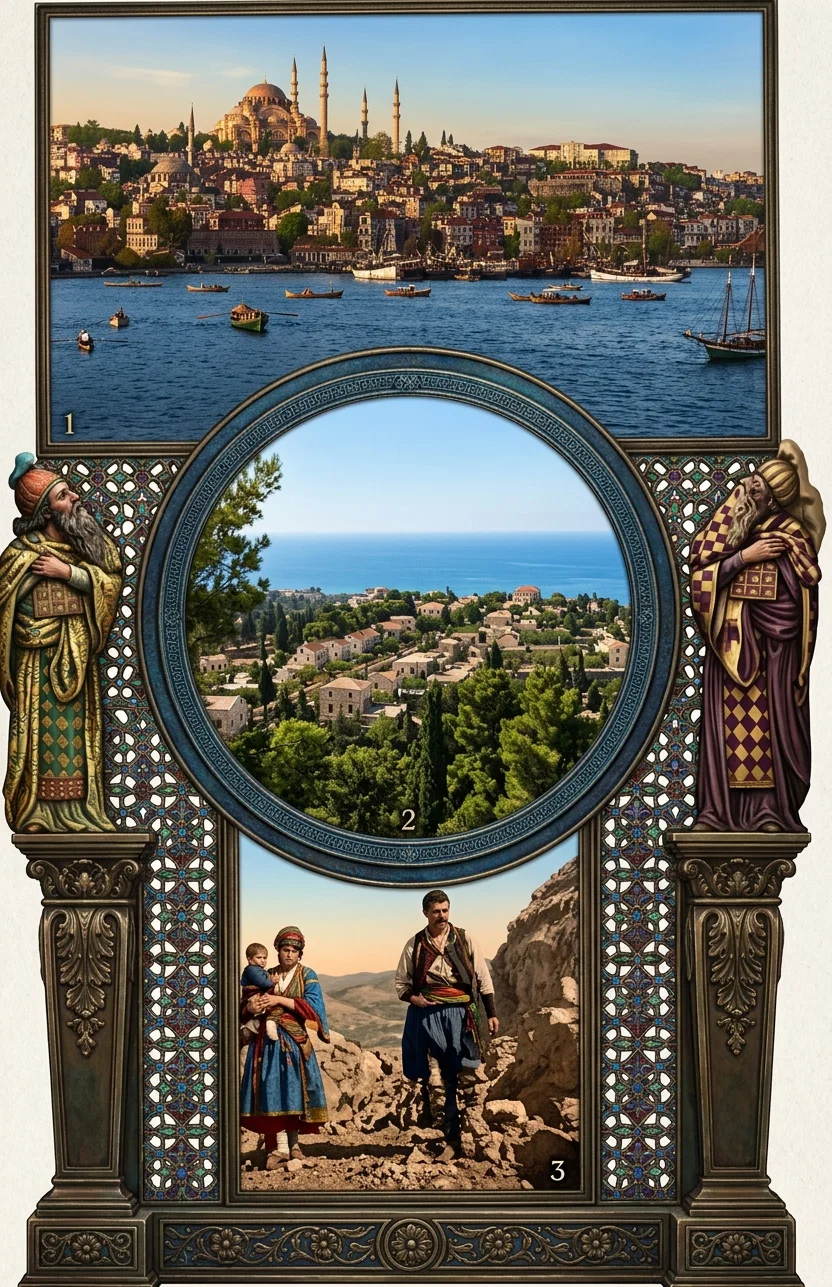
CONSTANTINOPLE
GERMAN COLONY, MT. CARMEL, SYRIA
GREEKS
Whether you consider it politically, religiously, or prophetically, no other country in the world to-day occupies a position of so unique importance as does the Turkish empire.
No longer can we maintain the plea that Turkey is so largely a closed field that it will not pay to spend our energies upon it until the door is opened, for now the door is open. How important that we should be ready to enter these regions beyond at these critical moments!
C. D. AcMoody.
No se Rinde
By Walter G. Bond
A Message From Spain
According to the monkish historians, Zaragoza, in Aragon, was founded by Noah’s grandson Tubal, in the year 242 post diluvium. The former name of city was Salduba, and is said to mean, in Chaldaic, “the property of Tubal,” or “the city of the sun.” Be this as it may, its strategical importance did not fail to attract the eye of Cæsar Augustus, who walled the city, and quartered here several legions of his soldiers. It then took the name of Cæsarea Augusta, which was converted by the Moors into Saracosta, to become finally Zaragoza.
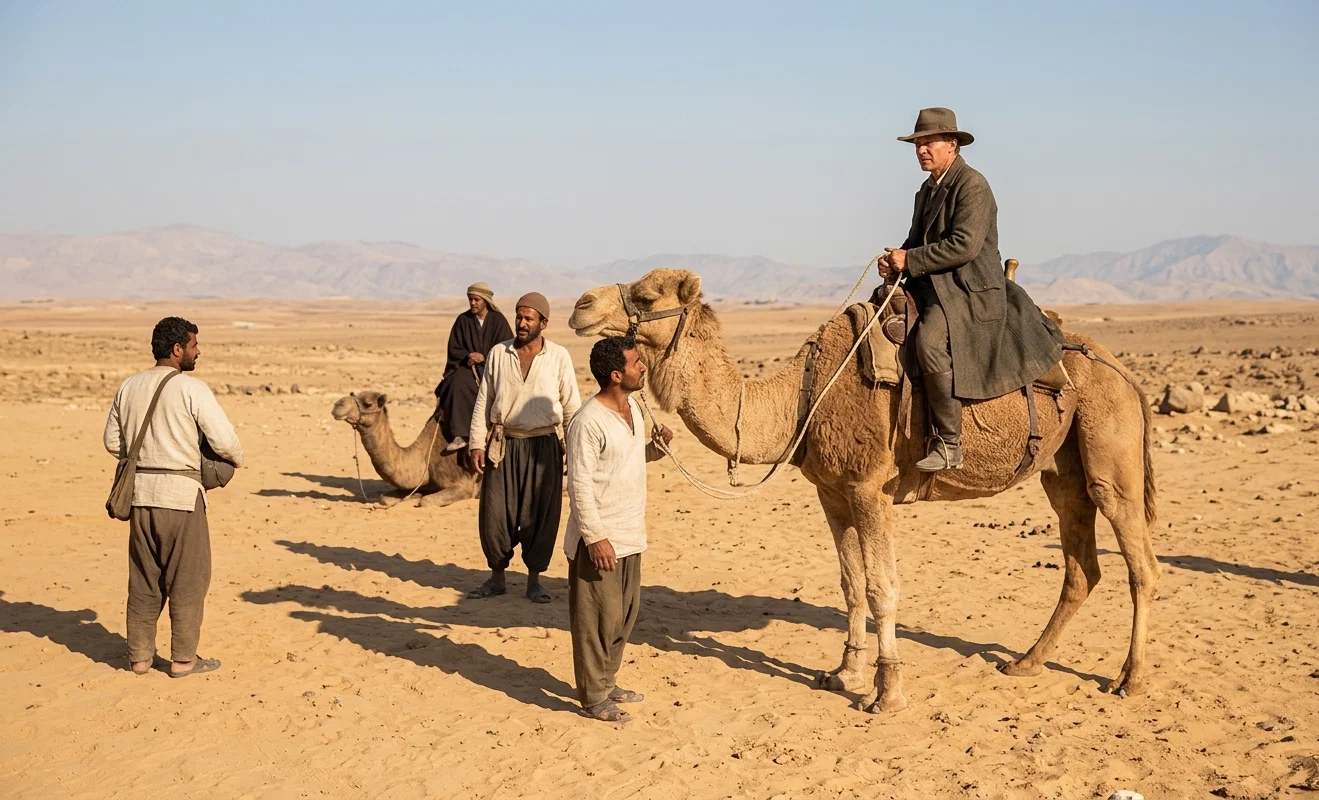
OUR MISSIONARY ON TOUR IN SYRIA
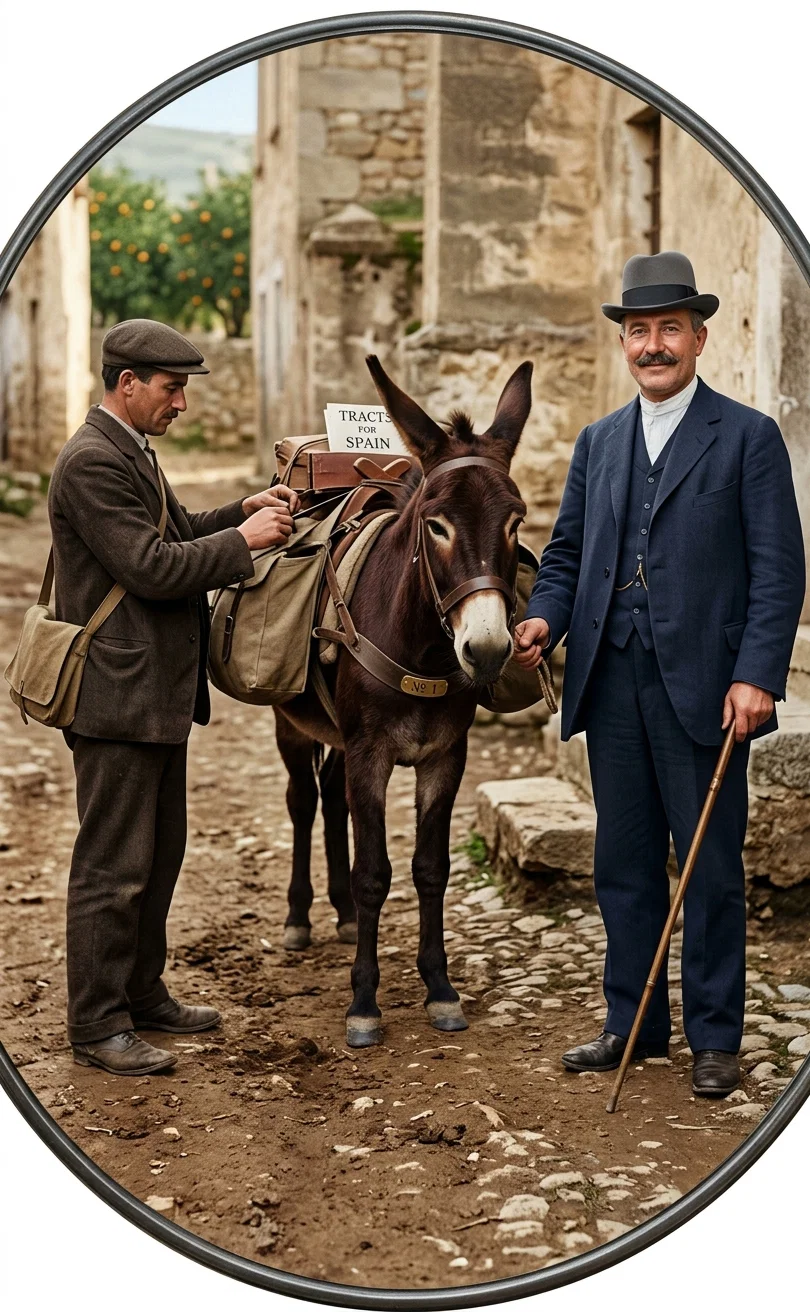
One hundred years ago a French army of eighteen thousand men bombarded the city, and terrible were the results. To-day, one lone colporteur is beginning a far more important campaign, by scattering tracts and papers, filled with the message for this last generation. During that French siege, several proposals of capitulation on honorable terms were made to the Spanish; but they always responded, “Zaragoza no se rinde” (Zaragoza does not surrender). So to-day, though this whole country is filled with idolatry and superstition, and though the battle goes hard and slow, by God’s help the soldiers of the cross will never surrender until the battle is won, and the Life-giver comes to give the victor’s crown. WALTER G. BOND.
Zaragoza.
1. THE SPANISH COLPORTEUR'S
“BURRO EXPRESS”
2. INTERIOR OF AN ARMENIAN MIS-
SIONARY HOME
GREEK PEASANTS
Syrian-Egyptian Mission
By W. C. Ising
The diversity of creeds, and the notorious fanaticism of the various sects in Palestine, sufficiently suggest the difficulty of mission work in Syria. Jews, Catholics, and Mohammedans have their strongholds here, and all are jealous of their rights. It will be of interest to call attention to the fact that here in Syria, this southwestern corner of Asia, the world's three great monotheistic religions—Judaism, Christianity, and Mohammedanism—have originated; and it is here—in this land of Armageddon's battle plain—that the adherents of these religions will again meet in the last great struggle of all nations in the near future.
Our mission is gaining a foothold. At present our laborers are distributed in Beirut, Haifa, Jaffa, and Jerusalem in Syria, and at Cairo and Luxor in Egypt. The very near future must see a number of missionaries enter all the great cities, and the many smaller places. Brethren, needy Syria calls for help.
Beirut, Syria.W. C. ISING.
France Needs the Gospel
By H. H. Dexter
In speaking of France, a certain writer has said that it is the only nation in the world of which the authentic record survives, that, as a nation, it lifted its hand in open rebellion against the Author of the universe. Plenty of blasphemers, plenty of infidels, there have been elsewhere; but France stands apart in the world's history as the single state which, by the decree of her legislative assembly, pronounced that there is no God.
The god of reason is still the shrine before which fall a large proportion of the French people. Silver-tongued orators go from city to city holding mammoth meetings, where they ridicule the Bible and deny the existence of God. There are organized societies of “free thinkers” in nearly all the towns and cities of the nation.
We believe that there are thousands of honest souls in all these cities, who are prepared to hear and accept the message of truth. But where are the workers? Our little French Conference is not yet able to carry on unaided a vigorous campaign in our great centers of population.
The future success of the work in France depends in a large measure upon the proper training of our young people; we are therefore anxious that our Latin Union training-school at Gland shall become a strong factor in preparing young men and women to give their lives to the work in France.
H. H. DEXTER.
Lost in Rome: A Catholic Professor Finds the Way
By C. T. Everson
One day an intelligent-looking but sad-faced man appeared at our door in Rome. “What can I do for you?” I asked.
“From what I know of this world,” he replied, “it is very beautiful, and I think the next world will be exceedingly so. But I have no hope of eternal life. I do not expect to be saved; but if you can give me any hope of being saved in God’s everlasting kingdom, I do not want anything else.”
I told him that he must believe in Jesus Christ.
“Yes,” he said, “but there are so many Christs; there is the Methodist Christ, the Presbyterian Christ, the Baptist Christ, the Catholic Christ, and the Waldensian Christ, and all kinds of Christs. Which Christ shall I believe in?” I told him to believe in the Christ of the Bible. He replied that they all said they had the Christ of the Bible. I told him he must believe in the Christ of the prophecy. He said, “I like your way of telling things. I want to go ahead with you, and study this matter.”
I might say this man was a priest of the Catholic Church, and had been a professor of theology in one of their higher schools. But he had left the church, and wanted to find something better. We had Bible readings together, studying the evidences of prophetic truth, the great lines of historic prophecy centering round the first and second advents, showing the nearness of the coming of Christ and the message for our time. I put into his hands that little book of ours, “Steps to Christ.” After reading this and studying other matter, he came and said, “I believe in the Lord, I believe he has forgiven me, and has made me his child.”
C. T. EVERSON.
“And Also the Greek”
By W. E. Howell
The whole eastern half of the Mediterranean is essentially Greek. There are about ten or eleven million Greeks altogether. The countries of Turkey, Palestine, Egypt, and the northern shores of Africa as far west as Algiers, are all familiar with the Greek language.
As to the Greeks of to-day, their religion and their education both teach them to look backward—backward for their moral and social ideals and for the basis of their national pride.
As to religion, while we may well look backward to the life and teachings of Christ for our moral and spiritual ideals, yet if we must view them through a telescope darkened and blurred with the traditions of men; with the adoration of saints, relics, and pictures; with the literal use of crosses, holy oil, candles, feasts, and fasts; and with individual ignorance of the pure, simple teachings of the Word of God, looking backward ceases to be a virtue. It constitutes, rather, a serious impediment to the entrance of that gospel which points us forward to the blessed hope and the glorious appearing of our Lord.
But “the word of God is quick, and powerful, and sharper than any two-edged sword, piercing even to the dividing asunder of soul and spirit, and of the joints and marrow.” In this, and in this only, we trust for results in Greece.