ROUND the margin of these pages are views of a few of our sanitariums, in this country and abroad, all of which are established not only to heal the sick and teach the principles of healthful living, but to train missionaries for the worldwide field.
An Evangelizing Agency
Medical missionary work is coming to be recognized by all as a most important feature in evangelizing the world. Christ’s work consisted very largely in ministering to the needs of the suffering and afflicted, and with his commission to go into all the world and preach the gospel to every creature, he said also, “Heal the sick.”
Medical missionary work has been said to be the right hand of the gospel message. As such, those who have made use of it find that it furnishes a most successful means of bringing help to people, whether rich or poor, civilized or in heathen darkness. The gospel comprehends man’s physical needs, as well as spiritual.
Our Sanitarium Work
Medical missionary effort in connection with the work of Seventh-day Adventists began at an early stage in their history. As early as 1867 a health institution was established for the rational care of the sick, and for promulgating the principles of health and temperance. From time to time other health institutions have been added in this country and abroad, until at present eighty such institutions for ministering to the sick are being conducted by Seventh-day Adventists, forty-four of which are operated directly by the denomination. Of these, four are in Australia, one in New Zealand, two in India, one in Japan, two in South Africa, one in Palestine, one in Norway, two in Denmark, one in Germany, one in Switzerland, one in Ireland, two in England, and twenty-five in the United States, distributed from Maine to California and from Canada to the Gulf of Mexico.
Sickness is not partial to rank or wealth. When a person needs help physically, he will go where that help can be secured most certainly. The success of these institutions in relieving sickness and restoring persons to health has been so marvelous that people in all classes are glad to avail themselves of the privileges offered. A canvass of the various institutions mentioned above would show that each year, among the thousands who patronize them—last year 21,731 patients were reported—there are governors, senators, representatives, judges, lawyers, ministers as well as people who stand high in the financial world.
Some Facts and Figures
A glance at the financial statistics of our sanitariums for the past four years may be of interest. The sanitariums reported at the end of 1908 a valuation of $2,766,346. After doing quite a large amount of charity work, the net gain of twenty of these institutions reported was $18,980, or nearly one thousand dollars each. The monetary valuation of this institutional work is but a small part of its worth.
There are, in all our sanitariums, nine hundred sixty-six nurses in training. These all earn the entire expense of their education by laboring while studying. Ordinarily a year of training in an educational institution costs each student about two hundred dollars. This is a low estimate. This item of educating young people in our sanitariums would, on this basis, aggregate nearly a quarter million dollars annually. There were in our institutions last year, in all departments, 1,843 helpers, representing a wage roll of half a million dollars annually, and practically all are paying into the treasury their tithes and offerings for the support of the gospel work.
ROSTREVOR HILLS HYDRO., IRELAND.
COLLEGE VIEW-NEBR
GLAND, SWITZERLAND
PORTLAND, OREG.
SKODSBORG, DENMARK
TAKOMA PARK, WASHINGTON, D. C.
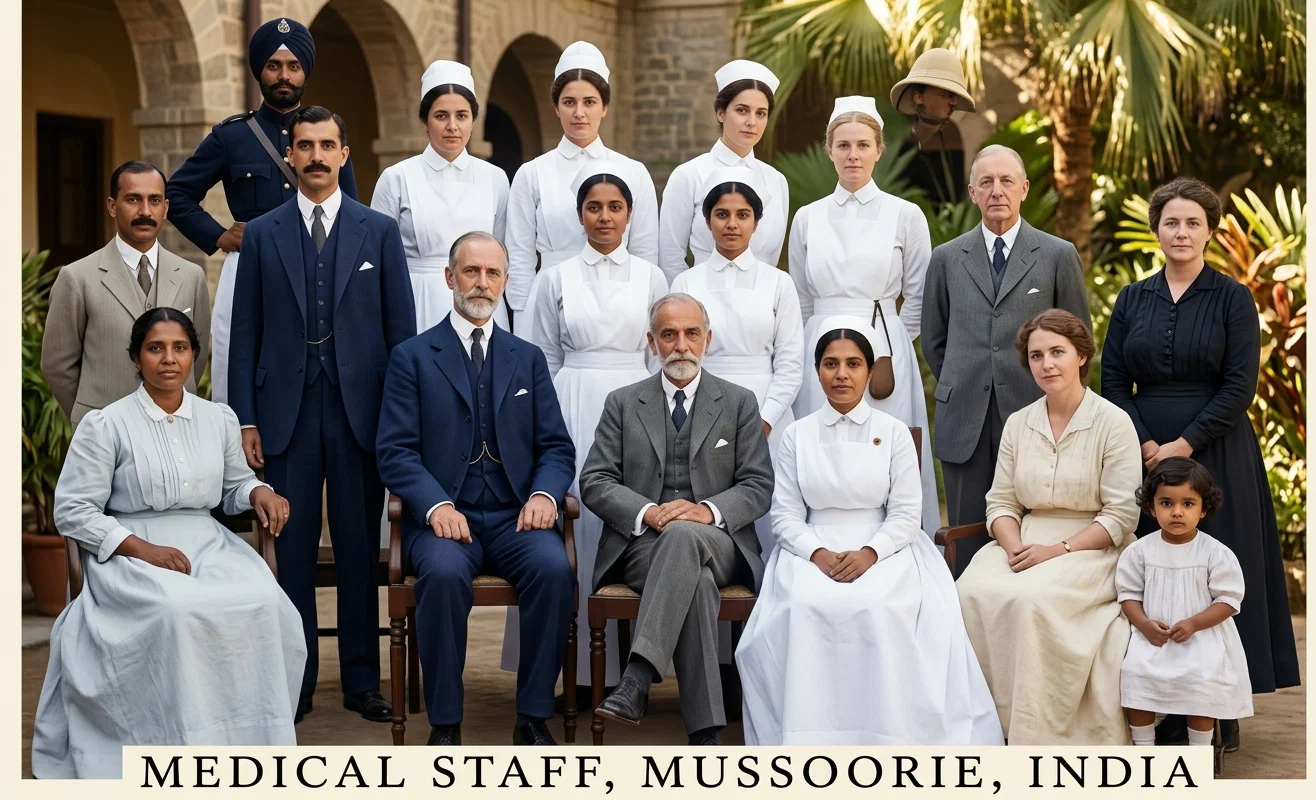
MEDICAL STAFF AT MUSSOORIE, INDIA
17
ST. HELENA'S CAL.
THE NORMAL CITY, CAL.
The amount of charity work reported by twenty-seven of these sanitariums last year was $58,796, or $2,174 apiece. The same average, applied to the eighty sanitariums in existence, would mean over one hundred sixty thousand dollars annually devoted to caring for worthy poor. I am well aware that we can not estimate the worth of this branch of the gospel message in dollars, or its strength in men, but the enumeration of these various points is a great stimulus to enthusiasm and devotion in our work, and without either of these agents we could do but little.
Health Literature
It is a well-recognized fact that medical literature is an important agency in advocating health and temperance reform. The various periodicals published in connection with this department of our work have had wide distribution. Life and Health, our health monthly, published at Washington, D. C., has steadily grown in circulation, now approaching one hundred thousand a month. Our English Good Health, published at Watford, England, has a circulation of 45,000 copies a month; the German Gute Gesundheit, 17,000 monthly; the French health journal, 6,000; the Dutch, 5,000; the Danish, 5,000; and the Australasian Good Health, 7,000.
The following medical books are published in English by our denominational publishing houses as a part of the educational work we are doing in behalf of right living: “Home and Health,” 600 pages; “Practical Guide to Health,” 668 pages; “School of Health,” 400 pages; “Health for the Millions,” 266 pages; “Colds,” 75 pages; “Health—How to Find It When It Is Lost, How to Keep It When It Is Found,” 240 pages; “Ministry of Healing,” 540 pages; “Vegetarian Cook Book,” 266 pages; “Friend in the Kitchen,” 100 pages.
Besides these are a number of smaller books, and forty or fifty tracts and pamphlets on health and temperance subjects.
FRIEDENSAU, GERMANY.
WAHROONGA, SYDNEY (N.S.W.)
MELROSE COTTAGES
LAFAYETTE BLDG.
AL
LOMA LINDA, CAL.
Health literature is published also in various languages other than the English, in Europe, Africa, India, China, Mexico, South America, and other regions.
Medical missionaries, both physicians and nurses, have been sent by our Mission Board to almost every country on the globe. We are grateful to God for his prospering hand over our medical missionary work during the years past, and by his aid we trust this agency, as the right hand of the gospel missionary work, may become increasingly efficient in helping to carry the glad news of salvation to all the world in this generation.
W. A. RUBLE, M. D.,
Secretary Medical Department.
Illustrative Field Notes
ONE of our doctors had just joined a mission station in Korea. The people at once so thronged him that “it was necessary to build a wire fence about his house, that he might get sleep and the necessary time for language study.”
A Tamil boy in South India had been saved from cholera by successful treatment. The next Sabbath a silver rupee (thirty-three cents) lay on the table in the meeting hall, a thank-offering from the boy’s father. “It represented four or five days’ work, and more—the poor man’s feeling of appreciation.”
From amid busy, crowded days of ministry to bodies and souls in the chief city of far Hunan, China, Dr. Emma Laird writes: “What we need here more than anything else, perhaps, is your prayers that the power of the enemy may be overcome, and people loosed from the bondage of superstition and sin.”
Miss Schlegel writes from Cairo: “It is not easy to nurse in an Arabic house. If anybody is ill, all the relatives and friends come to the house, and sit about, talking, smoking, and drinking coffee, with windows closed.”
THE NEGLECTED CONTINENT
By J. W. Westphal
The Highway Prepared
ON its discovery, South America fell under the yoke of papal domination. The Inquisition was set up, and civil and religious liberty were unknown. But the awakening to liberty that swept over North America and Europe a little over a century ago, overturning the old order, aroused South America also, and these peoples proclaimed liberty. The independent republics were the result.
Though papal oppression was by no means at an end, the leaven of liberty was planted. Through revolution and struggle, by voice and pen and sword, each striving for mastery, the power of the oppressor has been broken. The Word of God passes majestically through the lands where only a few years ago it was unknown. The door is open for the final gospel message to be preached in every South American land.
With the open doors of the nations, there are also open hearts. Souls are hungering and thirsting for the truth. Deaf ears are unstopped. Wicked men are turned to the ways of God. This shows that the opening of the doors is of God, and that the highway is prepared in order that we may quickly do our appointed work. The ever-present question is, Will we do it?