Review and Herald Publishing Company · Washington, D.C.
The Back-Door Entrance
By C. A. Hartley
C. A. Hartley
In my home town of Pomeroy, Ohio, for twenty-five years I have sat at a desk where I could look across the street at the rear entrance of a saloon. I was not there many days until I noticed a stripling of a country boy go into that back door with an older companion. The boy went with a hesitancy which indicated to me that he was persuaded against his desire and better judgment to do so. When he came out, he looked up and down the street before walking away. It was a long time before he came again, a little more boldly this time, and he was less careful not to be seen when he departed.
Within a year his visits grew more frequent, and he remained longer inside. Up to that time he never seemed to be the least intoxicated when he left. In fact, he looked better and acted better. He had shaken off somewhat that shrinking country air so common in rural boys coming to town. He dressed better, and had assumed a sort of jaunty mien, and would have been taken as an average youth not yet down to the even and steady trot of life.
The next year he came still more frequently, and sometimes had not come out when I had finished my day's work and gone home. Once about the middle of the second year I noticed a reddish flush on the cheek next to my window as he came out, and a little later he staggered slightly as he turned down the sidewalk, and seemed to be ashamed of it.
The next year he moved to town, and secured work in a factory. For a few years then I never saw him go in that back door except on Saturday afternoons, but he was pretty sure not to miss appearing on these half-holidays. He seemed to be a man of habit. The appetite fastened on him with all the certainty of death, but somehow he never got to going in at the front door. It was always the same old path he trod, notwithstanding he had lost whatever hesitancy he had in the beginning about entering and leaving. He now plunged in without looking to the right or the left, and walked out when he was ready to do so, unabashed and unafraid.
Ten years after I first began to notice him, he married a girl of about his own station in life. For a while his back-door visits almost ceased. Evidently he was spending his leisure hours with his young wife. Within a year, however, he came oftener than ever; and one evening I saw his wife standing irresolutely on the sidewalk waiting for him to come out. When he did emerge from the building, there was a little scene. He scolded her for coming after him, and she apologized for interfering with his pleasures, for the reason that the supper was getting cold, and the baby was not well.
Notwithstanding his growing bibulous habits, he accumulated a comfortable little home, and several interesting children had come to bless it, all within the next five years. Then came an appointment to a public office, by reason of a public pull and political affiliations. One day he awoke suddenly to the fact that he had gone far down the road toward making a drunkard of himself. He rallied, and went off to a cure establishment, and came back apparently ready to start life over. He fell again by way of the back door of the same saloon, regained his feet by taking treatment again, and again fell. He had not the moral force to try again to recover his footing, and has since put in his days and nights, no doubt, trying to keep the path from the sidewalk to his favorite saloon well-worn and easy to find.
His home has been broken up; his wife and children have been obliged to leave him for self-protection. He has lost all his property, self-respect, and friends; and but a few days ago I saw him hobbling in at the selfsame back door, old, broken, and bent, a pensioner on his relatives and friends, and a hopeless wreck.
That is the plain, unvarnished story of what has happened at the back door of one of our dozen or more saloons in the third of the span of an ordinary lifetime — told without an attempt at sermonizing or pointing a moral.
Only last week I saw the proprietor of that saloon come out the back way to enter his carriage for a drive, and, meeting the human derelict of this story in the path, ordered him off the premises.
So far as I have been able to observe, not a saloon in our town has ever turned out a minister, a successful lawyer, a prominent educator, a writer of ability, a politician with a lasting reputation, a good husband, a kind father, or loving sons; but, on the other hand, they have all had a large part in unmaking the lives of hundreds in the few years that I have been looking from my window at the scene.
The phase of the saloon question which permits of the secret or rear entrance is that which has impressed me much. There must be a beginning to every man's downward course, and the back door is usually the first entering-place. If the saloons can not be closed forever by law, many lives and homes can be saved by spiking their back doors so tightly that they can not be opened.
Whisky or the Baby
By H. S.
“Don't go out now, papa. Baby is so sick that I fear she will die before you come back,” pleaded the young mother.
“It's the same old song with you!” was the rough reply.
“Well, don't go to the saloon; please don't.”
With a terrible oath he left the house, banging the door as he passed out. The sick child started, but the mother's tender caresses again quieted the blue-eyed sufferer.
Only twenty-one years had passed since the mother herself was a babe in her own mother's loving arms. Now at her side played a little two-year-old boy, and in her lap lay a baby girl. Had it not been for the accursed liquor, her cup of joy would have been full.
Her betrothed promised her that he would never drink after their marriage; and she, like many others, was hopeful, and believed that love was stronger than the appetite for liquor. But, alas! liquor conserves only love for itself. Love for friends and right is soon overshadowed by an ever-increasing love for self.
So the sorrow of a drunkard's wife had now been her portion for three years. Night after night had she waited long for him to come home; and when he came, she had only a staggering, cursing, drunken sot to welcome. And now spinal meningitis was fast doing its fatal work for her baby girl. She could see plainly, as the hours wore on, that the little life was slipping away. She longed for the sympathy and support of the father of her child; but he did not come. Finally, in her agony, she cried: “My poor baby is dying, and he isn't here. What shall I do?” A convulsion, an appealing look, and the child was gone. Neighbors came, and did what they could for the sorrowing wife and mother; but no husband was there. They found him drunk in a saloon, H. S.
Rum as a Factor in the Border Wars and Conquest of Ohio
By George P. Donehoo
Rum as a Factor in the Border Wars of the Early Days, and Its Influence in the Conquest of Ohio
George P. Donehoo, D. D.
[Mr. Donehoo has done much research work for the Smithsonian Institution, Washington, D. C., and has contributed considerable historical material to various publications.]
The history of the French and Indian war, and the succeeding period of Indian hostility, when western Pennsylvania, Virginia, and Ohio were simply deluged in blood, would read differently had the traffic in rum been eliminated from the problem which the English had to solve. The conquest of the rich region beyond the “endless mountains,” in which there now exists the greatest empire this world has ever known, is one of the romances and one of the tragedies of history. The struggle between the French and the English for the possession of this transmontane empire is one of the most fascinating stories of human history. When the conflict began on the shores of the “beautiful river” in 1753, there were three leading actors in the drama, which was to result in the greatest conquest the Anglo-Saxon race has ever made,—the French, the English, and the Indian.
In the years of strife and bloodshed which followed before this empire was possessed, the Indian held the balance of power. The armies of France and those of Great Britain alike sought the friendship and assistance of these red warriors of the mountains and forests. Had the English treated these proud and haughty warriors with the kindness and respect which had been the custom of the Penns, the Indian as a factor in the solution of the problem would have been eliminated, and the conquest of the Ohio would have been a less bloody one. After the death of William Penn, the policy of the province in dealing with the Delawares was changed. Before these Indians sensed what was being done, they had lost all their lands along the river, which had belonged to their ancestors for generations. They began their migration to the waters of the Susquehanna. They, with the Shawnees, who had come into the province from the South, settled along the shores of the “winding river,” hoping that they might be allowed to live along the beautiful valleys of this forest-enshrouded wilderness, undisturbed by their invaders. But no sooner had they builded their wigwams than they were followed by the Indian traders, who followed them as keenly as ever Indian hunter pursued the trail of the deer, bringing their ponies laden with rum, which was their chief article of trade. The debauchery which they had escaped on the Delaware followed them into their villages on the Susquehanna.
The wise chiefs of the Iroquois, Shawnees, and Delawares petitioned the authorities of the province again and again to put a stop to this trade, which was ruining the women as well as the men of their tribes. They sent envoy after envoy to Philadelphia protesting against the sale of rum. Canassatego, the eloquent Iroquois chieftain, and Shikellimy, the vicegerent at Shamokin, again and again besought the provincial authorities to keep this horde of Indian traders, with their death-dealing rum, away from their settlements. The authorities made a half-hearted effort to put a stop to the sale of rum in the Indian villages, but it had little effect. The traffic in rum went on, with its strifes and bloodshed. The colonial records and archives of Pennsylvania are filled with the accounts of the conflicts of the Indians and the Indian traders because of the quarrels, debauchery, and bloodshed caused by this unrestricted traffic in rum. The Indians were made drunk, and then cheated of their skins and peltries. When they sought revenge for these wrongs, bloodshed resulted, and they were then brought into conflict with the white settlers, who were rapidly pressing into the Susquehanna region. Almost every murder of a white settler of this period was due to a quarrel following a drunken brawl, in which the Indian had been cheated out of his entire year’s store of skins2and peltries. The writer does not know of a single murder which was not so caused, and that after reading the official accounts of every murder of a white settler by an Indian in this period.
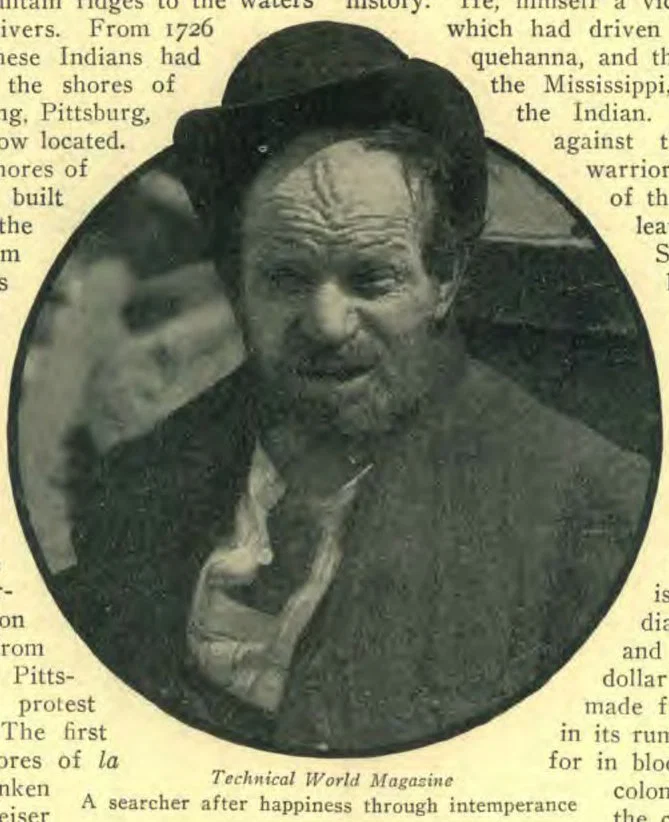
Technical World Magazine
A searcher after happiness through intemperance
When the Shawnee and Delaware along the Susquehanna found out that they could not keep the traders in rum out of their villages, they began to move in large numbers across the great mountain ridges to the waters of the Allegheny and Ohio rivers. From 1726 to 1732 a great many of these Indians had builded their villages along the shores of these streams, where Kittanning, Pittsburg, Beaver, and other cities are now located.
Here, on the forest-bounded shores of the “beautiful river,” they built their wigwams, hoping that the rum trader would leave them alone to paddle their canoes over the waters of what was then a beautiful paradise, and to hunt in the forests, which were filled with game. But the smoke had hardly arisen into the blue sky from their fires before out from the forest trails came the trader with his rum-laden ponies. Then commenced the same history of cheating, quarrels, bloodshed, and murder on the Ohio. The first message from the chief who lived where Pittsburg now stands was a protest against the traffic in rum. The first murder committed on the shores of la belle rivière was due to a drunken debauch. When Conrad Weiser crossed the mountains to the Ohio in 1748, on his way to Logstown, where the first council of the English race was held with the Indians west of the mountains, one of the chief matters spoken of by the representatives of the Indian tribes on the Ohio was the traffic in rum. The French had been brought into trade relations with these Indians, and the English were doing everything in their power to win them back to their allegiance to them. Every effort had been made by the authorities of the province to induce the Delawares and Shawnees to move back to their old homes on the Susquehanna, which they had left to escape the traffic in rum. Mark well what this means. When the struggle between the French and the English for the possession of the Ohio began, the situation was complicated because of the presence of the Delawares and Shawnees, who had been driven from their homes on the Susquehanna chiefly because of the various land sales and the rum traffic. When General Braddock’s ill-fated army was cutting its way through the dark forests and over the great ridges of mountains, these Ohio Indians were nearly all on the side of the French, who would not allow rum to be sold to them. Braddock’s fearful disaster on the banks of the Monongahela was due far more to the abuse and the bloodshed which had resulted from the rum traffic by the Indian traders than to any lack of ability on the part of the sacrificed British general. After Fort Duquesne had finally fallen into the hands of the British, there commenced the struggle for the possession of the land, which the Indian claimed by right of previous conquest and settlement.
The history of this period is one almost unbroken succession of scenes of bloodshed and cruelty. The Indian was fighting for his “home and native land” as truly as did any patriot who fought for his fireside against the invader of it. The chief factor in the fearful scenes of bloodshed which make this period one of the darkest in American history, was the same which had stained the waters of the Susquehanna with blood a generation before. Tedyuskung, the last of the great chiefs of the Delawares, pleading for peace and the rights of his people to live in the land which had belonged to his fathers, is one of the most pathetic pictures in American history. He, himself a victim to the vice of the race which had driven the Delawares to the Susquehanna, and then to the Ohio, and then to the Mississippi, knew what rum meant to the Indian. At last, after a struggle against the stronger race, the red warrior vanished from the waters of the Susquehanna and the Ohio, leaving his beloved vales of Skehandowana and the rich hunting-grounds of the Monongahela to his conqueror, whom he defeated in almost every battle, but to whose rum he bowed his feather-crested head in humiliation and defeat. The story of the border wars of the early days has been repeated in Dakota, in the Lava Beds, in Alaska, and is being repeated in every Indian village of South America and Mexico to-day. For every dollar the Anglo-Saxon race has made from any of the native races in its rum traffic, it has in return paid for in blood. Eliminate rum from the colonial history of America, and the conquest of the Ohio and the Mississippi and the great Northwest would not be written in letters of blood.
A Spurious Basis for Happiness
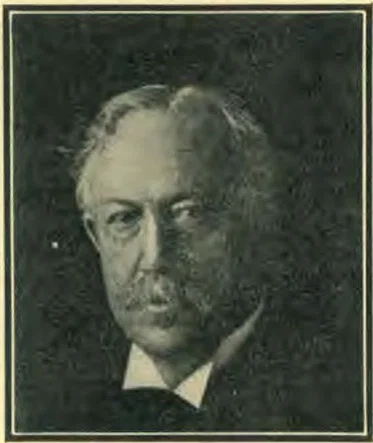
David Starr Jordan
PRESIDENT OF LELAND STANFORD JUNIOR UNIVERSITY
[An article for this number of the INSTRUCTOR was solicited from Dr. Jordan; but as he was traveling in Europe at the time, his secretary sent us one of his books, from which we gathered the following strong words for the temperance cause.]
David Starr Jordan
THE basis of intemperance is the effort to secure through drugs the feeling of happiness when happiness does not exist. Men destroy their nervous system for the tingling pleasures they feel as its structures are torn apart. There are many drugs which cause this pleasure, and in proportion to the delight they seem to give is the real mischief they work.
Pain is the warning to the brain that something is wrong in the organ in which the pain is felt. Sometimes that which should be felt as pain is interpreted as pleasure. If a man lay his fingers upon an anvil and strike them one by one with a hammer, the brain will feel the shock as pain. It will give orders to have the blows checked. But if, through some abnormal condition, some twist of the nerves, or clot on the brain, the injury were felt as exquisite delight, there would arise the impulse to repeat it. This would be a temptation. The knowledge of the injury which the eye would tell to the brain would lead the will to stop the blows. The impulse of delight would plead for their repetition; and in this fashion the hand might be sacrificed for a feeling of pleasure, which is no pleasure at all, but a form of mania. Of this character is the effect of all nerve-exciting drugs. As a drop of water is of the nature of the sea, so in its degree is the effect of alcohol, opium, tobacco, cocaine, kola, tea, or coffee, of the nature of mania. They give a feeling of3pleasure or rest, when rest or pleasure does not exist. This feeling arises from injury to the nerves which the brain does not truthfully interpret.
Some phase of mental unsoundness is the natural effect of any of those drugs called stimulants or narcotics. Alcohol gives a feeling of warmth or vigor or exhilaration, when the real warmth or vigor or exhilaration does not exist. Tobacco gives a feeling of rest which is not restfulness. The use of opium seems to intensify the imagination, giving its clumsy wings a wondrous power of flight. It destroys the sense of time and space; but it is in time and space alone that man has his being. Cocaine gives a strength which is not strength. Strychnine quickens the motor response which follows sensation. Coffee and tea, like alcohol, enable one to borrow from his future store of force for present purposes. And none of these make any provision for paying back the loan. One and all, these various drugs tend to give the impression of a power, or a pleasure, or an activity, which we do not possess. One and all, their function is to force the nervous system to lie. One and all, the result of their habitual use is to render the nervous system incapable of ever telling the truth. One and all, their supposed pleasures are followed by a reaction of subjective pains as spurious and as unreal as the pleasures which they follow. Each of them, if used to excess, brings in time insanity, incapacity, and death. With each of them, the first use makes the second easier. To yield to temptation, makes it easier to yield again. The weakening effect on the will is greater than the injury to the body.
Our Responsibility
By M. Ellsworth Olsen
M. Ellsworth Olsen, Ph. D.
PROFESSOR OF ENGLISH IN THE FOREIGN MISSION SEMINARY, TAKOMA PARK, WASHINGTON, D. C.
SIR ANDREW CLARK, physician in ordinary to Queen Victoria, said that when he looked at the hospital wards, and saw that seven out of ten owed their diseases to alcohol, and when he thought of all the other evils wrought by drink and drink alone, he felt impelled to give up his profession, “to give up everything, and go forth upon a holy crusade, preaching to all men, Beware of this enemy of the race.”
Would he had done so! Would that thousands of other talented physicians might devote their lives to giving the same solemn warning! By so doing they would most truly serve the interests of suffering humanity, and exemplify the principles of the healing art.
The drink traffic is the foulest blot upon our twentieth-century civilization. It has made the white man a desolating curse to many other noble races, and has poisoned his own race at its source, tainting the blood of millions of innocent little ones, multiplying crime and disease, crowding prisons and insane asylums, and filling to the brim the cup of bitterness for an untold number of wives.
And the saddest thing about it all is that it is entirely unnecessary. Alcohol satisfies no natural want. It is wholly uncalled for. The man who pays ten cents for a drink would better throw his dime into the gutter. The money spent Saturday night in the saloon might far better have been burned up. It does absolutely no good to any one. Have we then so much money that we can afford this terrible waste?
But alcohol is much more than useless. It does real harm to the body; for it is a poison, and in anything like large doses a deadly one. But even a very small quantity interferes with a person’s doing his best work. Sir Frederick Treves was in the Boer War, and with the column under Lord Roberts that marched on Johannesburg. It was a hard march, and many succumbed to fatigue. He says significantly that it was not the tall men that dropped out, nor the short men, nor the men with weak stomachs, or weak kidneys, or other weakness or infirmity: it was the men who took alcohol. Nansen, while at a dinner of medical men and scientists held at Munich, was asked, “Did you take any alcohol with you when you left the ‘Fram’ to make your heroic expedition by sledges?” “No,” he replied; “if I had done so, I should never have returned.”
Alcohol is not only absolutely useless, and distinctly harmful to the one who takes it, but it is the agent of such terrible moral transformations, involving not only ruin to the user, but also dragging down with him his innocent wife and children, that on this account alone it should be judged the chief enemy of the race. The influence of the saloon is perhaps best understood by a consideration of its doings from day to day. Here is an item from a London daily, telling in plain, straightforward language what was seen on the outside of a saloon one Saturday night during the space of an hour and a half:—
The watchers saw during that time 795 persons enter its doors. Of these 209 were men, 380 women, 83 youths and girls, and 123 very young children and babies in arms. Seven perambulators were taken in, some of which had in them two children. Outside there was scarcely an uneventful moment. Three women were turned out and five men. There was one very bad fight, and six disturbances. Three girls about seventeen came out quite drunk. Twenty-four men, including a pot-man in livery, and nineteen women left the house helplessly drunk. Two of the women had babies in their arms. At 10:50 the house had to be closed, with the exception of one small door, on account of a frightful row. A policeman had to stay outside after that till closing time.
The saloon tells only a small part of the story, however. It is when one follows the victim of drink to his home, if home it may be called, that the full effects are seen. To let wife and children go hungry and naked is a small thing. That goes without saying. The man who is maddened with drink is capable of any crime. One such poor intemperate was met, as he returned home, by his four-year-old son. Had he been sober, he would have pressed him to his bosom; but he had been drinking heavily, and he took that boy by the shoulder, lifted him over his head, and threw him out of a second-story window. They picked the little fellow up with both thighs broken.
Drunkenness is to be fought, not only because it is a terrible evil in itself, but because it opens the door to almost all other evils. In the words of John B. Gough, who could speak from experience, it “solidifies, crystallizes, and makes chronic every evil passion of depraved human nature. It is the promoter of all that is evil, and all that is vile, and all that is abominable.”
But let us not forget to lend a helping hand to the man who has fallen. There is no one more to be pitied than the slave of strong drink; he has the whole world as it were against him. Temptation compasses him on every side, and there are so few, so very few, to put a kind hand on his shoulder, and call him brother. Even the most hopeless cases sometimes respond to kindness. Said John B. Gough:—
In the heart of the worst drunkard, away up a great many pairs of stairs, in a very remote corner, easily passed by, covered with cobwebs, there may be a door. It is our business to find that door. It is our business to seek for it, and when we have found it, to knock! Yes, and wait, and not go away and say, “It is no use!” Remember Him who knocks at the door of our hearts, till his hair is wet with the dew; and remember this is one for whom he died, and that he is your brother. Knock on! And, by and by, the quivering lip, and faltering tongue, and starting tear, will tell you that you have been knocking at the heart of a man—a heart that can be touched by tenderness and love.
And what should be the attitude of Christians, yes, of all lovers of their fellow men, toward the traffic in such a monster evil as alcohol? Surely there should be no lukewarmness, no sitting on the fence, no glossing over of the terrible facts. Christians should set their faces like a flint against the drink evil. They should be prohibitionists in word and in deed. Their zeal in fighting the drink curse should be something like that of a very4determined and pious little girl whose brother had set some traps for singing birds. Asked what she did under the circumstances, she replied: “First I prayed that the birds might not get into the traps, then I prayed that the traps might not hold them if they did get in, and then I went and kicked the traps all to pieces.”
(Concluded on page five)
The application is clear. We owe a duty to the boys and young men who have not yet been caught in these traps. We owe it as a duty to help those who have been caught to get out again. It also behooves us to do our utmost in a lawful way to destroy the traps,—to do away with the licensed saloon, which is responsible for more crime and misery than any other one institution in the world.