LIFE is a race, not so much a race in which we try to get ahead of others as one in which a prize is tried for, and in which there is a big prize for every one who strives honestly and according to the rules of the game.
Boys, I am an older boy than you, but I began when I was your age with great interest watching the other boys around me at school and at college, and, later, at work. As far as I could, I have kept track of every one of them. I was in Switzerland a few years ago climbing a big hill to get a view out over a glacier, when suddenly I came upon a little party of climbers, and there among them I found an old familiar face. “Are you J. Mc B.?” I asked. “Yes, I am.” “Why, I have been trying for thirty years to find out what had become of you, and have never been able to up to this moment.”
I was at Silver Bay, on Lake George, six years ago, and there at the head of the table sat a gentleman named Scott. Something familiar prompted me to ask him: “Can you tell me anything about Walter Q. Scott, whom I used to know twenty-five years ago, camping out in the North Mountain, in Sullivan County, Pennsylvania? I have never seen him since, though I have often inquired.” He answered: “I am the man. Are you the Howard Kelly who used to swim races up and down the lake [Long Pond]?” I replied that I was. And a delightful friendship was taken up just where it had been left off, and has continued year by year since. Boys, count friends the best possessions on earth. Collect eagerly all you can, and seek day by day so to live in the grace of God our Father that you may be worthy of them.
Now what I have just said was a digression; but I wanted to know you, and to get your confidence, before speaking more in detail about that race of so much importance to us all. At best, though life looks long to you and the goal of the race far away, every one who has got more than half-way over the course says it is really but a short race after all, something like a hundred-yard dash, and it is over, and you are done, and must clear the track for others coming after you. Now not one of you has ever been over the course before, and you don’t know where the hurdles and the pitfalls and the obstructions are, the things that tend to throw a fellow, and make him lose his prize. But every older fellow does; for there is not one who has not been tripped sometime or other, and got up badly bruised, and had to nurse a game leg afterward, which seriously handicapped him in continuing his race. Indeed, I have seen some fellows limp all the rest of the way; and a few poor boys at the first fall just lay down by the roadside and died, and never got there at all. How often I think of them, and wonder if I could have protected them in any way if I had run a truer race myself and offered to help!
Now, boys, it is an odd thing that, while we run the race with our bodies, yet it is as a rule these very bodies which have other desires than winning races and prizes, and so conspire to keep us back. The old body, which is of the earth, wants to take it easy, to lie down and sun itself by the side of the track, to indulge its various appetites , many of which are a sore hindrance to the spirit within. The body says: “Let me have all I can get out of life right now and here; don’t go to disciplining me. I don’t care for that bothersome prize at the end, which the spirit inside me so longs for.”
The body asks for things that bring immediate pleasure, regardless of cost, and I grant you there is often a lot of fun in giving way for a time; but it is like spending your capital; afterward you can seldom, if ever, get back to the place you occupied before.
The boy who indulges his body for the sake of the immediate pleasure he gets is like a general who is attempting to hold an enemy in check, but carelessly allows him to occupy every strategic position. Each one he may foolishly give away makes him weaker and weaker, until at last he who was the master now has to capitulate to the enemy.
If you want to make a bee-line for that tree far away across the field, keep your eye steadfastly on the tree and run for it. Don’t dawdle and watch your feet as you put one foot before the other, trying to make a straight line, or you will soon begin to go backward.
I tell you, boys, with all the earnestness I can command that most of the fellows I have known who let their old bodies get control of them in that way, and gave up trying for the prize, fell by the wayside; or, if they still live, they—well, I wouldn’t be one of them for all the wealth and honors the world can offer.
Now the body is a good deal of a sneak, and utterly lacking in sense, and has to be controlled by its master, the spirit, even for its own preservation, let alone any consideration of that prize at the end of the race. The body tries to wheedle you, saying, “Well, just indulge me a little; I don’t ask for much.” But, fellows, be warned. That is a trick of the body to pull you over the danger line. Don’t give in one inch, or for one minute.
I find one of the things which hinders most is impure talk, telling or hearing stories which are not sweet enough and pure enough to be told to mother and sisters.
Then there is that curse, drink. Don’t touch it. No person can tell beforehand that he is safe. Those are safest, I have found, who have the least self-confidence. What a list I could make out here of the splendid men, so sure and boasting of their will-power when they were young, who have been destroyed by the drink demon! Then, too, even if I can know it is not going to hurt me, how can I in conscience and decency take something which I really do not need, and which has wrecked the lives of so many I love? You, too, when you get to be fifty years old, will be able to make out a sad list of your friends who have died of drink, wrecking their prospects, and blighting the happiness of wives and children.
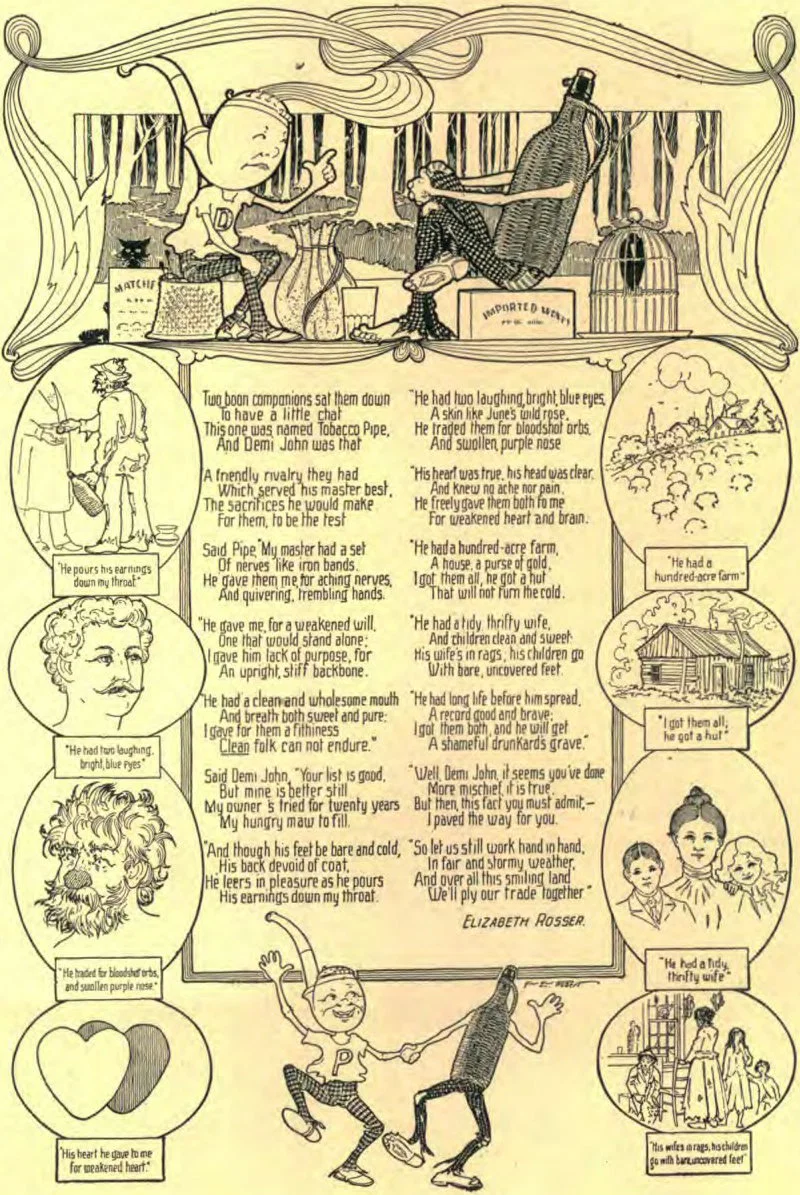
Boys, if I were you, I would let tobacco alone, too. As a doctor, I see and constantly hear of many who are seriously hurt by it. It is a wasteful habit, and easily becomes a harmful one, readily interfering with your success in life. The national bill for tobacco is something appalling; it is a terrible indictment against a nation like ours, where so much good can be done with modest sums of money, that so much is utterly wasted yearly in smoke.
If you master your body, the other fellows may for a little while think you are odd, and you may feel somewhat estranged from some of the companions you like; but after a while they will rally round you again, and17you will become a sort of prop for many who need just such an example and just such a friend.
Now here comes the connection with the digression at the start. There is no more precious possession in the world than good friends, but you can not get them, and you can not hold them, unless you keep your bodies in subjection to the spirit. Friendships on a lower plane than this are not worth having, the bond is such a weak one, and so easily broken.
Boys, friends, keep your old body in subjection, and run your race in the grace and power of God, given through our Lord Jesus Christ, and you will surely win the great prize, the only one worth having.
Prohibition and Personal Liberty
By Lewis M. Simes
Lewis M. Simes
SOUTHWESTERN COLLEGE, WINFIELD, KANSAS
Lewis M. Simes
[The following article is a prize oration, delivered by the author last June in the national oratorical contest of the Intercollegiate Prohibition Association, at Valparaiso, Indiana. Mr. Simes won second place in this contest; but in the central interstate contest of seven States he won first place.]
Evil Disguises Itself as Good
I’m for “personal liberty”
The powers of evil delight to take for their standard an emblem of heaven. The prince of darkness comes “transformed into an angel of light.” In the facts of to-day this truth is confirmed. The liquor traffic hides behind the insignia of truth, and takes personal liberty for its watchword. Therefore, I stand here to-night, not to heap anathemas upon the drunkard, not to proclaim the economic evils of the drink traffic, great as they are, but to tear from this shameless hypocrite of the ages his thin mask of righteousness, and to proclaim him as he is.
Prohibition Consistent According to Law
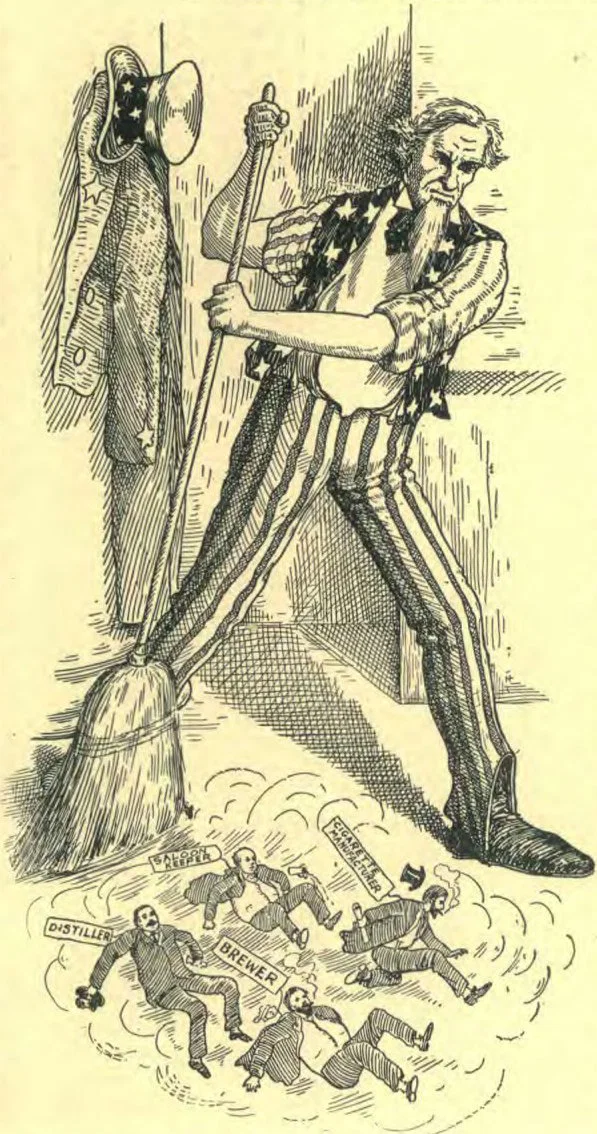
Consider the status of the liquor traffic before the law. More than half a century ago the saloon forces began to make the hollow plea before the courts of the land that prohibition endangered the freedom of the individual. With pretended patriotism they declared that the abolition of the saloon infringed upon the constitutional privileges of American citizenship. The Supreme Court passed judgment upon these sophistries. It swept them away like cobwebs. Decision after decision was handed down. Finally, in the case of Crowley versus Christensen, the court delivered an opinion, approved by every member of that judicial tribunal, and written in such definite and forceful terms that none could misunderstand its meaning. This decision declared that the retailing of alcoholic liquors is not an inherent right of citizenship, and that the restriction or entire prohibition of the liquor traffic does not infringe upon the liberty of the individual. But the crowning decisions rang out in the court-rooms of this grand old State of Indiana, when Judges Artman and Christian boldly declared that the mere licensing of such a moral ulcer as the liquor traffic is immoral, illegal, and unconstitutional. And God grant that, not only from Indiana’s district court, but from America’s supreme tribunal, shall come the words: From henceforth, O rum king, you are outlawed; no more shall legislatures license your villainies or protect your crime!
Prohibition Consistent According to Principles of Liberty
But some may think that court decisions alone do not prove prohibition consistent with personal freedom. To them I would say, Consider the true nature of liberty itself. What is this freedom we so fondly cherish? Is it the right to do as one pleases, regardless of others’ welfare? Is it the right to break law, to injure property, to destroy life?—No, that is not liberty; that is license. Except a man remove beyond the confines of human habitation, he may not do as he will. As long as men dwell together, so long must each regard the others’ rights. What, then, is true liberty?—True liberty is that sphere of action granted to the individual in the exercise of which he does not infringe upon an equal sphere of action granted to others. Apply this principle to the saloon. True, we are told the law can not say what a man shall drink if no one is harmed thereby. But the fact is, the saloon does harm some one. It seizes the laborer in its greedy clutch and filches his toil-bought gold. It crowds the vacant corridors of poorhouses, prisons, and asylums. It touches pure hearts with its polluted finger—and behold blighted souls! It blows its poisoned breath upon innocent womanhood—and behold dead hopes and ruined hearts! Sin and sorrow follow in its wake. Death and destruction marshal their cohorts upon its track. Then do we infringe upon personal liberty by the prohibition of such a monster? The government infringes upon no constitutional rights when it compels the owner of a powder-mill to conduct his business apart from other buildings: the public safety demands it. The law deprives no man of personal liberty when it prohibits public lotteries: the public morality demands it. The health officer tramples upon no individual freedom when he tacks the smallpox placard upon the disease-infected home: the public health demands it. Then who dares to affirm that the prohibition of the liquor business infringes upon personal liberty? For the liquor traffic is a hundredfold more corrupting than a lottery, a thousand times more deadly than the smallpox, and ten thousand times more dangerous than all the powder-mills in America.
Prohibition Consistent According to Evidence
We have seen the rightful place of the saloon before the law. We have tested its false claims by the true principles of personal freedom. One more step remains. Call forth the witnesses. Let us summon before us those countless thousands who have left this demon’s baleful hand. Go first to the poorhouses. Bring forth the paupers drink has made. They will not be hard to find; for one out of every four of these unfortunates owes his condition to the saloon. Open the iron-bound doors of the asylums. Lead forth those wild-eyed wrecks of humanity placed there for public safety. One out of every four of these, also, comes to witness before us to-night. Summon the patrons of the saloon. They also witness to the slavery of their taskmaster. Unbar the jails, the prisons, and the penitentiaries. Lead forth the murderers and anarchists and criminals of every kind. One out of every three stands before us to declare: The liquor traffic made me what I am; it took my liberty; it stained my hands with human blood. Some there are whom I would summon that can not appear; for death has claimed them. But if I could call back to life George C. Haddock, of Iowa, and Senator Carmack, of Tennessee, those martyrs for the cause of righteousness would stand here to say: The liquor traffic aimed the weapon that took my life. Is not this evidence enough? See this vast array of witnesses who tell of the saloon power’s thralldom and crime. Does it look as if the monster is a defender of liberty? Is it likely that the creator of criminals would defend the loftiest principles of our body politic?—No, a thousand times no. When its own votaries declare it to be a slaveholder, when ten thousand witnesses proclaim it an anarchist, and when the departed dead brand it a defiant murderer, it is time for the jury of American public opinion to pronounce the verdict that this thing18shall die. But still the liquor dealer makes his hollow, brazen appeal. Still he blasphemes the sacred cause for which our forefathers shed their blood. I have seen the sacred words of Holy Writ flaunted across the pages of a liquor dealers’ paper. I have seen the name of Frances Willard gracing the arguments of a liquor dealers’ plea. Aye, I have seen the actions of the Saviour of mankind interpreted as hostile to prohibition. And when I hear the liquor men boast of love for liberty, as they did but recently in Chicago; when I read of their so-called organizations of freedom, like the Personal Liberty League of Southern Illinois,—when I face these facts, I am led to exclaim, as did Madame Roland, going to her execution, “O Liberty, what crimes are committed in thy name!”
Patriotic Post Card Company
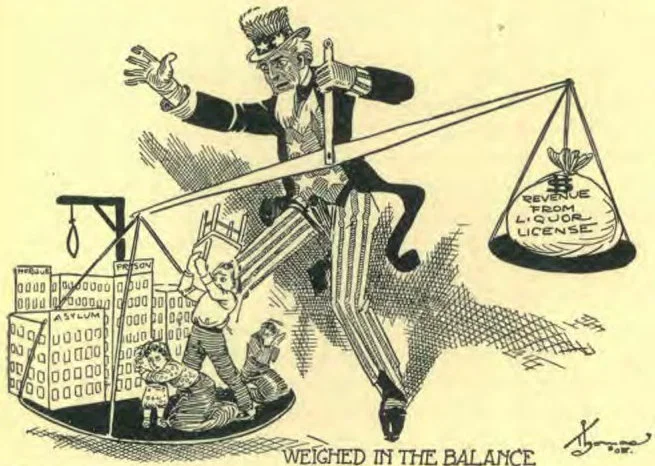
There are forty dollars of economic loss to the country for every dollar of revenue.—Richard Pearson Hobson
Conclusion
Friends of true liberty, we must still fight the defenders of false freedom. Every atom of energy, every power that we possess, must be spent for the conflict. At the battle of Trafalgar, when the sea powers of France and England were marshaled against each other, Lord Nelson issued this famous proclamation, “England expects every man to do his duty.” To-day the defenders of true and false liberty are drawn up in battle array. Hear the command of your leader, O friend of prohibition: The King of heaven expects every man to do his duty. Strike for the land you love. Strike for the untarnished name of American manhood. Strike for the unsullied purity of American womanhood. Strike for the sacred altars of the American home. Strike for the true liberty that was wrought in the battle stains of Concord and Lexington and Bunker Hill. In the name of Almighty God, strike till the rum king turns white with fear; till his cringing henchmen flee. Strike till the liquor traffic falls and dies. And throughout the land there shall be no more a drunkard and no more a legalized saloon. Then, in the light of a larger liberty, freed from the galling bondage of the tyrannical slaveholder of the ages, we shall write in letters of living light: America is free! America is free!
Anti-Prohibition Arguments
DURING some extended travel in the West, I came into some territory where a constitutional amendment providing for State-wide prohibition was to come before the people at an early date. Sitting in the writing-room of a hotel, I found literature generously scattered about for the information and education of the guests. The whole tenor of this literature was against prohibition, and presented arguments to business men and working men in general why they should vote against State-wide prohibition.
Adapted from cartoon in New York American
The key-stone of all these arguments was simply this: If State-wide prohibition is secured, then liquor will be sold just the same, perhaps in greater quantities, but without legal restrictions. In other words, even in the face of prohibitory enactment, the liquor traffic may be counted upon to violate the law and continue its business even if the people of the State shall present a majority vote against it.
It is worth while to know that the attitude of the liquor traffic, as frankly stated by its friends, has so little regard for the will of the State or the welfare of the community that it boldly flaunts its purpose to violate the laws of the land for the sake of personal gain. Any institution that bears this character, and announces this purpose, is manifestly a menace to the welfare of the nation, and should be driven out of every State at the earliest possible moment.—Service.
LICENSE is unconstitutional.
A Temperance Lecture in Brief
BOOKER T. WASHINGTON once said at a dinner in New York that he could not speak for temperance more effectively than to quote the words of old Uncle Calhoun Webster, who said:—
When I sees a man a-goin’ home wid a gallon o’ whisky an’ a half pound o’ meat, dat’s temperance lecture enough for me— an’ I sees it ebery day. An’ I knows dat every’ting in dat man’s house am on de same scale—a gallon o’ misery to ebery half pound o’ comfort.
Help From Heaven
By M. E. Kern
M. E. Kern
PRINCIPAL OF THE FOREIGN MISSION SEMINARY, TAKOMA PARK, WASHINGTON, D. C.
THE temperance cause has advanced by means of two principal methods of work, — moral suasion and legislative enactment. In the beginning of the great temperance movement, two generations ago, the appeal was mainly to the individual conscience. In the present generation, the efforts of the temperance forces have been concentrated almost entirely on legislative reforms and constitutional prohibition. Both lines of effort are proper.
And they must go hand in hand if the temperance cause is to be victorious.
It is right to abolish by law a business which is a breeder of the foulest crimes the devil can invent, and which casts its hellish shadow over home and country. If it is within the province of civil government to enact sanitary laws for the preservation of the public health, as surely as the moral is greater than the physical it is right to abolish by law any institution or business whose chief product is immorality and crime. If it is proper to protect ourselves by statute against adulterated foods, and to quarantine against deadly germs of contagious disease, it is surely the duty of the state to protect the innocent against this moral leprosy of mankind. Truly this line of effort appeals to all good and thoughtful men. It appeals even to the slaves of intemperance who realize that they must have the help of some power outside themselves to save them from the curse.
But the greatest and most effective temperance reform — without which political effort can not succeed — is the moral and spiritual reformation of the individual which locks the door from within. Said Lincoln: “The man who molds public sentiment is greater than he who enacts laws or enforces statutes. For without an enlightened public opinion, laws will never be enacted, nor will they be enforced.” With the danger of reaction, especially where drastic laws are going into effect, and with the necessity of a mighty forward movement before us, surely the times demand a return to the old-time temperance evangelism. In this way only can we hold what has been gained, and go on to perfection.
This temperance evangelism must not be merely a campaign of education. That is good, but many men and women, though intelligent as to the awful results of drink, have fallen beneath its power. Many brilliant minds, with the fairest prospects in life, have been ruined by this awful curse. After all, the temperance issue is one of moral fiber. Temperance is self-control. A writer, in the Northwestern Christian Advocate, truly said: “Apart from this indwelling of Jesus Christ, there is no hope for the subjugation of the drink curse. Whatever our theory of salvation may be, it remains true that only as Jesus reigns in the citadel of a man’s being,—his heart and his will,—is there assurance of complete victory.” “For there is none other name under heaven given among men, whereby we must be saved.” Acts 4:12. The only safety of any man or woman from the power of evil passion or perverted appetite, is to trust in the power of that Name.
“You talk about my drinking,” said the drunkard, “but you say nothing about my thirst.” That thirst it is that drives him to despair. His promises and resolutions are like ropes of sand, and the knowledge of his forfeited pledges causes the loss of all confidence in himself. “Never,” said John B. Gough, “did I hate liquor more than when I was its abject servant.” Many a slave to intemperance has cried out, with Paul, “O wretched man that I am! who shall deliver me from this body of death?” Rom. 7:24, margin. Would that every one might learn, as Paul did, that the power of the divine-human Son of God can set us free! “I can do all things,” said he, “through Christ which strengtheneth me.” Phil. 4:13. The finite is mastered by the infinite. Men have learned to expect no mastery in the physical world except as they yield to the God of nature. No one endeavors to make a building stand except by yielding to God’s law of gravitation, nor an engine move without applying his law of expansion. Neither can we control our own spirits except as we yield to “the law of the Spirit of life.”
Is there hope for the tempted? Is there help for the downtrodden? —O, yes, there is hope! Hope in God! Help from heaven!
Francis Murphy, the drunken keeper of a grog-shop, found help behind prison-bars, where he had been cast for manslaughter. On the cold floor of his prison cell, he found God, and became a new man. And he became one of the most powerful temperance advocates of our time.
The temperance cause is the cause of Christ. Then let the church of the living God occupy her place in this warfare, lending her influence to every good work, and heralding the gospel of “righteousness, temperance, and judgment to come.”