TEMPERANCE LECTURER, AND AUTHOR OF “PROFIT AND LOSS IN MAN,” “WEALTH AND WASTE,” ETC.
THE Boy,—spell it with a capital B, Mr. Printer, for the Boy is a capital thing,—the Boy has rights as sacred as any which the Man can boast or claim, but to which, in large measure, the Man gives little heed. Seeing that the Man was once the Boy, this carelessness on the Man’s part would be inexplicable if it did not follow the Boy’s own unconsciousness. The rights of the Boy are not realized by him. Of those deepest and most sacred he can have no clear understanding. They concern his advent into being as a babe,—they pertain more to his future as a Man than to his present as a lad; to his fitness as a father by and by, when boys come to him; to his career as a citizen and a producing patriot. He can not, as a Boy, comprehend the rights which are his; but as a Man he should understand them, and stand for them, and insist that they be recognized and maintained. If all men were now to concede these rights of the Boy, and fairly guard them, society would soon be revolutionized, and the reformation resulting would shine across our world like a millennial glory.
A. A. Hopkins
THE FIRST RIGHT OF THE BOY is as fundamental as his birth—the right to be born with pure blood. Suppose all would-be fathers were to admit this, and to govern themselves accordingly, what would happen?—Well, nothing might just happen, but a law of cause and effect would insure astonishing results. Saloon doors would close. Distilleries and breweries would go out of business. The liquor traffic would mean bankruptcy for all engaged in it. For pure blood—the blood whereof babes have the right to be born—has no alcohol in it. No Man who expects to be, or who may become, the father of a child, has any right to taint with alcohol the blood of his own veins, and thereby entail such taint upon future generations. How extensive such taint is now, and how prolific of evil, only those can dimly apprehend who have studied sociological conditions with the most care, and who realize the widening effect of hereditary tendencies.
To insure the Boy’s right to be born with pure blood, we must deny the Man’s right to drink alcoholic liquors. Prohibitionists have not gone that far, generally, in their contention. On behalf of the Boy that is, and the Man who must be, of the nation that is and that must be safeguarded in its citizenship. I am willing to stand on that picket-line of reform, and to deny the right of any Man to poison his physical system with alcohol. Even if there were no such thing as hereditary taint—even if the Boy were to be in no danger from the curse of inherited appetite—still the effect of alcohol upon the father’s blood, and upon his procreative power, would be such undeniably as to prejudice the Boy’s rights later on,—to rob him of his proper chance, to place him at a disadvantage from babyhood to manhood and beyond.
The Boy’s Second Right
Concede, please, that the Boy’s next right, after birth, is the right to live. He did not seek this mortal being in which he finds himself. It came as a divine gift, under human conditions. No Man should be responsible for its curtailment, through responsibility for such human conditions as must imperil the divine gift. One such condition is drink in the parentage—paternal, or maternal, or both; drink, in the parent, that means death for the child.
Professor Laitinen has investigated child mortality with great care. His investigation “covered over 5,000 families, in more than a fourth of which parents were abstainers, or had been since marriage.” And he found that among the children of these abstaining parents, the mortality was 13.45 per cent, with but 1.07 per cent of abortions, while among the children of moderate drinkers the mortality was 23.17 per cent, plus 5.26 per cent of abortions; and among the children of immoderate drinkers the mortality was 32.02 per cent, plus 7.11 per cent of abortions. When drink in the parent means death for so much greater a percentage of children than results under abstaining parentage,—when, averaging the moderate and the immoderate drinking classes, drink must be held accountable for more than one half the deaths among children—are we not justified in denying to parents the drinking right?
The Boy’s Third Right
Concede the Boy his right to live, and you can not rightly deny him the right to live at his best, to live long; you surely have no right, as a Man, to weaken the blood upon which his life depends, to cripple the heart which must propel that blood, to impair the lungs which must keep the blood pure and assist the heart to maintain the life. The Boy’s right to live, as babe and Boy, is no greater than the Boy’s right to physical conditions that can resist the encroachments of disease, as Boy13and Man. It must be remembered that the large mortality among children of drinking parentage does not represent all the perils and loss for which drink is responsible through the effect of alcohol upon the blood. The Boy may live to become the Man, yet an easy prey to crippling and costly disease, a frequent burden to his family, if not a constant burden to the state. The blood of the Man must be his productive energy, as it is the seat of his protective mechanism.
Is your child marked for a drunkard? Many are
Professor von Bunge conducted an inquiry as to the percentage of diseases among children in 2,051 families whose histories can be obtained, the fathers of which were none of them total abstainers. Of these diseases, where these fathers were occasional drinkers, 6.4 per cent were tubercular, and 4.3 per cent nervous; where the fathers were regular moderate drinkers, 9.4 per cent of the diseases were tubercular, and 7.6 per cent were nervous; where the fathers were regular immoderate drinkers, 17.1 per cent were tubercular, and 11.1 per cent were nervous; where the fathers were heavy drinkers, admitted drunkards, 24.2 per cent of the diseases were tubercular, and 22.2 per cent were nervous.
Only an insignificant number of drinkers' children are physically and mentally normal: 17.5 per cent according to Legrain, 6.4 per cent according to Demme, and 11.7 per cent according to Demoor.— Sir Victor Horseley
Without any statement as to the percentage of tubercular and nervous diseases among the children of abstainers, these figures by Professor von Bunge are painfully impressive as to the effect of alcohol upon the blood of those who do not abstain. The upward sliding scale of mortality, as the drink usage increases, is fearfully eloquent of the awful results.
Professor Landouzi, dean of the Paris faculty of medicine, and said to be “one of the most illustrious of French medical scientists,” has declared that “alcoholism is the road to tuberculosis.” According to the latest authoritative information, as to France, an appalling number of men are taking that road. As to Great Britain, Dr. John Hay, lecturing in Liverpool, lately reported that in one of the wards of a large union infirmary, devoted to pulmonary tuberculosis, there were thirty-six patients, and that, of these, thirty-four confessed to habits of immoderate drinking. The other two were children.
The admitted effects of alcohol upon the lungs, as related to pneumonia, and upon the heart, as related to the work of that organ, and the vital relation of both heart and lungs to tuberculosis, leave no room for doubt as to the effects of alcohol in spreading the “white plague,” and through that in curtailing the life of Boy and Man.
Remarkably wide-spread and active recent efforts, in this country, to cope with tuberculosis and overcome it, have shown how extensive and fearful a curse it is, although the chief cause of it has not been so generally and frankly recognized and asserted as by scientists and others across the sea.
Henri Roberts, a distinguished attorney of Paris, in an address before the Congress of Temperance Societies in Belgium last June, sorrowfully asserting first place for France in the progress of alcoholism and in demonstration of its frightful results, thus declared:—
Entire provinces, such as Normandy and Brittany, have been decimated. In some departments we have seen the population diminish by a half, in others by a third or a fourth, as a result of the ravages of alcoholism. It has been proved that forty, fifty, and even sixty per cent of the young men offering themselves for military service are unfit.
Another Right of the Boy
The right of the Boy to be born with pure blood, and his right to live long at his best, imply and require his right to be born into a sober home, and to go out of that home upon the safe streets of a sober town. To insure these rights, law must stand for them, and on the side of the Boy, not against them, on the side of the saloon. There can not be a license law, anywhere, which does not make against the Boy’s rights. No MAN CAN STAND FOR LICENSE, ANYWHERE, WHO DOES NOT ACTUALLY AND DIRECTLY OPPOSE THOSE RIGHTS WHICH, AS A BOY, SHOULD HAVE BEEN SAFEGUARDED FOR HIMSELF, AND WHICH, AS A MAN, HE SHOULD SAFEGUARD FOR BOYS TO-DAY.
According to the most conservative figures, which the least radical investigators have recorded, about fifty per cent of the crime, and over forty-two per cent of the pauperism, in these United States, are the direct result of the drink habit. This habit would not have been formed in sober homes, on streets that for the Boy were safe.
By the same conservative estimates of men far from radically minded, it has been shown that full forty-five per cent of the destitution of children is directly due to drink; and every destitute child has been robbed in some measure of his or her rights. Bear in mind, let it be said again, that the Boy has the right to live, and to live long, at his best. When drink means his deprivation, starves his life, and hastens his death, drink is not merely his curse but our crime.
WHOSE CRIME?—HIS FATHER’S, TO BE SURE, WHEN HIS FATHER IS THE DRINKER. THE STATE’S, WHEN THE STATE PROVIDES A LEGAL PLACE WHERE THE FATHER’S CRIME IS COMMITTED. YOURS AND MINE, MY BROTHER MAN, IF WE SANCTION THE STATE’S ACT, AND IF IN ANY MANNER, BY ANY MEANS, FOR ANY REASON, WE CONDONE AND PERPETUATE THE CRIME.
Patriotism alone should forbid the crime and command that it cease; for this republic is founded on manhood; and permanent prosperity, the highest welfare, will never come to our nation, until every man pays dividends on himself. He can do this only after his rights while a Boy have been safeguarded as patriotic duty requires, and under conditions that safeguard his life and labor as a Man, insure him fulness of productive years, make him a profitable producer instead of a costly consumer, and guarantee compensating return from society’s cash investment in him. Christianity and humanity should make the crime impossible. No cross of Christ points upward which does not call upon all men to protect the way where boyhood’s feet must walk. There is no licensed saloon in all this land which does not mock at Christ’s life, and, for many a sinner, nullify his death. The Christian spirit and the Christian faith, the very divine purpose out of which came the crimson cross, the heart of humanity itself, all combine in potent pathetic appeal to the soul and citizenship of every Man, that with every attribute of his, as a Man and a citizen, he shall stand for the Boy’s rights,—shall defend from wrong and injustice, from perilous tendencies and ruinous environment, the Boys that are and that are to be.
Drink as the Paramount Cause of Pauperism
ONE third of the population of Massachusetts were beneficiaries of charitable corporations during the past year. Nearly six million dollars was used by the State in caring for paupers. Twenty-four out of every thousand persons in London are paupers, and twenty-one out of every thousand in all England and Wales. Drink is the acknowledged paramount cause of all this pauperism. Ireland, said to be the poorest country in the world, spends annually fifty-five million dollars for liquor. This amount, if rightly used, would do much for her needy people.
Why Be a Total Abstainer?
By Wilfred T. Grenfell
Wilfred T. Grenfell, M. D.
MEDICAL MISSIONARY TO LABRADOR AND ITS NEIGHBORING ISLANDS
Dr. Grenfell
Some persons do things because they do not think. I am not writing to that class of people; this letter is to those who have some reason for doing a thing or not doing it. In my younger days time was valuable, and to win out in the physical and intellectual competitions everything counted. When it came to the question of, Shall I drink alcoholic beverages as do my acquaintances? the reply was, What’s the good of it? It was on the basis that it was not only not necessary, but also not advisable, that I came to my resolution never to swallow alcoholic liquors as a beverage. When I passed a prohibition measure against my own throat, I may as well confess that it was not a high sense of duty to God or to my neighbors that actuated me, but a conviction that it would be an advantage to myself. It has been an immense advantage.
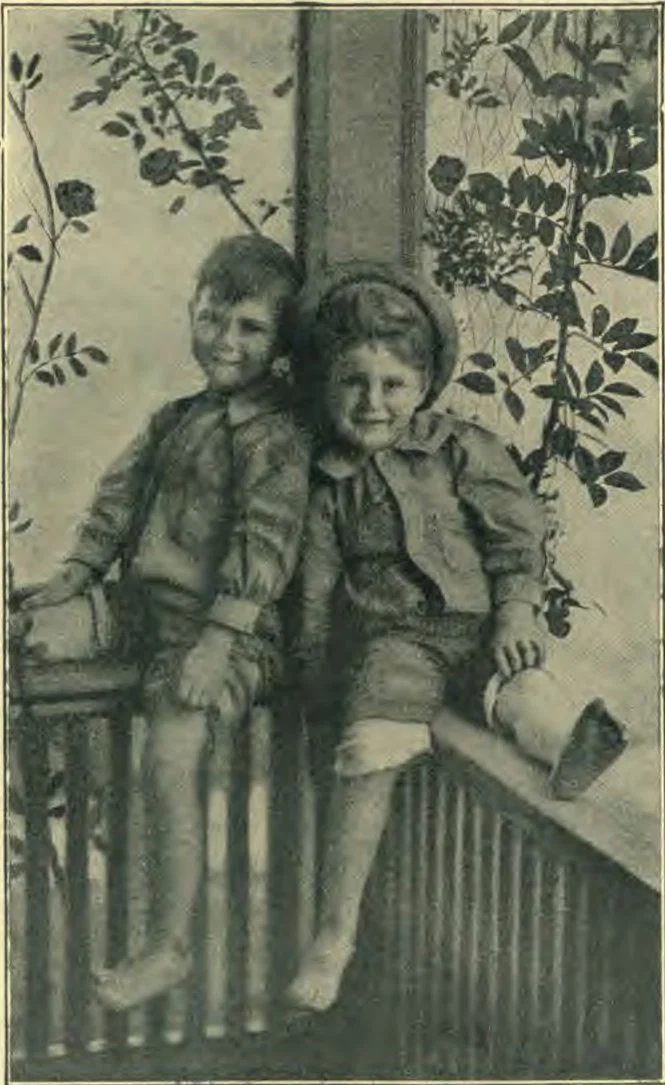
Our papa says he thinks too much of his boys, and all other boys, to vote for any man to sell liquor
Some will tell you that it is all sentimentality and “goody-goody” to become a teetotaler. I confess again I decided it long before I cared whether it was a sin or not; nor have I ever in all my life known any one who regretted having decided against it; whereas I have known hundreds who have regretted that they ever tasted it, and many who started in life with me whom it has robbed of everything worth living for.
What is the use of working for all you are worth, and at the same time crippling your physical capacities by swallowing stuff to please other people? Very few persons take alcoholic liquors at first because they like them; it is because other people like them; but they soon cultivate a liking for them that they would give any money not to have. What is the good of burning midnight oil to get intellectual honors, or even to keep up with your class, if you are befuddling and crippling your brain with an alcohol-poisoned blood supply?
Is it worth while, just to bid for cheap popularity, or to avoid a silly sneer or two, to pay the price of a self-governed life, and the approbation and respect of one’s own conscience? Let me say, without any fear whatever that any person can contradict it, “Le jeu ne vaut pas la chandelle;” that is, “The game is not worth the candle.”
A farmer, after listening to a temperance orator, said, “Well, guv’nor, you’ve proved her ain’t no good to Oi, and you’ve proved her makes a peck o’ troubles for Oi, but you ain’t proved Oi don’t like her.” Well, I didn’t like the first and only taste of whisky I ever had; so I claim no merit for not touching it; nor did I care for wine; and I couldn’t afford liquors, if only from the lowest point of view, namely, dollars and cents.
A clergyman sent me a gift of a large case of liquor when I was appointed to my first position of responsibility , as house surgeon in the largest London hospital. It lasted me to light the fire in the morning till nearly the day I left. I am very glad to-day it never circulated through my blood-vessels and kidneys. Possibly some of the fellows did not frequent my rooms because they never got a drink there. They could get drinks in most of the other rooms if they needed them. So I never thought they suffered much lack, and it is certain that I did not. Yes, I liked the taste of a wine sauce on an English plum pudding,—I am English,—and this is the only reason I might have to feel virtuous in not further cultivating the taste.
No Good in It
I say again, There is no good in drinking it. Deny that who can. “I do not see as there is any harm in it,” a man said to me once. But only a mummy, I should think, could fail to recognize the danger and the damage that come from it.
When the licensed victualers proved to the government that enormous sums were spent in spoiling good grain to make beer, the officials replied, wisely enough, that all that was entirely beside the issue. They would be satisfied if, after it was made, it was all poured into the ocean instead of down the people’s throats; because the coldest, hardest facts showed the beer river formed an ocean of crime, poverty, and suffering. What the officials wanted to avoid was damned bodies, ruined homes, broken hearts, and starved children. I will admit it would not be quite so bad an economic problem if the cost of all the jails, insane asylums, prisons, criminal courts, hospitals, charities, police, and poor asylums was borne by the trade.
With the government it wasn’t a chemical problem as to whether starch and sugar, C₆H₁₀O₅, was wasted by becoming C₂H₅OH; or a physiological problem as to whether in the new form good food supplies, known to be of value, were made more responsive to digestive functions; it was a question of what is the good of letting some people get rich to make a thousand times as many get poor. It was the same question again, “Does it pay to allow some to tempt, and make it easy for the individual, the home, the village, the city, the nation, to swallow alcoholic liquor?” No one except the seals and fishes but would admit it were far better for humanity, after the liquor is made, to pour it all into the polar sea, where, if it caught fire, and burned the ice instead of men’s bodies and souls, it might possibly render access so easy that polar quarrels would be averted; whereas it is, as a rule, only an endless quarrel causer.
So much has been said about alcohol as a beverage that nothing now remains to be said. The up-to-date cry is15to DO, not to TALK, and, thank God, the twentieth-century world is doing things in this matter. The best feeling of the world is against the liquor traffic, and America is nobly beginning to do her share to eliminate it.
“But alcohol is a food,” some say. What does that matter, when we are not intending to use it as that? It is of about as much interest as to solemnly state that our sealskin boots are a food, because poor Wallace and Hubbard, when forced to eat theirs, found that it helped a little to sustain life.
Ninety-six per cent of moderate-drinking youth are lured to perdition.—Frances E. Willard
Some argue that it is a good drug. Very well, then, put it in the drug cupboard, on the diffusible stimulant shelf. Laudanum, prussic acid, strychnia, and arsenic are all invaluable drugs. It does not follow that we ought to swallow them every day till we get such a craving for them that they will kill us by a slow and cruel death. I have seen many good fellows die from alcohol. I sat at the foot of a doctor’s bed a little while ago, who had brought on arterial disease by drinking alcoholic beverages, and was then reaping a further reward in the horrors of angina pectoris. Poor fellow, he realized too late the awful damage it was doing him! He was only my age.
It was a glorious morning, and I was leaving for a holiday trip, as full of spirits and health as a boy. He had been sitting up all night, the awful horror of death over him every minute, intensified by the knowledge that it was his own fault, and that he might have averted it; intensified, also, by the fact that from down-stairs the sound of the footsteps of a loving, true, unselfish wife, and the ripple of baby voices came floating up to his bedroom door.
It Is a Foe
Alcohol is a foe of our human physical bodies more cruel and hateful because it is so subtle and so absolutely relentless. It passes into the blood, and circulates in every tiniest corner of the body. And it does this so subtly that its victims not only do not get frightened and turn it down until it is next to impossible to undo its work, but foster the appetite until every organ has learned to cry out for more—and more—alcohol. The tissues hardened, or sclerosed, by the use of alcohol never recover.
It is a foe to our minds, also, crippling them and warping them until they can not think straight. A drinker becomes a liar, as sure as the world becomes dark when the sun sinks. If you don’t want to get left, don’t trust him. I wouldn’t dream of turning in below with a fellow at the helm who might see two lights instead of one. I don’t take a drinker on any long trips where endurance is called for; because I have seen them play out a good deal too often. In fact, we haven’t any use for them down here at all, or anywhere else really. We can’t afford them any more than they can afford to poison themselves.
Again, it is a foe to our real selves—our spirits—because it makes them sink to extremities that no one would believe till they actually knew the facts to be true. Where shall I begin to illustrate this? Facts come so fast into my brain that my pen fairly runs away.
A few years ago one of our fishermen, a fine fellow with a delightful family, was doing well. He made good money and had a beautiful little home. He was such a general favorite, and so easy-going, that he often found himself taking “a drop of Old Tom, you know, just to make a good time.” Gradually I lost sight of him until suddenly one day I was called in by his haggard, threadbare, broken-hearted wife. He, the splendid fellow I had known, had, in despair, just hanged himself from a rafter in his own ruined home. There was not a cent in the house, and not a thing left to pawn. She had remembered our friendship, and thought I might help to bury him. He had spent everything he owned for some years at the saloon across the way. I went over at once, told the barkeeper the case, and asked him to subscribe to the coffin. It was up to him to do so, as he had made it necessary. He refused in a violent, profane manner. And he was some mother’s darling only a few years before.
Yes, I know. I have heard it a hundred times,—There’s no danger. You won’t be such a fool as to let it become your master. Every man I ever knew submerged in the alcohol flood said the same thing before you. But be larger-hearted than that; forget what you like, and what won’t harm you. Remember you are your brother’s keeper, and to save him you must be on firm ground yourself.
Enlist at once with those who are fighting this foe. As a first blow, every boy and girl can pass a personal prohibition resolution, without any amendment against drinking the harmful drug. And then right through the land would grow up a battalion of helpers of infinite value in hastening the coming of righteousness, joy, and peace, which is the kingdom of God.
The Baby for Bait
The Bankutu tribe of Africans lives in the center of the Belgian Kongo. This is almost the only tribe that has successfully resisted the advance of the white man. This fact is attributed to their skill in warfare. The ways to their villages are defended by deadly poisoned spikes hidden by leaves. They use bows and arrows set like traps in the form of primitive spring-guns, and are quite ready, if a white man is expected, to bait such traps with a live baby, being sure that the European will be unable to resist the temptation to pick up an apparently abandoned child.
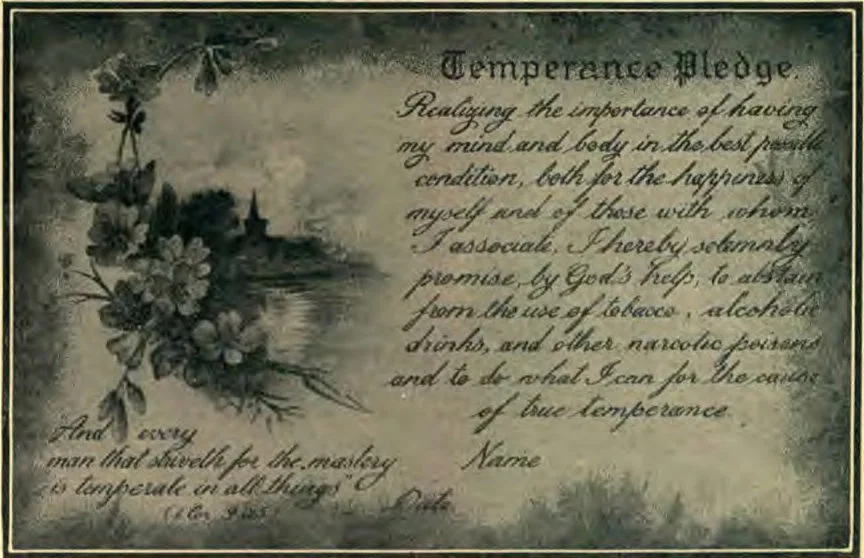
Sign the pledge: because it marks the crossing of the line into the total abstinence brotherhood; because it strengthens one in the hours of temptation; because it encourages others to abstain from intoxicating liquor.—W. J. Bryan
If the Indians or any class of people in this country were to use the helpless babe in this way, the country at once would be aroused, and federal legislation would very soon be enacted to stop this cruel procedure. But the liquor men of this country in their use of doped candies, nickel treats of beer and wine, and play-rooms as a bait for children, to insure future patronage, are even more inhuman than the heathen African. And yet we continue year after year to license the business that we know perpetrates such evils.