Your ShelfYour Projects

The Youth’s Instructor, Temperance Number

The Back-Door Entrance
Earlier text: The Rapid Increase of the Tobacco Habit, and Its Effect Upon the Rising Generation

A Clear Case Against Tobacco

[The following article is an extract from an address given to the St. Louis Medical Society by Dr. L. Bremer, late physician to the St. Vincent's Institution for the Insane at St. Louis, Missouri. The entire address can be obtained in pamphlet form from the Gospel Publicity League, Tremont Temple, Boston, Massachusetts.]
At the outset, without entering into preliminaries and details, I will state that I side with those who, looking at the injurious effects collectively, consider tobacco more harmful than alcohol, from the simple fact that its use is more general, its effects more gradual and less obvious, and that, from a moral point of view, it is in better standing.
The breath of tobacco is held permissible, and will be condoned by all classes; that of alcohol is looked upon as odious, and exposes its bearer in some quarters to social ostracism.
It is this connivance, on the part of public opinion, at this kind of luxus consumption, as it is euphoniously styled by modern physiologists, that fosters its spread, especially among those who can least afford to offer any insult to their nervous systems. And, unfortunately, it is just this class of persons who delude themselves into the belief that tobacco is indispensable to them.
Our ancestors were evidently not so deleteriously affected either by alcohol or tobacco as modern man is, with the strain of the requirements of a more complicated life weighing upon him, and handicapped, as he frequently is, in his nervous and psychical make-up.

Tobacco Leads to Imbecility and Insanity

It may look like overstating and exaggerating things, but I know whereof I speak, when I say that tobacco when habitually used by the young leads to a species of imbecility; that the juvenile smoker will lie, cheat, and steal when he would not had he let tobacco alone. This kind of insanity I have observed in quite a number of cases at the St. Vincent's. The patients presented all the characteristics of young incorrigibles. They had exhausted the indulgence of their parents, who saw no other way to protect them from their insane pranks than to commit them to the institution. Had they been less favorably situated financially, they would have landed at the house of correction or the workhouse.
I do not know whether a lasting improvement was effected in any of them. There was not one among them that was able to comprehend that tobacco was injuring him; they were constantly on the lookout for obtaining it, by begging, stealing, or bribing, and regarded the deprivation of the drug as a punishment. The sense of propriety, the faculty of distinguishing between right and wrong, was lost. The father of one of them, who looked upon his son only as an aggravated case of bad boy, told me that he himself had been smoking ever since his tenth year and it never had affected him. In reality, being only forty-five years old, he was a wreck, physically and mentally, though he came of healthy stock. He could not or would not comprehend that tobacco was gradually undermining his own mind and body, although his wife and his friends knew it.
But it is not only in the young that the use of tobacco is followed with such disastrous effects. Smoking or chewing, when commenced in the period of manhood, and even at the time it generally does least harm, after middle age, will tell on the mind if excessively indulged in. Is it to be wondered at that a drug which has such potent and palpable effects as to produce loss of coordination and unspeakable malaise, and after the organism has become used to it, is capable of setting up the well-known heart disturbances, amblyopia and even amaurosis,—which, in short, possesses the characteristic qualities of a powerful nerve poison,—is it a wonder if such drug, when, in spite of the warnings on the part of various organs, excessively and persistently used, finally produces one or another form of insanity?
It has always seemed to me that whenever tobacco entered at all as a factor in the case of insanity, it was the immediate cause, vivifying, uniting, and condensing, as it were, the dormant morbid elements which predisposed the individual to mental disturbance. Thus I have seen melancholia, more often mania, and very frequently general paresis, hastened and precipitated by the excessive use of tobacco. I know, however, of instances where the last-named disease, or “softening of the brain,” as it is called by the lay public, could not be referred to any other cause but tobacco.
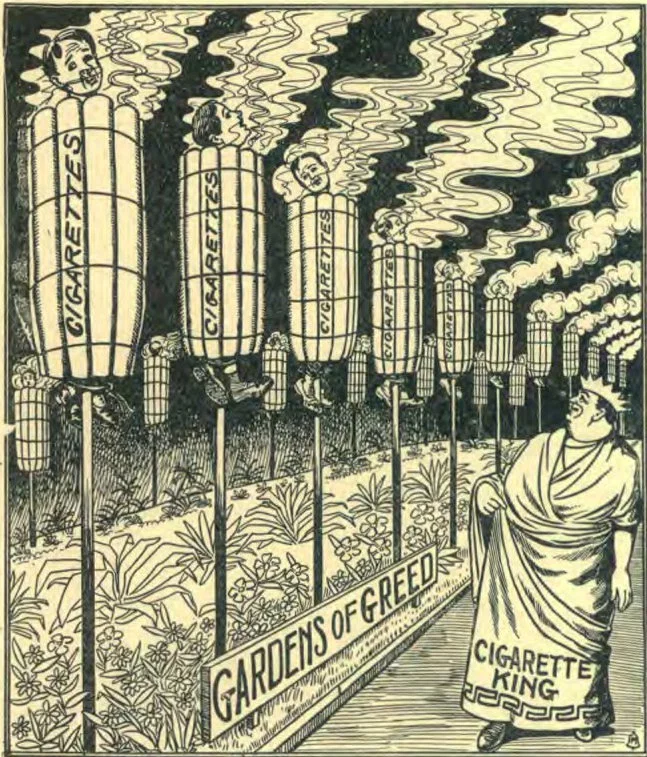
The cigarette Nero and his living torches
That tobacco really does cause insanity is evidenced by the magic effect seen in some cases after the discontinuance of the drug, when the patient's condition is still such that he is not wholly inaccessible to reason, and has will power enough to abandon the habit. Thus I have seen that beginning melancholia with suicidal impulses, hallucinations of various kinds, forced actions, besides the precursory symptoms of insanity, such as insomnia, crying spells, præcordial anxiety, fears of impending evil, “that something is going to happen,” impotency, vertigo, beginning impairment of memory and judging power, and even the lowering of the moral tone, all of which, and a host of other symptoms, were attributable to chronic tobacco intoxication, disappear after freedom from the habit was established.
But whenever a case has gotten so far that commitment to an institution has become necessary, the prospects are not so good, because such persons, as a rule, can not be convinced that tobacco is, or has been, the cause of their mental trouble. Their argument is that almost everybody smokes, that all their friends and acquaintances chew or smoke, without showing any symptoms of insanity. The alcoholic insane, when leaving the institution to enter active life again, generally knows and admits that alcohol has been the cause of his mental breakdown. The nicotine victim does not admit anything.
French medical observers are of the opinion that one of the factors causing the depopulation of France is the excessive use of tobacco by its inhabitants; for the offspring of inveterate tobacco consumers is notoriously puny and stunted in stature, and lacks the normal power of resistance, especially on the part of the nervous system. Again, in our country it is a significant fact that an astounding percentage of the candidates for admission to West Point and other military schools are rejected on account of tobacco hearts. From all countries and from all classes of society come reports in increasing numbers of the baneful effects of the tobacco habit.
But the consumption goes on, and will do so until an example is set by those who, above all others, can estimate the disastrous effect of the habit. If—

Teachers, Preachers, and Physicians

would pronounce an anathema against tobacco, and abstain from it themselves, others would follow. But here is the difficulty. It is only exceptionally that a smoking pedagogue, clergyman, or physician can be convinced that he would be a better man physically, intellectually, and morally, if he would give up tobacco. Instances are cited by them of great men, inveterate and excessive tobacco consumers, who left their mark in the history of civilization as savants, artists, etc. They do not consider the possibility that these men accomplished what they did in spite of their habit, and not in consequence of or aided by it.
There is only one way to lessen the evil, and that is by the dissemination of knowledge of the baneful effects of tobacco among the rising generation, initiated and sustained by the three professions mentioned above. Of course they ought to practise first what they are going to preach.

Why Men Smoke

THREE centuries had hardly passed after the introduction of tobacco into Europe before its use was world-wide. Though borrowed directly from the North American Indians in their aboriginal condition, civilized nations have readily acquired the smoking and chewing habit. At first protests were made, especially by the rulers; but their efforts proved unavailing.
King James I of England sent to his subjects the following worthy appeal:—
Now, my good countrymen, let us, I pray you, consider what honor or policy can move us to imitate the barbarous and beastly manners of the wild, godless, and slavish Indians, especially in so wild and filthy a custom. Shall we, I say, that have been so long civil and wealthy in peace, famous and invincible in war, fortunate in both,—shall we, I say with blushing, abase ourselves so far as to imitate these beastly Indians?
The grand duke of Moscow forbade his subjects to use tobacco, and made a second offense punishable by death. In Turkey stringent laws were made against its use, and the victims of the habit were bastinadoed and beheaded. The pope issued bulls of excommunication; but, notwithstanding all the vigorous efforts made to suppress and forestall the tobacco habit, it steadily gained ground, and soon found a foothold in “every nook and corner of the world where civilized man has erected his habitation.” “It is prevalent in Polynesia, China, Japan, and Siam. In Burma the mother takes the cheroot from her mouth, and puts it to the lips of her nursing babe. In New Zealand the habit is almost universal among the natives, women and girls using it the same as do men and boys. The Kafirs of Africa are habitual smokers. Stanley’s pygmies of Central Africa are also said to be inveterate users of the weed.”
But the Indians are not the ones who have introduced the weed into every quarter of the globe where human beings exist. No; the white, the civilized man, the so-called Christian man, must bear the responsibility of this degrading act. We would that he had committed this grave wrong unwittingly, and was now seeking in every way possible to counteract his evil work. But, rather than this, every year multiplies his efforts to increase its exportation into heathen as well as into civilized lands.
As one writer observes: “Good men have written against it on the ground of its immoral effects; political economists have attacked it on account of its entire uselessness; physicians have fought it because of its mischievous effects on the health of the body; yet its use has crept on, and is still advancing.” And why?—Simply because it is one of the enemy’s best means of destroying man’s moral, physical, and spiritual nature. And he has succeeded in making it a source of so great revenue to individuals and to nations that the sacrifice of the bodies and souls of men seems of little matter compared with the loss of the revenue.
May heaven yet find some way of arousing men and nations to their God-given responsibility of conserving humanity, instead of destroying it by heathenish habits.

The Tobacco Habit

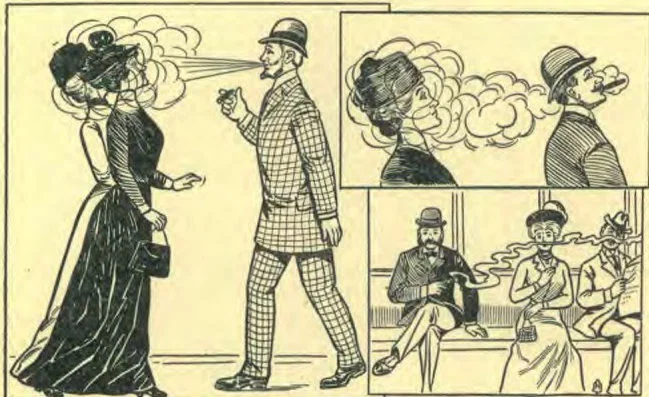
TOBACCO using in any form is a vile, selfish habit. It is vile because it defiles mouth, breath, clothes, blood, and person. It is selfish because others are forced against their will to breathe the smoke, clean up after the chewer, pay extra in fares that a special car, and a special room at railway stations, may be provided for its users. Then, further, it is decidedly selfish for a father to spend from twenty-five to fifty dollars or more every year just to satisfy a filthy habit of his own, when his wife, his boy or girl, and perhaps an aged father and mother, must go without many little luxuries which he could provide for them were it not that he must keep himself in tobacco.
While it is a vile habit for any one who really wishes to be master of himself, what can be said about one using it who professes to follow in the footsteps of the pure Jesus of Nazareth? The very thought is repulsive. It is said that a minister of the gospel by the name of Vinton suddenly gave up tobacco, because a young miss of about twelve caused him to see the selfishness and sin of the habit. Dr. Vinton was urging her to perform some self-sacrificing service during the season of Lent.
“Pshaw,” she said, “don’t preach self-denial to me when you have your mouth full of nasty tobacco!”
This remark so stung this ambassador of the Lord Jesus that he turned aside and removed the odious quid from his mouth, and was never again defiled with it.
No, my boy, it is not even manly to chew or smoke. If you want to be a man, a genuine man, let tobacco entirely alone forever. T. E. BOWEN.

What the Boys of Round Rock Did

I LIKE the attitude the boys of the dormitory of Trinity College, Round Rock, Texas, took after making a study of the evil results of smoking cigarettes. They immediately signed a pledge of total abstinence, and began to work for others who were addicted to the habit. By earnest, persevering effort the cigarette was finally banished from Trinity College.
Mr. Wald, professor of Latin in Trinity College, who espoused the cause of the boys, says:—
While we must continue our work of trying to save those who have become victims of the evil, and of persuading others from coming under its bondage, yet the ultimate aim must be finally to secure prohibitive legislation. To save a hundred boys by pledging them to abstain is well, but to remove the temptation from thousands of them is better. In Texas, with its large Mexican and Negro population so sadly addicted to the habit, it will mean a fight of years. But the cigarette must go. This is a struggle for a great and noble cause, and it shall, it must, go on to final victory.

The Ballot-Box

“Be the ballot-box a pillar that shall not be overthrown, Rising still erect, unbroken, ’mid the perils which abound; While around it men shall gather, in the greatness they have grown, To defend the rights of manhood they have found.
“Make it clean from all corruption, keep it free from curse of gold; Shield it well from sin that sanctions other sin for guilty gains, Till the lords of mighty nations in their majesty behold How the rule of man in majesty remains.”

State-Wide Prohibition

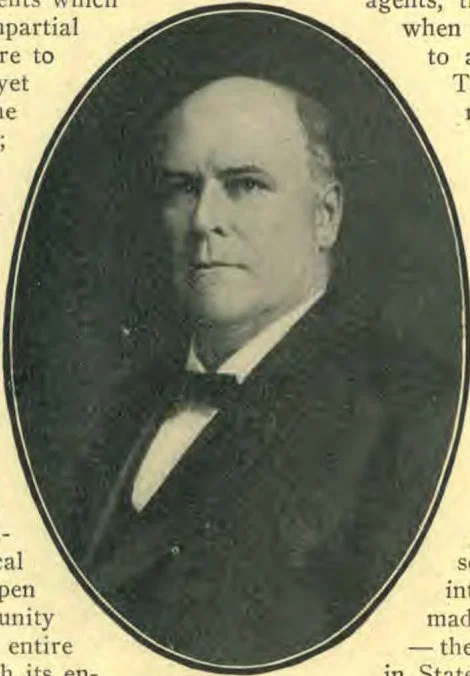
R. B. Glenn
EX-GOVERNOR OF NORTH CAROLINA
Robert B. Glenn
Robert B. Glenn
HAVING been requested to give my reasons why I believe that State-wide prohibition is the most effective method of curtailing the liquor evil, I desire to make a few statements which I believe will convince any fair, impartial reader that State prohibition does more to prevent the evil than any other plan yet tried. There are three views on the liquor question: First, high license; second, local option; third, State-wide prohibition. Now the one that lessens the drinking habit most must certainly be considered the best. No one will contend truthfully that the open saloon does this, even though operated under high license; for the higher the license, the more strong drink has to be sold in order to make it a paying investment; and therefore the owners of saloons have to make their establishments as attractive as possible in order to insure them enough cash to make their investments pay. The second method, local option, is an improvement on the open saloon, and is to a town or community what State-wide prohibition is to the entire State; and as it abolishes the bar, with its enticements and mixed drinks, and does away with a place where men can meet for social drinking and enjoyment, it does a great deal to promote the cause of temperance, and may be a stepping-stone to final adoption of prohibition in the State. Being confined, however, to a community or a town, which community or town is often surrounded by other counties and cities where the open saloon is still retained, persons from the dry territory easily go or send into the wet section, and bring back their supplies of liquor for personal use in their homes, or for distribution among others. Even the most effective laws—which are not very prevalent in the States—forbidding the shipping from wet territory into a local option community, do not always avail; for the law can be evaded by bringing the liquor in valises, wagons, etc., and when shipped, it is often disguised under another name than that of strong drink. Any thinking person will admit that the farther you remove a temptation from individuals, the easier it is for them to resist that temptation. This is embodied in the prayer of our Master, when he said, “Lead us not into temptation, but deliver us from evil.” A man will not go out of his State, or even solicit a shipment from another State, in order to get strong drink, as quickly as he will go around the corner to an open saloon, or from a dry place to an adjoining wet one. Transportation from State to State has to be made generally over railroads or through steamboat facilities, and has to be handled by various agents, thus making it more conspicuous than when one goes in person or sends by a friend to an adjoining town for a small supply. The officers of the law also can more readily see what is going on when it is done by public transportation than when smuggled in secretly; and no one yet has been found so bold as to want the public to know that he is receiving shipments of liquor, especially when in so doing he is opposing the public sentiment of his State, which has declared for prohibition. In the last two years I have been in thirty-seven different States, and after a thorough and most careful examination, I can truthfully say that in the States that have State-wide prohibition—though there is some violation of the law, and some persons who, by permission of the interstate commerce law, have shipments made to them of liquor from other States—the drink evil is fifty per cent less than in States having high license, and even thirty or forty per cent less than where there is local option. Take, as an example, the State of Kansas. Its governor sees to it that the law is enforced, and with the exception of towns and communities bordering on States where liquor is allowed to be sold, one scarcely sees any indication of liquor selling, and the people are sober and industrious. Take my own State of North Carolina: I know there is not one half the drinking in the State to-day that existed under the old system; and it was amusing when a leader of one of the political parties recently gave as a reason why our State prohibition law should be repealed, that the people who drank were getting tired of having to go all the way to Virginia to get a little booze. The very class that we desire most to protect from the liquor habit, being unable to order, or afford the expense of going after it, are compelled to be temperate; and now we hear less complaint from employers, and from fathers and mothers, of the drinking of their employees and their children.
Let each State where public sentiment is ripe for it, adopt State-wide prohibition, and then let Congress pass a law prohibiting any public utility corporation from hauling liquor into a dry State, and also refuse to license persons in a dry State, and the liquor problem will be on the way to solution; for, unable to spend their money on strong drink, persons who have hitherto wasted their substance in riotous living will invest it in homes, in stock, in mills, and in other corporations; or put it in clothes for themselves and their families, and in better educating their children. When this is done, the development and upbuilding of these prohibition States will so far exceed that of those where open saloons encourage, and local option only partially forbids, that, to keep up in growth and prosperity, the liquor States will perforce be compelled to adopt similar laws prohibiting the sale and manufacture of liquor in their borders.
To prove this assertion I will give you a brief comparison between the State of New Jersey, which has high license, and not even local option in any county, and the States of Maine and Kansas, both of which have State-wide prohibition:—
New Jersey Kansas and Maine
The unofficial population for 1910 2,404,617 2,435,336
Assessed value, real and personal property (1908 / 1909) $918,418,741 $2,876,068,999
Valuation per capita $381 $1,139
Unmortgaged homes 661,755 192,046
Rented homes 250,848 181,268
Liquor dealers, including druggists 11,605 3,694
U. S. liquor tax $3,470,644 $102,508
Convicts in State prison and penitentiary 1,827 1,036
Insane 6,075 3,519
Cost of maintaining insane, 1909 $1,125,491 $763,481
Average school attendance 289,167 384,387
Students 3,214 7,604
These figures fully explain themselves, and show that in one State the people are spending their money upon the things that perish, while in the other two States they are spending their substance for homes, investments, and deposits in banks. One column also shows increase in poverty, ignorance, and insanity, while the other is a strong argument that prohibition tends to make a State wealthier, healthier, and wiser. With such facts staring us in the face, who can deny that State-wide prohibition is the most effective way for regulating the whisky traffic, and is really a boon to every legitimate interest of the people? Again quoting from the report of F. B. Coburn, secretary of the board of agriculture of Kansas, I desire to add these facts. He says: “After thirty years’ trial, prohibition is so popular in Kansas that no person would dare to advocate its repeal. Twenty-eight poorhouses are without inmates; eighty-seven have no insane inmates; fifty-four have no feeble-minded persons in them; twenty-one counties have no convicts in the penitentiary; thirty-six, no prisoners in the reformatory; fifty-two, no prisoners in jail; and sixteen, without a single person serving any kind of sentence.” The governor confirms this report, and says the people of Kansas were never better clothed, better fed, had finer houses, or larger bank accounts, or were in better health, than they are to-day, and they attribute these great blessings to a very large extent to the effects of State-wide prohibition.
With these facts, then, before us, desiring as we do to save our children from the liquor evil, and to make them more useful citizens, let us use every honorable method to bring about State-wide prohibition in the vari-ous States. This, of course, can not always be accomplished in a day, and local option may be the most effective remedy to bring it to pass; but let us never be satisfied to submit to a high license, or even to local option save as a means to an end, but go forward until State-wide prohibition is accomplished, as it is the best, surest, safest, most effective, and most certain method of stopping and extinguishing an evil that is now destroying the bodies and minds of our people while in this life, and dwarfing the development of souls intended for the enjoyment of life eternal.
Again, unhesitatingly, I authorize you to quote me as saying that State-wide prohibition is the one end for which all true temperance people should contend, as giving the greatest good to the greatest number, the fundamental doctrine of our democratic form of government.
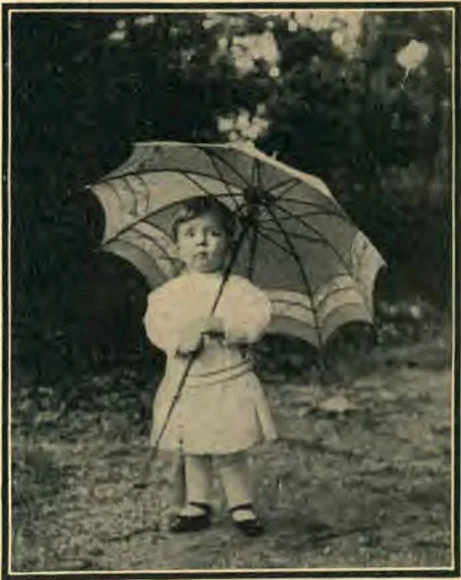
Vote for prohibition umbrellas for all boys

Teachers and Doctors to Guide

Dr. T. N. Kelenack, honorary secretary of the British Society for the Study of Inebriety, says of the relation of teacher and doctor to the alcohol problem:—
The bishop of Birmingham, some time ago, at a conference in London, caused some surprise by saying: “People tell us that a man’s first duty is to obey his conscience. It is not so. That is only a man’s second duty; his first duty is to instruct his conscience.” In making such a statement, Dr. Gore manifested true insight and real scientific precision. “Verify your references,” is advice which every one would do well to comply with, but I know of only two professions that habitually and of set purpose revise their precepts—the teaching and the medical professions. It takes much grace for an ordinary man or woman to admit that he or she is an imperfect being. But teachers and doctors have ever the witness of dead and departed editions of their works, literary and otherwise, to testify that their knowledge is in need of growth and revision.
Teachers and practitioners of medicine have for long loyally co-operated, and with the entry of the doctor into the schools, they look forward to association as allies. Together they seek to lead the child into his kingdom, to aid each life to win the best, to shield and shelter all committed to their care from the manifold hampering, hindering, deranging, and destroying influences of evil in every form. Facing work in this spirit, it comes to pass that teachers and doctors have to study the problems which circle around the alcohol problem. To these two professions the nation rightly looks for direction and guidance.

America Blacklisted

THE following paragraph on law enforcement is by Dr. Len G. Broughton, of Atlanta, Georgia:—
I am satisfied that the great problem before the American people to-day is the problem of law enforcement. It outweighs every other consideration. Do you know that America is blacklisted in every other country with reference to this one matter? There were over eleven hundred murders in the United States last year. There were three hundred fifty murders in the city of Chicago,—more murders in Chicago last year than London has had in the last fifty years, and Chicago is just one third the size of London. In three years London has had only twenty murders, and Chicago has had three hundred fifty in one year. Out of the eleven hundred murderers in the United States less than one hundred have been convicted and punished. The rest have gone free. These facts are talked about and written about wherever I have gone; and we stand before the world to-day as a people who disregard the laws that we make. Our judiciary has no force, and people are thinking that perhaps it is not safe to invest money here if life is so cheap, and if law is so easily disregarded; they reckon that money and property interests are also cheap and lightly regarded. So I say to you again, From a financial consideration, and of course from a moral consideration, the one supreme problem in America to-day is that of law enforcement.

Our Temperance Creed

There is a cause for the moral paralysis upon society. Our laws sustain an evil which is sapping their very foundations. Many deplore the wrongs which they know exist, but consider themselves free from all responsibility in the matter. This can not be. Every individual exerts an influence in society. In our favored land every voter has some voice in determining what laws shall control the nation. The advocates of temperance fail to do their whole duty unless they exert their influence, by precept and example, by voice and pen and vote, in behalf of prohibition and total abstinence. We need not expect that God will work a miracle to bring about this reform, and thus remove the necessity for our exertion. We ourselves must grapple this giant foe, our motto, “No compromise, and no cessation of our efforts till victory is gained.”
— Mrs. E. G. White.
Continue reading: Temperance To-day