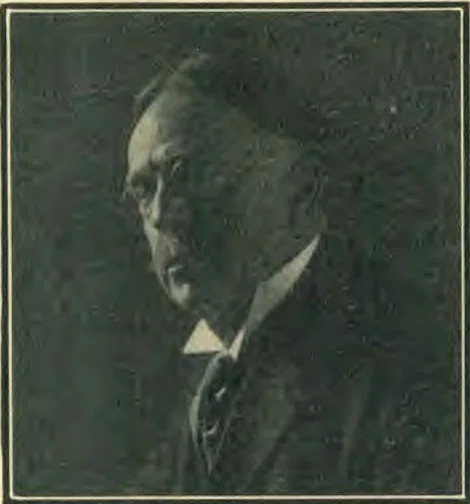
ONE OF THE MOST ACCEPTABLE TEMPERANCE ORATORS OF THE DAY
John G. Woolley
As the fires of the human body are in the muscles, so the fires of the body politic are in that mighty network of applied morality that we call, in a word, business; and this shows why philanthropy, however broad and deep, bears mostly disappointment until it works its way into the shafts of competition.
The temperance movement, now so imminent and compelling, began in terms of fear and pity; and, for all the logic, loyalty, and labor it employed, and the sporadic betterment it wrought in individuals and homes and towns, the balance of account stuck like a leach to the wrong side of the social ledger. The light of its arguments was clear, but not impressive. “Quit the drink,” it said to the drunkard; “it tends to poverty, sickness, degradation, and domestic discord.” But the infatuated devotee only muttered, “They have stricken me, and I was not sick; they have beaten me, but I felt it not; I will seek it yet again.”
“Sign the pledge of total abstinence,” it said to lusty youth. “‘Wine is a mocker;’ it will ensnare you; it may make you a drunkard.” But “the glory of young men is their strength,” and the young man answered: “Not me. I am too sound and proud and strong to go that way.”
Of all the fuel energy consumed in the initial period of the great reform, perhaps not less than ninety-five per cent went up the smokestack; but the good fraction of power was enough to keep the keel of progress up into the wind. Some debauchers reformed. Some young men took warning. Parents and priests began to notice, learn, and teach. Flocks of children — thickets of twigs in the forest of humanity — were bent so that their maturity was inclined to total abstinence. But the great body of society showed no interest; and the degrading business held its cruel sway. The medical profession kept the liquor side, and statesmanship was silent.
A Small, Sure Gain
Yet there was a small, sure gain of position. Farmers began to see that the jug in the fence corner slowed the harvesting. Builders took notice how the black bottle scored in accidents, when the swaying bents were raised. Factories began to recognize the heavy tare of boozy holidays upon their labor cost. Here and there antagonism to the traffic organized feebly, but on the blindly wicked basis of its sharing profits with the public. And money talked so fluently that for many years the rising tide of temperance sentiment rolled back and downward in a treacherous undertow of license legislation, in which the weak were swept away by thousands, while the liquor trade grew rich and powerful and insolent by the terrible wreckage.
Then came Neal Dow, and, later, Frances Willard, and an epoch of organization, interrupted by the Civil War and the reconstruction period. And the scouts and prophets of the movement came together and let up the banners of a compact army of invasion. Medical science saluted the colors ungraciously, after the manner of hard-headed doctors in presence of their ancient blunders suddenly exposed. Practical politics, in legislatures, uncovered in presence of deputations of unfranchised womanhood, and lit the beacons of abstinence in the public schools. But this was altogether, or nearly altogether, on the negative score of inebriety. Alcoholic drink tends to excess; therefore eschew it; that was the argument.
Meanwhile, boys and girls who learned at school that alcohol was a poison, dangerous even as a drug, were taught by home example that it was an almost universal remedy. The school taught boys that drink meant peril of drunkenness; while the habit of fathers and visitors swerved the teaching in most attractive and convincing ways. Progress never ceased; but it was deadly slow on the surface. Society drank more and more. The slums sank deeper and deeper into the coma of despair. The per capita consumption of the drink increased. The liquor business grew in impudence and power like a forest of green bay-trees. But a mighty change of position was taking place, that would convert the rebellion into successful revolution.
Out of the Valley and Upon the Heights
Not to follow tediously the blazed trees through the wilderness of agitation, we find ourselves to-day advanced from the valley of the shadow of defending against drunkenness, to the high plateau of economic fitness. Not failure but efficiency is our major premise now. The guns of argument train no more on loss, at the edge of the target, but on the bull’s-eye of profit. The drunkard’s story of redemption has not lost its interest or its power; but men of science have become the chief trophies of the agitation. The argument now is: “CUT OUT THE DRINK. EVEN IN MODERATION IT BEARS DISEASE, AND LETS YOU DOWN THE SCALE OF FITNESS IN THESE DAYS OF STRENUOUS COMPETITION, WHEN SUCCESS TURNS ON HAIR-LINE MARGINS OF ABILITY.”
Chas. W. Eliot, for instance, long president of Harvard College, and accustomed for a lifetime to the temperate use of wine, steps to the front of the movement with a message on moderation, backed by all the bayonets of science, which neither youth nor age will venture to gainsay. “It is well known,” he says, “that alcohol, even if moderately used, does not quicken the action of the mind or enable one to support mental labor. We have had a great deal of German investigation and some American investigation in psychological laboratories in that direction, and the results are perfectly plain, and they are all one. The effect of alcohol on the time reaction of the human being has been studied carefully, tested in hundreds of thousands of cases, and there is no question about the ill effect of alcohol even in very moderate doses on the time reaction. That means that alcohol in moderate doses diminishes the efficiency of the working man in most instances, and makes him incapable of doing his best in the work of the day.”
This, I think, is the present message of the great reform: If you would be sufficient unto your day in this great age of the world, avoid the drink. Even a little alcohol as a beverage means to be a little less a man. So the high appeal at last goes to the whole range of manhood, and its corollary grips the throat of the infamous liquor business. Everywhere the signs are eloquent of trouble for the trade that robs all trade. The doctor and the grocer and the butcher are tired of writing in their books the bad accounts of drunkards’ families, while the liquor dealer sells his wretched merchandise for cash. Politicians begin to loathe and fear the dirty, insolent29fellowship of the liquor traffic. Half of the population of the nation is nominally, and with increasing actuality, under prohibition. It is the beginning of the end; and the lesson borne in to us by all the symptoms of the struggle is, Keep sweet; keep together; keep right on.
What You and I Can and Ought to Do
To Overthrow the Tobacco and Liquor Habits
Be a total abstainer, and sign the abstinence pledge.
By personal effort seek to lead others to sign the pledge.
Educate the people by distributing anti-tobacco and anti-alcoholic literature.
Speak against the habits whenever opportunity presents itself.
Appeal to our lawmakers for aid in prohibiting the manufacture and sale of tobacco and liquor to minors.
Endeavor to secure officials that will demand the enforcement of law.
“Children should be legally protected. Patriotism as well as humanity demands this; for what can be the future of a country that allows young life to be wasted, and moral character degraded from birth?”
Since tobacco is no real benefit to the adult, but is generally, if not always, a positive harm to him; since it produces very grave injuries to the growing youth; and since boys are largely influenced to smoke and chew by the example of their elders, hold the same standard of abstinence for teachers and students, for ministers and laymen, for men and women, for father and son, for business and laboring men, for Sabbath-school teacher and pupil,—tobacco to be eschewed alike by all sexes and all classes of mankind.
Cast our vote always with the “drys.”
Refuse to sign any man’s petition for license.
Refuse to rent property to be used for the manufacture or sale of liquors.
Cease arguing that the beer-drinking habit aids sobriety by reducing the consumption of distilled liquors.
Remember that a man drunk from a gallon of beer is as drunk as a man drunk on a half-pint of whisky.
Refuse to deal with stores that sell liquors as part of their business.
Refuse to laugh at stories of drunken debauch.
Refuse to apologize for the drinking habit.
Personally seek to encourage young men just forming the habit to become total abstainers.
Do not regard the inebriate as past reformation until we have tried to lift him up.
Be on the right side of the debate whenever the question of the use of these stimulants comes up in our circle of acquaintance.
Encourage every effort that looks toward the overthrow of this traffic.
Cease being intolerant of the views held by others as earnest in this cause as ourselves.
Support every effort toward educating the young to sentiments that will be actively and intelligently hostile to the business of liquor making and selling.
Refuse absolutely to touch fermented wine when offered at the communion table, as well as elsewhere.
Study the question in all its aspects till we have some fair notion of what remedies to use for the cure of these national diseases.
Pray daily for God’s blessing on all efforts in opposition to intemperance.
Do our part toward securing a practical enforcement of the law for temperance instruction in the public schools.
Make earnest effort to arouse public sentiment to demand the cessation of the exportation of tobacco and liquor. AMERICA is charged, and we would it were unjustly, WITH TURNING “THE ENTIRE WEST COAST OF AFRICA INTO ONE LONG BARROOM, FROM WHICH NO FEWER THAN TWO MILLION SAVAGES GO FORTH TO DIE EVERY YEAR AS A RESULT OF THE TRAFFIC.” According to Dr. Reichel, of the Moravian mission, “a cry of horror rises from all mission fields at the ruin wrought by intoxicating liquor” — from civilized lands.
Cigarette Smoking and the Responsibility of Adults
By Robert J. Wilkin
Frequently in the children’s court I hear the statement, “The boy is addicted to the use of cigarettes.” Who is to blame for it? Is cigarette smoking harmful? If we say, “Not to an adult, but it may be to a child,” why do we criticize him who smokes cigarettes? And when shall it be determined what is the proper age when cigarette smoking is reputable and when it is disreputable? Can we expect the children of the community to attain a higher standard than that of the body politic? Must we not all make an effort, therefore, to raise the standard of that body politic, so that the growing child may see the example and be attracted to follow it by imitation?
Robert J. Wilkin,
Judge of the Brooklyn Juvenile Court.
Woman’s Effort at Extermination
By Frances E. Beauchamp
AN ALLEGORY
Frances E. Beauchamp
[The following article was read as a paper, by Mrs. Beauchamp, president of the Kentucky W. C. T. U., at the Inter-church Temperance Federation held in Washington, D. C., Dec. 9-11, 1910, then passed on to this paper for publication.]
HAVE you heard the fable that once the animals of the tropics were called to meet in convention? A great company responded, large and small. The giraffe was chosen chairman, and called upon the lion to state the object of the meeting. The king of beasts made a remarkable speech. He stated that the terrible drought had dried up the springs and brooks, and that this had forced all the animals to seek water in the larger streams and lakes. Ferocious crocodiles, hearing of this, had gathered from every quarter of the globe and swarmed in these waters. “They are preying upon all animals until longer endurance is not to be considered,” he said. “Not only is our offspring destroyed, but our wives, flying to the defense of our young, are also killed, and the enemy has even dared to attack and destroy many males; and, Mr. Chairman, this meeting has been called to determine upon some method of defense, that the animals of the forest may not be exterminated.”
This statement of the object of the meeting opened the debate, and for two days able and eloquent speeches set forth the audacity and destructiveness of the crocodile. No epithet was too strong or too violent to describe his baseness, no language too insinuating to picture his guile and his depravity. But all this florid eloquence failed to set forth any system for ridding the country of the curse of the crocodile. Even while the convention was in session, word came more than once that the deadly work of destruction was going right on, and one and another of the members of the convention were called to mourn the loss of members of their own family.
At last the chairman, as he busied himself browsing on the tip ends of the boughs and branches of the near-by trees, ventured to remind the assembled hosts that they had been two days in convention; that in these two days not fewer than forty of the animals that were sent to represent had been slain by the destroyer, and there was no further need of eloquence to convince this assembly of the necessity of immediate action. He was personally in favor of sending a committee to interview the crocodiles, and see if they would not consent to yield certain lakes and streams to the other animals,—a sort of local option.
This suggestion precipitated a second debate, which continued for some hours, but the committee was appointed and went on its errand. Alas! while under the flag of truce, many of these committeemen were caught and devoured. The survivors, however, reported favorably, but added that the crocodiles suggested a high-license law as better even than local option, as local prohibition could not be enforced, because the crocodiles already held the waters and controlled them, and they would not enforce a law against themselves. If their suggestion for high license was accepted by the convention, they would put a heavy tax on the business of destroying animals; and only when this tax was paid, could crocodiles catch and eat any animal.
Finally both propositions were approved and set in operation, but, alas! after many years of test the number of animals slain was not decreased, but continued to increase, until it looked as if the land animals would indeed be exterminated. Meanwhile great meetings were being held, and eloquence flowed, and collections were taken, and especially gifted speakers were employed at fine salaries as advocates of the two systems of regulating the crocodiles. All the while death held sway.
There was one little animal that was frequently seen to come and go at these great conventions. Occasionally it was observed in earnest conversation with small groups or addressing moderate-sized audiences. At one great convention of the Anti-Crocodile League one of these insignificant animals on the outskirts of the vast assembly called out, in piping tones, “Mr. Chairman, I have a suggestion.”
The giraffe was outraged that so insignificant an animal would dare lift its voice in the great assembly. He was at first inclined not to recognize it; but the piping tones were insistent, and finally it was with scant courtesy recognized. Then, in clear, forcible tones, came the suggestion, “The way to be rid of the crocodiles is to destroy them in the eggs.” The chairman replied, “A good suggestion, Mr. Ichneumon; come up and have a seat in the convention, and tell us how to proceed.”
So modestly this meanest of all animals came forward, and set forth in gentle, persuasive voice that its family were all prohibitionists, not local optionists nor license advocates; that they believed in the extermination of all crocodiles; that all the time these learned theories were being set forth, they had been at work training the children of all animals to destroy the crocodiles’ eggs. These children had been gathered in the Sunday-schools, and once a quarter the dangers of the crocodile, and the only way of practically dealing with it, had been faithfully taught to them; that they had been instructed not to go near the crocodile, but to be faithful in destroying its eggs, which were its source, and thus they could easily exterminate them. These truths had also been faithfully taught each day of the week in the secular schools, until every year twenty million young animals were being instructed as to these facts; and laws had been secured in this country and in many other nations, compelling such instruction. He also stated that great was the magnitude of the evil against which they contended, since the laws of all countries protected the crocodile for the sake of its teeth and also for the revenue; therefore they taught the children, until now they knew better than to go near the crocodile, and they were intelligently at work creating sentiment to destroy its eggs. And so great had been the success of this manner of dealing that they had driven the crocodile from many waters. And if this larger, more powerful and influential body of animals would unite with this force of young recruits that had been so thoroughly drilled, the enemy could soon be exterminated.
It seemed such a simple proposition that it was received with enthusiasm by the laity. But there was scurrying to and fro of the wise ones, hurried whispered councils were held, and just when the motion to adopt the suggestion as a plan of work was about to be carried, one of the wise, conservative, trained leaders arose, and gracefully and graciously complimented the speaker, but cautioned the convention against the danger of rashness and haste in any action, and claimed that the methods of the Anti-Crocodile League have thinned out the crocodiles till there are not nearly so many of them. True, the ones that remain are far more destructive than they have formerly been, but the crocodile is a very great interest in this country, and has to be dealt with cautiously. So he earnestly hoped nothing rash would be done. He urged not to enrage them. We must be tactful. Of course, we all agree with the modest and forceful speaker, and ultimately we all intend to arrive at prohibition. But, really, would not the speaker agree that he and the others associated with him in the work, and who had built up this splendid league, knew more of conditions than one, however active and devoted and long31in the service, who was not acquainted with political methods? Gradually they would all work up to prohibition, but patience was essential to reach that end. So he moved to refer this plan to the official board to consider carefully, and report on at the next or some other annual convention. The motion was adopted. The cause was lost.
However, little ichneumon went cheerily on its way, training the children of all animals, knowing that one day enough of these would grow up in the strength of this teaching to destroy the source of the evil.
The meaning of this allegory is too apparent to need explanation. While men in church and state have declared the evils of liquor, have organized great movements, collected and expended thousands and millions of money, the modest, persistent, insistent, gentle-voiced women have entered the church through the Sunday-school, have taught God’s “Thou shalt not;” have emphasized his fiat, “You shall be ashamed of your revenues;” have entered the public school and there secured the teaching of the law of nature, which is but another way of saying the law of God; and have organized juvenile societies. All these forces have resulted in bringing up an army that have oiled the hinges of the church door until it swings easily to admit prohibition advocates. They have entered legislative halls, and they have sung and prayed until legislators have forgotten graft, and have been inspired with a courage that raised them above intimidation, until in nine States, legislators have dared to stand for the enactment of prohibition laws. All the while these meek, disfranchised citizens, “the queens of the home,” have gone about their work of living in three hundred thousand homes the principles of total abstinence. This healthy administration has filtered out through the communities, and touched and transformed thousands of other homes. The loyal young subjects of these miniature kingdoms have formed alliances and gone out to establish domains of their own. In these new kingdoms these principles have been established until to-day from a million homes, forces, more or less demoralized, it is true, by the voice of expediency advocates, are striking wildly at the foe. The church is getting its key-note from these homes, and is appointing permanent committees on temperance. These are ringing true to the home doctrine of total abstinence for the individual and total prohibition for the State and the nation. The church can not, will not, stand for compromise. Its constituency has been drilled for prohibition in the homes. And to our expediency brother, who is now on the throne, we say, with Elijah of old, “Prepare thy chariot, and get thee down, that the rain stop thee not;” for these prohibition “clouds are big with mercy, and will break with blessings on your head,” if you take note in time; but will prove an overwhelming torrent of destruction if you continue your efforts in the name of temperance to obstruct the rising tide of prohibition flowing from the homes of this nation.
“Ye Have Done It Unto Me”
By Arthur V. Fox
A TRUE INCIDENT
Arthur V. Fox
It was an August afternoon. The hot winds were sweeping over the Western prairies. Not a green thing was to be seen. The earth was parched and dried up, and the heavens were brass. Everything seemed to be crying, “Water! Water!”
Rachel stood in the door of the rude cabin on the plain, and, shading her eyes with her hand, looked far out over the prairies. “Why don’t father and mother come?” she said. “There, I guess they are coming now.”
No, it was only an immigrant wagon, but it was following the trail that would bring it right by her door. Two half-starved horses drawing a dilapidated wagon, a drunken driver, a sick woman, and four children,—these were what Rachel saw when they drew near.
“Any water?” asked the driver. “Whisky ain’t as cooling as some other things on a day like this.”
For an instant Rachel hesitated; a pail of water stood on the bench behind the door, but it was the very last they would be able to draw from their well, and when that was gone, where was more to come from? A thin white hand lifted the cover, and a pale face looked out. “God will bless you, my child, if you will only give us a little water.”
Rachel hesitated no longer. She quickly took the dipper from the nail on which it hung, and carried the pail to the wagon. The half-famished creatures soon emptied it, and the dog came and licked it dry. “Remember, child,” said the woman, as they drove away, “who it was that said, ‘Inasmuch as ye have done it unto one of the least of these my brethren, ye have done it unto me.’”
Rachel watched them out of sight, and when she turned and entered her humble home, she felt happy, despite the fact that she knew not whence the next drop of water was to come. All the afternoon a still, small voice kept saying, “Ye have done it unto me; ye have done it unto me.” It was dark before her father and mother returned. They had gone several miles beyond the village to a well where they heard water was to be had, and brought back two barrels full. The little family on the plain suffered many privations during that year of drought, but the needy were never turned from their door.
The years passed by, and the desert began to “blossom as the rose.” Fertile fields, thriving villages, and populous cities were to be seen on all sides. It was then that the brave-hearted people began “a peaceful war for God, and home, and native land.”
Rachel was no longer a barefooted girl, but had developed into a comely matron, and was one of the most valiant soldiers in the great struggle. She had been the means of securing a well-known speaker to deliver a lecture in her town.
“I love this country,” said the speaker, as he looked over the large audience. “I shall always love it; for it was on these plains that I took my first temperance pledge. When I was a lad, my father settled in the western part of the State, but during the summer of the great drought we were literally starved out. Packing our few effects into the wagon, we started back East.
“For days we traveled over the parched desert, through scorching winds and drifting sand, with scarcely water enough to moisten our burning lips. Finally we came to a house. It was only a shanty standing alone out on the wide prairies, but it was the home of the angel of our deliverance. A sweet girl brought out a pail of water, and gave us all we could drink. I have since been afraid that it was all she had, and have often wished she could know just how much her cup of cold water did in our family. We held a praise meeting right there in the old wagon. My father threw away his whisky bottle. ‘That is my thank-offering,’ he said. ‘Mine,’ said my mother, ‘shall be my boy.’ I promised her then for the rest of my life to be a soldier in the cold-water army.”
Rachel bowed her head to hide the tears that were coursing down her cheeks, and she heard the still, small voice say, “Ye have done it unto me! Ye have done it unto me!”
Former Army Chaplain Urges Abstinence From Intoxicating Liquors
By E. W. J. Lindesmith
I HAVE been in the ministry over fifty-five years. I was chaplain in the regular army of the United States for eleven years. During all my life I have seen the most dreadful results from drinking intoxicating liquors. I charitably beg of all our American people to quit drinking intoxicating liquors, and all our young people never to begin it. E. W. J. LINDESMITH (a Catholic priest).
Methodist Conference Urges Ministers to Avoid Tobacco
THE Western North Carolina Conference of the Methodist Episcopal Church recommends its ministers to refrain from the use of tobacco. Why shouldn't it recommend the same to its laymen? And why shouldn't every church do the same? There is one church in our country that receives no one into membership who uses tobacco or liquor. All churches should put the ban also on fermented wines at the communion supper.